OF A GROUP OF
TASMANIAN ADOLESCENTS
Daphne D. Cooper, B.A. (Tee.)
Submitted in fulfilment of the requirements for the Degree of
. Master of Arts.
I wish to acknowledge the help given by the University of Western Australia in financing the costs of materials used in the collection of data for this thesis.
My thanks are due also to Mrs. Maria Kavenoka, Mr. John Walker and others of the staff of the
Page. Summary
Introduction iii
Chapter I Aims 3
Chapter II Survey of Previous Studies 5 Chapter III Techniques, Procedures,
Material 8
Chapter IV Description of Groups Used in the Study 19
-Chapter V Results 23
Chapter VI Discussion of Results 44
Chapter VII Conclusions 97
ChapterVIII A Subsidiary Study 101
Bibliography 114
SUMMARY.
The purpose of this investigation was to make a study of the interests of a group of Tasmanian secondary school pupils in the early stages of their transition from
childhood to adulthood. The information was obtained by means of an Interests Questionnaire, the Bell Adjustment Inventory, and the Otis Intelligence Test.
The children studied were the boys and girls in the age ranges 12.9 to 13.3 years and 14.9 to 15.3 years attending four Hobart state secondary co-educational schools.
A study of the children's interests was made in relation to certain areas of their activities such as their prescribed school studies, and to certain aspects of their development such as their social maturity. Interest patterns for various smaller groups into which the group of children was divided were described and compared.
The children indicated their interests by preference ratings. The frequency and the rank order of these ratings were considered, and preference indices calculated.
The wish to conduct such an investigation was born of years of contact with Tasmanian children of all ages, first as a teacher and later as a.pqschologist.
During those years successive groups of children again and again exhibited similar patterns of activities and interests. This persistent recurrence of behaviour patterns
If
provoked the question: What interests, activities and stages of development belong together in children of this environment?" Numerous studies of children and adolescents in other countries, especially in America, have enabled psychologists to build up
fairly complete pictures of the typical development of individuals in their culture, and to summarise the behaviour, interests and attitudes characteristic of the various stages of development
from infancy to maturity. But little study on similar lines has been made of children of our own country and, in particular, of the children of this small and rather isolated State.
Interests are basic features in human behaviour and a knowledge of children's interests is basic in planning effective educational programmes. It seems advisable therefore to know what interests are likely to be expressed in the behaviour •
other environments in respect of such aspects as culture and traditions, systems of education, and social codes to which children are expected and trained to conform, it seemed possible that there might also be corresponding di 4'ferences
in childhood and adolescent interests, activities and attitudes.
—11
AiLSLILULI2gY
The general aim of this study is to discover the interests and activities of groups of thirteen-year-old and fifteen-year-old children taken from four Hobart State
secondary schools and to differentiate and to compare these interests and activities according to -
(a) Age (b) Sex
(c) Type of school attended (d) Intelligence
(e) Socio-economic status (f) Personality adjustment
In addition it is hoped that the study may give answers - or at least pointers in the direction of possible answers - to s everal specific questions. Of these questions some Were provoked by the findings of other studies and some arose from opinions held by people working amongst children, particularly from opinions expressed by secondary school teachers in this State.
Chief of these questions are:-
(1) Are going to the movies, reading comics and listening to the radio activities which make strong appeal to adolescents t and do adolescents consider that they frequently participate in these activities?
indulge in dydreaming?
(3) Is there any noticeable trend in preference from participation in sport to spectator sport in early adolescence?
(4) Do girls in middle adolescence more than boys of the . same age, prefer sedentary leisure-time occupations? (5) Do girls lose their .interest in team games at an earlier
age than boys?
.(6) When does the bollecting mania' begin to decline? These questions are treated incidentally in the course of the study and no attempt is made to assess their exact importance.
. Definitions
For the purpose of this study we have defined 'interests' as those situations to which an individual gives his attention, or those things which he prefers to dO, -without apparent compulsion, or, if choice is restricted to a limited field, those which he selects in preference to others.
The term 'adolescence' is used broadly to cover the period of transition from childhood to adulthood when
physical, emotional, social and mental m2turity are being attained. Maturity in one or more of these aspects may be more apparent and advanced than in others.
CHAPTER II'
Survey of Previous Studies
The review of some previous studies which follows may be of help in showing which aspects seem to have proved most important, and what emphasis aught to be given to thelp in this study.
A. Interests and Chronological Age:
Opinion as to whether there is much value in, or justific-tion for, relating interests to chronological age has - differed widely. Lehman and Witty (1927a, 1927b, 1930) concluded first that attempts to differentiate certain
chronological age periods according to differences shown
in the diversity of play activities setmed unjustifiable, and secondly, that there was an enormous overlapping in play
interests for individuals of the same age but of different sex or different intelligence levels. Stone and Barker (1937, 1939) found that significant and characteristic changes in interests and preferred activities of girls paralleled the changes associated with sexual maturation, and that degree
of pubescence was more highly correlated with interest patterns than was chronological age. Sollenberger (1940) found a
higher correlation between maturity of interests and sex hor-mone activity than betwem maturity of interests and
But Dimock (1937) searching for an association between stages of pubescence and changes in play interests found no factual
-
grounds for assuming any important association between puberty and play behaviour. He decided that pubescence had a negligible role in determining the play interests of adolescent boys and that
changes in participation in activities during adolescent years were associated with age rather than pubescence.
B. Interests and Sex:
Terman (1925) found the educational interests of gifted boys and girls to be sufficiently different as to make it impossible to combine them for any practical use. Lehman and Witq's(1927c) studies revealed considerable similarity
in the activities of bright boys and girls. Symonds (1937) found sex differences in interests present from birth but accentuated at adolescence; the greatest sex differences
were found in interest .in nersonal appearance. James and Moore (1940) reported an increasing tendency for the recreational interests of the two sexes to become more alike between the
ages of twelve and sixteen. Jordan (1928), Mitchell, Sullenger (1930), Stolz (1937) report sex differences in specialised
interests such as reading, movies and dancing. C. Interests and Intelligence:
MacKaye (1927) concluded that adolescents of inferior intelligence were more fixed and stable in their
ability have as many play interests as those of lower ability. Lehman and Witty (1927c) found differences between the types of interests and activities preferred by children of superior intelligence and those preferred by children of average
intelligence. Boynton (1941) and Lewis and McGehee (1940) reported an association between specific hobbies and superior intelligence.
D. Interests and Socio-economic Status:
Symonds (1936) reported greater interest in social skills amongst city adolescents than amongst rural adolescents. Dimock (1937) found that boys from 'better'
homes showed a tendency to participate in more social activities than those from 'poorer' homes.
CHAPTER IV
Materials Techni ue Procedure (1) Materials
• The data for this study was secured from three main sources; an InterestsQuestionnaire, the Bell Adjustment Inventory and the Otis Intelligence Test.
A. The InterestsQuestionnaire - (a) Advantages and Disadvantege: The Questionnaire was constructed especially for this investigation since no existing interests inventory covered the entire range of aspects we wished to study, nor was directly applicable to individuals in this particular environment.
In spite of the many objections that may be made to the questionn-aire method of getting data, it was used in preference to
interviews for several reasons.
First the method was impersonal and gave the student
privacy. The children had opportunities to answer the QuestionnairE at school without the supervision of their teachers, or privately at home. At no time were the questionnaires open to the scrutiny of the teachers. Such privacy was considered essential in order to avoid reflection of adult opinions, through either interference from adults, particularly the parents, or fear of incurring
neither to complete the questionnaire nor hand it in,
participation became voluntary. It was probable that some children would not wish to participate because they regarded the investigation as an intrusion on their affairs and were resentful; others might be fearful of giving answers that seemed foolish,and others would be definitely disinterested. Any of these attitudes was likely to produce falsified answers, and so by keeping participation voluntary, it was hoped to eliminate much that was not true.
Thirdly,the questionnaire enabled the study to be made with a much larger number of subjects than would have been possible, because of time limitations and disrupting of school programmes t with the interview method.
The disadvantages of the questionnaire are fairly obvious. Items selected by adults who have carefully observed adolescent and child activities are nevertheless likely to be less accurate and complete than if the interests were reported by the children themselves. The adult may overlook certain activities of considerable importance and
over-emphasise others. Where this did occur in this questionn- aire will be pointed out later. Then, too, where the subject is asked to rate preferences in a questionnaire, the results are likely to be to some extent equivocal, as gall (l2948)
how the interest shown by one individual differs in emotional intensity from that displayed by another." There are also individual differences in the way in which descriptive terms are interpreted or instructions read and followed that the
investigator cannot assess. But similar differences are likely to occur in interviews. So that though the questionnaire method cannot be expected to produce exact results, particularly where it requires preference ratings; its disadvantages do not seem to outweigh its advantages for this particular investigation.
(b) Description.
The questions were built round the content of the school curricula and the activities within the experience, knowledge and culture pattern of the children. For example, activities like ski-ing and yachting, though not likely to be part of the actual experience of many of the children in the group studied, were included because they are3 familiar to most of them by nature of the geographical setting of the city in which the children lived and because of the popularity of those activities with the adult section of the community. Film strips have given familiarity with other activities which are just finding their way into our society e.g. baseball. Similarly questions in other sections pe.g. Social and
(c) Plan of the Questionnaire.
The Questionnaire was divided into seven sections:- I Academic, II Sport, III Reading, IV Social, V Heterosexual, VI Personal, VII Actual Participation.
In more detail -
I Academic: (i) School Subjects:. Although all the
children answering the Questionnaire were attending Stgte Schools, because of differences in details of curricula and choice of
subjects, they had not all studied the same subjects.. So sub-jects were "typed" into seven groups each group having a common or key quality. TI -le child was asked to make a preference rating of the types of subjects. The idea was to find the direction or bias of his interests rather than his interest in
specific subjects. The latter might be unduly influenced by the personality of the subject teacher, or the child might be at a disadvantage in selecting specific subjects because of the limitations of the particular course of subjects open to him at his particular school.
(ii) Clubs: School curricula in Tasmania
fremently require a child to participate in activities neither strictly academic nor vocational but supposed to have some relate ion to his hobbies. His choice may be restricted to those which
school usage has established as the children's preferred interests e.g. stamp collecting, model aeroplane clubs, knitting groups, or sometimes it may be broadened at the demand of the children or because of the changing needs of life, e.g. Cadet Corps.
sorts of group activity the 13 year old and the 15 year old child would prefer, if he had to participate. Left to his own volition he may, in real life, take part in no group activity; if forced to choOse he may accept the activity nearest at hand. Here, hOw-ever, he is asked to make a theoretical choice only. Since he has the right to refuse to state his choice or to add to the list if he wishes, it seems reasonable to suppose that he will be most libtly to select activities which come nearest to the trends of his interests.
II Sport: The sports listed are those which the children are likely to know best through experience or through media such as the cinema and books. Special individual interests are catered for by allowing the child to add the name of any other sport which appeals to him. In the same section a list of activities more conveniently classified as hobbies was included. These are activities of a different calibre from sport - generally less highly organised, less competitive, cnd, with one or two
exceptions, requiring less maintained physical exertion. III Heading: The list of reading choices closely followed that used by Hildreth (1933). The second list was designed to give some indication of the strength of appeal reading has in relation to other types of leisure ,-ctivities.
IV Social and V Heterosexual: These sections were built up round the half dozen most commonly accepted social activities for adoledcents in the particular age groups being
studied, viz: Guides and Scouts, Socials, Dances and Balls,
Although it was patterned on American (.4uestionnaires, many situ-tions used in these Questionnaires - e.g. Stone pnd Barker's (1939) - were felt to be inappropriate for children in Tasmania. In our society most schools and many parents object strongly to children indulging in dating, frequent , parties, dances, balls or night entertainments, the use of cosmetics, flashy and unconventional dressing, before the end of their school life at approximately the age of 16 years. The Questionnaire was, therefore, modified accordingly.
VI Personal: This section was suggested originally by Stone and Barker's (1939) Questionnaire but did not follow it. It is divided into two parts, one for girls aid one for boys, with questions comparable as far as possible.
VII hctual Participation: Here the child stated the six activities he most frequently indulged in, so that it was possible to compare what the child thinks he would prefer to do with what he actually does.
B. The Bell Adjustment Inventory.
The Bell Adjustment Inventory was used to assess the relati -ve adjustment of the individual in relation to the rest of the group. It was realised the the Inventory was neither a complete nor a sufficiently exact measure of adjustment and that one of the projective tests would be more likely to give more information as to the dynamics of personality functioning.
The Inventory permits four separate measures of
personal and social adjustment - viz,. home, health, social, and emotional - as well as a total 'composite score'. It was the social, emotional and composite scores which were
expected to be of most use in the study. Although Bell's measures are normed for High School students who would be in some ways comparable with the group of Tasmanian children, it was, at the same time, obvious that the two groups would be
likely to differ considerably owing to differences in such factors as the culture, economy, education,and geographical situation of their countries. This necessitated the establish-ment of new norms for the Tasmanian children.
C. The Otis Intelligence Test.
Otis Higher Form C was used. It was chosen because *
it is a group test providing a quick and convenient way of assessing intelligence levels. More weight was attached to the ranking on intelligence obtained by the individuals in the group than to the absolute values of their intellisence
quotients.
(2) Procedure.
Sufficient time was given to enable them to finish the Questionnaire at school, but they could, if they wished, complete it in their own time, the only provision being th at the answers should indicate their own unaided choices. 'Since the completion of the investigation materials was voluntary, there were a few children in the groups who ultimately did not participate in the investigation.
The material was mab:pitted to the various groups as close in time as the organisations of their schools permitted, but in actual fact this required a period of time from May until July for the the material to be completed by all groups.
It was desirable to keep this period brief so that variation in Interest patterns arising from seasonal changes of activities would not be too marked. On the other hand it must be remembered
that had the Questionnaire been given at a different season of the year, there might have been corresponding differences . in the patterns of the findings.
(3) Techniques. A. The Questionnaire:
Where there were lists permitting a range of choice the children were asked to rate their choices 1,2 03 and so on
0
in order of preference. Only the first three preferences were taken into consideration when preference indices were being claculated. This decision was based on the fact that many children did not attempt to make more than three selections; It was also in accordance with the number of choices used by Dimock (1937) for computing a popularity index . for play
A value of three points was assigned to each first choice, two points to each second choice and one point to each
third choice. The total number of points for each interest or a ctivity was then commuted into its corresponding value on a hundred point scale, that is, to its percentage of the possible score had every subject ranked it first. An activity receiving no firsti second or third choices would have an index of 0. This figure then provided a rough index of the relative preference for that activity shown by the group.
The indices permitted both the establishment of preference scales for various groups of students, e.g. grouped according to sex or level of intelligence,and the comparison of relative strength of choices for specific items within the
range for any one group.
W.D. gall (1948) who used this technique in assessing the newspaper reading preferences of adolescents and adults points out that -
"this method of obtaining a group index is open to objections both logical and statistical, especially if we
-se8k to apply the indices so obtained to individuals
;none-the-less, it does indicate central tendencies within each group and seems to be as accurate as the nature of the data itself warrants."
made by using the Chi-square test of homogeneity for differences in the frequencies of the choices, and the formula for "t" for differences in the mean rankings or values of the choices.
In the section devoted to social interests the
scoring technique was different. The aim here was not to find which social activities were preferred to others but the
strength of the individual's interest in social situations
in relation to the rest of his group.kccording to the direction of his choice - towards the social or towards the a-social situation, so. the subject scored or failed to score on the
social scale. Higher scores indicated greater interest in social situations. To cater for those children who for some reason had been debarred from any experience of the situations
an
presented/alternative form of question was given, e.g. "If you dont would you like 9" and this was
scored instead of the original question.
A similar method of scoring was used for the sections on personal and heterosexual interests.
B. The Otis Intelligence Test:
Using the intelligence quotients derived from the Otis Intelligence Test, the students were divided into
18.
Rating A
I.Q.
123 and above l08 to 122
93 to 107
78 to 92
77 and less
but since no subjects for the investigation came into classification E owing to the segregation of children of very inferior intelligence into Welfare Schools or their retardation in Primary Schools, and only 7% of the total group into classification A, divisions of the students was reduced further to only three groups-
Rating
)A Above average: )and
)B
Range of I.Q. 108 and above Average:
Below average: )D and )E
C. The Bell Adjustment Inventor
93 to 107
92 and below
Distributions of scores for the separate and
CHAPTER IV,
Descri tion of the Groups Investigated,
The present sample was selected in the following way:- The Questionnaire, Inventory and Otis Test were
submitted to all the pupils between the ages of 12.9 to 13.3 and 14.9 to 15.3 attending the four following state secondary schools in Hobart - Hobart High, Elizabeth St. Plodern,
Albuera Street Modern, Robert Cosgrove Modern. The schools chosen were those which are co-educational . All social classes were likely to be represented in the groups since state secondary school enrolments are drawn from all classes in the community.
Apart from differences in socio-economic
environment of the individuals they had backgrounds that were comparable in that all were attending schools in the same city organised, staffed and supervised by the State.
The two age groups chosen were selected because although age is not perfectly correlated with Lx„turtty, ln general terms 121 to 131 marks approximately the beginning of adolescence, while the choice of 141 to 151 provided a group of individuals likely to be in a more advanced stage of
adolescence.
In addition 121 to 131 is the usual age of change from primary to secondary education and the age at which
h ge 15, in actual practice is frequently the final year of Modern School and, in the High School, marks the transition from the junior to the senior school.
The sample consisted of:
Analysis of numbers of students answering Questionnaire and Intelligence Test.
,—
Age Sex Type of School No. Total F Total M
13 High School 28
ft Modern " 23 51
n High " 18
" Modern " 27 45
15 r=4 High School 46
tt Modern " 45 91
tt High " 30
tt Modern " 51 81
Analysis of numbers of students answering the Bell Adjustment Inventory.
Age Sex Type of School No. Total F. Total 14
13 High School 22
IT Modern " 28 50
IT High " 18'
it Modern " 33 51
15. rz.
rx4
High School 28
IT Modern " 48 74
?? High " 30
Analysis of numbers of students according to Soda-economic Status.
Status Female'
Age 13
Male Total Female'
Age 15
Male Total
Grand Total 1. Profess-
ional 1 1 2 4 5 9 11
2. Semi- Profess-ional & higher
business, 10 10
.
20 11 15 26 46
_business & cleric-al.
3. Skilled
labour 12 16 28 , 19 16 35 63 4.
Semi-skilled
labour 5 6 11 7 17 24 35
5. Unskilled
labour 6 3 9 11 3 14 23
In strictly statistical terms, the present sample does not give the assurance of being representative of the state population for these age groups. However, the groups concerned are drawn from schools which have -
1. an enrolment drawn from similar socio-economic groups 2. similar or identical curricula and teaching methods 3. interchangeable or interchanged staffs of teachers
who have been trained by and in the same method and supervised by the same education officers.
On the other hand where other things are equal but the socio-economic background is differeht, e.g. in rural areas, the
same general conclusions may not seem to be justified without some further investigation.
The failure of some eight per cent of the children in the groups investigated to complete all the material submitted no doubt also affected the results somewhat. However trends and not absolute measures of interests were being sought. The failure of these few does not seem likely to make such major differences as to invalidate the probability of the conclusions which. are drawn.
RESULTS
The data of the investigation are analysed with
regard to certain factors or groups of factors. Frequency of choice, preference indices based on the strength of choice, rank order of preference -re compared; the results of tests of significance for differences in choice are indicated (see
'Technigues , , Chapter IV.)
Two basic differences divide the group from the start , viz, sex and age. But by nature of the sources of the sample a third factor, the type of school attended, is immediately intro-duced. Although, as stated in Chapter IV, all students are drawn from schools having similar or identical curricula and teaching methods, nevertheless there is a certain difference between High ard Modern Schools. It is essentially a difference in where the emphasis is placed in teaching. The High School aims to give a wide cultural background for living, the Modern School emphasises rather the usefulness of the subjects taught. Therefore, this last faetor is likely to be of particular sig-nificance for certain sections of the Questionnaire, such as Section I. So starting from a two-fold classification, i.e. according to age and sex, the results mgy be further analysed according to a three-fold classification of the group - age, sex and school. Intelligence may be more important than school training in some sections such as that devoted to
Analyses of results are also mode for certain areas of the Questionnaire on the basis of, first, the personality adjustment, and secondly, the socio-economic status of
certain groups of students.
These were attempts to see if -
(a) there were any noticeable differences between the
interests of the children of average personality adjustment and those who rank as poorly adjusted in relation to the rest of their group.
(b) there is any noticeable relationship .between patterns of preferred interests and socio-economic status of the home.
Concisely the findings of the study are as follows: (1) Academic Interests (Questionnaire, Part I):
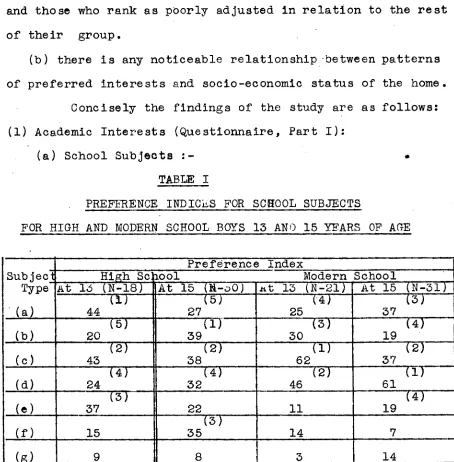
[image:29.545.52.506.203.665.2](a) School Subjects :- TABLE I
PREFERENCE INDICES FOR SCHOOL SUBJECTS
FOR HIGH AND MODERN SCHOOL BOYS 13 AND 15 YEARS OF AGE Preference Index
Subject High Sc:lool Modern *School Type
. (a)
At 13 (N-18) At 15 (1I-00) At 13 (N-21) At 15 (N-31) (1)
44 27
(5) (4)
25
(3) 37 (b)
(5)
20 39
(1) (3)
30
(4) 19 ' (c)
(2)
43 38
(2) (1)
62
(2)
37 (d)
(4)
24 32
(4) (2)
46
(1) 61
(e)
(3)
37 22 11
(4) 19
(f) 15 35
(3)
14 7
(g) 9 8 3 14
At age 13. Both Modern and High School boys have a major interest in subject type (c), but otherwise
their choices diverge, High School boys preferring subjects involving abstract problem-solving (a), and self-expression (c), and Modern School boys preferring concrete problem-solving (b) and practical tasks . (d). At age 15. The interest of Modern School bays is focussed
on practical tadks with a subsidiary interest in
mathematics and vocational training. The interest of High School boys is spread more evenly over a Wider range of subject types, science, literary, and
practical subjects Share priority of choice, there being no statistically significant difference, as
indicated by the statistics Chi-sr ,uare nd 't', in the choice ranking or choice frequency of these three types.
TABLE II.
PREFERENCE INDICES FOR SCHOOL SUBJECTS
FOR HIGH AND MODERIFSCHOOL GIRLS 13. AND 15 YEARS OF AGE.
Subject Types
—
Preference Index
High School , Modern School . At 13 (N:.28) At 15
17
(N.46), At 13 (N.23) 28(4)
At 15 (N-43) 26(5)
(a) 8
(b) 6 9 17(5) . 3
(c) 56(2)
-
49 (2) 41(2) 36(3)
(d) 41 51(1) 50(1)
(e) 57(1) 57 (1) 39(3) 41(2)
(f) 7
r
4 ...
9
(g) 7 6 30(4)
Figures in brackets indicate the rank orders of preference for items.
At age 15. The pattern is largely a repetition of the 13-year pattern with the exception of the increased interest taken by the Modern School gifls in
vocational training. Comparison of Sexes:
Subjects dealing with practical tasks are
favoured by both sexes but the girls' preference for self-expressive subjects (e) is significantly higher than the boys , .
High School girls as compared with High School boys tend to concentrate their interests on fewer
subject types anft to give these higher preference ratings.
The average level of intelligence of High School students is superior to that of Modern School students, eligibility for enrolment in High Schools being
determined usually by -success in intelligence nnd achievement tests at the end of the primary school years. Nevertheless there is a certain overlapping
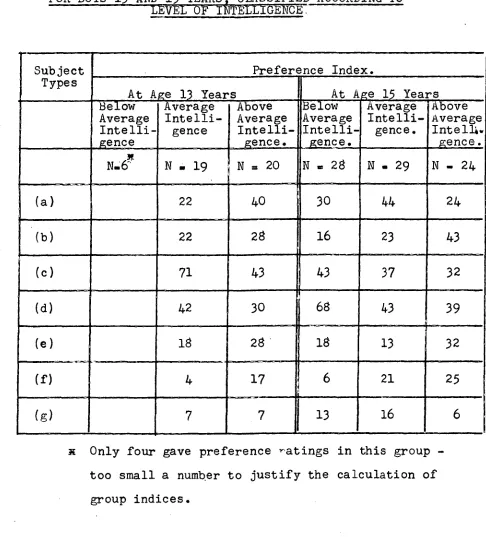
in the two types of schools; (See Table D(i) and D(ii), Appendix). Therefore preference indices were calculated for groups according to age and level of intelligence but regardless of type of school. Table III, below,
D CCOR
LEVEL OF IhTBILIGENCE,
FOR BOY A YEAR GTO
TABLE III
PREFERENCE INDICES FOR SCHOOL SUBJECTS
Subject Types
Preference Index.
At Age 13 Years I At A•e 15 Years .e ow
Average Intelli- gence
Average Intelli-
gence
Above Average Intelli- , gence.
Below Average Intelli gence.
Average Intelli-
gence.
Above Average Intellii. gence.
w
N.6 N 19 N . 20 N . 28 N.29 N . 24
(a) , 22 40 30 ' 44 24
(b) 22 28 16 23 43
(c) 71 43 43 37 32
(d) 42 30 68 43 39
(e) 18 28 18 13 32
(f) 4 17 6 21 25
(g) 7 7 13 16 6
[image:33.542.39.525.125.662.2]At age l3. Logically, since the average-intelligence group corresponds closely with the Modern School group and the above-average group with the High School group, the preferences related to type of school follow much the same pattern as preferences related to intelligence level.
At age 15. The below-average-intelligence and the above- average-intelligence patterns correspond roughly with the Modern School and High School patterns respectively. The pattern for the average-intelligence group wavers between the two, but tends rather more to the Modern School pattern since the majority of children in the
TABLE IV.
• PREFERENCE INDICES FOR SCHOOL SUBJECTS FOR
GIRLS 1 AND 15 YEARS CLASSIFIED ACCORDING-TU-IEVEL OF NTE GENC .
Subject Type
Preference Index.
At A e 1 Years At A e 15 Years :e ow Average Intelli- -ence. _ Avera ge Intelli- gence. ove Average Intelli- ence.
1 . e ow 'Average Intelli ence. Average Intelli- gence Above Average Intelli- ence.
N 5x N - 17 N . 6 N 6
(a) 26
I
2•
2216 3 11
1 1 56
(d) 44 • 3'
48 5
2 ,
11
- • 2
Only three gave preference ratings in this group -- too small a number to justify the calculation of group indices.
26(3)
74
(1)
8 1 II I OD R
FOR HIGH EARS OF AGE.
28(3)
62 (1)
Preference Index
High_School Modern School
At Ale 1 At AL 15 I At Ale 1 At Agp 15 Type
of Club
6
(b) School Clubs:-
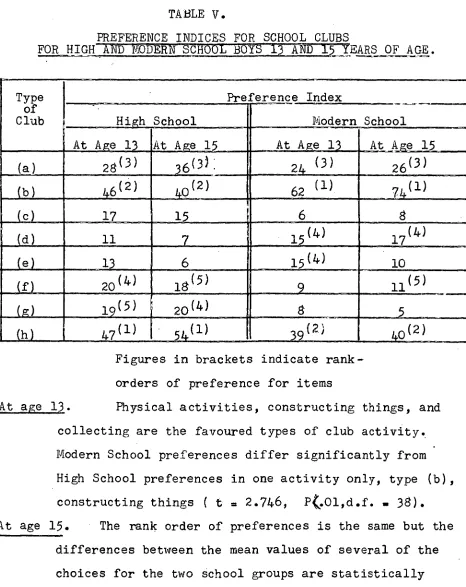
TABLE V.
PREFERENCE INDICES FOR SCHOOL CLUBS
Figures in brackets indicate rank- orders of preference for items
L.Laa_12.
Physical activities, constructing things, andcollecting are the favoured types of club activity. Modern School preferences differ significantly from
High School preferences in one activity only, type (b), constructing things ( t = 2.746, q.01,d.f. 38). At age 15. The rank order of preferences is the same but the
[image:36.545.56.522.96.683.2]High School boys give higher mean choice than Modern School boys to clubs concerned with collecting (t . 3.353, p(.01, d.f. - 72), physical activity (t = 6.396 P(01 d.f. = 72) and natural science (t 2.268, p ( .05, d.f. . 72). Modern School boys give higher mean choice to constructing
things (t = 7.90, p < .01, d.f. = 72), and to self-expressive activities (t - 2.26, p( .05, d.f. = 72).
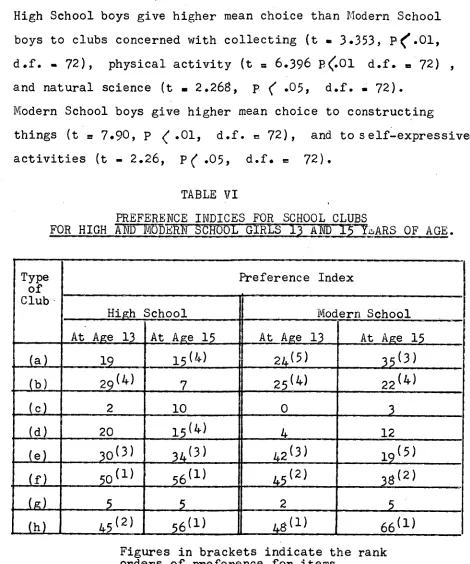
TABLE VI
PREFERENCE INDICES FOR SCHOOL CLUBS
FOR HIGH
ATIFULDER
CHOO G R S 43 A I5
.
.z, ARS OF AGE.Type of Club
Preference Index
High School Modern School
At Age 13 At A e 15 15 (4)
At ARe 13 24(5)
At Age 15 35(3) (a) 19
(b) 7 25(4) 22 (4)
(. ) 2 10 0 3
(d) 20 15 (4) 4 12
(e) 30(3) 4(3) 42(3) 19 (5)
(f) (1) 56 38(2)
:) 2 5
[image:37.542.59.529.62.626.2](h) 45(2) 56(1) 48 (1) 66(1)
Figures in brackets indicate the rank orders of preference for items.
high preference indices. High School girls give a significantly higher rating to self-expressive
activities than do Modern School girls; Modern School girls rate enjoyment of the arts higher than the High School girls.
At age 15. There is little variation in the rank order of
preference at fifteen as compared with that at thirteen. The tendency is rather for the indices of the preferred activities to be more equable within the group for
each type of school.
Differences in the mean values of choices between the two school groups are statistically significant at the one per cent level for types (a), (b) and (e). Modern School girls give higher choice to (a) and (b) and High School girls to (e).
(2) Play Interests. (Questionnaire,. Parts II & III): Since these sections include some groups of
activities not intimately associated with the classroom and not likely to be influenced substantially by the
type of school the child is attending, it has not been thought useful to maintain throughout descrimination between the two distinct school populations. Previous studies have suggested that for certain interests division of the group on the basis of intelligence
(a) Sports: (Boys)
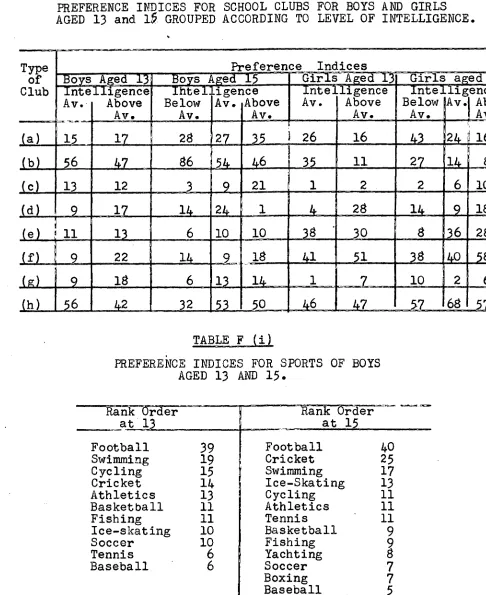
Indices are indicative of preference for, not participa-tion in, various sports. Of a list of thirty-six suggested
sports, together with others added by the child if he wished, only fourteen received sufficient first, second, and third choices to give them an index of more than 5 points. (See Table F(i) Appendix). Football, cricket and swimming gain markedly higher preferences than any other sports with all groups whether comparable according to age or intelligence. Some sports, e.g. basket-ball, are definitely favoured by the brighter children, others such as tennis seem to be associated with the type of school attended.
(Girls)
Only ten sports received more than a 5-point index
from the girls' choices. Swimming, basket-ball, ice-skating and dancing are the first favourites.
Both boys and girls tend to prefer vigorous physical activities, though the girls' favourite sports require, on the whole, a less sustained output of physical energy. The girls' interest in team games appears to decline at an earlier age than the boys' interest.
(b) Non-sport Activities: (See Table F(ii) Appendix). Theatre-going and Reading have the highest and most consistent appeal for all groups but there are noticeable
26(4)
22
I
Interestor Activity
Girls N 52 Reading
Sport Talkin-
Daydream-ing Going to Pictures
Dancing 27 —listening
to Radio . 1, Hobby
Playing a Musical Instrument
At A
3
21
Preference Index
(2) (1)
3)
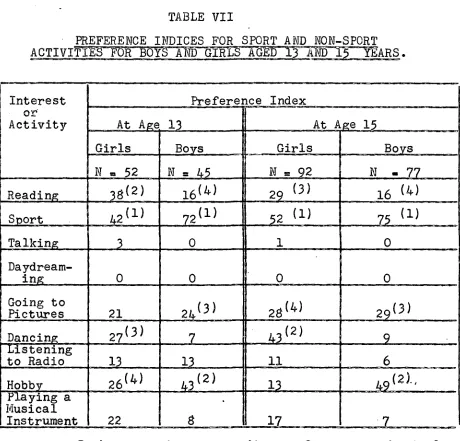
[image:40.541.63.523.85.526.2](c) Sport and Non-sport combined: TABLE VII
• PREFERENCE INDICES FOR SPORT AND NON-SPORT ACTIVIT S FOR BOY A i IR S AGED A 1
5
YEARS.Both sexes give outstanding preference to physical activities as designated by 'sport'. As major preferences at both ages, girls choose sport, reading and dancing, and the boys choose sport, hobbies and going to the pictures. There
Passive or sedentary activities such as talking, daydreaming and listening to the radio have relatively low or negligible appeal.
Intelligence seems to be closely associated with choice of two activities, --- reading, with both boys and girls, and threatre-going, with the girls only.
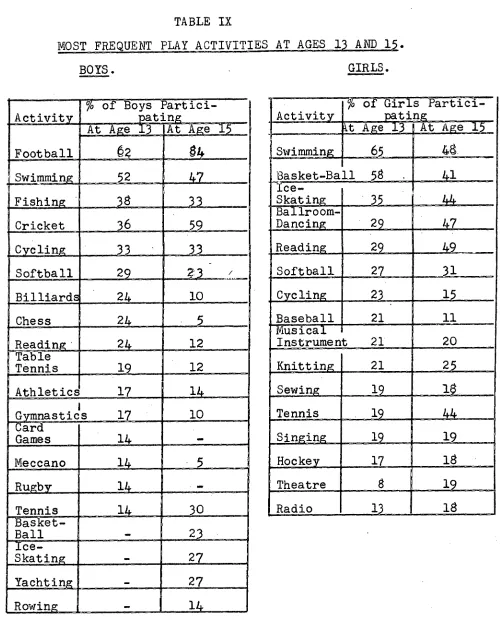
(3) Play Participation (Questionnaire, Part VII): The children were asked to write the names of the six activities in which they most frequently participated. The following table shows the activities in which 10 per cent or more of the children said they
Readin
[image:42.545.44.544.70.690.2]23 15 37.
TABLE IX
MOST FREQUENT PLAY ACTIVITIES AT AGES 1 AND 1 .
BOYS. GIRLS.
ActilLity Football
of Boys Partici- atin
At Ae At
of Gir s artici-Activit tin t Age 13 At Age 17—
Swimmin 6 4tt
Swimming Fishin
52 Basket Ball 8
Ice-
Skating 35
Ba lroom-
Dancing 29 8
1
47
Softball
Softball 29
Billiards 24
Chess
Reading 24 Tab e
Tennis
19
Athletics 17 G nasticCard Games Meccano Rugby Tennis "Basket- Ball -Ice- Skating Yachting Rowin 10 24 12 12 1 4
10 NNW 4 14 30 3
Baseball 21 Musicar-1
Instrument 21 Knittin 21
Tennis Singing Hockey Theatre Radio 17 19 19
13
18Sport activities have conspicuous priority, Reading being the only non-sport activity with pprticipation of more than 10% of the students. The buys show a tendency to con-centrate on some three or four games but the girls are more diverse in their interests and so there is a tendency for them
to spread their participation over a larger group of games. There is no great disparity between most of the preferred activities and performed activities. That is, most of the
sports that these girls and boys indicate that they do play are the ones which they prefer to play. Softb.l1 appears to be an exception. Quite a high percentage of both boys and girls participate in softball but the only inclusion it has vith preferred sports is as a last choice by the 15-year old girls. On the other hand there are few sports included amongst the preferred ones which score a low or nil percentage of
participation. Ice-skating for the 13-year boys, and soccer for both 13- and 15-year boys are the two exceptiOns.
(4) Reading Interests (Questionnaire, Part II) :
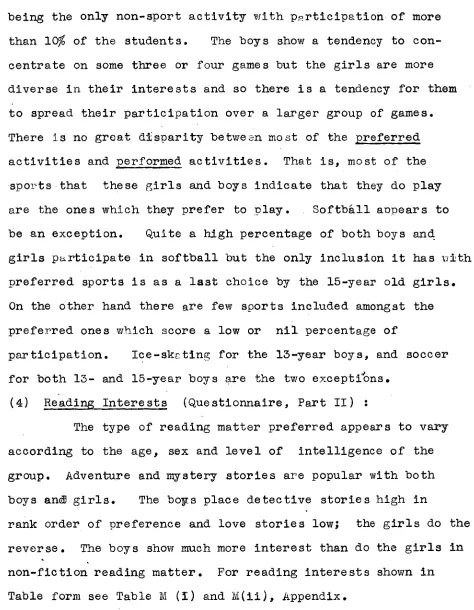
The type of reading matter preferred appears to vary according to the age, sex and level of intelligence of the group. Adventure and mystery stories are popular with both boys and girls. The boys place detective stories high in
[image:43.542.50.524.58.668.2](5) aocial, Heterosexual and Personal Interests.
(Questionnaire iarts IV, V, VI):
The mean scores for each of these three sections were compared for each of the four groups -- Boys aged 13, boys 15, girls 13, girls 15. Certain differences were found to be
statistically significant:-
In social interests the (7,ir1s of fifteen have a higher mean score than the boys of the same age.
In heterosexual interests the qirls of fifteen have a higher mean score than any of the remaining three groups. (P
In personal interests the mean scores of the fifteen year olds of both sexes nre higher than the means for the thirteen year olds.
For the comparison of these means see Table K, Appendix.
Scores for these three types of interests (Social, Heterosexual, and Personal) were:
(a) correlated with levels of intelligence, using a fifteen-point scale rricl the results on the Otis Intelligence Test.
(b) correlated with th , scores obtained on measures of the Bell Adjustment Inventory.
(c) intercorrelated.
GROUP r
.
Social Interests, Intelli-
gence
P
r
Hetero- sexual Interests, Intelli-
P gence
_
r
Social, Hetero- sexual Interests
P
r
Hetero- sexual, Personal Interests
I P
r
Social Interest § Bell (c)
P
GIRLS
age 15 -.09 - -.23 .05 +.36 .01 +.46 .01 +.21 .05 BOYS
age 15 +.11 - .09 - +.13 - +.32 .01 +.32 .01 GIRLS
age 13 4..16 - -.21 - +.52 .01 • .54 .01 +.28 .05 BOYS
Low but significant correlations are present for the majority of the groups between social and heterosexual interests, personal and heterosexual interests, social interests and scores on the tc , scale (the social measure) of the Bell Adjustment Inventory.
There was no significant statistical evidence of association between the level of intelligence and the total scores on the Bell Adjustment Inventory, nor of association between scores on Social Interests or Heterosexual Interests and Total Adjustment.
(6) Socio-economic Status and Interests:
Each of the age-sex groups was divided into 5 sub-groups according to the Taussig five-grade classification of the fathers' occupational status. Comparisons were made of the preferred types of leisure interests (as listed in the Questionnaire, Part III, Q.2) of these socio-economic groups. It was found that, within each age group, socio-economic status made apparently no noteworthy difference to the types of interests preferred and the rank orders of their preference. A second comparison was made, this time of the activities in which they most frequently participated. Again, within each age-group, the same types of activity, and in most instances the same specific activities, had the highest percentage of participants from each socio-economic class.
(7) The Bell Adjustment Inventory:
applied to the Tasmanian groups studied gave distributions which were markedly massed at the lower end of the scales
and tailed away on the higher scores. By using the Chi-square test of goodness of fit it was found that for scales (a),
(c) and (d) the upper half of the distribution (i.e. the frequencies for scores above the median value) conformed to the distribution for a normal curve. That is, scales (a),
(c) and (d) provided suitable measures for differentiating between 'normal' - and 'mai.' - adjustment, but yielded an undifferentiated massing of individual scores at the 'well'- adjusted end of the scales. This differentiation was sufficient for the purposes of this study.
(8) Adjustment and Interests:
A brief survey was made of the interests of children whose scores on scales (c) and (d) were regarded as being high
Sport preferences, activities in which they
participated most often, preferred types of leisure activities, and reading interests of those with high scores on Cc) were
compared with those of the remaining children of the same sex. These 'maladjusted' children tended to choose the same activities and to prefer the same types of reading matter as the normally adjusted children. Similarly for those with high scores on
CHAPTER VI
Discussion of Results
The results of the investigation sketched in bare outline in the preceding chapter are discussed more fully here and related to the finding d of other studies briefly recapitulated in Chapter III. Although some previous studies had found •
pubescent development to be a more effective discriminant than was chronologiaal age in isolating group patterns of interests, no attempt was made to determine the pubescent development of the individuals in this study. To get evidence of the degree of pubescence would have necessitated calling in the aid of medical
services, which was impracticable. Secondly, the study had an educational and sociological bias rather than a playsiological one, the beginnings of social maturity in the school world being marked by acceptance into the secondary school population.
Nevertheless, possible effects of puberty on certain interests ,m
were not ignored. Thirdly, Dimock (1937) in his study of 1406 boys ranging in age from 10 to 16 confirmed the results of earlier
investigators such as Crampton (1908) and Leal (1932) that puberty spreads over a wide range of chronological ages, but .
looked in vain for a direct association between pubescent growth and play bahaviour. He compf..red the participation records of pre-pubescent boys with those of boys of the same age who were pubescent but found only one activity, car driving, whve differences in participation appeared consistently to be associated with pubescence at the various age levels.
The gradual tendency for boys to be less versatile in their play activities as they grow older he found by statistical analysis to have little association with pubescence once the age factor was taken into account. He finally concluded that 'changes in play interests from the years twelve to fifteen may be as readily accounted for without assuming the influence of pubescence nr other physiological causes as can the apparent- ly more marked changes in the childhood or pre-pubescent period.'
Since we are not rejecting the idea that pubescence may be important pa2ticularly in the development of social 4 interests, interest in personal appearance, and interest in
certain specific sports, we will recall the findings of some other investigators that
(a) Girls of all races precede boys on the average by 12 to 20 months in pubertal development
(b) The average are for pubescence is 13.5 years for
girls of U.S.A. Fifty per cent mature between 12.5 and 14.0 yrs. age
(c) The average/for pubescence is 14.5 years for boys of U.S.A. Fifty per cent mature between 14.0 and 15.5 years.
(See Table L, Appendix).
On the bases of these findings, we expect our 13-year male group ( made up of boys ranging from 12.9 to 13.3 years
In the 13 year female group (age range 12.9 to 13.3 years)
we expect to have a big proportion of pre-pubescent girls
and in the 15 year female group (age range 14.9 to 15.3 years)
to have a big percentage of post-pubescent girls.
Adolescent Interests.
The young teenagers t life is, for a considerable part,
governed by what the adult world thinks he should know and do.
His school studies are mapped out with an eye to what it will
be good for him to know as a mature citizen. The non-academic
activities which are offered him are usually those which adults
believe he likes to do or those which it is traditional for
him to do. It may be that his interests conform to this
pre-arranged pattern, or it may be that they are so strong
in other directions that given freedom of choice he would break
away from these patterns.
If the studies of young adolescents in other countries
such as the United States. give findings which are, for the
most part, applicable to adolescents in this country, and if
the traditional adult ideas of adolescent interests are correct,
then this study may produce nothing that is not already known
and accepted.
We shall consider therefore what the 13 year old
and 15 year old think they would like best to do had they wide
choice and the ability to do these preferred activities.
Then we shall compare these preferences with what they actually
In expressing the findings as generalised statements of what a 13 year old or a 15 year old boy or girl from our selected group likes to do, we must realise that we are
creating theoretical individuals. We are working on pre'ference scales where first, second and third choices have been averaged out and many of the individual differences have been masked
or lost. This is unfortunate but unavoidable in a study seeking primarily for trends of interest and behaviour rather than for precise and closely defined particularisations.
(I) Academic Interests 1.Subjects in the School Curriculum:
If the adolescents in our group could pick and choose freely amongst their school subjects, what would they prefer to do? They gave their answers as ranked choices.
It was possible from these ratings to compute a preference scale for all the 13 year old boys, all the 13 year old girls and so on (See Tables A(i) and A(ii) Appendix ); but such broad treatment seemed likely to ignore or conceal too many important differences.
Although', as was stated in Chapter V, the educationa] backgrounds of the children were in many ways identical or
Considerable emphasis in the teaching in the Modern School falls on vocational preparation and the development of
. practical ability, in the High School the primary aim is to give a well-rounded cultural background. In addition the average level of intelligence of the children attending the
Modern School is much lower than that of the High School students. Therefore it seemed of more practical value to
study the group divided into its two school populations,
noting the similarities and differences between them, and the variations in the interest patterns of their 13 year old and 15 year old student groups.
Since the High School caters for those chiefly above average intelligence and the Modern School chiefly for those of average and dull-average intelligence (See Table D(i). and D(ii))it seemed doubtful whether division of the group according to levels of intelligence would reveal any fresh differences in interest patterns. However, because there is some overlap between enrolment at the VATO types of schools at the average-intelligence level, this second division was made.
(The standard of significance was P = .05). However, if we divide the age groups according to the type of school attended, i.e. into High School and Modern School populations, we find a higher frequency in choice of subject --groups (e) by 13 year High School boys (Chi-square = 4.21, P < .05, d.f. = 1) in subject group (f) by 15 year old High School boys (Chi-square = 13.01, P < .01, d.f. = 1), and in subject group (d) by 15 year old Modern School boys (Chi-square = 4.562, P( - 0 51 d.f. = 1). It is interesting to note in passing that subjects of types (e) and (f) preferred by the High School boys are verbal and those of (d) are non-verbal.
But in considering only frequency of choice we are passing over another important difference that may occur - the difference in the strength or rank order of the choice given individual items. Although comparable numbers of High School and Modern School boys may give one of their first three preferences to the same subject group, there may be a marked difference in the preference index because, say, the
this
bulk of the High School boys selecting/subject group give it a first preference whereas the majority of the Modern School boys give it only a third preference. By means of the "t" test it was found that -
(A) High School boys give significantly higher mean choice than Modern School boys to:
(B) Modern School boys give a significantly higher mean choice than High School boys to
(i) Subjects of types (c) and (d) at the age of 13 • (ii) Subjects of types (a) and (d) at the age of 15.
See Table C(i) Appendix
In addition to these differences between High School and Modern School patterns there are also differences between the patterns of the two age groups within the two
types of schools. Not only is the Modern School boys , interest in practical work greater than that of the High School boy
but at fifteen it has intensified so that the mean rank of the Modern School boys' choice for this subject group is much higher
than at thirteen (t
4.395,
P ( .01, d.f. 70).There is also an increase in strength of
preference, at fifteen years of age as compared with thirteen years of age, that Modern School boys show for subjects of types
(a) and (g). (For differences see Table B(i) Appendix )
There seems to be quite a reasonable connection between the preferences for these three types of subjects - an interest in abstract problem work (type (a) - arithmetical calculations) associated with practical constructive tasks
(type (d) - carpentry etc) and a growing desire to escape from •an academic environment into the practical environment of the
For High School boys the changes according to • age have a different pattern. Liking for subjects type (f)
shows the greatest relative change, being more frequently chosen and more highly rated at fifteen than at thirteen (See Table B(ii) Appendix). Type (b) is given a significantly higher rank of choice. But types (a) and (e) are much less prefarerred by the fifteen year olds than by the thirteens. So that amongst the High School boys the subject types which gain the higher preference with the older boys are the sciences - (b) and (f) - and those which have lower preference are the mathematical and self-expressive types- (a) and (e). The direction of the interests of the High School boys is less clearly defined than is that of the Modern School boys: they distribute their
preferences more evenly over the whole range of subjects offered them. This is probably due to the nature of High School
education which endeavours to give every subject an important • placein the curriculum rather than to emphasise specific
vocational training.
The subject types with high, and virtually identical , preference indices in the fifteen year old High School boys, viz
favoured courses dealing with vocational choice, training
and placement.
Adolescent girls and the School curriculum:
the preferences of the girls, whether they be High School or
Modern School, at both thirteen and fifteen years of age fall
conspicuously on three types of subjects - the cultural (c),
the practical (d),and the self expressive (e). Natural sciences
and mathematics have little appeal.
The only significant difference in the frequency
of choices of thirteen year old Modern School and High School
girls is for subjects of type (c) (Chi-square 10.45, P( .01,
d.f. 1) where the High School girls' more frequent choice is
an indication perhaps of a bias towards verbal subjects. At
fifteen relatively more High School girls than Modern School
girls give science subjects (f) one of their first three choices
(Chi-square 6.995, P( .01, d.f. = 1), and relatively more
Modern School girls than High School girls show interest in
vocational subjects (g), (Chi-square 7.966, P(
As with the boys, there are also significant
differences between the mean rank of choice given certain
subjects by High School and Modern School girls.
(A) High School girls give higher preference than Modern
School girls to:
(i) Subjects of types (c), (e) and (g) at 13 years of age.
(11) Modern School girls give hi7her preference than High School girls do to:
(i) Subjects of types (a) and (d) at 13 years of age
(ii) Subjects of types (a), (d) and (g) at 15 years of age. See Table C(ii) Appendix.
A noticeable feature here is the change in Interest associated with vocational subjects. The thirteen-year-old High School girls show an early flash of interest - vocational
subjects rank fourth in order of preference - but the fifteen-year-old High School girls show very little interest. This may be because at the beginning of the High School course some att- ention is given to the question of future careers when appropriate
school courses are being selected. At fifteen the intrinsic interest of the subjects and the interest in exploring the wider fields opened up by the High School courses supplant the earlier concentration on vocational subjects.
General Comments.
(1) In comparing the choices of the two sexes it is
noticeable that the girls throughout have significantly higher preference indices for the Arts - type (e). It is probable that the boys feel handicapped by the physical changes of adolescence, particularly by their changing voices, and therefore tend to
(2) Practical tasks are popular with both High School and Modern School boys and girls, though the Modern School
students give such tasks significantly higher rating than the High School students. The High School students tend to rate verbal subjects more highly than Modern School students though the differences between the boys' groups are not always statistically significant.
(3) Interest shown by all the thirteen year age groups
in the natural sciences is low but at fifteen it is considerably higher amongst High School students (for girls t = 2.687,
P (.01, d.f. . 72; for boys t = 3.28, P ( .01, d.f. = 46). This is due in part to High School organisation which provides better facilities for the study of science and more highly specialised teachers to instruct in science subjects than the Modern School organisation does.
(2) School Clubs.
(i) Boys' References (See Table V Chapter Si )
Clubs devoted to collecting, constructing, and physical activity are most favoured by the boys. As one might expect from the study of preferences for school subjects, practical constructive activities are more highly favoured by the Modern School than
Modern School boys give higher preference than High School boys do to types (b) (P=.01), and (d) (P...05); High School boys'
interests are definitely strOnger in Clubs concerned with collecting (P=.01), natural sciences (P...05), and physical activity (P=.01), as indicated by the significantly higher mean rank of choice they give these activities. The Modern School boys' choice of (d) may well be influenced by the fact that craftwork is suggested as a medium for self-expression, and selection could then be very
large-ly another reflection of their liking for constructing things. For the two High School groups the interests at 13 and 15 years of age follow the same pattern, the clubs which had the most appeal at thirteen still have the most appeal at fifteen. And with the exception of (b) where interest has strengthened
(P=.01) this is true for the Modern School boys also.
When Dimock (1937) studied the play interests of boys aged twelve to fifteen he found over this period of four years a drop of 20/0 in the number of boys who engaged in 'Making something'. The same sort of change did not occur with the Tasmanian boys.
Hurlock (1949) believes that the decline may be due largely to a growing interest in 'crowd' life and that 'where the group can meet and make things together, this type of recreation continues to be popular until middle or even late adolescence.' The
evidence, then, suggests the influence of a cultural factor.
It appears from current literature that American society accepts a much freer expression of adolescent heterosexual interests than does Tasmanian society. Involved in the 'crowd' the American
solitary creative activities. Though the young Tasmanian adolesc-ent may want to be with the 'crowd', the normal authoritarian attitude is to encourage him to remain in the home (where he is more likely to 'make things' as a means of solitary entertainment)
or to satisfy his need for companionship amongst groups of his own sex. This could account in part for the maintained interest of the Tasmanian boys in constructing things. But in addition there appears to be some association with intelligence - the lower the level of intelligence the higher the preference index for (b). (See Table E, Appendix). Possibly the duller boys' need for self-eT:pression is
satisfied by the creation of a material object whereas the brighter boys find ready expression in verbal modes also. Probably too, the duller boys accept more readily the ttitudes of their schools, i.e. they are influenced by the practical bias of the Modern School.
Witty and Lehman (1930) studying children's interest in collecting placed the peak of this interest between the ages of nine and thirteen with a considerable waning after fourteen. Dimock
(1937) noticed a rather earlier waning in participation but found that appeal remained fairly constant up to the age of 15. Dimock's finding more nearly - describes the resilts given by the Tasmanian boys. At fifteen there is no significant change in the preference index for any male group though the difference in the means for High School boys of thirteen and fifteen suggests a trend towards increased interest at fifteen (P=.07).
In contrast to constructing things, collecting ranks highest with the boys of above-average intelligence. It is in the
enthusiasm and this is what may be reflected in this high preference rating.
Physical activities rate higher with High School than with Modern School boys because although the boys below average
in intelligence choose (h) as freauently as the boys of the average and above-average groups the value of their choices is lower (mean value for above-average grthup 2.4; mean value for below-average group 1.5). In addition interest in physical activities is fostered by High School organisation where sport is an integral part of the training of the child and where interest in sport is encouraged by means of intra- and inter-school matches. There is less of this 'sporting tradition' in the Modern Schools.
"Discussions, in common with arguments, are more characteristic of middle and late adolescence than of early adolescence", says Hurlock (1949). In this study interest in discussion even at fifteen, which may be regarded as bordering on mifdle adolescence, is very slight. Amongst High School boys where one might expect to find greater verbal fluency and an earlier
consciousness of social and political problems, the index is a little higher than for the Modern School boys but just misses
discouraging this interest since the preference for such
activities is much higher for boys coming from the High School which provides much more encouragement of, and opportunities for,
social activities than the Modern Schools. However, even with the High School boys, social activities are not so appealing that they can outdo the attraction of activities less closely allied to social and heterosexual behaviour; e.g. activities of the types (a), (b) and (h).
Natural Science as a club activity receives few first preferences but the High School boys who do choose it tend to give it a higher preference than the Modern School boys. At thirteen the difference in the mean rank of their choices just fails to be statistically significant (P falls between .05 and .10) but at fifteen the difference is significant at the 5 per cent level. This divergence of interest between the two school populations is consistent with the pattern shown for school subjects.
(ii) Girls , Preferences (See Table VI, Chapter V) Of the eight types of clubs suggested the girls show definite preference for five, viz. (a), (b), (e), (f) and (h), but there are marked fluctuations in the pattern according to type
a
school, age, and level of intelligence.
At thirteen, High School girls are far mote
collecting and constructing, but the High School girls are more keenly interested in social activities and the arts.
When the groups are divided according to levels of intelligence we find that interest in collecting and
constructing is comparatively lower and in social activities higher, for the above-average groups (See Table B Appendix ).
At thirteen both High and Modern School girls regard collecting with comparatively equal interest. At fifteen this interest in relation to the others has remained static for the High School girls but appears to be still
increasing for the Modern School girls. However, intelligence level is the important factor here. For the average and above-average girls of both 13 and 15 years of age, the preference
index is identical and its rank order almost unchanged ( it ranks 5th at thirteen and 4th at fifteen). But the duller girls
rate it far higher (at fifteen it is then second highest choice) and since they constitute about 44% of the 15-year Modern School group, they 'push up' the index for this group. (Because