Kilpatrick, Rural Training Programs: Effectiveness and Profitability, University of Tasmania
RURAL TRAINING PROGAMS:
- EFFECTIVENESS AND PROFITABILITY
Susan Isabel Kilpatrick, MEc (NE), BEc (Tas), Grad Dip Lib (TCAE), Dip Ad Voc Ed (Tas)
Submitted in fulfilment of the requirements for the degree of Doctor of Philosophy
Kilpatrick, Rural Training Programs: Effectiveness and Profitability, University of Tasmania
This Thesis contains no material which has been accepted for a degree or diploma by the University or any other institution, except by way of background information and duly acknowledged in the Thesis, and to the best of my knowledge and belief no material previously published or written by another person except where due acknowledgement is made in the text of the Thesis.
----
~
---
__
i_~L_/-'i)
---Susan Isabel Kilpatrick Date
This Thesis may be made available for loan and limited copying in accordance with the Copyright Act 1968.
__
_1JSJ-1-r
Kilpatrick, Rural Training Programs: Effectiveness and Profitability, University of Tasmania
ABSTRACT
A diversity of groups including the National Farmers Federation, politicians and business leaders, stress the need for farmers to upgrade their skills in order to compete effectively on international markets. There are public demands for improved environmental management of farming land which require farmers to make changes in addition to those changes required for global competitiveness. These calls for change come at the same time as· Australia reforms its training system.
The National Farmers Federation believes that farmers will be motivated to participate in education and training if it can be shown that training leads to changes which improve farm profitability. Hitherto there has been a lack of empirical data on the effectiveness of training in agriculture and a consequent uncertainty about what sort of training and which delivery modes are most effective in facilitating profitable changes to farm management or agricultural practice.
A multi-method methodology was used in this study. A large sample of Australian farm businesses from the Australian Bureau of Statistics' Agricultural Financial Survey 1993-94 provided cross-section, quantitative data on farm managers' education levels, recent and planned participation in training and changes to practice, in addition to financial data. The quantitative data were analysed within constraints imposed by the Australian Bureau of Statistics in relation to confidentiality and the amount of technical support allowed for analysis.
This quantitative data set is illuminated by a semi-structured interview survey of 65 Tasmanian farmers, 45 of whom had completed one of three agricultural courses. The methodology proved most appropriate with the quantitative and qualitative data providing a richer understanding of farmers, change, training and profitability.
The findings relate to (i) the relationship between education/training and profitability, (ii) the relationship between training and change, and (iii) future training.
Considering farm businesses of similar asset value, large farm businesses managed by those with formal, agricultural qualifications are more profitable than other farm businesses, and more profitable farm businesses of all sizes tend to participate in more training.
Kilpatrick, Rural Traming Programs:Effectiveness and Profitability, University of Tasmania
Whilst a large proportion of farm business managers intend to participate in some training in the next three years, most intend to participate in training about agricultural practices. In contrast, areas identified by
Kilpatrick, Rural Training Programs: Effectiveness and Profitability, University of Tasmania
Acknowledgements
First, I would like to thank my supervisor, Professor John Williamson, for his invaluable support and advice during my doctoral studies, and for his support as Head of my department.
Next, I extend my thanks to those organisations who provided the funds for the collection of the data, and to the representatives of those organisations who made up the project steering committee. Without the support of these organisations this thesis would not have been possible. In particular, I would like to _thank Mr George Rance of the Tasmanian Farmers and Graziers Association, Mr SR Zichy-Woinarski of the Tasmanian Rural Industries Training Board, Ms Julie Austin of the National Farmers Federation and her predecessor on the committee, Mr Gary Goucher, Mr Ian Neeland of Tasmania Development and Resources, Mr Chris Shearer, who represented the Farmers Fighting Fund, and Mr Daniel Albert of the Tasmanian Department of Vocational Education and Training.
Third, I would like to thank the Research Assistants who assisted in gathering and entering some of the data for the Tasmanian interview survey: Ms Catherine Doherty and Ms Jenny Jones. They conducted 53 of the 65 interviews, and coded and entered the data relating to those interviews. Fourth, my thanks go to the staff of the Australian Bureau of Statistics Hobart Office where I worked on data analysis, in particular Mr John Pollard, Mr Ken Watt, Mr Frank McCallum and Mr Nigel Gibson. The Australian Bureau of Statistics assisted with the design of the questions added to their Agricultural Financial Survey 1993-94, included these questions in their piloting process and in their data collection. They entered all the data, gave me a workstation in the Hobart office of the Bureau and provided me with some training on their computer system.
Kilpatrick, Rural Training Programs: Effectiveness and Profitability, University of Tasmania
TABLE OF CONTENTS
CHAPTER 1 INTRODUCTION 1
1. Global and domestic change 1
2. Change and education and training 2
2.1. Government support for education and training 3 2.2. Industry and business support for education and training 4 2.3. Managers, change and education and training 5 3. The agricultural sector, change and education and training 6
3.1. How does agricultural education and training compare with other countries and other
sectors? -g
3.2. Rural participation in post-compulsory education and training 9
3.3. Motivating farmers to train 11
4. What sorts of changes should farmers make? 12
5. Research questions 13
5.1. What impact has training had on farm profitability? 14 5.2. What 'triggers' farm managers to make major changes to their farming practices? 14 5.3. What are the support mechanisms or who are the people who mentor farmers as change is
undertaken? 14
5.4. What are the reasons which foster farmer, and their workforce, participation in training? 15 5.5. What are the future training needs in agriculture? 15
6. Structure of the thesis 15
CHAPTER 2 LITERATURE REVIEW 1 6
1. Research Question 1: What impact does education and training have on
economic indicators? 16
1.1. Macroeconomic and industry level 16
1.2. Micro enterprise level 19
1.3. Education and agricultural indicators 21
2. Research Question 2: What 'triggers' major changes to practices? 2 5
2.1. The extent of innovation 26
2.2. Organisational innovation 28
2.3. Decision making 30
2.4. Diffusion of innovations 35
2.5. Communication channels and awareness 40
2.6. Interaction and change 41
2.7. Values, attitudes and beliefs 56
2.8. Education and training and adoption of innovations 61
2.9. Change and other characteristics 69
2.10. Changes to practice - summary 73
3. What are the support mechanisms and mentors as change is undertaken? 7 4 3.1. The place of support in the change process 74
3.2. Farmer change-support sources 75
4. What are the reasons which foster participation in training? 7 6
4.1. Small business managers and training 76
4.2. Prior education as a barrier to training 76 4.3. What encourages training in agriculture? 79
Kilpatrick, Rural Trairung Programs: Effectiveness and Profitability, University of Tasmania
5. What are the future training directions? 5.1. Farmer training needs
6. Conclusion
CHAPTER 3 METHODOLOGY
1. Introduction
1.1. Purpose of data collection instruments 1.2. Data analysis
2. Comparison of methodology with similar studies 2.1. Methodology for research question 1
2.2. Methodology for research questions 2 and 3 2.3. Methodology for research question 4 2.4. Methodology for research question 5 2.5. Definition of variables
3. The Agricult.iral Financial Survey (AFS) 3.1. Question development and testing
3.2. Response rate
3.3. Industry and geographical information
3.4. Description of Agricultural Financial Survey variables 4. Tasmanian interview survey
4.1. Sample
4.2. Pilot of questionnaire 4.3. Sample selection
4.4. Participant contact and conduct of interview
5. Relationship between training and change data
CHAPTER 4 RESULTS
1. What impact has training had on farm profitability? 1.1. Education
1.2. Participation in training (AFS)
1.3. Profit and participation in training (AFS) 1.4. Training and profit - Tasmanian survey 1.5. Training participation over time
87 88 92 94 94 94 95 95 95 97 98 99 99 100 101 101 102 102 104 105 107 107 107 110 112 112 112 117 118 126 131 2. What 'triggers' farm managers to make major changes to their farming
practices? 131
2.1. Agricultural Financial Survey 132
2.2. Tasmanian survey 132
2.3. Education and change 134
2.4. Recent training and change 136
2.5. Other characteristics and change 140
2.6. Prompts for change 149
2.7. Training, change and profit 157
3. What are the support mechanisms or who are the people who mentor as change is undertaken?
farmers 159
159 162 3.1. Agricultural Financial Survey
3.2. Tasmanian survey
4. What are the reasons which foster farmer, and their workforce, in training?
4.1. Education as a barrier to training 4.2. Industry
participation 163
/
Kilpatrick, Rural Training Programs: Effectiveness and Profitability, University of Tasmania
4.3. State
4.4. Size of management team 4.5. Value of assets
4.6. Indebtedness 4.7. Profit
4.8. Reasons given for not attending
4.9. Factors which foster course participation
5. What are the future training needs in agriculture? 5.1. Agricultural Financial Survey
5.2. Tasmanian survey
CHAPTER 5 DISCUSSION AND CONCLUSION
1. Research Question 1: What impact has training had on farm 1.1. Agricultural qualifications and profitability
1.2. Schooling and profitability 1.3. Training and profitability
1.4. Training-influenced change and profit
1.5. Education and training and profit - the direction of causation
166 166 167 169 170 171 174 175 175 177 181 profitability?181 181 184 186 190 190 2. What 'triggers' farm managers to make major changes to their farming
practices? 19 2
2.1. The extent of change to practice 192
2.2. Changes to practice and farm business profitability 196 2.3. The characteristics of farm businesses which make changes to practice 198
2.4. Triggers and influences for change 201
2.5. Training and change 205
2.6. Changes to practice, education and training 207 3. Research Question 3: What are the support mechanisms or who are the
people who mentor farmers as change is undertaken? 208 3.1. Who provides support in implementing change? 208
3.2. Multiple sources of support 210
3.3. Support and training programs 210
4. Research Question 4: What are the reasons which foster farmer, workforce, participation in training?
and their 4.1. Characteristics of farm businesses most likely to participate in training
4.2. Prior education and participation in training 4.3. Reasons given for not attending training programs 4.4. Effective training delivery methods
4.5. Summary of barriers to participation
210 212 215 217 217 219 5. Research Questions 5: What are the future training needs in agriculture? 220
5.1. Training intentions 221
5.2. Outside identification of training needs 222 6. Areas for further research identified in this thesis 223
7. Conclusion 224
REFERENCES 227
APPENDIX A TASMANIAN INTERVIEW QUESTIONNAIRE
/
Kilpatrick, Rural Training Programs: Effectiveness and Profitability, University of Tasmania
APPENDIX C PARTICIPANT INFORMATION SHEET
APPENDIX D PARTICIPANT APPOINTMENT LETTER
APPENDIX E AGRICULTURAL FINANCIAL SURVEY FORM
APPENDIX F MULTIPLE REGRESSIONS
Kilpatrick, Rural Training Programs: Effectiveness and Profitability, University of Tasmarua
LIST OF .FIGURES
FIGURE 1 EDUCATION AND AGRICULTURAL INDICATORS: RESEARCH STUDIES 22 FIGURE 2 FARM BUSINESS INNOVATION: RESEARCH STUDIES 27 FIGURE 3 FARMERS' GOALS AND DECISION MAKING: RESEARCH STUDIES 32 FIGURE 4 DIFFUSION OF INNOVATIONS: RESEARCH STUDIES 36
FIGURE 5 MODELS OF THE DECISION PROCESS 38
FIGURE 6 INTERACTION AND CHANGE: RESEARCH STUDIES 42 FIGURE 7 PEERS AND THE DECISION MAKING PROCESS: RESEARCH STUDIES 48 FIGURE 8 EXPERT ADVISERS AND THE DECISION MAKING PROCESS: RESEARCH
STUDIES 53
FIGURE 9 VALUES, ATTITUDES AND BELIEFS: RESEARCH STUDIES 56 FIGURE 10 EDUCATION AND TRAINING AND ADOPTION OF INNOVATIONS:
RESEARCH STUDIES 62
-FIGURE 11 'OTHER' CHARACTERISTICS AND ADOPTION OF INNOVATIONS:
RESEARCH STUDIES 71
FIGURE 12 PRIOR EDUCATION AS A BARRIER TO TRAINING: RESEARCH STUDIES 77 FIGURE 13 FACTORS WHICH ENCOURAGE TRAINING: RESEARCH STUDIES 79 FIGURE 14 TRAINING METHODS AND PARTICIPATION: RESEARCH STUDIES 83 FIGURE 15 FUTURE TRAINING NEEDS: RESEARCH STUDIES AND SURVEYS 89 FIGURE 16 EDUCATION LEVEL AND GROSS OPERATING SURPLUS (AFS) 113 FIGURE 17 AGRICULTURAL QUALIFICATIONS, ASSETS AND GROSS OPERATING
SURPLUS (AFS) 115
FIGURE 18 EDUCATION, ASSETS AND GROSS OPERATING SURPLUS (AFS) 116 FIGURE 19 DISTRIBUTION OF FARM BUSINESS TRAINING BERA VIOUR (AFS) 117 FIGURE 20 METHODS OF FARM BUSINESS TRAINING (AFS) 117 FIGURE 21 NUMBER OF TRAINING 'EVENTS' ATTENDED (AFS) 118 FIGURE 22 PROFIT AND NUMBER OF TRAINING EVENTS (AFS) 119 FIGURE 23 TRAINING AND AVERAGE GROSS OPERATING SURPLUS BY LOW, MID
AND HIGH VALUE OF ASSETS* (AFS) 120
FIGURE 24 SIZE OF MANAGEMENT TEAM, TRAINING AND PROFIT (AFS) 121 FIGURE 25 PROFIT GROUP AND FIELD DAY ATTENDANCE BY ASSET GROUP (AFS) 123 FIGURE 26 PROFIT AND PARTICIPATION IN TRAINING OTHER THAN FIELD DAYS
(AFS) 124
FIGURE 27 RETURN ON ASSETS AND PARTICIPATION IN TRAINING (AFS) 124 FIGURE 28 PROFIT GROUP AND SEMINARS AND WORKSHOPS BY ASSET GROUP
(AFS) 125
FIGURE 29 PROFIT GROUP AND CONFERENCES AND INDUSTRY MEETINGS BY
ASSETS(AFS) 126
FIGURE 30 NUMBER OF CHANGES PER FARM BUSINESS (TAS SURVEY) 133 FIGURE 31 CHANGE TO PRACTICE AND EDUCATIONAL QUALIFICATIONS (AFS) 135 FIGURE 32 NUMBER OF CHANGES AND EDUCATION LEVEL (TAS SURVEY) 136 -FIGURE 33 TRAINING AND CHANGES TO PRACTICE (AFS) 137
FIGURE 34 PROPORTION OF THOSE MAKING A CHANGE BY TYPE WHICH TRAIN
(AFS) 137
FIGURE 35 PROPORTION OF THOSE ATTENDING TRAINING WHICH MADE A
CHANGE (AFS) 138
FIGURE 36 NUMBER IN MANAGEMENT TEAM AND CHANGES TO PRACTICE (AFS) 141 FIGURE 37 AVERAGE VALUE OF ASSETS AND TRAINING AND CHANGE (AFS) 143 FIGURE 38 PROFIT AND CHANGES TO PRACTICE (AFS) 144 FIGURE 39 CHANGE, VALUE OF ASSETS AND AVERAGE PROFIT (GOS) (AFS) 146 FIGURE 40 TYPE OF CHANGE AND PROFIT BY VALUE OF ASSETS (AFS) 147 FIGURE 41 PROMPTS FOR CHANGE BY TYPE OF CHANGE (AFS) 150 FIGURE 42 HIGHEST EDUCATION LEVEL IN MANAGEMENT TEAM AND PROMPT
FOR CHANGE (AFS) 151
FIGURE 43 AVERAGE GROSS OPERATING SURPLUS AND PROMPT (AFS) 153 FIGURE 44 SOURCES OF AWARENESS FOR CHANGES INFLUENCED BY COURSES
(TAS SURVEY) 154
Kilpatrick, Rural Training Programs: Effectiveness and Profitability, University of Tasmania
TABLE 29 CONTRIBUTION TO AUSTRALIAN FARM PROFIT BY ASSETS AND CHANGE
(AFS) 148
TABLE 30 CHANGES TO PRACTICE AND PROFIT (TAS SURVEY) 149 TABLE 31 PROMPTS FOR CHANGE TO PRACTICE (AFS) 150 TABLE 32 PROMPTS, ASSETS, MANAGERS AND EQUITY (AFS) 152 TABLE 33 HOW FARMERS BECOME AW ARE OF IMPORTANT CHANGES (TAS
SURVEY) 154
TABLE 34 OTHER INFLUENCES FOR TWO MOST IMPORTANT CHANGES (TAS
SURVEY) 155
TABLE 35 TRIGGERS FOR THE TWO MOST IMPORTANT CHANGES (TAS SURVEY) 156 TABLE 36 PROPORTIONS OF FARM BUSINESSES BY TRAINING AND CHANGE (AFS) 158 TABLE 37 CONTRIBUTION TO TOTAL FARM PROFIT BY TRAINING AND CHANGE
BEHAVIOUR (AFS) 159
TABLE 38 COURSE PARTICIPANTS, COURSE INFLUENCED CHANGE AND PROFIT
(TAS SURVEY) 159
TABLE 39 SOURCES OF SUPPORT FOR MOST IMPORTANT CHANGE (AFS) 160
TABLE 40 SOURCE OF SUPPORT AND PROFIT (AFS) 161
TABLE 41 SOURCE OF SUPPORT AND ASSETS (AFS) 161 TABLE 42 SOURCE OF SUPPORT AND MANAGERS (AFS) 161
TABLE 43 SOURCE OF SUPPORT AND EQUITY (AFS) 161
TABLE 44 FREQUENCY OF USE OF NIL, ONE, AND MULTIPLE SOURCES OF
SUPPORT (TAS SURVEY) 162
TABLE 45 SOURCES OF SUPPORT FOR THE TWO MOST IMPORTANT CHANGES (TAS
SURVEY) 162
TABLE 46 TRAINING ATTENDANCE BY INDUSTRY (AFS) 165 TABLE 47 TRAINING METHODS BY VALUE OF ASSETS (AFS) 168 TABLE 48 SIZE OF MANAGEMENT TEAM AND SEASONAL COMMITMENTS AS A
REASON FOR MISSING TRAINING (AFS) 172
TABLE 49 TRAINING EVENTS NOT ATTENDED (TAS SURVEY) 173 TABLE 50 REASONS FOR NOT ATTENDING (TAS SURVEY) 173 TABLE 51 WHAT PEOPLE LIKED MOST ABOUT THE COURSE (TAS SURVEY) 174 TABLE 52 WHAT PEOPLE LIKED LEAST ABOUT THE COURSE (TAS SURVEY) 174
TABLE 53 AREA OF INTENDED TRAINING (AFS) 175
TABLE 54 TRAINING INTENTIONS BY ASSETS, PROFIT, EQUITY, MANAGERS AND
EDUCATION (AFS) 176
TABLE 55 INTENDED TRAINING AREA BY VALUE OF ASSETS (AFS) 177
TABLE 56 FUTURE TRAINING NEEDS (TAS SURVEY) 178
TABLE 57 SUMMARY OF IDENTIFIED TRAINING NEEDS BY COURSE/NON-COURSE
SAMPLES AND AREA (TAS SURVEY) 179
TABLE 58 PREFERRED DELIVERY MODE FOR IDENTIFIED FUTURE TRAINING (TAS
Kilpatrick, Rural Training Programs: Effectiveness and Profitability, University of Tasmania
CHAPTER
IINTRODUCTION
Farm businesses operate in a climate of on-going change. This chapter sets out the contexts of the changes which impact on farm businesses, starting from a global perspective, moving on to a national perspective, and then an agricultural industry perspective.
Education and training is identified as a means for facilitating change at national, industry and individual business levels. The words 'education and training' are used in this thesis to refer to general education and industry-specific. training. Governments, industry and individual farm businesses all have an input into the ease with which individuals can access available education and training. This chapter briefly examines general government education and training policy, and then the views of national industry and business leaders on education and training.
A large part of the chapter is devoted to issues of the farm workforce's participation in education and training. This part of the chapter compares participation rates, first, with Australia's international competitors, second, with other industry sectors and third, there is a discussion of the differences between urban and rural participation in education and training. Next, factors which influence farmers' motivation to train are considered.
A brief discussion of the areas where farmers should be making changes to their practice precedes the final section, which comprises the research questions of this thesis.
1. Global and domestic change
The fortunes of Australia's agricultural sector have a substantial impact on the Australian economy; the rural sector contributed 29% of Australia's merchandise exports in 1994-95 (Martin, 1996). Most of Australia's agricultural production is sold in the global marketplace, where our farmers are 'price-takers' who do not supply a sufficient proportion of the world production to influence the prices they receive. Farm businesses are directly exposed to global competitive pressures and subject to international economic cycles. The terms of trade received by
-our farmers have declined substantially in recent years (Australian Bureau of Agricultural and Resource Economics, 1996).
Kilpatrick, Rural Training Programs: Effectiveness and Profitability, University of Tasmania
that this advantage will continue to be sufficient for farm business to compete successfully, as changes continue in trading arrangements. For example, there have been recent changes to the protection policies of our competitors, such as the United States and the European Community, and to regional trading agreements, for example, the establishment of trading blocks in Asia and North America.
Products need to be of consistently high quality to compete with products from around the world, and to satisfy the increasingly discerning consumers in the growing Asian food market. Strict regulations on chemical residues in food imposed _by overseas markets such as Japan, coupled with domestic concerns about the impact on the food chain of the use of chemicals in agriculture, require farmers to rethink and change many of their traditional on-farm practices. Not only must there be changes on the farm, there must also be changes in farmers' relationships with others in the 'marketing chain'. A cattle producer, for example, must communicate with those from whom stock are purchased about previous chemical treatment of the stock; communicate with cattle buyers about fat requirements; and communicate with the abattoir about the condition of carcasses after slaughter. It is no longer sufficient to load the cattle onto the truck then wait for the cheque to arrive (Falk & Kilpatrick, 1996).
The changes occurring in global markets are parallelled by domestic changes, many of which have had an unfavourable impact on farm businesses. Deregulation of domestic markets, disbanding of marketing authorities such as the Apple and Pear Marketing Board, a policy of reduction in government support in times of poor seasonal conditions, and removal of tariffs and other import restrictions have exposed those selling on domestic markets to more competition (Mahoney, 1996; Murray-Prior, 1996; Miller, 1994).
Further pressures for farmers to change their farming practices come from a growing awareness of environmental degradation in both urban and rural Australia.
Since farm businesses are operating in global and domestic contexts which are characterised by on-going change, it is essential for the agricultural sector that Australia's farmers are adept at dealing with change. Because of the importance of agriculture's contribution to the Australian economy through exports, having farmers who are skilled in dealing with change is a national imperative.
2. Change and education and training
Kilpatrick, Rural Training Programs: Effectiveness and Profitabilitf, University of Tasmania
dealing with change is recognised internationally, for example, in this World Bank discussion paper by Haddad (1990):
Education has been recognized as the cornerstone of economic and social development. Now it is even more important as technological change and new methods of production transform the world economy. (Haddad, 1990).
OECD and government reports have identified low levels of participation in post-school education and in training as an impediment to economic growth and international competitiveness, for example, Economic Planning Advisory Commission (1995b), Carmichael (1992) and Finn - (1991). The following quote from an OECD report suggests that changes are required in Australia's education and training system in order to match changes in other countries:
Australia's system of education and training [has] not been capable of keeping up with increases in educational attainment overseas and [has been biased against vocational skills... (Organisation for Economic Cooperation and Development, 1992)
Australian reports, such as Clare and Johnston (1993), Mayer (1992) and Finn (1991), also espouse the view that education and training assist in dealing with change. The following quote from an Economic Planning and Advisory Commission report by Clare and Johnston (1993) links education to the ability to respond to change:
An educated workforce should be more flexible and adaptable to changes in technologies and workplace methods, and thus more productive. Training and re-training in particular are essential to maintain workforce flexibility and adaptability and to provide competence and foster creativity. (Clare & Johnston 1993, 9)
Several Australian reports have identified a need for continuing education and training for those already in the workforce in addition to entry level training. One such report is Finn (1991), which suggests that initial post-compulsory education and training should be followed by an on-going commitment to learning for work.
Traditional notions of separation between education and work, especially the notion of a one-off period of education followed by employment, will be replaced by an integrated concept of work intertwined with lifelong learning commencing with post-compulsory ed~cation and training. (Finn, 1991, 6-7)
2.1. Government support for education and training
Kilpatrick, Rural Training Programs: Effechveness and Profitability, Uruversity of Tasmarua
the United Kingdom, New Zealand, Germany, France and Sweden which have traditionally been benchmarks for Australian education and training policies (Fitzgerald, 1994). Government support for training at an enterprise level exists in many countries. For example, Ploszajska (1994) describes a system of extensive support for enterprise level training in Britain. Skills development policies may also address changing demands for skills as some industries decline whilst others expand. For example, in the United States, the Clinton Administration's Re-Employment Act provides training for workers who lose their jobs as a result of economic restructuring (Fitzgerald, 1994). Australia's National Training Reform Agenda recognises the central place of training in achieving international co~petitiveness (Australian National Training Authority, 1994).
The reform of vocational training in Australia in recent years follows from the reports .of Finn (1991), Mayer (1992) and Carmichael (1992). The reform agenda reflects a belief in the link between training, change and economic competitiveness. One of the aims of the National Training Reform Agenda, outlined in the Australian National Training Authority's Toward a Skilled Australia: A National Strategy for Vocational Education and Training, is to:
... raise the skills profile of the labour force to better equip the nation to adjust to change and to increase our general level of international economic competitiveness. (ANTA, 1994, 6)
The National Strategies Conference, convened by the Economic Planning Advisory Commission, identified Australia's national goals as "a country that is both creative and productive and inclusive and ecologically sustainable" (Keating, 1995). Two of the four key future priorities for achievement of these goals are particularly relevant to education and training in agriculture, namely:
• further development of Australia' capacities as an
Innovative Nation in each of the economic, social and environmental spheres;
• reinvigoration of the commitment to a Sustainable Australia through ecologically sensitive activities and policy development. (Keating, 1995)
The Liberal-National Party government elected in March 1996 also recognises the need to improve Australia's skills base, with policies which focus on youth training through its Modern Apprenticeship and Traineeship System. The government also has specifically acknowledged the need to enhance the- education and skills base of farmers, farm workers and support industries (Anderson, 1996).
2.2. Industry and business support for education and training
Kilpatrick, Rural Training Programs: Effectiveness and Profitability, University of Tasmania
Australia's future (Allan Moss in Economic Planning Advisory Commission, 1995a; Ralph, 1994; Ritchie, 1994) .
... the two most important measures of national success are economic growth and social harmony - and education and training skills are central to both .... Today, that link is nearly as critical in primary industry as it is in manufacturing and services. (Allan Moss in Economic Planning Advisory Commission, 1995a, 215)
At the same conference, corporate leader and then Chairman of Wool International, - Richard Wharburton, listed the skills required for economic growth and asked how best our education and training system can produce people with these skills. Skills that he suggested were required included:
• lifelong learning; ...
• excellent communication skills;
• flexible adaptive technical skills with a base of strong general skills ....
• accepting change and continually developing skills as required. (Economic Planning Advisory Commission, 1995a, 228)
He advocated that:
The educational sectors must seek to include;
• a more thorough and broader preparation for the workforce;
• a greater commitment to workforce retraining, especially for those people with no post school qualifications; and • introducing and accepting concepts of 'best practice' and
quality across the board. (Economic Planning Advisory Commission, 1995a, 4, 229)
Like the government reports discussed i~ the previous section, business and industry leaders perceive the need to have a workforce which is more flexible and better able to respond to change. Education and training are regarded by business and industry leaders as the means for achieving this change in the workforce. Their view of education and training as the means for improving the flexibility and adaptability of the workforce is in accord with the broad thrust of government policy for upskilling the Australian workforce.
2.3. Managers, change and education and training
Kilpatrick, Rural Training Programs: Effectiveness and Profitability, University of Tasmania
threats or opportunities to their organisation, and ensuring that the organisation responds, or changes, appropriately. The following quote from management author Gareth Morgan (1988) illustrates the importance of awareness of changes which are occurring, and of making changes accordingly.
Increasing turbulence and change will require organisations and their managers to adopt a much more proactive and entrepreneurial relationship with the environment, to anticipate and manage emergent problems, and to create new initiatives and directions for development. (p 4)
- The Karpin report (Karpin, 1995a) into management education in Australia stresses the urgent need to improve the skills of managers of businesses of all sizes. In the following quote Karpin concentrates on the need to upgrade. the management skills of the managers of small and medium-sized businesses.
Good managers are the key to a more competitive economy and better performing enterprises. . .. We must upgrade the capacity of vocational education and training, and of business support, to improve the skills of managers in small and medium-sized enterprises. (pp 10-11)
3. The agricultural sector, change and education and training
There are both macro and micro imperatives for Australian farmers to become more able and willing to respond to change. As suggested in the first section of this chapter, at a macro level, farmers need to be adaptable, flexible, and willing to accommodate change if Australia is to compete effectively in global agricultural markets (National Farmers' Federation, 1993). In order for the macro situation to change, there must first be change at a micro level. That is, individual farm business must be willing and able to adopt new technologies and practices. There is evidence that there has been insufficient willingness to change on the part of farm businesses, as the following quote suggests:
Rural industry research councils .... have been increasingly concerned about what they perceive as the widening gap between research output and farm practice (i.e., adoption). Primary Industries and Energy Minister, John Kerin, in listing his top seven issues for making agriculture sustainable in the 1990s placed at the top: "What are the barriers to farmers adopting known, economically viable, environmentally sound technologies and practices?" (Ison, 1990, 102)
Kilpatrick, Rural Training Programs: Effectiveness and Profitability, University of Tasmania
productivity, as suggested by the following quote from a National Farmers' Federation report by Ferguson and Simpson (1995):
The significant erosion in farmers' terms of trade world-wide has encouraged farmers to sustain substantial increases in productivity .... This has been possible through the uptake of significant advances in technology by Australian farmers.
(p5)
A Department of Primary Industries and Energy (1988) report into rural post-secondary education suggests that the education and training which has occurred in rural Australia has made a substantial contribution to the improvements in productivity. This report confirms that there is a link between education and training and farm business outcomes:
... it would appear that education and training have played a key role
ir1-
facilitating the outstanding productivity growth experienced by agriculture in recent years. (Department of Primary Industries and Energy, 1988, 8)Changes to technical agricultural practice are not the only class of changes which can be made in farm businesses. Other areas of farm management practice include financial management, marketing, and the increasingly prominent area of environmental management. The National Farmers' Federation identified increased participation in management training and establishment of a training culture as priorities in its strategy document entitled New Horizons: A Strategy for Australia's Agrifood Industries
(National Farmers' Federation, 1993). In this document, the National Farmers' Federation emphasised the need for training and flexibility in order for the agricultural sector to remain internationally competitive.
. . . the skills required of farmers in the past in order to succeed in agriculture will in future need to be supplemented with additional skills in order to cope with the changes that have emerged over recent decades. Good technical skills in crop and livestock husbandry will need to be supported with skills in financial management ... and with skills in risk management. This is not to say that good technical skills are of any less importance than in the past, but in the future, additional skills will be pivotal to the survival of farm businesses ... (National Farmers' Federation, 1993, 75-76)
Kilpatrick, Rural Training Programs: Effectiveness and Profitability, University of Tasmania
Finance Summit Activating Committee. The Activating Committee is to develop workable proposals coming from the recommendations of the Summit and identify further action. The first newsletter published by the Activating Committee stated that education and training were a recurring theme at the Summit and that education and training are a mechanism for assisting farmers to deal with change.
Education and training were identified as key mechanisms by which enhanced productivity, initiative, financial self reliance and smooth adjustment could be better achieved. . .. Farmers need to be able to identify challenges arising out of change and how best to deal with those challenges. . .. attitudinal change is a complex and long term task which -needs to be addressed through education ... (National Rural Finance Summit Activating Committee, 1996, 1-2)
3.1. How does agricultural education and training compare with other countries and other sectors?
An earlier quote from the OECD report (1992) suggested that the Australian education and training system had not kept up with the systems of countries which are our international competitors. There is evidence that the Australian farm workforce is less well qualified than the workforces of our overseas competitors, and is less likely to train than other sections of the Australian workforce.
3.1.1 Our competitors in agricultural markets
Kilpatrick, Rural Training Programs: Effectiveness and Profitability, University of Tasmania
Percentage of farm workforce with school leaving or higher qualifications, 1993
100%
80%
60%
40%
20%
0%
Australia
Source: Cameron & Chamala (1993)
New
Zealand
Europe
The data presented above suggests a need for increased participation in post-compulsory education and training in order for the farm workforce to be more responsive and adaptable, and consequently better able to compete on international markets.
3.1.2 Other Australian industry sectors
Australian Bureau of Statistics (1994) reports that 23.6% of employees in the agriculture, forestry, fishing and hunting industry group had post-school qualifications compared to 47.8% of all Australian employees.
Training activity in Australia is measured by the Australian Bureau of Statistics' Employer Trainin:? Expenditure, Australia (1994) which measured training expenditure and activity over a 6 month period in 1993. Training, which includes on-the-job training, averaged 4.1 hours per employee over six months for small employers (one to 19 employees), and 5.3 hours for employers of 20 to 99 people. Only 18% of small employers reported training expenditure, compared to 80% of those employing between 20 and 99 people.
On an industry basis, 79.7% of employees in the agriculture, forestry, fishing and hunting industry group received some training in the six month period (the lowest of any industry group), compared to 85.8% of all employees, including, 80.1 % in manufacturing, 84.8% in construction and 91.2% in mining. The same trend is evident for external training, where 7.2% of employees took a training course in the agriculture, forestry, fishing and hunting industry group, compared to 11.8% overall.
-3.2. Rural participation in post-compulsory education and training
Kilpatrick, Rural Training Programs: Effectiveness and Profitability, University of Tasmania
most of the farm workforce not only lives in rural Australia, but also grew up in rural Australia. The comparatively low level of educational qualifications of the farm workforce quoted above is likely to be related to the lower participation of rural Australians in post-compulsory education.
Relatively low participation in education and training is both an equity issue and an economic issue (National Board of Employment, Education and Training, 1991; Department of Primary Industries and Energy, 1988; Clarke, 1987). The economic aspects of lower participation in education and training are those which have been discussed above; they are related to reduced flexibility, adaptability and willingness to change, and to reduced awareness of changes in the farm business's environment which offer opportunities or pose threats to the farm business. The macro level
outcome of lower participation in education and training is being less competitive in international markets, which in turn means a lower rate of economic growth in Australia.
The equity issue is complex. Its dimensions range from inadequate access to the full school curriculum in secondary school, which limits opportunities for future study, to the travel time and associated costs of accessing post-compulsory education and training which are incurred by
those living at a distance from where the education training is delivered. Government reports identify several barriers to rural participation in education and training related to provision of suitable courses, financial considerations and lack of information about possible education and training opportunities. The National Board of Employment, Education _ and Training (1991) argued that lack of access to appropriate, relevant, quality education and training opportunities is the major reason for low rural participation in education and training. It identified locational and consequent financial barriers to access. The Commonwealth Tertiary Education Commission and Department of Primary Industries and Energy (1987) identified low rural incomes and the high cost of education and related expenses, lack of information about suitable courses and inadequate provision of education and training in rural areas as barriers to participation. Clarke (1987) identified lack of suitable port-secondary education opportunities in rural areas, lack of information about educational opportunities and the relatively high cost of participation in post-secondary education for rural Australians as barriers to participation in post-secondary education.
Kilpatrick, Rural Training Programs: Effectiveness and Profitability, University of Tasmania
as a barrier and/or fostering factor to participation in further education and training is explored further in Chapter 2.
These equity issues are closely related to economic outcomes, through the economic performance of the farm businesses which are managed by those with reduced opportunities for participation in post-compulsory education and training.
The picture of lower rates of participation in post-compulsory education and training compared to urban Australia is balanced by a substantial increase in the qualifications of those _living in- rural Australia in recent times, albeit from a low base level- of qualifications (Epps, 1993). Farm women tend to be better educated than their husbands, but their qualifications are mostly in non-agricultural areas (Woodford & Collins, 1993).
3.3. Motivating farmers to train
There are sections of the agricultural industry which are sceptical about the value of education and training: they say that farmers have always managed without much education. Historically, there has been an assumption that if you provide people with land they will know by instinct how to be effective farmers. In the past, less academic sons have traditionally worked on and inherited the farm. They are less disposed towards formal courses which are viewed as too theoretical for 'practical' farming. These attitudes were found, for example, by Lees and Reeve's (1991) in a review of competencies required for farming, and by Moore (1990) in a New Zealand study. They are reiterated by the National Farmers' Federation (1993):
Most farmers continue to put local knowledge, the willingness to work hard (for extended hours) and the ability to work reliably without close supervision ahead of trade or university qualifications in farming when listing the important characteristics of a farm manager. (Moore, 1990, 5)
The most difficult barrier to improving managerial skill levels in agriculture is to develop a recognition among farmers of the need for additional skills ... (National Farmers' Federation, 1993, 76)
Kilpatrick, Rural Training Programs: Effectiveness and Profitability, University of Tasmania
and training. Industry leaders also want to persuade those with control over funding of the benefits of investing in agricultural education and training. The funding provided by agricultural industry bodies for the research study of which this thesis is an outcome, is an illustration of the importance which industry leaders place on obtaining accurate information about the impact of education and training on their industry. Background information to the Karpin Report (Karpin, 1995a) illustrates the importance of considering the managers of small agricultural businesses when talking about Australian management skills. Eighty percent of businesses have four or fewer employees and the majority of these small businesses are· - in agriculture and personal services (Andrewartha, 1995). Two thirds of the Australian farm workforce are classified as farmers or farm managers and only one third as employees or other workers such as shearers (Australian Bureau of Statistics data in Ferguson & Simpson, 1995). The high proportion of the agricultural workforce who are in managerial roles points to the importance of management skills and strategic planning ability for the future of Australian agriculture.
4. What sorts of changes should farmers make?
Many possibilities for change exist on Australian farms. The range of choices includes, which enterprises to engage in and technical choices about how to manage those enterprises; financial choices such as, where to borrow, how much to borrow, whether to invest returns on- or off-farm; how and where to market the farm production; and choices about how to manage the land, for example, consideration of long and short term costs and gains of conservation practices.
There appears to be some consensus that many farmers do make changes to their agricultural practices, but no such consensus emerges in relation to farmers' willingness to make changes in other areas of the farm management, such as financial management, marketing and land management. Changes in the non-technical agricultural areas are essential. The National Farmers' Federation strategy document quoted earlier suggested that changes required for the survival of farm businesses are related not only to the technical aspects of agriculture, but also to management.
Kilpatrick, Rural Training Programs: Effectiveness and Profitability, University of Tasmania
Agriculture is under pressure in rural Australia from other industries such as mining and tourism, and from the increased environmental awareness of the general public (Epps, 1993). Land degradation is a major problem in agriculture in Australia (Mahoney, 1996; Evans, 1996). Farmers are under pressure to change their land management practices to ensure sustainability of land and water resources. Their use of chemicals in pesticides and fertilisers and subsequent impacts on the food chain is under increasing scrutiny (Fulton, 1994). These pressures on farmers to manage the land and water resources responsibly and sustainably, are evidenced by initiatives such as a recent project which established benchmarks for farm sustainability (Rendell McGuckian, 1996).
At a more general level, farmers need skills in recognising opportunities and threats to their business, and responding appropriately. Some of these skills are related' to being aware of the available research output (Ison, 1990) others are related to being aware of and interpreting market signals.
Another major area for change is the development of a training culture in agriculture. A training culture is the prerequisite to increasing participation in education and training in agriculture, and in rural Australia more generally. Benefits in terms of increased willingness and ability to change and a resultant improved economic performance will flow from establishment of a training culture in agriculture.
If education and training do impact on farm managers' propensity to make changes to their farm management practice, and those changes do impact on farm business profitability as the discussion to this point implies is the case, then it is essential to identify those factors which foster and hinder farmer participation in training.
5. Research questions
Five research questions emerge from the issues considered in this chapter and are addressed by this thesis. The first question relates to the economic impact of education and training on farm businesses. It is:
1. What impact has training had on farm profitability?
Two research questions emerge from consideration of the role of change in farm management. They are:
2. What 'triggers' farm managers to make major changes to their farming practices?
Kilpatrick, Rural Trairung Programs: Effectiveness and Profitability, University of Tasmania
Two final research questions emerges from a consideration of fostering and hindering factors to participation in education and training, and the areas of change which are necessary for future farm prosperity. They are:
4. What are the reasons which foster farmer, and their workforce, participation in training?
5. What are the future training needs in agriculture?
Each is discussed in tum below.
5.1. What impact has training had on farm profitability?
The scope of 'training' investigated is broad, ranging from formal qualifications from agricultural colleges and other institutions to seminars and field days. It includes technical agricultural training (ranging from Agricultural Science degrees to field days), management training (university degrees to bookkeeping courses) and training in sustainable agriculture. The impact of 'advice' from agricultural extension officers and development authorities, fellow farmers and others is also relevant. In practice it is difficult to distinguish between 'training' and 'advice'; for example, is watching a video on using chemicals 'training' or 'advice'? To help clarify these and other issues, both training and advice are considered in this thesis.
5.2. What 'triggers' farm managers to make major changes to their farming practices?
The discussion above says that the provision of training is widely regarded as increasing adaptability and so facilitating adjustment to changing conditions and opportunities. There are 'triggers' to change including training itself, advice from government authorities, agricultural companies, consultants, accountants, bank managers and informal exchanges with fellow farmers and employees.
Are some 'triggers' (including different types of training) more successful in precipitating change than others? Do some 'triggers' result in more profitable changes than others? Does the amount of educa_tion and/ or training of those involved in the farm influence the likelihood of change? Are there other factors that influence the likelihood of change?
5.3. What are the support mechanisms or who are the people who mentor farmers as change is undertaken?
Kilpatrick, Rural Training Programs: Effectiveness and Profitability, University of Tasmania
5.4. What are the reasons which foster farmer, and their workforce, participation in training?
Government and industry bodies have expressed concern about low training participation rates in agriculture. The National Farmers' Federation document, New Horizons; a Strategy for Australia's Agrifood Industries (1993) which arose out of discussions across Australia with farmers, farm organisations and government, identified a& a priority for a more competitive and profitable agrifood sector "acquisition of broader managerial skills including finance, risk management and marketing."
This leads to the questions: Which delivery mode is most acceptable (and effective)? How important is the location of a training program? Are there personal or farm characteristics (for example, education, age, value of farm business assets) which influence participation rates?
5.5. What are the future training needs in agriculture?
The first four questions provide a data base to consider this final question; that is, how to implement a training strategy to improve farm profitability. Both effective delivery modes and content are relevant to planning.
6. Structure of the thesis
Kilpatrick, Rural Training Programs: Effectiveness and Profitability, University of Tasmania
CHAPTER2
LITERATURE REVIEW
This chapter is structured around the five r~search questions. More general literature relevant to each question is discussed first, followed by
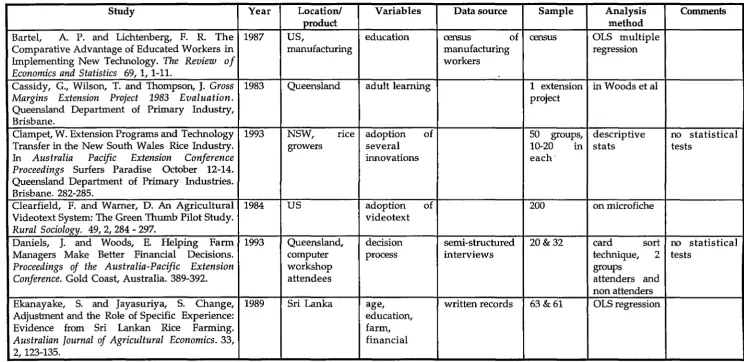
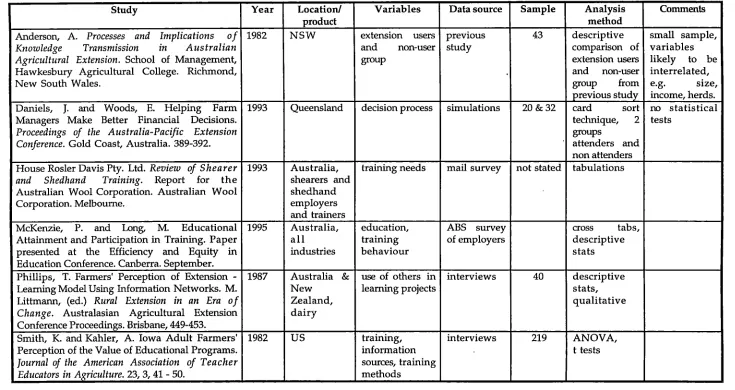
literature relating to agriculture. The exception is the second focus question, concerning triggers for changes to practice (section 2.), where much of the research effort has been in agriculture. In this section agricultural and general literature are considered together. To assist the reader, summary tables of relevant research studies appear at the start of a
number of the sections.
-1. Research Question 1: What impact does education and
training have on economic indicators?
1.1. Macroeconomic and industry level
Education and training are widely acknowledged as contributors to national economic well-being and growth, as discussed in Chapter 1. Countries with higher levels of income generally have higher levels of education; human capital, which includes both formal education and informal on-the-job training, is a major factor in explaining differences in productivity and income between countries (Hicks, 1987). Two writers who stress the importance of education for a nation's economic success are Porter (1990), writing in his influential book, The Comparative Advantage of Nations, and Lundvall (1992), a Scandanavian writer and researcher on the role of learning in organisations and networks of organisations within nations:
Education and training constitute perhaps the single greatest long term leverage point available to all levels of government in upgrading industry. (Porter, 1990, 628)
First, it is assumed that the most fundamental resource in the modern economy is knowledge and, accordingly, that the most important process is learning. (Lundvall, 1992, 1)
Kilpatrick, Rural Training Programs: Effectiveness and Profitability, University of Tasmania
Whilst there is a widespread consensus that investment in education and training promotes economic growth, international comparisons of the impact of education and training on macroeconomic indicators do not provide clear cut evidence of the relationship between education and economic growth (Sloan, 1994; Maglen, 1990; Leslie & Brinkman, 1988; Gottchalk, 1978; Blaug, 1972). Maglen (1990) goes so far as to suggest that there is no quantifiable evidence that education affects national output from either cross-country studies or time-series studies within a country. The increased participation in post-compulsory education and training in Australia in recent years has not coincided with a significant rise in labour productivity, or output per hour worked (Maglen, McKenzie, Burke & McGaw, 1994). There are, however, some difficulties in accurately measuring lal?our productivity, particularly in the tertiary, service sector of the economy which has been expanding relative to the primary and secondary sectors. Also, it is difficult to disentangle the contributions of capital and labour to total productivity (Maglen, McKenzie, Burke & McGaw, 1994) .
The income of education graduates and non-graduates or apprentices and the 'non-qualified' can be used to compare relative contributions to national output (gross domestic product) and to compare individual income. Such 'rates of return' studies include Dockery and Norris (1996), Maglen (1995), Chia (1991), Leslie and Brinkman (1988) and Miller, (1984).
The rate of return model assumes earnings are an accurate measure of productivity. It ignores the possibility that education itself does not increase productivity, but is used as a screening device by employers to select employees with 'high productivity' characteristics. Additionally, the external benefits of education are not captured. External benefits include the impact of the management skills of well educated managers on their staff's productivity, and an increased willingness to invest in new technology. Because they consider life time earnings, rate of return studies reflect historical income trends rather than the impact of education on current income and output (Blaug, 1992).
Kilpatrick, Rural Training Programs: Effectiveness and Profitability, University ofTasmania
education in Indonesia of between 8% and 29% depending on gender and province. Education also increases productivity, as measured by income, for less skilled workers, for example, a study of manufacturing workers in the United States finds that better educated workers earn more (Daily Report Card, 1996).
1.1.1 Does education cause economic growth or does economic growth induce higher levels of education?
The rate of return model is the way in which the traditional neo-classical economic theory of labour markets, known as human capital theory, explains ~he decision of individuals and society to invest_ in education and training. Individuals and society undertake education or training, according to human capital theory, if the rate of return is positive, that is, if an investment of time and money in education and training will return a greater. financial reward than investing that same time and money elsewhere in the economy, for example by doing unskilled work. Human capital theory also maintains that education causes increases in productivity and economic growth in firms and nations (Norris, 1993). This is society's return on its investment in education and training.
Several writers argue that the relationship is actually more complex, and the direction of causation is not only from education to economic growth.
Human capital plays a dual role in the process of economic growth. As a stock of knowledge, it is a source of technological change. At the same time, the formation of skills in the work force is, in part, induced by changes in technology. (Mincer, 1989, 31)
Doucouliagos and Hopkins (1993) also hold that human capital formation, productivity and economic growth are interrelated and interdependent. Investment in education and training aids economic growth, but also increases as a result of growth. Reduced productivity can hinder human capital formation, and productivity will decline as a result of lower human capital formation.
1.1.2 Global change and education
Changes impacting on Australia as part of the rapidly evolving global economy imply a major role for education and training. The occupational structure of the economy must change as it continues to open up to international competition. Labour intensive production of physical goods and the associated low skilled and unskilled jobs is moving to low wage countries such India and China. A relatively high wage country such as Australia will require more people skilled in generic skills, adaptability, problem-solving and creativity; that is people with skills which can sustain higher wages (Maglen, 1994).
Kilpatrick, Rural Training Programs: Effectiveness and Profitability, University of Tasmania
analysts' are adept at the 'management' skills of problem solving, problem identification and strategic brokering. These people will generate economic activity to employ other workers in service industries as well as those directly employed.
1.1.3 Summary of the impact of education on macroeconomic indicators
Overall, then, the evidence regarding the impact of education and training on macroeconomic indicators is mixed. This mixed result applies particularly to the evidence from the economic studies, such as the 'rate of return' studies and Maglen' s (1990) comparison of macroeconomic indicators from a number of countries. As mentioned above, the economic studies in this area suffer from a number of problems. Chief among these problems are first, they necessarily rely on historical data rather than future expected trends; for example, the 'rate of return' studies use income that "has been earned over a working lifetime. Second, they suffer from difficulties in isolating the impact of education from other changes which may have taken place, particularly technological improvements which impact on the productivity of capital.
The literature which is most positive about the impact of education and training on economic well-being comes from writers such as Porter (1990), Lundvall (1992) and Reich (1991) whose works can be placed broadly in the disciplines of management, education and sociology. These writers stress the importance of education and training in dealing with change and facilitating adaption to the world of the future. This thesis will further examine the concept of change as the mechanism whereby education and training impacts on economic variables.
1.2. Micro enterprise level
International support for the relationship between education, change and enterprise performance comes from the World Bank's (1995) report on workers from developing countries:
Education is essential for raising individual productivity ... [General education] augments the ability to perform standard tasks and use information and adapt to new technologies and practices. ... Enterprise-based training in Taiwan has been associated with a significant rise in output per worker, with the largest gains realized in firms that simultaneously invested in training and technology. (World Bank, 1995, 36)
Major changes to practice can be termed 'innovations' to the business or enterprise which makes them, even if the practice is widespread in other enterprises. An innovation may be defined as:
Kilpatrick, Rural Training Programs: Effectiveness and Profitability, University of Tasmania
organisations only, whereas others may be given overt and tangible expression. Gones, 1963, 387)
The term innovations as used in this thesis broadly equates with changes to practice which are expected to improve profitability or long term viability.
Wozniak (1984) develops a theoretical model of the decision to adopt interrelated innovations in a dynamic economic environment and concludes:
that innov:ative decision-making is a human capital intensive activity .... Thus, the incentive for agents to acquire the ability to invest in innovative ability (education or retraining) increases as the technological environment becomes n:iore dynamic. (Wozniak, 1984, 78)
Employee training programs increase worker productivity in manufacturing in the United States. Bartel (1994) found that businesses that were operating at productivity levels below that of comparable businesses were able to bring their productivity to expected levels by
implementing new employee training programs. In another example from manufacturing, but this time related to the impact of change on growth and profitability, technologically innovative Australian manufacturing businesses increase their sales on average by more per year than manufacturing businesses which do not make technological innovations, according to a survey by the Australian Bureau of Statistics (1995c).
A number of studies summarised in World Bank (1995) find that small businesses with better educated managers are more likely to grow and/ or survive. Cooper, Gimenogascon and Woo (1994) examined over 1000 new business ventures in all industries and geographic regions of the United States. They found that the entrepreneur's level of human capital as represented by education influenced both the probability of business survival and the rate of business growth. A similar Australian study over a twelve year period of over 10 OOO business ventures which started in 1973 found there was a significant relationship between the study of business/management courses and success, and between the duration and relevance of formal education and business survival (Williams, in McMahon, 1989, 62).
Kilpatrick, Rural Training Programs: Effectiveness and Profitability, University of Tasmania
terms "high-performance" work practices such as total quality management, self-managed work teams, flexible production lines, and just-in-time inventory. One of the literacy training programs quoted by
Business Council for Effective Literacy (1993) resulted in a 75% drop in defects per unit and allowed inventory to be reduced by a factor of 2.5:1.
1.2.1 Summary of the impact of education on enterprises
The literature reviewed here suggests that education and training does improve the performance of individual businesses. Writers such as Wozniak (1984), emphasise the link between education and innovation, or change. This path from education and training, through change, to improved business performance is consistent with the view which emerged from the previous section in relation to how education and training impact on economic indicators at the macroeconomic level.
1.3. Education and agricultural indicators
Kilpatrick, Rural Training Programs: Effectiveness and Profitability, University of Tasmania
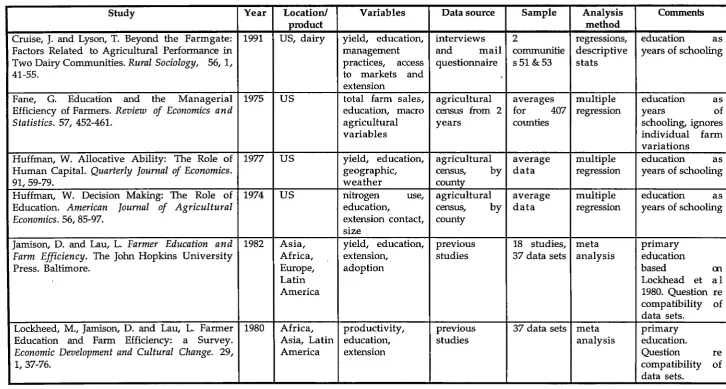
Figure 1 Education and agricultural indicators: research studies
Study Year Location/ Variables Data source Sample Analysis Comments
product method
Cruise, J. and Lyson, T. Beyond the Farmgate: 1991 US, dairy yield, education, interviews 2 regressions, education as Factors Related to Agricultural Performance in management and mail comm uni tie descriptive years of schooling Two Dairy Communities. Rural Sociology, 56, 1, practices, access questionnaire s 51 &53 stats
41-55. to markets and
extension
Fane, G. Education and the Managerial 1975
us
total farm sales, agricultural averages multiple education as Efficiency of Farmers. Review of Economics and education, macro census from 2 for 407 regression years ofStatistics. 57, 452-461. agricultural years counties schooling, ignores
variables individual farm
variations Huffman, W. Allocative Ability: The Role of 1977
us
yield, education, agricultural average multiple education as Human Capital. Quarterly Journal of Economics. geographic, census, by data regression years of schooling91, 59-79. weather county
Huffman, W. Decision Making: The Role of 1974
us
nitrogen use, agricultural average multiple education as Education. American Journal of Agricultural education, census, by data regression years of schoolingEconomics. 56, 85-97. extension contact, county
size
Jamison, D. and Lau, L. Farmer Education and 1982 Asia, yield, education, previous 18 studies, meta primary Farm Efficiency. The John Hopkins University Africa, extension, studies 37 data sets analysis education
Press. Baltimore. Europe, adoption based m
Latin Lockhead et al
America 1980. Question re
compatibility of data sets.
Lockheed, M., Jamison, D. and Lau, L. Farmer 1980 Africa, productivity, previous 37 data sets meta primary Education and Farm Efficiency: a Survey. Asia, Latin education, studies analysis education.
Economic Development and Cultural Change. 29, America extension Question re
1, 37-76. compatibility of