© 2002Kluwer Academic Publishers. Printed in the Netherlands.
Towards a systemic research methodology in agriculture: Rethinking the role
of values in science
Hugo Fjelsted Alrøe and Erik Steen Kristensen
Danish Research Centre for Organic Farming, Tjele, Denmark Accepted in revised form September 4, 2001
Abstract. The recent drastic development of agriculture, together with the growing societal interest in agricultural practices and their consequences, pose a challenge to agricultural science. There is a need for rethinking the general methodology of agricultural research. This paper takes some steps towards developing a systemic research methodology that can meet this challenge – a general self-reflexive methodology that forms a basis for doing holistic or (with a better term) wholeness-oriented research and provides appropriate criteria of scientific quality. From a philosophy of research perspective, science is seen as an interactive learning process with both a cognitive and a social communicative aspect. This means, first of all, that science plays a role in the world that it studies.
A science that influences its own subject area, such as agricultural science, is named a systemic science. From
this perspective, there is a need to reconsider the role of values in science. Science is not objective in the sense of being value-free. Values play, and ought to play, an important role in science – not only in form of constitutive values such as the norms of good science, but also in the form of contextual values that enter into the very process
of science. This goes against the traditional criterion of objectivity. Therefore,reflexive objectivityis suggested
as a new criterion for doing good science, along with the criterion of relevance. Reflexive objectivity implies
that the communication of science must include thecognitive context, which comprises the societal, intentional,
and observational context. In accordance with this, the learning process of systemic research is shown as a self-reflexive cycle that incorporates both an involved actor stance and a detached observer stance. The observer stance forms the basis for scientific communication. To this point, a unitary view of science as a learning process is employed. A second important perspective for a systemic research methodology is the relation between the actual, different, and often quite separate kinds of science. Cross-disciplinary research is hampered by the idea that reductive science is more objective, and hence more scientific, than the less reductive sciences of complex subject areas – and by the opposite idea that reductive science is necessarily reductionistic. Taking reflexive objectivity as a demarcator of good science, an inclusive framework of science can be established. The framework does not take the established division between natural, social, and human science as a primary distinction of science. The major distinction is made between the empirical and normative aspects of science, corresponding to two key cognitive interests. Two general methodological dimensions, the degree of reduction of the research world and the degree of involvement in the research world, are shown to span this framework. The framework can form a basis for transdisciplinary work by way of showing the relation between more and less reductive kinds of science and between more detached and more involved kinds of science and exposing the abilities and limitations attendant on these methodological differences.
Key words: Agricultural systems research, Context, Holistic, Objectivity, Organic farming, Philosophy of science, Reflexive, Reductionistic, Research methodology, Values
Hugo Fjelsted Alrøeis a Postdoctoral Scientist at the Danish Research Centre for Organic Farming (DARCOF) who works with philosophy of research, research methodology, and value inquiry. His research interests include systems research, transdisciplinary research, the role of values in science, sustainable agriculture, organic farming, and agricultural and environmental ethics.
Erik Steen Kristensenis Chief Scientist and manager of DARCOF. DARCOF is a “center without walls” that coordinates a joint Danish research effort based on collaboration between many different research institutes and stakeholder organizations. About 140 scientists from 20 institutes participate in the 35 research projects that are running at present. The research supports the development of organic farming and the general promotion of sustainable agriculture. The center also plays a decisive role in the development of innovative and efficient research methodologies and means of research communication.
Introduction
Agriculture has developed rapidly in the last half century, and today agriculture – and agricultural research – is faced with problems concerning nature and environment, human health, and animal welfare, as well as a general concern for the sustainability of modern agriculture. Two major trends can be discerned: a continuing technological and structural development, which is the cause of a substantial rise in productivity as well as a (partial) cause of the prob-lems, and the rise of counter movements towards a more natural, sustainable, and locally based agricul-ture.
This paper has a practical background in agricul-tural systems research and research in organic farming. Agriculture is characterized by an agricultural prac-tice that involves both social and ecological systems. Research into these socio-ecological systems faces the dual challenge of understanding complex agro-ecosystem interactions and the practices of human actors in social systems. Agricultural systems research is therefore inherently framed in a social context, and necessarily involves questions concerning different interests and values in society as well as different structures of rationality and meaning (Kristensen and Halberg, 1997). Organic farming in particular has differentiated itself from conventional agriculture by way of an alternative agricultural practice, which has developed as part of a wider organic movement incor-porating producers, manufacturers, and consumers. The organic movement has formulated a set of basic principles and standards that are based on a percep-tion of humans and human society as an integrated part of nature and a conception of health as part of a continuum through soil, plant, animal, and man (Woodward et al., 1996).
In this paper, we address the challenges to agri-cultural research entailed by the general agriagri-cultural development and the intricate relations between agri-cultural practices and values in society. According to Lockeretz and Anderson (1993), there is a need for rethinking the approaches, processes, and institutional structures of agricultural research, because of the range and scale of consequences that agricultural research is expected to address today. There are high political demands on the relevance and proactive perspective of research in relation to the changing goals, inten-tions, and values of society and agriculture. These demands are not restricted to agricultural research. They are part of a more general change in the
concep-tion of science1 and its role in society, from that of
an independent science as a source of objective know-ledge to that of science as a special learning process for society. The agricultural background of this paper
does, however, provide a particular perspective on science, because agricultural science obviously is what we call a “systemic” science.
A systemic science is a science that influences its own subject area. Agriculture is an area in rapid development – both in terms of technological devel-opment and in terms of the develdevel-opment of altern-ative production systems. And agricultural research plays an influential role in these developments. Hence, agricultural science influences its own subject area, agriculture, in important ways. Other sciences that are clearly systemic are for instance health science and environmental science; engineering and techno-logical sciences such as biotechnology and informa-tion technology; and economical, political, and social sciences. And even some of the physical sciences such
as condensed matter physics.2
The sciences of science (philosophy of science, social studies of science, etc.) are also systemic. In accordance with this insight, we do not aim at an observational, sociological description of research in agricultural systems in this paper. We take a wider philosophical and systemic perspective that aims also at contributing to the development of agricultural science. Social studies of science have revealed that science is in many ways similar to other social systems where power and interests play an influential role. This has led to suggestions that scientific knowledge is
socially constructed.3Recognizing science as a social
system does not, however, in itself question objectivity and truth as general regulative ideals, despite the actual shortcomings of science in this respect. But when science plays a role in the world that it studies, the criteria of objectivity becomes problematic as a
general scientific ideal.4
Due to this, there is a need for rethinking the role of values in agricultural research. Both in terms of where and how values enter into the research process (contex-tual values), and in terms of how the systemic nature of agricultural research relates to the conventional
scientific criteria of quality (constitutive values).5This
opposi-tion is a development that is connected to more general changes in environmental concerns (Stern et al., 1995). Therefore, the need to investigate and develop the methodology of “holistic” or systemic research has been particularly evident in research in organic farming (e.g., Krell, 1997: 5; Zanoli and Krell, 1999). But the general picture, according to William Lockeretz (2000), is that organic research at present is hardly different from conventional research with respect to actually using holistic or even system-oriented methods. One reason for this can be that the holistic approaches are generally perceived as less scientific than conventional, analytical approaches. Perhaps this is so because there is no well-founded general systemic research methodology that incorpor-ates both system-oriented and analytic research, with appropriate and clear criteria for how to do good systemic science.
Different meanings can be attached to the concepts of “systems” and “systems research.” The kind of systems theory that underlies the present paper has its roots in the theory of living systems as autopoi-etic (Maturana and Varela, 1980, 1987), second order cybernetics (Foerster, 1984) and the communicative theory of social systems (Luhmann, 1995). As a systems methodology, it is related to critical systems thinking (Ulrich, 1994, 1990) and to the soft systems approaches (Checkland, 1981; Bawden, 1992).
The primary aim of this paper is to contribute to the development of a systemic research methodo-logy in agriculture and similar sciences. This includes determining appropriate criteria of scientific quality for systemic research, with special regard to the role of values in science. We take two approaches towards this goal. The first approach is to investigate science as a learning process in order to see how intentions enter into cognition in general, how analogies can be drawn to science, and in which respects science is special. It is also to see what the consequences are for (especially) the criterion of objectivity. The second approach is to investigate the distinctions between different kinds of science that are actually used, and to analyze the distinctions that need to be made, seen from our perspective on science. This approach is to provide a more adequate framework for doing trans-disciplinary research. In the present paper, we do not intend to actually show what the values in agricultural research are or precisely how the suggested methodo-logy is to be applied to agriculture. We merely want to show how one should think about the claim that there are such values in research. But we do intend to follow this paper with a paper on the implica-tions of the systemic research methodology that will show the relevance to agricultural research in more detail.
Space does not allow for detailed examples of how values enter into agricultural research in this paper. But one aspect of this has already been the subject of some attention, namely the exposure of values embedded in scientific concepts. Several papers have discussed the different meanings of important evaluative or norm-ative concepts in agricultural research and what values these meanings imply, as well as the ethical basis for the normative concepts. For example concerning sustainability (e.g., Douglass, 1984; Thompson, 1996, 1997) and precaution (e.g., O’Riordan and Cameron, 1994; Gremmen and Belt, 2000; Alrøe and Kristensen, 2001), nature conservation (Callicott et al., 1999) and nature quality (Alrøe and Kristensen, 2000), animal welfare (e.g., Tannenbaum, 1991; Rollin, 1996; Sandøe et al., 1996; Fraser, 1999; Alrøe et al., 2001), and soil fertility (Patzel et al., 2000).
Science as a learning process
Prior to the question of whether holistic or systemic research in agriculture can be scientific, and prior to the determination of criteria for good systemic science, lies the question of what science is. Answering this question also, in turn, comprises an answer to the question of “demarcation” as the defining distinction
between science and non-science.6
A conventional conception of science is that science is an independent, detached, and objective observer of the world. This conception of science can be, and has been, criticized through sociological studies of how science is actually performed, of the impacts of interests and power structures, and of the role of science in society. However, such sociological
studies have no critical force in relation to theidealof
an objective science. One could argue that science can be objective if it is done in the right way. And there is some force in the argument that the critical method of science eventually will overcome the actual biases – in the final opinion. But the conventional conception of science can also be the subject of a more involved, philosophical investigation that provides a normative critique of scientific inquiry.
We suggest that answers to the questions of what
science is and whatgoodscience is, are best sought by
analyzing science as a special learning process. This focus on learning is distinct from both the focus on scientific knowledge and the focus on scientific social practice.
Science as a cognitive system and as a social, communicational system
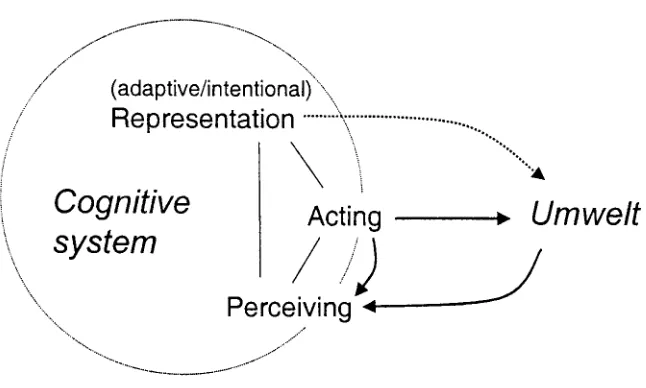
Figure 1.A simple model of a cognitive system. The dotted arrow indicates a semiotic reference, the solid arrows indicate causal processes, and the thin lines indicate a systemic connection and coordination (Alrøe, 2000).
research as the learning process of a cognitive system, and science as a social, communicational system (see further in Alrøe, 2000). Considering science as a cognitive system is most appropriate at the level of the researcher or the research unit, while seeing science as a communicational system is more appropriate at the level of the scientific community and the society.
Science shares common features with other learning processes, but it also has some distinct features. Common features are found when consid-ering science as a cognitive system and scientific learning as, in some respects, similar to the learning of organisms. This is a naturalistic approach to science in line with John Dewey’s theory of inquiry (e.g., Dewey, 1991: 30ff.). We take such an approach as our starting point. The naturalistic approach does not imply that there is no difference between less complex and more complex kinds of cognition – only that there are common features and that something can be gained from investigating these features. Some of the differ-ences between the learning process of science and that of an organism are to be found in the devel-opment of scientific research methods and technolo-gical tools. There are also different lotechnolo-gical types of learning involved (Bateson, 1972: 279–308). Scient-ists and cognitive research systems are distinct from most organisms with respect to their potential for self-reflexive learning. And finally, as indicated above, science is distinct by being a social, communicational system based on openness to criticism.
According to Dewey, cognition, or experience, is primarily about doing and interacting with the environ-ment. Cognition cannot be understood independent of emotion and activity, and knowledge is therefore not something separate and self-sufficing (Dewey, 1948:
84–87). As a basis for understanding research as a cognitive system we use a simple model of embodied
cognition (see Figure 1).7
In the cognitive system, there is a representation of the world that involves a semiotic reference to the
“Umwelt” (the phenomenal world of the system).8The
causal interaction with the world is divided into acting and perceiving in the model, and these two elements are connected to the representation. Hence, the use of the term “representation” in the model does not imply that the acting is controlled by way of some sort of map or depiction of the world, only that the acting and perceiving of the system is coordinated and to some degree refers to patterns outside the system. Furthermore, the representation entails meaning or significance for the system. That is, the representa-tion involves both an “adaptive” aspect that refers to
previous experience, and an “intentional”9aspect that
refers to future experience.
interests employed in the research. And the possibil-ities of observation depend on the available knowledge and means of intervention.
For example, investigating environmental prob-lems often involves the use of indicators. Indicators are simple and feasible measures that are taken as signs of the state of the environment or of important
driving forces in environmental change.10These
indic-ators are means of observation that both enforce and constrain the possibilities of learning about environ-mental changes. And the indicators are chosen with reference to specific intentions that are related to envir-onmental goals and to conceptions of what counts as problematic issues (see, e.g., Bossel, 1999).
The second main aspect of science as a learning process is science seen as a social, communicational system. This aspect has received more attention than the cognitive aspect of science, because it entails some of the distinctive features of science.
In a philosophical perspective, one of the distinct features of scientific learning is the public nature of scientific communication and the critical approach of science, as emphasized by Karl Popper (e.g., 1998: 256). The critical approach is connected to a fallibil-istic view of scientific knowledge and the conception of a community of inquirers, as found in the tradition of philosophical pragmatism (Peirce, 1868).
In his general theory of social systems, Niklas Luhmann describes science as one of the functional systems that are differentiated in modern society (e.g., Luhmann, 1989: 76ff.). It is differentiated through a specific code of communication based on the differ-ence between true and false. Luhmann states that:
The code of scientific truth and falsity is directed specifically toward a communicative processing of experience, i.e., of selections that are not attributed
to the communicators themselves[, and]. . .towards
theacquisitionof new scientific knowledge. (Luhmann, 1989: 77–78)
In other words, Luhmann says that scientific communication is based on “objective experience.” In the next section, the notion of objectivity and the rela-tionship between the value-laden aspects of research and the “objective experience” of scientific communic-ation will be investigated. Further below, the question of how experience is “objectified” is described by means of a model of the self-reflexive circle of learning in systemic research.
Objectivity and the method of science
In the late 19th century, Charles S. Peirce gave a description of the general method of science that is still met with sympathy. Peirce states that inquiry is caused
by the irritation of doubt and ends with the cessation of doubt. The sole object of inquiry is the settlement of opinion. Science is distinct from other methods of fixing belief, such as tenacity, authority, or a priori assumptions, because in science “our beliefs may be caused by nothing human, but by some external permanency – by something upon which our thinking has no effect.” (Peirce, 1877). In other words, the beliefs of science are based on empirical evidence. Peirce also made clear the fundamental hypothesis behind the method of science:
There are real things, whose characters are entirely independent of our opinions about them; those real-ities affect our senses according to regular laws, and, though our sensations are as different as our rela-tions to the objects, yet, by taking advantages of the laws of perception, we can ascertain by reasoning how things really are, and any man, if he have suffi-cient experience and reason enough about it, will be led to the one true conclusion.
(Peirce, 1877)
And Peirce had developed a conception of truth and reality that takes this view of scientific method into its ideal consequence: Truth is the final opinion, towards which the communal mind of man is tending through scientific inquiry – on the whole and in the long run, despite all errors and individual peculiarities. Everything that will be thought to exist in the final opinion is real, and nothing else (Peirce, 1871).
This view of scientific method still plays an important role in our understanding of science and Peirce is helpful in making it very clear that it is linked with a specific conception of reality. It seems obvious that truth and reality in Peirce’s view can only concern the more permanent phenomena in the world, which are independent of human activity – such as the tradi-tional subject areas of natural science. And, notably, this view is entailed in the conventional criteria of objectivity in science.
Eugene Freeman has given a fine description of the conventional conception of objectivity in science, which emphasizes that “the objective” is the external, that which is not self, and that it is defined as the opposite of the subjective:
of “objectivity,” as given for example in Webster’s unabridged dictionary, quite instructive. “Object” is defined in one context as, “The totality of external phenomena constituting the not-self”; “objectivity” is defined derivatively as “the quality, state, or rela-tion of being objective,” and objective, in turn, is defined as “something that is external to the mind.” Here “subject” (or self, or mind) is the basic undefined term, in terms of which we can define objectivity as nonsubjectivity, in polar contrast to “subjective,” which means “that which is part of or inside of the self.”
(Freeman and Skolimowski, 1974: 464–465)
This view of objectivity has been challenged in one of the most prestigious areas of science, atomic physics. There are many other areas where the conven-tional conception of objectivity has been criticized, but the critique in atomic physics has more force as it is less prone to be dismissed by declaring the area non-scientific. There has been a longstanding discussion of the epistemological problems in atomic physics, with Niels Bohr as a leading figure. In Bohr’s own account of the discussion with his main opponent on this issue, Albert Einstein, he explains how the discussion of the epistemological problems has shown that it is not possible to comprehend the evidence of quantum phenomena, obtained under different exper-imental conditions, within a single picture (Bohr, 1949). The evidence from different experiments must be regarded as complementary in the sense that only the totality of the phenomena exhausts the possible information about the atomic objects. The comple-mentary pictures of quantum phenomena are insepar-able from the observational situation – it is impossible to separate the behavior of atomic objects from the interaction with the measuring instruments that serve to define the conditions under which the phenomena appear. And Bohr advocated the application of the very wordphenomenonexclusively to refer to the observa-tions obtained under specific circumstances, including an account of the whole experimental arrangement (Bohr, 1985: 27).
This meant that Bohr had to dismiss the “real-istic” presumption of a distinction between mutually exclusive subjects and objects entailed in the conven-tional conception of objectivity. Subsequently Bohr’s “Copenhagen interpretation” of quantum theory was
derided as “subjectivist.” But his philosophical
analysis of the observational situation in atomic physics still stands, and it suggests a new conception of objectivity. According to Bohr, the inclusion of an account of the experimental arrangement and the results of observation in the language of everyday life and classical physics was the only way to provide an
unambiguous descriptionof the experiences in atomic physics, where the phenomena far transcend the clas-sical phyclas-sical experiences. And to Bohr, objectivity meant simply the unambiguous description of exper-iences. Furthermore he suggested that the situation in physical science was analogous to the situation as regards analysis and synthesis of experience in many other fields of human knowledge and interest, such as psychology and life sciences.
We follow Bohr. The conception of research as a cognitive system does not presuppose a distinction between subject and object. It focuses on the systemic connections of research. Below, a model of the exper-iential situation in research is outlined that makes the role of science as both actor and observer more explicit. This self-reflexive model forms the basis for understanding how the cognitive experience that is gained in research is “objectified.”
The self-reflexive circle of learning in systemic research
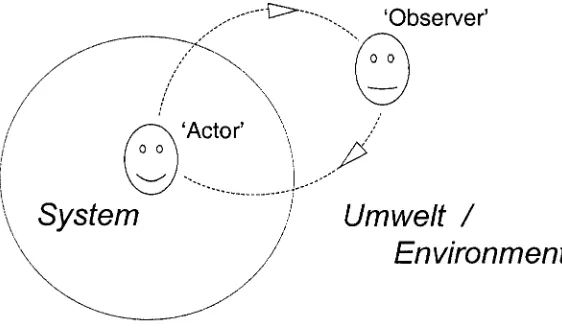
Looking at research as a cognitive system, we can picture the learning process of systemic research as a self-reflexive circle – a cyclic cognitive process including the representation of oneself as another (Figure 2). This model is in analogy with human self-conscious learning based on the ability to take a mental step out and look upon oneself and one’s actions from outside, and use this outside view in later action. Self-reflection starts from the viewpoint, or stance, of the “actor” – the first order involved viewpoint of a cognitive system (with the capacity for self-reflection) – then it moves to a second order detached viewpoint
where the “observer” views the system from outside.11
And the observations made from this outside point of view can take effect upon returning to the first order viewpoint of the system.
The distinction between inside and outside view-points has been widely, although not consistently, used in anthropology and other fields under the names emic
(inside) and etic (outside).12We prefer the terms actor
and observer,13or the simple terms inside and outside
viewpoint, for several reasons. First of all, they are easily understood and interpreted in a common way, as opposed to emic/etic, and they can be linked to the guiding metaphor of self-reflection in a straight-forward way. It might be tempting to use the terms subjective and objective, but there is a load of connota-tions in those terms (as indicated above) that are better avoided in this context for the sake of conceptual precision.
Figure 2.The self-reflexive circle of learning in systemic research, moving from an inside actor viewpoint, or stance, to an outside observer viewpoint, and back.
influencing its own subject area, this leads to reflection on how it interacts with the world. And the model in Figure 2 can support this growth of reflexivity.
Moving from an inside to an outside viewpoint entails that an overall distinction between the system and its environment needs to be made – the system has to be identified as an object of observation. This first movement also involves the determination, or at least presumption, of certain goals and values upon which the choices and delimitations that need to be made in planning and initiating research, can be made. The ensuing observations are thus based on these value-laden choices. These choices, together with the initial choice of system to be studied, determine the relev-ance of the research. The questions of for whom the research is done and what intentions guide the research are determined here. In other words, if the obser-vations are to be part of a learning process for the observed system, or for some specific social system, the choices made need to reflect the values and goals in that system, because these choices can be decisive when the observations are later used in the develop-ment of the system (no matter whether the research unit realizes this or not).
Sometimes the researchers are, in a sense, already within the system that they are researching, because they share the worldview, values, and goals present in the system in a way sufficient to initiate the research. But often there is a need for a reflexive determination and clarification of the inside point of view. There may be no single point of view to be found, but the research unit needs to settle on a specific point of departure in order to substantiate the research. In agricultural research, the inside view can be approached by way of interviews with farmers, consumers, and other stake-holders, or through participatory research, including public meetings, etc., which can provide some access
to and representation of the values and discourses involved in the particular socio-ecological system being studied. On a more general scale, this involves institutional mechanisms for democratic participation in research and in the setting of research priorities (Middendorf and Busch, 1997). In a philosophical perspective, the values and interests of the actors can also be the subject of critical normative analysis as a means of establishing a coherent point of departure for research.
The second movement, back to the inside view-point, may take direct or indirect paths, depending on the relation between the system and the research unit. In research as a cognitive learning process, a direct path is taken in the form of actions that transform the system. The indirect path goes by way of communica-tion. As well recognized, the observer stance forms the basis for scientific communication. But the communic-ational learning process in science is dependent on the quality and adequacy of the connection to the under-lying cognitive process. In other words, it is dependent on how the cognitive experience is “objectified.”
value-free, Archimedean point of observation that is entailed in the conventional criterion, or ideal, of objectivity. Therefore, the independence of the observed dynamics of the system can only be a tional independence, an independence that is condi-tional on the choices made in order to take an outside viewpoint.
Based on the understanding of research as the learning process of a cognitive system that has been presented above, the model of self-reflexive learning in Figure 2 applies to all research. All research depends both on cognitive experience and the transformation of those experiences into scientific communication. In other words, all research starts with a complex system that embodies values, namely the research unit and its world. In laboratory research, the research unit acts in
the construction of equipment and experiments.14 In
the observational and historical sciences the research unit acts in the choice and development of tools of observation and the construction of coherent narrat-ives. Research that considers itself only a detached observer of the world without also being an actor is thus blind to parts of its own function. On the other hand, research that operates only as an involved actor fails to be scientific.
In a critical perspective, self-reflection allows research to make an “objective” description of the specific value-laden point of departure, which can be communicated as a part of the context of the observa-tions. However, it is by no means an obvious or easy task to identify this context. The next section treats the intricate relationship between objectivity, context, and communication.
“Reflexive objectivity,” relevance, and cognitive context
The purpose of peer criticism in the scientific community (as opposed to the general discourse of society) is to subject the knowledge of the individual researcher or research group to the perspectives of other researchers, and thereby root out errors due to the influence of the individual perspectives and
peculiarities.15And, as stated above, one of the distinct
features of scientific learning is the open, public nature of scientific communication. As generally recognized, however, peer criticism is only in principle open to the scientific community in general due to the specializa-tion of science. In practice, peer criticism is typically to some degree conditional on special knowledge and restricted to disciplines or sub-disciplines. However,
if the scientific communication is to be evenin
prin-ciple open, it has to include sufficient context to be unambiguous, as stressed by Bohr. And, insofar as the value-laden context of scientific inquiry is
an important aspect of the knowledge production of science, this aspect has also to be included in the scientific communication in order to maintain the ideal of openness. Even though this seems to be in conflict with the conventional scientific ideal of objectivity, which implies independence of contextual values.
With reference to Luhmann and Bohr, the exper-ience of the research unit becomes “objectified” by
being transformed into scientific communication.16In
this transformation process, the researcher approaches the stance of an “ideal” observer so that this “objective experience,” in principle, can be shared with and criticized by any member of the scientific commu-nicational community. The means of “objectifying” experience are the conventional scientific methods of documentation and control of observations and exper-iments, etc. In our view, this must also include a full documentation of the contextual background. The demarcation of science as a special learning process, we suggest, is the very ability to take an “objective” stance. Not the conventional, un-reflected objectivity, which excludes the intentional and value-laden aspects
of science, but areflexive objectivitythat includes these
aspects and exposes their role.17The characteristic of
reflexive objectivity is that the false assertion of value-freedom is considered less objective than the admit-tance of the contextual values and interests involved in research, because this context can be decisive for the learning process by way of the choices and delim-itations made. The value-laden starting point should therefore be well described and clear, and included as a necessary context in the subsequent communication of “objective experiences.”
Where the conventional criterion of objectivity seems to stand in opposition to the criterion of ance, reflexive objectivity is interrelated with relev-ance through a common focus on context: Relev-ance concerns how the context of research is formed, and reflexive objectivity concerns how the context of research is exposed. In effect, reflexive objectivity demarcates the outer boundary of what is good science, while relevance determines the research that is actually to be performed.
In the perspective of science as a self-reflexive learning process and the criterion of reflexive objectivity, the answers that science gives depend
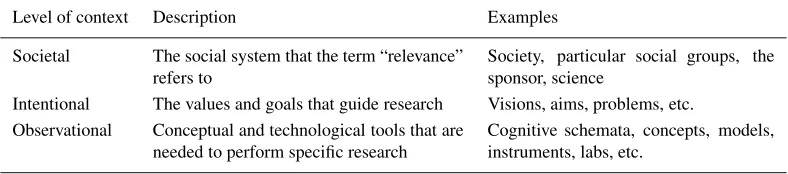
on thecognitive context.18 The cognitive context can
be divided into at least three levels (see Table 1). The societal context is the group or social system that the term “relevance” refers to, that is, those or that which the research is supposed to be relevant for (e.g., society, farmers, the third world, the market, the employer, the sponsor, or the scientific
community). The intentional context consists of the
Table 1.Three levels of cognitive context.
Level of context Description Examples
Societal The social system that the term “relevance” refers to
Society, particular social groups, the sponsor, science
Intentional The values and goals that guide research Visions, aims, problems, etc. Observational Conceptual and technological tools that are
needed to perform specific research
Cognitive schemata, concepts, models, instruments, labs, etc.
taken as relevant problematic situations. The
observa-tional context includes the actual distinctions, delim-itations, models, and technological constructions that are employed in research, that is, the means that are needed to perform research and obtain observations. When Bohr defined “phenomenon” as referring to the observations obtained under specific circumstances, he pointed to the observational context.
We use the term “levels” as an indication of the structure of conditional independence of the obser-vations and types of context. The obserobser-vations are influenced by the observational context, while they are independent of the other levels of context given the observational. The observational context is influenced by the intentional context and it is independent of the social context given the intentional. And finally the intentional context is influenced by the societal. For instance, when considering research as a tool for devel-oping organic agriculture, the societal context is first of all the organic movement. The organic movement has a set of rather explicit visions, values, and goals that frame the intentional context. And this, at least to some extent, determines the observational context. On the other hand, some of the organic values are relevant in a wider societal context. And the research that is actually performed can very well be relevant to other farming traditions with other goals and values.
Usually, peer criticism is primarily directed
towards the relation between the research results and the observational context. However, given the above structuring of the context of research, there is also a role for critique of how the observational context is related to the intentional context (as it is commonly done in applied sciences). For example, is the intentional context made clear? Do the chosen approaches, methods, and concepts address the prob-lematic situation or the expressed goals and values in a fruitful way? The meaning of the evaluative and normative concepts that are used in science, such as soil quality, animal welfare, and sustainability, is a well-known problematic issue. The exposure of the values embedded in the usage of such concepts is an important aspect of reflexive objectivity. There is furthermore a role for critique of how the intentional
context is related to the societal context. For example, do the stated goals, values, and problems reflect the concerns of the social systems that the research is to be relevant for? Is the funding of the research made clear or hidden?
In addition to peer criticism, which concerns the exposure of the cognitive context and the coherence of context and results in relation to reflexive objectivity, there is a role for public criticism, which directly concerns the contextual values: is the exposed context found to be relevant?
Peer criticism is often conceived as the peer review of papers as part of the publishing process. But there is an important role for criticism in other parts of the research process. In particular, new research projects are determined through a process that involves politics and funding. In this process, the relevance of research can be improved by way of exposure and commu-nication of the suggested cognitive context. The task of making clear and criticizing the intentional context and the relation to the societal context involves value inquiry. This is not an easy or straightforward task, but it is a substantial and important element in a systemic research methodology.
It is argued above that, given a particular well-described observational context, the values and inten-tions that led to this particular setup will not influence
the results.19 If this is so, one might ask why we
should care about the intentional context. Exposing the intentional context is, however, an important back-ground for seeing the particular observational context, and the “objective” knowledge that is gained, in a larger perspective. It will facilitate the coordination and cooperation with other research that has a compat-ible intentional context, and allow groups with certain values to identify research that is compatible with those values and use the research with confidence in the relevance of the results. Similarly, exposing the societal context (e.g., for whom is the research done, funding, etc.) will allow for a normative and polit-ical discourse on the intentional context and thereby provide the structure that enables the functioning of science as a genuine learning process for society.
play a role in the method of science, because there is only one objective scientific approach to any given problem, or because science is not a problem-driven but an explorative, descriptive enterprise. These argu-ments build on a very narrow conception of science that disregards the role of science as a tool for action and development (the distinction between descriptive and developmental science is further explored in the next section). There is always a (reflected or un-reflected) choice of subject matter or research issue in science. If science is seen as problem-driven and a tool for action, this choice depends on what is taken as problematic, and this involves goals, interests, and values. And even the enterprise of “pure science” entails certain values that may be questioned in relation to the role of science in society.
Values also play a role in the method or approach employed in addressing a specific problematic issue. The delimitations and reductions employed and the choice of methods are intertwined with value-laden issues. As a fictional example, let us imagine the general problem of fungus diseases in wheat crops (a problematic issue that already presumes certain values and perspectives). There are many ways to do research in regard to this problem:
− you can develop pesticides that are (more or less
selectively) effective against fungi
− you can search for and breed new sorts of wheat
that are more resistant towards fungi, or use genetic engineering to develop wheat that is toxic towards fungi
− you can investigate different agricultural
prac-tices (in terms of levels of fertilisers, etc.) that make the wheat more resistant towards fungi
− you can investigate different agricultural
produc-tion systems where the wheat is less prone to get fungus diseases in the first place (through crop diversity, landscape diversity, etc.)
− you can investigate the use of other crops than
wheat
− or you may even investigate other land uses than
crop production, depending on the interests and goals of society and stakeholders.
Such choices are made in research initiation, and the choice of approach or method indicates something about the intentional context that is (knowingly or unknowingly) employed. The relevance of the research depends on whether these choices correspond to the values present in agriculture and society, or whatever specific intentional and societal context “relevance” refers to.
To sum up, relevance is concerned with research as a tool for development with respect to certain groups with certain goals, interests, and values, while
reflexive objectivity is concerned with making clear the context of the learning process. The criterion of reflexive objectivity suggests that research should investigate and describe its own societal, intentional, and observational context and work explicitly with the goals and values involved, in order to facilitate peer criticism and the use and critique by different users and stakeholders. In particular, research should describe the choices made in research initiation, the delimita-tions and constraints these choices place on the results, and the areas of ignorance that this implies, as an essential context of the results produced. Such changes in the norms of science cannot be implemented by single researchers or research groups. Their successful implementation involves all the different institutional structures of science, such as the organizational tures of research, the media of publication, the struc-tures of research policy and funding, the educational institutions, etc.
Distinctions and boundaries in science – towards a common framework that can form a ground for transdisciplinary systemic research
In the previous section, a unitary view of science as a learning process has been developed. This view does not presuppose different kinds of science, such as the established division between natural, social and human science. A second important perspective for a systemic research methodology is therefore the relation between the different and often quite separate disciplines in the highly fragmented science of today. In order for science to function as a common learning process, there is a need for a common framework that can serve as a basis for doing transdisciplinary systemic research.
The “boundary work” of science (Gieryn, 1983), the actual demarcations of science from non-science that science employs in the pursuit of its professional goals, has implications for the conditions for doing transdisciplinary systemic research, which needs to work across the established boundaries of science. Cross-disciplinary research is often hampered by the idea that reductive science is more objective, and hence more scientific, than the less reductive sciences of complex subject areas – and by the opposite idea
that reductive science is necessarily reductionistic.20
This has led to an unfruitful opposition between “reductionist” and “holistic” science in connection with, for instance, agricultural and ecological research (see, e.g., Lockeretz and Anderson, 1993: 65–69; Thompson, 1995: 118ff.; Rowe, 1997).
they do not capture the connectedness of complex reality. And reductionist science is (in part) to blame for the present agricultural and environmental prob-lems. From the reductionist point of view, analytic, reductive methods ensure the quality of science, and other methods are, therefore, not scientific.
Two comments are pertinent here. First, the cognitive model of research that has been outlined in this paper, implies that the world is always “reduced” in cognition – the phenomenological world is not “the real world,” whether it is the world of a frog or of science. Hence the term “holistic” seems to promise more of science and cognition than can be fulfilled. Second, since reduction is a powerful approach in science that can contribute significantly to the learning process, the term “reductionist” should be used only where a science is un-aware of the consequences of reduction or denies that there are any such consequences. Given an evolutionary meta-physics that asserts the reality of emergence (see, e.g., Emmeche et al., 1997), reductionist science is to be regarded as bad science. Given even the hypothesis that there are emergent phenomena, a science that does not investigate what may be left out in reduction, does not meet the quality criterion of reflexive objectivity.
The condition for avoiding reductionism is a reflexive awareness of the observational context, including the analytic methods. The conditions for
being “wholeness-oriented”21 are, in addition, a
reflexive awareness of the role of specific discip-lines and research activities in relation to the larger wholes or systems that are found to entail problem-atic issues (e.g., environmental problems), and an awareness of the role of science in society. In the perspective of organic agriculture, which takes the connectedness of the world as a basic presumption and the independence of things as something special, there is a particular emphasis on the problems related to science being fragmented by disciplinary special-ization without enough awareness of the need for
interdisciplinary and transdisciplinary22work and for
methodological and organizational structures that can facilitate such work.
Our conception of science as systemic and the promotion of wholeness-orientation is largely in congruence with Michael Gibbons et al.’s (1994: 19) description of how the production of knowledge (scientific learning) is advancing into a new phase. From the conventional natural science-like know-ledge production (Mode 1) has evolved a new mode (Mode 2), which continues to exist alongside the old mode. Mode 1 is discipline-based and carries a distinc-tion between basic and applied sciences, with a linear operational relation between a fundamental theoret-ical core of knowledge and its practtheoret-ical use in applied
sciences.23By contrast, Mode 2 knowledge production
is transdisciplinary – it is characterized by a constant flow back and forth between the basic and the applied, between the theoretical and the practical. In Mode 2, more emphasis is placed on contextualized results and less on the search for fundamental principles, and the processes of discovery are integrated with those of fabrication. Where the problems of science in Mode 1 are set largely by the academic interests of a scientific community, Mode 2 is fuelled by practical problems in specific contexts, involving heterogeneous groups of participants.
In the following, the unitary view of science as a learning process is linked to a framework that can assist transdisciplinary work. The framework locates different kinds of science in accordance with the kind of motivation or interest behind the research and their main methodological characteristics.
Classifications of science based on motivation and methodology
The notions of systemic science, wholeness-oriented research, and Mode 2 knowledge production seem to capture essential features of an important shift in the conception of what science is as well as in the general methodology and structure of science. The shift may also involve changes in how science is divided into different kinds. This shift is related to the involvement of science in new complex areas, such as the socio-ecological problems of society and environment. Here, different disciplines such as ethics, sociology, ecology, and chemistry ought to be in close cooperation. This is not often the case.
Our main interest in reflecting on the distinctions between different kinds of science is therefore method-ological: how can different kinds of science cooperate in such complex research areas? Which distinctions need to be taken into account and which can be dismissed as historical relics? These questions involve critical analyses of what the proper distinctions of science are, as a means to promote the operation of research across the perceived boundaries of science.
Donald Stokes has recently, in a discussion of the basic/applied distinction, suggested a distinction between four kinds of science that is based on two
dimensions of motivating factors for research: the
considerations of use and the quest for fundamental understanding of the causes of phenomena (Stokes,
1997; see also Whitley, 2000: xx–xxi).24 Stokes’s
critique of the basic/applied distinction is well taken, and his identification of two different dimensions in this distinction seems to address a real problem with it. There are, however, some difficulties in his fourfold
by a quest for fundamental understanding seems to
conflate two different methodological dimensions of
science, the degree of reduction and the degree of observational detachment. We shall return to this in a moment.
As for the motivating factors of science, we agree that the basic kinds of interests in doing science may distinguish different types of science. But the motiva-tions that Stokes refers to (use and fundamental under-standing) seem to be restricted to natural science and therefore not sufficiently general.
In an analysis of the relation between know-ledge and interest, Jürgen Habermas (1972: 302– 303, 308–310) distinguishes between three kinds of science. This is a distinction that might resemble the traditional distinction between natural, human, and social sciences, but it is one that is not based on the character of the subject area. Habermas’s distinction refers both to methodology (“the char-acter of the logical-methodological rules”) and to motivations (“knowledge-constitutive, or cognitive, interests”). The three kinds of science are (1) the empirical-analytical sciences with a cognitive interest in technical control over objectified processes, (2)
the historical-hermeneutic sciences with a practical
cognitive interest directed towards mutual under-standing and meaning, and (3) the systematic sciences
of social action with an emancipatory cognitive
interest. These latter sciences, including economy, sociology, and political science, not only produce nomological knowledge of causes and laws – they are also critical social sciences by way of the method of self-reflection in society, because self-reflection “releases the subject from dependence on hypostat-ized powers” (1972: 310). The very awareness of the causal mechanisms allows for the liberation from these mechanisms. Critically oriented sciences share this emancipatory cognitive interest and the method of self-reflection with philosophy.
We follow Habermas in acknowledging the dependence of science on cognitive interests and agree that there is no “pure knowledge” – that knowledge is always connected with interest, and that it can only become “objective” and decontextualizedk by including and revealing the context. But we take a slightly different view of the connection between different kinds of science and cognitive interests. We suggest a distinction between only two different, but
interacting, general cognitive interests: A
norma-tive interest, which seeks to establish meaning in
form of ideas on the valuable and the good (corres-ponding to Habermas’s practical interest), and an
empiricalinterest, which seeks to establish descriptive and predictive knowledge with regard to contempla-tion, social accontempla-tion, and technical control. The two
different cognitive interests correspond to the two different aspects of the cognitive representation of the world in Figure 1. The normative interest is intentional or forward-looking and concerned with the choice of future potential courses of action (knowing what to choose in an open world). The empirical interest is adaptive or backward-looking and concerned with description, classification, and prediction of general, habitual, and law-like phenomena (knowing what is given – and what is open).
The empirical interest includes both Habermas’s technical and emancipatory cognitive interests, which we consider to differ only in degree, and not in kind, due to differences in the reduction of the subject matter. That is, the cognitive interest is the same, but there is a difference between more reductive and less
reductive sciences.26Apart from being predictive, the
knowledge of natural laws is also “emancipatory” in making it possible to take these laws into account in technical control. And the knowledge of social laws or habits is also predictive, apart from making it possible to seek to change or overcome those laws. Any know-ledge of general and lawful phenomena offers both prognostic and transformative abilities, in that it indic-ates both what is given and what is open. With a dramatic example, the prediction of a meteor hitting the earth also offers the possibility of changing its course. Furthermore, the recognition of a general phenomenon suggests the possibility of changing the general. But this option is highly dependent on the nature of the subject area. Laws and habits can only be changed by way of changing the underlying static structures upon which the lawful dynamics are based. And this may be prohibited by lack of power or by ethical concerns.
Accordingly, we do not follow Habermas’s distinc-tion between three kinds of science. Basically, we suggest, there are only two kinds of science: the
empirical27and thenormativesciences, corresponding to the two cognitive interests. The empirical sciences produce descriptive and predictive knowledge refer-ring to actual, habitual and potential phenomena (how the world is, will be, and can be). The norm-ative sciences produce prescriptive knowledge, that is, meaning and ideas on the good referring to how we want the world to be. More precisely, these can be
called twoaspectsof science, because the one builds
The distinction between empirical and normative sciences does not correspond to any of the tradi-tional distinctions between natural, social, and human sciences. In this view, which is closely related to that of Joseph Rouse (1987: 169f., 198–208), the natural and social sciences are not seen as different kinds of science, but as science done in different areas with different degrees of reduction, where there are different conditions for experimentation, manipula-tion, and control.
A framework for the cooperative understanding of different kinds of science
We now return to the question of basic methodolo-gical differences between different kinds of science, speaking first of the empirical aspect of science.
If we look at, for instance, laboratory research, field experiments, on-farm research, and sociological research in agriculture, they are different with respect to the reduction and abstraction of the subject matter (that is, the complexity of the “research world”), and subsequently in the conditions for experimentation and control, and thereby for replications or reproductions of phenomena. They are also different with respect to the need for ethical considerations. As stated above, there has been a more or less tacit conception of science, where systemic approaches that include, for example, the human and social parts of the agricultural systems into their research world, are perceived as less scientific than conventional, analytical approaches, which have reduced their research worlds to exclude
those aspects of reality. Thereareobvious differences
between agricultural systems research and analytical chemistry, for example, but sciences in some subject areas are not necessarily more scientific than sciences in other areas – there is no necessary difference in the potential for doing good science in more and less reduced subject areas. And in a learning perspective, the possibility for doing good science does not increase with the amount and “solidity” of existing knowledge and theories.
We want here to outline a common framework of science that shows the methodological differences between different kinds of research, and the implic-ations of these differences, where they can be seen as having the same potential for being “scientific.” Both the benefits and costs of reduction need to be addressed.
The important methodological dimensions of such a common framework are, first, the dimension of more or less reduced “research worlds” and, second, the dimension of detached observational knowledge versus involved experimental action. The latter dimen-sion refers to the two stances of the learning circle
(Figure 2), the detached observer stance, where general “objective” knowledge can be generated, and the involved actor stance, where decisions and actions actually take place in specific contexts. With respect to the first dimension, the reduction of subject matter in science involves a construction of a simplified research world by way of abstraction and metaphor-ical construal (“gedankenexperimente”) and mostly also by way of physical delimitation, manipulation, and control (classical experimental science). The conception of reduced research worlds is in line with Joseph Rouse (1987; see also Latour, 1983), who rethinks the role of laboratories in our understanding of science.
Fundamentally, a laboratory is a locus for the construction of phenomenal microworlds. Systems of objects are constructed under known circum-stances and isolated from other influences so that they can be manipulated and kept track of. They constitute attempts to circumvent the chaotic
complexity . . . by constructing artificially
simpli-fied “worlds.” In these microworlds there exists only a limited variety of objects, whose provenance is known and whose forms of interaction are strictly constrained.
(Rouse, 1987: 101)
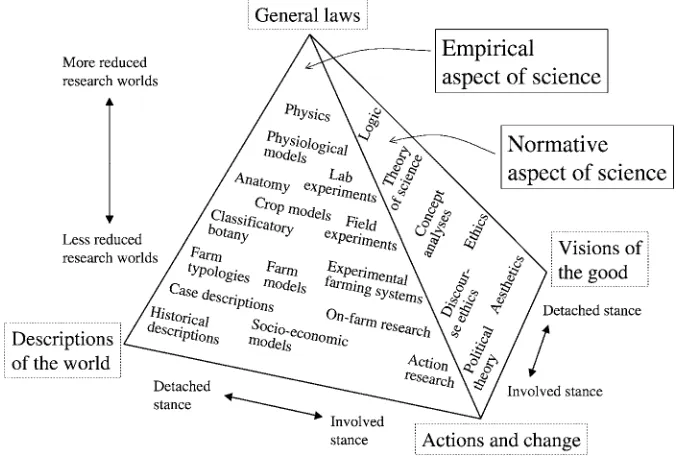
The common framework of science that emerges from the above considerations is illustrated in Figures 3 and 4 (Figure 3 only shows the empirical aspect of science). The two methodological dimen-sions span the framework: vertically the more or less reductive sciences, with the very reduced research worlds at the top, and horizontally the involved and
the detached stance.28 The triangular form represents
the effect of reducing complexity and working with restricted research worlds. The more detached, obser-vational kinds of research can be classificatory (more reduced worlds) or descriptive and historical (less reduced worlds). And the more involved, experiential kinds of research can be experimental (more reduced
worlds) or developmental (less reduced worlds).29 In
highly reduced research worlds (such as the world of high energy physics), the classificatory and exper-imental sciences are so closely connected that they cannot be separated and hardly distinguished. In less reduced worlds, on the other hand, the descriptive and developmental sciences are very different and hardly seen as connected.
In Figure 4, the normative aspect of science is included. The two aspects of science, the empirical and the normative, are shown as two faces of a
pyram-idal structure.30 Each face is spanned by the two
Figure 3.An illustration of the relation between different types of empirical science. The framework is spanned by two key meth-odological dimensions of science, the reduction of the research world and the involved versus detached stance. The triangular form shows the effect of reduction.
Figure 4.A common framework of science with some examples of different disciplines and types of research. The two faces of the pyramid represent the empirical and normative aspects of science. The faces are spanned by two key methodological dimensions of science, the reduction of the research world and the involved versus detached stance. The pyramidal form shows the effect of reduction.
are indicated that are of relevance to systemic research in agriculture. With respect to other subject areas, other examples would be appropriate. Even though the examples are placed on one of the two faces, none are purely empirical or purely normative. Every actual field of science has both normative and empir-ical aspects even though the focus may be entirely on one or the other. In particular, among the highly involved systemic or developmental sciences, action
research has substantial normative aspects and political theory has substantial empirical aspects.
Among the more reductive normative sciences are the sciences of good thinking (logic) and good inquiry (normative theory of science). In the latter, we locate the systemic research methodology that is outlined in
the present paper.31
[image:14.595.128.467.342.570.2]of a phenomenon, while moving towards the detached can be aligned with seeking a classification or a communicable description of a phenomena. “General laws,” such as the natural laws of physics, can be taken as the extreme expression of the method of reduction in science, providing an ideal causal explan-ation. They represent a general knowledge that is valid everywhere, but it is only valid given the constraining
presumptions in the reduced research world.32 If you
let an egg fall from the leaning tower of Pisa, it will (largely) fall in accordance with the laws of gravity. If you let a feather fall, more complex laws interfere. If you let a swallow fall, the laws of gravity play only a minor role in explaining what happens.
In more complex worlds, the epistemological limitation with regard to using causal knowledge from reduced worlds is that some aspects are
neglected because of the reduction.33 Some examples
of neglected aspects are the crop rotation effects when doing research on single fields; the effects on farm economics when doing research on cropping systems (e.g., Olesen, 1999); the management factor when studying farm dynamics in experimental farming systems or in the assessment of animal welfare (e.g., Sandøe et al., 1997); or the role of motivation (inten-tion) in behavioral studies (e.g., Brier, 1998).
Conversely, the methodological and technical
limits of doing research in more complex research worlds are due to the complexity and variety of the research world and the diversity and individuality of the entities. For example, it is very difficult to make a general predictive model of a complex world – in particular if the world involves self-reflexive actors, such as persons and their social systems, that learn, adapt, and change course in accordance with the
know-ledge they gain from that model.34 There are also
ethical limits to research in complex worlds, connected to the presence of human and non-human actors in the research world that the research system has a moral responsibility to take into consideration and, in the case of persons, involve in a moral discourse (see also Latour and Woolgar, 1979: 256–257). In this perspective, reduction entails (apart from methodolo-gical benefits) that the ethical questions are external-ized – they become part of the external communica-tions of science and the actual research can be done without ethical considerations. In a wider systemic perspective, however, where science is seen as a part of society and nature, and with reference to the criterion of relevance or (more generally) given a theory of moral responsibility for actions (Jonas, 1984; Alrøe and Kristensen, 2001), there can be decisive ethical concerns connected with the potential consequences of reductive science.
Conclusion
Society’s demand for more wholeness-orientation in (for instance) agricultural research implies a critique of traditional disciplinary research that is not well suited to handle cross-disciplinary problems. And it implies a critique of the sciences that have difficulties with hand-ling the criteria of relevance because they aspire to the scientific ideal of being value-free and independent of social interests. There is, however, no established alternative research methodology that can meet the demand for wholeness-orientation.
In this paper, we have taken some steps towards a systemic research methodology for agricultural science and similar sciences. That is, a methodo-logy for doing wholeness-oriented research that can meet the challenges facing science in complex research areas that involve human actors and social and ecolo-gical systems. An important aspect of this methodo-logy is the role of values. Science is neither value-free nor independent. The important questions are what the role of values is and how science interacts with its subject area and with society. Values play an important role in science – not only in normative sciences such as ethics and theory of science, but also in empir-ical sciences. This view necessitates a revision of the conventional ideal of objectivity.
there-fore serve as a basis for promoting transdisciplinary systemic research.
Acknowledgment
The current version of this paper has profited from the helpful comments of several anonymous reviewers.
Notes
1. In this paper the term “science” is used in a broader sense than common in English, in line with the German “Wissenschaft,” as a generic term that includes social and human sciences (or cultural sciences) as well as natural science.
2. Generally, all the so-called human, social, and cultural sciences are systemic, because persons and social systems have some ability to react to what science says. And further-more all technological or “developmental” sciences are systemic, because they influence the evolutionary course of the world. One might object, as an anonymous reviewer did, that the term “systemic science” seems to be too general to be of much use. Indeed, taken as a whole, science must be characterized as systemic – science influ-ences the world that it studies. But, firstly, there are special sciences that are destined (cosmology and pure historical sciences) or determined (classical observational sciences)notto influence their subject area. And secondly, the concept is intended more as an eye opener than as a practical way of categorizing sciences. When taking this perspective and recognizing some science as systemic, one is led to reflect upon the interactions between science and the world. Sciences that are recognized as systemic from without are not necessarily self-reflexively aware of their systemic nature. But describing them as systemic may lead to such reflection. In the following, the terms “systemic science” and “systemic research” will mainly be desig-nating science that has some insight in its own systemic character. These terms differ from “applied science” in that they do not share the conception of a clear separation and linear relation between basic and applied sciences (see further below).
3. For a good and balanced discussion of social construc-tionism in science, see Ian Hacking (1999).
4. To the surprise of some, perhaps, Karl Popper recognized that social science cannot be objective due to the influ-ence of social sciinflu-ence on society – and that this interaction between the observed object and the observing subject is not limited to social science, but also found in biology, psychology, and, even, physics (Popper, 1957: chapters 6 and 32).
5. The distinction between constitutive values, which consti-tute the norms of good science, and contextual values, which are the personal, social, and cultural values that may influence science, is due to Helen Longino (1990: 4ff.). 6. In the history of demarcation, the positivistic distinction
between science and “metaphysics” employed “verifiab-ility” as a criterion of meaning that designated scientific
knowledge as meaningful and sensible as opposed to non-sensible metaphysics. Karl R. Popper claimed that his criterion of testability (or falsifiability or refutability) was not a criterion of meaning but a criterion of demarcation between science and non-science, and that metaphysics (the not testable, non-scientific knowledge) could therefore be sensible knowledge (e.g., Popper, 1998: 37ff., 255– 258). However, Popper retains a focus on knowledge (on the theory or the theoretical system) and not on learning or method. That is, he sees demarcation as the question of which hypotheses or theories can be subjected to the scientific method of testing, and thereby perhaps falsified. We are interested in science as a learning process and in “demarcating” better and worse ways of doing research. Demarcating science as a special learning process does not imply that scientists are different from other people, only that they employ certain methods. And the philo-sophical question of what might “demarcate” scientific learning – what makes for good scientific learning – is still open.
7. The model builds on Jacob von Uexküll’s biological theory of meaning and his functional circle of behavior (Uexküll, 1982: 32). See further in Alrøe, 2000.
8. The German term “Umwelt” is here used to designate the phenomenal world that an organism perceives and acts in accordance with. The usage of the German term in English comes from the field of biosemiotics, see for instance (Hoffmeyer, 1997).
9. The meaning of “intentional” here is in line with the everyday meaning of intention (as related to desire, value, purpose). It is not the specific philosophical notion of inten-tionality, which means “being directed at” or “referring to” something.
10. See e.g., OECD, 1999, and examples of agricultural envir-onmental indicators in Hansen et al. (2001).
11. Including observations of the cognitive system’s first order observations – hence, “second order,” as in second order cybernetics (Foerster, 1984; Luhmann, 1989: 23ff.). A fuller discussion of this is given in Alrøe (2000).
12. The terms emic and etic were introduced into linguistics and anthropology by Kenneth L. Pike, who generated these somewhat odd terms from the linguistic distinction between phonemic and phonetic. The emic/etic distinction was picked up by Marvin Harris who entrenched them into anthropology (see Headland et al., 1990). See also Paul Thompson’s (1995: 150ff.) discussion of the emic/etic distinction in relation to agricultural sustainability. 13. The terms actor and observer are used for instance by
Luhmann (1989: 25) in connection with a second order cybernetic perspective on science, and by Jones and Nisbett (1972) in social psychology, describing differences in the attribution of causes of behavior.