Guided by the Philosophy of Constructive Alignment,
Directed by the Realisation of Niche Construction
Colin Jones
University of Tasmania, Hobart, Australia [email protected]
Abstract: This paper highlights the potentially important role of the student in shaping the
nature of the learning environments within which they interact. It is proposed that the use of constructive alignment in tandem with a learner-centred approach containing criterion-based assessment can empower students in important ways. That such empowerment can go further than increasing their ability to learn to also include an increased role in helping to shape their learning environment. The use of an evolutionary approach within this paper helps facilitate discussion of the often-neglected process of niche construction through which such possible empowerment is enacted. The primary drivers of the processes discussed are regular summative and formative feedback. The assertion being that students’ habits of thought are susceptible to change when the students understand how they contribute to their overall fitness vis-à-vis satisfying stated learning objectives. The implications of the arguments within this paper go to the very heart of enacting the philosophy of learner-centred approaches to teaching and learning. The opportunity to work with students to achieve both superior learning outcomes and learning environments is highlighted as an important consequence of being truly learner-centred.
Keywords: Constructive alignment, niche construction, learner-centred
Introduction
To what extent (if any) could students be co-architects of the learning environments they encounter? This paper argues that as a consequence of adopting a learner-centred approach to teaching and learning, students can become co-creators of future curriculum. The aim of this paper is to demonstrate the process through which this suggested role of students unfolds. In doing so, this paper adopts an evolutionary approach to draw out both the suggested causal factors and the nature of the process of change. A consequence of this approach is that while educators may pursue certain teaching philosophies, the reality of their implementation may be problematic if they give rise to a continual process of never-ending change.
design that is unpredictable. To move this argument forward within the space limitations of this paper, let us consider the following syllogism:
Student learning outcomes will be advanced through the use of learner-centred teaching and learning pedagogies that incorporate criterion-based assessment.
Criterion-based assessment processes can enable students to understand their
performance at a given point in time and how to improve that performance over time against specific curriculum objectives, therefore…
Overtime, a process of continual adjustment to learning objectives, learning activities and assessment procedures will be required to cater for improved student learning and dynamic student/learning environment interaction.
As a result, the following discussion is based on several specific premises. The first being that freedom provided to students through a learner-centred approach may open up a wide array of interaction possibilities between students and their learning environment. The second being that educators may have to accept that it is not fully possible to create the perfect learning environment in advance of such interaction. Finally, and following on from the last point, the process of curriculum design may well represent a process that has no obvious starting or end point.
Such ideas are commonplace with regards the process of genetic and social change that unfolds in our everyday life (Veblen, 1925). This point of view challenges the traditional legitimacy of the lecturer to assume sole responsibility for curriculum design. That is, it suggests that student learning may significantly influence the process of achieving
constructive alignment (Biggs, 2003), or the aligning of learning objectives, learning activities and assessment procedures. This represents a departure from the assumption that each cohort of students from one year to the next experiences a similar starting point and are subject to a consistent experience of education. Using the experiences of several cohorts of students in the unit BMA204 Foundations of Entrepreneurship as the context for the following discussion, the ideas introduced thus far will now be explored in finer detail.
Student-learning environment interaction
The unit BMA204 Foundations of Entrepreneurship provides students with an entry point into enterprise related study at the University of Tasmania and for many, a new way of studying. Delivered since 2002, the unit has evolved significantly, with the curriculum co-developed through frequent lecturer/student consultation. At the heart of the unit is a learner-centred focus inline with the requirements of enterprise education (Gibb, 2002). Students are encouraged to learn in their here and now (Whitehead, 1929), developing many differing interpretations of the required learning topics. A key factor in the learning process has been the provision for continuous student reflection (Tyler, 1949) related to the repeated learning activities that occur during the fortnightly workshops. Over time the learning activities have evolved to include games, case study discussion, workshop presentations and reflective diaries that are all tied to the topics introduced cumulatively throughout workshops.
two specific aims of the program. One relates to assisting students to be capable of making the journey from student to graduate entrepreneur and the other (more general) aim relates to helping the students develop the attributes of a reasonable adventurer. Heath (1964) defines the reasonable adventurer as a graduated student capable of making his or her own
opportunities for satisfaction. A disposition argued to be a necessary pre-condition for engaging in entrepreneurial behaviours.
On each occasion the unit has been delivered, increasing degrees of freedom have been provided to the students to find their own meaning of the topics covered. The students’ interactions with the learning environment and their contribution of artefacts (e.g.
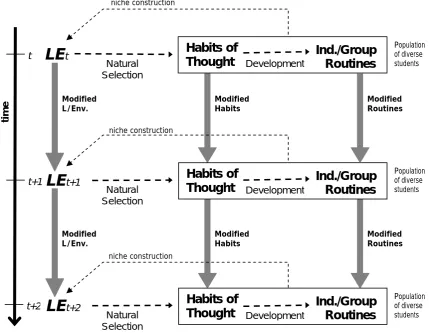
presentation formats) that have been carried forward have had a profound influence on the development of subsequent curriculum. This next section introduces an evolutionary model (Figure 1) that helps to explain how such influence is thought to occur, before the
[image:3.595.70.500.297.630.2]implications of the model are considered in the concluding sections.
Figure 1: Proposed Causal Pathways of Niche Construction
Niche construction
The process illustrated in Figure 1 above is an adaptation of Olding-Smee, Laland and Feldman’s (2003) niche construction process. These authors in championing the neglected
process of niche construction bring to life the previous work of Lewontin (1983). Lewontin sought to refute the assertion that an organism proposes (a set of predefined) solutions to the
Habits of
Thought Development Ind./Group Routines
Population of diverse students t t+1 t im e
LE
t Natural Selection Habits ofThought Development Ind./Group Routines
Population of diverse students
LE
t+1 Natural Selection Habits of Thought Ind./Group Routines Development Population of diverse studentsLE
t+2 Natural Selection t+2 ModifiedHabits Modified Routines
problems it encounters in its environment, and that the environment then efficiently rewards or punishes those solutions that prove beneficial or injurious to the organism. For Lewontin, any explanation of the process of adaptive change must cater for the ongoing reciprocal interaction between the organism, its generative mechanism and the environment. He asserted that organisms determine relevance, alter their external world, and transduce physical signals from their external environment. Essentially, rather than merely being on the receiving end of natural selection, organisms both make and are made as a consequence of interaction with their environment.
Developing this line of thinking, Olding-Smee, Laland and Feldman (2003) again cast doubt on the conventional view that organisms adapt to their environment, but environments do not adapt to their organisms. From an educational perspective, the conventional view would assume that student interaction within a particular learning environment would result in the sorting of students by specific (learning) traits as ordered by the assessment procedures they encounter. That, while some students may improve throughout the process, the structure of the learning environment would remain essentially unaltered through such interaction. It is highly likely that such a process could occur through the application of a lecturer-centred approach complete with reliance upon norm-reference assessment procedures. However, that is not the focus of this paper, and therefore, an alternative process is being considered.
In Figure 1, it is assumed that both change internal to the student (i.e. habits of thought) and external change (i.e. phenotypic expression) is possible due to interaction with a learning environment (LE). The illustrated process begins with the interaction between a student as an individual and as a group member within the learning environment (Et). During this first period of time, each student and his or her group will engage in various learning activities, which will be assessed using both summative and formative feedback. During the process of assessment, the fitness of the routines used individually by each student and by his or her group will be selected either for or against. Such routines represent the mechanisms
responsible for phenotypic expression (e.g. the content and context of the student’s/group’s performance and associated identity projected for consumption).
As a consequence, the habits of thought (Veblen, 1925) of each student are subject to differential selection (for or against) on the basis of their contribution to the phenotypic expression of the individual or group. A combination of freedom (Whitehead, 1929) and reflection (Tyler, 1949) then provide the means through which the group and therefore individuals may alter behaviours via a shift in their collective and separate habits of thought. This process of group and individual change is facilitated in the first instance by the
summative information received (i.e. a grading) and then by the formative information that relates to both negative and positive aspects of the group’s/individual’s performance. Therefore, the various assessment procedures used act as selection mechanisms.
This process of generating both summative and formative assessment performs two important functions. First, the summative feedback provides an indication of the immediate fitness of the group’s/individual’s performance vis-à-vis the various performance criteria at a particular moment in time. Second, the formative feedback provides feedback through which future change is possible. So the “difference between them is that at some point the judgement has to be final” (Biggs 2003, p. 142). The other factor that influences the composition of the
First, the students’ habits of thought (derived from their habits of life) are subject to revision as they determine what mental capabilities will best assist their progress. Altered habits of thought are then inherited from one learning environment to the next (i.e. LEt to LEt+1) either via individual student behaviour or through their contribution to their group. Second, those aspects of the modified phenotypic expression (deemed to be favourable) and related to any changed habits of thought, are inherited by the groups from one learning environment to the next (i.e. LEt to LEt+1). Third, and perhaps most importantly, the behaviours of the
individuals and the groups has the potential to alter the nature of future interaction between the learning environment and all entities to be assessed. This is the central thesis of the paper, that niche construction provides a process through which students alter their learning
environment within their time and space and/or at least place significant pressure on the learning environment within their time and space.
Throughout the many times BMA204 Foundations of Entrepreneurship has been delivered, students have been the continuous co-architects of an ever-changing learning environment. In its simplest form, such change has been determined through the changing perceptions of individuals that impact upon the process of peer assessment operating on and within group performances. As groups collectively alter their judgements as to what satisfies the stated learning objectives contained within the process of criterion-based assessment that alters the process of natural selection operating on both individuals and groups. Also, as students make profitable alterations to their habits of thought (and therefore their group routines) they do so locked in an inquisitive battle to find better solutions to the problems present in their learning environment. Many of the solutions they devise place substantial pressure on the learning activities used. This creates the need to adjust learning activities to continually stretch the students’ capabilities. As such, the students have the ability to inherit a modified learning environment due to their direct and indirect influence.
Discussion
It is exciting to contemplate a dynamic learning environment that is both demanding of students and also shaped by the needs and behaviour of students. Such a process however places stress of any desire to achieve constructive alignment across learning objectives, leaning activities and assessment procedures. At first glance, two contradicting processes appear to be present within the discussed niche construction and constructive alignment processes. This paper takes the view that there is not really a significant contradiction. Essentially one process moves a system towards a stable equilibrium (i.e. constructive alignment) and the other that shifts a system continually towards a dynamic equilibrium (i.e. niche construction). So while there is the potential for compatibility, there is essentially a temporal inconsistency. As noted by Veblen (1925), “institutions are products of the past process, are adapted to past circumstances, and are therefore never in full accord with the requirements of the present” (p. 191). What is always is at play is an adjusting of inner relations (i.e. habits of thought) to outer relations (i.e. the learning environment). This is especially so when students are encouraged to learn in their here and now.
Several implications arise from allowing a learner-centred approach (complete with criterion-based assessment) off the leash. The implications of allowing criterion-criterion-based assessment to fulfil its purpose in such a context are quite significant. What has been observed in BMA204
2006) where the ideas and behaviours of each group are proudly put forward for consumption by fellow groups. Ideas and techniques are revealed and any perceived advantage is
transferred across groups through imitation (and trial and error) resulting in mutations as the semester unfolds. Essentially the students are energised by the presence of their fellow groups. Because the students interpret assessment in this context as a valuable guidance tool, they are prepared to fail in order to succeed. Throughout this process, the occasional
introduction of a more norm-referenced approach (i.e. judgements concerning student versus student, or group versus group) has brought about the resumption of behaviours that could be best labelled competitive jockeying. Where admiration was replaced with suspicion, openness gave way to secrecy, and fair peer assessment became an instant casualty.
This suggests the need to ensure students have the support and guidance of the lecturer regardless of how many mistakes are encountered on their journeys. A useful way of supporting the process of niche construction may be to gather regular informal and formal feedback. This process can serve as both an invitation and a means of legitimising both the role of students as change agents and any new habits of thought under consideration. A simple way to proceed would be to ask students what aspects should be kept, added and removed from the learning environment to aid their learning. This process may provide access to very rich and insightful comments that could guide modifications to the learning environment with greater surety.
Conclusion
It has been argued that students can perform the role of co-architect of the learning environments within which they learn. That the process of development through which student learning outcomes is achieved can be related to an evolutionary process. From this perspective, it is the students’ habits of thought that are altered to advance their ability to succeed in their learning environments. This process assumes that students develop the means challenge their own “assumptions about the nature, limits, and certainty of knowledge” (Baxter Magolda, 2004, p. 16). That they are capable of constructing their own meaning of their learning experiences. The repeated processes across workshops give rise to knowing being associated with action (King and Kitchener, 1994) leading to upward pressure being placed on the learning environment. This pressure inturn acts to threaten the potential attainment of a constructively aligned stable curriculum.
In their highly seminal paper on learning and evolution, Hinton and Nowlan’s (1987) work suggests that the predicament that both the lecturer and the student face is like searching for a needle in a haystack. There is no optimal path to conduct such a search, only helpful voices in the dark that guide our search. For the students in BMA204 Foundations of Entrepreneurship, that voice has been frequent formative and summative feedback. For the lecturering team, that voice has been regular feedback from the students related to all aspects of the learning
environment they interact with.
References
Baxter Magolda, M. (2004). Making their own way: Narratives for transforming higher education to promote self-development. Stirling, Virginia: Stylus.
Biggs, J. (2003). Teaching for quality at university (2nd ed.). Buckingham: SRHE & Open University Press. Heath, R. (1964), The reasonable adventurer. Pittsburgh: University of Pittsburgh Press.
Jones, C. (2006). Reflections from a not so distant microcosm, Proceedings of the 7th International Conference on the Dynamics of Strategy: Strategy and Sustainability, Mahe, The Seychelles, July 10-12.
King, P.M., & Kitchener, K.S. (1994). Developing reflective judgement: Understanding and promoting intellectual growth and critical thinking in adolescents and adults. San Francisco, CA: Jossey-Bass. Gibb, A.A. (2002). Creating conducive environments for learning and entrepreneurship: Living with, dealing
with, creating and enjoying uncertainty and complexity. Industry & Higher Education, 16(3), 135-148. Olding-Smee, F.J., Laland, K.N., & Feldman, M.W. (2003). Niche construction: The neglected process in
evolution. Oxford: Princetown University Press.
Lewontin, R.C. (1983). Gene, organism, and environment. In D.S. Bendall (Ed.), Evolution from molecules to men (273-285). Cambridge, UK: Cambridge University Press.
Veblen, T. (1925). The Theory of the Leisure Class. London: George Allen & Unwin.