Iterative Decoding and Soft Interference
Cancellation in Fast Frequency Hopping Multiuser
System Using Clipped Combining
Sohail Ahmed, Soon Xin Ng, Lie-Liang Yang and Lajos Hanzo
School of ECS, University of Southampton, SO17 1BJ, UK.Tel: +44-23-8059 3364, Fax: +44-23-8059 4508
Email:{sa03r,sxn,lly,lh}@ecs.soton.ac.uk; http://www-mobile.ecs.soton.ac.uk
Abstract— Iterative decoding (ID) aided fast frequency hop-ping (FFH),M-ary frequency shift keying (MFSK) using clipped combining in multiple access (MA) channels is investigated. All users’ data are convolutionally encoded and the encoded bits are interleaved and converted to M-ary symbols, which are transmitted using FFH-MFSK modulation. The soft metrics to be passed from the demodulator to the decoder are derived assuming a Rayleigh fading channel. We also propose a novel multiuser detection (MUD) scheme which employs joint soft decoding as well as successive interference cancellation (SIC), the receiver exploiting the soft information fed back by the decoder to the demodulator in order to cancel the interference imposed by reliable symbols. Our simulation results show that the proposed scheme is capable of combatting multiuser interference and outperforms the conventional ID by about 3dB.
I. INTRODUCTION
In fast frequency hopping (FFH), M-ary frequency shift keying (MFSK) systems operating in a multiple access (MA) scenario [1], narrowband interference imposed by other users is the main source of performance degradation [2]. In a conventional cellular system [3], the base station’s (BS) re-ceiver usually employs a separate single-user detection (SUD) receiver for each user [2]. However, given the knowledge of all users’ addresses, the BS’s receiver may invoke Multiuser Detection (MUD) [4], which jointly detects all users’ signals. Specifically, when a multi-stage Successive Interference Can-cellation (SIC) assisted MUD [2] is employed, the effects of symbols reliably detected at a specific SIC stage can be removed in the subsequent stages, thereby reducing the interference constituted by these reliably detected users.
A plethora of work has been contributed towards joint MUD and Soft-Input-Soft-Output (SISO) decoding designed for Direct Sequence Code Division Multiple Access (DS-CDMA) [5], [6]. The basic idea behind soft-cancellation assisted iterative MUD, also referred to as turbo MUD[6] is to carry out demodulation/decoding in multiple stages. More specifically, in coherently detected DS-CDMA, estimates of the dispersive channel are generated, which facilitate the can-cellation of the exact interference imposed by reliably decoded symbol on the composite multiuser signal. This remodulated
The financial support of the EPSRC, UK and EU under the auspices of the Phoenix and Newcom projects and of Higher Education Commission, Pakistan is gratefully acknowledged.
signal estimate can then be subtracted from the received signal. By contrast, frequency hopping (FH) systems are typically employed in conjunction with noncoherently detected MFSK. Thus, in the context of FH-MFSK the lack of knowledge concerning the channel conditions prohibits the employment of classic SIC based MUD schemes typically employed in DS-CDMA [4], [5], [6]. Consequently, the idea of joint decoding and MUD has attracted limited attention as far as FH-MFSK systems are concerned.
Nonetheless, some soft metrics and detection algorithms have been proposed in [7], [8], [9] for employment in slow-and fast-FH. In the context of combatting multiuser inter-ference (MUI), Fiebig and Robertson [10] employed soft decision decoded convolutional, turbo and RS codes, although no attempt was made to exploit the decoder’s soft output. Park and Lee [11] extended the work reported in [10] employing Iterative Decoding (ID). The concept of iterative soft informa-tion exchange between anM-ary orthogonal demodulator and a SISO decoder has been investigated in [12], [13].
In this contribution, we employ for the first time the concept of soft information assisted MUD in FFH-MFSK and introduce a novel MUD scheme that invokes joint SISO decoding combined with SIC for mitigating the effects of MUI. We demonstrate the power of the proposed algorithm using binary convolutional codes. In the receiver, we employ clipped or Soft-Limiter Combining (SLC) [1] and SIC based on feedback from the SISO decoder. The soft metrics passed by the MFSK demodulator to the decoder are also derived, assuming uncorrelated Rayleigh fading.
The rest of this paper is structured as follows. In Section II, the system under consideration is described and in Section III, the soft metrics are derived and the proposed Soft-SIC scheme is discussed. In Section IV, we will demonstrate with the aid of simulation results that the proposed SIC method results in useful performance gains. Finally, in Section V, we present our conclusions.
II. SYSTEMDESCRIPTION
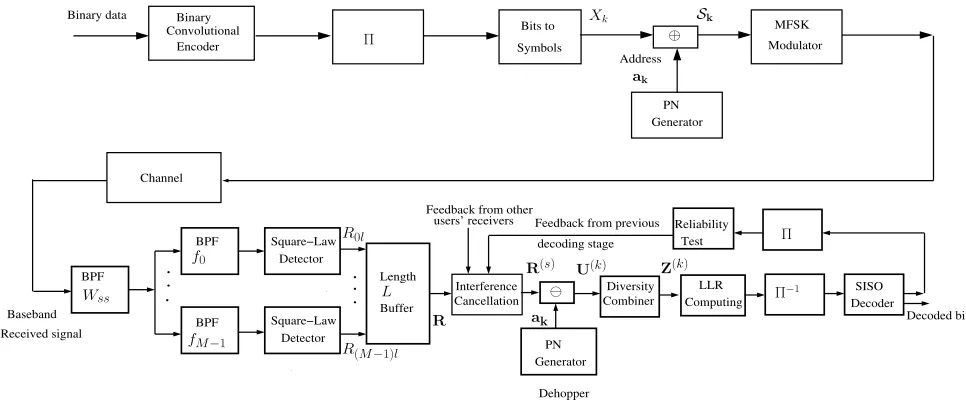
The FFH-MFSK system considered consists of a single cell, serving multiple users with the aid of a BS and utilizing a spread spectrum bandwidth of Wss. The schematic of the proposed system is depicted in Fig. 1. All users’ binary
Channel
.
.
. . .
Detector
Square−Law Square−Law
Detector
Decoder BPF
BPF
Received signal
Buffer
. .
. CancellationInterference
BPF
Diversity Combiner
LLR Computing
Dehopper Baseband
Length
Decoded bits Reliability
Test
SISO Bits to
Symbols Encoder
Binary Convolutional
PN Generator Binary data
Address
Feedback from other users’ receivers
PN Generator
Feedback from previous
decoding stage
Modulator MFSK
R(M−1)l R0l
Π−1
Wss
fM−1
f0
L
Π
U(k)
R(s) Z(k)
R ak
⊕ Sk Xk
Π
[image:2.595.62.545.48.254.2]ak
Fig. 1. Block diagram of the FFH-MFSK system for thekth user,k= 1,2, . . . , NU, employing SISO convolutional decoding and SIC.
data are encoded by a binary non-recursive, Non-Systematic Convolutional (NSC) [14] code before bit interleaving. Fol-lowing bit interleaving, the NSC coded bits are converted to M-ary symbols as shown in Fig. 1. The kth user, k = 1,2, . . . , NU, is assigned a unique and random L-tuple FFH address ak = [ak(0), ak(1), . . . , ak(L−1)], which is output by the PN generator seen in Fig. 1, where ak(l) ∈ GF(M), l = 0,1, . . . , L −1, L is the number of frequency hops per symbol and GF(M) represents a Galois field having M elements. In the MFSK modulator of Fig. 1, an MFSK tone is chosen for transmission whose frequency during the lth hop of duration Th is chosen according to [2]
Sk= [Sk(0),Sk(1), . . . ,Sk(L−1)] =Xk.1⊕ak, (1)
where 1 denotes a unit vector of length L, Xk is the M
-ary symbol to be transmitted by the kth user and ⊕
de-notes addition in the Galois Field. Note that Sk(l), ak, Xk ∈
[0,1, . . . , M−1]. We assume that the bandwidth occupied by the signal transmitted during each FFH chip interval is given by Rh = 1/Th. The frequency separation between adjacent FH tones is also assumed to be Rh. Thus, the orthogonality of the FFH frequency tones is maintained. Note that for ease of analysis, random FFH patterns are assumed [2].
The channel is modeled by uncorrelated, frequency-flat Rayleigh fading for each transmitted frequency. We assume that the frequency separation between the adjacent signalling frequencies is higher than the coherence bandwidth of the channel. Thus each signalling tone can be assumed to experi-ence independent fading. The fading envelopes experiexperi-enced by the various users are also independent of each other. Furthermore, the transmitted signals are corrupted by Additive White Gaussian Noise (AWGN) having a one-sided power spectral density ofN0.
When a particular user transmits a signal to the BS, the signals transmitted by all other users may be modeled as continuous-wave interfering tones. For the sake of simplicity, we also assume a chip-synchronous system, where the chip
transitions of all users are aligned in time. Furthermore, perfect power control is assumed, hence the power of all the signals received by the BS from all users is identical.
The BS receiver’s schematic is also shown in Fig. 1, where we assume that the hopping sequence of the FFH demodulator is in synchronism with that of the FFH modulator of the transmitter. After carrier demodulation, a bank of M square-law detectors detect the energy received in each MFSK tone. The outputs of the detectors are dehopped and combined over L hops using SLC, as will be discussed in the next section. Then soft decoding and SIC is employed for cancelling the multiuser interference (MUI), which is also discussed in the context of the proposed SIC scheme in the next section.
III. SOFTINFORMATION BASEDSIC SCHEME
As seen in Fig. 1, the decoder accepts soft inputs from the demodulator, employs the Maximum A Posteriori (MAP) algorithm [14] and delivers soft a posteriori information as well as the decoded bits. In the following section we discuss how soft information is derived by the demodulator from the channel observations.
A. Soft Decoder Input and Iterative Decoding
combiners of Fig. 1, is received. This probability is given by
P(k)(Xk =m|Z(k)) =p
(k)(Z(k)|X
k =m)P(k)(Xk=m) p(k)(Z(k)) ,
(2) where p(k)(Z(k)|Xk = m) is the PDF of the received sig-nal Z(k), given that Xk = m is transmitted. Furthermore, P(k)(Xk = m) is the a priori probability of the symbol Xk = m, while p(k)(Z(k)) is the probability of receiving signalZ(k), which is given by
p(k)(Z(k)) = M−1
m=0
p(k)(Z(k)|Xk=m)P(k)(Xk=m). (3)
The probability given by (3) is a constant for a given received signal Z(k). Moreover, for equiprobable symbols, we have P(k)(X
k =m) = 1/M. Hence, the PDF p(k)(Z(k)|Xk =m)
uniquely and unambiguously describes the statistics required for estimating the probability P(k)(X
k =m|Z(k)). For inde-pendent fading of all tones, the PDF p(k)(Z(k)|Xk = m) is given by
p(k)(Z(k)|Xk =m) = fz(mk)(xm|Xk=m)
× M−1
n=0,n=m
fz(kn)(xn|Xk =m),(4)
where fz(nk)(xn|Xk=m)represents the PDF of the output of the nth diversity combiner, n = 0,1, . . . , M −1, given that Xk=mis transmitted.
In order to derive the PDFs of the diversity combiner outputs, we first consider the PDFs of the square-law detec-tor outputs before diversity combining. Although the signal transmitted by a specific user may be interferred by other active users’ signals, it is challenging to derive the PDF of the square-law detector output considering all possible combinations of the interfering tones. Hence, we derive the soft information from the channel observations assuming a somewhat simplistic but tractable interference-free channel. Moreover, although clipped combining is employed in the receiver, as discussed in the following section, we perform the forthcoming analysis assuming linear combining, using no clipping at the receiver. This assumption has been stipulated for further simplifying the analysis and is supported by the observation that clipping is an operation performed to reduce effects of MUI. Hence, our analysis may result in sub-optimal soft information, but we will nevertheless demonstrate in Section IV, that valuable performance improvements can be achieved using this approach.
Assuming thatXk=mis transmitted by thekth user in the lth hop, it can be readily shown that for independent Rayleigh fading, the PDF of the noise-normalized square-law detector output Uml(k)after dehopping as seen in Fig. 1, is given by [3]
fU(k)
ml(ym|Xk =m) =
1
1 +γhe
−ym
1+γh, ym≥0, (5)
whereγh=bRcEb/(N0L)is the Signal-to-Noise Ratio (SNR) per hop, Rc is the code rate,Eb is the transmitted energy per bit andb is the number of bits per symbol.
Similarly, for all the interfering or non-signal tones, n = 0,1, . . . , M−1, n=m, the corresponding PDF is given by
fU(k)
nl (yn|Xk =m) =e
−yn, y
n≥0. (6)
From (5), using the Characteristic Function (CF) ap-proach [3] 1, we can derive the PDF of the linear combiner outputZm(k) seen in Fig. 1, which can be expressed as
fZ(k)
m (xm|Xk =m) =
xL−m 1
(1 +γh)LΓ(L)e
−xm/(1+γh). (7)
Similarly, for all the non-signal tones,n= 0,1, ..., M−1, n=
mwe have
fZ(k)
n (xn|Xk=m) =
xL−n 1
Γ(L)e
−xn. (8)
Inserting (7) and (8) in (4) and after further simplifications, we have
p(k)(Z(k)|Xk=m) =
1
(1 +γh)L
1
ΓM(L)
M−1
n=0
xL−n 1e−xn
× exp
xmγh
1 +γh
. (9)
We can see in (9) that all the terms, except the last
ex-ponential term are common, for any of the mth symbol,
m = 0,1, ..., M −1. Since the computation of the LLRs requires the logarithm of the bit probabilities, we consider the common terms as a normalization factor and express the normalized probabilityp(Z(k)|Xk =m)as
p(k)(Z(k)|Xk=m) = exp
xmγh
1 +γh
. (10)
Upon inserting (10) in (2), we can derive the corresponding normalized symbol probabilities. Finally, the bit probabilities can be derived from the symbol probabilities [10], [12] and using the bit probablities, the LLRs can be computed [14]. The decoder now outputs a posterioriinformation, which may be fed back to the demodulator asa prioriinformation, for further assisting the demodulator to improve its soft information output. In conventional ID, this exchange of soft information between the demodulator and decoder may be invoked a number of times [14].
B. Soft-SIC Algorithm
Let us now outline our proposed Soft-SIC algorithm. Based on the LLRs derived above, the joint Soft-SIC and SISO decoding process may be described as follows:
1) As seen in Fig. 1, the matrixRhosting the square-law detector outputs is separately dehopped by each receiver using the corresponding unique user address, resulting in the matrix U(k), k = 1,2, . . . , NU, for the kth user. The dehopping process may be expressed as
Upl(k)=Rml,givenp=mak(l), (11) m, p= 0,1, . . . , M−1;l= 0,1, . . . , L−1.
1The CF is the Fourier transform of the PDF and the fact that CF of a
2) SLC is performed on the dehopped signals of Fig. 1, resulting inM decision variables for each of the users. The clipping operation may be expressed by [1]
f(Uml(k)) =
C, ifUml(k)≥C Uml(k), otherwise,
(12)
where C represents an appropriately chosen clipping threshold. The decision variable recorded after clipped combining for thekth user is given by [1]
Zm(k)= L−1
l=0
f(Uml(k)), m= 0,1, ..., M−1. (13)
3) From the diversity combiner outputs of Fig. 1, the soft information, as derived above, is passed asa prioriinput to the SISO decoder, which generates the a posteriori
LLRs. The a posteriori LLRs are then converted to
equivalent bit probabilities and then to symbol proba-bilities [10]Papo(k)(Xk=m|Z(k)), m= 0,1, . . . , M−1. 4) Next, as seen in Fig. 1 a reliability test of all users’ symbols is carried out. Specifically, if the ratio of the second largest to the largest of theM number ofa pos-teriori probabilites Papo(k)(Xk =m|Z(k)) corresponding to a symbol is less than a predefined thresholdT, that is, if we have
(k)= max2
Papo(k)(Xk =m|Z(k))
maxPapo(k)(Xk=m|Z(k))
< T, (14)
then the symbol is declared reliable, else it is deemed unreliable. The reliable symbols are estimated from thea posteriorisymbol probabilities using conventional hard decisions. Specifically, if the kth user’s symbol, k = 1,2, . . . , NU satisfies the reliability test given in (14), thenXk(d)is the estimate of thekth user’s symbol, where Xk(d) = 0,1, . . . , M−1, is the index of the maximum of Papo(k)(Xk = m|Z(k)). If no user passes the test, we earmark that specific user’s symbol for subsequent erasure, which has the lowest value of.
5) If some but not all symbols are reliably detected, we proceed with the sth stage of SIC, wheres= 1,2, . . .. We also defineR(s) as the modified form ofR at the sth stage, as seen in Fig. 1. The sth stage of the SIC, s≥1, consists of the following steps:
a) Modify the matrixR(s−1)by erasing the elements representing the signals, which correspond to all the symbols that were declared reliable in the (s− 1)th stage (Step 4). Hence, ifXk(d)is the estimated symbol of the kth user, then, after interference cancellation, we have
R(mls)=
0 for m=Xk(d)⊕ak(l)
R(mls−1) otherwise.
(15) b) Repeat Steps 1 to 4 outlined above for the ma-trix R(s), to determine if more symbols can be declared reliable. In each SIC iteration, for symbols already declared reliable, use the symbol probabil-ities P(k)(X
k = m|Z(k)), m = 0,1, . . . , M −1
obtained in the specific SIC stage in which they were declared reliable. For the remaining unreli-able symbols, new values of symbol probabilities, bit probabilities and LLRs will be obtained after each iteration. The SIC iterations can be continued until all users’ symbols meet the reliability test or, until the affordable number S of SIC stages have been completed.
6) After all symbols have satisfied the reliability test, or alternatively, when S number of SIC iterations have been completed, we perform convolutional hard decoding using the symbol probabilities and LLRs obtained at the end of last SIC stage.
It can be observed from our discussions of the Soft-SIC scheme that the cancellation of the symbols declared reliable in a specific stage may lead to inadvertent cancellation of hitherto undetected symbols, if two users happen to transmit the same FFH tone. This might lead to erroneous decisions and to subsequent propagation of decision errors. However, the probability of this event is typically low and we will show in the next section that the proposed SIC scheme yields a useful overall BER performance improvement. Another drawback of
the proposed scheme is that the optimum test threshold
defined in (14) has to be determined, which may depend upon the SNR, the number of users, as well as the modulation and diversity order.
IV. SIMULATIONRESULTS ANDDISCUSSION
In this section we present our BER performance results for the SUD-ID scheme and the Soft-SIC scheme discussed in Section III, when they are employed in a FFH-MFSK system operating in a frequency-flat Rayleigh fading MA channel. Unless otherwise stated, a maximum of three SIC stages per MFSK symbol have been allowed, after which the detection process is concluded, i.e. we have S = 3. For the sake of fair comparisons, we also invoke three decoding iterations in the context of the SUD-ID scheme. Additionally, optimum clipping thresholds C and the test thresholds , defined in Section III, have been employed in all simulations. Unless otherwise stated, we employ a 1/2 rate NSC code with constraint length of 3 characterised by octal generator polynomial of (7,5), and the coded bits are interleaved by a (70×40)-bit block interleaver.
Fig. 2 shows the BER versus SNR performance of the
Soft-SIC and SUD-ID schemes, assuming L = 6, M = 32 and
10-6 10-5 10-4 10-3 10-2 10-1 100
0 5 10 15 20 25 30 Pb
Eb/N0 (dB)
SUD-HDD
SUD-SDD SUD-ID
Soft-SIC
[image:5.595.325.551.52.216.2]Single User
Fig. 2. BER versus SNR performance for SIC and ID schemes employed in soft decoded FFH-MFSK SLC receiver communicating over a Rayleigh fading channel, assumingL= 6,M= 32, andNU= 15.
10-6 10-5 10-4 10-3 10-2 10-1 100
0 5 10 15 20 25 30 Pb
NU
SUD-HDD
SUD-SDD
SUD-ID Soft-SIC
Fig. 3. BER versus number of users performance for SIC and ID schemes employed in soft decoded FFH-MFSK SLC receiver communicating over a Rayleigh fading channel, assumingL= 7,M= 32andEb/N0= 15dB.
Eb/N0 value required by the SUD-SDD scheme, although
it is 8dB higher than that of the single user scenario. We also note in Fig. 2 that our proposed scheme ourperforms the conventional SUD-ID scheme beyond the point of Eb/N0=
14dB. For Eb/N0 <14dB, the Soft-SIC scheme is inferior in comparison to the SUD-ID scheme, indicating that at low SNR values the SIC scheme is ineffective. However, at our target BER of 10−5, the Soft-SIC scheme performs by about 3dB better than the SUD-ID scheme.
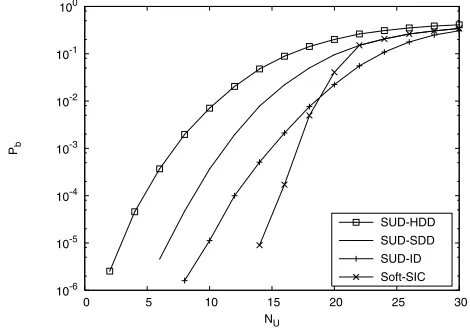
Next, we consider the BER versus the number of users performance of the schemes under consideration in Fig. 3,
where we assume M = 32 L = 7 and Eb/N0 = 15dB.
We observe in Fig. 3 that for a high number of users, the performance of our proposed Soft-SIC scheme is poorer than that of the SUD-ID scheme. However, in the practical range of BERs, the Soft-SIC outperforms the ID scheme. The reason is that the Soft-SIC becomes overwhelmed, when the number of users is high. Thus, at high values of NU, the best values of are those which ensure that all users’ symbols are decoded without subjecting them to the reliability test discussed in Section III. By contrast, the iterative gain recorded in the
context of the SUD-ID is achieved for all values of NU
considered. However, it can be seen from Fig. 3 that at
10-6 10-5 10-4 10-3 10-2 10-1 100
0 10 20 30 40 50
Pb
NU
SUD-HDD
SUD-SDD SUD-ID
[image:5.595.56.292.53.216.2]Soft-SIC
Fig. 4. BER versus number of users performance for SIC and ID schemes employed in soft decoded FFH-MFSK SLC receiver communicating over a Rayleigh fading channel, assumingL= 7,M= 64andEb/N0= 15dB.
highNU values, the BER of all schemes considered becomes excessive to be of any practical use. By contrast, at the BER of 10−5, the Soft-SIC scheme is capable of supporting 50% more users than the SUD-ID scheme and nearly twice as many users as that supported by the SUD-SDD scheme.
In Fig. 4 we depict the BER versus the number of users performance of the schemes under consideration for higher
order of modulation, i.e. for M = 64. All other system
parameters remain the same as in Fig. 3, except that the interleaver’s block length is 60×40 bits. We observe in Fig. 4 that the SUD-ID scheme outperforms the Soft-SIC scheme for a wide range ofNU values, although at BER of10−5, the two schemes support a similar number of users. Comparison of this result to those shown in Fig. 3 demonstrates that the SUD-ID scheme exhibits more substantial performance benefits in the context of increased modulation orders. This observation is in harmony with the results of [13], where it has been shown that the iterative gain attained by the ID scheme increases as M increases. By contrast, the performance of the Soft-SIC scheme is mainly dependent upon its ability to cancel the interference and is hence not affected as substantially by the increased value of M, as that of the SUD-ID scheme.
The results of Fig. 5 characterize the effects of interleaver length (IL) on the BER performance of the schemes under con-sideration. All other parameters remain the same as in Fig. 4. The results of Fig. 5 indicate that the performance of the SUD-ID scheme is more adversely affected by a reduced IL than that of the Soft-SIC scheme. This is understandable, because the iterative gain of an ID scheme is strongly dependent upon the interleaver’s size. Thus, as seen in Fig. 5, when IL=(10
×60) is employed, the performance of the SUD-ID scheme
degrades dramatically, while that of the Soft-SIC scheme is not much poorer compared to that at IL=(120×200). This result indicates another advantage of our proposed scheme. More specifically, since having a high IL implies a longer delay, our Soft-SIC scheme is more suitable for applications requiring low delays.
[image:5.595.54.289.258.422.2]10-6 10-5 10-4 10-3 10-2 10-1 100
0 10 20 30 40 50
Pb
NU SUD-ID, IL=120 X 200
SUD-ID, IL=30 X 40 SUD-ID, IL=10 X 60
Soft-SIC, IL=120 X 200
[image:6.595.325.557.49.220.2]Soft-SIC, IL=30 X 40 Soft-SIC, IL=10 X 60
Fig. 5. BER versus number of users performance for SIC and ID schemes employed in soft decoded FFH-MFSK SLC receiver communicating over a Rayleigh fading channel for various values of interleaver sizes, assumingL= 7,M= 64andEb/N0= 15dB.
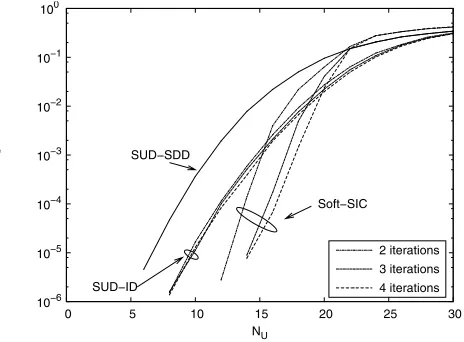
same as in Fig. 3. We observe that for the SUD-ID scheme, there is very little improvement after the second iteration, while our proposed Soft-SIC scheme yields noticeable BER improvements even during the fourth iteration. However, for low values of NU, using an increased number of iterations does not yield further BER improvement.
V. CONCLUSION
We have investigated ID between a FFH-MFSK demodu-lator invoking SLC as well as a SISO binary convolutional decoding and derived the soft information to be passed from the demodulator to the channel decoder, when operating in Rayleigh fading MA channels. We also proposed a novel MUD scheme that invokes SIC in conjunction with SISO decoding. Our results shown in Figs. 2 to 6 demonstrate that the SDD using the derived soft information yields significant performance improvement over HDD, when subjected to MA interference. Furthermore, we have shown that the proposed Soft-SIC scheme is capable of substantially enhancing the achievable performance of the FFH-MFSK receiver. Our Soft-SIC scheme outperforms the conventional SUD-ID scheme at a similar number of iterations, especially forM ≤32, while in conjunction withM >32, the SUD-ID schemes benefits from a more substantial iterative gain. Moreover, the performance of the proposed Soft-SIC scheme is not significantly degraded, when a low IL is employed, rendering it superior to the SUD-ID scheme for low delay applications. The proposed Soft-SIC scheme also yields a higher iterative gain, as the number of iterations is increased, although the iterative gain saturates for both schemes after a certain number of iterations, when the number of users is low. Our future work will investigate the Soft-SIC scheme using a Recursive Systematic Convolutional (RSC) code and EXtrinsic Information Transfer (EXIT) charts. Although we investigated our Soft-SIC scheme using a binary convolutional coding scheme, the algorithm may also be employed in conjunction with other soft decoding schemes, such as non-binary LDPC codes, Reed Solomon (RS) codes or turbo codes. A specific drawback of the proposed scheme is that its achievable performance is dependent upon
10−6 10−5 10−4 10−3 10−2 10−1 100
0 5 10 15 20 25 30
Pb
NU
SUD−SDD
SUD−ID
Soft−SIC
[image:6.595.56.291.53.216.2]2 iterations 3 iterations 4 iterations
Fig. 6. BER versus number of users performance for SIC and ID schemes employed in soft decoded FFH-MFSK SLC receiver communicating over a Rayleigh fading channel for various number of iterations, assumingL= 7,
M= 32andEb/N0= 15dB.
the choice of the reliability test thresholds. In conclusion, for a wide range of parameter values of practical interest, our Soft-SIC scheme proposed in Section III constitutes an attractive design option.
REFERENCES
[1] O. C. Yue, “Maximum likelihood combining for noncoherent and dif-ferentially coherent frequency hopping multiple access systems,”IEEE Transactions on Information Theory, vol. IT-28, pp. 631–639, July 1982. [2] U. C. Fiebig, “Iterative interference cancellation for FFH/MFSK MA systems,” inIEEE Proceedings of International Conference on Commu-nications, pp. 90–95, December 1996.
[3] J. G. Proakis,Digital communications. Singapore: Mcgraw-Hill, 2001. [4] L. Hanzo, L.-L. Yang, E.-L. Kuan, and K. Yen,Single- and Multi-Carrier DS-CDMA: Multi-User Detection, Space-Time Spreading, Synchroni-sation, Networking and Standards. New York: John Wiley and sons, England, 2003.
[5] J. Hagenauer, “Forward error correcting for CDMA systems,” inIEEE 4th International Symposium on Spread Spectrum Techniques and Ap-plications Proceedings, 1996, vol. 2, pp. 566 – 569, September 2001. [6] H. V. Poor, “Iterative multiuser detection,” IEEE Signal Processing
Magazine, vol. 21, pp. 81 – 88, January 2004.
[7] Y. T. Su and R. C. Chang, “Performance of fast FH/MFSK Signals in jammed binary channels,” IEEE Transactions on Communications, vol. 42, pp. 2414 – 2422, July 1994.
[8] B. M. Peric, M. R. Souryal, E. Larsson, and B. R. Vojcic, “Soft Decision Metrics for Turbo-coded FH M-FSK Ad Hoc Packet Radio Networks,” in IEEE 61st Vehicular Technology Conference, Spring 2005, vol. 2, pp. 724 – 727, May-June 2005.
[9] N. Sharma and E. Geraniotis, “Soft multiuser demodulation and iterative decoding for FH/SSMA with a block turbo code,”IEEE Transactions on Communications, vol. 51, pp. 1561 – 1570, September 2003. [10] U. C. Fiebig, “Soft-decision and erasure decoding in fast
frequency-hopping systems with convolutional, turbo, and Reed-Solomon codes,”
IEEE Transactions on Communications, vol. 47, pp. 1646 – 1654, November 1999.
[11] D. Park and B. G. Lee, “Iterative decoding in convolutionally and turbo coded MFSK/FH-SSMA systems,” inIEEE International Conference on Communications, ICC 2001, vol. 9, pp. 2784 – 2788, June 2001. [12] P. C. P. Liang and W. E. Stark, “Algorithm for joint decoding of
turbo codes and M-ary orthogonal modulation,” inIEEE International Symposium on Information Theory, 2000, p. 191, June 2000.
[13] M. C. Valenti, E. Hueffmeier, B. Bogusch, and J. Fryer, “Towards the capacity of noncoherent orthogonal modulation: BICM-ID for turbo coded NFSK,” inIEEE Conference on Military Communications, 2004. MILCOM 2004, vol. 3, pp. 1549 – 1555, October-November 2004. [14] L. Hanzo, T. H. Liew, and B. L. Yeap,Turbo Coding, Turbo