Biosensors and Bioelectronics 21 (2006) 2015–2045
Review
Biofuel cells and their development
R.A. Bullen
a, T.C. Arnot
b, J.B. Lakeman
c, F.C. Walsh
a,∗aEngineering Chemistry Group, School of Engineering Sciences, University of Southampton, Highfield, Southampton SO17 1BJ, United Kingdom bDepartment of Chemical Engineering, University of Bath, Claverton Down, Bath BA2 7AY, United Kingdom
cPower Sources and Energy Storage Team, Physical Sciences Department, Dstl, Porton Down, Salisbury, Wiltshire SP4 0QR, United Kingdom
Received 20 October 2005; received in revised form 26 January 2006; accepted 26 January 2006
Abstract
This review considers the literature published since 1994 on microbial and enzymatic biofuel cells. Types of biofuel cell are classified according to the nature of the electrode reaction and the nature of the biochemical reactions. The performance of fuel cells is critically reviewed and a variety of possible applications is considered. The current direction of development of biofuel cells is carefully analysed. While considerable chemical development of enzyme electrodes has occurred, relatively little progress has been made towards the engineering development biofuel cells. The limit of performance of biofuel cells is highlighted and suggestions for future research directions are provided.
© 2006 Elsevier B.V. All rights reserved.
Keywords: Biofuel cell; Enzymatic fuel cell; Microbial fuel cell; Enzyme electrode
Contents
1. Introduction . . . 2016
1.1. Applications of biofuel cells . . . 2017
1.2. Key performance characteristics . . . 2018
1.3. Definitions and classifications of biofuel cells . . . 2018
1.3.1. Classification of electrochemical devices according to fuel containment . . . 2019
1.3.2. Fuel and catalysis sources . . . 2020
1.3.3. Origin of enzymes for biologically catalysed devices . . . 2020
1.3.4. Method of electron transfer between reaction site and electrode . . . 2020
2. Bioelectrochemical cells involving a whole organism . . . 2021
2.1. Whole organism product biofuel cells . . . 2021
2.2. Whole organism diffusive MET biofuel cells . . . 2025
2.3. Whole organism non-diffusive biofuel cells . . . 2028
2.4. Photomicrobial fuel cells . . . 2031
3. Fuel cells utilising a purified enzyme . . . 2031
3.1. Enzymatic product type systems . . . 2031
3.2. Enzyme electrodes: the common challenges in DET and MET enzymatic biofuel cells . . . 2036
3.3. Diffusive MET enzymatic electrodes . . . 2037
3.4. Non-diffusive enzyme electrodes . . . 2038
4. Conclusions . . . 2041
4.1. Review of progress . . . 2041
4.2. A forward look . . . 2041
Acknowledgements . . . 2043
References . . . 2043
∗Corresponding author. Tel.: +44 2380 598 752; fax: +44 2380 598 754. E-mail address:[email protected](F.C. Walsh).
2016 R.A. Bullen et al. / Biosensors and Bioelectronics 21 (2006) 2015–2045
Nomenclature
A geometric area of electrode (cm2)
Ae area of electrode per unit volume (cm2cm−3)
ci concentration of speciesi(mol dm−3)
E electrode potential versus a reference electrode (V)
Ecell cell potential (V)
Ee equilibrium potential (V)
F Faraday constant (C mol−1)
I current (A)
j current density (A cm−2)
k rate constant for a chemical reaction (first order s−1, etc.)
kmax maximum rate constant for an enzyme reaction (first order s−1, etc.)
Km Michaelis–Menten constant (mol)
m mass (g or kg)
Pcell power output of cell (W)
R molar gas constant (J K−1mol−1)
Re resistance ()
t time (s)
T temperature (K)
Ve electrode volume (cm3)
z number of electrons involved in electrode reactions
Greek symbol
η overpotential, =E−Ee(V)
Subscripts
A anode
C cathode
O oxidised species R reduced species
1. Introduction
Biological fuel cells (biofuel cells) have been defined as fuel cells that rely on enzymatic catalysis for at least part of their activity (Palmore and Whitesides, 1994). A broader definition would consider biofuel cells as those fuel cells which use biocat-alysts, which includes systems utilising non-enzyme proteins as well. In the broadest sense, we would define biological fuel cells
are devices capable of directly transforming chemical to electri-cal energy via electrochemielectri-cal reactions involving biochemielectri-cal pathways.
The connection between biology and electricity has been known since the experiments of Galvani in the 1780s (Galvani, 1791), when it was discovered that current from a static elec-tricity generator could cause a severed frog’s leg to twitch, revolutionising the understanding of the nervous system. The fuel cell has been known for almost as long, since Grove success-fully reversed the action of the electrolysis of water, recombining hydrogen and oxygen to produce water and electrical current (Grove, 1839). Given the early nature of these two discoveries it is perhaps surprising that a half cell using microorganisms was not demonstrated until 1910, when M.C. Potter, a professor of Botany at the University of Durham observed electricity pro-duction byE. coli(Potter, 1910). These results were not widely reported until the experiments of Cohen in 1931 who demon-strated a voltage greater than 35 V from microbial fuel cells connected in electrical series (Cohen, 1931).
The expansion of interest in fuel cells triggered by the USA space program, in the late 1950s and early 1960s, led to the development of microbial biofuel cells as a possible technology for a waste disposal system for space flights that would also generate power. Also in the late 1960s, the biofuel cell using cell-free enzyme systems began to be used, with the early goal of a power supply for a permanently implantable artificial heart (Kreysa et al., 1990; Wingard et al., 1982) and references within). In a fuel cell, an oxidation reaction occurs at the anode and a reduction reaction at the cathode. The oxidation releases elec-trons, which travel to the cathode via the external circuit doing electrical work. The circuit is completed by the movement of a compensating charge through the electrolyte often in the form of positive ions.
Conventionally, fuel cells operate using relatively simple inorganic chemistries, taking such fuels as hydrogen or methanol (MeOH), and producing energy, water and carbon dioxide (in the case of methanol). Other fuels, such as other lower order alco-hols and alkanes, are also used, but they are frequently reformed to produce hydrogen before the fuel cell process (Mitsos et al., 2004; Vielstich et al., 2003).
Conventional fuel cells are regarded as ’low temperature’ if they operate in the region of 80◦C and typically require expen-sive p-group catalysts (Larminie and Dicks, 2000). A summary of the main types of inorganic fuel cell is presented inTable 1.
[image:2.842.31.553.659.742.2]Biofuel cells use enzymes as catalysts (alone or within an organism) and tend operate under mild conditions (20–40◦C,
Table 1
Inorganic fuel cell properties (afterLarminie and Dicks, 2000)
Type of fuel cell Mobile ion Operating temperature (◦C) Application
Alkaline (AFC) OH− 50–200 Used in NASA space vehicles, e.g. Apollo, shuttle
Proton exchange membrane (PEMFC) H+ 50–100 Especially suitable for vehicles and mobile applications but also for low
power CHP systems
Phosphoric acid (PAFC) H+ ≈220 Large numbers of 200 kW CHP systems in use
Molten carbonate (MCFC) CO32− ≈650 Suitable for medium to large scale CHP systems up to MW capacity
R.A. Bullen et al. / Biosensors and Bioelectronics 21 (2006) 2015–2045 2017
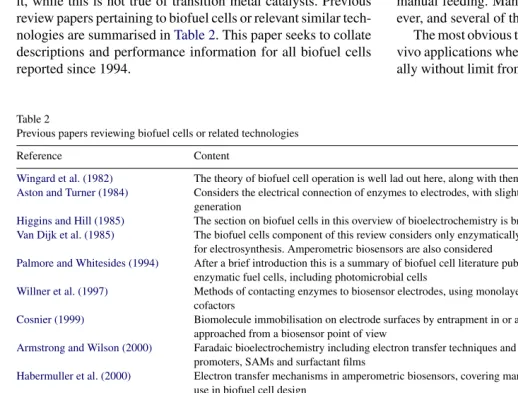
near-neutral pH). These properties make biofuel cells an attrac-tive development prospect for use in applications where gen-erating high temperatures is difficult, or where harsh reaction conditions are undesirable. Biofuel cells are not, in theory at least, limited to these mild conditions as extremophile organ-isms or enzymes derived from them should be able to operate under a wide variety of reaction conditions. Also the variety of reactions able to be catalysed by enzymes makes the use of a much wider range of fuel substances possible (in some systems, up to the use of molecules as large as soluble starches). Bio-catalysts, either protein, enzyme or whole organism, can also offer cost advantages over metallic catalysts, although this is not likely to be the case until the consumption of the enzyme is sufficient to merit large scale production. Widespread usage of a biocatalyst would however tend to lower the cost of producing it, while this is not true of transition metal catalysts. Previous review papers pertaining to biofuel cells or relevant similar tech-nologies are summarised inTable 2. This paper seeks to collate descriptions and performance information for all biofuel cells reported since 1994.
1.1. Applications of biofuel cells
[image:3.842.44.563.352.745.2]Presently there are two practically applied systems; a test rig operating on starch plant wastewater (microbial fuel cell sys-tem), which has been operating for at least 5 years has been demonstrated as a bioremediation method (Gil et al., 2003) and as a biological oxygen demand (BOD) sensor (Kim et al., 2003a), and also a biofuel cell has been employed as the stom-ach of a mobile robotic platform ‘Gastronome’, designed as the precursor to autonomous robots that can scavenge their fuel from their surroundings (gastrobots). The original Gastronome ‘eats’ sugar cubes fed to it manually (Wilkinson, 2000), but other groups have refined the concept somewhat to produce predators consuming slugs (Kelly and Melhuish, 2001), or flies (Ieropolous et al., 2004), although so far they both still require manual feeding. Many applications have been suggested how-ever, and several of these are in varying stages of development. The most obvious target for biofuel cells research is still for in vivo applications where the fuel used could be withdrawn virtu-ally without limit from the flow of blood to provide a long-term
Table 2
Previous papers reviewing biofuel cells or related technologies
Reference Content
Wingard et al. (1982) The theory of biofuel cell operation is well lad out here, along with then-recent and proposed research
Aston and Turner (1984) Considers the electrical connection of enzymes to electrodes, with slightly more focus on biosensors than on power generation
Higgins and Hill (1985) The section on biofuel cells in this overview of bioelectrochemistry is brief but clear and remarkably prescient
Van Dijk et al. (1985) The biofuel cells component of this review considers only enzymatically catalysed biofuel cells, and mainly considers them for electrosynthesis. Amperometric biosensors are also considered
Palmore and Whitesides (1994) After a brief introduction this is a summary of biofuel cell literature published between 1985 and 1992 on microbial and enzymatic fuel cells, including photomicrobial cells
Willner et al. (1997) Methods of contacting enzymes to biosensor electrodes, using monolayers, multilayers, reconstituted enzymes, and tethered cofactors
Cosnier (1999) Biomolecule immobilisation on electrode surfaces by entrapment in or attachment to electropolymerised films. Mainly approached from a biosensor point of view
Armstrong and Wilson (2000) Faradaic bioelectrochemistry including electron transfer techniques and kinetics at the protein-electrode interface, including promoters, SAMs and surfactant films
Habermuller et al. (2000) Electron transfer mechanisms in amperometric biosensors, covering many electron transfer pathways that are potentially of use in biofuel cell design
Kano and Ikeda (2000) Fundamentals and practices of mediated bioelectrocatalysis. A review of bioelectrochemical kinetics and thermodynamics
Ikeda and Kano (2001) A electrochemical approach to investigating biological reactions. Methods of using electrochemical means to probe biological reactions in oxidoreductase and whole cell systems are presented; applications to biosensors, bioreactors and biofuel cells are briefly discussed
Ikeda and Kano (2003) The applications of quinoprotein enzymes in bioelectrochemistry on their own and when operating as a part of the cell in whole organism systems for bioelectrocatalysis and biosensor applications. Some theoretical treatment of mediated bioelectrocatalysis is included
Kano and Ikeda (2003) An update of the themes of the previous (2001) paper and describing an ambient temperature, neutral pH biofuel cell
Katz et al. (2003) The current ‘standard text’ on the subject covering both microbial and enzymatic biofuel cell systems, updated slightly from an older online review. The content in parts focuses strongly on the authors’ own specialisms, slightly at the expense of other approaches
Wong and Schwaneberg (2003) Applications of protein engineering to bioelectrocatalysis, with particular reference to rational design and directed evolution processes
Calabrese Barton et al. (2004) A very clear summary of the state of research into enzyme based biofuel cells for implantable and microscale devices
Heller (2004) A summary of the rationale behind the design and the projected capabilities of the two fibre glucose/O2biofuel cell concept
for powering implantable biosensors
Mitsos et al. (2004) An overview of competing non-biological approaches to using fuel cells for micropower generation comparing a variety of fuels
Palmore (2004) Comments on a recently described (Chaudhuri and Lovley, 2003) microbial biofuel cell, and the implications of its high performance
2018 R.A. Bullen et al. / Biosensors and Bioelectronics 21 (2006) 2015–2045
or even permanent power supply for such devices as pacemak-ers, glucose sensors for diabetics or small valves for bladder control. The early goal of powering an artificial heart has been abandoned as the difficulty of realising a functioning implant has become more apparent. Once small systems are in place and functioning, this challenge may well be revisited. A biofuel cell capable of operation implanted in a grape (Mano et al., 2003a) shows that progress is being made in this. The challenge of bio-catalysis over a suitably long period is particularly problematic in these areas, where surgical intervention could be required to change over to a new cell and ethical constraints are paramount. Ex vivo proposed applications are diverse. The large scale is represented by proposed power recovery from waste streams with simultaneous remediation by bioelectrochemical means, or purely for power generation in remote areas, the medium scale by power generating systems for specialist applications such as the gastrobot above, and perhaps of greatest potential the small scale power generation to replace battery packs for consumer electronic goods such as laptop computers or mobile telephones. The larger scale applications tend to be organism based and the smaller scale ones more likely to be enzymatic. In the case of enzymatic fuel cells, at least, the major barrier to any successful application is component lifetime, particularly in view of the limited enzyme lifetime and problems of electrode fouling/poisoning.
1.2. Key performance characteristics
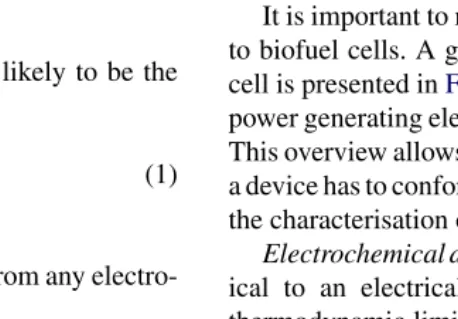
For any fuel cell the power output,Pcell is likely to be the bottom line determining its value.
Pcell=Ecell
Idt (1)
Or, if the current is constantPcell=EcellI.
The overall cell voltage that can be derived from any electro-chemical system is given by:
Ecell=EC−EA−
IR
e (2)
ECandEAare experimental potentials of the cathode and anode, respectively. These electrode potentials can be related to the equilibrium potential for the couple by:
η=E−Ee (3)
The equilibrium potential is in turn related to the formal potential E0e for the couple (the potential when the reduction and oxidation potentials are equal) by:
Ee=Ee0+
RT
zFln
c O
cR
(4)
To obtain an optimal voltage from a cell it is desirable to max-imise the driving force (EC−EA) and to minimise the ohmic resistance losses, IR. The latter can be achieved through appropriate cell design considerations such as minimising the inter-electrode gap or operating at low current density. Low cur-rent density operation is, however, counter to the generation of a high power density.
For a fuel cell to be viable, its total energy budget (power out-put from the cell minus power consumed by pumping, stirring, sparging and any other ‘utilities’) must be positive. The utility costs must be minimised by appropriate chemical or physical design or economies of scale, or may be eliminated altogether in some situations (a conventional battery has no pumping costs, relying purely on diffusion, an implanted biofuel cell in vivo could rely on the heart to perform the pumping duty, etc.).
As one of the target applications for biofuel cells is portable power (particularly for enzymatic cells) consideration must be given to the size of a proposed device. For the fuel cell itself
Power density= Pcell
A (6)
and
Volumetric power= Pcell
Ve =
Ae
APcell (7)
For a complete fuel cell system it is also necessary to con-sider the fuel as adding volume and, for man-portable systems especially, weight. Another useful metric to consider is:
Specific power= Pcell
mcell,fuel(s),utilities
(8)
1.3. Definitions and classifications of biofuel cells
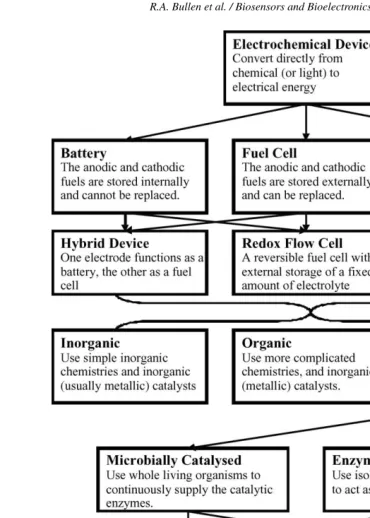
It is important to review the fundamental definitions relevant to biofuel cells. A generalised schematic of a biofuel cell half cell is presented inFig. 1, and an overview of different types of power generating electrochemical devices is presented inFig. 2. This overview allows us to consider the different definitions that a device has to conform to in order to be a biofuel cell, and allows the characterisation of different biofuel cell-like devices.
[image:4.842.313.542.538.697.2]Electrochemical devicesconvert energy directly from a chem-ical to an electrchem-ical form. This allows them to bypass the thermodynamic limitations of combustion based power cycles. Furthermore, in an electrochemical system, the rate of energy production can be finely controlled through an external circuit.
R.A. Bullen et al. / Biosensors and Bioelectronics 21 (2006) 2015–2045 2019
Fig. 2. A classification of biofuel cells.
1.3.1. Classification of electrochemical devices according to fuel containment
Abatteryis an electrochemical device that allows a reaction to occur at an anode and a cathode, the fuel being contained internally by the battery housing (Gileadi, 1993).
A fuel cell is a similar device in which fuel is sup-plied from outside the housing and wastes resulting from a spent fuel are removed. It is not a requirement that the fuel is added continuously, merely that it is stored and supplied from outside the reaction chambers (Gileadi, 1993).
2020 R.A. Bullen et al. / Biosensors and Bioelectronics 21 (2006) 2015–2045
generate current. As the charged chemical is stored outside the main body of the electrochemical cell this can be considered as resembling a fuel cell but it cannot truly be fuelled indefinitely (Divisek and Emonts, 2003).
1.3.2. Fuel and catalysis sources
Any type of electrochemical device will require both a fuel and a catalyst, and by considering these, further definitions can be arrived at:
Inorganic devices utilise inorganic chemistries and usually employ metals as catalysts (Palmore and Whitesides, 1994), for example the classic Pt-catalysed H2/O2 fuel cell (E0cell=
1.23V),
H2 Pt/anode
−→ 2H++4e− (9)
1
2O2+2H++4e−
Pt/cathode
−→ H2O (10)
or an Al/Air hybrid battery.
Organically fuelled devices operate using more complex chemicals as fuel sources, but still rely on inorganic catalysts to achieve the reactions as in, for example, the direct methanol fuel cell (DMFC) (E0cell =1.20V).
CH3OH+H2O
inorganic anode
−→ CO2+6H++6e− (11) 3
2O2+6H++6e−
inorganic cathode
−→ 3H2O (12)
Biologically catalysed devices (usually also organically fuelled) utilise biological molecules as catalysts for achieving their redox reactions (in at least one half cell), either as purified enzymes (or enzyme derivatives) to catalyse a specific reaction, or through the use of whole organisms (Palmore and Whitesides, 1994). For methanol oxidation(11)a nicotinamide adenine dinucleotide (NAD) mediated sequence of reactions is (Palmore et al., 1998):
CH3OH+2NAD+
alcohol dehydrogenase
−→ CH2O+2NADH (13)
CH2O+H2O+2NAD+
aldehyde dehydrogenase
−→ HCOOH
+2NADH (14)
HCOOH+2NAD+formate dehydrogenase−→ CO2+2NADH (15)
3NADH+6Mediatorred diaphorase
−→ 3NAD++6Mediatorox (16)
6Mediatorox anode
−→6Mediatorred+6e− (17)
In practice, working cell voltages tend to be0.5 V due to kinetic restrictions.
This latter category combined with the various types of elec-trochemical device allows for the definition of the biological battery (biobattery) and biological fuel cell (biofuel cell). A bio-redox flow cell has not yet been demonstrated, nor has any suitable chemistry for such a device been proposed.
1.3.3. Origin of enzymes for biologically catalysed devices
Biologically catalysed devices can be divided according to the source of the biocatalysts (usually enzymes) used to perform the catalysis.
Microbially catalysedsystems use whole living organisms as the source of complete enzyme pathways. These are gen-erally robust systems that can operate on variable feedstocks and are resistant to poisoning due to being living systems, and are usually capable of oxidising the substrate completely to carbon dioxide and water. For example direct electrochemical communication ofShewanella putrefacienswith an anode via membrane cytochromes (Kim et al., 2002a).
Lactatemicrobial metabolism−→ wastes+(membrane cytochrome)− (18)
(membrane cytochrome)−anode−→(membrane cytochrome)+e− (19)
Enzymatically catalysed systems use isolated and purified enzyme proteins to perform specific reaction catalysis (reac-tions(13)–(17)). This generally gives a better defined system and several enzymes can be combined to completely oxidise the substrate, although structuring the enzymes so that the different reactions can occur in the right order is problematic. In some cases protein units smaller than complete enzymes can be used as catalysts, but these cases can be treated as enzymes for fuel cell purposes.
1.3.4. Method of electron transfer between reaction site and electrode
Electrons can transfer between the reaction site and the elec-trode through the diffusion of a secondary fuel, via a mediator molecule that repeatedly cycles or via a direct electron transfer (DET) between the reaction site and the electrode.
There has been some variation in the literature on how to define these types of systems.Aston and Turner (1984)define a system in which a secondary fuel for the electrode is generated by the biological reaction as indirect biofuel cells, with cases involving electron-shuttling reversible mediators or direct elec-tron transfer between the biological component and the electrode being direct biofuel cells. However Palmore and Whitesides (1994)define indirect biofuel cells as any that include a dif-fusive component, hence according to their definition a sys-tem involving diffusing reversible mediators is indirect, but one involving non-diffusing mediators is direct.Higgins and Hill (1985) defined three categories; product type (organisms or enzymes convert electrochemically inactive species to elec-trochemically active species), regenerative type (organisms or enzymes regenerate redox compounds which in turn carry out the electrochemical reaction) or depolariser type (organisms or enzymes act as catalysts of the electrochemical reactions at the electrode, or themselves diffuse to the electrode and transfer electrons directly). These definitions, while internally consis-tent and comprehensive are unsatisfactory, particularly the use of the word ‘depolariser’ which is misleading in the context of electrochemistry.
R.A. Bullen et al. / Biosensors and Bioelectronics 21 (2006) 2015–2045 2021
encompassing all forms of regenerative mediation whether dif-fusive or non-difdif-fusive (Calabrese Barton et al., 2004). Product type operation was not covered.
This paper will also consider DET in the case using whole microorganisms where electrons transfer directly between the surface of a microorganism and an electrode. MET will similarly be used to describe microbiological fuel cells where a mediator molecule is used as an electron relay.
2. Bioelectrochemical cells involving a whole organism
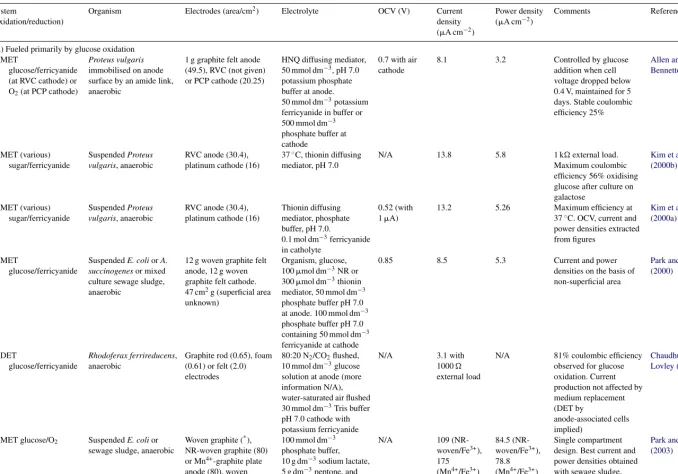
The use of whole organisms as a biofuel cell system allow multiple enzymes and hence multiple substrates (or mixed sub-strates) to be used, with the organisms contained in the fuel cell system acting as micro-reactors providing appropriate con-ditions for each enzyme to act optimally. Recent examples of biofuel cells making use of whole organisms as catalysts are tabulated inTable 3.
Evolution has produced highly efficient electron control sys-tems within living organisms. This informs a search for a medi-ating system that can either transport readily across the cell membrane in both directions, exchanging electrons with the metabolic system inside the cell and the electrode outside it, or that can contact the membrane and collect electrons with-out penetrating the cell. The former approach tends to lead to indirect electron transfer systems with freely diffusing mediator molecules (diffusive MET), and the latter to indirect transfer sys-tems with the mediator incorporated into the electrode or the cell membrane (non-diffusive MET). In MET cases, it is desirable for a mediator to have a reaction potential as close to that of the biological component to minimise potential losses. (The overall cell potential is determined by the terminal electron transfer to or from the electrode.)
In some organisms, DET can be achieved through the exis-tence of electron transferring capacity within the cell membrane (Kim et al., 1999; Kim et al., 2002a), occurring either naturally or through genetic engineering.
The third mode of operation, product type, relies on the microbial metabolism releasing a secondary fuel product that then diffuses to the electrode and is oxidised or reduced (as appropriate) to form a final waste product, which is discharged. In practice, product operation has many similarities to conven-tional fermentation processes, with the fermentation product being the fuel used at the electrode. Indeed, product systems could be separated into two entirely separate processes with the products of the microbial reaction being stored and fed to a fuel cell process as the fuel. Such systems are not biofuel cell systems, but the distinction is not as certain when the vessels are directly connected.
2.1. Whole organism product biofuel cells
Product systems producing hydrogen gas were recently reviewed byDas and Veziroglu (2001). In general they are non-electrochemical processes, consisting of the photosynthetic or fermentative generation of hydrogen in a vessel entirely separate from that containing the electrolytic fuel cell system. Maness
and Weaver achieved the water-gas shift reaction(20) produc-ing H2and CO2from CO and H2O using photosynthetic bacteria Rhodocyclus gelatinosusandRhodospirillum rubrum.
CO+H2O bacteria
←→H2+CO2 (20)
In particular they were able to use bacterial strains that would incorporate CO into their cell mass, leaving almost pure hydro-gen (0.1 ppm CO at equilibrium) which could be fed directly to an (inorganic) fuel cell (Maness and Weaver, 1994) and isolate an oxygen tolerant, CO-linked terminal hydrogenase enzyme (Maness and Weaver, 1999) which may lead to the genetic engi-neering of a cyanobacterium capable of producing hydrogen from water in photosynthetic conditions (Fig. 3A).
Other fuels can also be produced by product processes; by definition biofuels are obtained from the manipulation of organic processes. Microbial product processes to generate a fuel from waste products have been developed such as methane mass pro-duction from food wastes (Kim et al., 2002b). These systems are essentially not biofuel cells, although the overall process when such a system is connected to an appropriate fuel cell system
Fig. 3. Schematic illustrating product type systems. (A) External fermenter feed-ing hydrogen to H2/O2inorganic fuel cell (afterManess and Weaver, 1994). (B)
[image:7.842.323.548.328.693.2]2022 R.A. Bullen et al. / Biosensor s and Bioelectr onics 21 (2006) 2015–2045 Table 3
Summary of microbial bioelectrochemical devices
System
(oxidation/reduction)
Organism Electrodes (area/cm2) Electrolyte OCV (V) Current
density (A cm−2)
Power density (A cm−2)
Comments Reference
(A) Fueled primarily by glucose oxidation MET
glucose/ferricyanide (at RVC cathode) or O2(at PCP cathode)
Proteus vulgaris immobilised on anode surface by an amide link, anaerobic
1 g graphite felt anode (49.5), RVC (not given) or PCP cathode (20.25)
HNQ diffusing mediator, 50 mmol dm−3, pH 7.0
potassium phosphate buffer at anode. 50 mmol dm−3potassium
ferricyanide in buffer or 500 mmol dm−3
phosphate buffer at cathode
0.7 with air cathode
8.1 3.2 Controlled by glucose
addition when cell voltage dropped below 0.4 V, maintained for 5 days. Stable coulombic efficiency 25% Allen and Bennetto (1993) MET (various) sugar/ferricyanide SuspendedProteus vulgaris, anaerobic
RVC anode (30.4), platinum cathode (16)
37◦C, thionin diffusing mediator, pH 7.0
N/A 13.8 5.8 1 kexternal load.
Maximum coulombic efficiency 56% oxidising glucose after culture on galactose
Kim et al. (2000b)
MET (various) sugar/ferricyanide
SuspendedProteus vulgaris, anaerobic
RVC anode (30.4), platinum cathode (16)
Thionin diffusing mediator, phosphate buffer, pH 7.0.
0.1 mol dm−3ferricyanide
in catholyte
0.52 (with 1A)
13.2 5.26 Maximum efficiency at
37◦C. OCV, current and power densities extracted from figures
Kim et al. (2000a)
MET
glucose/ferricyanide
SuspendedE. coliorA. succinogenesor mixed culture sewage sludge, anaerobic
12 g woven graphite felt anode, 12 g woven graphite felt cathode. 47 cm2g (superficial area
unknown)
Organism, glucose, 100mol dm−3NR or
300mol dm−3thionin
mediator, 50 mmol dm−3
phosphate buffer pH 7.0 at anode. 100 mmol dm−3
phosphate buffer pH 7.0 containing 50 mmol dm−3
ferricyanide at cathode
0.85 8.5 5.3 Current and power
densities on the basis of non-superficial area
Park and Zeikus (2000)
DET
glucose/ferricyanide
Rhodoferax ferrireducens, anaerobic
Graphite rod (0.65), foam (0.61) or felt (2.0) electrodes
80:20 N2/CO2flushed,
10 mmol dm−3glucose solution at anode (more information N/A), water-saturated air flushed 30 mmol dm−3Tris buffer
pH 7.0 cathode with potassium ferricyanide
N/A 3.1 with
1000
external load
N/A 81% coulombic efficiency
observed for glucose oxidation. Current production not affected by medium replacement (DET by anode-associated cells implied) Chaudhuri and Lovley (2003)
MET glucose/O2 SuspendedE. colior
sewage sludge, anaerobic
Woven graphite (*),
NR-woven graphite (80) or Mn4+-graphite plate
anode (80), woven graphite (*) or
Fe3+-graphite plate (80)
cathode
100 mmol dm−3
phosphate buffer, 10 g dm−3sodium lactate,
5 g dm−3peptone, and
5 g dm−3yeast extract.
pH 7.0
N/A 109
(NR-woven/Fe3+),
175 (Mn4+/Fe3+)
84.5 (NR-woven/Fe3+),
78.8 (Mn4+/Fe3+)
Single compartment design. Best current and power densities obtained with sewage sludge.
*Woven graphite anodes
are 1.27 m2
non-superficial area
R.A. Bullen et al. / Biosensor s and Bioelectr onics 21 (2006) 2015–2045 2023
MET and DET glucose/oxygen
Mixed culture derived from anaerobic methanogenic sludge, some experiments with purified isolates, anaerobic
Graphite plate electrodes (50)
‘Oxoid’ nutrient broth at anode
0.5–5 g dm−3day−1
glucose, nitrogen purged, 100 mmol dm−3
phosphate buffer, 100 mmol dm−3
potassium hexacyanoferrate, continuous aeration at cathode
N/A N/A 360 Four cells to a block,
two blocks operated in parallel
Rabaey et al. (2003)
DET
glucose/ferricyanide
SuspendedE. coli, anaerobic
Woven graphite cloth (7.5) platinised and polyaniline modified as anode, unmodified woven graphite cloth cathode (7.5)
10 g dm−3glucose,
5 g dm−3yeast extract,
10 g dm−3NaHCO 3and
8.5 g dm−3NaH2PO4at
anode, 50 mmol dm−3 ferricyanide solution, 10 g dm−3NaHCO3and
8.5 g dm−3NaH 2PO4at
cathode
0.895 2600 1200 5 s oxidative pulses
every 1000 s can be used to regenerate the anode. Current and power are ‘steady state’ values but the stabilisation time is not defined
Schroder et al. (2003)
Product biofuel cell using starch, glucose or molasses to generate H2/ferricyanide
Clostridium butyricumor Clostridium beijerinckii
Woven graphite cloth (7.5) platinised and poly(tetrafluoroaniline) modified as anode, unmodified woven graphite cathode (7.5)
10 g dm−3substrate,
5 g dm−3yeast extract,
10 g dm−3peptone,
0.5 g dm−3 l-cysteine–HCl, 8 mg dm−3CaCl
2,
8 mg dm−3MgSO 4,
40 mg dm−3KHSO 4,
80 mg dm−3NaCl,
0.4 g dm−3NaHCO 3and
1 mg dm−3resazurine,
nitrogen purged at anode. 50 mmol dm−3
ferricyanide solution in phosphate buffer pH 7.0 at cathode
0.759 5070 (steady
state) or 16,000 (peak value) 4000 (at 0.473 V) Steady state stabilisation time not defined
Niessen et al. (2004)
MET and DET glucose/ferricyanide
Mixed culture from anaerobic methanogenic sludge, some experiments with purified isolates, anaerobic
Graphite plate electrodes (50)
Anolyte ‘nutrient broth’ with glucose fed at 1 g dm−3day−1.
Catholyte 50 mmol dm−3
potassium ferricyanide solution in
100 mmol dm−3potassium/sodium
phosphate buffer pH 7.0
N/A N/A 431
(maximum, at 0.66 V)
A long-term study over several months, with many
investigations into the bacterial and electrochemical cell behaviour
Rabaey et al. (2004)
(B) Primarily using other fuels MET lactate and
pyruvate/–
Desulphovibrio
desulphuricans, anaerobic
Activated charcoal anode Sulphate/sulphide mediator, pH 7.8
N/A 1980 N/A Lactate gives a higher
specific current density but pyruvate used 40% less sulphate
2024 R.A. Bullen et al. / Biosensor s and Bioelectr onics 21 (2006) 2015–2045
Table 3 (continued)
System
(oxidation/reduction)
Organism Electrodes (area/cm2) Electrolyte OCV (V) Current
density (A cm−2)
Power density (A cm−2)
Comments Reference
DET lactate (also pyruvate and for-mate)/ferricyanide
SuspendedShewanella putrefaciens, anaerobic
Carbon felt anode (9.3), RVC cathode (21.6)
0.05 mol dm−3phosphate
buffer containing 0.1 mol dm−3NaCl, pH
7.0. Anode also contains FeOOH
N/A 0.645 N/A 500external resistance.
Biosensor, rate of current increase approximately proportional to lactate concentration
Kim et al. (1999)
MET acetate/O2 SuspendedE. coli,
anaerobic
NR-modified graphite plate anode (118), graphite plate cathode (118)
80 mmol dm−3acetate,
1 g dm−3of each of
KH2PO4, yeast extract,
peptone, NH4Cl and
CaCl2, 2 g dm−3NaCl at
anode. 1 mol dm−3KCl at cathode
N/A 3.1 1.14 Current and power
densities with native (i.e. no NR) anode were 1.41A cm−1and
0.239W cm−2,
respectively
Park et al. (2000)
MET H2/MET O2 Suspended
Desulphovibrio vulgaris, hydrogen saturated (anode)/0.1mol dm−3
BOx solution, oxygen-saturated (cathode)
Carbon felt mat (5.1) (both)
50 mmol dm−3phosphate buffer pH 7.0, ionic strength made to 0.1 with KCl. 0.5 mmol dm−3MV
or 0.25 mmol dm−3
anthroquinone 2-sulphonate (AQS) mediator at anode, 0.25 mmol dm−3ABTS
mediator at cathode
1.17 176 (with MV) 176 (with MV) Complete biofuel cell. Current values limited by BOx concentration
Tsujimura et al. (2001a)
DET lactate/O2 SuspendedShewanella
putrefaciens(various strains) andE. coli (MET), anaerobic
Graphite felt (56) (both) 50 mmol dm−3
Na-phosphate buffer pH 7.0, 0.1 mol dm−3NaCl.
For some experiments withE. colianode also contains 25 mmol dm−3
methylene blue
0.5 (0.52 with E.
coli+ mediator) 0.71 (stabilised at 0.43 after 6 days)
0.02 (0.01 stabilised after 6 days)
Current decrease is after sequential batch operation and may be due to nutrient limitation or dead cell contamination
Kim et al. (2002a)
DET/MET marine sediment con-stituents/seawater constituents
Mixed natural bacteria Drilled graphite discs (1830) (each)
Seawater. Anode 15 cm below sediment surface, cathode 15 cm above sediment surface
0.75 7 3.2* Complete biofuel cell.
Single compartment design. Electrode area is footprint of disc.
*Another site gave 2.66
reducing to 2.54W cm−2over 6
months
Tender et al. (2002)
MET lactate (also pyruvate, acetate and glucose)/O2
SuspendedShewanella putrefaciens, anaerobic
Woven graphite (*),
NR-woven graphite (*) or
Mn4+graphite plate (80)
anode, Fe3+modified
graphite plate cathode (50)
100 or 200 mmol dm−3
lactate, 100 mmol dm−3
phosphate buffer, 1 g dm−3of each of yeast
extract, peptone and NH4Cl. pH 7.0
0.6 (with Mn4+-graphite
anode)
3.75 (with Mn4+-graphite
anode, after 60 h incubation, 1 kexternal resistance)
0.94 (with Mn4+-graphite
anode, after 60 h incubation, 1 k( external resistance)
Single compartment design.*Woven graphite
anodes are 1.27 m2
non-superficial area
Park and Zeikus (2002)
[image:10.842.54.741.49.531.2]R.A. Bullen et al. / Biosensors and Bioelectronics 21 (2006) 2015–2045 2025
could be considered as such. An extensive review of the means by which various liquid and gaseous fuels could be produced using biotechnology, of which ethanol (EtOH), methanol and methane are the most potentially useful in fuel cells, was writ-ten byKosaric and Velikonja (1995).
A product type system that can be considered as a true bio-fuel cell involves combining two unit operations, such that the microbial process takes place in the same compartment as the electrode reaction (Fig. 3B). Prior reviews of this type of system have been carried out (Katz et al., 2003; Palmore and Whitesides, 1994).
The fuel cell systems of Bennetto et al. (1983)were cited as the main contributor to the microbial fuel cell design cur-rently used in gastrobotics, the construction of food powered autonomous robots and a robot, ‘Gastronome’, was presented at the International Conference on Robotics and Applications 2000 (Wilkinson, 2000). The proposed design uses a digestive anode compartment bacterial population, consuming a variety of fuels/foods. The initial product ‘Gastronome’ operates on the addition of sugar cubes as food, and as such is not autonomous, but serves as a test bed for the technology. More recently car-nivorous robots aimed at hunting and eating slugs (Kelly, 2003) or trapping flies have been designed (Ieropolous et al., 2004).
Mixed mode systems showing some of the characteristics of a product type system have been developed (Tender et al., 2002); a marine biofuel cell that partly derives its power from the oxidation of sediment sulphides produced by the micro-bial breakdown of sedimentary organic carbon and partly from biocatalytic oxidation of the organic carbons. This biofuel cell system used uncatalysed drilled graphite disc electrodes used either ‘as received’ or lightly sanded. The electrodes were placed parallel to the sediment surface with the anode ca. 15 cm below the surface and the cathode ca. 15 cm above it, in water with a mid-tide depth of ca. 4 m. The fuel cells generated approxi-mately 26 mW m−2 at 0.27 V for periods of 5–6 months, with the voltage only dropping significantly during one incident in which the cathode was covered by sediment. Clearing the sedi-ment by the use of human divers restored power production. In one environment, the power was derived ca. 40% from oxidation of biologically generated sediment sulphide, and the remainder from biocatalytic oxidation of sediment acetate. The magnitude of these two contributions would clearly depend on the spe-cific environment. This technology produces only low power, but could be scaled up relatively easily to provide long-term power to, e.g., marine sensors.
Recently, a product type system in which electricity can be generated from macromolecules (starch), glucose or molasses via the in situ generation of hydrogen byClostridium butyricum
or Clostridium beijerinckii (Niessen et al., 2004). The anode used was woven carbon based but the platinised-woven carbon electrode was also coated with electropoly-merised poly(tetrafluoroaniline). This coating layer is claimed to prevent the platinum from becoming poisoned by the con-stituents of the microbial fuel cell broth. Unlike an earlier elec-trode design (Schroder et al., 2003), no pulsed oxidative cleaning process is required to maintain the activity of this electrode. The fuel cell system described in this paper was able to achieve
cur-rent densities as high as 1 mA cm−2when operating with starch as the electron source. The time stability of the system and the efficiency of the energy conversion, however, were not eluci-dated.
2.2. Whole organism diffusive MET biofuel cells
Living organisms use both internal and external membranes as a highly effective control of their metabolic redox processes, serving both to support and provide a suitable environment for the enzymes performing the reactions and to regulate electron and chemical movement around the cells. Without careful reg-ulation electron transfers and reactions within the cell would lead to a uniform intracellular potential, whereupon metabolism would stop. Unfortunately for the purposes of researchers try-ing to produce a biofuel cell, this very regulation often makes it difficult to force a cell to ‘leak’ electrons to an electrode. MET biofuel cells utilising whole cells rely on the reduction (oxida-tion) of mediators within the cell or at the cell surface (reaction
(21)) followed by their oxidation (reduction) at the anode (cath-ode) (reaction(22)).
substrate+mediatorO organism
−→ product+mediatorR (21)
mediatorR anode
−→mediatorO+electrons (22)
A whole range of properties are therefore desirable in such a mediator: a potential just different enough from the potential of the organism to facilitate electron transfer while maintaining a high (electrochemical) cell potential, a high diffusion coeffi-cient in the supporting electrolyte and (possibly) through the cell membrane, rapid electron transfer at the organism and electrode, suitability for repeated redox cycles, non-cytotoxicity, and good absorption/adsorption/desorption profiles at the organism, elec-trode and other fuel cell surfaces so that it remains in solution and remains available for the process.
A cell has been manufactured with a biofuel cell anode compartment using 2-hydroxy-1,4-naphthoquinone (HNQ) as a mediator in solution and Proteus vulgaris bound to carbon felt anode via either an amide bond or culturing the bacteria on the anode (Allen and Bennetto, 1993). The cathodic reaction was either reduction of ferricyanide at a reticulated vitreous car-bon (RVC) electrode or reduction of O2at a platinised carbon
2026 R.A. Bullen et al. / Biosensors and Bioelectronics 21 (2006) 2015–2045
external resistance) was more rapid with the immobilised cells. Both immobilised and free cells gave a stable current of ca. 0.5 mA at 1 k. By computer control of glucose addition, inject-ing substrate whenever the voltage produced dropped below 0.4 V, a stable current of 0.4 mA was maintained for 5 days, only requiring intervention to maintain the pH of the cathodic buffer. Glucose was initially oxidised at a coulombic efficiency of 33% for 48 h but this stabilised at 25% after a week, this rep-resenting a doubling of the efficiency that would be achieved by a single large dose of substrate. The period of current oscil-lation from this fed batch operation was 22 min with free cells and 12 min with immobilised bacteria. This system gave a very small current density of 19.8A cm−2at 1 kload.
A biofuel cell concept has been considered (Cooney et al., 1996) in which the reduction of sulphate ions to hydrogen sul-phide was driven by the oxygenation of substrate by the sulphate reducing bacteriumDesulphovibrio desulphuricans. In this cell
Desulphovibrio desulphuricansEssex 6 oxidised lactate or pyru-vate, reducing
SO24−+substratebacteria−→S2−+biomass+wastes (23) S2−+4H2O
anode
−→SO24−+8H++8e− (24) sulphate to sulphide(23). The sulphide was then reoxidised at the anode, regenerating the sulphate(24). Their study demonstrated that for equal biomass, a higher current density was achieved by using lactate as substrate rather than pyruvate, but the pyruvate required less sulphate due to a lower production of hydrogen sulphide gas. Unfortunately, their work investigated the growth kinetics, substrate consumption and production of sulphides and acetate (by-product) but did not actually record the performance of the actual fuel cell.
Kim et al. (2000a,b)developed aProteus vulgarisfuel cell using thionin as an anodic mediator and comparing it to safranine O. The first work optimised the operation of the fuel cell: a plate-and-frame configuration with a Nafion membrane between the compartments and RVC anode. Unfortunately, the paper fails to give either a weight or pore size for the RVC, so the non-superficial electrode area cannot be estimated. The cathode was platinum in 0.1 mol dm−3ferricyanide solution. The best
perfor-mance of the cell was at 37◦C, which is the optimum temperature for growth ofP. vulgaris, although below a current of ca. 1 mA the cell voltage did not show sensitivity to temperature. The opti-mum concentration of thionin was found to be 0.1 mmol dm−3. At 0.01 mmol dm−3 the electron transfer to the electrode was limited by thionin concentration, and at 1 mmol dm−3 it was postulated that surplus oxidised thionin molecules adsorb onto the electrode surface and hinder the transfer of reduced thionin to that surface.
[image:12.842.301.553.98.192.2]The second paper (Kim et al., 2000b) investigated more thor-oughly how the coulombic efficiency of a series of fuel cells of the same design utilisingProteus vulgarismediated by thionin varied with the variation of both fuel carbon source (sources used: glucose, galactose, maltose, sucrose, trehalose) and the carbon source in which the bacterium was cultivated. The cell was discharged through a 1 kexternal resistance until the cell
Table 4
Percentage coulombic efficiencyafor various carbon source conditions (after
Kim et al., 2000b) Initial carbon source condition
Percentage coulombic efficiency for various carbon sources
Glucose Galactose Sucrose Maltose Trehalose
Glu-ini 29 56 27 32 26
Gal-ini 33 42 41 b 36
Suc-ini 26 12 26 – 0.9
Mal-ini 41 40 30 19 32
Tre-ini 39 63 48 – 37
a Coulombic efficiency defined as the ratio of coulombic output obtained from
the fuel cell vs. that calculated from the consumed quantity of carbon sources added.
b Current output hardly observed.
voltage dropped below 0.1 V, then another injection of 0.5 cm3 fuel carbon source solution was added and a discharge curve was recorded. The coulombic efficiencies observed are presented in
Table 4. It was found that after complete discharge the addition of new carbohydrate resulted in the cell recovering its initial voltage with the exception of galactose for Glu-ini (bacteria ini-tially cultured on glucose). With galactose as fuel however the cell operated for a longer period (ca. 50 min), resulting in high coulombic efficiency despite the lower voltage. Glucose showed the highest recovery rate, but the voltage dropped rapidly after 20 min resulting in a lower overall efficiency. Disaccharides gen-erally gave a lower efficiency, with maltose giving a marginally higher efficiency than sucrose and trehalose (32, 27 and 26%, respectively). With different initial culture conditions differing metabolic pathways were induced, giving different discharge profiles and coulombic efficiencies. The peak voltages obtained were of the order of 0.4 V as the system was discharged through a 1 kexternal resistor. Although the system designed in this case was suitable for use as a fuel cell it was operated as a batch pro-cess with very limited amounts of substrate, and therefore gave no information about the long-term viability of fuel cells based on these systems. The duration of any changes to metabolic pathways induced by different growth media was unreported.
R.A. Bullen et al. / Biosensors and Bioelectronics 21 (2006) 2015–2045 2027
Choi, Jung et al. investigated the electrochemical effects of homeoviscous adaptation (change in membrane fluidity via change in membrane fatty acid composition) inProteus vulgaris
in response to environmental shocks (Choi et al., 2003a). The bacteria were grown aerobically at 37◦C in a nutrient broth. At the mid-log phase of growth a temperature (10, 25, 46◦C) or ethanol (0.5, 1.0, 3.0%) shock was applied for 3 h, after which the bacteria were harvested, washed and resuspended for the experiments. The fuel cell used had two nitrogen-bubbled compartments separated by Nafion membrane. An RVC anode (area unknown) was used with phosphate buffer containing 1 mg dry wt. cm−3 microorganism and 1mol thionin media-tor as the anolyte. The cathode was a platinum plate, with 0.1 mol dm−3ferricyanide solution as catholyte. Upon the addi-tion of 1mol glucose to the anode compartment the current was recorded with time with a 560external resistance and the coulombic yields were calculated from this for bacteria exposed to each type of shock. Cold temperature shocks slightly increased the maximum current output and also the coulom-bic yield (0.69 C at 37◦C, 0.73 C at 10◦C, 0.76 C at 25◦C), but the high temperature shock at 46◦C resulted in a drastic decrease in both current output and coulombic yield (0.25 C).
P. vulgariscan grow at 46◦C, so this decrease is not due to death of the organism, but rather to changes in the cell mem-brane lipid composition. After having experienced ethanolic shock, the maximum currents and coulombic outputs reduced as the percentage of ethanol used in producing the shock was increased (0.71 C at 0% EtOH, 0.64 C at 0.5% EtOH, 0.48 C at 1% EtOH, and 0.40 C at 3% EtOH). Chromatography analysis of the degree of saturation of cell membrane lipids showed that the various shocks caused the bacteria to change the composi-tion of their cell membranes to maintain their integrity and the electrochemical measurements demonstrated that this change can have significant effects on the ability of thionin mediator to penetrate the cell. Cyclic voltammetry of extracted lipids on a glassy carbon electrode demonstrated that after high tempera-ture (or ethanolic) shock the membrane compositions excluded the thionin. These results show that the cell membrane compo-sition can be varied by culturing cells in different conditions and that such changes can have dramatic effects on the effectiveness of the mediator molecules for electron transfer. This paper did not produce longer term results, being limited to batch oper-ation with the experiments limited to an hours duroper-ation. It is unknown to what extent and how quickly the membrane com-position recovers its unshocked state. This is an important area for future study.
Park and Zeikus studied the relationships between differ-ent bacterial cultures and electron mediators (Park and Zeikus, 2000). The properties of neutral red (NR) and thionin for NADH (the reduced form of NAD) oxidation were determined and com-pared. NR was found to be a better electron mediator than thionin for enhancing electricity production from glucose in a biofuel cell system using eitherE. coliorActinobacillus succinogenes. The effect of growth phase of organisms was investigated. Bio-fuel cell experiments performed with a mixed microbial culture (sewage sludge) were described, showing that electricity could be produced during waste-water treatment. The fuel cell used
for these experiments used carbon felt electrodes separated by Nafion membrane. Either NR or thionin in phosphate buffer was used as anolyte with phosphate buffer plus 50 mmol dm−3 fer-ricyanide as catholyte. The best current density achieved under load was 0.085A cm−2with a cell potential of 0.62 V with an external resistance of 120, and an initial glucose concentra-tion of 111 mmol dm−3. The system was stable for 118 h. As this was a batch system it is unclear whether the stability limit was simply due to falling substrate concentration, but comparison with figures for smaller initial glucose supplies suggest other-wise since a similar system with one tenth the initial amount of glucose remained stable for 32 h.
Tsujimura et al. (2001a)demonstrated a H2/O2biofuel cell
operating at ambient temperature and neutral pH. The anodic reaction was methyl viologen (MV) mediated hydrogenase activity ofDesulphovibrio vulgaris. The cathodic reaction was the ABTS2−mediated reduction of oxygen by bilirubin oxidase (BOx) in free solution. Carbon felt electrodes were used in both compartments. The biofuel cell system achieved an open circuit potential of 1.17 V, close to the standard value of 1.23 V for the reaction H2+ 1/2 O2→H2O. TheEcell remained at 1.0 V with
a current of 0.9 mA but rapidly fell to zero at 1 mA (catholyte 0.1mol dm−3BOx and 0.4 mmol dm−3ABTS2−, anolyteD. vulgaris(H) at absorbance at 610 nm = 10 and 1.5 mmol dm−3 MV2+). The maximum current was found to be controlled by the rate of the cathode reaction, and was dependent on the BOx concentration. The duration of this system was only given as ‘at least 2 h’ and the study of the chemistry governing the lifetime of the cell was identified as the next direction for research.
It has been noted from the work ofPark et al. (2001)that a biofuel cell culture consortium can enrich itself over a period of time. This process and the nature of electron transfer between suspended and attached bacteria in a biofuel cell were studied over several months byRabaey et al. (2004). Bacteria obtained from a methanogenic sludge from a potato-processing plant were placed in a fuel cell system. Following nine cultivation stages each lasting a week, at the end of each of which bacteria grow-ing on the graphite anode were removed and resuspended to inoculate the next stage, both the suspended and attached bac-teria in the system were removed and used to inoculate the test biofuel cell. After 2 weeks of operation the anode suspension was removed and replaced, with the removed suspension being inserted into a second test cell so that the performances of the free and attached bacteria could be compared. From this point oper-ation was maintained for a further 155 days. The culture compo-sition was tracked using denaturing gradient gel electrophoresis, which revealed that the culture composition changed over time, although the reasons for this were not entirely clear and the authors concluded that it would be desirable to avoid this for future experiments (although culture composition variation had no noticeable effect on fuel cell stability). This also revealed that by the end of the 155-day culture period the suspended and attached microbial consortia were similar.
2028 R.A. Bullen et al. / Biosensors and Bioelectronics 21 (2006) 2015–2045
to a maximum of 4.31 W m−2. Hydrogen concentrations in the headspace decreased from 43% to below detection limits. Methanogenesis was largely suppressed from the beginning of the experiments onwards. The maximum power output occurred in the cell which was initially inoculated with the suspended bacteria only. When the electrolytically active bacteria were cul-tured in the same broth without an electrode present they were found to rapidly revert to utilising H+ as the terminal electron acceptor, indicated by hydrogen evolution. At the end of the 155 days operation, some of the bacterial species in the fuel cell were isolated by plating on Agar gel and it was possible to identify that some of the isolates excreted a mediator molecule, phenazine pyocyanin. The electrochemical activity of some of these isolates grown in a biofuel cell was compared with that of the same species grown anaerobically without an electrode, and was found to be five times greater. Some of the bacteria in the consortium were found to connect directly with the electrode via cell wall-associated mediator molecules, others excreted redox mediating molecules. Amongst other things, this finding indi-cates that bacterial cultures which appear not to be effective in the short-term may develop an electrical connection to an anode over a longer period.
A similar biofuel cell system (using an enriched culture pre-sumably arising from the same source) was used by the same group to investigate the effects of loading rates (i.e. substrate supply per unit volume per unit time) (Rabaey et al., 2003). A mixed bacterial culture obtained after 5 months of enrichment in a biofuel cell (as above) was used, and glucose was used as the carbon source at feed rates from 0.5 to 5 g (COD) dm−3day−1 (0.04 g [COD] corresponds to 1 g [glucose]), although the feed was conducted in a batch rather than continuous manner. The coulombic efficiencies, biomass and volatile fatty acid production were tabulated and compared, revealing that at low feed rates the coulombic efficiency is highest (89% at 0.5 g (COD) dm−3day−1) and that above a certain feed con-centration (ca. 3 g (COD) dm−3day−1) the coulombic efficiency dropped dramatically (77% at 2.5 g (COD) dm−3day−1, 65% at 3.0 g (COD) dm−3day−1, 19% at 3.5 g (COD) dm−3day−1). At high feed rates it appeared that the mode of metabolism changed from outwardly oxidative to fermentative as the biomass production was approximately constant across feed rates (except at the lowest extreme of 0.5 g (COD) dm−3day−1 feed where the biomass production was much lower), but at 3 g (COD) dm−3day−1 and above the volatile fatty acid concentration rapidly increased, reducing the pH (below 3 g (COD) dm−3day−1 the volatile fatty acid concentrations in the fermentation broth actually decreased over the course of the experiment). This work suggested that the problem in biofuel cell development is not energy conversion efficiency (which at >80% is high), but energy conversion rate—for other green energy systems such as anaerobic digestion a feed rate of 5–25 g dm−3day−1is cited.
2.3. Whole organism non-diffusive biofuel cells
Direct electron transfer in microbial biofuel cell systems is achieved by culture of organisms on the electrode surface,
com-Fig. 4. MET and DET processes. (A) Schematic illustrating non-diffusive MET in this case betweenE. coliand a neutral red (mediator) modified carbon elec-trode after (Park et al., 2000). (B) Schematic showing how naturally occurring cytochromes in the outer membrane of some organisms can permit DET to an unmodified electrode, in this case withS. putrefaciens(afterKim et al., 1999).
bined with either a surface modified to accept electrons from the cell through incorporation of a mediator or metal ion sys-tem (non-diffusive MET), or an organism with electron transfer groups naturally (or through genetic modification) incorporated into the cell membrane (DET) (Fig. 4).
A fuel cell-based biosensor using direct electron transfer between a suspension ofShewanella putrefaciens IR-1 and a graphite felt anode was demonstrated byKim et al. (1999). The anode compartment was continuously sparged with oxygen free nitrogen to maintain anoxic conditions and to provide agita-tion. The cathode was RVC with potassium ferricyanide in the catholyte. Lactate solutions of known concentration were added to the anolyte and the change in current was recorded at 5 s inter-vals. Currents through a 500external resistance were found to increase to a plateau of ca. 2A, and a somewhat crude corre-lation between the initial rate of current increase and the lactate concentration in the sample was found. The potential of this as a power generating fuel cell was not investigated and the exper-iments were only of a few hundred seconds duration.
[image:14.842.312.540.66.372.2]R.A. Bullen et al. / Biosensors and Bioelectronics 21 (2006) 2015–2045 2029
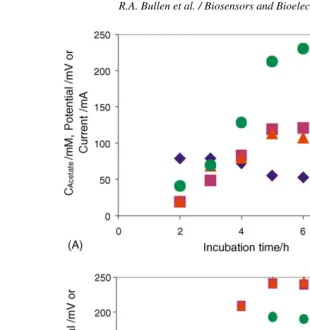
Fig. 5. Illustration of the effect of modifying an electrode with a mediator, in this case neutral red. (A) Electricity production in a two compartment biofuel cell using
E. coliand unmodified graphite plate electrodes. (B) The same system with the anode modified by covalent attachment of neutral red (afterPark et al., 2000).
was only very weakly influenced by the electricity production (1.44 mV, 1.41A cm−2, 21 mmol dm−3 acetate consumed in 30 h,Fig. 5A). With the NR-modified anode the growth was inhibited by electricity production despite more substrate being consumed (3.12 mV, 3.10A cm−2, 39 mmol dm−3acetate con-sumed in 30 h,Fig. 5B). No comment was made in the paper on the time stability of the system, as the paper was simply a feasi-bility study on the system.
Kim et al. (2002a) investigated the mediatorless electron transfer properties of various different strains of Shewanella putrefaciens and ofE. coli(NCIB 10772). The bacteria were employed as a cell suspension in the anode compartment of the fuel cell, which was nitrogen bubbled to maintain anaerobic conditions. Both electrodes were graphite felt and the cathode reduced supplied oxygen. Ten millimoles per cubic decime-tre of lactate was used as the fuel fed to the anode compart-ment when the bacteria used wereS. putrefaciens, and glucose (10 mmol dm−3) was used in theE. colibased fuel cell. It was
found that anaerobically grown suspensions of allS. putrefaciens
were electrochemically active, but aerobically grown cell sus-pensions were not, and thatE. coliexhibited no electrochemical activity. In the fuel cell theE. colisuspension showed no increase in potential (from 0.03 V) on 10 mmol dm−3glucose addition. When 25 mmol dm−3methylene blue mediator was added the potential increased to 0.52 V.S. putrefacienssuspensions gave
an initial potential of ca. 0.2 V, which rose to 0.44–0.55 V on the addition of 10 mmol dm−3lactate, depending on strain. Cur-rents of 0.03–0.04 mA (0.6–0.8A cm−2) were generated by
theS. putrefaciensstrains with 1 kexternal resistance (no cur-rent was generated by unmediatedE. coli). In a sequential batch operation the current produced by the IR-1 strain declined from 0.039 to 0.025 mA over 6 days but then stabilised somewhat at 0.02 mA after 8 days, a similar trend (decrease and then stabilise) occurring in the coulombic yield. This pattern was explained as being caused either by nutrient limitation or by the presence of contaminants metabolising the dead cells and substrate. The bacterial strain may have developed a protective mechanism to reduce the loss of energy to the electrode.
Tender et al. (2002) deployed a biofuel cell in a marine environment as described above under product type micro-bial biofuel cells. Reference is made here as the action of the microbes involved was partially direct electrocatalysis by microbes colonising the electrode surface.
2030 R.A. Bullen et al. / Biosensors and Bioelectronics 21 (2006) 2015–2045
with Re= 1000 (actual current 0.20 mA) for approximately 27 days (after approximately 6 days start-up following bacteria addition). Although the power density of this cell is very low, the coulombic efficiency is high and it is more readily scalable than many enzyme based designs. The concentrations of fuel (0.36 g dm−3glucose) used in this system are very low and the work ofRabaey et al. (2003)suggested that increased fuel con-centrations (75 g dm−3was an upper limit for high coulombic efficiency) may lead to a drop in efficiency and that the major barrier to a practical biofuel cell is now conversion rate rather than coulombic efficiency.
Gil et al. (2003)attempted to quantify the effects of changing various parameters based around an already optimised mediator-less biofuel cell. The bacterium used was probablyClostridium butyricum EG3, as isolated from a biofuel cell that has been operated on a starch plant waste-water for over 3 years (Park et al., 2001), but it is unclear whether this isolate or a mixed culture from the biofuel cell was used. The research attempted to iden-tify rate-limiting factors in the steps of oxidation of fuel, electron transfer (cells→anode), external electric load, proton transfer through membrane and oxygen supply at cathode. The possibil-ity of mass transfer limits on substrate at the anode was not con-sidered. The fuel cell system operated at 37◦C and used carbon felt electrodes separated by a Nafion membrane; the anode com-partment was continuously purged with nitrogen. The cathode compartment was initially set up with pH 7.0 phosphate buffer and 100 mmol dm−3NaCl electrolyte and the anode compart-ment contained starch plant wastewater diluted to 400 mg dm−3 chemical oxygen demand (COD) with the same electrolyte. Vari-ation of pH in the anode compartment demonstrated an optimal pH (7–8) for maximum current (ca. 0.22 mA) and coulombic output. Variation of the external load demonstrated a rate limit-ing effect for external load >500, with a low level but steady current maintained for over 30 h. At lower external resistances of 10 and 100the current rapidly reached a maximum peak and then decreased rapidly to two shoulders, showing that the rate limiting step at over 500was the external resistance; below 200the rate limit is due to a limited supply of either protons or oxygen reaching the cathode. The coulombic output decreased as the external resistance was increased, probably indicating that limiting the current output encourages side reactions leading to the use of alternate electron acceptors, such as oxygen diffused through the membrane. The third experiment varied the elec-trolyte composition using wastewater diluted to COD 100 ppm. Removing the NaCl from the buffer caused a slight decrease in the peak current measured (1.35 mA→1.20 mA), presumably attributable to a reduction in conductivity, while removing the phosphate drastically reduced it to ca. 0.45 mA, and using dis-tilled water gave ca. 0.50 mA. The coulombic output showed the same trend (phosphate + NaCl > phosphate alone > distilled H2O > NaCl alone). The lower limit on the conductivity and
coulombic output presumably indicate the effects of the wastew-ater itself. A fourth experiment compared pH change of the fuel cell with buffer and with distilled water. Within 10 h, the pH of the anode operating with distilled water had dropped to 5.4 and the catholyte pH had risen to over 9.5. In contrast, the control (buffered) system changed pH by less than 0.5 units in each
compartment. This demonstrated that proton transfer across the membrane was slower than both consumption of protons in the cathode and generation of protons in the anode and that buffer is required to maintain optimal microbial activities. A single com-partment design was commended on grounds of avoiding this problem. A comparison between aerating the cathode compart-ment and using air-saturated buffer feed to the cathode showed that aeration is required to avoid a mass transfer rate limit at the cathode. The authors assert that this demonstrates that the dis-solved oxygen level is the major limiting factor in the operation of a microbial fuel cell where graphite is used as the electrode, but it is possible that the aeration introduced turbulence and hence simply improved the mass transport of oxygen to the cath-ode.
Kim et al. (2003a)reported a BOD sensor based on this fuel cell using measurement of the coulombic output. The sensor had the drawback that it could take up to 10 h to measure the BOD of a sample (sample at 206.4 ppm BOD), but the advantage that provided an unlimited supply of fuel (in this case wastewater from the starch plant) is available the sensor is viable for at least 5 years. The culture upon which the anode was based was enriched by utilising the wastewater the experiments were based on however, so this particular sensor may give different perfor-mance if a substrate (test stream) has a different BOD chemical composition, and may require recalibrating over long periods as the culture enriches further.
Park and Zeikus (2003)investigated electron transfer in a sin-gle compartment biofuel cell usingE. coliand oxidising lactate using carbon plate electrodes doped with Fe3+, Mn4+or woven graphite felt - bonded neutral red. The surface concentration of NR was estimated at 30mol dm−3NR by cyclic voltammetry of the electrode. The metal ions were incorporated into a kaolin (porcelain clay)/graphite plate. Two fuel cell designs were used: in a two compartment system a proton-permeable kaolin septum was used to separate the two compartments, and the catholyte required the aeration and addition of ferricyanide mediator. The single compartment fuel cell was achieved by attaching a 1 mm kaolin septum to the surface of the Fe3+-graphite cathode during its manufacture. This cathode was then window mounted with the proton-permeable kaolin side inwards. The modified elec-trodes enhanced the power density for both fuel cells based on
E. coliand on mixed sewage sludge culture, with the combina-tion of the manganate anode and the ferric cathode being the most effective. Comparing the electricity produced by the NR-modified graphite felt and soluble NR with graphite felt elec-trode (Park and Zeikus, 2000) the soluble NR system obtained a maximum potential of 0.65 V and maximum current density of 0.47 mA g−1woven graphite, where the NR-modified graphite developed 0.35 V and 1.2 mA g−1woven graphite. The modified electrodes were found not to develop as great a potential as the redox couples they were based upon, but pass equal or greater current due to better electron transfer kinetics.