IMPROVED GPS SINGLE POINT POSITIONING USING WEIGHTED LEAST SQUARE METHOD
LOH KAH HOW
This Report Is Submitted in Partial Fulfilment of Requirements for The Bachelor Degree of Electronic Engineering (Telecommunication Electronics)
Faculty of Electronics and Computer Engineering
i
UNIVERSTI TEKNIKAL MALAYSIA MELAKA FAKULTI KEJURUTERAAN ELEKTRONIK DAN KEJURUTERAAN
KOMPUTER
BORANG PENGESAHAN STATUS LAPORAN
PROJEK SARJANA MUDA II
Tajuk
Projek : Improved GPS Single Point Positioning using Weighted Least Square Method
Sesi
Pengajian : 1 5 / 1 6
Saya LOH KAH HOW
mengaku membenarkan Laporan Projek Sarjana Muda ini disimpan di Perpustakaan dengan syarat-syarat kegunaan seperti berikut:
1. Laporan adalah hakmilik Universiti Teknikal Malaysia Melaka.
2. Perpustakaan dibenarkan membuat salinan untuk tujuan pengajian sahaja.
3. Perpustakaan dibenarkan membuat salinan laporan ini sebagai bahan pertukaran antara institusi pengajian tinggi.
4. Sila tandakan ( √ ) :
SULIT* *(Mengandungi maklumat yang berdarjah keselamatan atau kepentingan Malaysia seperti yang termaktub di dalam AKTA RAHSIA RASMI 1972)
TERHAD** **(Mengandungi maklumat terhad yang telah ditentukan oleh organisasi/badan di mana penyelidikan dijalankan)
TIDAK TERHAD
Disahkan oleh:
__ ________________________ ___________________________________
(TANDATANGAN PENULIS) (COP DAN TANDATANGAN PENYELIA)
ii
STUDENT’S DECLARATION
“I hereby declare that the work in this project is my own except for summaries and quotations which have been duly acknowledge.”
Signature : ...
Author :...
iii
SUPERVISOR’S DECLARATION
“I acknowledge that I have read this report and in my opinion this report is sufficient in term of scope and quality for the award of Bachelor of Electronic Engineering
Electronic Telecommunication with Honour’s.”
Signature : ...
Supervisor’s Name : ...
iv
ACKNOWLEDGEMENT
This final year project report could be realized with the sincere help and support from many people. I am very appreciating their help and support.
Firstly, I would like to thank my final year project supervisor, Dr Ho Yih Hwa for his complete support in geodetic knowledge and the excellent guidance in my final year project. I was impressed with his knowledge in geodetic sciences. I really enjoy studying of GPS single point positioning. The position of a receiver can be calculated by using the least square method which is a numerical calculation to estimate the approximation position of receiver. Besides, Dr Ho is friendly behavior while answering my question and always give the comment and suggestion for me. So that, the project having the improvement with his continuous supervision.
Next, I would like to thank the final year project panels. They are the persons who give the questions, comments and suggestions on my project and presentation works. The comments for my presentation is valuable for the future. It should be improving for the future.
v
ABSTRACT
vi
ABSTRAK
vii
TABLE OF CONTENTS
CHAPTER TITLES PAGES
STUDENT’S DECLARATION ii
SUPERVISOR’S DECLARATION iii
ACKNOWLEDGEMENT iv
ABSTRACT v
ABSTRAK vi
TABLE OF CONTENTS vii
LIST OF FIGURES x
LIST OF TABLES xi
LIST OF ABBREVIATIONS xii
I INTRODUCTION
1 OVERVIEW 1
1.1 PROJECT BACKGROUND 1 1.2 PROBLEM STATEMENT 2
1.3 OBJECTIVES 3
1.4 SCORE OF PROJECT 3
1.5 REPORT OUTLINE 3
II LITERATURE REVIEW
2 OVERVIEW 5
viii
2.2.1 Space segment 6 2.2.2 Control segment 7 2.2.3 User segment 7 2.3 BASIC GPS POSITIONING 9
2.4 GPS SIGNALING 10
2.5 SOURCES OF ERROR 11 2.5.1 Denial of accuracy 11 2.5.2 Ionospheric delay 12 2.5.3 Tropospheric delay 12 2.5.4 Satellite clock offset 13
2.6 GPS DATA 13
2.6.1 RINEX Files 13
2.6.2 SP3 files 16
2.7 LEAST SQUARE METHODS 16
III METHODOLOGY
3 OVERVIEW 19
3.1 PROJECT FLOW CHART 19 3.2 COLLECT AND CALCULATE DATA 21 3.2.1 Import RINEX raw data 21 3.2.2 Satellites coordination calculation 22 3.2.3 Error sources correction 26 3.2.4 Least square method 30
3.3 DATA ANALYSIS 31
3.3.1 Mean 31
3.3.2 Standard deviation 31 3.3.3 Variation of each sample relative to first epoch 32 3.3.4 Satellites’ orbit view 32
ix
4 OVERVIEW 33
4.1 RESULTS 33
4.2 DISCUSSION 39
V CONCLUSION AND RECOMMENDATIONS
5 OVERVIEW 44
5.1 CONCLUSION 44
5.2 FUTURE WORKS 44
x
LIST OF FIGURES
FIGURE TITLES PAGES
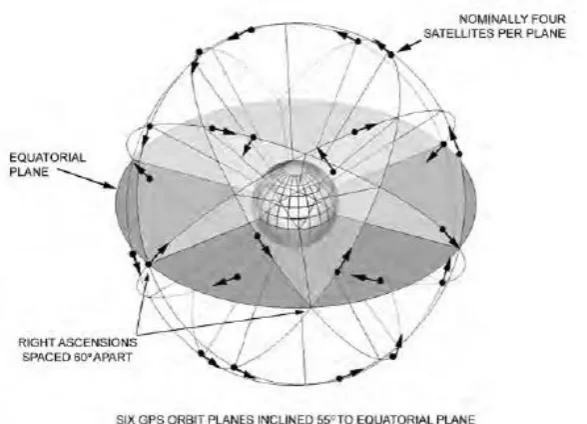
2.1 Basic GPS satellite constellation 6
2.2 GPS control segment 7
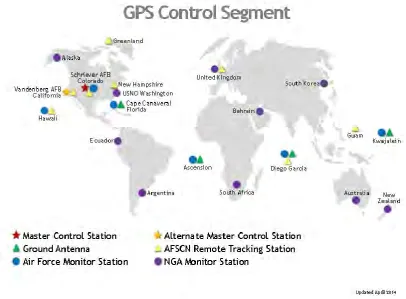
2.3 3D Positioning 8
2.4 Trilateration Positioning 8
2.5 Example of navigation file 15
2.6 Example of observation file 15
2.7 Example of sp3 file 16
2.8 RMS error (m) of positioning for eight methods 18
3.1 Project flowchart 20
3.2 Example of O-file format 22
4.1 Algorithm in MATLAB software 33
4.2 GUI to import N-file 34
4.3 GUI to import O-file 34
4.4 Navigation data from N-file 35
4.5 Coordinate of satellite 35
4.6 3D view of satellites coordinate 36
4.7 Delta X of user position 36
4.8 Position over time 37
4.9 Observation data from O-file 38 4.10 Scatter plot of latitude and longitude 38
xi
LIST OF TABLES
TABLE TITLES PAGES
3-1 Data format of N-file. 22
4-1 Standard Deviation of each least square method 40 4-2 Mean of user position from each least square method 41 4-3 Variation of approximate position with mean position 41 4-4 DOP for each least square method 42
xii
LIST OF ABBREVIATIONS
CA - Coarse Acquisition or Clear Acquisition DOP - Dilution of Precision
DRMS - Distance Root Mean Square ECEF - Earth Center Earth Fixed
GDOP - Geometrical Dilution of Precision GNSS - Global Navigation Satellite System GPS - Global Positioning System
HDOP - Horizontal Dilution of Precision LLA - Latitude Longitude Altitude MATLAB - Matrix Laboratory
MEO - Medium Earth Orbit OLS - Ordinary Least Square
PDOP - Position Dilution of Precision RINEX - Receiver Independent Exchange SA - Selective Availability
1
CHAPTER 1
INTRODUCTION
1 OVERVIEW
This chapter is discussed the introduction to the project. The project background is briefly introduced the GPS and the important of the GPS system. Next, the project problem statement is stated clearly and proposed the solution. In order to achieve the objectives, the scope of project is fixed and carried the methodology the to achieve the objective of project.
1.1 Project background
In this era, Global Positioning System (GPS) plays the important role among the civilians and the military applications. For civilians, it is always useful in the navigation system. The users can go everywhere by using a low cost GPS receiver in car even through a smartphone for route navigation purpose.
However, the accuracy of navigation is not that critical compared to the rescue and life-saving application. Nowadays the most important role for GPS development is the emergency solution which is the critical application for rescue and life-saving [1]. In addition, the GPS applications also including the agriculture control, aerospace and marine navigation.
2
life-saving, the position provided by a 2G and 3G mobile network in very low accuracy. Hence, it has possibility located to a position which is inaccurate from the actual position. In this situation, the position provided by a GPS is better than the mobile network. However, the accuracy of GPS also depends on the quality of GPS receiver, the signal loss and time delay in the free space propagation. A best approximation algorithm is needed for a low cost GPS receiver in order to calculate better accurate position for critical application.
In this project, weighted least square method is proposed to improve accuracy of a low cost GPS receiver for single point positioning. This weighted least square method is compared to the ordinary least square method in order to know the improvement brought by weighted least square method.
.
1.2 Problem statement
Nowadays, Global Positioning System (GPS) is play an important role in space– based navigation system. The GPS single point positioning is often used in the critical application such as rescue and life-saving. The accuracy of the coordinate of the user or receiver is very important for the saving and rescue mission to positioning search victim accurately and take the action plan immediately.
However, the accuracy for user’s receiver is affected by the satellite views in the space. Since the Selectivity Availability is switch off on 1 May 2000, the error correction is only including the satellite clock offset, ionospheric delay and tropospheric delay [2][3][4]. The path of the GPS signal affects the accuracy of user position due to the ionospheric delay and tropospheric delay. If the GPS satellite signal from the longer path will affected more on the ionospheric delay and tropospheric delay.
3
shorter path to each satellite path. The algorithm is written in MATLAB software, and using the least square method with the RINEX data from observation and navigation file were post processing to estimate the position of user.
1.3 Objectives
The main objectives of this project is to analyze the improvement GPS single point positioning by using weighted least square method. The GPS single point positioning is using the L1 frequency (1575.42 MHz).
To develop the ordinary least square and weighted least square algorithm in MATLAB for GPS positioning computation.
To analyze and study the improvement of accuracy brought by weighted least square method.
1.4 Score of project
This project is focused on L1 frequency of GPS single point positioning to determine the receiver coordinate in Earth Center Earth Fixed (ECEF) coordination. The algorithm tested in this project is written in MATLAB software with the RINEX v2.11 navigation and observation file as the input data to estimate the approximation location of GPS receiver by using ordinary least square and weighted least square method. The single point positioning model is based on world geodetic system 1984 (WGS84) datum and the errors correction are included for satellite offset clock error, satellite relativistic clock error, ionospheric delay based on Klobuchar model and tropospheric delay based on Hopfield model.
1.5 Report outline
4
5
CHAPTER 2
LITERATURE REVIEW
2 OVERVIEW
This chapter is briefly explained the GPS constellation and the basic concept for single point positioning. Then, the degradation of GPS signal that caused by the source of errors in signal propagation from space segment to ground segment is discussed. Next, there will be a short introduction to the raw data of GPS which is the RINEX file format. Lastly, least square methods are discussed in detail and comparing the previous work of others researchers.
2.1 Introduction to GNSS
Global Navigation Satellite System (GNSS) is the infrastructure that allows users with a compatible device to determine their position, velocity and local time by processing signals from satellites in space. There are 4 common satellite constellation under GNSS which is GPS developed by US, GLONASS developed by Russian, Galileo developed by European Union and BEIDOU developed by China [1].
2.1.1 Important of GNSS
6
2.2 Global Positioning System
Global Positioning System (GPS) is the utility owned by US Department of Defense. The main purpose of having this system is to provide the users with positioning, navigating and timing services at all the time. Basically, GPS is divided into 3 segment which is space segment, control segment and users segment to control and monitor the satellite vehicles in the space. In addition, the orbits design of GPS is different from other satellite constellation [5][6].
2.2.1 Space segment
[image:19.595.180.474.459.671.2]7
2.2.2 Control segment
[image:20.595.116.523.276.575.2]Figure 2.2 shows the location of control segment. The control segment consists of ground facilities in global network to track, control and monitor the location of the satellite vehicles and its transmission, perform analyses and send commands and data to the constellation. This segment is divided into several station such as a master control station, an alternative master control station, twelve command and control antennas and sixteen monitoring station. The master control station is set at Colorado which is main system control directly to each satellite vehicle to set their navigation message in order to have the accurate information of ephemeris data [5][6][7].
Figure 2.2: GPS control segment
2.2.3 User segment
8
[image:21.595.220.457.186.387.2]is needed an authorized GPS receiver. The GPS signal for PPS is encoded as p-code or sometime is called Y-code [6][9]. Figure 2.3 shows the three dimensional positioning method. A GPS receiver uses triangulation to determine its position on the surface of earth by using the angle and intersection points between 4 satellites in Global Positioning System (GPS).
Figure 2.3: 3D Positioning
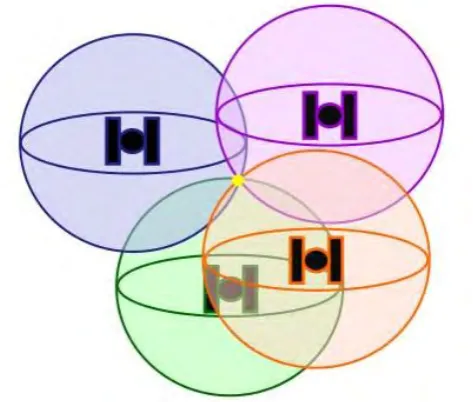
[image:21.595.191.452.518.692.2]Figure 2.4 shows the trilateration positioning method. A GPS receiver uses trilateration to determine its position on the surface of the earth by timing signals from four satellites in the Global Positioning System (GPS).
Figure 2.4: Trilateration Positioning
9
two-dimensional case. Two satellites have two intersection point for the user’s position. Hence, the third satellite is used to determine the exact user’s position. In three dimensional case, the position of receiver is determined by using four satellites. Three satellites are used to determine the latitude, longitude and altitude. The equal-distance trace to a fixed point is a sphere in a three-dimensional case. Two spheres intersect to make a circle. This circle intersects another sphere to produce two points. In order to determine which point is the user position, one more satellite is needed[10].
2.3 Basic GPS positioning
The basic of GPS positioning to be establish is at least to have 4 satellites to determine the position of a GPS receiver [8][11]. However, a 2D positioning is required 3 satellites to determine the location in latitude and longitude. But 3D positioning is required minimum 4 satellites to determine the location in latitude, longitude and altitude. The basic positioning for 4 satellite is shown in equation (2-1) to (2-4):
𝜌1 = √(𝑥 − 𝑥1)2+ (𝑦 − y
1)2 + (𝑧 − 𝑧1)2 + 𝜀1 (2-1)
𝜌2 = √(𝑥 − 𝑥2)2+ (𝑦 − y
2)2+ (𝑧 − 𝑧2)2+ 𝜀2 (2-2)
𝜌3 = √(𝑥 − 𝑥3)2+ (𝑦 − y
3)2+ (𝑧 − 𝑧3)2+ 𝜀3 (2-3)
𝜌4 = √(𝑥 − 𝑥4)2+ (𝑦 − y
4)2 + (𝑧 − 𝑧4)2+ 𝜀4 (2-4)
where 𝜌𝑖 is pseudo-range in meters, and x, y, and z is the ECEF coordinate of receiver in meters, the 𝑥𝑖, 𝑦𝑖 and 𝑧𝑖 are the ECEF coordinate of satellite. The 𝑖 indicates the number of satellites. The 𝜀𝑖 is the clock bias error [9].
10
and Δz are 0. If the x, y and z are the coordinate from the receiver, 𝑥𝑖, 𝑦𝑖 and 𝑧𝑖 is the coordinate of the satellites view in the space and 𝜀 = 𝑐𝑡, c is the speed of light, 𝑡 is the clock bias of user receiver. The value 𝑖 is the number of satellites view. Pseudo-range is the sum of the actual range and the offset due to the user clock bias. In order to calculate the coordinate of user, receiver is using a linear equation to solve the 4 unknown value. Hence, the value of x, y and z are
𝑥 = 𝑥𝑛+ Δ𝑥
𝑦 = 𝑦𝑛+ Δ𝑦
𝑧 = 𝑧𝑛+ Δ𝑧
𝑡 = 𝑡𝑛+ Δ𝑡
𝜌𝑖 = 𝜌𝑛𝑖+ Δ𝜌𝑖
The equation (2-1) to (2-4) is simplified as in equation (2-5)
[𝑋𝑛− 𝑋𝑖
𝜌𝑛𝑖−𝑐𝑡𝑛] (Δ𝑥) + [ 𝑌𝑛− 𝑌𝑖
𝜌𝑛𝑖−𝑐𝑡𝑛] (Δ𝑦) + [ 𝑍𝑛− 𝑍𝑖
𝜌𝑛𝑖−𝑐𝑡𝑛] (Δ𝑧) + 𝑐Δ𝑡 = Δ𝜌𝑖 (2-5)
This equation is represented one satellite. There are at least 4 satellites are detected, the equation is formed with the 4 x 4 matrix. Then, the solution of Δ𝑥, Δ𝑦, Δ𝑧 and Δ𝑡 are determined by using the least square method as in equation (2-6) and (2-7).
2.4 GPS signaling
GPS signaling is the electromagnetic wave which is propagated from space to earth station. This EM signal is generated by atomic clock in satellite vehicle which is used to transmit PRN code to the receiver in L1 or L2 frequency. L1 is 1575.42 MHz and L2 is 1227.6 MHz but the fundamental frequency for both L1 and L2 are 1023Mbit/s the navigation data the code from each satellite is modulated into GPS signal and transmit signal to the ground receiver. There are two types of code is transmitted which is C/A code and P-code[12].
11
the L1 carrier frequency and it is used to acquire and decode the L1 satellite signals so that L1 pseudo-range measurements can be made (the Block IIR-M satellites add another civil code on the L2 frequency). GPS receivers internally generate the PRN string of bit code of for each GPS satellite and align the code to lock on to each signal. The 1.023 MHz chip C/A code repeats every 1 milliseconds giving a code chip length of 300 m which, is very easy to lock onto[13]. The Precise or Protected code with a pseudorandom string of bits that is used by GPS receivers to determine the range to the transmitting GPS satellite on the GPS L1 and L2 carrier at a chip rate of 10.23MHz (approximately 10 times the resolution of the C/A code), which repeats about every 267 days. Each week segment of this code is unique to a GPS satellite and is reset each week. Under the policy of the DoD, the P-code is replaced by an encrypted Y-code when Anti-Spoofing is active. Y-code is intended to be available only to authorized (primarily military) users.
2.5 Sources of error
This section will discuss the sources of error. The error is introduced by the GPS signals that travel a long distance from space to earth. So, there will be consists of error on delay and the required mitigate the effect to obtain the better accurate position. Since the SA is removed, the atmosphere layer is the dominant issue that affect the signal propagation path.