AN INVESTIGATION OF METHODS OF EXAMINATION AT THE 'QUALIFYING' STAGE
Douglas Moul McIntosh
A Thesis Submitted for the Degree of PhD at the
University of St Andrews
1933
Full metadata for this item is available in St Andrews Research Repository
at:
http://research-repository.st-andrews.ac.uk/
Please use this identifier to cite or link to this item:
http://hdl.handle.net/10023/13297
"QUALIFYING" STAGE
being a Thesis presented by
DOUGLAS MOUL MciNTOSH, M.A., B.Sc., B.Ed.
to the University of St. Andrews
I matriculated in the University of St . . ~ndrews in 192'7
and graduated in June 1931 with the degrees M.A. and B.Sc.,
with first class honours in Mathematics. In 1932 I obtained
the Diploma in Education of the University of St. Andrews.
I matriculated in the University of Edinburgh in 1934 and
graduated with the degree of B.Ed. in June 1935.
In October 1935 I commenced the research on methods of
examination at the "Qualifying" stage which forms the basis
of the Thesis now being submitted in ap~lication for the
?ART I.
I. IntroduGtory
II. ':'rP History of the Cualif;ring Examination
III. A Survev of nrevious Follow-up Investigations at the ~ualifying Stage
Page
1
10
23
I. The Investigation 115
II. The Standardisation of the Tests 129
III. ~orreletions 'Between the Various ~'easures l6P
IV. The Effect of ~ee on the Correletions 179
V. The Re1iqbility of the Test~ ~nd sxaminntions 191
VI. The ~T'edictive Velue of the Jnr"iviC:ur:l i'eesures 20C
VII. ':'he ?redictive V8lue of Combin'3_tions of ;,:easures ~19
VIII. The Predictive V!C'lue of ··'ei~hted ~ombinations of
I.~ ea sures
IX. The Relative Predictive Value of the ~uAlifying
229
Exemination and Intel ,_ igence Te~;t 2Z4
X. The Predictive Value of First Year Terminal
Examinations in the Secondary School 242
XI. The Bursary Examination 248
XII. Summary of Conclusions 2 59
Bibliogranhy.
From earliest times, examinations have played an important part
in the systems of education adopted by communities, barbaric and
civilised. The youths of the primitive tribe were subjected to
examinations in the form of initiation ceremonies in which they
had to achieve certain physical and mental standards before
being admitted as adult members of the tribe. This practice
was a feature of Greek education, particularly among the
1.
Spartans, from about 500 B.C. There are, also, records datine
1.
The Schools of Hellas: Kenneth Freeman. Macmillan
&
Co.Ltd.l907back three or four thousand years, of a national examination
system in Ancient Chinese civilisation which had as its object 2.
the selection of public officials.
2.
The Meaning of National Examination System, Pan. Q..
China Critic, 1928, 1, 512-515.
Examinations of Western educational systems have as
their prototypes those of the mediaeval universities. The
analogy has been dr~wn between the early universities and the
trade and craft gilds of the same period, the former in fact
being teachers' gilds. Just as trade gilds had their
apprentices, journeymen and masters, so the universities had
their. scholars, bachelors and doctors.
gilds/
gilds, the various stages could only be completed when the
candidate had performed a piece of work to the satisfaction
of the gild, so each stage in the university could only be
successfully accomplished by passing an examination set by the
University Authorities. The scholar had to undergo a test of
his ability to define and explain terms, success in which
entitled him to his baccalaureate degree and, on concluding his
bachelor's course, before he became a doctor or master he was
compelled to teach in public or to defend a thesis before the
University Authorities.
Two points in connection with the examinations of the
Mediaeval Universities may be observed. Firstly, the
examina-tions were oral; secondly, they fulfilled the purpose for which
they were intended, namely, to find whether the candidates
could acconplish a task similar to that with which they would
be confronted in their post graduate situations.
Written examinations seem to have been a product of
the early 18th Century. In 1702, Cambridge University
intro-duced the written examination, a system which was adopted soon
afterwards by Oxford University and the other centres of
learn-ing and has been continued down to the present day. With the
extension of the function of the Universities the oral
examina-tion with its essentially practical character gradually fell
into .decay and the written examination ass~ed other functions
which affected considerably not only the examinations but the
system of education itself.
Dissatisfaction with the examination system began in
England and America about the year 1880. Professor Edgeworth
of Oxford University published practically the first important
1
statistical investigation on examinations in three papers
1.
(i) The Statistics of Examinations, Journal of the Royal Statistical Society, vol. 51, pp 599- 635 (1888).
(ii) The Element of Chance in Competitive Examinations, Journul of the Royal Statistical Society, vol. 53, pp 460-?5 and 644-63. (1890)
(iii) On Problems in Probabilities, Philosophical Magazine, August 1890.
on the results of examinations.
In these papers he drew attention to two problems,fir~,
the discrepancies which might arise when a number of different
examiners marked the same examination scripts, and secondly,
when the same examiner marked the same scripts a second time at
a later period.
With regard to the constancy of marking Professor
Edgeworth found that in the First Class Civil Service
Examina-tions the element of chance was so great that only one third to
two thirds of the successful candidates could be sure of success
if a different set of equally competent examiners had been
appointed. In another experiment, a piece of Latin Prose when
marked by twenty eight highly qualified examiners was awarded
marks varying from 45 to 100 out of a possible mark of 100.
Dealing with the second problem, he found that in a
typical examination the total probable error due to such errors
as correction at great speed, fatigue, and the examiner's
idiosyncracies, was more than two per cent of the aggregate of
marks. "For instance, if a candidate obtains an aggregate
of 1,965 marks, thus falling below the Honour line by 35 marks,
the odds that he ought by right to be in the Honours Class are
considerable, say one in four. Even if he has obtained only
1,800 marks, it is by no means certain that he is rightly placed
among the rank and file of Pass Candidates."
At about the same time, in America, several of the
prominent educationists were protesting against the system of
examinations which was rapidly dominating education. President
Charles W. Eliot of Harvard College attacked the examinations
from the point of view that they treated all pupils alike, 1.
ignoring the individual differences of the children. His
Educational Reform.
c.w.
Eliot, New York. 1901.plea was for the adaptation of the examinations to individual
capacities, though at this time the technique of measurement
had not developed far enough to accomplish such a task, and the
only substitute he could suggest was teachers' estimates.
An attack from a different angle was made by Professor J. Rendell
Harris of Haverford College, whose claim was that the magnitude
of the mark mattered little in comparison with its position in
relation to the others of the group. "A well conducted
examina-tion divides the students one from another like the opening of
a fan. I affirm that the first thing to be aimed at is to
produce a dispersion among the group of persons presented for
2.
examinations.
"
2.
Proceedings of the First Annual Convention 0f the College Association of the Middle States and Maryland, 1890.
Indeed, what Professor Harris was advocating was that the marks
of an examination should be distributed along a normal frequency
curve, a technique which was to be introduced some twenty years
later with the development of statistical research.
With the rapidly changing philosophy and outlook of
the early twentieth century and the development of the new
techniques in educational and psychological measurement, the
~uestion of the place and functions of examinations in education
was being critically examined in practically every country.
When the New Education Fellowship met fLocarno in 1927, an
A.
international commission was appointed to look into the subject.
In 1929, at the Elsinore Conference, there was a discussion of
the evidence submitted by the representatives of some twenty
countries. That the subject of examinations should be studied
internationally was felt by all representatives and it was
decided to continue the investigations. After a Conference
which was held at Nice in 1932 a report, "Examinations and the
way out", was published in 1935.
The next step in the organisation of international
resources for the attack upon examinations came with the
establishment of the International Examinations Inquiry, under
the sponsorship of the Carnegie Corporation, the general
super-vision of the work being undertaken by Professor Paul Monro8,
Director of the International Institute of Teachers College,
Columbia University. The first Conference was held at
Eastbourne in 1931 when twenty eight representatives from
England, France, Germany, Scotland, Switzerland and the United
States discussed the problems connected with examinations,
a report of the Conference being published under the title 1.
"Conference on Examinations"
1.
Bureau of ~ublications, Teachers College, Columbia University. 1931.
In his opening address, Dr. Monroe pointed out that,
in addition to the problems concerning examinations themselves,
there was a great need for a study of the effect of examinations
upon the social structure of the nation. Scant attention, he
declared, had been paid to examinations as a means of social
control. In most of the European countries, for example• the
gateway to all the professions and government service was
. .
guarded by examinations which therefore formed the foundation
of the intellectual class. America, on the other hand, did
not have the same intellectual and cultural tradition on which
to base a system of education and consequently an intellectual
class did not exist. Another problem, however, had arisen,
namely, the tendency to produce a greater number of those
pre-pared for intellectual, professional and clerical activities
than could be well absorbed by the respective societies.
At the Eastbourne Conference there was a general
consensus of opinion that in each country the problem of
examinations had reached a different stage of development,
and the only method whi.ch could be adopted with any success was
for each country to undertake an investigation appropriate to ~(6
their own situation. It was decided, therefore, that national
cocrmittees should be set up with this aim in view. In England
and France, for example, the unreliability of the marking of
examinations had not been appreciated to the same extent as in
Scotland and America, with the result that the committees in
the former countries undertook inquiries on this point before
considering any further problems.
In Scotland two investigations by the Scottish Council
for Research in Education had already been started dealing with
teachers' estimates and the time devoted to examinations.
These were completed and published in 1932 and two new
investi-gations were undertaken. One, a mental survey of Scottish
children and a subsequent. follow up of a selected group, and
the other dealing with the predictive value of the Leaving
Certificate Examination. In Germany as in Scotland, a committee
had already been at work on the problem of examinations, their
particular subject being the selection of children for admission
to the secondary schools. This investigation was continued and
another was undertaken by Dr. Robert Ulich and Dr. Erich
Wohlfabrt, the aim of which was to show the relations between
the social origin of students, the type of secondary school
which they selected, their professional aims, and the success
in the courses undertaken. The Swiss representative, Professor
Bovet, undertook the task of preparing the history of the
examination of army conscripts in Switzerland.
In June 1936, at the third Conference on Examinations,
the final reports of the investigations were presented, an
Interim Conference having been held in London in· 1933. The
work of the English committee had been published under "An
English Bibliography of Examinations (1900-1932)", "An
Examination of Examinations", "Essays on Examinations", and
"The Marks of Examiners". The French investigation which deal·s
mainly with the Baccalaureat, the examination at the close
of the secondary school, is entitled "La Correction des Epreuves
Escrites dans les Examens". In Germany,
o.
Bobertag haspublished the investiga~ions of the committee under the title
"Schulerauslese" and in America, Professor Kandel has prepared
a report entitled "Examinations and their Substitutes in the
United States." Two volumes have been published by the
Scottish Committee, naoely, "The Intelligence of Scottish
Children A National Survey of an Age Group" and ttThe
Prognostic Value of University Entrance Examinations in Scotland~
Another investigation, also, has been started by the Scottish
Commdttee dealing with the methods of examination at the
"qualifying stage" and it is some of the results of this
investigation with which the second part of this thesis is
II. HISTORY OF ~UALIFYING EXAMINATION
In 1901, the Education (Scotland) Act raised the age of
compU3ory attendance at school fro~ thirteen to fourteen and
thus some instruction of a more advanced nature than that given
in the elementary school was possible for the majority of the
pupils. A re-organisation of the school system was therefore
necessary. Provision for two years courses of specialised
instruction, called supplementary courses, was made in 1903
by the Code of that year.
Entry to such courses was determined by a pupil's
success in an examination - the qualifying examination.
Although the establishment of the qualifying examination is of
fairly recent origin, the idea of providing a 'hurdle' between
elementary and secondary education may be traced back to the
time of the Reformation.
In his First Book of Discipline, Knox devotes a
chapter entitled, "Schools and Universities", to education
where he sets out a complete national system of education with
a corresponding national system of examinations. For the
purpose of examining the pupils at the end of each grade it was
decreed that "discreet, learned, and grave men be appointed to
visit all schools for the trial of their exercise, profit and
continuance; to wit the ministers and elders, with the most
learned men in every town, shall every quarter take examination."
The examinations like all others at this time were oral in
character.
These visitations of examiners became a feature of
school life and the day on which the visitation took place was
an event both to scholars and teachers. Teachers were anxious
that their pupils would show up as well as those of neighbouring
schools and thus efficiency of instruction and discipline were
maintained. As the examination was carried out with great
thoroughness, a certain uniformity of instruction was kept
throughout the schools. Despite many efforts to deprive the
church of the right of inspection and visitation, this privilege
was retained till the Education Act of 18?2.
It was evident by the middle of the nineteenth
century that some national body would have to be created to
supervise the distribution of the grants for education made
by the government. Accordingly, in 18?2, by the Education Act
of that year, there was established the Scotch Education
Depart-ment. This body included among its functions the annual
inspection of schools. By the Act financial provision was made
for the Parish Schools which were not limited to elementary
education, the School Boards being enjoined to conserve the
secondary education given in these schools. The Burgh Schools
were non "state aided" and were known as Higher Class Public
Schools under School Boards. The demand for secondary
education steadily increased and provision had to be made
either by_ the development of the secondary education provided
in the Parish Schools or by increasing the number of Burgh
Schools which would then be brought into the national system
as providing secondary (as distinct from primary) education.
It was .the former method which was chosen and thus a national
system was evolved, in keeping with the ideal of John Knox to
establish distinct grades of national education leading from
elementAry through secondary education to the Universities.
Several factors assisted the development of secondary
education within the state-aided schools and the steady merging
of the Burgh Schools into this system. Among these were, the
introduction in 1899 of Higher Grade Schools providing.a three
years' post primary course, many of which developed into full
secondary schools; the development of two years' post-primary
courses known by the name of Supplementary Courses being of
four types - Commercial, Industrial, Rural and Domestic; the
establishing of the Leaving Certificate Examination in 1888
to mark the successful completion of a full secondary course.
These, along with a careful manipulation of grant regulations
by the Department assisted in bringing the Burgh Schools into
line, but what was perhaps the most important factor of all
was the demarcation between primary and secondary education at
about the age of 12.
At this point, brief mention may be made of an
examination system introduced into the schools during the
nineteenth century, namely, the system of payment by results.
In short, the method was that the state grant was dependent
on the examination success of the pupils as determined by the
inspectors' reports. Fortunately such a system was not
tolerated for any length of time in Scotland though its effects
were felt for many years after the system had been abolished.
In 1885 all traces of the system were removed from the lower
standards and by 1890 it was abolished completely from the
clementary school.
Elementary education became practically universal
by the Education Act of 1872. To give a greater definiteness
to its aim, the merit certificate was introduced by the Education
Department, thus providing a goal for the elementary school
child similar in nature to that afforded by the Leaving
Certifi-cate for the secondary school pupil of to-day.
The Code of 1892 laid down the necessary requirements
for the attainment of this certificate. Briefly, these were
that the child should be over thirteen years of age; that he
should be thoroughly proficient in the three R's; that he
should be proficient also in two class subjects sucl1 as English,
Geography, Eistory, Needlework, and Elementary Science; and
that he had passed satisfactorily through all the grades of one
specific subject. The prime motive in this was that each
child should receive a thorough grounding in the three R's,
although it was hoped that many would be encouraged to remain
at school longer than the compulsory school leaving age.
Up to this point r.1ost of the legislation and
move-ments for reform had been directed towards the elementary
school, but it soon became evident that the secondary school
system was also in need of similar attention. In 1898, the
3cottish Education Department carried out reforms with this
end in view. The merit certificate was now given the function,
not of marking the completion of the elementary school as
previously had been the case, but to provide a line of
demarca-tion between primary and post-primary educademarca-tion. It acted as
a hall-mark of the satisfactory completion of a primary course,
and a guarantee of fitness for entry upon a post-primary course.
To this end, the age qualification was reduced to twelve and
the regulations regarding specific subjects w~thdra~m. In
the words of a Scottish Education Department Memorandum, what
was required of the pupil was that he should have "the ability
to read, write, speak and understand plain English and to
perform simpe calculations."
The actual requirements are given in Article 29 of
the Code. A pupi~ is expected
"(a) To read at sight, with good pronunciation and with
intelligent phrasing, narrative prose of moderate difficulty.
(b) To write to dictation, with good spelling and legible and
regular handwriting, a narrative passage previously unseen.
[c)
To answer questions as to the subject-matter of and the meaning of words and sentences in the reading books in usein the class; these answers, when necessary, to be
expressed in complete sentences or in a consecution of
sentences.
(d) To write a composition, the heads being given, or to give
in writing, the substance of a passage read.
(e) To know the four rules of Arithmetic as applied to whole
numbers, easy vulgar fractions, and decimals to three places,
and to be expert in applying this knowledge to the
calcula-tion, both mentally and on paper, of simple sums in money
end in common weights and measures.
(f) To be reasonably proficient in the other subjects included
in the approved scheme of work of the class."
It is to be noted also that this examination was not conducted
by Local but by Central Authority and accordingly was uniform
throughout the country, apart from individual differences among
the inspectors.
Still another change necessitated by the raising of
the age for compulsory attendance at school from thirteen to
fourteen by the Education (Scotland) Act of 1901 was introduced
in 1903 by the Code of that year. It was felt that an
advanced course of instruction should be available to those who
would be leaving at the age of fourteen and who had successfully
completed their elementary course at the age of twelve.
Accord-ingly, two years "supplementary courses" were introduced.
To mark the completion of these new cours~ the merit certificat
was transferred to this stage and its place was taken by a
qualifying examination which carried with it no certificate.
The next stage in the history of the Qualifying
Examination was reached in 1921 when by Circular 44 the
Depart-ment intimated the abolition of the Qualifying Examination as
conducted by H.M. Inspectors. The importance of the break
between primary and post-primary education was not forgotten
and it was pointed out that the qualifying stage must "mark
something of an epoch in the school career of every pupil."
The various education authorities were advised to come to
"some arrangement under which those who have taught and those
who are to teach particular individuals shall combine in an
endeavour to estimate the potentialities of the material to be
handled."
As to the method the Department suggested
"It is neither necessary nor desirable that any rigid
uniformity of method should be insisted upon. What is
practicable and convenient in one education area may
•
conceivably be unsuitable in another. Broadly speaking,
however, the Departoent will expect that the standard of
the existing ~ualifying Examination, the soundness of which
has been proved by an experience of nearly twenty years,
will be reasonably maintained. That is, any test to be
applied should be such as the average pupil of 12 may fairly
1.
be called upon to meet."
Scottish Education Departnent Circular 44, par. 2 and 3, 12th December, 1921.
An account of the methods adopted by the various
Authorities is given by Professor McClelland in the 1934 Yeur
Book where he gives a summary of the results of a questionnaire
to the education authorities. Slightly less than half retain
a uniform written exwaination, the subjects being English and
it.rithmetic, with the addition, in a proportion of ceses, ot
history and geogra~hy. "So~etimes the papers are set by an
examination board, sometimes by the Director of Education,
external exaciners or head teachers. Even in these areas
considerable weight is given to the sohool records of the pupils,
and in oases where the uniform exaoination has been abandoned
these are the main basis of the decision. Formal oral
examina-tion is uncommon, but twelve areas are making use ot
intelli-gence teste, and five areas of standardised scholastic tests.
While in about fourtePn [1reas the pttssing of the
~ualifying test is all that is de~anded for entrence upon a
secondary course, the uajority of authoritles place a higher
hurdle before the door of these courses. In eight areas the
s~e test is used for.this purpose, but a higher mark is required.
In eight other areas there is a s~eciul examination - usually
called a "control" exaMination - for entry to the secondary
departments; and in a nunber of cuses the second':iry schools
have their own entrAnce tests. :-~.s a rule, consultation between
.
the receiving and transmitting headnasters is provided for,
either in all or in doubtful cases."
Such was the position in 1934 but there has been
considerable change since then and one of the functions or
the International Examination En;uiry Conmittee's ~ualifying
Investigation will be to provide a statement of the position
as it is to-day. One- of the greatest changes which has taken
place is the change in attitude towards the ~ualifying
Examina-tion. Formerly it was regarded as a barrier or hurdle which
the child must clear before passing into a post-primary school,
but now the great range of individual differences in children
is being recognised end the ~ualifying Examination, no matter
what its form may be, is assucing a prognostic function.
Formerly, too, examinations looked towards the past.
A candidate gained adl'lission to b secondary school by passing
an entrance examination. This method of selection, however,
gave no guarantee of success in whatever course he followed
in that school. To-day the tendency is to look forward to
the future. An attempt is being nade to frame the tests so
that they will give sooe reliable prediction of a candidate's
likelihood.of success in the various post-primary courses of
instruction. For this purpose it is not sufficient to find
out what he already knows.
Little is known as to the prognostic value of the
var1ous types of tests and examinations used by authorities
at the ~ualifying stage. It is with this problem that the
following investigation is concerned.
It has been seen that one of the main points in
the development of secondary education was the establishment
of a clear line of division between primary and secondary
education. The transfer from the one to the other generally
took place at about the age of 12 years, although the less able
children unable to surmount the exa~ination barrier between
the two types of education were much older. One of the most
significant trends in the schemes of promotion to post-primary
education is the "clean out" promotion of pupils at about 12
years or age, especially of the pupils unable to quality on
the basis of achievement.
The "clean cut" grew out of the recommendation of the
Department that the now qualifiable type of child should be
--promoted on the basis of age alone not later than the age of 13 1.
years. The Department CirculRr 44(1921) stated "there need
1. Scottish Education Departnent, Circular No. 44, Dec. 13, 1921, page 2.
be no restriction as to the age at which promotion takes place.
If a pupil is ready to move forward before he is 12 years old,
an~ if he can do so without risk of over-pressure, no hindrance
should be placed ir. his way. Nor will it be advisable to
require that those who a.re below 0he average in ordinary school
subjects shall necessarily remain in the "qualifying" class
until the obstacle has been surmounted. In the lar~er schools,
at least, there will elways be a not inconsiderable proportion
whose tastes are anything but bookish, and whose interest can
be ~ore effectively awakened through the hand than through
the hea.d ••••••••••••••• To re~uire that boys and girls shull
s9end two or three years of their lives in striving after the
unattainable is as futile frou the point of view of the State
as it is cruel from the point of view of the individual."
-~ain, there was the growing recognition of the value
ot practical post-primary courses and the need for a longer
period or time to devote to such courses in the advanced division 2.
schools. The Primary School Code in 192·3 and the
Sub-•
Code ot Regulations for Day Schools in Scotland, Art.l5, 1923.
1.
1.
Committee of the Department's Advisory Council, 1923, urged
Report of the· Advisory Council to the Scottish Education Department on the General Organisation of Day Schools
a~d of Continuation Schools and Classes, 1923, pp. 3-4.
that pupils who were unable to qualify by achievement when they
had reached the age of 13 years should be automatically promoted
.
to a post-pri~r1ary course where a special curricultli'l might be
developed for them. The 1923 Code reads "As a rule, no child
should be promoted to a higher division who has not
satis-factorily completed the work of the division below, but
education authorities in all ce.ses f'lay, and in the case of
children over 13 should, nake special provision for the
in-struction of children who in the course of normal promotion
have failed bir more than a year to reach the division
appro-. ~ 2.
priate to their age." The Corn.Llittee on Education and
2.
Committee on Education and Industry, Second Report, 1928, p.l?.
Industry in Scotland in 1928, were strongly in favour of the
principle of the'~lean-cut" at 13.
It is to be remembered that the Hadow Conmittee in
their report on "The Education of the Adolescent in 1926"
supported the tenet that there should be automatic promotion at
the age of ll+to a suitable course of post-primary instruction.
Scotland, therefore, had been slowly adopting such a system
for several years before the publication of the Report.
As to the actual position in Scotland it would appear
as if most of the authorities are ado_pting the "clean-cut"
system at 12 years of age, although only a minority have
qualified at this age. As a result of a questionnaire in
1934, Professor NcClelland found that GO% of the authorities
reported 12 to be the norr•1al age of transfer. Some would
prefer a reduction to 11 plus, while very few favour 11 or
Ill. SURVEY OF PREVIOUS FOLLOW-UP n:VE3TIGATIONS AT THE
~UALIFYilfG STAGE
A. INTRODUCTORY
1.
In his contribution to "Essays on Examl.nations", Spearman
1.
Essays on Examinations:- Note on the Reliability and Validity of MeasurementR by C. Spe:1rmana International Institute Examinations Enquiry. l:acm.l.llan, 1936. p. 108.
distinguishes between reliability and validity. The former
is the degree of agreement between any two independent sets of
measurements of the same set of things while the latter is the
agreement of measurements with the things measured. He points
out that of the two validity is by far the more important, but
unfortunately this aspect of examinations has been, to some
extent, neglected, largely due to difficulties involved in any
investigation dealing with such a ~roblem. The r.-"ost pronising
method of dealing with the validity of exruninetions is that of
tracing the subsequent cbreers of the exaninees. Spearman
concludes his artic·.le with tr1e hope that future resehrch on the
subject of examinations woulc extend its scope so as to include
their "follow-up".
"Follow-up" investigations have been compc:Jrati vely
few though several experh1ents v1ere carried out in .America,
particularly with students enterin~ the Universities. The
Scottish Committee of the International Institute took up this
1uestion, also at a University stage, and the results of their
investigation have been published in 'Prognostic Value of
University Examinations in Scotland", (University of London
1>ress, 1936}.
Little has been done to test the validity of the
various oethods of selection of pupils particularly for
post-primary courses of instruction.
B. BRITISH INVESTIGaTIONS
Prior to 1924 investigations on exa~inations had been concerned
mainly with reliability ann the introduction of intelli~ence
tests as one of the nethods of selecting pupils for secondary
education. .An account of som.e of the ex}'erinents conducted
in the use of tests in free place exar.1inations in Ene;land is
given il). the Governnent report on Psychological Tests of
1.
Educable Capacity.
1.
Psychological Tests of Educable Capacity. Board of Education Report, H.M. St£::.tionery Office, 1924. Appendix II, p. 149.
Several areas had been introducing and experinenting
with intelligence tests in their methods of selecting children
for secondary schools. It was mainly due to discrepancies in
the results of these tests and the results of "control"
examina-tions in English and Arithmetic which gave rise to further
experiment on the ~uestion of the validity of these examinationso
Actually there seems to have been no large investigation.
Most of the reports were of a general nature citing particular
cases in support of specific arguments.
In the County Borough of Blackpool, experience with
tests seems to have indicated that the test results were a
helr-ful supplement to the usual scholastic examination. Although
no definite experiment is quoted, the Director states ttthat a
comparison of the work of the pupils,subsequent to the applicati~
of the tests, was showing that these tests did assist in the
discovery of educable capacity."
In 1922, an intelligence test vvas used in Bradford as
well as a scholars.hip examination for the awarding of free
places to secondary and central schools, although the test
results were used only with border line cases. When pupils
were awarded scholarships mainly due to their score in the
intelligence test, it was found that these pupils generally
justified their selection.
An
investigation with 48 boys and 44 gi~ls revealedthat, in general, the results obtained from the intelliwgence
tests corresponded with the progress made in the secondary schoolJI
as indicated by the teruinal examinatio~ to a rather greater
extent than obtained when a comparison was instituted between
the marksawarded in the ordinary scholarship examination and the
marks given in the secondary schools.
In the County of' Northumberland more, perhaps, has
been done with intelligence tests than in any other area.
Professor Godfre~r H. Thomson, who was largely responsible for
much of' the early work, reported that free places were given to
any who scored highly in either the examination or the test
provided they were average in other respects. In 1921, however,
fourteen places were given on the result of an intelligence test
alone, and of these, only one did unsatisfactory work in the
secondary school.
The Director of Education for Northumberland has also
submittetl statistics which indicate that pupils who had low marks
in the examination but intelligence ratios of 120 or more were
all doing satisfactory work in the secondary school with the
exception of one pupil. . On the other hand, cases are quoted
of pupils who obtained high marks in the examination but low marks
in the test and whose progress in the secondary school was
unsatisfactory. His general conclusion was that "the introducti~
of a psychological test, as a supplement to the examination in
school subjects, has been of great value".
Another interesting experiment was that carried out by
T. P. Tomlinson, Head Master of Love Lane Council School,
Pontefract, who tested with a group intelligence test 1600
children distributed among 16 schools in the West Riding of
Yprkshire. The test had a reliability of ·95 and correlated
with individual Binet testing to the extent of ·?1 to •84.
From the data it is concluded that the intelligence test
reveals ability not shown by the examination due to such causes
as nervousness, home circumstances and the like. Also, that
success in examinationsmay be due not so much to ability as to
diligence and favourable home conditions. The intelligence
test often reveals a low mental level thus hidden and the
subsequent school career indicates the pupil's inability to
cope with the increasing difficulties of the curriculum.
In one central school
25;
of the children had I .Q,s. below 85,their success in the entrance exanination being probably due
to special preparation. The head :mster' s report on the work
of these pupils indicated that they were unable to make a succes~
of the course to which they had been promoted.
Similar conclusions were reached by R. R. Dobson,
Head Master of Pate's Grammar School, Cheltenham, in experiments
conducted by him in the selection of pupils for free places to
secondary schools. This report is of interest from the point
of view that the investigator, in one experiment, used an oral
intelligence test (Burt's graded reasoning tests}. In his
selection of 26 from some 150 candidates he awarded some free
places solely on the grounds of the pupils' success in the
intelligence test.
came/
to that in the normal city schools. The subsequent progress
of the pupils showed that the selection had been fully justified.
Another important point is made in the report, namely, that some
sort of an examination is required as a certain level of
attain-ment is necessary before a child can take advantage of a
secondary school course.
1.
1.
In a published report of this experiment, the author
The Value of Intelligence Tests in Scholarships Examinations. R.R. Dobson. The Forum of Education, Vol, I, No. I, 1923.
defined the object of an entrance exanination to be the
selection of "the most mentally alert boys as distinct from those
whose standard of attainment is high in virtue of efficient
teaching, cultured hones and even careful coaching for the
examination itself." He pointed out, also, that the difficulty
is complicated by the fact that the quality of the teaching staff
varies very much from one aementary school to another, and it
would appear that the teaching in elementary schools in England
varied far more than was generally supposed.
The correlation between the reasoning tests and the
written examinations was •41 and this coefficient, when worked
out for the school which sent the greatest number of candidates,
becomes •56. This emphasises the fact that where teaching is
uniform, for example, in the same school, whether it be good or
bad, there the written scholastic examination may give a
fair estimate of comparative intelligence among the boys
of that school; but where the teaching conditions differ
greatly, there such a1 examination by i tse1.f is less just.
1.
1.
In an investigation on intelligence tests , Oates
A Statistical and Psychological Investigation of Intelligence Tests. D.W. Oates. The Forum of Education. Vol. VI, No.I, 1928. p. 38.
came to the important conclusion that much greater care was
necessary in refining tests to be used in discriminating between
the relative intelligence of boys of average ability than in
devising tests for selection of the brightest boys.
It is worth emphasising that this conclusion holds
not only for intelligence tests, but selective examinations of
all kinds. It is usually a fairly easy task to differentiate
between the outstanding pupils as also is the case with the
very dull children. The real difficulty arises among borderline
cases and, as one mark often decides whether or not a pupil is
to gain a free place to a secondary school, it is essential that
the examination must have a fine discrimination at this point.
The following two investigations give weight to this argument.
oates, in an investigation, tested with Ballard's
Chelsea Test, Co1umbian Test and Crichton Test, 2?0 secondary
school boys whose ages ranged from 11 to 18 and who were
tributed among ten forms. For each pupil> besides the
ordinary school examination m.arks> there were prepared
indepen-dent rank estimates for intelligence by the two masters who
had the best knowledge of the boys in each form. It is
interest-ing to note that the coefficients of reliability of the estimates
were ·69, ·70> •83, •48> •69> ·67, ·77, •26, •72, ·85 for the
respective forms. The two separate estimates were given equal
weights and combined giving a figure which was used as the
teacher's estimate of intelligence. These estimates of
intelligence seemed to be influence~ to some extent, by success
in school examinations, a fact which was shown in another
1.
investigation.
The Nature and Validity of Subjective Estimates of IntelligenCE Forum of Education, II, 1924. pp. 103-121.
ln the case of perallel forms A and B, in ten out of
the eleven cases, teachers' estimates yielded a higher coefficiat
with intelligence in the superior form than they did in the
poorer form "which suggests that there is some constant factor
operating in these cases." Tbns it is c0ncluded that
differentiation is easier among pupils of superior ability than
among pupils who approach more nearly the median for the normal
distribution of ability.
This same point was raised by Valentine in his
1.
investigation on the Reliability of Examinations where he
1.
The Reliability of Examinations - i1.n Enc~uiry. C.W. Valentine. University of London Press, 1932. Chap. III. pp.43 - 50.
reveals the weakness of 9.11 classification, nam.ely, that
children cannot be divided simply into those fit and those
unfit for secondary education. There is always a large
borderline group of whor1 it is extremely difficult to say
whether they fall in either the one category or the other•
"consequently a delicacy of discrinim .. ttion in the examination,
especially near the borderline of ~asses, is extrenely
inportant."
Valentine, in a preliminary discussion of his
investigation, shows how in onA centre, at which the entrance
examination is considered to be fairly reliable, 130 children
lie within about 1~;. of the admission mark and of these only
65 have to be selected. "If nothine further is done, one
might almost as well put the names in a bag and draw out 651 " ,
is his comment. The subse~uent careers of these children
also indicates the seriousness of the problem. Out of 36
pupils who constituted the last three in twelve entrance
examination lists in thif-1 centre, 1? gained a School Certj_ficate
four or five years later.
entrance/
entrance exarnination consisted of ( 1} intelligence tests,
(2) written papers in English and Arithnetic, (3) an oral
test, the candidates with G05~ or over gained admission. There
were 18 successful candirletes, of whom 12 were only separated
The last four in the list, all of whom scored the
borderline 60%, were the most distinguished pupils of the
group in their second1":lr? school course. Every one eained a
School Certificate, onG i'Vi th matri~ulation, while the top boy
in the entrance examinatic~ failed to obtain a School
Certificate. That this is a general result is shown by the
fact that, from the results of five centres, 30 out of 67
children who were in the bottom third at entrt1nce, gained a
School Certificate.
That success in tte secondnry schcd is not necessarily
measured by success in gaining a School Certificate is ad~itted
but the conclusions are also .Proved when progress in the
secondary school is ~easured by the Head Teacher's reports.
In six large schools no less than 140 out of 797 left school
with bad reports in the first four years. The following shows
the position of these pupils in the entrance
examination:-. examination:-.
.
14• 37:: had bad reports 19·1% tl " "19·2% " 11
" Top third at entrance
Middle " 11 11 Bottom " " "
.
.
.
...
"Thus in entrance examinations even better than the average of
those tested, the examination order fRils to discrimincte
clearly between the good and the bad, and fails to exclude
many who are apparently unfit for secondary education,· taking
as our criterion the report of the Heads. Here again then
we see how important it is that the order of merit at the
entrance examination should be a reliable one."
Amos carried out an experiment in an industrial area
with 2000 children whose ages ranged from lOi to 14! yeurs
with a median age of 12~ years, sjtting a secondary school 1.
entrance examination. One third of the candidates gained
1.
Examination and Intelligence Test Forecasts of School Achievement. A. Dono.ld Arnos. Brit. J. Educ. Psych., 1931, Vol. I, Part I, p. ?3.
places in secondary schools and the follow-up involved 2?0
pupils from different schools. The results deal mainly with
the first two years in the secondary school. Raw scores are
used in the calculations and age allowance is not dealt with
"arising from the consideration that we were engaged in the
investigation of a problem under conditions presented by the
existing system."
The first ye~r results given in Table I (page 34)
show that the correlations with school marks are higher in the
case of the intelligence test than with the entrance
examina-tion while a combinaexamina-tion of the intelligence test and the
examination gives a higher correlation than either the test
or the examination. From these first year results the
investigator concludes that "we have strong erounds for
recommending the inclusion of intelligence tests in entrance
examinations for admission to secondary schools. If we have
to chose one or the other, then the intelligence tests are
preferable to the usual Aritlmetic - English examination,
but the strongest argumen~of all advocate the inclusion of
both types of examination."
TABLE I •
. Group n rac rbc rqc
Mq 30 .43 .50 .53
Km 30
(.19)
.26 .34Ea 31 .31 .32 .37
Hk 32 (. 26) .35 .43
I
B 33 .47 .44 .57
c
48 .29 .41 .40D 70 .35 .49 .54
a = Forecast by Entrance Examination in English and Arithmetic.
b = Forecast by Intelligence Test
q
=
Forecast by Entrance Examination andc
=
Actual achievement at the end of theintelligence tests combined.
first secondary school year.
(The coefficients in brackets have no significance)
TABLE II.
Group n re.c rbc rqc
Mq2 30 .43 .50 .50
K2 48 .24 .16 .29
c
48 .57 .50 .58D2 3? .0? .24 .24
TABLE III.
Group 04 (N
=
36) D4 (N=
26)Coefficients rac rbc rqc rac rbc rqc
1st Year .31 .49 .40 .23 .51 .51
2nd Year .55 .57 .68 .07 .26 .23
4th Year .24 .35 .35 .26 .62 .62
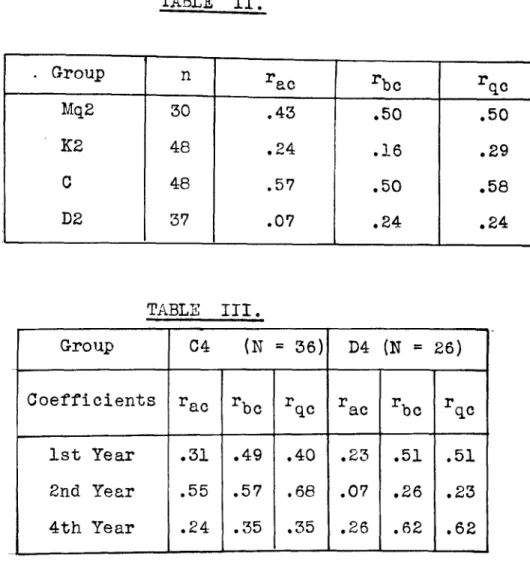
Similar results were obtained when comparisons were
made with second and fourth yeer term examination marks. (See
Tables II and III above). In each case the combined
intelli-gence test results and Arithmetic-English examination giving
higher correlations with term examination marks than either of
these taken separately. The conclusions drawn from the
experiment are that the intelligence test gives the best single
forecast of secondary school progress; that a more accurate
prognosis is obtained when the combined test and examination
results are used; that "abilities measured by the intelligence
tests are not the same as those neasured by the ordinary
examination e.ncl that the conrnon ground between them is not so
great as might be supposed." As both the abilities measured
by the tests and by the examinations Rre important factors
in the determination of success in the secondary school it is
important that a measure of each be a component of the
examination to select ch:i.J.dren for secondary education.
1.
Valentine in his investigations deals mainly with
c.p. Reliability of Examinations.
the results of the entrance examinations and their prognostic
value for secondary education. Four different criteria of
success in the secondary school are taken. (1) The gaining
of a School Certificate four or five years later, (2) the
school's order of merit as deternined by internal examinations,
(3) the order of merit in the School Certificate Examination,
and (4) the order of merit obtained by combining the school's
order of merit with that given by the School Certificate
Examination. The pupils who reached the School Certificate
stage in the secondary school were arranged in order of merit
according to their mark at the extrance examination and this
list was divided into three eq_ual groups, "the top group",
"the middle group" and the "bottom group".
Considerin~ the perform~nce nf the School Certificate
Examination as a measure of the _pupils' success, Valentine
adnits, of course, that the e;aining or losing of a School
Certificate is no reliable estimHte of a pupil's ability since
the award is often separted fro~ the f~ilure by a mere murk or
two. The results (see Table I, ~i.Pllendix I) show how,in all
cases, a large percentage of the cunr1iclates who were placed
in the lowest group at entrance do better than many who were
in the top group. There is thus the possibility that some
who just fail to secure entrance to the secondary school might
have been successful in gaining the Certificate.
A similar result was obtained when the matriculation
examination was considered. The percentage passing the
matriculation standard in the various centres is given in
Table II, Appendix I.
Again, it is e.dmitted that the criterion is not
extremely reliable, the more so as the numbers at this stage
are small. Nevertheless, the results do show that many pupils
in the middle and bottom third at entrance ultimately do better
than a large percentage of those in the top third. The pupils
at the matriculation stage are of a conparatively high ability
level hence it is concluded that the entrance examination fails
also as a method of selecting the pick of the pupils.
As has been 'ointed out, the gaining or losing of a
School Certificate or "rtatriculation" nay depend on a few marks
in a compulsory subject, hence to take these as measures of a
pupil's ability is unsatisfactory. Valentine states that
ua pupil
A,
with total of marks 50% greater than that of pupilmay fail to gain a Certificate, though B gets one."
To avoid this uncertainty Valentine then takes as his
criterion of success ( 1) the order of merit in the School
Certificate Examination, (2) the order of merit in the schools
own examinations at the time of the School Certificate
Exanina-tion, and (3) the order of merit obtained by blending these two
orders. The correlations between each of these three orders
and the order of merit given by the entrance examination were
calculated (See Table III, Appendix I). In each case the
correlations were of such a magnitude as to support Valentine's
conclusion that the entrance examination gives little or no
prediction of the order of merit of the pupils in these
examinations four or five years later.
There is a strong possibility that the chance errors
in the school examinations and the Certificate Examinations
will cancel each other. Added to this is the fact that there
was a high degree of relationship between the order of merit
in the two examinations.
were/
were "75, •69, •87, and •87, giving an average of about •8.
Valentine's conclusion is that the blended orders may therefore
be taken as representinr; with a hig1·: degree of reliability the
examination capacity of the pupils in the subjects taken in
these examinations. The entrance examinations, therefore,
failed to predict this examination ca1)aci ty four or five years
later.
Valentine's investigations deal only slightly with
the use of intelligence tests as part of an entrance examination.
In Centre J, which is considered as having the most reliab+e
entrance examinations, mental tests were introduced along with
other changes such as a rr1.ore detailed standardisat1_o'1 of the
marking of essays and the like. Prior to the introduction of
the tests, the average correlation coefficient between entrance
and School Certificate orders for fifteen classes over a period
of three years was •35, while for the two years, 1926-27, when
the new conditions were in operation,the average correlation
coefficient was ·46.
It is worthy of note, at this point, that a coefficient
of the order of ·5 indicates marked discrepancies between the
1.
two sets of variables compared. Otis has shown that with
1.
statistical Method in Educational Measurements. A.S. Otis. Chicago, 1926. p. 223.
such a coefficient.one third of the successful candidates
should have been replaced by pupils who failed to gain
admission. Indeed, the coefficients between the entrance
examination and the subsequent careers of the pupils are such
that it may be concluded that several who gained admission to
the secondary school should have been excluded while, conversely,
several of the failures would have justified their admission.
Valentine concludes "that at present, there is no
well-established agreenent as to how best to select pupils for the
type of education now usual to secondary schools."
In Centre G, the Headmaster tested the pupils on
entrance with Speerman's intelligence tests and found that
the tests were decidedly superior to the entrance examination.
The actual figures are given in Table IV.
TABLE IV.
-Correlation between 1928 1929
Entrance Examination and School
%
·29 ·03Test and School
%
·43 •57Number 59 14
The 1929 results, of course, mean little due to the
number in the group although the tendency in the superiority of
the test is indicated. Fron these and reference to other
investigations, Valentine concludes that the intellige~ce test
is uore reliable and more valid than the entrance exmaination
but that, on the whole, it seems s1fe to say already that the
co~bination of written examinations plus carefully selected
intelligence tests is likely to supply PJ.ore reliable means
of selecting pupils for secondary schools bt 11+ than will
the examinatioD alone.
Valentine has also tried to find out the causes of
the discrepancies between the entrance examination Rnd the
subsequent attainments of. the candidates in tl1e secondary school.
Sources of error may be chissified into three t;roUIJS ( 1} tlle
unreliability of the criterion (2) the unreliability of the
entrance examination and {3) causes wll:i..ch influence tile child's
performance at the examination.
Considering the reliability of the School Certificate
Examination and the school marks, it seems evident that the
results of these examinations, including as they do the results
of several examinations, would offer less opportunity for chance
errors than a single examination such as nornally civen for
entrance to secondary schools. It has been admitted, of course,
that the passing or failing in the School Certificate
Exam.ina-tion is not of itself a reliable criterion. There is the
possibility that the orders of .r1erit civen by the schools and
the School Certifica-ce ExBI.'l.ination may be unreliable. In four
centres, the average correlation between these orders was ·8,
while for four classes in another centre it was •82, which
shows that the two orders were to a large extent similar.
'\'Jhen the entrance examination order was com.)ured with the
School Certificate order for two groups the coefficients were
·35 and ·3?. Now, as has been indicated, tlle co.r:J.bination of
the school's mm. OJ:'der and that of the Scbool Certificate should
eliminate chance errors but it was found that this blended order
gave no greater correlation with the entrance examination.
The explanation of the discrepancies, therefore, nust be with
the entrance examination or other cauRes.
Another reagon given for the discrepancies nay be that
qualities of character, industry, persistence and the like,
influence the secondary school work to a greater extent. To
test this argument it was decided to investigate the change
within the school's own order over a period of years. Taking
a group of 12 to 13 year olds and comparing their marks after
a year in the secondary school with those after four or five
years the correlation was •?9 (?4). Dealing with a group of
about 1?0, the following results were obtained to give a
com-parison between the school order frofl year to year.
TABLE
V.Correlation of Orders from Year to Year in the Secondary 3chool.
Entrance 4 (or 5)
Order witH 1 2
3 V
1st Year V V School
Order 2 3 V Certificate
4
With age allowance .43