A. Sbardellati, S. Altamura, G. Paonessa, and C. Traboni, J. Virol. 76:7736-7746, 2002). In this report, we have dissected this phenomenon, examining the effects of the insertion of core sequences of different lengths on GBV-B IRES-dependent translation and RNA replication by using experimental approaches aimed at analyz-ing these two aspects independently. The results achieved indicate that an enhancement of translation efficiency does occur and that it correlates with the length of the inserted core sequences. Interestingly, the insertion of these sequences also has a direct similar effect on the efficiency of replication of the GBV-B replicon. These results suggest that in GBV-B replicon RNA and potentially in the complete viral genome, the core coding sequences not only are part of the IRES but also take part in the replication process, independently of the presence of the corresponding whole protein.
Selectable dicistronic replicons that replicate in cultured cells independently from the infection capability of the corre-sponding virus have been described for flaviviruses and pesti-viruses (5, 10, 23, 26, 32, 40). The description of a replicon system for hepatitis C virus (HCV) (26) represented a real milestone for the study of the severe worldwide disease pro-voked by this virus (31), since a true infection system was lacking. The use of HCV subgenomic replicons is supplying a wealth of information about important features of HCV rep-lication and virus-cell interactions (1, 6, 11, 14, 15, 24, 28, 34, 41) as well as about the mechanisms of antiviral drugs (12, 13, 18, 33). Full-length genomic HCV replicons, including the ge-netic information for capsid and envelope proteins, have also been described (7, 13, 20, 33) and might represent an efficient way to select for cells suitable as hosts for viral maturation and infection.
A subgenomic replicon of GB virus B (GBV-B) that repli-cates in cell lines selected from human hepatoma Huh7 cells was previously described (10). The main interest in developing cell-based systems for GBV-B lies in the possibility of using this virus as an indirect but valid alternative to using HCV in animal models (4). In fact, HCV infects only chimpanzees, considered the nearest relative to humans, a fact which sets obvious limitations on the development of in vivo studies. On the contrary, the similar flavivirus GBV-B infects small mon-keys, such as tamarins (Saguinusspp.) (3, 9, 39) and owl mon-keys (Aotus spp.) (8), which present several advantages for research over apes (4).
The construction of chimeric molecules in which part of the GBV-B genome is substituted by its HCV counterpart would be a valuable tool for studying HCV in nonhuman primates,
taking advantage of the capability of GBV-B to replicate in these animals. It is conceivable, however, that these chimeric species would not replicate as efficiently as the wild-type virus, since the necessary interactions among viral genomes and virus and/or host factors would involve elements derived from dif-ferent parental viruses. Preliminary cell-based experiments are thus required to optimize constructs used to challenge cells and, eventually, animals. From this viewpoint, even a moderate enhancement in the replication performance of a construct might be crucial to identifying permissive host cells and “lead constructs” amenable to amelioration.
The work presented here originates from an observation made during experimental work to develop the GBV-B repli-con system (10), based on the selection of permissive clones that depend on neomycin phosphotransferase gene expression driven by the IRES located in the 5⬘untranslated region (5⬘ -UTR) of the GBV-B genome. We noticed that the efficiency of selection of permissive clones was reproducibly enhanced by the inclusion of the first 21 nucleotides (nt) of the GBV-B capsid protein (core) coding sequence immediately down-stream of the GBV-B 5⬘-UTR and in frame with the selector gene.
In this study, we analyzed the effects on the translation of protein products under GBV-B IRES-mediated control and on the replication of subgenomic RNA achieved by the addition of 5⬘-terminal core coding sequences of different lengths down-stream of the GBV-B 5⬘-UTR.
MATERIALS AND METHODS
Cell lines and culture conditions.Human hepatoma cell lines Huh7 and cB76.1/Huh7 (10) were grown in high-glucose Dulbecco’s modified Eagle me-dium (Life Technologies) supplemented with 2 mML-glutamine, 100 U of penicillin/ml, 100g of streptomycin/ml, and 10% fetal bovine serum. Cells were subcultivated twice a week at a 1:5 split ratio. Cells transfected with neomycin-resistant constructs were grown in the presence of 0.250 mg of G418/ml.
Plasmids.The construction of the neo-RepB and bla-RepB GBV-B replicons, containing the first 21 nt following the AUG start codon of the core coding
* Corresponding author. Mailing address: Istituto di Ricerche di Biologia Molecolare P. Angeletti, Via Pontina Km 30,600, 00040 Po-mezia, Rome, Italy. Phone: (39.06) 91093241. Fax: (39.06) 91093654. E-mail: [email protected].
7502
on November 8, 2019 by guest
region upstream of the neomycin phosphotransferase (neo) and-lactamase (bla) genes, respectively, was previously described (10). The RepA, neo-RepC, and neo-RepD constructs were obtained by replacing theBamHI-AscI fragment of neo-RepB with the corresponding fragment including no core coding sequence (neo-RepA) or 39 nt (neo-RepC) or 63 nt (neo-RepD) of core coding sequence after the AUG start codon. The bla-RepA, bla-RepC, and bla-RepD constructs, including the -lactamase (bla) reporter gene downstream of the GBV-B 5⬘-UTR, were obtained by replacing theAscI-PmeI fragment carrying the neomycin phosphotransferase gene of the neo-Rep constructs with theAsc
I-PmeI fragment of bla-RepB carrying the-lactamase gene. Mutations in the polymerase active site (GDD motif to GAA) were constructed for all of the replicon constructs as described previously (10).
Sequence analysis.Sequencing was performed as described previously (10).
Transfection of GBV-B replicon RNA and monitoring of replication.Human hepatoma Huh7 and cB76.1/Huh7 cell lines were used to test the replication of GBV-B replicon constructs. Linearized plasmids carrying replicons were in vitro transcribed by T7 RNA polymerase as described previously (10). Confluent cells from 15-cm plates were split 1:2. Cells were recovered after 24 h in 5 ml of medium, washed twice with 40 ml of cold diethyl pyrocarbonate-treated phos-phate-buffered saline, filtered with Cell Striner filters (Falcon), and diluted in cold diethyl pyrocarbonate-treated phosphate-buffered saline at a concentration of 107cells/ml. Aliquots of 2⫻106cells were subjected to electroporation with 10
g of in vitro-transcribed RNA by two pulses at 0.35 kV and 10F with a Bio-Rad Genepulser II. Immediately after the electric pulses, the cells were diluted in 8 ml of complete Dulbecco’s modified Eagle medium and processed with different protocols depending on the selection or tracer used. For transfor-mation with constructs bearing the neomycin phosphotransferase gene, cells were divided into three 15-cm plates; on the following day, the selecting antibi-otic G418 (Sigma G-9516) was added at 0.250 mg/ml. In 2 weeks, G418-sensitive cells died, and at week 4, surviving cell clones could be picked and expanded by growth in individual plates. When the-lactamase reporter gene was used, 5⫻ 105to 7⫻105 transfected cells were plated in each well of six-well plates
(Falcon) to be stained after 4 h with the membrane-permeating substrate CCF2 (Aurora Biosciences Corporation) (30, 43), which can be hydrolyzed by the intracellular-lactamase, resulting in a fluorescence shift from green to blue. When quantitative PCR was used to measure transient replication after the transfection of either bla-Rep or neo-Rep RNA, 1⫻105to 2⫻105cells were
plated in each well of six-well plates. After 3 days, total RNA was purified as described for the TRIzol protocol (Life Technologies), and 10l from the 100l of total RNA recovered was used in each TaqMan reaction. The electroporation efficiency was monitored by measuring intracellular specific RNA soon after electroporation by the TaqMan reaction.
TaqMan quantification of GBV-B RNA.GBV-B RNA was quantified by a real-time, 5⬘exonuclease PCR (TaqMan) assay with a primer-probe set that recognized a portion of the GBV-B 5⬘-UTR. The primers (GBV-B-F3, GTAG GCGGCGGGACTCAT; and GBV-B-R3, TCAGGGCCATCCAAGTCAA) and the probe (GBV-B-P3, 6-carboxyfluorescein-TCGCGTGATGACAAGCG CCAAG-N,N,N⬘,N⬘-tetramethyl-6-carboxyrhodamine) were selected by using Primer Express software (PE Applied Biosystems). The primers were used at 10 pmol/50-l reaction, and the probe was used at 5 pmol/50-l reaction. The reactions were performed by using a TaqMan Gold reverse transcription-PCR kit (PE Applied Biosystems) and included a 30-min reverse transcription step at 48°C, followed by 10 min at 95°C and by 40 cycles of amplification with universal TaqMan standardized conditions (denaturation for 15 s at 95°C followed by annealing-extension for 1 min at 60°C). Standard RNA was transcribed by using a T7 Megascript kit (Ambion) and was purified by DNase treatment, phenol-chloroform extraction, Sephadex G-50 filtration, and ethanol precipitation. RNA was quantified by measuring the absorbance at 260 nm and was stored at⫺80°C. All reactions were run in duplicate by using an ABI Prism 7700 or 7900 sequence detection system (PE Applied Biosystems). The PE Applied Biosystems specific primer set was used to quantify the endogenous reference human glyceralde-hyde-3-phosphate dehydrogenase mRNA. Whenever necessary, RNA extracted from cells transfected with RNA from replication-defective Rep-GAA mutant constructs was used as a calibrator. Results from two independent experiments were analyzed by using the comparative threshold cycle method.
In vitro translation.In vitro-transcribed RNA (1g), prepared as described above, was translated with a rabbit reticulocyte lysate system (Promega) by incubation for 1 h at 30°C in a 30-l final volume under the conditions suggested by the manufacturer. 35S-Met (Promix; Amersham Pharmacia Biotech) was
incorporated as a radioactive tracer. Aliquots of the in vitro translation reaction were analyzed by sodium dodecyl sulfate– 10 or 12% polyacrylamide gel elec-trophoresis, followed by treatment of the gels with Amplify (Amersham Phar-macia Biotech) and X-ray film exposure. The gels were also scanned with a Storm 820 Phosphorimager (Molecular Dynamics), and densitometric analysis of the radioactive bands was obtained with the program Image Quant.
Nucleotide sequence accession number. The nucleotide sequence of the GBV-B neo-RepB construct is available in the DDBJ/EMBL/GenBank nucleo-tide sequence database under accession number AJ428955.
RESULTS
The efficiency of selection of G418-resistant cell lines bear-ing GBV-B subgenomic replicons depends on the lengths of FIG. 1. Schematic representation of GBV-B neo-Rep and bla-Rep constructs. The nucleotide sequences below the drawing show the boundary between the GBV-B 5⬘-UTR and theneoorblagene. The portion belonging to the GBV-B 5⬘-UTR is underlined, that representing translated GBV-B sequences is shown in bold type, the sequence corresponding to aPmeI restriction site is shown in italic type, and the start Met of either neomycin phosphotransferase or-lactamase is shown in plain type. The translated sequences are organized in nucleotides triplets, and the corresponding amino acids are indicated below each cognate nucleotide sequence.
on November 8, 2019 by guest
http://jvi.asm.org/
the core coding sequences inserted downstream of the GBV-B 5ⴕ-UTR.Two series of GBV-B dicistronic replicons were con-structed in which the GBV-B IRES contained in the 5⬘-UTR modulates the translation of an exogenous selector or reporter gene in the first cistron and the encephalomyocarditis virus (EMCV) IRES directs the translation of GBV-B nonstructural proteins in the second cistron. The only difference between the constructs belonging to the two series was the length of a stretch of nucleotides that corresponded to the 5⬘end of the GBV-B open reading frame encoding the N terminus of the capsid (core) protein and that was inserted immediately down-stream of the GBV-B 5⬘-UTR and in frame with the exogenous gene in the first cistron.
The portions of the plasmids spanning the inserted core coding sequences are schematized in Fig. 1 both for the series of four replicons bearing the selector gene (encoding neomycin phosphotransferase;neo) and for the series bearing the non-selector reporter gene (encoding -lactamase; bla). The A version of each replicon series lacks any core coding sequence, whereas the B, C, and D versions include 21, 39, and 63 nt, respectively, after the AUG start codon. The rationale of the choice of these specific fragments is based on literature data that are referred to in the Discussion. The rationale for the use of both theneoand theblareplicons lies mainly in the possi-bility of using the first ones to select for replication and the second ones to examine translation efficiency in cells with a convenient colorimetric assay and in the absence of selection.
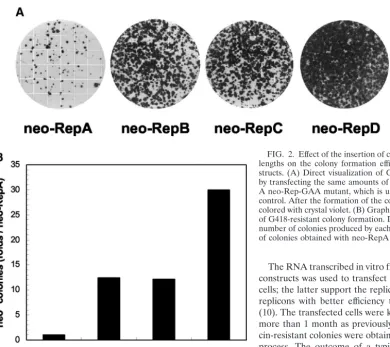
The RNA transcribed in vitro from each of the four neo-Rep constructs was used to transfect both Huh7 and cB76.1/Huh7 cells; the latter support the replication of GBV-B subgenomic replicons with better efficiency than the original Huh7 cells (10). The transfected cells were kept under G418 selection for more than 1 month as previously described (10), and neomy-cin-resistant colonies were obtained at the end of the selection process. The outcome of a typical experiment with original Huh7 cells is shown in Fig. 2A. The results indicated that the constructs bearing core sequences produced a significantly and reproducibly higher number of G418-resistant colonies than the construct (neo-RepA) in which the GBV-B 5⬘-UTR was immediately followed by the neo gene. The colony number increase was also related to the core sequence length: a 12-fold increase was observed with the addition of 21 or 39 nt of the core gene, whereas a 30-fold increase was reached with the addition 63 nt (Fig. 2B).
The presence of core coding sequences downstream of the 5ⴕ-UTR increases the replication potential of GBV-B sub-genomic replicons in cultured cells. We decided to explore whether the overall increase in the efficiency of colony forma-tion observed upon the inserforma-tion of core coding sequences between the 5⬘-UTR and the neogene resulted from an in-creased efficiency of replication of the constructs per se, inde-pendently from the G418 selection mechanism. We addressed this issue by measuring the GBV-B RNA levels in the absence of selection a short time after the transfection of RNA tran-scribed from both series of constructs, the neo-Rep constructs grown with G418 omitted from the culture medium and the constructs in which theneogene was replaced by the reporter
-lactamase gene (bla), which does not produce a selective advantage (10, 30, 43).
In order to achieve detectable levels of replication even shortly after transfection, enhanced cB76.1/Huh7 cells were used as the host and TaqMan was used for analysis, not only because it allows quantitative measurements but also because it is sensitive enough to specifically detect a low number of
lengths on the colony formation efficiency of GBV-B neo-Rep con-structs. (A) Direct visualization of G418-resistant colonies produced by transfecting the same amounts of neo-Rep RNAs into Huh7 cells. A neo-Rep-GAA mutant, which is unable to replicate, was used as a control. After the formation of the colonies, the plates were fixed and colored with crystal violet. (B) Graphic representation of the efficiency of G418-resistant colony formation. Data are reported as ratios of the number of colonies produced by each transfected RNA to the number of colonies obtained with neo-RepA RNA.
on November 8, 2019 by guest
[image:3.603.52.442.67.414.2]molecules per cell, such as that of plus-strand GBV-B replicon RNA (10). Unfortunately, in the GBV-B replicon system not even this method is suitable for obtaining reliable results with the much less represented minus-strand RNA, which is the replication intermediate form found in the flaviviruses life cy-cle. Figure 3 shows the results of TaqMan analysis at 3 days after transfection, in which the intracellular replicon RNA levels reached by the bla-Rep constructs and by a nonreplicat-ing control mutant were measured and compared to the levels reached by each construct in the presence of the known anti-viral agent alpha interferon (IFN-␣). The results indicated that transient replication of the bla-Rep RNAs only occurred in the absence of IFN-␣and was more efficient for constructs includ-ing core codinclud-ing sequences. These results reproducibly con-firmed the trend observed with the G418 selection of resistant colonies, i.e., an improvement from RepA to RepD constructs (Fig. 2), although with quantitative differences in the relative efficiencies of the four variants. The latter was especially evi-dent when bla-RepA was compared to the other constructs; e.g., with transient replication, RepD RNA was only threefold more abundant than RepA RNA. The sensitivity to the known antiviral agent IFN-␣(Fig. 3) was coherent with the interpre-tation that the increase in RNA levels was due to replication enhancement rather than to an increase in the stability of the RNA itself.
The improved efficiency of replication of the bla-Rep con-structs with longer core coding sequences was also confirmed by performing the transient replication experiments with the series of neo-Rep constructs in the absence of G418; in this case, the difference between the amount of intracellular RNA produced by transfection with neo-RepA and that obtained with the other constructs was slightly smaller than the differ-ence observed with the bla-Rep constructs (data not shown). Overall, these results indicate that the presence and length of core coding sequences affect the efficiency of replication of GBV-B replicons independently from effects on IRES-medi-ated translation.
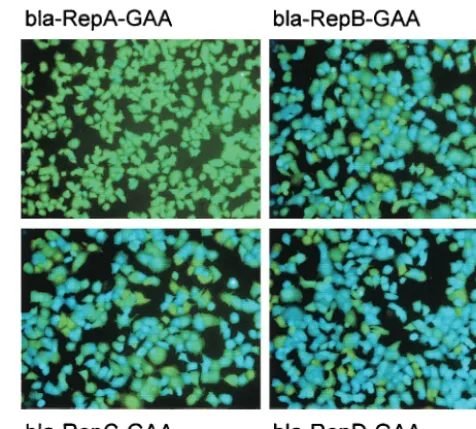
[image:4.603.302.540.70.284.2]The presence of core coding sequences in GBV-B sub-genomic replicons increases the expression of downstream reporter genes in cultured cells and in vitro.We next exam-ined, with both in vivo and in vitro experimental approaches, whether adding core coding sequences between the GBV-B 5⬘-UTR and downstream genes also affects GBV-B IRES-mediated translation independently from replication. For in vivo experiments, we exploited the-lactamase reporter sys-tem to examine the expression of the reporter gene in cells transfected with the four bla-Rep constructs described in Fig. 1 by a colorimetric assay (10, 30, 43). To analyze the specific contribution made by the core gene to the efficiency of trans-lation of the downstreamblagene in the absolute absence of replication, we generated a corresponding mutant unable to replicate for each bla-Rep construct. This was done by mutat-ing the GDD motif in the active site of the NS5B polymerase gene into the inactive GAA sequence (10). The cB76.1/Huh7 cell line was transfected with RNA transcribed in vitro from the four bla-Rep-GAA mutant constructs, and the-lactamase assay was performed at 4 h after transfection to detect tran-sient expression of the reporter. The results indicated that the ratio between the number of blue cells expressing-lactamase and the number of background green cells progressively in-creased from bla-RepA to bla-RepD (Fig. 4). Moreover, trans-fection with the construct lacking core coding sequences (bla-RepA) generated only pale blue cells barely distinguishable from green nontransfected cells. All bla-Rep-GAA constructs were confirmed as unable to replicate by TaqMan measure-ments of RNAs at different times after transfection in cB76.1/ Huh7cells (data not shown). The use of replication-defective
FIG. 3. Effect of core coding sequences on GBV-B replication ef-ficiency. Amounts of RNAs were measured by TaqMan reactions 3 days after transfection of cB76.1/Huh7 cells with bla-Rep RNAs in the absence and in the presence of IFN-␣. The amount of RNA detected in each transfection is reported relative to that obtained with a non-replicating control.
FIG. 4. Effect of core coding sequences on GBV-B IRES-mediated translation in vivo. cB76.1/Huh7 cells were transfected with the four bla-Rep-GAA RNAs, stained 4 h posttransfection as described in Materials and Methods, observed with a ⫻10-magnification micro-scope lens, and photographed with UV light. The cells stained blue contain detectable-lactamase levels; the cells stained green are back-ground nontransfected cells or cells producing-lactamase amounts below the detection threshold. The bla-Rep RNA used for each trans-fection is specified for each panel.
on November 8, 2019 by guest
http://jvi.asm.org/
[image:4.603.44.287.70.229.2]mutants was chosen to rule out any possibility of replication-dependent artifacts. However, we observed results similar to those obtained with GAA mutants even with replication-com-petent constructs when we performed the assay at 4 h after transfection (data not shown).
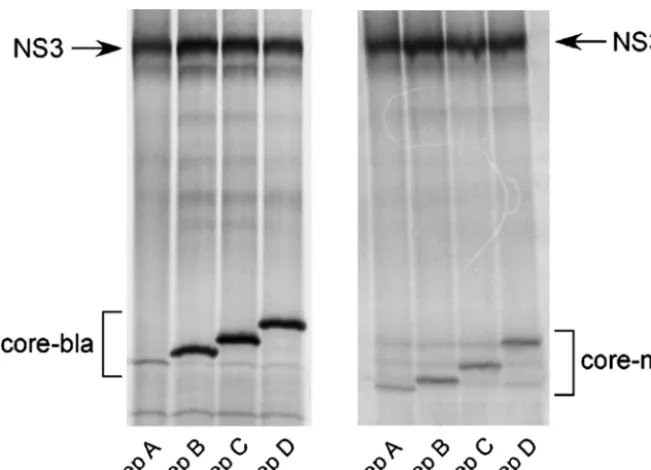
In vitro experiments were performed by translating RNAs from both neo-Rep and bla-Rep constructs in a rabbit reticu-locyte system. Figure 5 shows autoradiograms from represen-tative experiments. An increase in the level of the translation product was observed from RepA to RepD constructs, inde-pendently from the reporter (neoorbla) used, even though the differences in the constructs were reproducibly higher with the
bla constructs. These results showed the same hierarchy of functionality among the different replicon versions as that ob-served in in vivo experiments (Fig. 4). The relative amounts of the GBV-B IRES-dependent translation products ( -lacta-mase and neomycin phosphotransferase) produced were cal-culated for each construct upon normalization to an internal control, i.e., the NS3 protein. In these replicons, in fact, the translation of the nonstructural GBV-B protein associated with the second cistron of each construct is controlled by an exogenous (EMCV) IRES and is not affected by GBV-B IRES activity. The relative increases in the levels of the GBV-B IRES-mediated translation products of RepB, RepC, and RepD with respect to RepA were 10-, 15-, and 27-fold, respec-tively, for theblaconstructs and 1.25-, 2.7-, and 3.5-fold for the
neoconstructs. No Met residue, besides the starting Met, was present in the core sequences fused to the reporters, so that, within each series, the differences in the intensities of the fusion proteins translated under the control of the GBV-B IRES cannot be attributed to different radioactive tracer
amounts. The apparently higher efficiency of translation for the
blaconstructs than for theneoconstructs (Fig. 5) does reflect in part the higher number of Met residues present in -lacta-mase than in neomycin phosphotransferase (11 and 7, respec-tively).
Western blotting aimed at evaluating the intracellular amounts of neomycin phosphotransferase protein obtained af-ter transfection of the four neo-Rep constructs, although show-ing a high background due to the commercial polyclonal serum used, seemed to confirm that in cell extracts as well the non-fusion protein encoded by neo-RepA was present at lower levels than the fusion proteins encoded by the other constructs of the series (data not shown).
DISCUSSION
[image:5.603.130.456.68.303.2]The 5⬘-UTR of the GBV-B RNA genome has been hypoth-esized to fold into a secondary structure similar to those of HCV and pestiviruses, although with distinctive features (19, 25, 36). Like HCV, GBV-B contains a functional IRES (17, 36) directing cap-independent translation of downstream se-quences. The first published data on GBV-B IRES-mediated translation, based on the detection of the secreted alkaline phosphatase reporter protein upon in vitro translation of di-cistronic expression constructs (17), experimentally demon-strated that AUG446 is the Met starting codon. Results ob-tained with similar constructs exploiting the chloramphenicol acetyltransferase (CAT) reporter protein fused to GBV-B core coding sequences of different lengths (36) seemed to indicate that AUG446 is also the 3⬘ limit of the GBV-B IRES, since efficient translation did not require any core sequence; on the
FIG. 5. Effect of core coding sequences on GBV-B IRES-mediated translation in vitro. Autoradiograms of two sodium dodecyl sulfate-polyacrylamide gels showing the analysis of in vitro-translated bla-Rep (left) and neo-Rep (right) RNAs. The NS3 protein product of each autoradiogram is indicated. Brackets beside the autoradiograms indicate the sections of the gels in which the four reporters of each series, bearing N-terminal fusion fragments of increasing lengths, migrate. The relative amounts of the GBV-B IRES-dependent translation products, calculated by densitometric measurement and normalization to the EMCV IRES-dependent NS3 protein internal control, are reported in the text and correspond to the means for two independent experiments.
on November 8, 2019 by guest
brand and colleagues also suggested that in the HCV genome, an A-rich sequence present downstream of the 5⬘-UTR corre-sponds to nt 15 to 31 of the coding region (38). This sequence affects the efficiency of translation of the wild-type HCV polyprotein, which is higher than that of some currently used reporters showing strong secondary structures which interfere with binding to ribosomes. Comparison of the HCV genome sequence to that of GBV-B led the authors to hypothesize that an A-rich sequence spanning nt 43 to 59 of the coding region (40 to 56 nt after AUG) plays a similar role in GBV-B. This hypothesis was experimentally tested by inserting a stable hair-pin structure at the 5⬘end of the CAT gene and comparing the efficiencies of translation of RNAs transcribed from constructs with increasingly longer GBV-B core coding sequences with and without that hairpin (38). That experiment demonstrated that the addition of sequences including the putative A-rich box upstream of the CAT gene improved its translation effi-ciency.
In a previous study aimed at the development of a selectable GBV-B subgenomic dicistronic replicon (10), two versions of the GBV-B replicon, neo-RepA and neo-RepB, were con-structed. These contained in the first cistron no GBV-B coding sequence and a stretch of nucleotides of the core gene imme-diately upstream of the neomycin phosphotransferase gene, respectively. Antibiotic-resistant colonies formed more effi-ciently when cells were transfected with RNA transcribed from the neo-RepB construct, so that construct was used for subse-quent experiments. In order to optimize GBV-B-based con-structs, such as chimeric replicons bearing non-GBV-B viral sequences, expected to have a lower intrinsic replication po-tential, we decided to further analyze the effects of inserting GBV-B coding sequences between the GBV-B 5⬘-UTR and exogenous genes.
We first compared the efficiencies of colony formation upon transfection of subgenomic constructs bearing core coding re-gions of increasing lengths up to 63 nt, located between the 5⬘-UTR and the selector gene used in the previous study (neo). The choice of inserted fragments was based on published data (see above) indicating a possible involvement in translation efficiency of a GBV-B core gene “box” which was included in the longest segment used (38). The results of these experi-ments confirmed that the number of colonies supporting the replication of GBV-B replicons increased in proportion to the lengths of the added core sequences. The different efficiencies of the overall process of colony formation might imply a vari-ation in the efficiency of GBV-B RNA replicvari-ation or of trans-lation of the protein responsible for selection or both. To clarify this issue, we performed cell-based short-term
experi-resulted in a low number of positive cells that also were very poorly stained, suggesting that a suboptimal level of  -lacta-mase was produced per cell. The effect of the insertion of core sequences on translation was confirmed by in vitro experiments directly measuring the amount of protein produced in a short incubation time with bothneoandblaconstructs. The findings were consistent with the interpretation that the results of in vivo experiments detecting-lactamase activity did reflect the amount of-lactamase. Moreover, preliminary data obtained by Western blotting of total proteins from transfected cells show that the lack of core coding sequences actually correlates with the presence of smaller amounts of IRES-dependent translated products even in cells. Nonetheless, although not probable, the possibility cannot in principle be excluded that an increase in the length of the N-terminal partner of the core-reporter fusion proteins may augment the enzymatic ac-tivity or stability of the-lactamase and/or neomycin phospho-transferase fusion proteins in cells, rather than increase their synthesis, compared to the wild-type proteins.
Our data are comparable to those obtained by Rijnbrand et al. (38) by in vitro transcription-translation of a core-CAT plasmid containing a hairpin loop stabilizing the RNA struc-ture. These data are also compatible with the hypotheses that
blaand, to a lesser extent,neowild-type reporters have 5⬘-end RNA structures stronger than the corresponding region of the RNA encoding the CAT protein and that the translation effi-ciency is increased by the insertion of less stable core coding sequences upstream of the reporter genes. The hypothesis that an A-rich box spanning nt 40 to 56 of the GBV-B core gene is responsible for the increase in translation efficiency is not com-pletely matched by our data, since the construct including core sequences up to nt 39 also was efficiently translated. We ob-served the maximum difference in translation efficiency in the transition from 0 to 21 nt of the core sequence added after the start codon. The effect of inserting core coding sequences upstream of the reporter genes might also be due to nonspe-cific, sequence-independent spacing which locates the 5⬘ends of theneoandblareporter sequences farther from the AUG start codon. We tried to address this issue by applying a com-puter-based prediction approach, but the predicted stability did not consistently correlate with the observed efficiency of translation of the compared structures (data not shown). We observed that even minor differences in the lengths of the fragments used in folding predictions significantly affected the outcome of the elaborations. On the other hand, achieving an unequivocal experimental demonstration or disproof of the above-mentioned hypotheses exceeds the aim of this study. Our results indicate that, by whatever mechanism, the
on November 8, 2019 by guest
http://jvi.asm.org/
being transfected into cells cultured in the absence of G418 and one type bearing just a reporter gene (bla). In both situ-ations, GBV-B RNA amounts increased in relation to core gene sequence lengths, suggesting that these sequences also play a role in the replication process. The effect of inserted core sequences on replication was less dramatic than that on protein translation; this finding was especially evident when we analyzed the differences between bla-RepA and the other con-structs within the bla-Rep series. At the present time, we do not have data allowing speculations about the mechanism through which core coding sequences are involved in replica-tion, and no information has been reported so far by other groups dealing with any aspect of GBV-B replication. More experiments are necessary to determine whether these regions interact with viral or host cell proteins or with othercis-acting elements of the viral genome directly or by means of long-range bridging proteins, as suggested for HCV (2, 16, 21, 22, 29).
Overall, the above-described data indicate that in GBV-B dicistronic replicons, both replication and expression of genes controlled by the 5⬘GBV-B IRES are influenced by the pres-ence and length of sequpres-ences coding for the N terminus of the GBV-B polyprotein. The effects on GBV-B IRES-mediated translation and replication do not seem to be necessarily linked by a cause-effect relationship, as shown by the possibility of segregating the two functions. The occurrence of independent phenomena might be suggested further by the stronger effect on translation than on transient replication, which was partic-ularly evident with constructs lacking core sequences (RepA constructs), which were clearly more hampered for translation than for replication with respect to constructs bearing core sequences. It is also interesting that even minor effects in either translation or replication efficiency shortly after transfection (as in the case of neo-Rep constructs) might determine a stronger overall difference when combined in a long-term pro-cess, such as the selection of antibiotic-resistant cell clones. However, it must considered that, in the G418-based selection process, even very small amounts of neomycin phosphotrans-ferase are sufficient to generate resistance to G418 in cultured cells, as suggested by the transiently resistant cell phenotype observed for several days even with the transfection of repli-cation-deficient mutants (data not shown). This observation is in keeping with the hypothesis that, to determine a higher number of selected colonies bearing the GBV-B replicon, at least in this selection process, an enhancement of RNA repli-cation efficiency is more valuable than an increase in the base
C.
ACKNOWLEDGMENTS
We are particularly grateful to Giacomo Paonessa, Licia Tomei, and Giovanni Migliaccio for helpful discussions and critical reading of the manuscript. Manuela Emili helped with artwork, and Janet Clench helped by revising the manuscript. We also thank Raffaele De Francesco and Riccardo Cortese for continuous support.
REFERENCES
1. Bartenschlager, R., and V. Lohmann.2001. Novel cell culture systems for the hepatitis C virus. Antiviral Res.52:1–17.
2. Beales, L. P., D. J. Rowlands, and A. Holzenburg.2001. The internal ribo-some entry site (IRES) of hepatitis C virus visualized by electron microscopy. RNA7:661–670.
3. Beames, B., D. Chavez, B. Guerra, L. Notvall, K. M. Brasky, and R. E. Lanford.2000. Development of a primary tamarin hepatocyte culture system for GB virus B: a surrogate model for hepatitis C virus. J. Virol.74:11764– 11772.
4. Beames, B., D. Chavez, and R. E. Lanford.2001. GB virus B as a model for hepatitis C virus. ILAR J.42:152–160.
5. Behrens, S. E., C. W. Grassmann, H. J. Thiel, G. Meyers, and N. Tautz.1998. Characterization of an autonomous subgenomic pestivirus RNA replicon. J. Virol.72:2364–2372.
6. Blight, K. J., A. A. Kolykhalov, and C. M. Rice.2000. Efficient initiation of HCV RNA replication in cell culture. Science290:1972–1974.
7. Blight, K. J., J. A. McKeating, and C. M. Rice.2002. Highly permissive cell lines for subgenomic and genomic hepatitis C virus RNA replication. J. Vi-rol.76:13001–13014.
8. Bukh, J., C. L. Apgar, S. Govindarajan, and R. H. Purcell.2001. Host range studies of GB virus-B hepatitis agent, the closest relative of hepatitis C virus, in New World monkeys and chimpanzees. J. Med. Virol.65:694–697. 9. Bukh, J., C. L. Apgar, and M. Yanagi.1999. Toward a surrogate model for
hepatitis C virus: an infectious molecular clone of the GB virus-B hepatitis agent. Virology262:470–478.
10. De Tomassi, A., M. Pizzuti, R. Graziani, A. Sbardellati, S. Altamura, G. Paonessa, and C. Traboni.2002. Cell clones selected from the Huh7 human hepatoma cell line support efficient replication of a subgenomic GB virus B replicon. J. Virol.76:7736–7746.
11. Egger, D., B. Wolk, R. Gosert, L. Bianchi, H. E. Blum, D. Moradpour, and K. Bienz.2002. Expression of hepatitis C virus proteins induces distinct membrane alterations including a candidate viral replication complex. J. Vi-rol.76:5974–5984.
12. Frese, M., T. Pietschmann, D. Moradpour, O. Haller, and R. Barten-schlager.2001. Interferon-alpha inhibits hepatitis C virus subgenomic RNA replication by an MxA-independent pathway. J. Gen. Virol.82:723–733. 13. Frese, M., V. Schwarzle, K. Barth, N. Krieger, V. Lohmann, S. Mihm, O.
Haller, and R. Bartenschlager.2002. Interferon-gamma inhibits replication of subgenomic and genomic hepatitis C virus RNAs. Hepatology35:694–703. 14. Friebe, P., and R. Bartenschlager.2002. Genetic analysis of sequences in the 3⬘nontranslated region of hepatitis C virus that are important for RNA replication. J. Virol.76:5326–5338.
15. Friebe, P., V. Lohmann, N. Krieger, and R. Bartenschlager.2001. Sequences in the 5⬘nontranslated region of hepatitis C virus required for RNA repli-cation. J. Virol.75:12047–12057.
16. Gosert, R., K. H. Chang, R. Rijnbrand, M. Yi, D. V. Sangar, and S. M. Lemon.2000. Transient expression of cellular polypyrimidine tract binding protein stimulates cap-independent translation directed by both picornaviral and flaviviral internal ribosome entry sites in vivo. Mol. Cell. Biol.20:1583– 1595.
on November 8, 2019 by guest
22. Ito, T., S. M. Tahara, and M. M. Lai.1998. The 3⬘-untranslated region of hepatitis C virus RNA enhances translation from an internal ribosomal entry site. J. Virol.72:8789–8796.
23. Khromykh, A. A., and E. G. Westaway.1997. Subgenomic replicons of the flavivirus Kunjin: construction and applications. J. Virol.71:1497–1505. 24. Krieger, N., V. Lohmann, and R. Bartenschlager.2001. Enhancement of
hepatitis C virus RNA replication by cell culture-adaptive mutations. J. Vi-rol.75:4614–4624.
25. Lemon, S. M., and M. Honda.1997. Internal ribosome entry sites within the RNA genomes of hepatitis C virus and other flaviviruses. Semin. Virol.
8:274–288.
26. Lohmann, V., F. Korner, J. Koch, U. Herian, L. Theilmann, and R. Barten-schlager.1999. Replication of subgenomic hepatitis C virus RNAs in a hepatoma cell line. Science285:110–113.
27. Lu, H. H., and E. Wimmer.1996. Poliovirus chimeras replicating under the translational control of genetic elements of hepatitis C virus reveal unusual properties of the internal ribosomal entry site of hepatitis C virus. Proc. Natl. Acad. Sci. USA93:1412–1417.
28. Mottola, G., G. Cardinali, A. Ceccacci, C. Trozzi, L. Bartholomew, M. R. Torrisi, E. Pedrazzini, S. Bonatti, and G. Migliaccio.2002. Hepatitis C virus nonstructural proteins are localized in a modified endoplasmic reticulum of cells expressing viral subgenomic replicons. Virology293:31–43.
29. Murakami, K., M. Abe, T. Kageyama, N. Kamoshita, and A. Nomoto.2001. Down-regulation of translation driven by hepatitis C virus internal ribosomal entry site by the 3⬘untranslated region of RNA. Arch. Virol.146:729–741. 30. Murray, E. M., J. A. Grobler, E. J. Markel, M. F. Pagnoni, G. Paonessa, A. J. Simon, and O. A. Flores.2003. Persistent replication of hepatitis C virus
RNA: the ribosome entry site is at the authentic initiation codon. RNA
2:867–878.
36. Rijnbrand, R., G. Abell, and S. M. Lemon.2000. Mutational analysis of the GB virus B internal ribosome entry site. J. Virol.74:773–783.
37. Rijnbrand, R., P. Bredenbeek, T. van der Straaten, L. Whetter, G. In-chauspe, S. Lemon, and W. Spaan.1995. Almost the entire 5⬘non-translated region of hepatitis C virus is required for cap-independent translation. FEBS Lett.365:115–119.
38. Rijnbrand, R., P. J. Bredenbeek, P. C. Haasnoot, J. S. Kieft, W. J. Spaan, and S. M. Lemon.2001. The influence of downstream protein-coding se-quence on internal ribosome entry on hepatitis C virus and other flavivirus RNAs. RNA7:585–597.
39. Sbardellati, A., E. Scarselli, E. Verschoor, A. De Tomassi, D. Lazzaro, and C. Traboni.2001. Generation of infectious and transmissible virions from a GB virus B full-length consensus clone in tamarins. J. Gen. Virol.82:2437– 2448.
40. Shi, P. Y., M. Tilgner, and M. K. Lo.2002. Construction and characterization of subgenomic replicons of New York strain of West Nile virus. Virology
296:219–233.
41. Tardif, K. D., K. Mori, and A. Siddiqui.2002. Hepatitis C virus subgenomic replicons induce endoplasmic reticulum stress activating an intracellular signaling pathway. J. Virol.76:7453–7459.
42. Tsukiyama-Kohara, K., N. Iizuka, M. Kohara, and A. Nomoto.1992. Inter-nal ribosome entry site within hepatitis C virus RNA. J. Virol.66:1476–1483. 43. Zlokarnik, G., P. A. Negulescu, T. E. Knapp, L. Mere, N. Burres, L. Feng, M. Whitney, K. Roemer, and R. Y. Tsien.1998. Quantitation of transcription and clonal selection of single living cells with beta-lactamase as reporter. Science279:84–88.