Mathematics and Dumping Lectures?
Another Perspective on the Shift Towards Learner Pragmatism
PATRICIA. C. CRETCHLEY
Department of Mathematics & Computing, University of Southern Queensland, Toowoomba, Queensland 4350, Australia.
Abstract
A provocative report by Dolnicar [1] proposes that a shift towards learner pragmatism “defines the reality” of the current tertiary learning environment. It identified a group of so-called “pragmatics” (17% of the students investigated, and mainly Commerce and IT students) who claimed that they attended lectures almost solely to gain essential course information, as against enjoyment or to learn. This group is reported to have claimed the lowest levels of lecture attendance, yet delivered “the highest grade point average of the students in the study”. Are Mathematics students pragmatic in the sense that they only come to lectures to obtain essential course information, not to learn or enjoy? Are Mathematics lectures valuable in that they have an effect on performance? I present data from 85 Mathematics and Engineering students in an Algebra & Calculus course in Australia, in which all resources were readily accessible outside of lectures. Students attending class two thirds of the way through the course achieved statistically higher levels of performance on all but one of the course assessment items (significant at the .05 level) than those not in class at that point. “Strategic” learning styles, which may characterise the “pragmatics” described in [1], yielded only small non-significant
correlations with performance. Lecture attendance has diminished very little in this Mathematics course, despite full and easy access to all course information and materials, online and in hardcopy. Hence there was little evidence of the pragmatism reported in [1] for Commerce and IT students. A follow-up study indicated that mathematics attendees regarded lectures as an efficient and companionable way to meet new material and build understanding and confidence. Lectures were motivating, enjoyable, kept students on track, provided a sense of community and common purpose, and clearly suited those who prefer learning by hearing, seeing and asking, rather than reading. The strong relationship between attendance and mathematics performance
indicates the value of explicit teaching. Clearly ICT alternatives need quality resourcing and careful support.
AMS Subject Classification: 97C; 97D
1 Introduction: Students and face-to-face lectures
gather and manage information, and claims of short attention spans (as low as 10 to 15 minutes) are being fuelled by a plethora of fast technology-based activities for both leisure and learning.
Questions arise about the value of one or two-hour lectures, no matter how stimulating and interesting. Explicit face-to-face teaching is offered on the grounds that it is effective and efficient to resource. However, ICT’s and multimedia offer increasingly attractive packages for transmission of information, with full flexibility. Moreover, arguments about internet access no longer hold, with CD’s providing an inexpensive and convenient alternative. Burning questions are:
• Are the benefits (real or perceived) of lectures largely lost on a body of Generation Y pragmatists? • How can we tell if we are wasting time and resources designing and delivering classes to today’s
undergraduates?
• If the demise of lectures is inevitable, should we not advance the transition period by investing in the resourcing of technology alternatives?
Whatever the current trends and philosophies, there is substantial and documented evidence across a wealth of educational literature that teacher-centred learning has a strong positive effect on student performance. Hattie’s meta-analysis [2], for example, confirms that quality face-to-face teaching has a strong positive effect on students performance. That study investigated the educational effects on performance of a full range educational interventions reported in 160,000 studies of more than three decades of education research covering more than 50 million students across all disciplines and levels. The highest effects were associated with quality direct instruction, and quality feedback and remedial help, with motivation to improve. Clearly this study does not include the effects of burgeoning experience of new pedagogies. Educational technologies provide a host of new opportunities, and online stimuli are replacing the role of teacher, and the effects of these are probably being felt most keenly at tertiary level.
What do reasonably recent studies reveal about undergraduate lectures? Nothing surprising:
• That student variables (affect, cognition, behaviour, motivation) affect what they get out of lectures [3] • That expressive enthusiastic teaching behaviours relate to higher levels of student achievement [4] • That the lecturer communicating enthusiasm for the topic is effective in lectures [5],[6],[7],[8] • That meaningful context, and applying information in the lecture, are effective [9],[5], [10] • That large classes may cause some barriers [11]
And what do reports reveal about the reasons why students attend lectures? A range of responses:
• That enjoyment is the main factor for attendance, followed by concerns about difficult material [12] • That some attend to acquire current information [8], and assessment information [6]
What about disciplinary differences?
• That indeed there are some, at least for lecture attendance levels and motivation [12]
• That science use lectures as a way into their reading, whereas arts students use them to help interpret what they have read [13]
Observations of discipline differences are not surprising to those who teach Mathematics, and these pointers highlight the need for caution when interpreting and generalizing findings from other disciplines.
2 Is there growing learner pragmatism in our undergraduate classes?
Are changes in our student body resulting in a creeping learner pragmatism that affects learning attitudes and preferences? Are students prioritizing fast and flexible access of core information over deeper learning goals? Certainly access to technology, pursuit of studies for professional rather than academic reasons, and learners accommodating work and family commitments, may be powerful agents for change. Do we still need lectures, or should flexible online delivery and ICT’s take their place? In a recent study of reasons why undergraduates attend lectures, Dolnicar [1] collected data from 612 students in Australia. Students were invited to say if each of 12 listed reasons applied to them or not. I summarise and group the data that emerged below:
Highest frequencies of agreement were associated with “information” gathering: • to find out what they are supposed to learn (78 % agreement)
• not to miss important information (72%) • to find out about assessment tasks (59%) Moderate frequencies were related to learning:
• make sure I learn fundamentals (45% agreement) • easier than learning it myself (43%)
• make knowledge meaningful (39%) Expectation:
• expected to be there (30% agreement) Lowest frequencies for a mixed range of factors:
• work on problems (22% agreement) • find out real world application (21%) • enjoy them (21%)
• find out latest thinking (20%) • enthuses me (17%)
Dolnicar notes the relatively high frequency of responses on gaining essential information, compares this data with studies from the 1970’s, and claims there is a shift towards lectures being viewed more as a means of, rather than learning and enjoyment, and claims that the findings reveal a “shift towards pragmatism” that now “defines the reality of the tertiary learning environment”.
Indeed, the reliability and generalisability of these provocative findings may be affected by a number of factors:
• Discipline bias in the sample: 294 Commerce students, 156 Arts, 71 Informatics, 53 Health and Behavioural Science, 33 Engineering, and 5 Science.
• Courses sampled largely opportunist, and completion of the questionnaire voluntary.
• No indication of course level. Numbers suggest that Science and Engineering courses sampled may have been at a higher level than the Commerce and Arts courses.
• Timing of the questionnaire is not offered. Students may have different priorities at different stages of a course.
Particularly provocative is the finding for mainly Commerce students that links “lowest” levels of attendance with “highest” levels of performance for a group of Commerce and IT students. This finding may be discipline-specific, even institution-specific. Some of the effect may be explainable by the fact that top performers may be bored in ill-pitched lectures. But a growing trend of that kind would challenge well-established strong relationships between quality face-to-face teaching and performance: as evidenced by Hattie broad meta-analysis [2], for example. Discipline bias alone makes the findings in [1] well worth testing for Mathematics, Science and Engineering students, who were strongly under-represented.
3. This Study: Why do mathematics students want explicit face-to-face teaching, and do they benefit?
The underlying questions were: Are mathematics students pragmatic in their views about the usefulness of lectures? Do they want explicit face-to-face teaching? If so why? And do they benefit from large-group lectures? I tested the following questions in on-campus cohorts of mainly Science and Engineering students. Lectures were voluntary. All course materials and resources were fully and readily available outside of lectures. All students had the texts, Study Guide, course rules, and the assignments, and files containing all lecture slides and weekly exercises were posted on the course website some days before class. Hence there was no pressure of any kind at all to attend lectures.
1. Why do mathematics students attend lectures?
2. Did those who attended lectures perform better in the course than those who did not?
3. What were the performance levels of those students whose learning attitudes and approaches are well aligned with those that define Dolnicar’s so-called “pragmatics”?
4. Method:
Qn 1: I invited all 30 students present in an Algebra & Calculus II class roughly two-thirds into the course, to write a few sentences (anonymously) on why they come to mathematics lectures when they have full access to all the materials and lecture slides. This data was investigated for primary and common themes.
Qn 3: No equivalent data was available to identify so-called “pragmatics”, that is, those students who attended lectures to “find out what they are supposed to learn, not to miss important information, and to find out about assessment tasks”. However, these three characteristics are well aligned with those that define Strategic learners, viz organized studying, time-management, and alertness to assessment demands. And data on
strategic approaches, alongside deep and surface approaches, had been captured late in the course using the ASSIST scales (see Tait, Entwistle & McCune, [15]). Thus correlations and scatterplots were examined to establish whether the mathematics group contained a substantial number of strategic learners who were also high mathematics performers.
5. Findings
Qn 1: Students reported and listed a range of reasons for attending lectures. The primary reasons were: • to gain understanding of concepts and processes via explanations and examples;
• learning style: hearing and seeing, rather than reading; • to ask questions and hear what others ask;
• motivation, and the stimulus to keep up; • enjoyment;
• a sense of belonging and purpose;
• to establish and keep in contact with the lecturer.
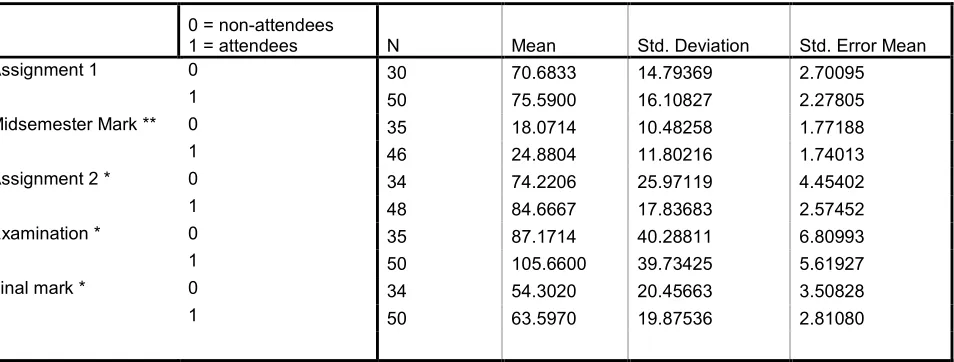
Qn 2: Attendees at a lecture two-thirds of the way through the course performed substantially better on all course assessment items than non-attendees. T-tests revealed significant differences between the group means on all assessment items but Assignment1. Table 1 gives the mean scores on all assessment items for the two groups. Variations in group size is due to some students not completing all assessments. Note that * indicates the difference was significant at the 0.05 level (2-tailed); ** indicates that the difference was significant at the 0.01 level (2-tailed).
Table 1 (SPSS): Group Means for the Five Course Assessment Items
0 = non-attendees
1 = attendees N Mean Std. Deviation Std. Error Mean
Assignment 1 0 30 70.6833 14.79369 2.70095
1 50 75.5900 16.10827 2.27805
Midsemester Mark ** 0 35 18.0714 10.48258 1.77188
1 46 24.8804 11.80216 1.74013
Assignment 2 * 0 34 74.2206 25.97119 4.45402
1 48 84.6667 17.83683 2.57452
Examination * 0 35 87.1714 40.28811 6.80993
1 50 105.6600 39.73425 5.61927
Final mark * 0 34 54.3020 20.45663 3.50828
1 50 63.5970 19.87536 2.81080
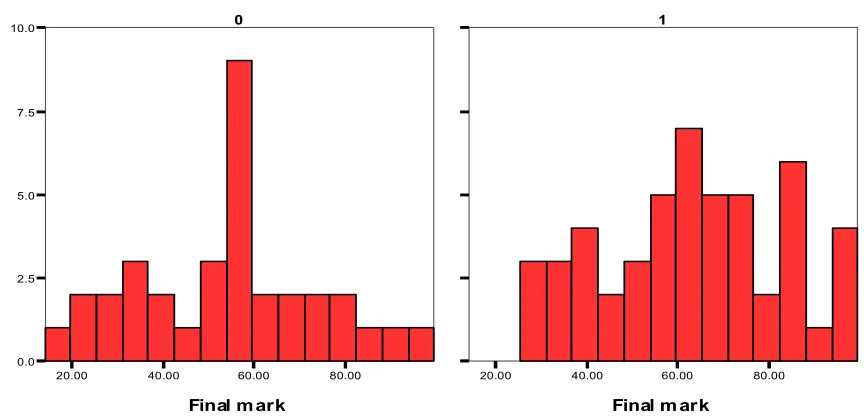
See Figure 2 for the distributions of overall performance levels attendees and attendees. Very few non-attendees scored in the top performance bracket, only 3 achieved over 80% compared to 10 non-attendees.
[image:5.612.55.532.470.651.2]example, Figure 3 show scatter plots for 46 attendees later in the course (not the same students as those analysed above.) These plots offer no evidence that high performance on the examination was related to highly strategic approaches; or to the subscale alertness to assessment demands, in particular.
0 1
Figure 2: Course performance levels for Non-Attendees (0) and Attendees (1)
20.00 40.00 60.00 80.00
Final m ark
0.0 2.5 5.0 7.5 10.0 C o u n t
20.00 40.00 60.00 80.00
Final m ark
[image:6.612.83.515.167.375.2]
Figure 3: SPSS Scatter Plots of Exam Performance and Approaches to Learning for 46 student present at a lecture at the end of the course
20.00 40.00 60.00 80.00 100.00
Final mark 30.00 40.00 50.00 60.00 70.00 80.00 90.00 S tr a te g ic a p p ro a c h
0.00 50.00 100.00 150.00 200.00
exam mark 6.00 8.00 10.00 12.00 14.00 16.00 18.00 20.00 A le rt n e s s t o a s s e s s m e n t d e m a n d s
5 Discussion and Conclusions
pragmatism of that kind vary with discipline, content and study-goals, and are strongly affected by the effectiveness, commitment, and approachability of the lecturer.
The attendees studied here regarded lectures as an efficient, companionable, and convenient way to meet new mathematical material, build understanding of the concepts, and develop the confidence to perform challenging tasks. Lectures were reported to be motivating, keep many students on track, gave many a sense of community and common purpose, and clearly suited the learning preferences of those who said they learned by hearing, seeing and asking, rather than reading. Gaining information per se was not found to be a primary reason why students attended lectures. However, that purpose is implicit in the ascribed learning role.
Students’ belief in the value of attending lectures may also have paid dividends. A strong positive relationship was evident between performance and lecture attendance. This is in line with a wealth of studies (see Hattie [2]) that indicate that face-to-face teaching and strong individualized feedback are generally highly effective for performance. Only a few students performed well without attending lectures, and relationships between mathematics performance and strategic approaches to learning were very low. Strategic approaches to learning, as defined in [15], are associated with organized studying, time-management, and alertness to assessment demands, three characteristics that seem closely associated with the attitudes ascribed to “pragmatics”. Thus this data suggests that the finding in [1], that pragmatics are high achievers but low attendees, may not be robust.
Certainly, lecture attendance has diminished only a little in the Mathematics courses described. It remains in the region of 60 – 65 % despite easy full access to all course information and materials, online and in hardcopy, and generous support for independent learning in the course by both email and phone. Particularly interesting is that a substantial number of students are second-years with a strong background of enforced collaborative work and online problem-solving. Yet they attend voluntary large group lectures willingly and good-naturedly, and voluntary online discussion has declined in the wake of enforced participation. Does that convey a preference for face-to-face communication, or simply falling back on old habits?
References
[1] Dolnicar, S., 2005, Should We Still Lecture or Just Post Examination Questions on the Web?: the nature of the shift towards pragmatism in undergraduate lecture attendance. In Quality in Higher Education, 11 (2) 103-115.
[2] Hattie, J., 1999, Influences on Student Learning: Inaugural Professorial Address. University of Auckland. http://www.arts.auckland.ac.nz/staff/index.cfm?P=5049.
[3] Perry, R.P., 1997, Perceived control in college students: implications for instruction in higher education. In R.P.Perry & J.C Smart (Eds), Effective Teaching in Higher Education: Research and Practice (New York: Agathon).
[4] Murray, H.G., 1997, Effective teaching behaviours in the College classroom. In R.P.Perry & J.C Smart (Eds), Effective Teaching in Higher Education: Research and Practice (New York: Agathon).
[5] Ramsden, P., 1992, Learning to Teach in Higher Education (London: Routledge).
[6] Browne, S. and Race, P., 2002, Lecturing: A practical guide (London: Kogan Page).
[7] Murphy, E., 1998, Lecturing at University (Perth: Paradigm Books).
[8] Exley, K. and Dennick, R., 2004, Giving a Lecture: From presenting to teaching (London: Routledge).
[9] Gibbs, G., 1992, Teaching Large Classes in Higher Education (London: Routledge Farmer).
[10] Biggs, J.B., 1999, Teaching for Quality Learning in Universities (Buckingham: Open University Press).
[11] Ward, A. and Jenkins, A., 1992, The problem of teaching and learning in large classes. In G.Gibbs & A Jenkins (Eds), Teaching Large Classes in Higher Education (London: Kogan Page).
[12] Hunter, S. and Tetley, J., 1999, Lectures: Why don’t students attend? Why do students attend? Paper presented at HERDSA Annual International Conference, Melbourne,12-15 July.
[13] Brown, G. and Atkins, M., 1988, Effective Teaching in Higher Education (London: Routledge).
[14] Brown, G.A. and Daines, G.M., 1981, Learning from lectures. In E. Oxtoby (Ed), Higher Education at the Crossroads (Guildford: Society for Research in Higher Education).