Australasian (ACIS)
ACIS 2004 Proceedings
Association for Information Systems Year 2004
Trust in Virtual Communities involved in
Free/Open Source Projects: An
Empirical Study
Michael Lane
∗Glen van der Vyver
†Prajwal Basnet
‡∗University of Southern Queensland †University of Southern Queensland ‡Sunshine Coast University
Trust in Virtual Communities involved in Free/Open Source Projects: An Empirical
Study
Michael S. Lane Glen Linton Van Der Vyver
University of Southern Queensland Information Systems Department
Faculty of Business, University of Southern Queenland Toowoomba, Queensland, Australia
Email: [email protected]
Email: [email protected]
Prajwal Basnet Sunshine Coast University Caloundra, Queensland, Australia
Email: [email protected]
Abstract
Interpersonal trust and group trust are factors which are critical to the success and cohesion of virtual communities. One such type of virtual community is the Open Source Application Development community. This study examines the influence of cognitive trust and affective trust in a large, active virtual community (SourceForge.Net) involved in open source application development. We find that cognitive and affective trust are both related to group cohesion and project outcomes in free/open source projects, as well as the perceived benefits group members derive from membership. Cognitive trust shows a more significant relationship to project outcomes while affective trust is more significantly related to group cohesion and perceived benefit.
Key words: Affective Trust, Cognitive Trust, Virtual Communities, Group Effectiveness, Open Source
INTRODUCTION
Open source is rapidly gaining credibility as a viable approach to software development. The open source community has proved itself capable of delivering high quality and commercially successful products such as Apache server and Linux. Indeed, many of the free/open source software applications are starting to challenge the commercial dominance of software produced by companies such as Microsoft. The dynamics of free/open source software development is, however, still not well understood. Trust is acknowledged as being an important factor in the success of free/open source projects but there has been a lack of empirical research into the impact of trust on the effectiveness of virtual communities in free/open source projects. This study builds on the previous work of Gallivan (2001) and Stewart and Gosain (2001, 2002) by testing the impact of two dimensions of interpersonal trust (affective trust and cognitive trust) on the effectiveness of groups of developers involved in free/open source projects.
In this paper, we report on a quantitative study examining the influence of trust in a circumscribed virtual community (Source Forge) with its own distinctive culture. The work is part of a larger project which incorporates qualitative and quantitative elements and whose goal is to assess the extent to which the dominant models of organisational trust are applicable within specific types of virtual communities.
The structure of the paper is as follows: first, the concept of trust is introduced with particular emphasis on the affective and cognitive dimension of interpersonal trust. Next, the parallel between virtual organisations and free/open source projects is established in the existing literature. Then, the importance of trust in organisation structures such as virtual communities is discussed. The research question and method for this study is outlined. Then, the results of the data analysis are presented and the findings of the study are discussed. Finally, the conclusions and implications of the study are discussed.
TRUST
organisation specifically because self-direction and self-control have taken the place of social controls based on authority. They argue that the benefits of trust in an organisation include interpersonal elements relating to reduced transaction costs and improved security and, organisation wide, a culture that is open with free-flowing communication channels.
Lewicki and Bunker (1995) argue that trust can be classified as an individual characteristic, a characteristic of interpersonal transactions or an institutional phenomenon. Various disciplinary perspectives have traditionally been associated with these various viewpoints. So, for example, sociologists have worked on trust in institutional settings and the development of trust between individuals (e.g. Goffman 1971; Zucker 1986). Personality psychologists view trust, or the propensity to trust, primarily as an individual characteristic while social psychologists view trust as an element of group dynamics and interpersonal transaction (Lewicki & Bunker 1995; Bhattacharya, Devinney & Pillutla 1998). Bhattacharya, Devinney and Pillutla (1998) argue that trust has a number of key attributes:
• trust is not applicable in environments where there is certainty - trust is associated with risk and uncertainty;
• trust is an expectancy that a particular outcome might occur and this expectancy is fluid and subject to change;
• depending upon circumstances, the importance attached to trust in any situation will vary; • trust is not simply absent or present, its intensity can be measured;
• trust is always specific to the situation; • in affective terms, trust is good.
Although trust may be approached from a social or rational perspective the rational approach, which focuses on the calculus of self-interest, is the norm (Jones & George 1998; Jarvenpaa & Leidner 1999). The social approach is more concerned with moral duty or mutual obligation, where each party is morally obliged not to put at risk any other party (Axelrod 1984; Zucker 1986) or to exploit any area where another party is vulnerable (Sabel 1993). Whatever the source of the trust, the organisational payoff it can deliver is significant. Where high levels of trust are present, the organisation needs to expend less energy on maintaining internal order. Trust engenders self-confidence, which in turn allows the organisation to take risks. (Bhattacharya, Devinney & Pillutla 1998; Jarvenpaa & Leidner 1999).
In this study, we focus on two dimensions of interpersonal trust, cognitive and affective. Although we have touched on aspects of these dimensions before their complexity requires further elaboration. Cognitive trust is related to knowledge. We touched on the uncertainty / certainty dimension of trust before, and knowledge is closely related. Trust is highly relevant to conditions of risk and uncertainty, the normal condition of so many corporations today. McAllister (1995) views trust as a leap of faith and argues that trust cannot exist if there is not at least some degree of knowledge embedded within the trust relationship. It would simply not be rational to trust someone of whom we knew nothing. Cognitive trust, in the context of this study, is defined as: trust based upon good reasons constituting evidence of trustworthiness in another party, such as demonstrated ability, responsibility and competence (McAllister 1995; Staples & Ratnasingham 1998).
Affective trust is directly related to human emotion and indirectly to affiliation and those psychological processes which might be called intuitive. McAllister (1995) argues that this type of trust is related to the emotional investments people make in relationships, the intrinsic value of the relationship and feelings of genuine concern for other members of the group. This type of trust is based on feeling rather than rational thought and many of the processes involved are subconscious. Affective trust, in the context of this study, is defined as: trust consisting of the emotional bonds between two parties who express genuine care and concern for each other’s welfare (McAllister 1995; Staples & Ratnasingham 1998).
VIRTUAL ORGANIZATIONS AND FREE / OPEN SOURCE PROJECTS
business processes by creating self contained modules that can be quickly plugged into as many different value chains as possible (Sawhney & Parikh 2000, p. p. 81). Free/open source projects provide an example of group work which has many similarities with the concept of a virtual organisation. Indeed, the high degree of correspondence between the open source movement and depictions of the organisation of the future - the virtual, networked organisation (Markus, Manville & Agres 2000; Gallivan 2001).
Free/Open Source Software Development
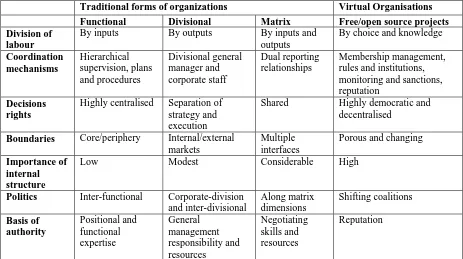
[image:4.595.66.529.216.475.2]Sharma, Sugumaran & Rajagopalan (2002) examined open source projects in terms of structure, processes and culture by comparing this type of virtual organisation against traditional organisations (Galbraith 1973; Miles & Snow 1978; Robey 1991). Table 1 sets out the differences between the two these forms of organization.
Table 1 Comparison Of Organisation Structure Between Free/Open Source Projects And Traditional Organisations (Adopted from Sharma, Sugumaran & Rajagopalan 2002, p. 12)
Traditional forms of organizations Virtual Organisations Functional Divisional Matrix Free/open source projects Division of
labour
By inputs By outputs By inputs and outputs
By choice and knowledge
Coordination mechanisms
Hierarchical supervision, plans and procedures
Divisional general manager and corporate staff
Dual reporting relationships
Membership management, rules and institutions, monitoring and sanctions, reputation
Decisions rights
Highly centralised Separation of strategy and execution
Shared Highly democratic and decentralised
Boundaries Core/periphery Internal/external markets
Multiple interfaces
Porous and changing
Importance of internal structure
Low Modest Considerable High
Politics Inter-functional Corporate-division and inter-divisional
Along matrix dimensions
Shifting coalitions
Basis of authority
Positional and functional expertise
General management responsibility and resources
Negotiating skills and resources
Reputation
Table 2 Comparison Of Free/Open Source Projects/Virtual Organisations and Traditional Organisations And Organisational Processes (Adopted from Sharma, Sugumaran & Rajagopalan 2002, p.15)
Traditional organisations Free/open source project/virtual organisation
Governance Enforce governance Self governance
Membership management
Management enforced Static/solid No such thing
Community based Fluid, but stable Professional identity
Rules and institutions
Management makes and changes the rules Community members make and change the rules
Monitoring and sanctions
Monitoring of performance and behaviour kept confidential by management
Monitoring of performance and behaviour visible to everyone
Sanctions by flaming, spamming, shunning and expulsion
Building and maintaining reputation a prime motivator
Reputation No emphasis on building reputation Loss of reputation a motivating factor
Development Survey Study Definition Configuration Procurement Design Construction Delivery Problem discovery
Finding volunteers for tasks Solution identification Code development and testing Code change review
Code commit and documentation Release management
In terms of the process of developing free/open source software, there is a reliance on self governance. Member management is community based and fluid but stable because the involved members wish to maintain their professional identity. Monitoring of performance and behaviour is visible to everyone in a free/open source project and sanctions are enforced through flaming, spamming and shunning and expulsions depending on the behaviour of an individual (Sharma, Sugumaran & Balaji 2002). These are quite powerful controls because building and maintaining a reputation is a prime motivation for participating in a free/open source project. Although the process of software development is much less structured than in the traditional approach it still follows a rigorous path. There are a number of checks and controls such as version and configuration management and mechanisms which ensure that only high quality code is released (Cubranic & Booth 1999; Healy & Schussman 2003). Table 3 presents a comparison of virtual organisations and traditional organisations as regards culture.
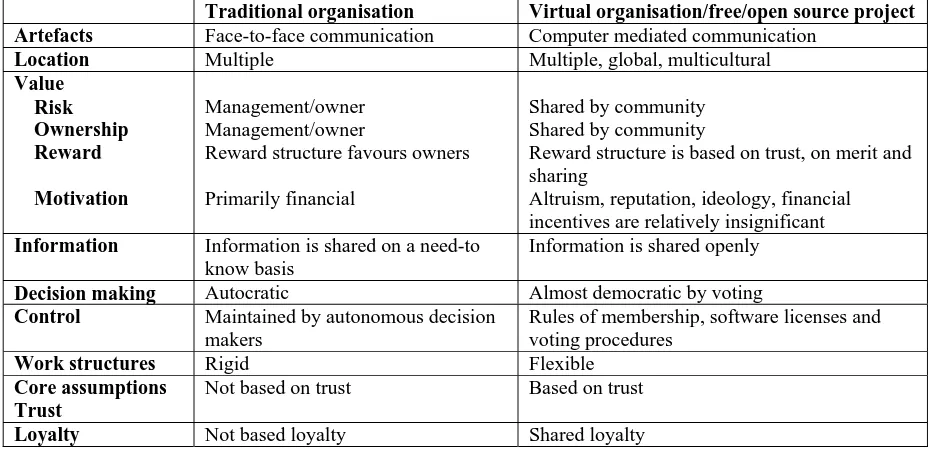
Table 3 Comparison of Traditional Organisations And Virtual Organisations/Free/Open Source Projects On Culture (Adapted from Sharma, Sugumaran & Rajagopalan 2002, p.17)
Traditional organisation Virtual organisation/free/open source project Artefacts Face-to-face communication Computer mediated communication
Location Multiple Multiple, global, multicultural
Value Risk Ownership Reward Motivation Management/owner Management/owner
Reward structure favours owners
Primarily financial
Shared by community Shared by community
Reward structure is based on trust, on merit and sharing
Altruism, reputation, ideology, financial incentives are relatively insignificant
Information Information is shared on a need-to know basis
Information is shared openly
Decision making Autocratic Almost democratic by voting
Control Maintained by autonomous decision makers
Rules of membership, software licenses and voting procedures
Work structures Rigid Flexible
Core assumptions Trust
Not based on trust Based on trust
[image:5.595.65.531.537.763.2]The culture of free/open source projects is underpinned by computer mediated communication, usually through IRC chat and email. The projects are frequently global and multicultural and involve shared risk and ownership. Information is shared openly, decisions are made through voting and the approbation of peers is highly prized (Stewart & Gosain 2001). When we look at the culture of free/open source projects it is evident that trust plays an important part in the development process. The core assumptions of free/open source development are based and built on trust between members. Furthermore, the reward structure is based on trust, merit and sharing (Stewart & Gosain; Sharma, Sugumaran & Balaji 2002).
RESEARCH HYPOTHESES AND METHOD
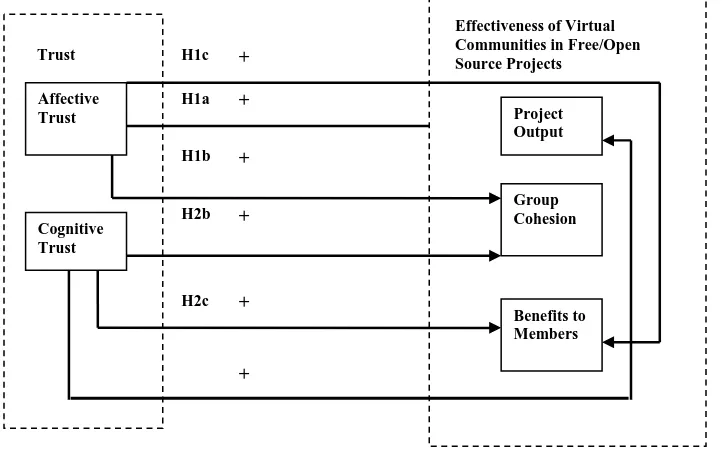
This study investigated the impact of trust on the effectiveness of a virtual community involved in free/open source projects. A number of empirical studies have examined the importance of trust in free/open source projects (Gallivan 2001; Stewart & Gosain 2001; Sharma, Sugumaran & Balaji 2002; Stewart & Gosain 2002). Our research has adapted a subset of the conceptual research model developed by Gallivan (2001) which postulated that Control and Trust impact on the group effectiveness of free/open source projects. Figure 1 presents the theoretical conceptualisation of the proposed research model which we tested empirically using parametric statistics Six hypotheses were tested to confirm or disconfirm the proposed research model:
H1a: Affective trust has a positive impact on the project output of virtual communities in free/open source projects
H1b: Affective trust has a positive impact on the group cohesion of virtual communities in free/open source projects
H1c: Affective trust has a positive impact on the benefits to group members of virtual communities in free/open source projects
H2a: Cognitive trust has a positive impact on the project output of virtual communities in free/open source projects
H2b: Cognitive trust has a positive impact on the group cohesion of virtual communities in free/open source projects
[image:6.595.88.450.441.667.2]H2c: Cognitive trust has a positive impact on the benefits to group member of virtual communities in free/open source projects
Figure 1 Research model: Impact of Cognitive Trust and Affective Trust on the Effectiveness of Virtual Communities in Free/Open Source Projects (Source: adapted from Gallivan 2001)
The research method employed to collect and analyse data to test the hypotheses was quantitative in nature. An online survey was sent by email to 5000 members of Source Forge (www.sourceforge.net) which is the largest open source portal in the world with over 80,000 members. The survey instrument was developed by adapting scales from existing empirical studies which had measured the constructs of interest in this study. Cognitive and
H1a
H1b
H2b
Effectiveness of Virtual Communities in Free/Open Source Projects
Affective Trust
Cognitive Trust
Project Output
Group Cohesion
Benefits to Members H1c
H2c Trust
+
+
+
+
affective trust were measured by adapting scales from a previous empirical study which measured interpersonal trust in open source projects (Stewart & Gosain 2002). The effectiveness of free/open source projects was viewed through the theoretical lens of Hackman’s (1990) group effectiveness theory which consists of three dimensions: group output, group cohesion and psychological benefits to group members. The measures of the three dimensions of group effectiveness were adapted to the context of virtual communities in open source projects by adapting a number of existing scales from previous empirical studies which examined various dimensions of group effectiveness (Denison 1996; Janz 1999; Carless & De Paola 2000; Lurey & Raisinghani 2001; Stewart & Gosain 2001, 2002; Pescosolido 2003) The survey instrument was pilot tested on a group of thirty academics and IT practitioners who had knowledge of or had participated in open source software development. Based their comments and suggestions, a number of adjustments and changes were made to final questionnaire. The targeted respondents were asked to focus on a particular current and recent free/open source project when answering the online questionnaire. The effective response rate was approximately 18 percent after the sample size had been adjusted for unreachable email addresses. In all, 785 surveys were returned, of which 635 were usable. One hundred and fifty three surveys were discarded for a variety of reasons. These were incomplete surveys where there were too many missing responses to individual questions.
RESULTS
The data set was found to be representative of a normal distribution after a number of descriptive statistics tests were conducted to assess the normality of the data set. Reliability analysis was conducted on all of the research constructs to ensure that the items measuring each construct were reliable measures of that construct. All of the constructs were above the recommended cronbach alpha score of 0.7 (Nunnally 1978) except for group cohesion which was still retained due to the exploratory nature of this study. Factor analysis was conducted to ensure that there was adequate convergent and discriminate validity in the items measuring each research construct (see Table 4 and All variable items were retained with factor loadings greater than .490 (Hair et al., 1998). All of the items for independent variables measuring affective trust and cognitive trust were retained and only three items were dropped from the dependent variables (project output – two items and group cohesion – one item see table 5 bolded in factors loading column) because these items had factor loadings less than the recommended .490.
Table 5
).Table 4 Reliability and Validity Analysis For The Independent Variables
Independent variables Factor loadings
Item to total correlation Affective Trust items
1. I have made an emotional investment into my working relationship with other programmers in this project
.748 .5878
2. I have a sharing relationship with the other member of this project .752 .6336
3. I can talk freely with other members of this project about any difficulties I am having and know that they will want to listen
.741 .5993
4. I would feel a sense of loss if I could no longer work together with the other members of this project
.702 .5709
5. If I shared my problems with the other members of this project, I would expect them to respond caringly and constructively
.708 .5628
Variance explained 31.5% Cronbach Alpha 0.8679
Cognitive Trust items
1. I consider the other member of this project to be trustworthy, even if I don’t know them personally
.621 .5170
2. Generally, the members of this project approach their work with professionalism and dedication
.827 .7085
3. Given the track records of the other members, I see no reason to doubt their competence and preparation for working on this project
.873 .7474
4. I can rely on the other members of this project to do a good job and not make a job more difficult through careless work
.816 .6503
Variance explained 29.5% Cronbach Alpha 0.8285
All variable items were retained with factor loadings greater than .490 (Hair et al., 1998). All of the items for independent variables measuring affective trust and cognitive trust were retained and only three items were dropped from the dependent variables (project output – two items and group cohesion – one item see table 5 bolded in factors loading column) because these items had factor loadings less than the recommended .490.
Table 5 Reliability and Validity Analysis For The Dependent Variables
Dependent variables Factor
loadings
Item to total correlation Project Output Items
1. I believe that the members of this project have been effective in reaching the shared goals of the project
.787 .6237
2. From the feedback that has been received so far, I think that other people find the output of this project useful
.681 .4758
3. I believe that the members of this project will continue to meet the goals of this project in future
.797 .6560
4. I believe that the software created from this project is of a high quality .632 .4950 5. The output from this project is greater than the sum of the individual
contributions from each member
(.484) Dropped
6. I believe that the members of this project have been able to produce knowledge and information that did not exist before the project started
(.360) Dropped
7. Generally, the members complete project related tasks with a reasonable amount of time
.607 .4530
Total variance explained 22.55% Cronbach Alpha 0.7650
Group Cohesion Items
1. Generally, I try to help out any member who is experiencing difficulties related to this project
.790 .4884
2. Responsibility for any mistakes or problems with this project and its output is shared among the project members
.789 .4163
3. I look forward to continuing as a member of this project .493 .3551 4. Based on my experiences on this project, I would be interested in participating in
other Open Source Software projects in the future
(.446) Dropped
Total variance explained 14.06% Cronbach alpha 0.6065
Benefits to Members Items
1. I developed many new skills while working on this project .860 .5368 2. I learnt things from this project that I will use in other projects .811 .5201 3. I am highly satisfied with the personal growth and development I have gained
from working on this project
.814 .5935
4. I get a feeling of worthwhile accomplishment from working on this project .703 .4892 Total variance explained 23.35% Cronbach Alpha 0.8482
Total Variance Explained = 59.97%; Kaiser-Meyer-Olkin measure of Sampling Adequacy = 0.828 Bartlett test of sphericity = 2492.640 Significance = 0.000
The hypotheses were tested using multiple regression analysis to confirm or disconfirm the proposed research model. The results of the multiple regression analysis are presented in Table 6.
Table 6. Results of Multiple Regression Analysis (N = 635)
Hypothesis Beta Coefficient
Independent variable – Affective Trust
H1a – Dependent variable Project Output 0.173 (***)
H1b – Dependent variable Group Cohesion 0.410 (***)
H1c – Dependent variable Benefits to Group Members 0.270 (***)
Independent variable - Cognitive Trust
H2a – Dependent variable Project Output 0.466 (***)
[image:8.595.73.434.610.764.2]H2c– Dependent variable Benefits to Group Members 0.023 (ns)
Legend: P <= 0.1 *; P <= 0.05 **; P <= 0.01 ***; Not significant = ns
For affective trust, all of the hypotheses were supported and were significant at the 0.01 level. There was weak support for the positive relationship between affective trust and project output with a beta coefficient of 0.173.There was moderately strong support for the positive relationship between affective trust and group cohesion with a beta coefficient of 0.410. There was moderate support for the positive relationship between affective trust and benefits to group members with a beta coefficient of 0.270. For cognitive trust, all of the hypotheses were supported and were significant at the 0.01 level. There was moderately strong support for the positive relationship between cognitive trust and project output with a beta coefficient of 0.466.There was moderate support for the positive relationship between cognitive trust and group cohesion with a beta coefficient of 0.198. There was no support for the positive relationship between cognitive trust and benefits to group members with a beta coefficient of 0.023.
CONCLUSIONS AND IMPLICATIONS
Cognitive trust appears to have a significant positive influence on the project output and group cohesion in a large, structured virtual community dedicated to free / open source software development. There is, however, apparently little influence on the perceived attainment of benefits by the virtual community. On the other hand, affective trust appears to have a significant positive influence on group cohesion and in providing benefits to group members. Affective trust appears to also have a significant but much weaker influence on project output. We would argue that these findings are in line with the theory underpinning these different types of interpersonal trust. Cognitive trust is based on knowledge of a situation which is critical for productive project output in a free/open source project. It is therefore not surprising that cognitive trust has the greatest influence on project output. For cognitive trust to exist, the virtual team members need to exhibit evidence of responsibility and competence. Competence is assessed in a rational, objective and detached manner. As the member of the virtual team delivers, the work is assessed and, gradually, the members of the group come to an understanding of what the member can potentially deliver. As the member continues to deliver and contribute, trust continues to grow. When the group initiates a project, members know who can be trusted to deliver, and at what level of expertise. The group is driven by mutual interdependency and mutual trust.
Development of software in a free/open source project is clearly highly reliant on the expertise and knowledge of the core programmers and a group trust that everybody will deliver on the work assigned to them. However, the very nature of free/open source projects means that these types of projects are more than just a group of people working on a job. Membership of a virtual community delivers far more than the satisfaction of working on interesting projects – it is a social phenomenon. The community satisfies a variety of social and psychological needs. In order for these virtual communities to be productive and effective, affective trust also needs to exist. For affective trust to exist, emotive bonds need to be developed between the members of a virtual community. These are the bonds of group affiliation of mutual respect and care, of empathy. It is again not surprising that affective trust is highly related to group cohesion and a feeling amongst members that they are getting something from the experience.
Overall, our findings suggest that both affective and cognitive trust do have a significant influence on project outcomes, group cohesion and perceived benefits to group members. We therefore conclude that trust is an important factor in the open source arena while acknowledging that the model we have tested in this study is limited in scope. Because the type of organisation we are looking at is so new and its dynamics so little known, much work remains to be done in a variety of areas, including trust. An important extension of this work would be the applicability of our study in other types of virtual communities.
REFERENCES
Axelrod, R 1984, The Evolution of Cooperation, Basic Books, New York.
Bergquist, M & Ljungberyg, J 2001, 'The power of gits: organising social relationships in open source communities', Information Systems, vol. 11, no. 4, pp. 305-20.
Bhattacharya, R, Devinney, TM & Pillutla, MM 1998, 'A formal model of trust based on outcomes', Academy of Management Review, vol. 23, no. 3, pp. 459-72.
Byrne, J 1993, 'The virtual organisation', Business week, pp. 98-102.
Cubranic, D & Booth, KS 1999, 'Coordinating open-source software development', paper presented to Eighth International Workshop on Enabling Technologies: Infrastructure for Collaborative Enterprises, Stanford, CA, USA.
Denison, DR 1996, 'From Chimneys to Cross-Functional Teams: Developing and Validating a Diagnostic Model', Academy of Management Journal, vol. 39, no. 4, pp. 1005-23.
Diker, VG 2003, 'Toward a Dynamic Theory of Open Online Collaboration Communities', paper presented to Ninth Americas Conference on Information Systems.
Galbraith, JR 1973, Designing complex organisations, Addison-Wesley, Reading, MA.
Gallivan, MJ 2001, 'Striking a balance between trust and control in a virtual organization: a content analysis of open source software case studies', Information Systems Journal, vol. 11, no. 4, p. 28.
Goffman, E 1971, Relations in Public, Basic Books, New York.
Hackman, JR 1990, Groups That Work (and Those That Don't), Jossey-Bass, San Fransisco, California.
Hair, JF, Anderson, RE, Tatham, RL & Black, WC 1998, Multivariate Data Analysis, 5th edn, Halldn, Upper Saddle River.
Healy, K & Schussman, A 2003, The ecology of open source software development, MIT, viewed 10th October 2003, <http://opensource.mit.edu/papers/healyschussman.pdf>.
Janz, BD 1999, 'Self-directed teams in IS: correlates for improved systems development work outcomes',
Information and Management, vol. 35, no. 3 pp. 171-92.
Jarvenpaa, S & Leidner, DE 1999, 'Communication and Trust in Global Virtual Teams', Organization Science, vol. 10, no. 6, pp. 791-815.
Jones, G & George, J 1998, 'The experience and evolution of trust: implications for cooperation and teamwork',
Academy of Management Review, vol. 23, no. 3, pp. 531-46.
Lewicki, RJ & Bunker, BB (eds) 1995, A model of trust development and decline, Conflict, Coperation and Justice, Jossey-Bass, San Francisco.
Lurey, JS & Raisinghani, MS 2001, 'An Empirical Study of Best Practices in Virtual Teams', Information and Management, vol. 38, no. 3, pp. 523-44.
Markus, ML, Manville, B & Agres, EC 2000, 'What Makes a Virtual Organization Work?' Sloan Management Review, vol. 42, no. 1.
Mayer, RC, Davis, JH & Schoorman, FD 1995, 'An integrative model of organisational trust', Academy of Management Review, vol. 20, no. 3, pp. 709-34.
McAllister, DJ 1995, 'Affect and Cognition-Based Trust as Foundations for Interpersonal Cooperation in Organizations.' Academy of Management Journal, vol. 38, no. 1 pp. 24-59.
Miles, RE & Snow, CC 1978, Organisational strategy, structure and process, McGraw-Hill, New York.
Nunnally, JC 1978, Psychometric theory, 2nd edn, McGraw-Hill, New York.
Pescosolido, AT 2003, 'Group Efficacy and Group Effectiveness: The Effects of Group Efficacy Over Time on Group Performance and Development', Small Groups Research, vol. 34, no. 1, pp. 20-42.
Raymond, ES 1998, 'The Cathedral and the Bazaar', First Monday, vol. 3, no. 3, p. 25.
Ring, PS & Van de Ven, AH 1994, 'Developmental process of cooperative inter-organisational relationships',
Academy of Management Review, vol. 19, no. 1, pp. 90-118.
Robey, D 1991, Designing organisations 2nd edn, Irwin,, Burr Ridge, IL.
Rotter, JB 1971, 'Generalised expectancies for interpersonal trust', American Psychologist, vol. 26, no. 5, pp. 443-52.
Sabel, CF (ed.) 1993, Studied Trust: Building New Forms of Co-operation in a Volatile Economy, Explorations in Economic Sociology, Russel, NewYork.
Sharma, S, Sugumaran, V & Balaji, R 2002, 'A Framework for Creating Hybrid-Open Source Software Communities', Information Systems Journal, vol. 12, no. 1, pp. 7-25.
So, H, Thomas, N & Zadeh, H 2002, 'What is in a Bazaar? A Model of Individual Participation in an Open Source Community', paper presented to Workshop on Open Source Development, University of Newcastle upon Tyne, 25-26 February.
Staples, S & Ratnasingham, P 1998, 'Trust: The Panacea of Virtual Management?' paper presented to International Conference on Information Systems, Helsinki, December.
Stewart, KJ & Gosain, S 2001, 'An Exploratory Study of Ideology and Trust in Open Source Development Groups', paper presented to Twenty-Second International Conference on Information Systems, New Orleans, Louisiana, U.S.A, December 16th - 19th.
---- 2002, Impacts of Social Coordination Mechanisms on Effectiveness in Open Source Development Groups (Working Paper), University of Maryland.
van Wendel de Joode, R 2002, 'Coordination and Collaboration in Open Source Communities', paper presented to Proceedings of the First International Doctoral Consortium on Technology
Zucker, L, G. (ed.) 1986, Production of trust: institutional sources of economic structure, vol. 6, Research in Organisational Behaviour, JAI Press, Greenwich, CT.
COPYRIGHT