Hardware-Based Engineering Problem Solving for
On-campus and External Teams
David R Buttsworth
Faculty of Engineering and Surveying, University of Southern Queensland, Toowoomba, Australia
Ray Malpress
Faculty of Engineering and Surveying, University of Southern Queensland, Toowoomba, Australia
Mark Phythain
Faculty of Engineering and Surveying, University of Southern Queensland, Toowoomba, Australia
Abstract: We contend that engineering analysis and design will continue to rely on the
synthesis of experimental observations and theoretical analyses. For the past three years, we have been providing teams of on-campus and external students the opportunity to work with actual engineering hardware as a focus for engineering analysis and problem solving. Providing external teams of student with the opportunity to problem solve with actual engineering hardware represents a number of challenges. By focusing on initial value problems and requiring the teams to design the parameters necessary to achieve the desired system performance, we have been able to expose both on-campus and external teams to problem solving with testable physical systems and actual engineering hardware.
Introduction
Historically, engineering analysis and design activities have relied on a combination of both
experiment and analysis. For example, engineering design codes generally evolve in response to the available engineering analyses and practical experience with related hardware. We expect the synthesis of experimental observations and theoretical analyses will continue to be an important skill for professional engineers for the foreseeable future.
The value of experimentation with real physical hardware in science and engineering programs is widely recognised. One of the cornerstones of science learning is the laboratory experience
(Nersessian, 1991; Clough 2002), and laboratory courses can positively affect the learning outcomes of engineering students (Magin et al., 1986). Therefore, we contend that skills in engineering analysis and problem solving should be developed in the context of real physical hardware and
experimentation.
Within the Faculty of Engineering and Surveying at the University of Southern Queensland, we have developed a suite of team-based problem solving courses of some repute as recognised by Carrick Citations and National Awards. However, the problems which teams tackle do not normally involved experimentation with physical hardware.
Teaching Context and Learning Objectives
The Faculty of Engineering and Surveying at the University of Southern Queensland operates a suite of four undergraduate Engineering Problem Solving courses for cross-disciplinary teams of both on-campus and external students. Students entering Engineering Problem Solving 1 have a wide range of ages and a diverse range of skills. In the first two courses (Engineering Problem Solving 1 & 2) there is an emphasis on communication and teamwork fundamentals. Establishing individual learning goals, effective mentoring practice, reflective writing and self analysis are also critical features of the earlier problem solving courses (Brodie, 2007a,b; Brodie & Porter, 2008). As students progress to the higher level courses (Engineering Problem Solving 3 & 4), the problems become increasingly complex and there is an increasing emphasis on the acquisition and application of skills and knowledge in engineering, and the critical analysis of data, information and solutions. Through the progression from Engineering Problem Solving 1 to 4, the team size reduces from around 10 down to about 4 and the emphasis on assessment of reflective writing is reduced.
The course in which we have introduced hardware-based activities is Engineering Problem Solving 3 which requires the application of well developed team skills to the solution to engineering problems with the aid of appropriate mathematical models and well structured computer programs. Three of the principal learning objectives published in the course specification for Engineering Problem Solving 3 indicate that the students must: (1) use a range of numerical computing techniques to develop an appropriate model from available data; (2) demonstrate a knowledge of and make appropriate use of a range of methods in the design and analysis of engineering experiments; and (3) analyse the behaviour of an engineering system using a general purpose numerical software package.
Teaching Approach and Objectives
The learning objectives of the course can be satisfied to some degree through simulated problems which do not require the students to participate in actual hardware activities. For example, the learning objective which requires the ‘design and analysis of engineering experiments’, can be satisfied by considering experimental data obtained by others. But we hypothesize that a more deeply satisfying learning experience will generally result if students are given learning opportunities which involve either: (1) the design of parameters that enable the control of real hardware and an engagement in the actual physical testing of that hardware; or (2) the design of physical experiments which are actually performed, ideally by the students directly.
At the University of Southern Queensland, the external student population exceeds that of the on-campus students; we are especially mindful of the need for equitable treatment of our on-on-campus and external populations. This presents a number of challenges when attempting to involve teams of both on-campus and external students in the engineering analysis of problems that involve real physical hardware and experimentation.
Our objectives in establishing a hardware-based approach for Engineering Problem Solving 3 can be summarized as:
(1) Exposing teams of students to problems involving physical hardware;
(2) Providing teams of students with access to experimental data from the hardware and ideally, providing them with the opportunity to experiment with that hardware as well;
(3) Requiring teams to analyze the problem and associated experimental data, and to then simulate the system performance; and
(4) Treating on-campus and external teams in an equitable manner.
more effective learning than that derived from simulated problems or problems which do not engage students in hardware testing. We have not yet attempted to test our hypotheses in a rigorous manner but we do offer some “Indicators of Success” as a later section of this paper.
Initial Value Problems
To satisfy our teaching objectives (items 1 to 4 in the previous section), we have focussed on problems in which student teams must specify certain initial operating parameters in order to make engineering hardware perform specified jobs. We have found that these initial value problems provide a good basis from which our objectives can be satisfied.
We have been using Matlab as the vehicle for our students’ engineering analysis and modelling. We generally require students to submit a Matlab script and associated function files which accept as inputs, the specific hardware configuration and the target performance of the hardware, and provide as outputs, the team’s suggested operating parameters (the initial values) which will enable the hardware to perform the required tasks.
The problem of throwing a ball some distance across a field is a simple example of what an initial value problem involves, and is relevant to the present work because most of the problems we have developed involve trajectory analyses. When cast in the framework that we tend to use for our problem specifications, the problem would be presented to the students in the following form. 1. Your objective is to use a ball launcher to make a certain ball travel a certain distance.
2. The ball has characteristics (e.g., mass, diameter) which are known to be with specified limits but are not going to be revealed until later (step 6).
3. The required distance is also known to be within specified limits but will likewise only be revealed at a later point (step 6).
4. Produce a program that accepts as inputs the ball characteristics and the required distance, and provides as outputs an appropriate combination of initial velocity and launch angle for the ball. 5. Submit your program for testing by teaching staff.
6. On the day of the testing, the specific ball characteristics and target distance will be entered into your program by the teaching staff.
7. One of the criteria for judging the quality of your solution is the proximity of the ball’s actual landing point to the specified target distance.
Thus, in more general terms, the problems that we develop typically:
• require system hardware, some of which is variable or imprecisely defined/characterised and some of which can be controlled or specified by the students;
• require teams to simulate the performance of the system, ideally by combining the analysis of experimental data with theoretical modelling; and
• require teams to design appropriate system parameters such that a specified system output is achieved.
Hardware and Experiments for On-campus and External Teams
Providing hardware to external teams for experimentation has a number of problems. In our problem solving course, external teams are formed by individual students who are generally isolated from each other geographically. The cost of multiple hardware packages and international postage would be prohibitive and in any case, only the designated experimenter within the team will have exposure to the hardware. Local construction of hardware by individual members of an external team might be a possible in some circumstances (e.g., if the apparatus was sufficiently low cost), but heath and safety considerations may over ride such an approach. Such difficulties would not normally impede development of hardware-based activities for on-campus teams, but bearing in mind the majority of our students are external, we have adopted a more moderate approach that is suitable for external teams.
complete experimental mapping of system performance, and therefore some engineering analysis for characterisation of system operation will be necessary for teams aiming for highest marks. In the case of one of our activities, we have enabled students to obtain experimental data for themselves by operating the actual hardware via a remote access laboratory.
Example Problems
Unmanned Arial Vehicle – 2006
This problem involved the flight testing of a radio controlled model aeroplane fitted with a table tennis ball release mechanism. The attitude of the aeroplane remained fixed, and the aeroplane climb rate depended primarily on the propeller power setting. Teams were required to design a propeller speed history that would allow that aeroplane to take-off, climb to a specified minimum height, and then land safely before the other end of an indoor sports stadium. Teams were also required to specify a time of release that would land the table tennis ball within the target zone. Various real data sets were
released to the teams. All teams were required to submit a package of a Matlab script and associated functions that: (1) analyzed the data provided; (2) accepted a range of specified parameters such as the distance to target, the distance to landing zone, the minimum climb height, and the ball mass; and (3) designed a set of propeller speed settings and a time of ball release appropriate for the specified parameters. The specified parameters were released at the flight testing event, and the package submitted by each team was run by a member of the teaching team. Solutions from each team (the propeller speed setting and time of ball release) were uploaded to a microprocessor on the aeroplane immediately before a flight test was conducted.
Air Cannon – 2007 & 2008
A small air cannon and a firing range (a few metres in total length) was designed for one of the problem solving activities in 2007. The air cannon operated with table tennis sized balls and the reservoir of the device was charged with shop-air. (In practice, the maximum pressure used in the cannon is normally less that 300 kPa gauge.) The range was inclined upwards so balls are returned to the cannon via the action of gravity. The reloading of the ball into the barrel of the cannon is
automated. Firing of the cannon is achieved by actuating a solenoid valve between the reservoir and the barrel. The objective of the activity is to determine appropriate settings for the launch angle and the reservoir pressure that will land a ball of a certain mass in particular target zones within the range.
In 2007, teams were provided with experimental data on the launch speed of a standard mass table tennis ball for different reservoir filling pressures. They were also provided with data on the
variability in range for a few angle-pressure combinations, and trajectory data for a single combination of angle and air pressure. Teams were required to submit a package consisting of a Matlab script and associated function files which: (1) analysed the data provided; (2) accepted a value for ball mass and target location; and (3) designed settings for launch angle and reservoir pressure which would land the ball in the target zone.
In 2008, a similar problem was performed, but in this case, teams were given access to a refined version of the air cannon and firing range so they could obtain their own experimental data. Access to the hardware was via the internet. A Remote Access Laboratory is being developed in the Faculty of Engineering and Surveying at USQ, and this is the first course in which both on-campus and external students were required to access the hardware as part of their assessment. A modest amount of laboratory access is offered to each team to emphasise the fact that performing physical experiments is normally expensive and engineering analyses should be developed and used whenever possible.
Water Rocket – 2008
as outputs the required launch angle and direction, the proportion of water in the tank, and the air filling pressure required.
Marking
A component of the marks awarded to each team is reserved for the performance testing of their solutions which typically occurs on the next working day following their submission due date. Solutions which rely on an empirical approach, for example an approach based on the interpolation and curve fitting of the experimental data without an engineering analysis to justify such an approach, are generally awarded lower marks than solutions which use engineering models to aid the design of appropriate settings for the hardware.
Indicators of Success
Students are certainly challenged by the problems but they appear to enjoy the experience of working with actual hardware and they do appreciate the effort of the teaching team in establishing such problems. For example, feedback received from individual team members following completion of the UAV problem of 2006 included:
“Thank you for tasking us with an (almost) impossible assignment. It was interesting and beneficial.”
“After completing this project its now seems simple, however it was only in the last two weeks that ‘the penny dropped’. … I would also like to thank the other staff involved for their time in creating this problem as I imagine it would have taken quit a lot of there [sic] time, as it was interesting. Thanks for the interesting problem 2, and I have learnt allot [sic] from this course.”
“Very enjoyable project even though it is though [tough].”
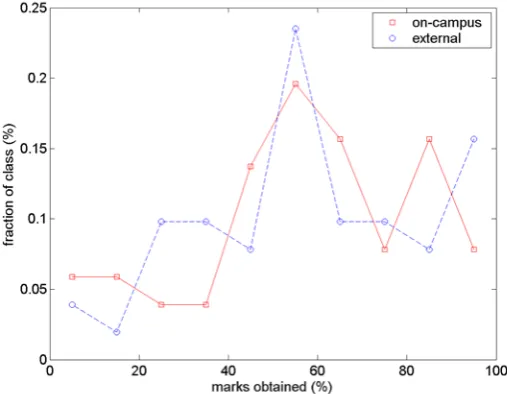
[image:5.595.164.418.550.747.2]Our objective of treating on-campus and external teams in an equitable manner has been satisfied to a large degree. It seems that in general, external teams have achieved similar success to the internal teams. For example, without moderating results between external and on-campus student teams, the average mark received by students in external teams for the UAV problem of 2006 was 174 out of a possible 300 whereas for on-campus students, the average mark was 171. There were approximately 50 students in both the on-campus and external groups in 2006. Figure 1 illustrates the un-moderated distribution of marks for campus and external students in the UAV problem of 2006. Both the on-campus and external distributions peaked in the 50-60% range with the on-on-campus peak being slightly broader. The fraction of students achieving marks within the highest range (90-100%) was larger for the external student population.
Conclusions
The positive feedback we have received from students encourages us to persist with hardware-based activities for our team-based engineering problem solving course. However, the development and implementation of our activities is resource-intensive, and therefore, relatively expensive.
Nevertheless, persisting with our focus on hardware-based activities is justified by reference to the role which professional engineers continue to play in synthesising experiment and analysis.
References
Brodie, L. (2007a). Problem Based Learning for Distance Education Students of Engineering and Surveying. In Connected - International Conference on Design Education, Sydney, Australia.
Brodie, L. (2007b). Reflective Writing By Distance Education Students In An Engineering Problem Based Learning Course, Australasian Journal of Engineering Education, 13(1), pp. 31-40.
Brodie, L. & Porter, M. (2008). Engaging distance and on-campus students in Problem Based Learning, European Journal of Engineering Education, in press.
Clough, M. P. (2002). Using the laboratory to enhance student learning. In R. W. Bybee (Ed.), Learning Science and the Science of Learning. (pp. 85-97). Washington, DC, National Science Teachers Association.
Ma, J. & Nickerson, J. V. (2006). Hands-on, simulated, and remote laboratories: A Comparative literature review. ACM Computing Surveys, 38(3), Article 7.
Magin, D. J., Churches, A., E., & Reizes, J. A. (1986). Design and experimentation in undergraduate mechanical engineering. In Proceedings of a Conference on Teaching Engineering Designers. (pp. 96-100). Sydney, Australia, Institution of Engineers.
Nersessian, N. J. (1991). Conceptual change in science and in science education. In M .R. Matthews (Ed.), History, Philosophy and Science Teaching: Selected Readings. (pp. 133-148). NY Columbia Teachers College Press.
Acknowledgements
We would like to acknowledge the excellent technical contributions of Terry Byrne and Brett Richards in the UAV problem solving activity of 2006. The development of the microprocessor-controlled power profile and ball release sequencing was theirs, as was the ball-release hardware and other modifications to the model aeroplane. Without their expertise, experience, and enthusiasm for radio controlled model aeroplanes, the 2006 problem solving activity would not have happened. We would also like to acknowledge the contributions of workshop staff, Brian Aston, Chris Galligan, and Adrian Blokland for construction of other hardware used in the various problem solving activities. Dr Tony Ahfock is leading the development of the FoES remote access laboratories, and without his
enthusiasm, the ping pong range project would not have been provided to teams in 2008.