This paper is based on the oral presentation at the German-Thai Symposium on Nanoscience and Nanotechnology 2011—Green Nanotechnology of the
Article
ZnO Doped with Bismuth in case of In-Phase Behavior for
Solar Cell Application
Phanuwat Krongarrom
1, Sirirat T. Rattanachan
1,*
, and Thipwan Fangsuwannarak
21 School of Ceramic Engineering, Institute of Engineering, Suranaree university of Technology,
Nakhon Ratchasima 30000, Thailand
2 School of Electrical Engineering, Institute of Engineering, Suranaree university of Technology,
Nakhon Ratchasima 30000, Thailand E-mail: [email protected]*
Abstract. Zinc Oxide (ZnO) nanostructure thin films doped with bismuth atoms were initially achieved by spin coating preparation from zinc acetate gel on the fused quartz substrate. The optical and structural properties have been preliminary studied in order to obtain more understanding the optimized factors for transparent conductive oxides (TCOs) of thin film solar cell. The optical transmittance was higher than 90% in the visible range for all films. In addition, the optical band gap of the prepared films calculated by Tauc plot showed the change of lightly blue shift but no significantly changed with increasing of Bi doping concentration. The glancing incident X-ray diffraction result showed that the Bi doped in ZnO nanostructure thin films after annealing have polycrystalline hexagonal wurtzite structure and good preferential orientation along c-axis. This chemical characterization indicated that in-phase behavior occurred in low Bi dopant content between 0.2 – 1.0 at.% Bi content, hence 1 atomic percentage of Bi content was uppermost to obtain preferential orientation in this study. However, the quality of the films surface was improved due to the larger number of coating layers but the electrical properties was improved. The tentative study in term of electrical behavior was investigated for application in TCO film of solar cell. The electrical property showed that more multi ZnO layers affected on an increase in the electrical conductivity of the films.
Keywords: Bi doped ZnO, ZnO thin film, TCO film, photovoltaic.
ENGINEERING JOURNAL Volume 16 Issue 3 Received 19 November 2011
Accepted 14 March 2012 Published 1 July 2012
1.
Introduction
In the recent, Zinc Oxide is a semiconductor material that is interested and applied in many applications, such as solar cells, transparent electrode, gas sensor, photo catalysts, transducers, laser diodes and acoustic wave devices [1-5]. Due to its properties such as n-type semiconductor with wide direct energy band gap (3.37 eV), high exciton binding energy (60 meV) [6] and the electrical resistivity can be adjusted between low and high which depend on the processing, annealing temperature and doping concentration [7-9]. Furthermore ZnO is stable in hydrogen plasma and environment, low cost material and transparent in visible light region. Therefore ZnO is interested and approached to replacement of indium tin oxide (ITO) which is widely used for transparent conducting electrode.
Nowadays, doped n-typed ZnO thin films has been prepared by various deposition techniques e.g. r.f. magnetron sputtering, pulsed laser deposition (PLD), chemical vapor deposition (CVD), evaporation, metal organic chemical vapor deposition (MOCVD), sol-gel, and spray pyrolysis [10-17]. Sol-gel technique is very low-cost effective due to nanostructural preparation under low-temperature, and it is simple to control the dopant composition. M. Jiang et.al (2009) [11] studied the effect of the annealing condition on the Bi-doped ZnO films prepared by r.f. magnetron sputtering. The Bi-doped ZnO films possessed high transmittance (about 85%) in the visible region and resistivity value with high carries density of the film. Furthermore, F. Chouikh et al. (2011) [18] studied the structural, optical and electrical properties of undoped ZnO and Bi doped ZnO thin films prepared by ultrasonic spray pyrolysis technique. The conductive and transparent Bi-doping ZnO films by sol-gel method have not been reported yet. Moreover, their structural and optical characteristics for this film have not been fully understood.
In this paper, the Bi-doped ZnO thin films were prepared by spin coating of the sol-gel method. The effects of dopant concentration on structural, optical and electrical properties with various Bi doping concentrations of ZnO thin films were investigated. The transmittance of the layers deposited on glass was measured in UV-visible region. Tauc plot was used for estimating the band gap energy of Bi-doped ZnO thin films that was appropriate to apply in TCO film in solar cell.
2.
Experimental
2.1. Materials
Undoped and bismuth doped ZnO gel were synthesized from zinc acetate dihydrate {Zn(CH3COO)2·2H2O}, Bismuth nitrate pentahydrate {Bi(NO3)3∙5H2O}, ethylene glycol and monoethanolamine (MEA) as starting material for ZnO, bismuth dopant source, solvent and sol-stabilizer, respectively. All materials were purchased from Ajax Finechem, Fluka, CARLO ERBA, Ajax Finechem, respectively.
2.2. Sol-Gel and Thin Film Preparation
Ethylene Glycol Monoethanolamine (MEA)
Zinc Acetate dihydrate 0.7 M
Bismuth nitrate pentahydrate solution
0.0 – 1.2 at.%
Dissolving at 80oC for 1 hr
while stirring
Clear solution
Spin coating 2500 rpm for 10 s
Drying at 100oC
for 30 min
Annealing at 600oC
for 2 hrs
Undoped and doped ZnO thin films
Recoated 1, 3, 5 times
Fig. 1. Flow chart of Bi doped ZnO thin film preparation.
2.3. Characterization of Bi-doped ZnO Thin Films
The phase and structural characterization of thin films were determined by using Glancing X-ray diffractometer (RIGAKU TTRAX III) with a Cu-Kα1 (1.54059 Å) as an X-ray source at 40 kV and 300 mA. Surface morphology was observed by using scanning electron microscope (Neo-1450VP). The optical transmittance and reflectance were measured by UV-Vis spectrophotometer (AJUK SPECORD 250+222P133) in the range of 300-1100 nm wavelength. The film thickness was measured by optical profiler (Veeco WYKO NT1100). The average grain size (d) of ZnO thin films was calculate by using Scherrer formula as Eq. (1) [20].
0.9
cos
d
B
B
(1) [image:3.595.105.494.76.508.2]
(
h
)
2
C h
(
-
Eg
)
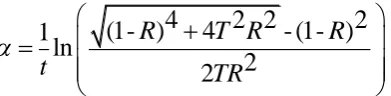
(2)where C is a constant for a direct transition and photon energy. The optical absorption coefficient (α) of ZnO thin films can be calculated by Eq. (3) [21]:
4
2 2
2
(1- )
4
- (1- )
1
ln
2
2
R
T R
R
t
TR
(3)where t, T, R are the thickness, the optical transmittance, the optical reflectance of the film, respectively. The Current-Voltage (I-V) curve of ZnO thin films was measured by using Keithley 2400 source meter and plot a J-V curve as a function of ZnO thin film thickness. Silver plate was used as electrode on 0.2 at.% Bi doped ZnO thin films with varying film layers.
3.
Result and Discussion
3.1. Structural Characterization
3.1.1. X-Ray Diffraction
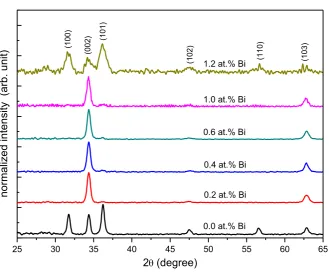
The undoped and Bi doped ZnO thin films were first coated on clean fused quartz substrate and annealed at 600°C. The effect of Bi doping concentration on the chemical structure of ZnO thin films was studied. Figure 2 shows X-ray diffraction patterns of ZnO thin films and undoped ZnO thin film which are polycrystalline with hexagonal wurtzite structure. The diffraction peaks are identified to (100), (002), (101), (102), (110) and (103) in the scanning angle (2θ) from 25 – 65°, compared with ICDD JCPDS pattern no. 36-1451 (the powder diffraction of ZnO structure). The evaluated structure parameters of thin films are presented in Table 1. ZnO thin films with 0.2 – 1.0 at.% Bi contents showed preferential orientation along (002) and (103) peaks. However, the diffraction patterns of ZnO thin film with 1.2 at.% Bi content were same as that of undoped ZnO thin film. It indicated that Bi atom was not in-phase of ZnO but it was probably separated in Bi2O3 phase into the grain boundary. However, it could not detect the diffraction peaks of Bi2O3 due to its small concentration. The lattice parameters can be calculated by using the following formula [22]:
2 2 2 2 2
1
4(
) / 3
/
hkl
d
h
k
hk
a
l
c
(4) [image:4.595.190.386.169.217.2]Table 1. Lattice parameters and Crystallite size of ZnO thin films.
Bi dopant concentration (at.%)
Annealing temperature
(°C)
Lattice parameters Relative intensity of (002) peak a (Å) c (Å)
0.0
600
3.254 5.213 0.228
0.2 3.250 5.220 0.769
0.4 3.246 5.219 0.720
0.6 3.252 5.218 0.673
1.0 3.237 5.223 0.705
1.2 3.268 5.179 0.320
25 30 35 40 45 50 55 60 65
1.2 at.% Bi
1.0 at.% Bi
0.6 at.% Bi
0.4 at.% Bi
0.2 at.% Bi
n
o
rma
lize
d
in
te
n
si
ty
(a
rb
. u
n
it)
2(degree)
0.0 at.% Bi
(1
03
)
(1
10
)
(1
02
)
(1
01
)
(0
02
)
(1
00
)
[image:5.595.133.463.134.289.2] [image:5.595.136.466.326.598.2]0.0 0.2 0.4 0.6 0.8 1.0 1.2 8
10 12 14 16 18 20 22 24 26
Avera
ge
cryst
allite size
(n
m)
[image:6.595.117.454.111.379.2]Bi content (at.%)
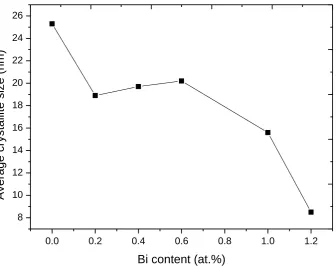
Fig. 3. Variation of average crystallite size of Bi doped ZnO thin films annealed at 600C with Bi dopant concentrations.
3.1.2. Surface Morphology
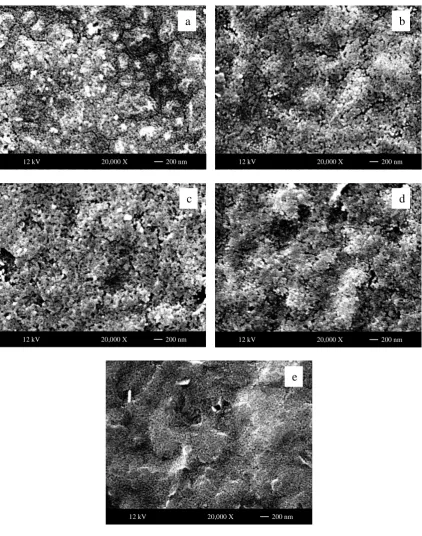
Fig. 4. SEM micrographs of Bi doped ZnO thin films annealed at 600°C with various Bi concentrations for 1 layer films (a) 0.0 at. %, (b) 0.2 at. %, (c) 0.4 at. %, (d) 0.6 at. %, (e) 1.0 at. %.
12 kV 20,000 X 200 nm
12 kV 20,000 X 200 nm
b
a
12 kV 20,000 X 200 nm
12 kV 20,000 X 200 nm
d
c
12 kV 20,000 X 200 nm
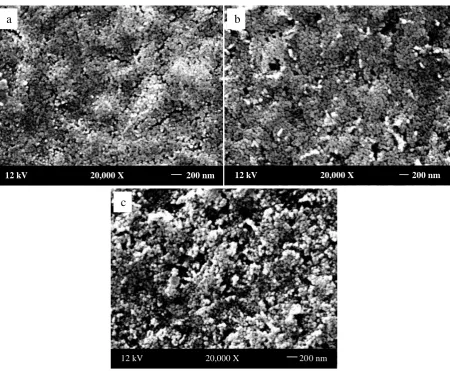
[image:7.595.88.511.74.611.2]Fig. 5. SEM micrographs of 0.2 at.% Bi doped ZnO thin films annealed at 600°C with varying layers (a) 1 layer, (b) 3 layers, and (c) 5 layers.
3.2. Optical Characterization
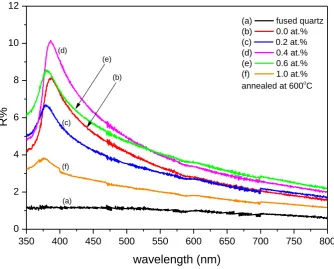
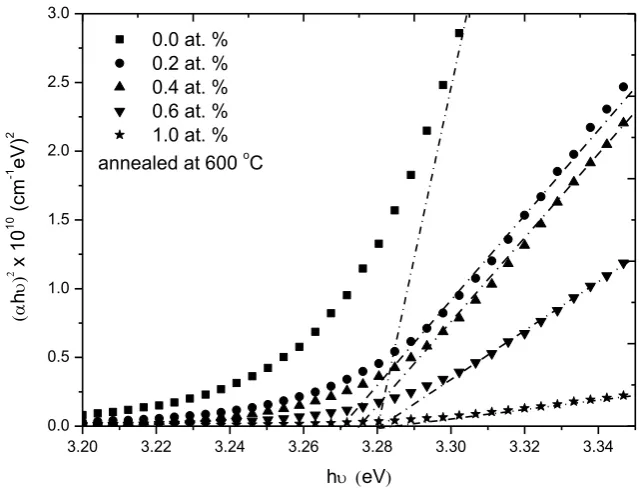
Figure 6 and 7 show the transmittance and reflectance spectra of the ZnO thin films (1 layer thin film) in the range of 350 – 800 nm, respectively. It shows low reflectance value in visible light region. It can indicate that the ZnO thin films are transparent and suitable to apply as the TCO. Moreover, the ZnO thin films responded to 350 – 400 nm in blue light wavelength. The optical band gap (Eg) of ZnO thin films can be estimated from the relationship curve between (αhv)2 versus (hv) by extrapolation of the linear portion (Tauc plot). As can be seen in Fig. 8, the band gap energy of Bi doped ZnO thin films decreased (3.27 eV) as compared with undoped ZnO thin film (3.28 eV) and no significantly change with different Bi doping concentrations as summarized in Table 2. This result is against the report of M. Jiang et al. [10] who observed the band gap shift from 3.24 to 3.29 eV for the Bi-doped ZnO thin films prepared by rf magnetron sputtering with increasing the argon pressure from 1.0 to 3.0 Pa. F. Chouikh et al. [18] who found that the band gap shift from 3.19 to 3.24 eV for Bi-doped ZnO films deposited by ultrasonic spray pyrolysis (to 5 mol% Bi concentration). They suggested that narrowing of optical band gap might be attributed to the forming of Bi impurity energy level. Therefore, the optical properties of thin films can be attributed to the deposition/ coating process and annealing temperature.
12 kV 20,000 X 200 nm
a
12 kV 20,000 X 200 nm
b
12 kV 20,000 X 200 nm
[image:8.595.73.524.74.445.2]350 400 450 500 550 600 650 700 750 800 0
10 20 30 40 50 60 70 80 90 100
(f) (c) (e) (d) (b)
T%
wavelength (nm)
(a) fused quartz (b) 0.0 at.% (c) 0.2 at.% (d) 0.4 at.% (e) 0.6 at.% (f) 1.0 at.% annealed at 600o
C
(a)
Fig. 6. Transmittance spectra of Bi doped ZnO thin films annealed at 600°C with varying Bi concentrations for 1 layer films.
350 400 450 500 550 600 650 700 750 800
0 2 4 6 8 10 12
(b) (e) (d)
(c)
(f)
R%
wavelength (nm)
(a) fused quartz (b) 0.0 at.% (c) 0.2 at.% (d) 0.4 at.% (e) 0.6 at.% (f) 1.0 at.% annealed at 600o
C
[image:9.595.116.466.111.381.2](a)
[image:9.595.128.463.449.718.2]3.20 3.22 3.24 3.26 3.28 3.30 3.32 3.34 0.0
0.5 1.0 1.5 2.0 2.5 3.0
h
x
1
0
10 (cm
-1 e
V)
2
heV 0.0 at. %
0.2 at. % 0.4 at. % 0.6 at. % 1.0 at. %
annealed at 600 oC
Fig. 8. (αhv)2 versus (hv) curve of Bi doped ZnO thin films annealed at 600°C with varying Bi contents for 1 layer films.
Table 2. Optical band gap of ZnO thin films (1 layer).
Bi
(at. %) Annealing Temp (°C) Eg (eV)
0.0
600
3.28
0.2 3.27
0.4 3.275
0.6 3.28
1.0 3.28
3.3. Electrical Characterization
[image:10.595.126.446.106.350.2] [image:10.595.203.392.442.540.2]-40 -30 -20 -10 0 10 20 30 40 -14
-12 -10 -8 -6 -4 -2 0 2 4 6 8 10 12
J
(A/
cm
2 )
Voltage (V) 1 layer
3 layeys 5 layers
Fig. 9. J-V curve of 0.2 at.% Bi-doped ZnO thin films with varying coating layers.
4.
Conclusions
In summary, undoped and Bi doped ZnO thin film on the fused quartz substrates have been prepared by a simple sol-gel spin coating method. XRD pattern of ZnO thin films with 0.2-1.0 at% Bi showed polycrystalline wurtzite structure with a preferential c-axis orientation. However, with 1.2 at.% Bi doped ZnO thin film, it occurred out-of phase ZnO. The optical characteristic showed that Bi doped ZnO thin films were excellent transmission in visible light region. Moreover, the transmittance showed sharp absorption edge shift in blue wavelength. The reflectance spectra showed low reflectance value which will be brought high photon energy to attack solar cell structure. The energy band gap was not affected by Bi incorporation with different concentrations. The surface morphology of 0.2 at.% Bi doped ZnO thin film was improved with increasing the number of layer. Furthermore, the electrical conductivity increased with increasing the number of layer as well.
Acknowledgement
[image:11.595.110.464.113.381.2]References
[1] J. Löffler, R. Groenen, J. L. Linden, M. C. M. van de Sanden, and R. E. I. Schropp, “Amorphous silicon solar cells on natively textured ZnO grown by PECVD,” Thin Solid Films, vol. 392, pp. 315-319, 2001.
[2] J. Owen, M. S. Son, and K.-H. Yoo, B. D. Ahn, and S. Y. Lee, “Organic photovoltaic devices with
Ga-doped ZnO electrode,” Appl. Phys. Lett., vol. 90, pp. 033512, 2007.
[3] X. Wang, Y. Ding, Z. Li, J. Song, and Z. L. Wang, “Single-Crystal Mesoporous ZnO Thin Films Composed of Nanowalls,” J. Phys. Chem. C, vol. 113, pp. 1791-1794, 2009.
[4] T. Makino, C. H. Chia, Y. Segawa, M. Kawasaki, A. Ohtomo, K. Tamura, Y. Matsumoto, and H. Koinuma, “High-throughput optical characterization for the development of ZnO-based ultraviolet semiconductor-laser,” Applied Surface Science, vol. 189, pp. 277-283, 2002.
[5] G. S. Kino and R. S. Wagers, “Theory of interdigital couplers on nonpiezoelectric substrate,” J. Appl. Phys., vol. 44, pp. 1480-1488, 1973.
[6] D.G. Thomas., “The exciton spectrum of zinc oxide,” J. Phys. Chem. Solids, vol. 15, pp. 86-96, 1960. [7] D. R. Sahu, “Properties of doped ZnO thin films grown by simultaneous dc and RF magnetron
sputtering,” Materials Science and Engineering B, vol. 171, pp. 99-103, 2010.
[8] M. S. Tokumoto, A. Smith, C. V. Santilli, S. H. Pulcinelli, A. F. Craievich, E. Elkaim, A. Traverse, and V. Briois, “Structural electrical and optical properties of undoped and indium doped ZnO thin films prepared by the pyrosol process at different temperatures,” Thin Solid Films, vol. 416, pp. 284-293, 2002.
[9] S. W. Shin, K. U. Sim, J.-H. Moon, and J. H. Kim, “The effect of processing parameters on the properties of Ga-doped ZnO thin films by RF magnetron sputtering,” Current Applied Physics, vol. 10, pp. S274-S277, 2010.
[10] M. Jiang, X. Liu, and H. Wang, “Conductive and transparent Bi-doped ZnO thin films prepared by rf
magnetron sputtering,” Surface & Coating Technology, vol. 203, pp. 3750-3753, 2009.
[11] M. Jiang and X. Liu, “Preparation and optical properties of Bi doped ZnO thin films with (100) orientation by rf magnetron sputtering,” J. Mater. Sci.: Mater Electron, vol. 20, pp. 972-976, 2009. [12] Y. Liu and J. Lian, “Optical and electrical properties of aluminum-doped ZnO thin films grown by
pulsed laser deposition,” Appl. Surf. Sci., vol. 253, pp. 3727-3730, 2007.
[13] K. Haga, P. S. Wijesena, and H. Watanabe, “Group III impurity doped ZnO films prepared by atmospheric pressure chemical-vapor deposition using zinc acetylacetonate and oxygen,” Appl. Surf. Sci., vol. 169-170, pp. 504-507, 2001.
[14] P. Petrou, R. Singh, and D. E. Brodie, “The use of ZnO in transparent type MIS solar cells,” Appl.
Phys. Lett., vol. 35, pp. 930-931, 1979.
[15] X. L. Chen, B. H. Xu, J. M. Xue, Y. Zhao, C. C. Wei, J. Sun, Y. Wang, X. D. Zhang, and X. H. Geng,
“Boron-doped zinc oxide thin films for large-area solar cells grown by metal organic chemical vapor deposition,” Thin Solid Films, vol. 515, pp. 3753-3759, 2007.
[16] V. Fathollahi and M. M. Amini, “Sol–gel preparation of highly oriented gallium-doped zinc oxide thin
films,” Materials Letters, vol. 50, pp. 235-239, 2001.
[17] M. Çopuroğlu, S. O’Brien, and G. M. Crean, “Sol–gel synthesis, comparative characterisation, and reliability analyses of undoped and Al-doped zinc oxide thin films,” Thin Solid Films, vol. 517, pp. 6323-6326, 2009.
[18] F. Chouikh, Y. Beggah, and M. S. Aida, “Optical and electrical properties of Bi doped ZnO thin films
deposited by ultrasonic spray pyrolysis,” J Mater Sci: Mater Electron, vol. 22, pp. 499-505, 2011.
[19] P. Krongarrom, S. T. Rattanachan, and T. Fangsuwannarak, “Structural and optical characterizations
of n-type doped ZnO by sol-gel method for photovoltaic,” presented at 8th ECTI Conference, Khon
Kaen, Thailand, 2011, pp. 50-53.[20] B. D. Cullity, Elements of X-ray Diffraction. MA: Addison-Wesley, 1978, pp. 102. [21] J. I. Pankove, Optical Processes in Semiconductors. New York: Dover Publications, 1976. [22] D. K. Schroder, Semiconductor Material and Device Characterization. New York: Wiley, 1990.
[23] R. Ghosh, D. Basak, and S. Fujihara, “Effect of substrate-induced strain on the structural, electrical, and optical properties of polycrystalline ZnO thin films,” J. Appl. Phys., vol. 96, pp. 2689-2692, 2004. [24] B. M. Ataev, A. M. Bagamadova, V. V. Mamedov, A. K. Omaev, and M. R. Rabadonov,