arXiv:hep-lat/0411019v1 15 Nov 2004
S. V. Wrighta∗
UKQCD Collaboration
aDivision of Theoretical Physics, Department of Mathematical Sciences, University of Liverpool,
Liverpool L69 3BX, UK
We discuss insights that may be drawn from our recent 2 flavourO(a)–improved Wilson quark simulations. We
discuss the evidence of the onset of chiral logarithms in the pion decay constant. An overview is given of current extrapolation methods and a modification of chiral perturbation theory is presented as an approach for sensibly extrapolating to the physical quark masses.
1. Introduction
In a recent work [1] we presented results from the lightest UKQCD Wilson quark simulations for the mass of the singlet pseudoscalar meson and the pseudoscalar (pion) decay constant. In this work we shall expand upon the pion decay constant extrapolation details and suggest a sim-plistic first attempt at an improved extrapolation method.
The motivation for this recent calculation of the pseudoscalar decay constant, fPS, is the ex-pectation of observing behaviour predicted by Chiral Perturbation Theory (χPT) as the pseu-doscalar mass is lowered. In particular evidence of the onset of chiral logs in observables. The low-est order chiral Lagrangian has non-analyticity resulting from loop corrections introduced in the parameters. This non-analytic behaviour pro-vides a good check that the lattice calculation is in the regime where chiral perturbation theory is valid.
Computational constraints have forced us to work at finite lattice spacing, however the choice was made to compare our results to the contin-uum predictions ofχPT. Whilst Chiral perturba-tion theory has been formulated for finite lattice spacing [2,3], it is at the cost of additional param-eters.
∗Current Address: Physics Division, Argonne National
Laboratory, Argonne IL 60439, USA.
2. Calculating fPS
Our results for the pseudoscalar decay constant were extracted from UKQCD simulations at three different quark masses: κ = 0.1358, 0.1355 and 0.1350. All lattices had 163×32 volumes with
[image:1.612.300.457.626.674.2]β = 5.2 and a non-perturbatively improved clover action. Using quark propagators with sources on the time planes t = 0, 7, 15 and 23 allowed an improvement in the statistics of the simulation. As the value ofmPSL≈4 in each of the cases we would expect some finite volume effects in our cal-culations. These are taken into consideration [4] in the subsequent analysis.
Table 1
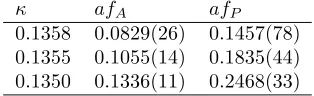
The raw lattice value ofafPSis given by using the order aimproved expression (1 +bAmPS)(afA+ cAafP) and we tabulate these two
contribu-tions. [1]
κ afA afP
0.1358 0.0829(26) 0.1457(78) 0.1355 0.1055(14) 0.1835(44) 0.1350 0.1336(11) 0.2468(33)
Our results forfPSwere presented in [1] and are reproduced here in Table 1 and Fig. 1. The lattice value ofafPSused in Fig. 1 is found by using the order aimproved expression (1 +bAmPS)(afA+
cAafP), wherefA,P are the axial-vector and
[image:2.612.83.291.236.381.2]pseu-doscalar decay constants and their contributions are listed in Table 1.
Figure 1. The pseudoscalar decay constant in units ofr0from UKQCD and JLQCD versusκ.[1]
To aid comparison with the only available com-parable data, that of JLQCD [5], we have used the same perturbative formulation of the corrections and also the same prescription forZA, the
renor-malisation factor. Finally as there is a discrep-ancy in the prescription for evaluatingr0we apply our determination ofr0 to their data. The com-parison of results is shown in Fig. 1. The agree-ment at the lightest commonκvalues is pleasing. The exciting feature of our new results is the in-dication of curvature versusmq. It is this result
that has motivated the current investigation.
3. Extrapolation Comparisons
The limitation of all current lattice calculation of the pseudoscalar decay constant to large quark masses necessitates some form of extrapolation to the physical quark (or equivalently pion) mass. Over the last few years it has become accepted within lattice groups that some form of chirally motivated extrapolation is appropriate [6,7,8,9], by using insights from chiral perturbation theory, when extrapolating physical observables. The
sit-uation is no different in the case of fPS, how-ever opinions of what isappropriatediffer between groups.
The chiral perturbation prediction for the pion mass dependence offPSis [4,10]:
fPS
fπ(0)
= 1−2
mPS 4πfπ(0)
2
log
m2 PS Λ2
4
+· · · (1)
wherefπ(0) is the pseudoscalar (pion) decay
[image:2.612.323.544.339.496.2]con-stant in the chiral limit.
Figure 2. The pseudoscalar decay constant in units ofr0from UKQCD versus the squared pseu-doscalar meson mass. Also shown is an expression including chiral perturbation theory terms to or-derm4
PS which has been fitted (see ref. [4] where we useµ= 0.75 GeV and ˜rF(µ) = −2) to agree
with the experimental values offπandfK which
are shown (*). An estimate [4] of the finite size ef-fect expected from chiral perturbation theory (to order m2
PS) is shown by the vertical lines.
Recent work [4] has provided a way of estimat-ing the expected finite size effects. The quark loops generate logarithmic corrections, but more-over they are the source of the finite size effects. UsingL= 1.5 fm andmπ= 400 MeV, which are
corrections may be determined. The solid curve shown is an expression including chiral perturba-tion theory terms to order m4
PS which has been fitted (see Ref. [4] where we use µ = 0.75 GeV and ˜rF(µ) =−2) to agree with the experimental
values offπandfKwhich are shown (*). An
esti-mate [4] of the finite size effect expected from chi-ral perturbation theory (to orderm2PS) is shown by the vertical lines. As an experiment, we also continued the χPT prediction for fPS to almost twice the kaon mass (dashed curve). It is clear the lattice simulation behaviour in this regime is fun-damentally different from the na¨ıve predictions of
χPT. This discrepancy indicatesχPT (as formu-lated) has a limited range of overlap with current simulations.
JLQCD
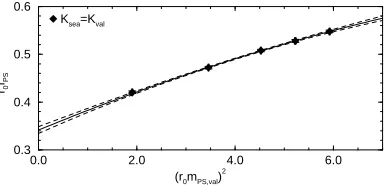
Recent progress in the extension of χPT has been attempted by the JLQCD collaboration [5]. Their approach usedχPT as motivation for their functional form which, in the dynamical case (κsea = κval) may be written as:
fPS=A+Bm2PS+Cm 4
PS (2)
The analytic (even powers of mPS) terms of Eq. (2) are consistent with both χPT and the JLQCD data set, as seen in Fig. 3. The success of such a fit may be seen to vindicate “leaving the problem of the chiral logarithm [. . . ] for future publication.” [5]
0.0 2.0 4.0 6.0
(r0mPS,val)
2
0.3 0.4 0.5 0.6
r0
fPS
[image:3.612.65.259.586.679.2]Ksea=Kval
Figure 3. Chiral extrapolation of the pseu-doscalar meson decay constant. The fit is made using Eq. (2). [5]
The problem with this approach is the selective nature of what parts ofχPT are used. The chiral logarithm term that occurs with a power of the pseudoscalar mass less than m4
PS is ignored. Yet this is the greatest contribution to the curvature in the small mass regime. The form is also in-consistent with the large mass behaviour of fPS which experience has shown to be proportional tom2
PSup to pseudoscalar masses of the order of 1.4 GeV2. Thus, any perceived successes of this form of extrapolation must be tempered by the clear inconsistencies with the behaviour of QCD as established byχPT.
Dyson–Schwinger Equation
An interesting alternative insight is that pro-moted by the Dyson–Schwinger Equation (DSE) community. The Dyson–Schwinger equations, whilst maintaining a Poincar´e covariant frame-work, provide a setting for a non-perturbative chiral symmetry preserving truncation that leads to an efficient one–parameter rainbow–ladder model [11]. In this DSE approach, the pion is well–understood and is essentially model– independent; it is both the Goldstone boson and a bound state of strongly dressed quarks [12,13]. This reduction of QCD to an understandable case benefits us as the circumstances of the lattice (that is equal mass quarks as discussed later) may be investigated.
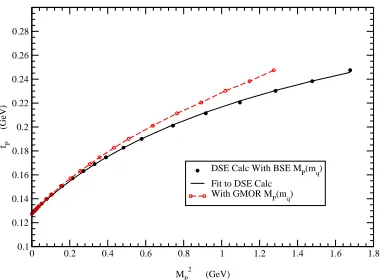
The DSE approach of Tandy [14] to the pseu-doscalar decay constant is presented in Fig. 4 by the solid curve. For the dashed curve, the same calculated decay constant is plotted against the pseudoscalar mass obtained frommq via the
Gell-Mann–Oakes–Renner relation, as would be used by χPT. This alternative approach differs from
0 0.2 0.4 0.6 0.8 1 1.2 1.4 1.6 1.8
M
P 2 (GeV)
0.1 0.12 0.14 0.16 0.18 0.2 0.22 0.24 0.26 0.28
fP
(GeV)
[image:4.612.93.285.197.337.2]DSE Calc With BSE MP(mq) Fit to DSE Calc With GMOR MP(mq)
Figure 4. The pseudoscalar decay constant ver-sus the square of the pseudoscalar mass both cal-culated within the Dyson–Schwinger framework. The solid line is the exact pseudoscalar mass, whilst the dashed curve is the mass obtained by using the Gell-Mann–Oakes–Renner relation-ship. [15]
fPS=
s
f2
π(0) +A0mPS 1.0 +A1mPS+A2m2PS
(3)
Whilst reproducing the correct QCD behaviour at large mPS it is incorrect at small quark masses. As was discussed above this should not be consid-ered a failure, as the model that motivated this form lacks the chiral behaviour that induces the logarithm in Eq. (1).
3.1. Modified χPT
The final approach we will mention is a mini-malistic modification ofχPT as motivated by our previous work [6,7,8,16]. In these investigations we found that a change in the form of the reg-ularisation of χPT admits an extended radius of convergence whilst maintaining an exact agree-ment with the results of the dimensional regu-larised solution. Recent work of the Adelaide group [17] has show that this exact agreement is indeed obtainable between different formulations of the regulariser, and it is indeed a requirement
of a regularisation scheme.
The changes we make to the dimensional regu-larised result ofχPT to form our ModifiedχPT are two:
• Terms ofO(m4
PS) and higher in the full ex-pression of Eq. (1) are neglected,
• An additional parameter Bm2
PS is intro-duced to absorb the physics ignored by the truncation.
The form used for extrapolating thus becomes:
fPS
fπ(0)
= 1−2
mPS 4πfπ(0)
2
×log
m2 PS
Bm2
PS+ Λ2
(4)
where the new term Bm2
PS suppresses the chiral logarithms above a certain energy scale and pro-vides the missing analytic behaviour near the chi-ral limit. A similar approach has been attempted by JLQCD [18].
The advantages of this form for extrapolating results from lattice QCD calculations are that it reproducesχPT near the chiral limit, but it also has the intermediate mass behaviour of QCD that the lattice has shown. This simple form allows an extension of the radius of convergence ofχPT. It must be noted that this form is indeed na¨ıve in the way the two mass limits are enforced but it does suggests hope for a more rigorous FRR solution that has been achieved elsewhere [17]. Such an extension is part of an ongoing investigation.
This modified χPT approach is more suited to extrapolating lattice QCD calculations, at the current juncture, than the dimensionally regu-larised approach of Eq. (1) for another reason too: it has fewer fit parameters. As shown in Fig. 1 near the chiral limit we currently have, at best, 5 data points, and fitting purely to our UKQCD data we would have only three data points. The
O(p6) low–energy constants expansion of Eq. (1) (see Ref. [4] for the full expression) has seven pa-rameters: fπ(0), Λ1, . . . , Λ4, ˜rF(µ) andµ; each
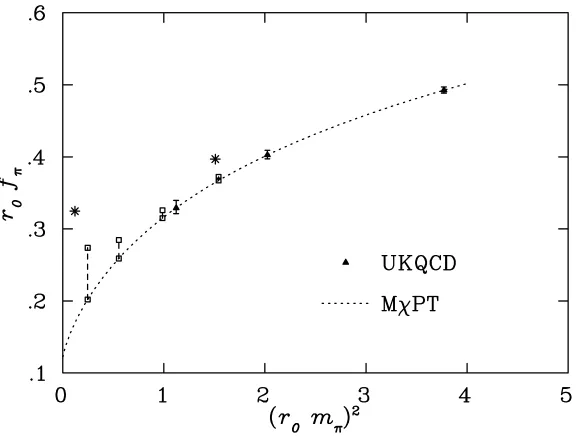
pa-Figure 5. The pseudoscalar decay constant in units ofr0from UKQCD versus the squared pseudoscalar meson mass. The experimental values of fπ and fK are shown (*). The dotted curve is the fit of
the Modified χPT result of Eq. (4). The vertical lines indicate expected finite size effects at various pseudoscalar meson masses, as in Fig. 2.
rameters must independently be determined by the theory.
Conversely the simplistic approach of Eq. (4) has only three parameters fπ(0), Λ and B. In
comparing these two approaches the expectation that the non-analytic behaviour should be the same is an important success. The values of Λ (Eq. (4)) and Λ4 (Eq. (1)) are consistent within the large uncertainties as previously discussed in [7]. The value of Λ4 from [4] is 1.25−+00..1513GeV whilst we find Λ = 0.93±0.42 GeV. In a simi-lar vein to Ref. [16] some of the physics we have neglected, i.e. higher powers of mPS, has been absorbed into the parameterB. We present our fit of Eq. (4) to our UKQCD data in Fig. 5. The vertical dashed lines are the same finite size error estimation calculations as discussed in Sec. 3.
It is clear that even with a finite size correc-tion to the UKQCD calculacorrec-tions there is a dis-crepancy between the data obtained from lattice simulations and the experimentally measured
de-cay constant of the K meson. This discrepancy highlights some of the limitations of the current results. The finite size corrections that have been applied to this data are indicative only and do not necessarily account for all the finite size effects in the simulation. The benefit is that they reinforce the intuition that finite size effects become less important as the quark masses get larger.
The discussion herein of an extrapolation of the quark mass ignores the other important extrapo-lation that has not been undertaken in these sim-ulations; that is the continuum extrapolation. In this work we have chosen a value of r0 as sug-gested by [21,22], however the uncertainty of this value is 5%. Additionally, the value ofZAwe use
to renormalise our result is determined perturba-tively. At first order the correction is 25% and the systematic error at second order is expected to be up to 5%. Whilst the value ofZA remains
[image:5.612.145.433.172.393.2]Finally there is a fundamental difference be-tween the object that is calculated at non-zero quark masses and the pseudoscalar meson that is experimentally detected. The K meson con-ceptually is astrange quark and alight quark in a sea of light quarks. The pseudoscalar meson calculated on the lattice with the same mass con-sists of two quarks with masses half of that of the strange quark in a sea of equivalently heavy quarks. The DSE calculations shown in Fig. 4 have this behaviour, but the experimental points of Figs. 2 and 5 are different objects. There is an expectation that the difference between a hqQi
object and hQ2 Q2imeson is not large, but this is yet to be quantified.
4. Conclusion
We have presented a review of our recent pub-lication [1] and in particular the discussion of the extraction of the pseudoscalar decay constant on the lattice. We have shown that this data set contains an indication of the onset of chiral log-arithms for the first time in this quantity. Ad-ditionally we have discussed how the need to ex-trapolate to the chiral limit still exists and fur-thermore that the suggestion of curvature neces-sitates the use of chiral perturbation theory. Fi-nally we discuss some approaches and present a first attempt at a form that respects chiral per-turbation theory whilst being applicable in the region where the lattice calculations are still be-ing performed.
Acknowledgements
The author would like to acknowledge Peter Tandy not only for providing Fig. 4 but for the helpful discussions and Craig Roberts for the same. SVW would also like to thank Chris Michael and Alan Irving for assistance during this research and helpful comments in the preparation of this proceedings. The support of the U.K. Par-ticle Physics and Astronomy Research Council is gratefully acknowledged.
REFERENCES
1. UKQCDCollaboration, C. R. Alltonet al.
Phys. Rev.D70(2004) 014501.
2. S. AokiPhys. Rev.D68(2003) 054508. 3. O. Bar, G. Rupak, and N. Shoresh, “Chiral
perturbation theory atO(a2) for lattice QCD”.
4. G. Colangelo and S. DurrEur. Phys. J.C33
(2004) 543–553.
5. JLQCDCollaboration, S. Aokiet al. Phys.
Rev.D68(2003) 054502.
6. D. B. Leinweber, A. W. Thomas,
K. Tsushima, and S. V. Wright Phys. Rev.
D61 (2000) 074502.
7. D. B. Leinweber, A. W. Thomas,
K. Tsushima, and S. V. Wright Phys. Rev.
D64 (2001) 094502.
8. R. D. Young, D. B. Leinweber, A. W. Thomas, and S. V. WrightPhys. Rev.D66
(2002) 094507.
9. C. Bernardet al. Nucl. Phys. Proc. Suppl.
119(2003) 170–184.
10. J. Bijnens, G. Colangelo, and P. Talavera
JHEP 05(1998) 014.
11. P. Maris and P. C. TandyPhys. Rev.C60
(1999) 055214.
12. P. Maris and C. D. RobertsInt. J. Mod. Phys.E12(2003) 297–365.
13. P. Maris, C. D. Roberts, and P. C. Tandy
Phys. Lett.B420(1998) 267–273.
14. P. C. Tandy, “Covariant QCD modeling of light meson physics”.
15. P. C. Tandy. Private communications. 16. G. V. Dunne, A. W. Thomas, and S. V.
Wright Phys. Lett.B531(2002) 77–82. 17. R. D. Young, D. B. Leinweber, and A. W.
ThomasProg. Part. Nucl. Phys.50(2003) 399–417.
18. JLQCDCollaboration, S. Aokiet al. Phys.
Rev. Lett.91(2003) 212001.
19. G. Colangelo, J. Gasser, and H. Leutwyler
Nucl. Phys. B603(2001) 125–179.
20. J. Gasser and H. LeutwylerAnn. Phys.158
(1984) 142.
21. UKQCDCollaboration, C. R. Alltonet al.
Phys. Rev.D65(2002) 054502.
22. UKQCDCollaboration, A. Dougall, R. D.
Kenway, C. M. Maynard, and C. McNeile
![Figure 1.The pseudoscalar decay constant inunits of r0 from UKQCD and JLQCD versus κ.[1]](https://thumb-us.123doks.com/thumbv2/123dok_us/8061364.226030/2.612.83.291.236.381/figure-pseudoscalar-decay-constant-inunits-ukqcd-jlqcd-versus.webp)