PoS(LAT2005)083
Eric B. Gregory∗, Alan C. Irving, Craig McNeile, Steven Miller, and Zbigniew Sroczynski
Theoretical Physics Division
Department of Mathematical Sciences University of Liverpool
Liverpool, L69 7ZL, UK
E-mail:[email protected]
We report on progress in measuring disconnected correlators associated with pseudoscalar flavor-singlet mesons. This will eventually allow us to compute the masses of the eta and eta’ mesons. Flavor-singlet physics also presents an interesting test of the staggered fermion formulation, as disconnected correlators are sensitive to whether the same action governs both sea quarks and valence quarks. It can also help test the validity of the “fourth-root trick” used in unquenched lattice calculations where the number of flavorsNf <4.
XXIIIrd International Symposium on Lattice Field Theory 25-30 July 2005
Trinity College, Dublin, Ireland
PoS(LAT2005)083
1. Introduction
Pseudoscalar flavor-singlet mesons are interesting for a number of reasons, including the rela-tion between theη0andπ mass difference and the U(1) axial anomaly [1, 2], and the connection to the topological susceptibility. Unlike flavor non-singlet states, the propagator of flavor-singlet meson contains disconnected correlators, which are particularly challenging to measure precisely in lattice simulations. Hence flavor-singlet mesons present a rich proving ground for lattice sim-ulations. To this end a number of simulations have been performed on the lattice using quenched Wilson [3],Nf =2 Wilson [4, 5, 6, 7, 8], andNf =2 staggered fermion formulations [9, 10].
Simulations utilizing modern dynamical staggered fermion gauge configurations are of partic-ular interest. The library of Nf =2+1 staggered fermion gauge configurations from the MILC
collaboration [12, 13] contains extremely light up and down quarks (mq/ms<0.2), simulated at
fine lattice spacings (a≈0.11fm and a≈0.09fm). These configurations, and other ensembles currently being generated provide an unprecedented opportunity to measure mixed operators nu-merically determine the masses of both theηandη0. Additionally, the sensitivity of disconnected correlators to sea quark loops offers a probe of the validity of the fourth-root trick in the staggered fermion formulation.
With this in mind, we make a preliminary presentation of measurements of pseudoscalar flavor-singlet propagators on Nf =2+1-flavor improved staggered fermion configurations. As
the work is in preliminary stages, we concentrate on some theoretical and technical issues in Sec-tions 2 and 3. In Section 4 we describe our early results with some discussion of ongoing quesSec-tions and issues, which we hope our continuing work will resolve.
2. Theoretical Considerations
The flavor-singlet pseudoscalar meson propagator is expressed as
G(x0,x) =h
∑
iqi(x0)(γ5⊗1)qi(x0)
∑
jqj(x)(γ5⊗1)qj(x)i, (2.1)
where the(γ5⊗1)denotes the meson as a pseudoscalar in spinor-space and a singlet in flavor-space.
One can group the possible contractions into two classes: Nf connected terms with contractions
connecting fields atxandx0, andN2f disconnected terms with theqs contracted withqs at the same space time points. So the full propagator is:
G=NfC−N2fD, (2.2)
whereCandDare the connected and disconnected correlators, respectively. The minus sign is due to the additional fermion loop in D. The functionC is also the connected pion propagator with
(γ5⊗1)operator. In full QCD, bothCandGwill have leading behavior that decays exponentially:
C(t)∼e−mπt and G(t)∼e−mη0t. (2.3)
So the ratio of the disconnected to connected contributions to the singlet propagator behaves as
R(t)≡ N 2
fD(t) NfC(t)
= NfC(t)−G(t)
NfC(t)
PoS(LAT2005)083
in full QCD [9]. The correct behavior of the full propagator depends on the sea quarks having thesame number of flavors and same masses as the valence quarks. If the det1/4trick introduces some unexpected pathology into the action of the sea quarks, we might expect to detect a deviation from the form of equation 2.4. For example, in the limit of quenched QCDRshould be linear:
R(t) =A+Bt. (2.5)
In non-degenerate flavor simulations one should employ obvious generalizations of equations 2.2 and 2.4. For example, whenNf is split intoNq+Nsflavors of light and strange quarks we have:
G −→ (NqCqq+NsCss)− Nq2Dqq+Ns2Dss+2NqNsDqs
R −→ N 2
qDqq+Ns2Dss+2NqNsDqs NqCqq+NsCss
. (2.6)
With staggered fermions, one must rescale the disconnected correlators by 1/4 with respect to the connected correlators to take account the two loops of four staggered valence tastes in the disconnected diagrams compared to the single valence loop in the connected diagrams[9]. In the discussion below such rescaling is implicit inD.
3. Simulation and Measurement
We have begun measurement of singlet propagators on the following gauge ensembles: Nf β L3×T am Nconfigs
0 8.00 163×32 0.02 104 2 7.20 163×32 0.02 268 2+1 6.76 203×64 0.007, 0.05 422 2+1 6.76 203×64 0.01, 0.05 644
The 163×32 configurations are small test lattices generated locally, while the 203×64 con-figurations are part of the library of MILC “coarse lattices” [12].
In principle there are two choices of flavor-singlet pseudoscalar meson operator available. These are the(γ4γ5⊗1)and the(γ5⊗1). The former is a three-link operator, with the quark and
antiquark sources set on opposite corners of the spatial cube, while the latter is a four-link operator, with the quark and antiquark situated on opposite corners of thehypercube. The(γ4γ5⊗1) has
a parity partner, namely the scalar(1⊗γ4γ5), which contributes an oscillating exponential to the
pseudoscalar propagator. The parity partner of the(γ5⊗1), however, has exotic quantum numbers
JPC=0+−, and contributes nothing to the pseudoscalar propagator. Hence, only the(γ5⊗1) is well-suited for looking at quantities such as the ratio in equation 2.4. We formulate the operators in a gauge invariant way, using symmetric covariant shifts to displace the quark and antiquark sources to their respective positions on the hypercube.
We measure the connected diagrams using standard point sources. We measure the the discon-nected diagrams with a stochastic volume source method [14]. We define a source fieldη whose value at every lattice site is drawn from a gaussian distribution. Then we solve for
O(t) = 1
Nsrc
Nsrc
∑
i x,
∑
x4=ty,∑
y4=tTrη†(i)
y ∆γr⊗1M
−1
yx η
(i)
PoS(LAT2005)083
whereMis the fermionic matrix and∆γr⊗1is the staggered meson operator that effects the four-linkshifts and the Kogut-Suskind phasing appropriate to theγr⊗1meson. We average over a number
of different source fieldsη, then compute the disconnected correlator:
D(∆t) =hO(t)O(t+∆t)i (3.2)
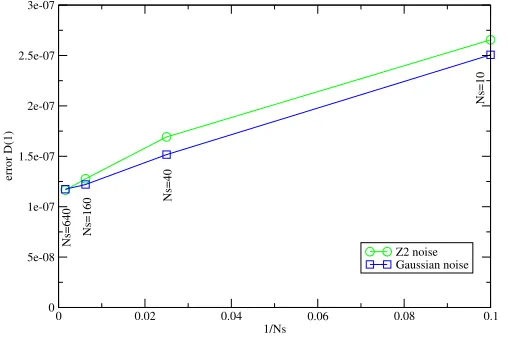
In tests on the small (163×32) lattices, we found that with as few as 40 noise sources our error would be dominated by gauge noise even with several hundred configurations, so in subsequent runs we usedNsrc=40. We also testedZ2 noise and found that it produced noise errors that were systematically larger than that obtained with gaussian noise, as shown in Figure 1. Previously, for Wilson fermions Z2 noise was found to be better than Gaussian for the simplest stochastic estimators [16].
0 0.02 0.04 0.06 0.08 0.1
1/Ns 0
5e-08 1e-07 1.5e-07 2e-07 2.5e-07 3e-07
error D(1)
Ns=10
Ns=40
Ns=160
Ns=640
[image:4.595.161.415.301.470.2]Z2 noise Gaussian noise
Figure 1: Error on theD(t=1)forNf =2β =7.2am=0.20 on 163×32 lattices for gaussian andZ2 noise as a function of the inverse number of sources.
4. Results and Discussion
Our results to date show clear signals for disconnected and connected correlators. For the 2+1-flavor ensembles, we formed the ratio:
R(t) =4Dqq(t) +4Dqs(t) +1Dss
2Cqq(t) +Css(t)
. (4.1)
An example of the resulting function is plotted as the dark curve in Figure 2. Results for both 2+1-flavor ensembles were qualitatively similar.
PoS(LAT2005)083
0 5 10 15
t 0
1 2 3
D(t)/C(t)
[image:5.595.177.409.119.291.2]102 - 732 738 - 1362 1368 - 1998 2004 - 2628 102 - 2628 (all)
Figure 2: R(t)onβ =6.76,am=0.007,0.05 on 203×64 lattices for full time series (black), and four
subsets (colored). Configurations indexed by trajectory number (6 trajectories per configuration).
0 500 1000 1500 2000 2500
trajecs
-0.0005 0 0.0005 0.001
Dqq(10)
Figure 3: Time series forDqq(t=10)onβ =6.76,am=0.007,0.05 on 203×64 lattices. Same color scheme as previous figure.
illustrate a flaw in the simulated staggered sea. We have suspicions that the normalizations of our disconnected operators may instead be incorrect, however. As we compute the disconnected and connected correlators by different methods, we must account for different numerical factors in each, and reconciling them is non-trivial. Further tests are being made.
[image:5.595.83.474.387.504.2]PoS(LAT2005)083
With these uncertainties, we do not conclude that the pseudoscalar singlet correlators producedthus far cast doubt on the staggered formulation, nor are we at this stage able to make statements about the lattice masses of theηandη0. It is evident that we will first have to confirm the correct normalizations, and then make measurements on extremely long time series ensembles. We are in the process of generating 2+1-flavor ensembles of∼104configurations on the UKQCD’s QCDOC machine. Additionally, we are investigating different optimization strategies [9, 15] such as dilution of the stochastic sources which may decrease disconnected correlator noise.
References
[1] E. Witten,Current Algebra Theorems For The U(1) ’Goldstone Boson’,Nucl. Phys. B 156(269). [2] G. Veneziano,U(1) Without Instantons,Nucl. Phys. B 159(213).
[3] S. Itoh, Y. Iwasaki and T. Yoshie,The U(1) Problem And Topological Excitations On A Lattice,Phys. Rev. D 36, (527).
[4] C. McNeile and C. Michael [UKQCD Collaboration],The eta and eta’ mesons in QCD,Phys. Lett. B 491(123) [Erratum-ibid. B551, 391 (2003)] [arXiv:hep-lat/0006020].
[5] T. Struckmannet al.[TXL Collaboration],Flavor singlet pseudoscalar masses in N(f) = 2 QCD, Phys. Rev. D 63(074503) [arXiv:hep-lat/0010005].
[6] V. I. Lesket al.[CP-PACS Collaboration],Flavor singlet meson mass in the continuum limit in two-flavor lattice QCD,Phys. Rev. D 67(074503) [arXiv:hep-lat/0211040].
[7] K. Schilling, H. Neff and T. Lippert,Computing the eta and eta’ mesons in lattice QCD,
[arXiv:hep-lat/0401005].
[8] C. R. Alltonet al.[UKQCD Collaboration],Improved Wilson QCD simulations with light quark masses,Phys. Rev. D70(014501) [arXiv:hep-lat/0403007].
[9] L. Venkataraman and G. Kilcup,The eta’ meson with staggered fermions,
[arXiv:hep-lat/9711006].
[10] J. B. Kogut, J. F. Lagae and D. K. Sinclair,Topology, fermionic zero modes and flavor singlet correlators in finite temperature QCD,Phys. Rev. D 58(054504) [arXiv:hep-lat/9801020].
[11] H. Fukaya and T. Onogi,theta vacuum effects on the chiral condensation and the eta’ meson correlators in the two-flavor massive QED(2) on the lattice,Phys. Rev. D 70,
(054508)[arXiv:hep-lat/0403024].
[12] C. W. Bernardet al.,The QCD spectrum with three quark flavors,Phys. Rev. D 64, (054506)
[arXiv:hep-lat/0104002].
[13] C. Aubinet al.,Light hadrons with improved staggered quarks: Approaching the continuum limit, Phys. Rev. D 70(094505) [arXiv:hep-lat/0402030].
[14] F. Farchioni, G. Muenster and R. Peetz,The volume source technique for flavor singlets: A second look,Eur. Phys. J. C,38(329) [arXiv:hep-lat/0404004].
[15] J. Foley, K. Jimmy Juge, A. O’Cais, M. Peardon, S. M. Ryan and J. I. Skullerud,Practical all-to-all propagators for lattice QCD, [arXiv:hep-lat/0505023].
[16] S. J. Dong and K. F. Liu,Stochastic estimation with Z(2) noise,Phys. Lett. B328(130)