Rochester Institute of Technology
RIT Scholar Works
Theses Thesis/Dissertation Collections
7-1-1985
Image reconstruction using Wiener filtering and
unsharp masking: a computer model
Jay Berman
Follow this and additional works at:http://scholarworks.rit.edu/theses
This Thesis is brought to you for free and open access by the Thesis/Dissertation Collections at RIT Scholar Works. It has been accepted for inclusion in Theses by an authorized administrator of RIT Scholar Works. For more information, please [email protected].
Recommended Citation
IMAGE RECONSTRUCTION USING WIENER FILTERING AND
UN SHARP MASKING: A COMPUTER MODEL
By
Jay H. Berman
B.S. North Carolina State University
(1979)
A thesis presented in partial fulfillment
of the requirements for the degree of
Master of Science in the School of
Photographic Arts and Science in the
College of Graphic Arts and Photography
of the Rochester Institute of Technology
July, 1985
Signature of the Author
Jay H. Berman
Center for Imaging Science
Ronald Francis
Accepted byCOLLEGE OF GRAPHIC ARTS AND PHOTOGRAPHY
Rochester Institute of Technology
Rochester, New York
CERTIFICATE OF APPROVAL
M.S. DEGREE THESIS
The M.S. Degree Thesis of Jay H. Berman has been examined and approved by
the thesis committee as satisfactory for the thesis requirements for the Master of Science Degree
Edward Granger
Dr. Edward M. Granger, Thesis Advisor
Willem Brouwer
Dr. W. BrouwerTHESIS RELEASE PERMISSION FORM
ROCHESTER INSTITUTE OF TECHNOLOGY
COLLEGE OF GRAPHIC ARTS AND PHOTOGRAPHY
Title of Thesis: IMAGE RECONSTRUCTION USING WIENER FILTERING
AND UNSHARP MASKING: A COMPUTER MODEL
I, Jay H. Berman, hereby grant permission to the Wallace
Library of R.I.T. to reproduce my thesis in whole or in
part. Any reproduction will not be for commercial use or
profit.
IMAGE RECONSTRUCTION USING WIENER FILTERING AND
UNSHARP MASKING: A COMPUTER MODEL
By
Jay H. Berman
Submitted to the Center for Imaging Science
in partial fulfillment of the requirements for the Master of Science degree at the Rochester Institute
of Technology.
ABSTRACT
Research was conducted to computer model and compare
the image reconstruction obtainable using Wiener filtering
and unsharp masking. Wiener filtering and unsharp masking
are techniques used to improve image quality and interpretation. It was demonstrated that far greater image
restoration is obtained by Wiener filter than by unsharp
masking because unsharp masking, unlike Wiener filtering, enhanced image noise along with the edges. A user friendly
computer model, that may be used as a tutorial aid for Image Science students, incorporating Fast Fourier Transform (FFT) techniques was designed. Graphics allow the user to follow
ACKNOWLEDGEMENTS
Assistance from the following sources is greatly
appreciated. Without the help of these dedicated
professionals this work would not have been done.
Dr. Edward M. Granger of the Eastman Kodak Co. and
Professor at the Rochester Institute of Technology, for
acting as my thesis advisor and primary instructor in
this exciting new field of Digital Image Processing;
The Eastman Kodak Co. for allowing me the use of their
facilities and for sharing their expertise;
Dr. W. Brouwer for acting as a member of the thesis
committee, keeping me on my toes, and providing helpful
assistance; and
The United States Air Force Institute of Technology
(contract no. f33600-76-a-7299) for paying the bills
and sending me to Graduate School.
-111-LIST OF FIGURES
Figure 1. The Comb Function.
Figure 2. Illustration of the Nyquist Frequency.
Figure 3. The Point Spread Function.
Figure 4. The Line Spread Function.
Figure 5. The Bartlet Window.
Figure 6. The Unsharp Masking Technique.
Figure 7. An Illustration of Contrast Enhancement.
Figure 8. An Image Restoration Process.
Figure 9. Simulating an Imaging System.
Figure 10. Simulating a Restoration System.
Figure 11. The Ideal System.
Figure 12. Restoring a Noiseless Object. Wiener Filter.
Figure 13. Restoring a Noisy Object. Wiener Filter.
Figure 14. Linear Fit for Wiener Filter Noise Response.
Figure 15. Wiener Filter Restoration Response.
Figure 16. Restoring Noisy Images. Wiener Filter.
Figure 17. Restoring Blurred Images. Wiener Filter.
Figure 18. Restoring a Noiseless Object. Unsharp Masking,
Figure 19. Restoring a Noiseless Object. Masking Filter.
Figure 20. An Illustration of Contrast Enhancement.
Figure 21. Restoring a Noisy Object. Unsharp Masking.
Figure 22. Performance of the Unsharp Masking Technique.
Figure 24. Restoring Blurred Images. Unsharp Masking.
Figure 25. Noiseless Image Restoration. Wiener and Masking,
Figure 26. Noisy Image Restoration. Wiener and Masking.
Figure 27. Comparison of Wiener Filter and Unsharp Masking
Restoration Responses. ( Varying Noise).
Figure 28. Comparison of Wiener Filter and Unsharp Masking
Restoration Responses. ( Varying Cutoff Freq.)
Figure 29. Unsharp Masking Approximation of the
Inverse Filter.
Figure 30. A Model for Unsharp Masking.
-INTRODUCTION
The purpose of digital image processing and enhancement
is to improve picture quality or image interpretation. More
specifically, it is used to remove noise, to enhance object's
edges, and to highlight specified features. (1). For the
photointerpreter, scientist, surgeon,and others who analyze
images, it is important to extract as much useful information
from an image as possible. Often much of this information is
contained in the fine detail of the image which is hard to
resolve because of noise and blurring, Wiener filtering and
unsharp masking are two image processing techniques which
have been used to help the user get at this information
and/or improve picture quality.
As is implied by the name Digital Image Processing,
images are processed by computers using discrete values
obtained by sampling an actual image. However, real images
are continuous. Sampling implies that not every member of a
population (in the case of film, not every silver crystal) is
measured. Therefore, how an image is sampled is critical to
the study of Digital Image Processing. Discrete values taken
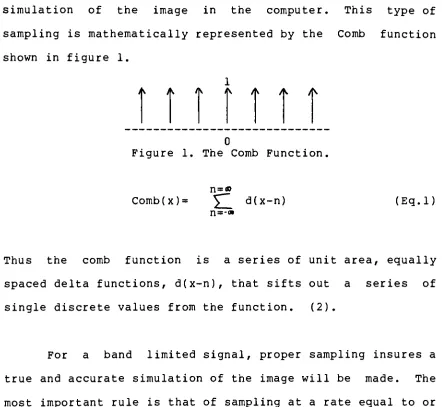
simulation of the image in the computer. This type of
sampling is mathematically represented by the Comb function
shown in figure 1.
Figure 1. The Comb Function,
n=
Comb(x)=
^_
d(x-n)n=-(Eq.l)
Thus the comb function is a series of unit area, equally
spaced delta functions, d(x-n), that sifts out a series of
single discrete values from the function. (2).
For a band limited signal, proper sampling insures a
true and accurate simulation of the image will be made. The
most important rule is that of sampling at a rate equal to or
smaller than the interval AX calculated by the Nyquist
criteria. The Nyquist criteria requires that the image be
sampled at a rate A X such that the highest frequency of
interest Fn is given by:
Fn = 1/(2*X) Therefore: AX = l/2Fn (Eq.2,3)
[image:10.545.53.495.65.472.2]-In any case where the signal is band limited within the
region of bandwidth Fn and AX = l/2Fn the function
may be
reconstructed exactly.
Incorrect sampling will cause aliasing, the overlapping
of displaced, adjacent spectra, making exact image recovery
impossible. (3) For this reason, when processing images using
FFTs it is important to band limit and sample correctly. For
example, given a function with N=256 points and a Nyquist
frequency = 128.0 lines/mm, what
sampling interval (AX)
should be used? Figure 2 and the following mathematics
provide a good guideline:
G(F)
-3Fn -2Fn -Fn 0 Fn 2Fn 3Fn
Figure 2. Illustration of the Nyquist frequency.
Fn = 1/(2MX) lines/mm (Eq.4)
Thus: AX = 1/(2* Fn) = 1/(2*128) =1/256 mm
(Eq.5)
Also: AF = Ft/256 = 256/256 = 1 line/mm
Figure 2 depicts the Discrete Fourier Transform G(F).
The function is band limited from -Fn to Fn in accordance
with the Nyquist criteria. The total frequency range, Ft, is
from -Fn to Fn with N number of discrete points separated by
F. However, because of sampling, Discrete Fourier Transforms
are periodic. The periodic nature of these functions
prevents the loss of information in performing the inverse
transformation always associated with sharp cutoffs in the
frequency domain.
The importance of sampling can not be stressed enough.
Using the simple concepts just presented will insure the best
reconstruction of an image. Just as important as sampling,
an understanding of how light behaves and how optical systems
respond to produce an image is primary to determining the
type of image processing used. A short tutorial of these
factors is presented here.
The irreducible object element is the mathematical
point. A fundamental characteristic of any photographic
material involves the way which a point or a line (an
assemblage of points) is imaged within the material. Due to
the nature of photographic emulsions, lenses, and other
elements in an optical system, the irradiance energy falling
on a film from a point or line is to some degree diffused and
-spread within the emulsion. (4). For an image of a point or
a line, this distribution of the irradiance by the emulsion
is known as its point spread function, (p(x,y)), and line
spread (l(x)) function respectively. Figures 3 and 4 are
plots of the point and line spread functions.
Figure 3. The Point Spread Function,
The Fourier transform of l(x) is (L(f)), commonly known
as the Optical Transfer Function (OTF). The modulus of the
OTF is known as the Modulation Transfer Function (MTF). The
OTF and the MTF are presently the most widely used criteria
for evaluating optical systems. The following mathematics
illustrate the relationships of the functions just discussed:
(5,6)
Kx) =
jp(x,y)
dy (Eq.7)re -i2TT fx
L(f)=/l(x)e dx = OTF(f) (Eq.8)
MTF(f) = OTF(f) (Eq.9)
NOTE: Throughout the rest of this paper, #^ will represent
the Fourier Transformation. Therefore, l(x) $*t L(f).
Another limitation associated with all films is
graininess. Due to the discrete nature of film grains and
because it is impossible to to make a truly monodispersed
emulsion (an emulsion in which all of the imaging particles
are the same size and are evenly dispersed), noise results in
-the image. Noise is a general term used to refer to any
undesired signal recorded on a recording medium or picked up
by an instrument designed to respond to a certain signal; for
example, static on a television or a radio. Photosensitive
grains or small integral areas on an emulsion receiving equal
exposures do not have equal densities when developed. These
fluctuations in density are commonly referred to as grain and
produce image noise. (7).
Image noise (G) on a film is defined as the product of
the measured mean-squared density fluctuations (T(a)**2 and
the area of the scanning aperture (A) used to make the
measurement. (8) .
G = A cr(a)**2 (Eq.10)
Image noise is related to granularity by the following:
S =
a (a) J~TA (Eq.ll)
Thus: S**2 =(/2A CT (a) ) **2 = 2G (Eq.12)
Where ** indicates exponentiation, S is the Selwyn
granularity coefficient, and (7(a) is the root-mean-square
The combination of the optics and film, and the grain
of the film usually degrade the object being photographed.
These undesirable effects are easily seen in aerial
reconnaissance where the objects of interest often appear as
very blurred and grainy images on the film. To improve the
image, or in this case, make it more like the original scene,
enhancements filters are used to reduce image noise and to
sharpen faint or barely recognizable details from blurred
edges. This report will compare two enhancement techniques,
Wiener filtering and unsharp masking.
The Wiener filter is a mathematical algorithm designed
to enhance images by removing noise and sharpening edges. Its
design is governed by a prior knowledge of the noise in the
system. The following is the mathematical description of the
Wiener filter (11,12)
H
* 2 2 2
(f) = L (f) /
[L(f)
+ ( N (f) / 0 (f))]
(Eq.13)Where L*(f) denotes the complex conjugate of L(f), normalized
to L(0)=1, and N (f) and 0 (f) are the noise and input signal
power spectra.
-By examining equation 13 it is easy to see how the
Wiener filter works. When the noise power greatly exceeds
the input signal power, which happens at very high
frequencies, H(f)-->0; the filter allows
very little signal
to pass through it. If the signal is much greater than
noise, as happens to be the case for the lower frequencies,
H(f)~> L *
(fJ/LU)1
= 1/L(f) thus
allowing most signals to
pass through the filter. For noiseless conditions the Wiener
filter becomes an inverse filter. For signal/noise ratios in
between these extremes the Wiener filter responds
accordingly. (13,14). Even though some of the noise will be
passed by the filter and some of the signal lost, the Wiener
filter is considered the optimal restoration filter in a
least squares sense and the standard to which other filtering
techniques are compared to because it minimizes the
mean-square differences between the input and the restored
target. (15,16).
The noise power (Wiener) spectrum of an image is the
Fourier decomposition of the noise. It can be used in the
frequency domain as a statistical evaluation of image noise.
(17,18,19,20). Once an estimate of the noise Wiener spectrum
designed. The several steps which must be taken to estimate
the Wiener spectrum are outlined below:
First calculate the mean density or signal in the system and
subtract this mean value from each data point. These values fluctuating about the mean are the noise. The next step is
to perform the technique of noise windowing. To better describe this technique the triangular or Bartlet window is
described below. Figure 5 illustrates the technique using the Bartlet window (21).
RRNDOtt GRUSSIRN NOISE NOISE WINDOW FILTER W(X) WINDOWED GRUSSIRN NOISE 3.
a*
h
is
b
i*i i i i i* f i i 4I"-.Figure 5: The Bartlet Window.
/ 1
-|2x/c|
w(x) = <
V 0 elsewher
x| C/2
(Eq.14)
-C. fsin ( Cf/2)1 C 2
= 2
L
f/2J
w(x)4==7W(f) = 2 L f/2 J = 2 sine (Cf/2) (Eq.15)
The windowing is performed by multiplying the noise data
(n(x)) with the window w(x). As is apparent the window acts to limit the extent of the noise, and it also eliminates end
transitions that cause Wiener spectrum estimate error that
could occur when performing the third step, FFT the windowed
noise. These three steps yield the following advantages:
1) Eliminates discontinuities at the end of data files. 2) Prevents wrap around when estimating Wiener Spectrum
by using an FFT algorithm.
3) Smooths the power spectrum. (Note: Multiplication in the space domain is a convolution in the frequency
domain. ) (22) .
Once the windowed noise is found, it is transformed to the
frequency domain. This is used in the final step. The final
The Wiener spectrum just calculated is used in Eq.13 to
produce the optimal Wiener filter. The noise reducing
characteristic of the Wiener filter is not present in the
unsharp masking technique. As previously indicated this is
the second filter that will be examined.
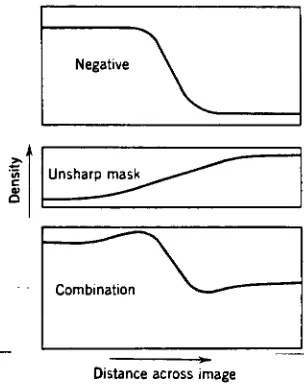
The unsharp masking technique aids in the retention of
detail and improves the visual appearance of an image by
sharpening the edges between distinct objects in the image by
exaggerating the density difference across the edge. (23).
Yule (24,25) outlines the procedure for implementing the
unsharp mask technique. An unsharp mask of an original scene
is produced on a moderately low contrast film (contrast
compression). The mask image is opposite in sign from the
original. This may be achieved by contact printing the
original and the mask with a sheet of diffusion material
between them or by defocusing if using a projection system.
The original and the mask are combined in register and used
to produce a final image on a higher contrast material; the
higher contrast material compensates for the contrast
reduction resulting from the combination of the original and
the mask.
-The unsharp mask affects the final image by reducing
the large scale tonal differences or density ranges of the
low frequencies. The fine details are blurred by the unsharp
mask. When the final image is made using the original image
and mask the contrast differences of the fine details are
maintained because they are not drastically effected by the
subtraction. This results in an increased contrast
difference along an edge gradient (improved sharpness) when
the original contrast is restored. (26). Figure 6 is an
illustration of the unsharp masking technique. Note the
increased density range due to the hump and dip along the
edge gradient resulting from the unsharp mask.
Negative
Distanceacrossimage
Actionofunsharpmaskinimprovingedgesharpness.
[image:21.545.151.303.381.574.2]The unsharp mask combined with the degraded image may
be regarded as a filter in the frequency domain with its OTF
increasing with spatial frequency. This results in an
increase in output modulation and MTF values greater than
unity, the phenomenon of contrast enhancement (28,29).
Figure 7 is an illustration of contrast enhancement from a
filter with a negative spread function.
itr
vf
SIMULATED FILM MTF
10' 10" swift, ftieouijcy
MASK TRANSFER FUNCTION
10' 10* rmin. ncnuoer
SYSTEM MTF (CONTRAST ENHANCEMENT)
10"
10"
10"
10' io1 smt1h. fhoucj
10"
Figure 7. An Illustration of Contrast Enhancement,
[image:22.545.76.466.314.578.2]
-From figure 7, observe that the unsharp mask, used here
in the technique of contrast enhancement acts as a
restoration filter and in its theoretical ideal case
approximates an inverse filter. Two questions arise from
this illustration: 1) How do we determine the line spread
function used to create the desired unsharp mask? 2) Once
the unsharp masking technique is modeled, how can it be
described it in terms of modulation transfer theory? The
following discussion will answer these question.
To create the desired unsharp mask and achieve the best
object restoration through contrast enhancement, it is
necessary to look at the mathematics involved. The following
mathematics, utilizes Fourier techniques in the frequency
domain, were developed by E.M. Granger (30,31). This work
follows a line of thought similar to Armitage, Lohmann, and
Herrick (32) with the added advantages of yielding an optimum
restored image in a least squared sense, and it is not
subject to the contrast limitations specified in the
The following symbolism will be used:
0(F) = OBJECT Bl = CONSTANT
MTF(F) = FILM1 B2 = CONSTANT
KF) = IMAGE Gl = FILM GAMMA IMAGE
U(F) = FILM2 G2 = FILM GAMMA MASK
MASK(F) = MASK G3 = FILM GAMMA FINAL
M2 = 2ND MOMENT PI = 3.14159
RO(F) = RESTORED OBJECT
0(F) * MTF(F) = 1(F) 1(F) * U(F) = MASK(F) (Eq.16,17)
Solving simultaneously;
MASK(F) = 0(F) * MTF<F) * U(F) (Eq.18)
Note that both MASK(F) and U(F) are unknown.
Therefore, to solve for MASK(F), U(F) must be written in a
non-variable form. A way to do this is extracted from the
Second Moment Technique developed by E.M. Granger (33). This
technique provides a means of estimating the MTF of a
system/element in a system by the statistical second moment
of the l(x). It is used here to determine the l(x) necessary
to produce the unsharp mask. He found the following
relationship exists:
-2 2 MTF = 1
-(2pi F M2) M2 is the Second Moment. (Eq.19)
For the complete derivation see the reference.
Substituting the Second Moment Approximation for MTF(F) and
U(F) into equations 16 and 17:
2 2
I(F)=0(F)*(l-(2pi *M2*F )) and (Eq.20)
2 2
MASK(F)=I(F)*(l-(2pi *M2*F )) (Eq.21)
Therefore:
2 2
I(F)=0(F)*(1-(B1 * F )) where Bl=2pi *M2 and
(Eq.22)
2 2
MASK(F)=I(F)*(1-(B2 * F )) where B2=2pi *M2
(Eq.23)
From Eq.18 or by combining Eq.22,23:
2 2
MASK(F) = 0(F) * (1-(B1 * F )) * (1-(B2 * F )) (Eq.24)
2 J> 4
MASK(F) = 0(F) * (1-(B1+B2) * F ) + (Bl*B2/* F ) (Eq.25) IKO.T.
The next step in restoring the original object is to combine
the image and the mask in register and exposed them onto a
higher gamma film. The following mathematics illustrate
RO(F) = (I(F)+
MASK(F)) (Eq.26)
Substitute Eq.22,25 into 26. Include film gamma constants.
2 RO(F)= G3* ( (G1*0(F)*(1-B1*F
)) +
2
(G2*0(F)*(1-(B1+B2)*F )) (Eq.27)
2 2
=
G3( (G1*0(F)-(G1*0(F)*B1*F ) + (G2*0(F)
-(G2*0(F)*Bl*F )
-2
(G2*0(F)*B2*F ) (Eq.28)
RO(F) = G3*( (G1+G2)*0(F)
-2 2
(G1+G2)*0(F)*B1*F -G2*0(F)*B2*F ) (Eq.29)
=
G3*nGl+G2)*0(F)-0(F)*(
(G1+G2)*B1*F +G2*B2*F))
(Eq.30)RO(F) = G3 * 0(F)
(
(G1+G2)-2 x ( (G1+G2)*B1 + G2*B2 ) *F
J
(Eq.31)To obtain optimum enhancement set (G1+G2) * Bl + G2 * B2 2
equal to zero and thus eliminate the F dependence.
Therefore: Gl*Bl =
-G2*(B1+B2) (Eq.32)
image mask
-G1/G2 = (Bl+B2)/Bl (Eq.33)
-Observe that the mask and image are opposite in contrast.
To restore original contrast chose values so that:
G3 * (G1+G2) = 1.0 (Eq.34)
The derivation above allows for direct modeling of the
unsharp mask. To describe the unsharp masking technique as a
linear filter in terms of modulation transfer theory the
operation involved must be approximately linear. The
mathematical linear approximation for masking, developed by
Armitage, Lohmann, and Herrick (34) is:
Tr(s) = Gl- G2(m)*Tr(m) (Eq.35)
where Tr(s) is the system MTF (MTF of the final image), G2(m)
is the mask contrast, and Tr(m) is the MTF of the mask.
Incorporating the results of the Granger method into their
approach allows the unsharp masking technique to be expressed
in terms of a linear filter, free of small contrast
limitations, and allows the final MTF of the masking
technique to be easily calculated. For the complete
formula it is apparent that Tr(m) must be negative to yield a
final MTF of 1.0.
As previously illustrated (Figure 6), unsharp masking enhances edges by adding the original image with a blurred negative of the original in register. Therefore, any spread
function and or film contrast combination may be chosen to
create the mask. However, this may not optimum if the
combination is not chosen according to the rules provided in
equations 16-34. Other contrast values and spread function
combinations will result in varied degrees of edge
enhancement.
According to Scarff, (35) unsharp masking results in
more visually pleasing photographs if the images are not made
to sharp. In his experiments he learned that a final image
with a maximum MTF of 1.3 produced from a scene with an input
modulation of .70 was visually preferred over the same an
image of the same scene produced at a higher or lower MTF.
However, he does not draw any conclusions about images
produced from scenes with other input modulations or the
effects of S/N on image quality.
-OBJECTIVES
It is the objective of this research to determine to
what degree of image restoration is possible, what are the
limitations to image enhancement/restoration using these two
techniques, and how do these filters differ. This paper will
quantify, analyze, and compare the digital image processing
techniques of Wiener filtering and unsharp masking. To study
these methods, noise and image components are cascaded, in
the frequency domain using Fast Fourier Transforms, through a
series of mathematical filters and transfer functions. The
model allows the user to examine each stage of the
processing. It is expected that a greater degree of image
reconstruction (restoration) is obtainable with the Wiener
filter than with the unsharp mask.
Another objective of this work is to design a user
oriented computer model that will aid students in learning
and understanding the use of Fourier Transform Techniques for
EXPERIMENTAL
The experimental part of this research consisted of
writing an image processing computer model and an analysis of
data obtained from the model. The experimental model was
designed in FORTRAN on an IBM/CMS computer system. The model
can easily be incorporated into any system that supports
FORTRAN 77 and the IMSL Library. The IMSL Library is a set of
statistical and scientific FORTRAN programs available on many
main frame computers. All graphics generated by this model
were made using the 'DISSPLA*
software package. 'DISSPLA' is
a product of the Integrated Software Systems Corporation, San
Diego, California 92121. The IBM system was used because of
availability, speed, and the vast amount of scientific
software supporting it.
The image processing model used has a modular design to
provide flexibility, ease for the user, and a tool for
learning. The modular design allows the user to choose
predefined elements or substitute a simulation into the
process. Various combinations were used and analyzed by this
researcher with the major goal to obtain optimal
reconstruction from the various inputted specifications.
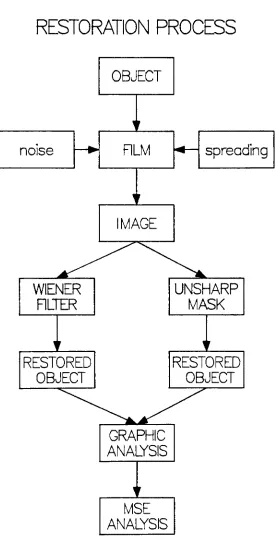
Figure 8 is an illustration of the image restoration process.
RESTORATION PROCESS
WIENER FILTER
RESTORED
OBJECT
OBJECT
spreading
IMAGE
UNSHARP MASK
RESTORED
OBJECT
GRAPHIC ANALYSIS
MSE ANALYSIS
[image:31.545.127.406.64.609.2]Each process illustrated here is software supported.
Documentation for and a copy of each experimental program
used is provided in the Appendix.
Discrete FFT techniques were incorporated into the
modular design. It is faster, easier, and less expensive to
do this digital image processing in the frequency domain by
cascading (multiplying) frequency components than in the
spatial domain via convolution. A 256 point FFT was chosen
to reduce processing time and because of limited computer
memory allocation. Using 256 points imposes a limitation on
the model; the transform of a bounded function in the spatial
domain is theoretically unbounded in the frequency domain.
Cutting off a function results in the loss of information at
the higher frequencies beyond the cutoff frequency. However,
as discussed in the Introduction, the Discrete FFT prevents
the loss of information because of its periodic nature; the
function in the spatial domain is exactly recovered by
inverse transforming. Despite these limitations both
frequency and spatial domains can be well represented with
256 points. For the 256 points, a frequency range of -160 to
160 cycles per millimeter (cyc/mm) was chosen because many
films can be modeled well over this range. Using the
mathematics discussed in the Introduction on sampling theory,
-we calculate AF=1.25 cyc/mm, AX= 1/320
mm, and the spatial
range from -.40mm to .40mm.
As illustrated on figure 8, the first step in the
restoration process is to simulate an object. A 5cyc/mm
tribar target was chosen for this work. Using this simple
target for the object has the following advantages:
1) It is a widely used standard in image processing and
evaluation.
2) Each cycle has 64 data points for analysis.
3) It is easy to see and examine the degradation and
restoration graphically as the image passes through the
system.
4) Tribar targets are easy to analyze mathematically.
The next step in the model is to degrade the object
using a simulated film model. This is done by blurring the
object and adding random gaussian noise to it, thus yielding
a simulated film image. The object was blurred by
multiplying it in the frequency domain with an MTF curve
generated using the widely accepted Frieser model. The
Frieser model is defined as:
2
where f is frequency and <X is the parameter controlling the
width of the curve. Note that the MTF for the Frieser model
does not go to 0. For this case, the periodic nature of the
Discrete FFT is especially important in preventing the loss
of information when performing digital image processing. To
simulate the random density fluctuations found in exposed
film, random numbers from a gaussian distribution with a mean
of zero and a user defined variance are then added to the
blurred image.
As shown in figure 8, the next step in the restoration
process is to reconstruct the tribar object via the Wiener
Filtering and Unsharp Masking techniques. This step in the
simulation is the thrust of this research. The results of
these two techniques will be analyzed, compared, and
quantified in the results section of this thesis. The
mathematics involved in these restorations have been
thoroughly described in the Introduction and are used in the
computer model.
The final step in the computer simulation is the
generation of data and graphics from these two restoration
methods. Two types of analysis will be performed; a graphics
analysis which allows us to see a graphical representation of
-every phase of the restoration process for the two filters
and a mathematical analysis of the mean-square error of the
restored object compared to the original. The graphic
simulations generated by the model permits a visual
comparison of the two techniques. The data collected by the
mathematical technique is used to generate graphs showing the
degree of image restoration and behavior of the filters for
various levels of degradation. The data and graphs collected
RESULTS
This research has found the Wiener filtering technique
to be superior to the unsharp masking technique for image
restoration under all test conditions within the limits of
the image processing model developed for this work. The
results that will be presented in this section will show this
quantitatively and graphically. Before any data could be
collected, a digital image processing model to simulate the
unsharp masking and Wiener filtering techniques was
developed. The model allows the user to examine each stage
of the simulation process graphically.
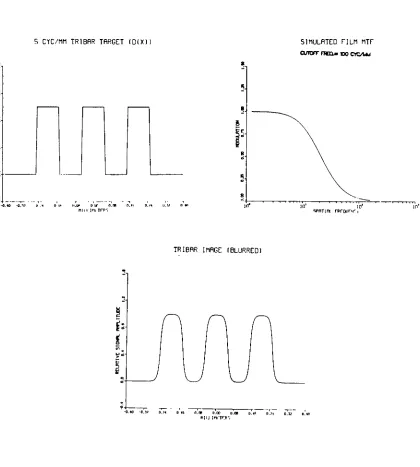
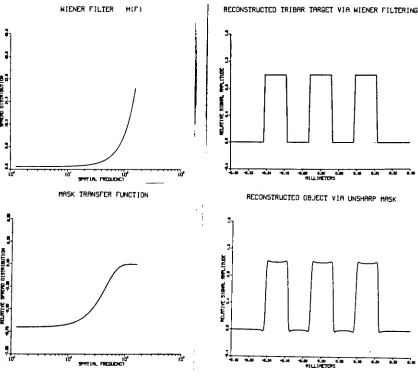
Figures 9 and 10 shows the simulation developed for
this research. Illustrated here are some of the major
imaging elements and processing stages simulated by the
model. Figure 9 (from top left) simulates a 5cyc/mm tribar object being blurred by a hypothetical film with an MTF
cutoff of lOOcyc/mm under noiseless conditions to yield an
image. As is easily seen this results in an image of the
object that is blurred and rounded off particularly along the
edges. Figure 10 shows the object restoration attainable
with the Wiener filter and the unsharp mask.
-5 CYC/MM TRIBAR TARGET (0(X1) SIMULATED FILM MTF ajicrr run- xx> ctc/uu
h--o.w -o.v u.v n* in" in'
spfiTim nro*trjr i
TRIBAR IMAGE (BLURRED)
[image:37.545.68.488.115.582.2]i
xtf
WIENER FILTER HIF)
10' 10" SfflTld. nEOUDCT
MRSK TRANSFER FUNCTION
10"
RECONSTRUCTED TRIBRR TARGET VIA WIENER FILTERING
3
I
i
V)
RECONSTRUCTED OBJECT VIA UNSHARP MASK
10* 10" I0" 10"
i
1
J
-. *cjb *_* -___i +m ijs o.a t.M waiicTots
Figure 10. Simulating a Restoration System,
[image:38.545.64.482.179.555.2]
-It was mathematically shown in the introduction that
under theoretically noiseless conditions the Wiener filter
was an inverse filter. Using an inverse filter to restore a
noiseless image yields a perfect reconstruction of the object
if the simulation does not suffer from the effects of sharp
cutoffs. Because the Freiser model does not go to 0, all 256
points are used in both the spatial and frequency domains,
and due to the periodic nature of Discrete FFTs, the
simulation created for this research does not exhibit sharp
cutoffs. The graph of the restored object demonstrates this
perfect restoration using Wiener filtering. Also shown in
the Introduction, figure 6, was that a smooth image combined
with a smooth, blurred mask resulted in a sharper image with
exaggerated edges. These results, shown in figure 10, for a
noiseless system agree with the results expected from theory.
As was stated in the objectives, the data collected
will be use to quantify, analyze, and compare the two
techniques. Data collected separately allows each method to
be quantified and analyzed individually. The information,
results, and data gathered separately will be included with
data obtained collectively to permit a thorough comparison of
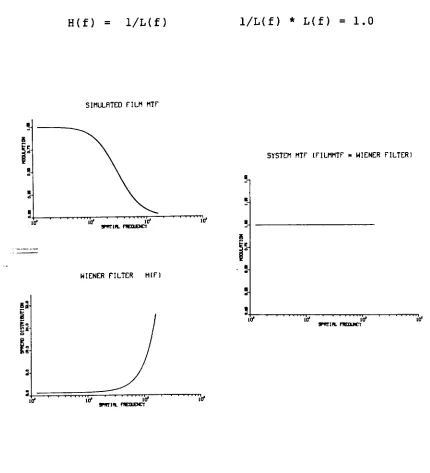
The Wiener filter will be looked at first. Note in
figure 11, since the film does not go to 0, neither will the
Wiener filter or the final MTF. The Wiener filter yields
perfect restoration of the object in the absence of noise
regardless of the spread function degrading the image. This
is possible because the Wiener filter becomes the inverse of
the film spread function so the effective system MTF over the
entire frequency range simulated is 1.0, an ideal system.
This is illustrated by the following equation and graph in
figure 11:
-H(f) = 1/L(f) 1/L(f) * L(f) = 1.0
SIMULATED FILM MTF
SYSTEM MTF (FILMMTF n WIENER FILTER)
10*
jpmin. nsnuDCT
WIENER FILTER HIF)
itf
10* 10" 10* 9nniL nsoicr
10*
10* iff "J1
jpmid. neouocr
io"
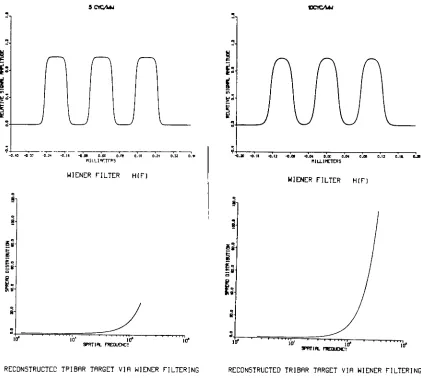
[image:41.545.55.485.96.569.2]Figure 12 show the reconstructions of a 5cyc/mm object
(left side) and a lOcyc/mm object (right side) blurred by a
film with a cutoff frequency of 150cyc/mm using Wiener
Filtering. The lOcyc/mm restored object is 2X scaled to
provide ease in comparing the two restorations. Note perfect
restoration in both cases is achieved even though the
lOcyc/mm image is more degraded. Also note, that the filter
for the more degraded image rises much faster.
In the presence of noise the Wiener filter responds
differently. As indicated in the introduction, the filter
seeks a compromise between noise removal and edge sharpening
dependent on the degree of the degradation due to each
factor. To determine the filter's overall response to
varying noise a series of restorations runs were performed
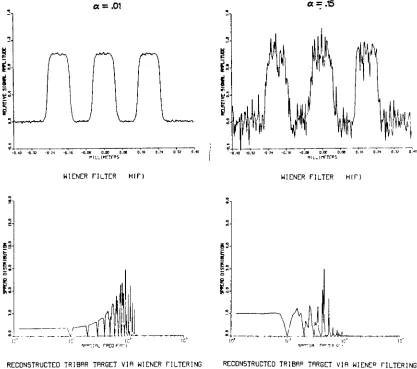
and analyzed. Figure 13 illustrates two of these runs.
Shown are the images of a 5cyc/mm target degraded by a film
with a cutoff frequency of 150cyc/mm Alpha noise level of .01
(left side, low noise) and .15 (right side, high noise). For
the case of the low noise, high S/N, note the edges are
enhanced but at the expense of increasing the noise. For the
high noise case, low S/N, much of the noise is removed but
little is done to sharpen edges. Also note, the filter for
the lower noise case rise three times faster.
-TRIBAR IMAGE (BLURRED)
SCYC/UJ
WIENER FILTER HIF)
Sg
is
C_g o e u
10" 10' 10"
SPflTIft. FUEOUOCY
101
TRIBAR IMAGE (BLURRED)
CCrC/Ui
WIENER FILTER HIF)
Es-I
l(f if "itr" surin. ncouocr
ID-RECONSTRUCTED TPIBAR TARGET VIA WIENER FILTERING RECONSTRUCTED TRIBAR TARGET VIA WIENER FILTERING
-C.1D -0.3"
-C.21 .16 -C.0B 0.0C COP 11.16 O.W 0.17 0.1
h
i
-0. -C.l <A2 -tJM -0.04 D.OD 0.01 O.OB 0.11 O.IS D.3D
MLLITCTEFS
[image:43.545.62.483.59.437.2]NOISY BLURRED TRIBAR IMAGE
a=.01
NOISY BLURRED TRIBAR IMAGE
a=.15
w
#1
yf
\j
f\
033 C. ___, hj.s; -CM -C.,* -o.OS O.OC O.OB D.lfi C* T.l?
| MiL^mrTrPS
WIENER FILTER HIF) WIENER FILTER HIF)
w::\_tpeo
11...T_
s: i
D e I:
u
w
s^TIfl rorn-tirr
RECONSTRUCTED TRIBAR TARGET VIR WIENER FILTERING RECONSTRUCTED TRIBAP TARGET VIA WIENE* FILTERING
t
aAAH
v^pvwwj wvA-^
tWvW W*^^
/VvVA^J VV^A/Wv
-040 -03? 0"M 0.16 -o. t.OO 0.0" O.IB 0.3* o.s? o 10 -010 -0.3? -C?* -C ?i r.i? c.ic
Figure 13. Restoring a Noisy Object. Wiener filter
[image:44.545.63.480.57.426.2]-This brought up an interesting question: At what point
does the filter respond more like a noise removal filter and
less like an inverse (edge enhancement) filter? figure 14
answers this question. It shows one result of this series of
restoration runs. It is a graph showing S/N (in) vs S/N (out)
of the system. It shows for S/N(in) less than 40:1 the
filter reduces noise and for S/N(in) greater than 40:1 it
will sacrifice (increase) the noise in favor of enhancing the
edges. The data on figure 14 appears to fit a Y=aX**b curve.
If this is so, it will plot as a straight line on a log-log
graph and the Wiener filter's performance may be qualified.
The fit is good statistically. Using a T test, it falls
well within the 95% confidence limits for S/N(in) ratios
999.99
COMPARISON OF WIENER FILTERING TO UNEAR RT
S/N
(in)
VS S/N(out)
S/N after filtering
100
10-
->-...!-""r"i-"!"!-:-t
.^... ...
....-..<.-.-...;...
O WIENER FILTERING
D UNEAR FIT
>:>.-:
.. ...
<---:~i--f>
/
i
i
i
/Mi!
10 100
S/N before
filtering
1000
Figure 14. Linear Fit for Wiener Filter Noise Response
[image:46.545.76.450.200.552.2]-Figure 14 leads an observer to wonder if there are
circumstances that will result in a restored object that is
worse than the image before filtering. In other words, can
the noise degradation become so great as to cancel out the
improvements of the edge enhancement? Figure 15 is a plot of
the standard error for the image before restoration vs the
standard error for the restored object at various levels of
degradation, where:
Standard Error =/_> [Restored Image
-Object] / n (Eq.42)
It shows that the Wiener filter always yields an improvement
regardless of the error resulting from the noise and cutoff
WIENER FILTER RESTORATION
STANDARD
ERROR(out)
VS STANDARDERROR(ln)
Standard Error afterfiltering
0.12
0.10-
0.08-
0.06-0.04
0.05 0.10 0.15 0.20 0.25
Standard Error before
Filtering
0.30
Figure 15. Wiener Filter Restoration Response
[image:48.545.88.455.78.436.2]-Figure 16 shows how much improvement is made. Observe
that doubling the noise does not result in a restored object
with twice the restoration error, as some might expect.
Instead, a greater proportion of restoration is gained from a
noisier image than from an image that has less noise. This
is depicted by the gradual leveling off of the curves as the
noise increases; the more noise there is, the easier it is to
remove. A user can quite accurately predict the degree of
restoration the model will yield from this graph.
Figure 17 is a graph of the same data used to create
figure 16 except cutoff frequency is the independent variable
instead of noise. Observe that restoration error is
gradually increasing as cutoff frequency decreases (blurring
increasing). Because figure 17 shows greater curvature than
figure 16, restoration is more dependent on the degree of
WIENER FILTERING
CUTOFF FREQVS RESTORATION ERROR
STANDARDERROR
0.06
0.04
NOISELEVELfa)
Figure 16. Restoring Noisy Images. Wiener Filter
WIENERFILTERING
RESTORATION ERROR VS CUTOFF FREQ.
STANDARDERROR
0.08
0.06
0.04-CUTOFF FREQUENCY
Figure 17. Restoring Blurred Images. Wiener Filter.
[image:50.545.143.389.55.285.2] [image:50.545.141.389.362.591.2]-The performance of the unsharp mask will now be
analyzed. Unsharp masking was simulated for an image on a
film of gamma = 1.0, a mask of film gamma =
.7, and the
restored object on to a film with gamma = 3.334. Figure 18
shows the reconstructions of a 5cyc/mm object (left side) and
a lOcyc/mm object (right side) degraded by a film with a
cutoff frequency of 150cyc/mm under noiseless conditions via
the direct method, an image placed in register with the
unsharp mask, of unsharp masking. Note the lOcyc/mm object
is 2X scaled to allow an easier comparison of the two
restorations. Observe a better restoration of a target is
attained from a less blurred image.
As just illustrated in the figure 18, unsharp masking
is usually performed in the spatial domain. Since it went
from a blurred image to a sharper image, the unsharp masking
technique can be described in the frequency domain as a
linear transfer filter. Using the mathematics developed in
the Introduction, an approximation of a linear filter, the
mask transfer function, for the technique is attainable. This
is shown in figure 19. Observe in this figure that the same
restoration as is shown in figure 18 resulted. Because the
two methods yield identical results the model is not limited
TRIBAR IMAGE (BLURRED)
5CYCAM
TRIBAR IMAGE (BLURRED) 10CfCAM
UNSHARP MASK UNSHARP MASK
i
V)B.W -0.33 -C.M -*-IO -D.00 0.00 O.OB O.IB O.Ji 0.33 0. -0.30 -0.11 -.U -4.00 -0.04 O.OD 0.O4 0.01 0.12 0.10 O.X
tllLUtCTERS niu.ifinDts
RECONSTRUCTED OBJECT VIA UNSHARP MASK RECONSTRUCTED OBJECT VIA UNSHARP MASK
i-U
r i
u
d _, , , , , 1 . f^
, , <m <33 4.M -0-10 <-0> 0.OD 0.01 0.10 O.M 0.33 0- ____, -_.|t _._}
MILLIMZTEP5
Figure 18. Restoring a Noiseless Object. Unsharp Masking,
[image:52.545.62.480.36.619.2]-TRIBAR IMAGE (BLURRED)
sctcam
TRIBAR IMAGE (BLURRED)
tJCYC/WM
-. U -%M -.u
MASK TRANSFER FUNCTION MASK TRANSFER FUNCTION
5
Id1
10' 10" swift,ncouocr
10"
e
i o
10* 10' 10*
SPRT1U.n___J_MCY
RECONSTRUCTED OBJECT VIA UNSHARP MASK RECONSTRUCTED OBJECT VIA UNSHARP MASK
s
b
i
j
u
u
rn
_. -ojj ** I <5 25 3o ! i- J>
niLLlicrore
[image:53.545.58.484.36.624.2]Figure 20 shows the contrast enhancement (or the system
MTF) achieved with the film specifications used to attain
figures 18 and 19. Observe the system MTF rises above 1.0.
This is why unsharp masking yields exaggerated edges.
lO*
6
10*
SIMULATED FILM MTF
CUTOFFFREO=.BOCTC/tvM
101 I01
SPflTIH. fREOUDCT
MASK TRANSFER FUNCTION
u.
10"
armin.neouocr
SYSTEM MTF (ABSOLUTE ENHANCEMENT)
i n.
uf
10"
101 101
STtirin. nsoiNcr
10"
Figure 20. An Illustration of Contrast Enhancement
[image:54.545.72.464.213.605.2]-It was just demonstrated that through unsharp masking,
contrast enhancement, a noiseless image can be improved. But
what about a noisy image? Will the unsharp mask improve it?
The mathematics developed in the introduction to describe the
technique does not include a noise component. Because the
unsharp mask is a linear filter and does not compensate for
noise, all the signals, desired signal as well as noise,
increase in direct proportion to the filter's transfer
function. Figure 21 illustrates the unsharp masking
technique for a 5cyc/mm target degraded by a film with a
cutoff frequency of 150cyc/mm and noise levels of .01 (left
side) and .15 (right side). These are the same conditions
set up in figure 13 for the Wiener filter. The graphs
demonstrate that the unsharp masking technique sharpens edges
at the expense of increasing the noise simultaneously. With
the noise continually increasing, there comes a point in the
image processing when more is lost than gained, when the
image being restored is better than the restoration. For the
NOISY BLURRED TRIBAR IMAGE
a=.01
*>
3-v
^-Vy*-*-NOISY BLURRED TRIBAR IMAGE
a=.B
4JJ 4J4 4.10 4 t.00 0. niLLircnx.
UNSHARP MASK UNSHARP MASK
i
RECONSTRUCTED OBJECT VIA UNSHARP MASK
4.00 4JB 4JI 4.10 4JB MO t.01 0.M 0~3i 0.S 0.00 niUltCTERS
RECONSTRUCTED OBJECT VIA UNSHARP MASK
i
j.d
Mrt
NM~\
t^f^u
Wh-tfVl
IfVvwJ VfMwM
^J4 *! -OJi -______- ** *** MLLIfCTEFS
Figure 21. Restoring a Noisy Object. Unsharp Masking,
[image:56.545.64.482.40.600.2]-To determine at what point the unsharp masking
technique is no longer beneficial, a series of restoration
runs was performed using a 5cyc/mm tribar target, a film
cutoff frequency of 150 cyc/mm, and variable noise to
generate figure 22. Figure 22 reveals that at a certain
point the ratio of the standard error for the restored object
to the inputted image exceeded 1.0. For this case, the graph
shows that for S/N(in) less than 42/1 more information is
lost than recovered. This is due to the noise boosting
degradation effect overwhelming the image restoration gains
of its edge enhancement effect.
UNSHARP MASKING RESTORATION
RATIO: ERROR(aftermasking)/ERROR(beforemasking) VSS/N(in) STANDARDERROR(out)/STANDARDERRORQrO
60
S/W(in)
[image:57.545.107.401.358.584.2]Figure 23 illustrates the effects of unsharp masking
for various levels of degradation. Shown here is the
standard error in reconstruction as a result of noise level
for five different cutoff frequencies. Note the four curves
are in very close proximity to each other, and they are
rising quickly. From this it may be concluded that film
cutoff frequency presents comparatively less hindrances to
image recovery than is presented by noise. It is also
interesting to note that unlike the Wiener filter (figure
16), doubling the noise here results in a restoration error
that increases proportionally. To give a better idea of what
this means, observe from the graph that the error associated
with a cutoff frequency of 150cyc/mm and a noise level of .15
is 0.45. This is the degradation depicted in figure 21, a
restoration almost indistinguishable.
Figure 24 is a graph of the same data used to generate
figure 23 except cutoff frequency is the independent variable
instead of noise. Observe that the results for the various
levels are very close to parallel. This observation shows
that no interaction between noise and spread exists; they are
acted upon independently when performing unsharp masking.
Also note that input noise has a great effect on restoration.
-UNSHARP MASKING NOISE VS RESTORATION ERROR
STANDARD ERROR
0.0
4-O imrr nmiu
I O curorr niui.il
o) tvnrrrotciiojo ' CtfTOfT fltO^lOO
0.00 0.03 0.10 NOISE
0.15 0.20
Figure 23. Restoring Noisy Images. Unsharp Masking,
UNSHARP MASKING
CUTOFFFREQ. VS RESTORATION ERROR
STANDARD ERROR
0.7-0.6
0.5
0.4-0.5
160
CUTOFF FREQUENCY
[image:59.545.143.389.59.290.2] [image:59.545.139.382.371.599.2]A direct comparison of the Wiener filtering and unsharp
masking techniques will now be presented. Many of the graphs
following have already been seen, but here they are shown
along side their counterpart. Figure 25 shows the two
filters and the restored object attained from them for a
noiseless image blurred by a film with a cutoff frequency of
150cyc/mm. Immediately it is observed that the Wiener filter
is superior to unsharp masking for object restoration. Also
seen in the figure is that both filters exhibit a rising
spread distribution and similarity in shape but the Wiener
filter does not level off, and it is rising much faster.
Figure 26 depicts the two filters and the restored
object attained by the two techniques for an image degraded
by a film with a cutoff frequency ofl50cyc/mm and a noise
level of 0.15. Observe that the mask transfer function
(filter) is unaltered in the presence of noise while the
Wiener filter is. The up and down fluctuations that result
gives the Wiener filter its noise removal capability. No
noise removal is possible with the unsharp mask. Once again
observe Wiener filtering is superior.
-WIENER FILTER HIF)
UNSHARP MASK
RECONSTRUCTED TRIBAR TARGET VIA WIENER FILTERING
i
ah
l. 4.33 -0.74 -0.10 -O.flP 0.00 O.OO 0.10 0.1* 0.33 0.40
muinrrois
RECONSTRUCTED OBJECT VIA UNSHARP MASK
""
2,
n
n
n
I
V)
y2-I
U
U
L.
T->. -0.33 -c.x .u -o.w e.tr o.m 6. it o. o.v b.
[image:61.545.63.487.109.563.2]WIENER FILTER H(F)
i
h
uW
lb" 10' io"
sphtii*.ntnuocr
io1
RECONSTRUCTED TRIBAR TARGET VIA WIENER FILTERING
a=.B
0.S 0.40
MASK TRANSFER FUNCTION
2l
S
r
t.
.<f
IO1 10"
apwriit. ncauDoci
i i
Vof
RECONSTRUCTED OBJECT VIA UNSHARP MASK
a=*.B
Figure 26. Noisy Image Restoration,
[image:62.545.66.483.114.579.2]-How much better is Wiener filtering than unsharp
masking? Figures 27 and 28 show it to be a lot better,
especially when the level of noise is high or increasing, in
figure 27, it can be observed that the masking / Wiener
filtering standard error ratios for restoration always
exceeds 1.0. Figure 28 directly shows the Wiener filter
performs better than the unsharp masking technique as
blurring is varied.
RAT10:UNSHARP MASKINGrJESTOtUTION/vVIENERFILTERINGRESTORATION
FILM CUTOFFFREQ= BO.O
or(moal0/r.wrjft4r.
30
S/N(in)
[image:63.545.78.489.149.575.2]COMPARISON OF WIENER FILTERING AND UNSHARP MASKING
NOISE LEVEL
(a)
= .05STANDARD ERROR
0.20
0.15-80 100 120
CUTOFF FREQUENCY
160
Figure 28. Comparison of Wiener Filter and Unsharp Masking
Restoration Responses (Varying Cutoff Freq.).
[image:64.545.76.485.157.470.2]-It was stated in the introduction that unsharp masking
approximated an inverse filter for a theoretical ideal case.
The results presented in this section represent a realistic
case that can be accomplished in the darkroom. The
mathematics controlling the linear mask filter's range is
dependent on the film Gammas chosen. With digital image
processing Gamma is not limited as with film; any values may
be selected. Using Gammal = 1.0, Gamma2 =
.98, and Gamma3 =
50.0, and scaling the graph of the filter appropriately will
illustrate this characteristic. Finding a real film with a
consistently controllable Gamma3 value of 50.0 is
unrealistic. Figure 29 shows the linear approximation to the
unsharp mask closely resembles the noiseless Wiener filter
(an inverse filter) when pushed to this extreme. Of course
such an unsharp masking filter in the presence of noise is
COMPARISON OF WIENER FILTER AND MASK TRANSFER FUNCTION
Relative Spread Distribution
40-
30-
20-
1 0-
D-O WIENER FILTER
D MASKING FILTER
1000
SPATIAL FREQUENCY
Figure 29. Unsharp Masking Approximation to the
Inverse Filter.
[image:66.545.86.466.155.501.2]-CONCLUSIONS
This research concludes the Wiener filtering technique
to be superior to the unsharp masking technique for digital
image restoration. It was shown that for all levels of film
blurring and noise degradation tested, the Wiener filter
improved image quality and increased the information content
available in the image via noise removal and edge
enhancement. In contrast, unsharp masking is a high
frequency content enhancer, and it does not discriminate
between edges and noise. Therefore, both noise and edge
signals are enhanced. Due to this, in the presence of high
noise the unsharp masking technique fails as an image
restoration technique.
It was also shown that in theory perfect restoration is
attainable with Wiener filtering in the absence of noise
because the filter becomes an inverse filter. Therefore, the
Wiener filter in combination with the original film yields an
ideal system with an MTF = 1.0 for the entire range of
spatial frequencies. In comparison, perfect restoration is
not attainable with unsharp masking under realistic
In addition, this paper has demonstrated that the
unsharp mask can be expressed as a filter in terms of linear
transfer theory. When this filter is cascaded with the
original film MTF, the final MTF had values that exceeded 1.0
before dropping off. For this reason, exaggerated edges are
observed in the restored objects.
-RECOMMENDATIONS
It is recommended that future work on this topic be
directed in three areas:
1. Two Dimensional Image Processing. The basic principles
put forth in this research should be performed and evaluated
using two dimensional digital image processing. This
researcher feels the results contained within this thesis
will be supported by such a work and further knowledge will
be obtained.
2. Testing the Unsharp Masking Model Experimentally. The
unsharp masking technique has the distinct advantage over the
Wiener filter in that it can be performed in both the
darkroom and on the computer. This affords the opportunity
to refine and improve the model based on real results
obtained
experimentally-3. Subjective Evaluation. Image produced two dimensionally
using these techniques could be subjectively evaluated and
analyzed, thus allowing the inclusion of the observer in
REFERENCES
1. D.C.C. Wang, A.H. Vagnucci, and C.C. Li, "Digital
Image Enhancement: A Survey,"
Computer Vision,
Graphics, and Image Processing. ,24, 363(1983).
2. J. D. Gaskill, Linear Systems, Fourier Transforms, and
Optics. John Wiley and Sons, New York, 1978, pp 266-285.
3. J. W. Goodman, Introduction to Fourier Optics,
McGraw-Hill, Inc., 1968, p21.
4. H.N. Todd and R.D. Zakia, Photographic Sensitometry
The Study of Tone Reproduction, Morgan and Morgan, Inc.,
New York, 1969, p.264.
5. J.C. Croteau, "Comparison of Methods of MTF/OTF
Analysis for Optical Systems," Thesis, Rochester
Institute of Technology, Oct. 1983.
6. E.M. Granger, "Lecture to Image Science
Class,"
Rochester Institute of Technology, January 1984.
7. H. Frieser, "Noise Spectrum of Developed Photographic
Layers Exposed by Light, X-Rays, and Electrons,"
Photogr. Sci. and Eng., 3, 164, (July 1959).
-8. J.C. Dainty and R. Shaw, Image Science, Academic
Press, London, 1974, p.58.
9. Ibid.,p.58.
10. E.W.H. Selwyn, "A Theory of Graininess," Photogr. J. ,
75, 571, (1935).
11. P.S. Cosidine and R.A. Gonsalves, " Optical Image
Enhancement and Image Restoration, " Topics In Applied
Physics, 23, Sprig-Verlag, Berlin, 59, (1978).
12. Granger, April 1984.
13. Ibid.
14. Cosidine and Gonsalves.
15. Ibid.
16. H.J. Zweig and A. Silverstri, "Experiments in Digital
Restoration of Defocused Grainy Photographs by Noise
Cheating and Fourier Techniques,"
Proceedings Society of
17. P.D. Burns and B.M. Levine, "Wiener Spectrum
Estimation at Zero Frequency via Direct Digital
Computation,"
Journal of Applied Photographic
Engineering, 19, 78, (1983).
18. M. DeBelder and J. DeKerf, "Determination of the
Wiener Spectrum of Photographic Emulsion Layers with
Digital Methods,"
Photogr. Sci. Eng., 11, 371, (1967).
19. Dainty and Shaw, p.222.
20. R.C. Jones, "New Method of Describing and Measuring the
Granularity of Photographic Materials,"
J. Opt. Soc.
Am., 45, (1955).
21. N.C. Geckinli and D. Yavuz, "Some Novel Windows and a
Concise Tutorial Comparison of Window Families,"
IEEE
Trans. ASSP-26, 501, (Dec. 1978).
22. Granger, April, 1984.
23. L.A. Scarff, "Quantification of the Unsharp Masking
Technique of Image Enhancement,"
Thesis, Rochester
Institute of Technology, June,1981.
24. J.A.C. Yule, "Unsharp Masks and a New Method of
Increasing Definition in
Prints,"
Phot. J. 84B, 321,
(1944).
-25. J.A.C. Yule, Principles of Color Reproduction, Wiley
and Sons, Inc., NY, 1967, pp. 74-78.
26. Ibid.
27. Ibid.
28. L. Levi, "Survey Unsharp Masking and Related Image
Enhancement Techniques," Computer Graphics and Image
Processing, 3, 163, (1974).
29. J.D. Armitage, A.W. Lohmann, and R.B. Herrick,
"Absolute Contrast Enhancement,"
Applied Optics, 4, 445,
(April 1965).
30. E. M. Granger, "A Summary Meassure of Image Quality,"
Proceedings of 27th Annual International Technical
Symposium & Instrument Display, Aug 21/26 1983, vol 432.
31. Ibid.
32. E.M. Granger, "Lecture to Image Science
Class,"
Rochester Institute of Technology, April 1984.
33. Armitage