This is a repository copy of The Identification of Mistakes in Road Accident Records – Part Two..
White Rose Research Online URL for this paper: http://eprints.whiterose.ac.uk/2533/
Monograph:
Austin, K.P. (1994) The Identification of Mistakes in Road Accident Records – Part Two. Working Paper. Institute of Transport Studies, University of Leeds , Leeds, UK.
Working Paper 407
[email protected] https://eprints.whiterose.ac.uk/ Reuse
Unless indicated otherwise, fulltext items are protected by copyright with all rights reserved. The copyright exception in section 29 of the Copyright, Designs and Patents Act 1988 allows the making of a single copy solely for the purpose of non-commercial research or private study within the limits of fair dealing. The publisher or other rights-holder may allow further reproduction and re-use of this version - refer to the White Rose Research Online record for this item. Where records identify the publisher as the copyright holder, users can verify any specific terms of use on the publisher’s website.
Takedown
If you consider content in White Rose Research Online to be in breach of UK law, please notify us by
Universities of Leeds, Sheffield and York
http://eprints.whiterose.ac.uk/
Institute of Transport Studies
University of Leeds
This is an ITS Working Paper produced and published by the University of Leeds. ITS Working Papers are intended to provide information and encourage discussion on a topic in advance of formal publication. They represent only the views of the authors, and do not necessarily reflect the views or approval of the sponsors.
White Rose Repository URL for this paper: http://eprints.whiterose.ac.uk/2533/
Published paper
Austin, K.P. (1994) The Identification of Mistakes in Road Accident Records – Part Two. Institute of Transport Studies, University of Leeds. Working Paper 407
UNIVERSITY OF LEEDS
Institute for Transport Studies
ITS Working Paper 407
ISSN 0142-8942May 1994
THE IDENTIFICATION OF MISTAKES IN ROAD
ACCIDENT RECORDS - PART TWO
KP Austin
This work was sponsored by the Science and Engineering Research Council.
CONTENTS
Page
ABSTRACT
1.INTRODUCTION 1
2.METHOD 1
3.RESULTS 2
3.1Age 2
3.2Gender 4
3.3Accident severity 4
4.CONCLUSIONS 6
5.ACKNOWLEDGEMENTS 6
ABSTRACT
AUSTIN, KP (1993). The identification of mistakes in the recording of accident information - part two. ITS Working Paper 407, Institute for Transport Studies, University of Leeds.
It has been acknowledged that there are many mistakes in the casualty variables on the police accident report forms. This study shows how a computer based linkage of police and hospital records can be used to routinely identify the mistakes for the variables of casualty age, gender and severity. The level of omissions and mis-identifications were 0.4 per cent for gender, 13.3 per cent for severity and 15.7 per cent for age. The number of records that had age omitted or coded incorrectly were not significantly greater for seriously injured casualties than for those that were slightly injured. The system could be effectively used to code casualty severity using medical information instead of relying on police judgement.
KEY-WORDS:
THE IDENTIFICATION OF MISTAKES IN THE RECORDING OF
ACCIDENT INFORMATION- PART 2
1.INTRODUCTION
An accident report form (STATS 19) is completed for all road traffic accidents involving personal injury that the police attend or are notified of. These records are then subjected to a series of manual and automatic checks to identify any mistakes. Unfortunately some mistakes still remain after the validation process has been completed. Studies involving samples of casualties attending hospitals (Bull and Roberts, 1973 and Thorson and Sande, 1969) have identified the level and nature of these mistakes. But, the hospital records have to be manually traced to police records which is time consuming and so its use on a routine basis would not be feasible.
An effective computerised validation system for casualty data would therefore be desirable and this is echoed by the Medical Commission on Accident Prevention (1984) who stated that:
"Consideration, therefore would have to be given to some form of automatic validation, as currently exist in the processing of STATS 19 data, to reduce errors and omissions."
This paper shows how a computer based linkage of police and hospital casualty records can be used to identify mistakes in the variables of casualty age, gender and severity as part of a routine validation system.
2.METHOD
Currently, there are no computerised validation procedures available to identify mistakes in casualty gender or age, whilst for severity there is only a consistency check which identifies those records where casualty severity is greater than accident severity. This is because the severity of the accident must reflect the most seriously injured casualty.
This study links casualty information held on Humberside police files with that on Hull Royal Infirmary's Accident and Emergency database. The variables used in the matching procedure were surname, forename, address, age, gender and accident date. The matching algorithm used the Dataease Query Language (DQL) on the Dataease 4.2 database and was designed to act like a sieve by looking at various combinations of the above variables to identify any police and hospital records that were reasonably closely matched (Austin, 1992). Accident date was included in all matching levels so that those casualties who were involved in two separate accidents in the time period would not be confused. To distinguish between members of the same family either gender and forename, or gender and age, or age and forename were required to be compatible in both records for a match to be considered.
3.RESULTS
3.1AGE
If casualty age is coded incorrectly for a large number of records then it could have implications on which groups should be targeted in road safety campaigns. Few studies have investigated mistakes in the coding of casualty age, although Shinar and Treat (1983) found the differences in the coding of driver age between the police records and the Multi Disciplinary Accident Investigation (MDAI) teams amounted to 11.6 per cent of the total sample. Southwell et al (1990) stated that there was a higher incidence of casualty ages ending with a 5 or 0 than other numbers, which would indicate the police round up ages, or make guesses where other information is not available. This phenomena was investigated using data from the 1038 linked police and hospital records in this sample. The number of casualties of each age recorded by the police were graphed (see Figure 1). The results indicate that those casualties with ages ending in a 5 or a 0 (highlighted in black) are not greater than any other age and so the hypothesis does not stand in this case.
3
Figure 1: Number of casualties by casualty age
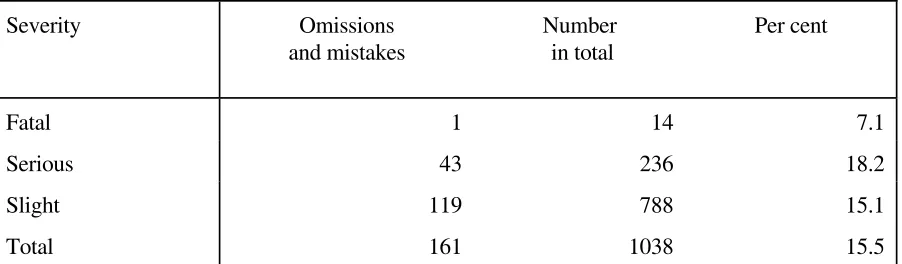
Table 1:The level of mistakes and ommissions in casualty age by severity.
Severity Omissions and mistakes
Number in total
Per cent
Fatal 1 14 7.1
Serious 43 236 18.2
Slight 119 788 15.1
Total 161 1038 15.5
The lowest level of omissions and mistakes were for fatal casualties. This is because the information is required for a coroners inquest and so time and effort are put in to ensure the data is accurate. In fact, for 7 of the 14 fatalities no age was recorded by the hospital. Seriously injured casualties did not have a significantly higher level of omissions and mistakes in casualty age than those that were slightly injured ( 2 = 1.33, p > 0.1 with 1 d.f.) For seriously injured casualties 6 per cent of ages were omitted on hospital records, whilst for slightly injured casualties this figure was 1.3 per cent.
A linked police and hospital database could reduce the mistakes and omissions in the coding of casualty age from 15.7 per cent of the linked police and hospital casualties to 0.2 per cent. The residual 0.2 per cent is due to age being omitted from both the hospital and the police records. If there are many years difference in casualty age between the hospital and police records then the number of casualties within each age cohort could be incorrect, so the targeting of population groups for road safety campaigns will not be optimised. The differences were calculated and the results are shown in Figure 2. In over 60 per cent of cases the ages differed by only one year and in 83 per cent of cases they differed by five years or less, hence the present inaccuracies are unlikely to affect safety studies greatly. However, even a slight improvement in the accuracy of the data, if it can be achieved easily, would be useful.
5
Figure 2: Difference in age (years) between hospital and police records
3.2GENDER
This study identified one case where gender was omitted on the police files and a further three cases where gender differed between the hospital and the police files. For those records with discrepancies, the casualty's forename on both the police and the hospital records were shown. The police were incorrect in two of these and so the total level of omissions and mistakes were 0.4 per cent for this variable. The adoption of this validation procedure could mean the number of omissions and mistakes in casualty gender for the linked records will be eliminated.
3.3ACCIDENT SEVERITY
The severity of a casualty's injuries are assessed by the police officer investigating the accident and are based on the following classifications.
•A fatal injury is when a casualty dies from their injuries within 30 days of the accident.
•A serious injury is when a casualty was admitted to hospital as an in-patient or sustained fractures, internal injuries, severe cuts and lacerations, crushing, concussion or severe shock.
•A slight injury would involve roadside attention or admission to hospital as an outpatient. This category includes sprains, bruises and cuts not judged to be severe and slight shock.
The combined totals of casualty severity are regularly used to estimate the societal cost of injury accidents at certain locations and to particular groups. Any discrepancies in the coding of severity will affect these totals which could alter the priorities given to these groups or locations.
6
recognised the injuries to be slight when the police coded them as serious.
In this study 14 casualties were identified as fatally injured on the police records, of which six died before arrival or within the Accident and Emergency Department, four were sent to the intensive care unit and four were sent to the wards. A coroners inquest is required for all road traffic related fatalities which involve the police and so all fatalities would be included.
7
Table 2:The location and type of injury for casualties identified as seriously injured by police but were not detained overnight nor received fractures.
Head Trunk Limbs Not known
Laceration 2 - - -
Contusion 2 2 6 1
Sprain - 1 5 -
Head Injury 1 - - 1
Not known - 1 - -
Injuries to the limbs and contusions accounted for 16 of the 22 casualties that the police classified as seriously injured but did not require admission. In total 9.3 per cent of seriously injured casualties could be reclassified as slightly injured although the severity of contusions, abrasions and lacerations were not possible to assign with the available hospital information and so these casualties could have been seriously injured.
There were 788 casualties that were classed as slightly injured by the police, of which 75 were admitted to hospital and 39 incurred fractures. The location and type of injury for these casualties are shown in Table 3.
Table 3:The location and type of injury for casualties identified as slightly injured by the police but recieved fractures or were detained overnight.
Head Trunk Limbs Not known
Contusion 6 - 3 1
Laceration 7 2 3 -
Sprain 2 - - 1
Fracture 5 14 35 -
Head injury 15 - 2 -
Not known 6 2 1 -
Head injuries accounted for a large proportion of those admitted (39 out of 54) and in many of these cases it would be as a precautionary measure. In total, 14.5 per cent of casualties identified by the police as slightly injured were seriously injured. An additional 382 casualties received contusions, abrasions or lacerations and were not admitted. Because there was only a limited amount of information available, the injuries to these casualties was assumed to be slight. In total, 13.1 per cent of casualty records had severity incorrectly coded.
[image:12.595.71.526.428.574.2]8
casualties recorded by the police but not by the hospital could be assumed to be slightly injured. It is likely that only 0.6 per cent of casualties will be coded incorrectly by this system which is considerably lower than the current value. This figure is calculated by multiplying the proportion of seriously injured casualties by the proportion of casualties recorded on both the hospital and police records that the algorithm failed to match. A regional or national linkage would avoid the problem of missing casualties who were injured in one highway authority but received treatment at a hospital in another highway authority. The application of this system will code casualty severity more accurately and also reduce the burden on the police to collect this information.
4.CONCLUSIONS
The computer based method of linking police and hospital casualty records using the name and address of the casualty is an efficient way of routinely identifying the mistakes in the variables of casualty age, gender and severity. The level of mistakes were 0.4 per cent for gender, 13.1 per cent for severity and 15.7 per cent for age. The number of records where age was omitted or incorrectly recorded was not significantly greater for seriously injured casualties than those that were slightly injured. The number of years difference in age between the police and the hospital records was small and so it would be unlikely to affect safety studies greatly. The adoption of this system on a regional or national basis could allow severity to be determined from hospital information rather than using the judgement of the police officers. This should provide more accurate data and will reduce the burden on the police to collect this information.
5.ACKNOWLEDGMENTS
The work undertaken in this project would not have been possible without the help of the Director of Technical Services, Humberside County Council, the Chief Constable of Humberside Police and the consultant of the Accident and Emergency department of Hull Royal Infirmary who allowed the data to be used. The author would like to thank Peter Shepherd of Humberside County Council, Dr Peter Haly of Hull Royal Infirmary and Dr Miles Tight and Howard Kirby of the University of Leeds for their encouragement and helpful suggestions which have contributed to the work reported here. This work was sponsored by the Science and Engineering Research Council.
6.REFERENCES
AGRAN, P.F., CASTILLO, D.N. and WINN, D.G. (1990). Limitations of data compiled from police reports on paediatric pedestrian and bicycle motor vehicle events. Accid Anal Prev, 22(4), pp 361-370.
AUSTIN, K.P. (1992). A linked police and road accident database for Humberside. Traffic Engng Control, 33(12), pp 674-678.
9
MEDICAL COMMISSION ON ACCIDENT PREVENTION, (1984). The Institution of Highways and Transportation/Medical Commission for Accident Prevention: Joint working party on data links between police and hospital accident records, in Medical commission on Accident Prevention report A, Bristol, The Medical Commission on Accident Prevention, pp 16 - 27.
SHINAR, D and TREAT,J.R. (1983). The validity of police reported accident data. Accid Anal Prev, 15(3), pp 175-191.
SOUTHWELL, M.T., CARSTEN, O.M.J. and TIGHT, M.R. (1990). Contributory factors in urban road traffic accidents, London, AA Foundation for Road Safety Research.
THORSON, J. and SANDE, J. (1971). Hospital statistics on road traffic accidents. Proceedings of the 3rd Triennial Congress 1969, International Association for Accident and Traffic Medicine,