Research into the implementation
of the National Reading and
Numeracy Tests
Social researchResearch into the implementation of the National
Reading and Numeracy Tests
BMG Research
Views expressed in this report are those of the researcher and not necessarily those of the Welsh Government
For further information please contact:
David Roberts, Senior Research Officer
Research for Education and Skills, Social Research & Information Division Welsh Government
Sarn Mynach Llandudno Junction LL31 9RZ
Tel: 0300 062 5485
Email: [email protected]
Welsh Government Social Research, 20 August 2014 ISBN 978-1-4734-1948-3
Table of contents
1 Introduction to the research ... 1
2 How the NRNTs were introduced and implemented in practice ... 7
3 How schools are using and plan to use the NRNT results ... 51
Acknowledgements
The authors would like to acknowledge the support and advice provided during the course of the project by the Welsh Government. In particular, we would like to thank David Roberts, Anthony Jordan, and Jayne Baxter for their expertise and their support of this research project.
Especially, we would also like to thank all the NRNT leads within schools who
Executive Summary
Introduction
The National Reading and Numeracy Tests (NRNTs) were implemented in May 2013 to support the ongoing assessment of progress against the National Literacy and Numeracy Framework (LNF) to ensure that clear, precise expectations are in place for the improvement of literacy and numeracy across the curriculum.
This report presents the findings of research undertaken by BMG Research on behalf of the Welsh Government into the implementation of the National Reading and Numeracy Tests (NRNTs). The research aims to:
Examine how the NRNTs have been introduced and implemented in practice.
Investigate the effect that the NRNTs are planned to have in support of teaching and learning.
Method
A mixed-method approach was utilised to meet the research aims and objectives and included:
A review of relevant documentation relating to the NRNTs.
A telephone survey of 550 schools.
In-depth interviews with key stakeholders (including 8 NRNT leads in schools, 8 Test Supporters, 7 Regional Consortia Test Monitoring Officers, and representatives from NfER and Accumina).
Key findings
How the NRNTs were introduced and implemented in practice
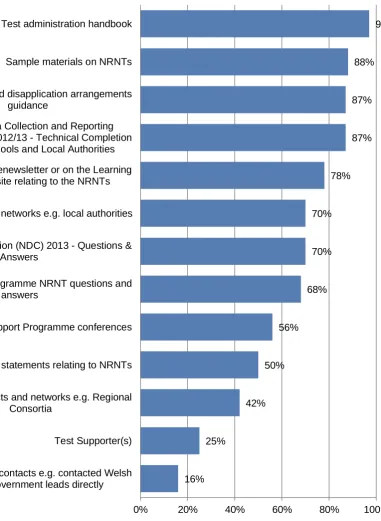
Almost all respondents (97 per cent) had made use of the test
87% using the national data collection and reporting arrangements technical completion notes); however, non-local resources were less widely used including regional consortia (42 per cent), Test Supporters (25 per cent), and national contacts (16 per cent).
More than half (56 per cent) of the representatives from the schools surveyed had attended an LNF/National Support Programme conference; however, in-depth interviews found these were not highly valued as attendees found the conferences to be too large with insufficient time to gain a deeper understanding or ask questions.
Test Supporters reported they were most likely to be contacted by a school once the NRNT lead had reviewed the guidance materials from the Welsh Government and had specific questions or wanted assurances their interpretation of the guidance was correct. Most frequently Test
Supporters reported that schools mainly contacted them with queries about the disapplication process.
Three-fifths of respondents (59 per cent) considered the guidance and manuals provided by the Welsh Government to be very relevant, while just over two-fifths (44 per cent) considered them to be very effective.
Respondents from English language medium schools were more likely than those from Welsh language medium schools to consider these as very relevant (63 per cent, compared to 52 per cent)
Nearly two-fifths of respondents (38 per cent) considered the sample test
materials to be very relevant, while around a quarter (24 per cent) considered them to be very effective. Most of the remainder considered the sample materials quite relevant (57 per cent) or quite effective (64 per cent).
from the Welsh Government to be clear and coherent (51 per cent, compared to 35 per cent).
The majority of respondents (95 per cent) felt their school was able to fully comply with the guidance issued by the Welsh Government in the Test Administration handbook; however, respondents in special schools were less likely than average to have felt their school were able to fully comply (39 per cent).
The most common approach to communicating the NRNTs to parents was
by letter (79 per cent) although this was significantly more likely to be reported by respondents in secondary schools than in primary schools (90 per cent, compared to 78 per cent). When prompted, 64 per cent of all schools reported that they would have liked to have received more
information or materials from the Welsh Government to provide to parents. Tests were mainly communicated to pupils via class teachers (82 per cent).
81 per cent of schools administered the NRNTs to whole classes. Where NRNTs were not administered to whole classes, they were administered to groups made up of whole year groups or smaller groups based on age.
Tests were most likely to be administered in the classroom (59 per cent),
followed by a combination of classrooms and larger rooms (22 per cent).
The majority of primary schools (83 per cent) had delivered the tests in shorter ‘chunks’ which was found to be useful as this approach
corresponded with their standard teaching practices.
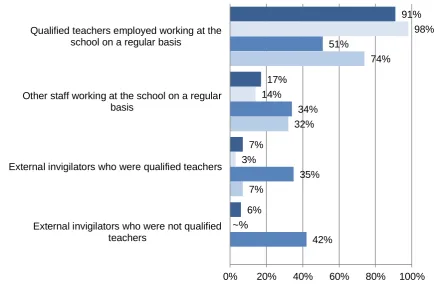
In the majority of cases tests were administered by qualified teachers employed at the school on a regular basis (91 per cent). However, secondary schools were significantly more likely than primary schools to use ‘other staff’ working at the school on a regular basis (34 per cent,
compared to 14 per cent).
More than a fifth of respondents (22 per cent) reported that their school had used modified NRNTs; the majority (87 per cent) did so to
Two in five respondents (40 per cent) reported that their school made use of the disapplication arrangements for the NRNTs and of these half (51 per cent) did so for the benefit of pupils with special needs/learning difficulties. However, disapplication arrangements were seen as the main source of confusion and concern in implementing the tests amongst all those interviewed in-depth, in particular two questions commonly arose: 1.Who could/should be disapplied, and 2. What would be the impact of
disapplication on amalgamated scores?
It was noted that some disapplied learners would have been able to take
part in tests if translations into a wider variety of language were made available or if schools could select the tests undertaken based on a child’s
ability as opposed to age, particularly in special schools.
More than a fifth of respondents’ schools had made use of extended
response questions; however, awareness of these were low in the interviews.
The average length of time invested in the testing process by schools (including administrative preparation and implementation but not including
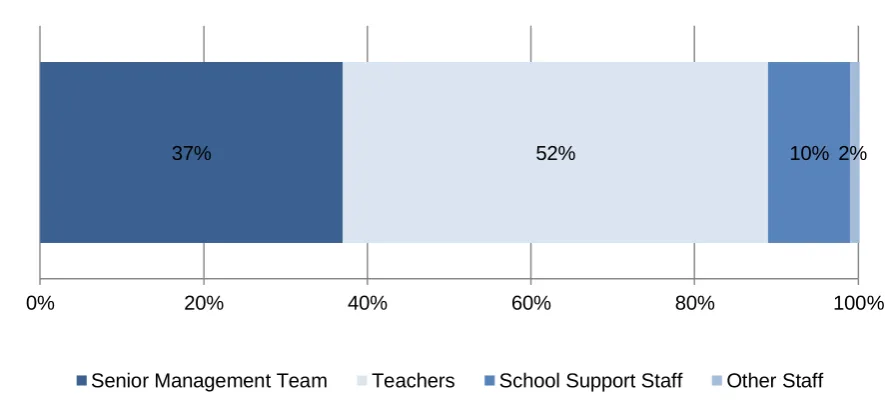
preparation of learners) was estimated to have been 23 hours; this was higher in secondary schools (29 hours) and lowest in special schools (20 hours), with respondents in primary schools estimating an average of 22 hours. This time was mainly invested by the senior management team.
The majority of respondents (91 per cent) were satisfied with how the NRNTs were implemented and administered at their school. More than half of all respondents (53 per cent) were very satisfied in this respect.
One-fifth (21 per cent) reported having experienced no challenges in implementing the NRNTs. The main challenge cited by respondents to the
survey was a lack of staff resource/time (26 per cent) which was
particularly the case in secondary schools compared with primary (35 per cent, compared to 25 per cent). Those interviewed in-depth tended to cite understanding and interpreting disapplication arrangements as the main challenge.
proportion was significantly higher amongst respondents working in primary schools than those in secondary schools (93 per cent, compared to 55 per cent).
The average time taken to mark 30 National Reading Test papers was just under three hours. This is at least one hour longer than the 90–120
minutes estimated in the Test Administration Handbook. The average time taken to mark 30 National Numeracy Test papers was shorter at two hours and 29 minutes this is also longer than estimated duration of 30-45
minutes.
When marking the tests the most frequent challenge was that of finding staff resources and time to do it (31 per cent of all respondents); however, 93 per cent of respondents reporting that they were quite/very satisfied with how the marking of the NRNTs was undertaken at their school. Data entry was most likely to be undertaken by ‘staff, other than teachers,
working at the school on a regular basis’ (School MIS: 63 per cent, NfER
portal: 63 per cent). On average, just under five hours (4.7) were spent entering NRNT results onto the school MIS and 4.4 hours for the NfER portal.
How schools are using and plan to use the NRNT results
93 per cent of schools have sent the individual test scores to pupils’
parents. Schools believed it was important that parents received the NRNT results at the same time as the school report so these could be interpreted and discussed in the report or at parents’ evenings. Schools believe the
scores were received too late in the term in 2013 to enable them to do this.
86 per cent of schools have used individual test scores to inform teaching plans; 85 per cent to inform pupil targets, to identify pupil weaknesses and plan interventions; and 82 per cent to provide more targeted support to learners.
Special schools were less likely to have used pupils’ scores; in-depth
NRNT leads interviewed in-depth plan to use the individual scores more extensively to measure individual pupil’s progress when comparator data
becomes available following future tests.
Schools were most likely to use amalgamated scores to inform teaching plans (86 per cent) and to inform curriculum development (86 per cent).
Respondents in primary schools were significantly more likely than those
in secondary schools to say their school intends to use the data to identify areas for staff development (78 per cent, compared to 64 per cent) and to monitor staff performance (61 per cent, compared to 30 per cent).
Schools and Regional Consortia Test Monitoring Officers (RTMOs) interviewed in depth preferred the use of the standardised scores as opposed to the age scores as they believed these allowed fairer comparisons which were less open to interpretation.
Respondents were most likely to specify getting information/results earlier (19 per cent) when asked how the results could be made more ‘usable’ for
them.
Conclusions and recommendations
The extent to which the administration of the NRNTs was implemented as envisaged in Welsh Government guidance.
The vast majority of schools that took part in the survey reported that they were fully compliant with the Welsh Government guidance; where schools were not fully compliant this was related to schools trying to meet the needs of children with specific requirements (such as those with special educational needs). All respondents had used some type of information from the Welsh Government to support the implementation of the tests. Schools interviewed in depth tended to view the handbook as the core source of information and generally found they could find the answers to any questions in this.
Recommendation: Continue to provide a range of up-to-date
The views of stakeholders involved in the administration of the NRNTs on the process of administering the tests and the arrangements and guidance
supporting this.
The vast majority of research participants were happy with the guidance that supported the NRNT administration process. Respondents were slightly less satisfied with the sample test materials. Findings from in-depth interviews suggest that schools would have liked a wider range of sample materials to use as practice papers to help their pupils better prepare for the tests.
Research participants were happy with the messages emerging from the Welsh Government. The main concern was the timeliness of information. Most would have preferred to receive information relating to the tests earlier in the year to help them prepare.
Recommendation: The Welsh Government should work with schools to introduce support and guidance earlier in the school year to
ensure teachers and pupils are best able to prepare for the NRNTs.
The patterns and rationale for use of modified tests, special access arrangements and disapplication of learners.
The main challenge schools faced when implementing the tests was the issue of disapplication and specifically who can/should be disapplied and the impact this has on school’s results. Disapplication arrangements were primarily used
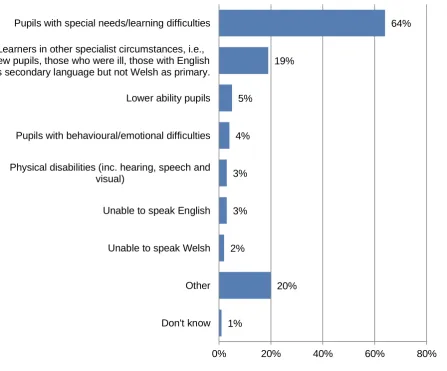
for learners in other specialist circumstances, such as new pupils, pupils who were ill (though this is an incorrect use of disapplication) and those whose first language was not English or Welsh.
Recommendation: The Welsh Government should consider (1) how more rigour, consistency, and clarity can be brought to eligibility for disapplication and (2) consider how disapplications can be dealt with when reporting test results so they do not arouse schools’ fears that true achievements and performance may be obscured.
views of some schools, particularly special schools, that pupils should be able to sit tests appropriate to their ability levels as recognised by their schools rather than strictly according to their age.
A fifth of respondents had used the modified NRNTs and this tended to be where the school has learners with visual impairments or special educational needs. Nearly half of those schools who had ordered modified tests had not used all of these. It was suggested in some of the in-depth interviews that this was likely to be a ‘teething’ problem in the first year to ensure preparedness
that would not be an issue in the future.
How the NRNT results were processed and disseminated.
The majority of schools surveyed reported that they had used qualified
teachers working at the school on a regular basis to mark the NRNTs. Where schools had used their own teaching staff to mark the tests they reported this was beneficial as it helped them to better understand the tests and how individual pupils were performing. However, in some instances schools would have preferred tests to be marked and moderated externally to ensure
consistency of the interpretation of the mark scheme.
The vast majority of schools surveyed had sent the tests scores to parents. However, schools were concerned about the timing of the release of the test results. Most of those interviewed in depth would have preferred to receive these earlier so they could be incorporated into end-of-year reports and parent’s evenings.
How the NRNTs are planned to be used within schools for teaching, assessment, curriculum planning and monitoring.
The majority of the work undertaken by schools following the receipt of the test results has been focussed on the individual test scores through sending parents the test results, identifying specific learner weaknesses and planning interventions, and providing more targeted support to learners.
It was noted by several schools and RTMOs interviewed that progress on the wider curriculum development and school performance monitoring plans were still in their relatively early stages. They believed more could be achieved in these areas when they had comparative longitudinal data from future test results.
Recommendation: The Welsh Government should ensure the
consistency of the types of data collected and ensure comparability between years to enable schools and pupils to gain the maximum benefit from the NRNTs.
Recommendation: The Welsh Government and regional consortia should identify opportunities to create data comparison tools to enable schools to best utilise the test results.
Recommendation: The Welsh Government should consider
1
1 Introduction to the research
1.1 This report presents the findings of research undertaken by BMG Research on behalf of the Welsh Government into the implementation of the National
Reading and Numeracy Tests (NRNTs).
Background
1.2 The School Improvement Action Plan1 provides a twenty-point plan for school
improvement to address concerns raised over literacy and numeracy amongst Welsh school-leavers.
1.3 To support this, the Welsh Government has introduced a National Literacy and Numeracy Framework (LNF) to ensure that clear, precise expectations are in place for the improvement of literacy and numeracy across the curriculum. Underpinning the LNF is the principle that ongoing assessment is a core element of good teaching practice. This ongoing assessment is supported by the National Reading and Numeracy Tests (NRNTs) which were implemented in May 2013. The NRNTs were developed by the National Foundation for Educational Research (NFER) in partnership with Acumina and are for all learners in Years 2 to 9 across all maintained schools in Wales.
1.4 The tests aim to generate summative, highly reliable, comparable data which will enable schools and local authorities to measure learner progress and focus attention on improving performance. They also include formative elements to generate data from which teachers can gain an accurate understanding of a learner’s progress in terms of their skills, in relation to the LNF and can be used
as one element in a diagnostic tool when planning for learner development. The tests also make it possible to get an understanding of achievement compared with the national picture.
1.5 A range of guidance and support has been provided for schools by the Welsh
Government and NfER since the introduction of the NRNTs. This includes the ‘Test Administration Handbook’ which includes: information on the manner and
method of test administration (for example test duration, suggested test
1
2 location and storage of test materials); guidance on access and disapplication
arrangements to assist schools where some learners may face challenges in accessing the tests; and further information on the Learning Wales and Welsh Government websites. In addition to this, assistance from ‘Test Supporters’
(usually former Headteachers) was offered. Test Supporters are individuals whom schools could approach to ask further questions or for further
clarification. Local authorities and regional consortia also have a role in monitoring schools’ progress in NRNTs and in providing appropriate support
and challenge.
Research aims and objectives
1.6 The Welsh Government commissioned this research into the implementation of the NRNTs to inform the ongoing support provided to the education sector on literacy and numeracy, to inform future arrangements for the NRNTs, to inform future guidance and support provided for the administration of the NRNT’s, and
to ensure that they are supporting practice within schools. The research aims to:
Examine how the NRNTs have been introduced and implemented in practice.
Investigate the effect that the NRNTs are planned to have in support of teaching and learning.
1.7 Specifically the research explores:
The extent to which the administration of the NRNTs was implemented
as envisaged in Welsh Government guidance.
The views of stakeholders involved in the administration of the NRNTs on the process of administering the tests and the arrangements and guidance supporting this.
The patterns and rationale for use of modified tests2, special access arrangements, and disapplication of learners.
How the NRNT results were processed and disseminated.
2
Modified tests were available to support learners with visual impairment or learners who
3 How the NRNTs are planned to be used within schools for teaching,
assessment, curriculum planning and monitoring.
1.8 The research also provides recommendations as to how the Welsh
Government, regional consortia, local authorities and schools can improve upon the implementation of the NRNTs in future years, and provides case studies exploring good practice in administering the NRNTs and the challenges faced by schools in doing so.
1.9 It should be noted that this research focuses on the process and
implementation of NRNTs and on plans for using the results. It does not
evaluate the content and purpose of the tests. A separate evaluation of the National Literacy and Numeracy Programme (NLNP) has been commissioned by the Welsh Government which will examine how the NLNP is being
implemented in practice, as well as what impact the NLNP is having on
teaching practice and educational standards.
Methodology
1.10 In order to meet the research aims and objectives it was agreed that a mixed-method approach would be the most appropriate approach, including:
A review of relevant documentation relating to the NRNTs.
A telephone survey of schools.
Qualitative research, including in-depth interviews with key stakeholders.
Document review
1.11 Following an initial inception meeting between BMG and the Welsh
Government it was agreed that key documents relating to the NRNTs would be reviewed to inform the development of survey questions and qualitative
research topic guides. Materials reviewed included:
Welsh Government test readiness progress reports
NRNT Test Administration Handbook
Individual Pupil Report examples
National Support Programme Questions and Answers
NRNT access and disapplication arrangements guidance
4 Quantitative survey
Survey respondent profile
1.12 The sampling frame for this survey comprised the member of staff in each school who had responsibility for implementing the NRNTs in all primary, secondary, and special schools in Wales. 1,617 unique school contacts were received from the Welsh Government.
1.13 Using this contact data, a proportionate sample approach was designed based upon school phase, type, region, language medium, and size (see Appendix 1 for a break down of number of interviews achieved) with the aim of achieving 550 interviews.
1.14 Overall, responses (from the individuals responsible for implementing the NRNTs) were provided at an individual school level by 550 schools. This represents a response rate of 34 per cent of all schools in Wales.
1.15 In order to address minor variations against specific targets the achieved data
was subsequently weighted by phase, region and language medium. The school population information as originally provided by the Welsh Government was used as the basis for the weighting scheme as this represented the most reliable estimate of underlying school characteristics available. Weighted data is used throughout this report to ensure the data is representative of the population as a whole. The un-weighted and weighted sample profiles are presented in Appendix 2. Where bases are small (e.g. for special schools) this is flagged on charts and tables and these findings should be treated with caution.
Fieldwork process
1.16 The survey questionnaire (provided in Appendix 3) was designed to capture how schools went about implementing the NRNTs and the extent to which they were able to access support and follow Welsh Government guidelines; and explored how schools have used and plan to use the test results. The survey
5 Interviews (CATI) using Confirmit software. The survey was conducted
between 22nd October and 13th December 2013.
1.17 The survey was made available in both Welsh and English language versions with respondents able to choose in which language they took part. 72 per cent of the interviews completed were undertaken in English and 28 per cent were completed in Welsh.
1.18 Survey interviews were designed to take no more than 15-20 minutes to complete. Potential respondents were called on a range of days and times on up to 10 occasions before being recorded as non-response.
Presentation of survey data in the report
1.19 Individual question bases are provided on the graphs and charts in this report. Cross-tabulations were undertaken, based on key variables such as school phase, type, region, language medium, and size. Independent t-tests3 were
conducted at the 95 per cent confidence level4 to identify where differences between groups were statistically significant.
1.20 Most data used in this report are rounded to the nearest whole percentage. For this reason, on occasion, tables or charts may not add up exactly to 100 per cent.
Qualitative research
1.21 To support the quantitative survey and to add further insights, a number of qualitative interviews were also undertaken with representatives of various stakeholder groups involved in the implementation of the NRNTs. These comprised:
School NRNT leads (8 telephone interviews), including:
- x4 primary schools, x3 secondary schools, x1special school. - x2 South West and Mid, x2 South East, x2 Central South, x2 North
Wales.
3
A T-test is a statistical test performed to determine if groups of data are significantly different from each other
4
6 Test Supporters (8 telephone interviews).
Regional Consortia Test Monitoring Officers (RTMOs) (7 telephone interviews).
NfER NRNT leads ( face-to-face group interview with 5 individuals).
Accumina NRNT lead (1 telephone interview).
1.22 In each case, interviews lasted around half to three-quarters of an hour and were conducted using a semi-structured topic guide (agreed in advance with the Welsh Government and reproduced in Appendix 4). The guide ensured answers to specific common questions were gathered but also gave
interviewees scope to make wider comments and observations. Thus, the topic guide allowed interviewees to explore their experiences relating to the NRNTs and discuss any current or future plans for using the test results. Interviews were audio-recorded (with respondent permission) to allow accurate recall at the analysis stage. Qualitative analysis was undertaken through the use of an analysis grid which was designed and populated based on both the topic guides and common themes emerging in the discussions themselves. The key points, supported by verbatim quotations were added into the grid for each
theme and for each interview to build up a complete record of all the points and issues raised against each theme. Research material obtained from these interviews is used at various points in the report to illuminate statistical findings from the quantitative surveys.
1.23 Respondents were offered the option to take part in either Welsh or English. Three schools out of the eight that took part in this qualitative work, one Test Supporter, and one RMTO chose to undertake interviews in Welsh.
Report structure
1.24 Following this introduction the report is structured as follows: Chapter 2
7
2 How the NRNTs were introduced and implemented in practice
2.1 This section explores how the NRNTs were introduced and implemented in practice. This includes examining how they were communicated and prepared for, how they were administered, and how schools approached the marking and the process of entering the data onto NfER and Welsh Government portals.
Guidance and preparation
Sources of information about process and implementation of NRNTs
2.2 The findings in this section are derived chiefly from the survey of schools; respondents were asked about the materials and sources of information they had used to gain knowledge of the process of implementation of the tests prior to the introduction of the NRNTs.
2.3 Almost all respondents (97 per cent) mentioned that they had made use of the test administration handbook. This figure included all respondents working in secondary or special schools.
2.4 Other particularly important sources of information mentioned included sample materials on NRNTs (88 per cent), NRNT access and disapplication
arrangements guidance (87 per cent), and ‘National Data Collection and Reporting Arrangements 2012/13 – Technical Completion Notes for Schools and Local Authorities’ (87 per cent).
2.5 By region, respondents in the South West and Mid Wales region were
significantly more likely than those based elsewhere to cite local contacts and
networks, such as local authorities, as sources of information that they had used (82 per cent, compared with an average5 of 70 per cent).
2.6 Respondents in North Wales were significantly less likely than those based elsewhere to cite regional contacts and networks, such as regional consortia as
sources of information (26 per cent, compared with an average of 42 per cent). Figure 2.1 summarises the materials/sources of information that respondents used.
5
8 Figure 2.1 Materials/sources used to find out more about the process and
implementation of the NRNTs, prompted, multiple response (all respondents)
Sample base = 550
2.7 Respondents from English language medium schools were significantly more likely than those from Welsh language medium schools to have mentioned:
97%
88%
87%
87%
78%
70%
70%
68%
56%
50%
42%
25%
16%
0% 20% 40% 60% 80% 100%
Test administration handbook
Sample materials on NRNTs
NRNT access and disapplication arrangements guidance
National Data Collection and Reporting Arrangements 2012/13 - Technical Completion
Notes for Schools and Local Authorities
Articles in Dysg enewsletter or on the Learning Wales website relating to the NRNTs
Local contacts and networks e.g. local authorities
National Data Collection (NDC) 2013 - Questions & Answers
National Support Programme NRNT questions and answers
LNF/National Support Programme conferences
Ministerial statements relating to NRNTs
Regional contacts and networks e.g. Regional Consortia
Test Supporter(s)
9 National Data Collection and Reporting Arrangements 2012/13 (93 per cent,
compared to 74 per cent);
NRNT access and disapplication arrangements guidance (91 per cent, compared to 80 per cent);
sample materials on NRNTs (91 per cent, compared to 83 per cent);
articles in Dysg newsletter or on the Learning Wales website relating to the NRNTs (82 per cent, compared to 68 per cent);
National Data Collection (NDC) 2013 – Questions and Answers (77 per cent,
compared to 57 per cent);
LNF/National Support Programme conferences (60 per cent, compared to 47
per cent); and
ministerial statements relating to NRNTs (53 per cent, compared to 40 per cent).
2.8 More than half (56 per cent) of the representatives of the schools surveyed had attended an LNF/National Support Programme conference. However,
qualitative interviews with NfER, Test Supporters, and schools identified that, in some cases, attendees found the conferences to be not particularly useful due to the size of the event and the need to communicate in both English and Welsh, both of which factors meant there was little time to gain a deeper understanding or ask questions.
2.9 When interviewed, Test Supporters identified that they were allocated up to 30 schools to contact by NfER. Test Supporters then sent emails to each of their allocated schools to ensure they were aware that support was available. Schools could subsequently make contact with the Test Supporter if they required help in implementing the tests. Test Supporters reported that following
their initial email they were subsequently contacted on average by around one-third of their schools, a proportion that is slightly higher than the 25 per cent of survey respondents who reported they had approached their Test Supporter. However, this can be seen as broadly consistent given that the qualitative research was not statistically representative.
10 going into schools to meet with groups of staff to explain the entirety of the test process. However, more frequently Test Supporters described supporting schools by confirming their interpretations of the guidance provided or by giving advice on specific issues, most frequently, that of disapplication:
‘They needed more clarification generally. The impression I had was that [the Welsh Government] didn’t give them enough details about the process, about disapplication or how they provide the data.’Test
Supporter
‘I was allocated 30 odd schools. People replied to my initial letter to say I was there to help them. Between visits and phone calls I’d say a maximum of ten, maybe twelve schools asked for support.’Test
Supporter
‘The queries that came up were just really practical things, “Who marks the papers, what do we do with special needs children?” ‘ Test
Supporter
2.11 Several RTMOs also reported providing support to schools ahead of test implementation, the majority of whom were simply responding to queries. However, two reported providing NRNT information during meetings including
half termly cluster meetings and specific training events:
‘Schools were using this as an opportunity to share concerns about
developments, aspects of the tests. It was just a sounding board, a chance to discuss issues as they were arising. Then to take them back to Welsh Government as well.’ RTMO
‘We had training sessions before the tests and guided teachers and schools into, ‘This is how you order your tests,’ but we just followed
11 we guided them through how they have access to modified tests.’ RTMO
2.12 Schools and NfER also reported that NRNT leads had contacted NfER directly to ask specific questions about ordering papers and about how to prepare pupils for the tests.
2.13 Some Test Supporters also noted that they believed schools benefitted from their own internal knowledge in cases where staff had previously been in post when other national tests such as SATs were conducted. As such they believed these schools were more confident in implementing the tests whilst those with a higher proportion of younger staff who did not have this knowledge or
experience had more questions.
Review of sample test materials
2.14 All respondents were asked about the relevance of the sample test materials provided by the Welsh Government to address what they needed to know and to their effectiveness in preparing their school for the NRNTs. Nearly two-fifths of respondents (38 per cent) considered the sample test materials to be very
relevant, while around a quarter (24 per cent) considered them to be very effective. Most of the remainder considered the sample test materials quite relevant (57 per cent) or quite effective (64 per cent). While only three per cent of respondents did not consider the sample test materials relevant at all, nine per cent did not consider them effective at all.
12 Figure 2.2 Ratings of sample test materials provided by the Welsh Government (all
respondents)
Sample base = 550
2.16 There were no significant differences when considering the responses given by phase, region or language medium. However, a third of special schools (33 per cent) reported they had not had these materials.
2.17 During the in-depth interviews several schools reported that they would have liked more sample and practice materials so they could better prepare their pupils for the tests:
‘I think most schools would say more sample materials because it is the first time any of us had seen that kind of test but now we have seen it once, it is quite straightforward.’ NRNT Lead, Secondary, English medium
Review of guidance and materials provided by Welsh Government (including the Test Administration Handbook)
2.18 All respondents were asked about the relevance of the guidance and manuals provided by the Welsh Government to address what they needed to know about the tests and to their effectiveness in preparing their school for the
3%
9%
57%
64%
38%
24%
3%
3%
0% 20% 40% 60% 80% 100%
Relevant to what you needed to know
Effective in preparing your school for the NRNTs
13 NRNTs. This guidance and manuals included the Test Administration
Handbook.
2.19 Three-fifths of respondents (59 per cent) considered the guidance and manuals to be very relevant, while just over two-fifths (44 per cent) considered them to be very effective. Most of the remainder considered the guidance and manuals quite relevant (39 per cent) or quite effective (52 per cent). While only one per cent of respondents did not consider the guidance and manuals relevant at all, four per cent did not consider them effective at all.
[image:26.595.94.524.346.588.2]2.20 Less than one per cent of respondents reported they had not had these materials.
Figure 2.3 Ratings of guidance and materials provided by the Welsh Government (all respondents)
* denotes less than 0.5 per cent
Sample base = 550
2.21 Respondents from English language medium schools were significantly more likely than those from Welsh language medium schools to consider the
guidance and manuals to have been very relevant to what they needed to know (63 per cent, compared to 52 per cent). There were no significant differences in views regarding the guidance and manuals’ effectiveness in preparing their
schools for the NRNTs.
1%
4%
39%
52%
59%
44%
*%
0% 20% 40% 60% 80% 100%
Relevant to what you needed to know
Effective in preparing your school for the NRNTs
14 Review of messages and guidance from the Welsh Government
2.22 Respondents were asked about the messages and guidance they had received from the Welsh Government prior to the introduction of the NRNTs. They were asked to rate it on the basis of its timeliness, how clear and coherent it was, how easy it was to follow in practice, its relevance to what they needed to know, its effectiveness in helping them to communicate the NRNTs in school, and its effectiveness in preparing their school for the NRNTs.
2.23 As Figure 2.4 shows, half of respondents considered the messages and
guidance received to have been very relevant to what they needed to know (50 per cent) and very easy to follow in practice (49 per cent). They were least likely to have considered the messages and guidance very timely (20 per cent). 2.24 When interviewed a few of the NRNT leads and RTMOs noted that it would
have been beneficial to receive some of the material, particularly that on guidance for disapplication and its impacts and sample materials sooner.
‘The guidance needs to come out earlier and if we’re going to be
expected to answer these queries for schools, I think we need to be briefed, if there’s going to be a national phone line, that needs to be
set. I think they need to think about the type of questions people are going to be asking and how we’re going to answer that challenge.’
15 Figure 2.4 Ratings of messages and guidance provided by the Welsh Government
(all respondents)
Sample base = 550
2.25 Respondents in secondary schools were significantly more likely than those in primary schools to have considered messages and guidance from the Welsh Government to be clear and coherent (51 per cent, compared to 35 per cent). In some cases the school NRNT leads and Test Supporters suggested that
secondary schools were more likely to understand messages and guidance on the NRNT process as they had more experience implementing tests and exams in general (such as GCSEs and A-Levels).
2.26 The interviews with schools indicated that generally the test administration
handbook was a good source of information on how to administer the tests and they were broadly happy that it had provided sufficient information to guide them through the process:
‘With the guidance information, I worked it out myself.’ NRNT Lead, Primary, Welsh medium
‘Everything was fine. It must’ve been clear enough because we went through the process.’ NRNT Lead, Secondary, English Medium
22%
5%
4%
3%
6%
8%
59%
58%
47%
47%
54%
60%
20%
37%
49%
50%
41%
32%
0% 20% 40% 60% 80% 100%
Timely
Clear and coherent to understand
Easy to follow in practice
Relevant to what you needed to know
Effective to help you communicate the NRNTs in school
Effective in preparing your school for the NRNTs
16 2.27 However, the interviews also revealed some areas where schools would like
further information from the Welsh Government, including on the disapplication process (specifically more information on who could be disapplied and the impact this has on schools’ results), on how test results could be used, and on
how they could best prepare pupils for the tests.
Implementation
Compliance with Welsh Government guidelines
2.28 The majority of respondents (95 per cent) felt their school was able to fully comply with the guidance issued by the Welsh Government in the Test
Administration handbook. All the school NRNT leads interviewed reported that they had been able to comply with the guidance. However, in some instances they reported that ensuring compliance had caused some organisational difficulties, particularly in identifying an appropriate space for pupils to sit the tests, and, in two secondary schools, finding secure storage space of test papers when GCSE exam papers were being stored at the same time.
2.29 Respondents in special schools were less likely than average to have felt their school were able to fully comply (39 per cent) and more likely than average to have felt their school were able to just partially comply (42 per cent). Although
because of the sample size this is not a significant difference.
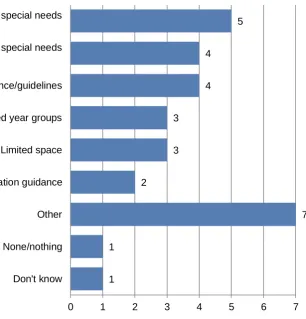
2.30 Overall, only 26 respondents6 felt their school was unable to comply with this Welsh Government guidance. This included 20 respondents from primary schools, 5 from special schools, and 1 from a secondary school. These respondents were asked about their difficulties. The reasons given for these responses are shown below.
6
17 Figure 2.5 Aspects of the guidance that schools were unable to comply with,
unprompted, multiple response (where unable to comply) Presenting responses as number of weighted cases
Sample base = 26
2.31 These findings are consistent with challenges identified in adhering to the guidance as reported by two of the RTMOs who were interviewed in depth.
‘The guidelines were adhered to in every case, what I did find and there was a variety of response from the teachers involved regarding the suitability of the test for their specific pupils.’ RTMO
‘There was a little bit of uncertainty about what happens if you’ve got mixed year groups.’ RTMO
5
4
4
3
3
2
7
1
1
0 1 2 3 4 5 6 7
Difficulty with children who have special needs (general)
Timing of tests (needing longer for special needs pupils)
Unclear guidance/guidelines
Difficulty due to mixed year groups
Limited space
Unable to interpret disapplication guidance
Other
None/nothing
18 Communicating the NRNTs
2.32 When asked how they had communicated information about the
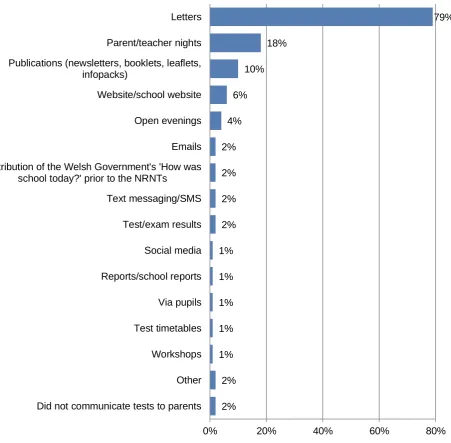
implementation of NRNTs to parents of pupils, overall by far the most common approach to communicating with parents was by letter (79 per cent) although significantly more likely to be reported by respondents in secondary schools than in primary schools (90 per cent, compared to 78 per cent).
2.33 The second most frequently reported approach to communicating this
information was parent/teacher nights (18 per cent). Parent/teacher nights were significantly more likely to be cited by respondents in primary schools than by those in secondary schools (20 per cent, compared to six per cent).
2.34 One in ten respondents (10 per cent) communicated the information through school publications, such as newsletters, booklets, leaflets and info-packs; however, this was only reported by primary and special schools.
2.35 Figure 2.6 summarises the methods by which schools reported that information
19 Figure 2.6 Ways in which information about the implementation of NRNTs were
communicated to parents of pupils, unprompted, multiple response (all respondents)
Sample base = 550
2.36 When asked if they would have liked more information from the Welsh
Government to provide to parents, 64 per cent of all schools reported that they would have. There were no significant differences by type of school, region or language medium to this response.
2.37 One school, when interviewed reported that they would have liked further information on how to interpret the test results from the Welsh Government to provide to parents although this was not explored in the survey.
79%
18%
10%
6%
4%
2%
2%
2%
2%
1%
1%
1%
1%
1%
2%
2%
0% 20% 40% 60% 80%
Letters
Parent/teacher nights
Publications (newsletters, booklets, leaflets, infopacks)
Website/school website
Open evenings
Emails
Distribution of the Welsh Government's 'How was school today?' prior to the NRNTs
Text messaging/SMS
Test/exam results
Social media
Reports/school reports
Via pupils
Test timetables
Workshops
Other
20 Case study: Welsh Medium School, Primary, South East
The school’s Acting Deputy Head oversaw the implementation and administration of the NRNTs after the school first found out about them through the Welsh Government in September 2012. This involved ensuring that:
‘there was a routine and a practical understanding among the staff, who participated in a training phase prior to the implementation of the tests.’
To prepare, the Acting Deputy Head used the Test Administration Handbook and also accessed materials online, then subsequently organised the school’s approach and procedures for the tests according to this guidance in order to be fully compliant.
The school sent a letter to parents to inform them about the NRNTs. The letter outlined when the tests would take place and why they were necessary; and explained the national nature of the tests. The Acting Deputy head was confident that this approach was effective as the school did not receive any requests for further information or complaints. However, they do believe that some more specific further information or materials from the Welsh Government to share with parents would have been useful:
‘It would be helpful to have more information from the Welsh Government to pass on to parents to explain about the test criteria and to help them understand how the tests are relevant to their child.’
The school did not use any modified NRNTs as none of their learners needed them. However, they were aware of the guidance materials available to them if they chose to use these. Only one learner from the school was disapplied and they found the guidance to do this clear.
Tests were delivered within classroom settings and in 20 minute ‘chunks’ for Years 2 and 3 as suggested in the Welsh Government guidance. The school found this approach was particularly effective for Year 2 learners as due to their age their concentration span is not as long as others.
Tests were supervised by teachers within the school. The Acting Deputy Head believed this approach created the minimum disruption to staff and learners:
‘This way means that test days do not cut across other classes who are not sitting the tests. In effect, teachers continue to work within their usual timetable.’
In the future, the Acting Deputy Head believes there is a role for the Regional Consortia to play in helping schools plan their curriculum to prepare for the tests:
‘There is a consortium for South East Wales and they do have a role to play. When the tests were first introduced the consortium had only been established for 6 months. Perhaps the consortium could have been set up sooner so that things were not rushed - in order to try and change things sooner rather than later. We could then embed what we need to into the school curriculum as preparation in advance.’ A mixed approach to marking was used by the school, utilising both teaching and senior staff with supply teachers brought in to enable staff to undertake marking without additional pressure. The Acting Deputy Head believes this approach was time-effective and also thought the marking scheme was suitably clear. School administrative staff inputted the data onto the school MIS and NfER portal and no problems or difficulties were reported.
The results from the tests have been used by the school in a number of ways, including: Providing information for parents, using the Welsh Government handouts;
using the scores to identify learners who have fallen behind and providing them with additional support through group sessions;
21 grouping children into sets based upon ability; and
making comparisons both locally and nationally.
However, the Acting Deputy Head noted that the results arrived too late to be able to be followed up in that academic year and would like to see these made available sooner.
Over time, when year-on-year results are available the school would like to analyse a 'bank' of scores which can help monitor the individual pupil’s and the school’s progress. The Acting Deputy Head is positive that this will be of benefit to the school, learners, and parents alike:
‘The fact that the tests are national means that the information given to parents will be more rigorous and will outline the needs of the child. This will help a lot, because it's consistent. It will get better and areas for improvement can be targeted - for example, if a notable number of children have misunderstood a particular question or have struggled with a specific type of text, we can work with that, because it will be more feasible to identify a way forward.’
The school believe their approach to implementing the tests was effective because they were able to accurately follow the guidance materials which they thought were clear to understand and pitched at the correct level. However, they believe the materials would be strengthened if they provided guidance on how to teach and prepare children for the tests.
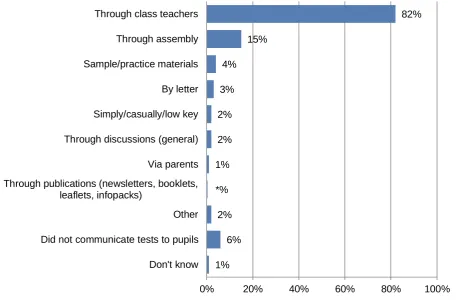
2.38 When asked how they communicated information about the implementation of NRNTs to pupils in their school, respondents most frequently said that this was through class teachers (82 per cent). This was by far the most common
approach but significantly more likely to be cited by respondents in primary schools than in secondary schools (86 per cent, compared to 67 per cent). This response increased to 94 per cent amongst respondents in Welsh language medium schools.
2.39 Respondents were next most likely to have communicated information to pupils in assembly (15 per cent). This mode of communication was significantly more likely to have been used by secondary schools than primary schools (52 per cent, compared with 10 per cent).
2.40 The use of letters to pupils was significantly more likely to be reported by respondents in secondary schools than by those in primary schools (11 per cent, compared to two per cent). However, the overall proportion using this medium to communicate with pupils on this subject was just three per cent overall.
2.41 School NRNT leads, RTMOs, and Test Supporters interviewed in depth reported that schools tried to ensure the tests were communicated in such a way as not to alarm pupils or cause them undue concern. This was particularly
22 2.42 Ways in which information about the implementation of NRNTs was
[image:35.595.75.538.179.482.2]communicated to pupils are summarised in Figure 2.7.
Figure 2.7 Ways in which information about the implementation of NRNTs were
communicated pupils, unprompted, multiple response (all respondents) * denotes less than 0.5 per cent
Sample base = 550
Administration approaches
2.43 Respondents were asked a series of questions about how NRNTs were administered in their schools.
2.44 In the majority of cases (81 per cent), NRNTs were administered to whole classes. It was slightly higher in primary than secondary schools (84 per cent, compared with 79 per cent) and higher within Welsh language (89 per cent) and bilingual (90 per cent) schools than in English medium schools (79 per cent). Although not a statistically significant difference due to a low base (12 unweighted and 14 weighted), it may be indicative that this proportion was considerably lower than average in special schools where just 16 perecent of schools reported that they administered the tests to whole classes.
82%
15%
4%
3%
2%
2%
1%
*%
2%
6%
1%
0% 20% 40% 60% 80% 100%
Through class teachers
Through assembly
Sample/practice materials
By letter
Simply/casually/low key
Through discussions (general)
Via parents
Through publications (newsletters, booklets, leaflets, infopacks)
Other
Did not communicate tests to pupils
23 2.45 Where NRNTs were not administered to whole classes, they were administered to groups made up of whole year groups or smaller groups based on age. This was particularly likely to be the case where schools included classes of mixed ages and where schools had very small class sizes. However, in one or two cases, large year groups were tested together, reflecting arrangements made for external exams. Younger children were sometimes tested in smaller groups, classes being split into small groups in order to provide greater levels of
supervision.
2.46 In terms of where tests were administered, the classroom was the most
frequently cited location (59 per cent). This was significantly more likely to have been the case in primary schools than in secondary schools (68 per cent, compared with six per cent). In this case secondary schools were significantly more likely to report having used a larger room to accommodate larger
numbers of pupils, i.e. where whole year groups were tested together (76 per cent of secondary schools, compared to eight per cent of primary schools).
2.47 More than a fifth of respondents (22 per cent) reported that they had used a combination of classrooms and larger rooms, with this being more likely in primary schools than in secondary schools (23 per cent, compared to 15 per cent).
2.48 Depth interviews with school NRNT leads, RTMOs, and Test Supporters identified that as might be expected, where tests were administered tended to depend on the space available within the school and how the availability of space fit in with exisiting timetabling:
‘Since they were administering the test also outside of the classroom, there was a lack of space in some of the smaller secondary schools, regarding where the test could be administered.’ RTMO
2.49 Survey respondents in primary and middle schools were asked if their school delivered the NRNTs for Years 2 or 3 in shorter ‘chunks’ which was a
recommendation in the Welsh Government guidance provided to schools in the Test Administration Handbook. The majority (as exemplified in the case study
24 teaching practices (to split lessons into short periods to achieve specific tasks) and was more appropriate for younger pupils who may have difficulty
concentrating:
‘This was particularly effective for Year 2 children, they are so small that their concentration span isn't very long really’ NRNT lead, Primary, Welsh Medium
2.50 In the majority of cases, across all school types, tests were administered to pupils by qualified teachers employed at the school on a regular basis (91 per cent). However, this proportion was significantly higher in primary schools (98 per cent) than in secondary schools (51 per cent). Secondary schools were significantly more likely than primary schools to use; ‘other staff’ working at the
25 Figure 2.8 Staff who administered the tests to pupils, prompted, multiple response
(all respondents) ~ denotes less than 0.5 per cent
Sample bases in parentheses *caution small sample base
Use of modified tests
2.51 More than a fifth of respondents (22 per cent) reported that their school had used modified NRNTs. This proportion almost doubled amongst respondents in secondary schools (43 per cent). It was 18 per cent in primary schools and 28 per cent in special schools.
2.52 The majority of respondents using modified NRNTs (87 per cent) did so in
order to accommodate pupils with special needs and physical disabilities (such as impairments of hearing or vision), with a further seven per cent reporting that some pupils needed larger print paperwork as part of their of their normal
classroom practice.
2.53 There were three main factors influencing respondents’ choice of modified tests. These included using NRNT guidance and consulting staff who worked
91%
17%
7%
6%
98%
14%
3%
~%
51%
34%
35%
42%
74%
32%
7%
0% 20% 40% 60% 80% 100%
Qualified teachers employed working at the school on a regular basis
Other staff working at the school on a regular basis
External invigilators who were qualified teachers
External invigilators who were not qualified teachers
26 with children with special needs and physical disabilities to identify
requirements for modified tests (46 per cent), looking at the needs of certain children (20 per cent), and selecting on the basis of pupils having special needs or physical impairments (16 per cent).
2.54 Just under half of respondents who used modified NRNTs (47 per cent) used all of those they ordered, fewer (38 per cent) used some but not all, and just seven per cent did not use any of them. Depth interviews with Test Supporters and school NRNT leads suggest that in some cases schools ordered modified tests as they wanted the option to use these but then chose not to use them following receipt. There was a belief that this was because it was the first year of the tests and schools wanted to be prepared for a range of eventualities. In addition, some pupils were disapplied following modified tests being ordered. 2.55 Several stakeholders interviewed,(including NRNT leads, Test Supporters and
RTMOs) identified that they would have wanted the tests translated into a wider range of languages so learners who had English as a second language (where
Welsh was not their first language) could have taken part in a way that reflected their abilities more accurately.
‘One of the issues that came up early on was, we wouldn’t have the capacity. I think you could, for instance, for the maths test have a translator. That’s fine if you’ve got someone who speaks each one of the 70 languages we’ve got in the area. In practical terms that’s very difficult to administer. Our English Language service didn’t have that capacity so we made that clear to schools from the beginning.’ RTMO
Use of disapplication arrangements
2.56 Overall, two in five respondents (40 per cent) reported that their school made use of the disapplication arrangements for the NRNTs. This varied little by school type, region or language medium. Although having only a small sample base, special schools appeared more likely than average to have used
disapplication arrangements (49 per cent).
27 2.58 One in five respondents (19 per cent of those in schools which used
disapplication) reported that their school made use of these arrangements for learners in other specialist circumstances, such as new pupils, pupils who were ill (although this was an incorrect use of disapplication), and those whose first language was not English or Welsh.7 Figure 2.9 shows the reasons given for the use of disapplication arrangements.
[image:40.595.90.538.320.691.2]2.59 It is noted that disapplication may not have been used as orginally envisaged by the Welsh Government in all instances due to the confusion in interpreting disapplication guidance materials which was reported by schools.
Figure 2.9 Instances in which disapplication arrangements were made use of – unprompted, multiple response (where made use of disapplication arrangements)
7
Pupils who are ill should be marked as absent and not disapplied. Pupils new to the English or Welsh based education system (NEWBES) must sit the WNT unless there are specific reasons to disapply. However, their test results may be excluded from calculation of aggregate statistics.
64%
19%
5%
4%
3%
3%
2%
20%
1%
0% 20% 40% 60% 80%
Pupils with special needs/learning difficulties
Learners in other specialist circumstances, i.e., new pupils, those who were ill, those with English as secondary language but not Welsh as primary.
Lower ability pupils
Pupils with behavioural/emotional difficulties
Physical disabilities (inc. hearing, speech and visual)
Unable to speak English
Unable to speak Welsh
Other
28 Sample base = 222
2.60 Disapplication arrangements were seen as the main source of confusion and concern in implementing the tests amongst all those interviewed in-depth (including school staff, Test Supporters and RTMOs).
‘They didn’t understand quite how the disapplication worked, so I would explain more about that.’ Test Supporter
‘I think the issue we had most difficulty with was who could be disapplied. There wasn’t enough clarity in the guidance. We tried to give the message that nearly all learners, regardless of additional learning needs or their linguistic skills should sit the test. I think there was ambiguity in the wording, in the message from Welsh Government, some schools did play one off against the other. In fairness to schools, for the best reasons, the concern they had was for the learners and their wellbeing. More learners in schools were disapplied than we would have anticipated.’ RTMO
“A number of the schools were unclear regarding their right to disapply pupils from the tests. That point in the regulation was vague as far as the actual teachers were concerned in some of the schools. I’m saying a good number, what I mean there is up to about half of the schools within the sample.’ RTMO
2.61 The issues related to disapplication identified by stakeholders interviewed in depth are discussed below.
Who could be disapplied:
Schools were often uncertain as to who could be disapplied. Particular groups about which there were uncertainties incuded those with special educational needs, pupils with English as a second language (where Welsh was not their first language), pupils who were seen as potentially disruptive, and those who they felt would be unduly upset by the tests. In order to come to a conclusion on this issue schools referred to the Welsh Government guidance on dissapplication and contacted NfER and Test Supporters with queries. It was noted by schools and Test Supporters that a response was often not immediate as they believed the Welsh
Government were not clear on this issue themselves.
29 Schools approached Test Supporters, NfER and RTMOs to identify the impact that disapplication would have on their amalgamated scores as they were concerned this would reflect badly upon them:
‘They received information about getting the test scores back, in two forms, as a whole score and then another with the disapplied children out of the equation. By disapplying certain children, it would have an overall effect on their school number.’ RTMO
‘It seemed to me that they were more concerned about the reflection on the school with the results, overall, including perhaps special needs children, and those children who perhaps had difficulty reading in general, and the impact of the results on how people from the outside could see the school. I think that’s the general idea they had, that it would reflect badly.’ Test Supporter
2.62 Test Supporters reported that schools varied in how they chose to approach disapplication. Some chose to disapply all pupils who could be disapplied if they believed they would not benefit from sitting the tests, whilst others had all pupils sit the tests to ensure that everyone was treated in the same manner:
‘There was a child there with a Welsh medium reading test and he’d only been there a short time, but the school still felt it was better for him to be included than not to be included. It would affect him more if he was put on his own, although they knew he wouldn’t do well.’ Test Supporter
‘They tended not to do it, and certainly with the youngest children, if they couldn’t cope they would just end the test and write on it too upset to continue.’ Test Supporter
2.63 Several schools and Test Supporters believed disapplied pupils should not be included in school’s aggregated scores (as they are currently) and/or the
results of disapplied students should be should be noted separately. This would be in order to ensure that concern to protect the school’s overall performance
figures is not a consideration when making disapplication decisions and in order that output figures represent a fair reflection of the school’s achievements
and standard.
30 for younger pupils. This was of particular concern to the NRNT lead in the special school (consulted in depth and whose views are described in more detail in the following case study). They believed that fewer of their pupils would have been disapplied and that the test results would have been of more use to them if their pupils could have sat tests appropriate to their aptitude as opposed to their age.
Case study: Special School, North Wales
Implementation of the NRNTs was led by the Headteacher. The school received information about the NRNTs in February/March 2013 which was perceived by the Head as later than they would have liked considering it was the first time tests were administered:
‘It was a bit late. It was a brand new venture. If we had it earlier, we may have looked at them earlier and seen what implications it would have for our pupils.’
The Headteacher reported that they did not receive all the information they needed initially and found they were learning throughout the process:
‘We did manage to do everything within the calendar but it became a bit tight. We were finding out things as they went along.’
The main issue faced by the school on implementing the tests was the issue of disapplication, and specifically who should be disapplied. The Headteacher knew a large proportion of their learners would be dissapplied as they were non-verbal and working below national curriculum level. However, other learners within the school may have been able to undertake the tests but not necessarily, those designed for their age group. The school would have liked the opportunity to offer these learners the NRNTs that were most appropriate to their ability as opposed to their age:
‘The tests told me nothing. If I could have given them the tests for their ability, i.e. if I could give one of my Year 9s that is working at Level 1 the Year 2 test, then I could see the point in doing them.’
The Head was happy with the information they received regarding the actual process of disapplying learners and on the administration of the NRNTs. However, they would have liked more information to inform them how the data might be used to monitor pupil’s progress:
‘The information is there and it's clear to administrate the tests and make them consistent in the approach across all settings. It's just the relevance of the tests for special schools and the fact that we have to follow the same procedure as a mainstream school. That obviously doesn't allow the tests to give me any information on how my pupils are performing or the progress they're making.’