rsob.royalsocietypublishing.org
Research
Cite this article:
Waardenberg AJ, Homan B,
Mohamed S, Harvey RP, Bouveret R. 2016
Prediction and validation of protein – protein
interactors from genome-wide DNA-binding
data using a knowledge-based
machine-learning approach.
Open Biol.
6
: 160183.
http://dx.doi.org/10.1098/rsob.160183
Received: 15 June 2016
Accepted: 5 September 2016
Subject Area:
bioinformatics/genomics/systems biology
Keywords:
machine learning, protein – protein
inter-actions, transcription factors, gene regulatory
networks
Authors for correspondence:
Ashley J. Waardenberg
e-mail: [email protected]
Richard P. Harvey
e-mail: [email protected]
Electronic supplementary material is available
online at
https://dx.doi.org/10.6084/m9.fig-share.c.3469887.
Prediction and validation of protein –
protein interactors from genome-wide
DNA-binding data using a
knowledge-based machine-learning approach
Ashley J. Waardenberg
1,2, Bernou Homan
1, Stephanie Mohamed
1,
Richard P. Harvey
1,3,4and Romaric Bouveret
1,31Victor Chang Cardiac Research Institute, Darlinghurst, New South Wales 2010, Australia
2Children’s Medical Research Institute, University of Sydney, Westmead, New South Wales 2145, Australia 3St Vincent’s Clinical School, and4School of Biotechnology and Biomolecular Science, University of New South
Wales, Kensington, New South Wales 2052, Australia
AJW, 0000-0002-9382-7490
The ability to accurately predict the DNA targets and interacting cofactors of transcriptional regulators from genome-wide data can significantly advance our understanding of gene regulatory networks. NKX2-5 is a homeodomain transcription factor that sits high in the cardiac gene regulatory network and is essential for normal heart development. We previously identified genomic targets for NKX2-5 in mouse HL-1 atrial cardiomyocytes using DNA-adenine methyltransferase identification (DamID). Here, we apply machine learning algorithms and propose a knowledge-based feature selection method for predicting NKX2-5 protein : protein interactions based on motif grammar in genome-wide DNA-binding data. We assessed model perform-ance using leave-one-out cross-validation and a completely independent DamID experiment performed with replicates. In addition to identifying previously described NKX2-5-interacting proteins, including GATA, HAND and TBX family members, a number of novel interactors were identified, with direct protein : protein interactions between NKX2-5 and retinoid X recep-tor (RXR), paired-related homeobox (PRRX) and Ikaros zinc fingers (IKZF) validated using the yeast two-hybrid assay. We also found that the interaction of RXRawith NKX2-5 mutations found in congenital heart disease (Q187H, R189G and R190H) was altered. These findings highlight an intuitive approach to accessing protein–protein interaction information of transcription factors in DNA-binding experiments.
1. Introduction
Complex gene regulatory networks (GRNs) guide development and tissue homeostasis in all organisms. While gene regulation is complex, transcription factors (TFs) provide a key focus for effector function in GRNs as their specific DNA recognition sequence motifs (transcription factor binding sites, TFBSs) are hard-wired into the genome sequence [1,2]. TFs do not act in isolation, and the progression of diverse cellular programmes in development depends upon binding site specificity, cooperativity of multiple TFs and the recruitment of a diversity of cofactors [3 –7].
Recently, machine-learning algorithms have been applied to genome-wide datasets to make novel predictions related to cardiac GRN function. These studies have focused on predicting muscle-specific enhancers from validated training sets [8,9] or identifying known and novel TFs governing heart precursor and organ development based on sequence-level discriminators (motif grammar) [10,11]. While such studies have demonstrated the power of machine-learning approaches
for validating known enhancers and predicting novel enhan-cers based on motif grammar, these methods have not yet been systematically focused on the discovery and validation of novel TF protein interactors—therefore relatively few such transcriptional cofactors have come to light. Furthermore, while large numbers of TFs have been proposed to act through indirect DNA binding [12,13], the nature and role of cofactors that indirectly guide TFs to regulatory elements has not been clarified or systematically validated.
NKX2-5 is an NK2-class homeodomain TF related to
Drosophilatinman, and its expression during mammalian devel-opment is regionally restricted to the cardiac fields and forming heart tube, as well as other organ-specific domains [14]. Consist-ent with a combinatorial model for TF specification of heart development, NKX2-5 acts cooperatively with other cardiac TFs whose expression is similarly regionally restricted, includ-ing GATA4, ISL1, TBX2/3/5/20, MEF2C and SRF. These factors are thought to form a cardiac collective or ‘kernel’ of TFs that show recursive wiring (many cross-regulatory inter-actions) [1] and which perform the executive functions of the cardiac GRN. NKX2-5 is essential for normal heart develop-ment and mouse embryos carrying homozygous NKX2-5 loss-of-function or severe point mutations show a rudimentary beating myogenic heart tube lacking specialized chambers, valves, septa and conduction tissues, with subsequent growth arrest and death at mid-gestation [15]. In humans,NKX2-5is also one of the most commonly mutated single genes in congen-ital heart disease (CHD), with heterozygous mutations causative for a spectrum of CHD phenotypes, most prominently atrial septal defects and progressive conduction block [15].
To expand our knowledge of the cardiac GRN, we recently identified NKX2-5 targets in cultured HL-1 atrial cardiomyo-cytes using DNA-adenine methlyltransferase identification (DamID), a sensitive enzymatic method for detecting genome-wide protein–DNA interactions [16]. DamID complements the chromatin immunoprecipitation (ChIP) method for detec-tion of TF-DNA interacdetec-tions while avoiding some of the artefacts associated with chromatin cross-linking and use of poor quality antibodies [16,17]. Approximately 1500 target peaks were detected and, consistent with a role for NKX2-5 in normal heart development, proximal target genes were enriched for those involved in cardiac development and sarcomere organization.
Further analysis of our DamID data [16] and ChIP data [11] identifying genome-wide cardiac TF target sets suggests that cardiac kernel TFs collaborate and interact widely with each other and with many broadly expressed signal-gated DNA-binding TFs. This includes factors embedded within canonical signalling pathways such as SMAD and TCF proteins (down-stream of BMP and WNT signalling, respectively), known to regulate cardiogenesis, as well as other extracellular signal-gated TFs of the ETS, TEAD, NFAT, STAT, YY, SP, LMO and MEIS families [8,18–21]. A model in which regionally restricted kernel TFs cooperate with broadly expressed but signal-gated TFs to define an organ-specific context for devel-opmental programmes is compelling because it allows for great regulatory flexibility, consistent with the GRN model [1]. In this study, we applied machine-learning algorithms to generate models for wild type (WT) NKX2-5 targets based on motif grammar, exploiting replicate NKX2-5 DamID exper-iments performed 2 years apart [16]. We developed a knowledge-based lasso method to generate sparse models with very high concordance between experiments. Using this
approach, we defined 27 TFs as discriminators of NKX2-5 DamID targets that included NKX2-5 and related proteins, as well as known direct NKX2-5 protein interactors such as TBX5, GATA1 and HAND1. We also identified novel NKX2-5 target discriminators and validated retinoid X receptor (RXRa), paired-related homeobox (PRRX2), Ikaros zinc fingers (IKZF1) and a number of their paralogues (PRRX1a, PRRX1b, IKZF3 and IKZF5) as direct NKX2-5 interactors using the yeast two-hybrid assay. Furthermore, we found that inter-actions between RXRa and a subset of NKX2-5 mutations causative for congenital heart disease (Q187H, R189G and R190H) were altered, linking TF–TF interaction networks to heart disease. To our knowledge, these are the first experiments to mine genome-wide TF–DNA interaction data for systematic discovery and validation of TF protein–protein interactions (PPIs) for expanding TF interactomes.
2. Results
2.1. Classification of bound regions by motif
composition
We previously identified 1536 and 1571 NKX2-5 target peaks, respectively, in two DamID experiments performed 2 years apart [16]. Three and four replicates, respectively, contributed to peak selection in these experiments, which we refer to as NKX2-51 and NKX2-52 [22]. The peak overlaps between
NKX2-51 and NKX2-52 were highly significant (p,0.001)
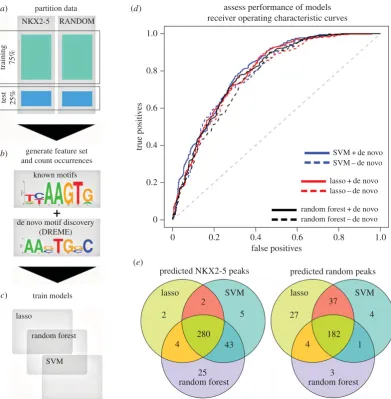
and comparison of gene ontology (GO) terms using a log odds ratio statistic implemented in the CompGO R package demonstrated these experiments were identical at a GO level [22]. We sought to determine if NKX2-5 targets could be classified based on the motif grammar embedded within their peaks, relative to a random peak set generated from sequences represented on the Affymetrix promoter micro-array chip used for DamID experiments [16]. For testing models, we used a leave-one-out cross-validation (LOOCV) approach to train models for NKX2-51 (compared with the
randomly generated peak set) on 75% of the data, withhold-ing 25% for testwithhold-ing performance (figure 1a). We used DREME [23] to generate position weight matrices (PWMs) de novo from the training sets only, which identified 70 de novo PWMs in total (figure 1b; electronic supplementary material, file S1). We next combined these de novo PWMs with PWMs from Transfac [24] and Jaspar [25], adding the PWM for TBX5, a known NKX2-5 cofactor [26] (figure 1b; electronic supplementary material, file S2), bringing the total number of PWMs to 1202. CLOVER [27] was next used to count motif instances in NKX2-5 target peaks, followed by normal-ization to peak length. From de novo motifs discovered, the NKX2-5 motif (NKE) was highly enriched (ranked first for NKX2-51 and shown in figure 1b, and third for NKX2-52),
consistent with previous findings [16].
We then generated classification models using three algorithms—least absolute shrinkage and selection operator (lasso) [28], support vector machine (SVM) [29] and random forest [30] (figure 1c)—and compared predictive performance using the area under curve (AUC) of receiver operating charac-teristic (ROC) graphs from the withheld test set (figure 1d). Performance of the lasso model on the test set resulted in an AUC of 0.789 (where 0.5 is random) (figure 1d). Removing de novo motifs from the feature matrix and refitting the
rsob.r
oy
alsocietypublishing.org
Open
Biol.
6
:
160183
model reduced the AUC slightly to 0.779—a marginal loss of 1% classification performance. AUCs of the SVM and random forest models using all motifs were 0.801 and 0.788, respectively, a marginal AUC improvement (0.012) or loss (20.001) compared with the lasso model (figure 1d). Removing de novo motifs again did not affect performance (figure 1d). This indicated that known TFBSs were sufficient to predict NKX2-5 peaks. NKX2-5 test peaks predicted correctly by the SVM and random forest models overlapped highly with the lasso predicted peaks, identifying a common set of 280 positive peaks (approx. 78%) (figure 1e). Specificity and sensitivity analysis (equations (5.1) and (5.2); see Material and methods) revealed that the random forest was the most sensitive, pre-dicting 88.7% as true positive peaks compared with the SVM (83.1%) and lasso (72.5%) (equation (5.1)). However, this was at the cost of specificity. The random forest model predicted the smallest proportion of true negative peaks (53.6%), fol-lowed by the SVM (63.2%) and lasso (70.6%) (equation (5.2)), suggesting a larger proportion of false positive predictions by the random forest and SVM models, and possibly overfitting by these models. Although these trade-offs were reflected by
the overall similarity of their AUC values in the ROC curves (figure 1d), the lasso had the greatest positive predictive value (PPV, equation (5.3)), correctly predicting the largest proportion (73.5%) of true positive peaks among all positive predictions, followed by the SVM (71.7%) and random forest models (68.2%). Consistent with these results, the lasso model had the lowest false discovery rate (FDR) (equation (5.4); see Material and methods) at 0.265, followed by the SVM (0.283) and random forest (0.318). As our aim was to identify new PPIs with greatest confidence for further vali-dation, we proceeded with the lasso algorithm, having the greatest PPV and the lowest FDR.
2.2. Assessing repeated NKX2-5 DamID binding
experiments
We then examined the similarity between distinct NKX2-5 experiments by applying lasso models generated from NKX2-51 to test peaks obtained from NKX2-52 and vice versa,
and assessed sensitivity of predictions (equation (5.1)). The (a)
(b)
(c)
(d)
(e)
assess performance of models receiver operating characteristic curves
partition data
generate feature set and count occurrences
known motifs
de novo motif discovery (DREME)
train models
lasso
random forest
SVM
training 75%
test 25%
NKX2-5 RANDOM
1.0
0.8
0.6
0.4
true positi
v
es
0.2
0
1.0 0.8
SVM + de novo SVM – de novo
lasso + de novo lasso – de novo
random forest + de novo random forest – de novo
0.6 false positives 0.4
2 27
37
SVM SVM
random forest random forest
lasso lasso
4
1 182 2
5
4 4
25 43 280
3 0.2
predicted NKX2-5 peaks predicted random peaks
[image:3.595.102.494.40.440.2]0
Figure 1.
Predictive workflow for identification of novel PPIs. The process of building and testing models is illustrated as four steps from (
a
) to (
d
). (
a
) Partition data:
NKX2-5 and random peaks were randomly partitioned into training (75%) and test (25%) sets. (
b
) Generate feature set and count occurrences: PWMs were determined de
novo from training sets only and appended to an existing set of known PWMs. Motif occurrence was determined using CLOVER and normalized to peak length. (
c
) Train
models: lasso, random forest and SVM models were trained and therefore generated from feature set data. (
d
) Evaluate models: receiver operator characteristic (ROC) curves
for the lasso, random forest and SVM algorithms evaluated against the withheld test set. Blue lines, SVM; red lines, lasso; black lines, random forest; dashed lines
cor-respond to removal of de novo motifs. (
e
) Overlap of test peaks correctly predicted as NKX2-5 positive or random using the lasso, SVM and random forest methods.
rsob.r
oy
alsocietypublishing.org
Open
Biol.
6
:
160183
sensitivity of the NKX2-51lasso model for correctly predicting
NKX2-52 peaks was 0.741 if de novo motifs were included
and 0.731 without de novo motifs. It is noteworthy here that the sensitivity of prediction was much greater than the approxi-mately 55% of peak coordinates identified as overlapping between NKX2-51and NKX2-52(figure 2a) (see below).
To determine the importance of unique as well as common genomic targets in the overlap depicted in figure 2afor gener-ating our models, data were split into A, B1, B2 and C sets, where A represented the peaks unique to NKX2-51, B1
rep-resents the specific peaks originating from NKX2-51 which
overlap with NKX2-52 peaks, B2 the peaks originating from
NKX2-52 which overlap with NKX2-51 peaks, and C the
peaks unique to NKX2-52. Positive predicted peaks (including
de novo motifs) for each set of peaks followed: A (75.1%), B1 (80.2%), B2 (79.2%) and C (69.5%). An important insight here is that the non-overlapping A and C sets do not represent a random signature, consistent with our previously described GO term analysis of repeated NKX2-5 experiments, which showed that peaks unique to each experiment were enriched in similar GO categories [22]. Overlapping peaks (B sets) did, however, demonstrate improved sensitivity by 5–10%, and there was a small bias towards unique peaks (A versus C sets) from the experiment that the model was generated from. Results were consistent when excluding de novo motifs and when models were generated from NKX2-52 versus
random peaks and applied to A, B and C sets. However, the model for NKX2-52was much larger, with 142 features
com-pared with 71 features for the NKX2-51 model, and the
number of positive peaks was slightly higher: A (71.2%), B1 (84.5%), B2 (83.6%) and C (77.6%).
It seemed unlikely that the increased number of features in NKX2-52could be explained by unique binding qualities of
NKX2-5 between the two experiments or fundamental differ-ences in the target cell states, given the similar number of peaks detected in NKX2-51and NKX2-52, as well as the
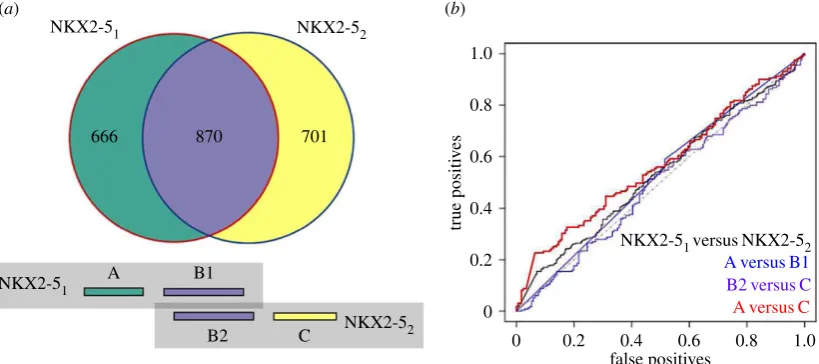
com-plete overlap in GO terms. The differences may rather relate to the inclusion or exclusion of borderline motifs in the models. To explore this further, we built models to compare each experiment directly (in contrast to comparing each to a random set) and all combinations of A, B and C (figure 2a)
seeking features that might be unique to each experiment. Using the NKX2-51training set versus the NKX2-52training
set, a classification model generated only four motifs (of which three were de novo) and the model performed poorly when applied to the withheld test data (AUC of 0.534) (figure 2b). Similarly, for A versus B, B versus C and A versus C, small models were generated (1, 1 and 6 motifs, respectively) with poor AUC performance (0.516, 0.569 and 0.508, respect-ively). The motifs present in the A versus C model were also present in the NKX2-51 versus NKX2-52 model (electronic
supplementary material, figure S1). These results demonstrate that both NKX2-5 experiments, including their unique peaks, consistently captured peaks with similar TF binding site composition. Notably, the A and C peak sets showed similar features and are not artefacts (see Discussion).
2.3. Prediction of NKX2-5 protein : protein interactions
Our aim to experimentally detect and validate novel PPIs requires that we predict the smallest number of high-confidence targets for experimental follow-up. Because the lasso algorithm selects features by shrinking less relevant coefficients to zero through application of a l penalty (via L-1 regularization; the shrinkage parameter), we investigated the model characteristics further. Removing de novo motifs (i.e. using only previously described motifs) and refitting a model for NKX2-51reduced the model size from 71 to 51fea-tures (reduction of model size to approx. 72%) while only reducing classification performance by approximately 1% (AUC of 0.779). Considering this marginal loss of perform-ance and the potential difficulty in associating de novo sequences to their cognate TFs, we continued to investigate the model based on previously described motifs. In addition, noting that the number of motifs included in the NKX2-52
model was much larger than that for NKX2-51 (112 versus
51), investigation of the l curves revealed two differently shaped curves that resulted in a sparser model for NKX2-51
(smaller number of features before reaching the 1 s.e. point of model selection) compared with NKX2-52 (electronic
supplementary material, figure S2). NKX2-52
NKX2-52 NKX2-51
NKX2-51versus NKX2-52
A versus B1
B2 versus C A versus C
NKX2-51
666 870 701
A B1
B2 C
1.0
0.8
0.6
0.4
true positi
v
es
0.2
0
1.0 0.8 0.6 false positives
0.4 0.2 0
[image:4.595.94.504.43.225.2](a) (b)
Figure 2.
Classification accuracy of unique and common genomic regions from repeated experiments. (
a
) Peak overlaps of NKX2-5
1and NKX2-5
2. Coloured boxes
beneath match the venn diagram colours and represent the A, B1, B2 and C defined peaks, where A are unique peaks to NKX2-51, B1 are the NKX2-51
peaks that
overlapped with NKX2-52
peaks (vice versa for B2) and C are unique peaks to NKX2-52. (
b
) ROC curves illustrating test set performance of models generated from
direct comparison of NKX2-5 experiments as well as overlapping and non-overlapping genomic coordinates.
rsob.r
oy
alsocietypublishing.org
Open
Biol.
6
:
160183
We therefore developed a ‘knowledge-based’ lasso method to reduce model size further, assessing the concordance of the models derived from replicate experiments. We hypothesized that the smallest predictive model for NKX2-5 would include NKX2-5 itself—the knowledge. We therefore continued to compress the lasso model until the point just before the known high-affinity NKX2-5 motif (‘NKX2-5 (M00240, Trans-fac)’; NKE) [31] was lost from our model (lof approx. 0.071; electronic supplementary material, figure S2a). This resulted in a model with 25 features for NKX2-51(including a cluster
of four motifs for other NK2-class homeodomain family mem-bers NKX2.2, 2.4 and 3.2, possibly representing alternative forms of the NKX2-5 TFBS), halving the model size and decreasing test AUC performance by only 0.020 (AUC 0.759). Similar results were achieved for the NKX2-52 experiment
versus random (lof approx. 0.078; electronic supplementary material, figure S2b), where 18 of 20 features overlapped with
the 25 features from the NKX2-51 knowledge-based model
(figure 3a,b). Notably, our knowledge-based model was no longer biased towards experimental origin, although overlap bias remained—that is, peaks common to NKX2-51 and
NKX2-52(represented as B1/B2 set; figure 2a) were predicted
correctly more often: A (67.3%), B1 (75.1%), B2 (75.2%) and C (67.7%). This suggests that the knowledge-based approach was superior in eliminating model origin bias, consistent with results from fitting models directly against each other.
Many of the motifs included in this knowledge-based model were known NKX2-5 protein–protein interactors [16,33], speaking to the validity of the proposed approach. Motifs for known NKX2-5 PPIs common to both models included T-Box 5 (TBX5) [26], heart and neural crest derivatives expressed (HAND; MA0092.1), SP-1/ETS TFs (MA0081.1), and nuclear factor I (NF-I; MA0161.1 and M00193) [16]. NKX2-51but not NKX2-52features included known NKX2-5
AP-1 (M00199) AP-1 (M00199) AP-1 (M00517) AP-1 (M00517) NR4A2 (MA0122.1) NR4A2 (MA0122.1) RXRA (MA0512.1) RXRA (MA0512.1) TBX5 (Mori et al.)
TBX5 (Mori et al.) AP-4 (M00175) AP-4 (M00175) MYOD (M00184) MYOD (M00184) NKX2-2 (PH0111.1) NKX2-2 (PH0111.1) NKX2-4 (PH0113.1) NKX2-4 (PH0113.1) NKX2-5 (MA00240) NKX2-5 (MA00240) NKX3-2 (MA0122.1) NKX3-2 (PH0004.1) PRRX2 (MA0075) GATA1 (MA0035.2) p53 (M00272) AP-2a (M00469) MZF1 (MA0056.1) ZNF354C (MA0130.1) NKX3-2 (MA0122.1) NKX3-2 (PH0004.1) PRRX2 (MA0075) GATA1 (MA0035.2) p53 (M00272) AP-2a (M00469) MZF1 (MA0056.1) ZNF354C (MA0130.1) SPIB (MA0081.1) SPIB (MA0081.1) HAND1/TCFE2A (MA0092.1) LYF1 (M00141) STAT4 (MA0518.1) NF-1 (M00193) NF-1C (MA0161.1) NF-1C (MA0161.1) AREB6 (M00415) FOX04 (M00472) SRF- secondary (BADIS09)
RXRA (MA0512.1) TBX5 (Mori et al. ) AP-4 (M00175) MY OD (M00184) NKX2-2 (PH0111.1) NKX2-4 (PH0113.1)
NKX2-5 (MA00240) NKX3-2 (MA0122.1)
PRRX2 (MA0075)
MZF1 (MA0056.1)
ZNF354C (MA0130.1)
SPIB (MA0081.1) L
Y
F1 (M00141)
NF-1 (M00193)
NF-1C (MA0161.1)
AREB6 (M00415)
SRF- secondary (B
ADIS09)
RXRA (MA0512.1) TBX5 (Mori et al.) AP-4 (M00175) MYOD (M00184) NKX2-2 (PH0111.1) NKX2-4 (PH0113.1) NKX2-5 (MA00240) NKX3-2 (MA0122.1) PRRX2 (MA0075)
% of peaks not co-occurring with NKX2-5
proportion
0.2 0.4 0.6
MZF1 (MA0056.1) ZNF354C (MA0130.1) SPIB (MA0081.1) HAND1/TCFE2A (MA0092.1) LYF1 (M00141) NF-1 (M00193) NF-1C (MA0161.1) AREB6 (M00415)
SRF- secondary (BADIS09)
RXRA (MA0512.1) TBX5 (Mori
et al.
)
AP-4 (M00175)
MY
OD (M00184)
NKX2-2 (PH0111.1) NKX2-4 (PH0113.1) NKX2-5 (MA00240) NKX3-2 (MA0122.1) PRRX2 (MA0075) MZF1 (MA0056.1)
ZNF354C (MA0130.1) SPIB (MA0081.1) HAND1/TCFE2A (MA0092.1) HAND1/TCFE2A (MA0092.1) L YF1 (M00141) NF-1 (M00193)
NF-1C (MA0161.1) AREB6 (M00415)
SRF- secondary (B
[image:5.595.66.536.43.506.2]ADIS09) HAND1 TCFE2A (MA0092.1) LYF1 (M00141) STAT4 (MA0518.1) NF-1 (M00193) AREB6 (M00415) FOX04 (M00472) SRF secondary (BADIS09) NKX2-5 1 NKX2-5 2 0.3 0.2 0.1 0 (a) (b) (c) (d)
Figure 3.
Knowledge-based model features. (
a
) Motifs remaining in NKX2-5
1and NKX2-5
2models after knowledge-based lasso modelling; green indicates present
as a feature, black not present. Hierarchical clustering was performed in STAMP [32] using default parameters, except trimming was disabled. (
b
) Motifs of the
knowledge-based models. (
c
) Co-occurrence matrix of motifs in common between NKX2-5
1and NKX2-5
2. Scale 0 – 1 indicates proportion of total peaks in NKX2-5
1data that contained both motifs. (
d
) Proportion of peaks with a positive match for the motif of interest that did not co-occur with NKX2-5; NKX2-5 is therefore zero.
Red boxes are to highlight the high-affinity NKX2-5 motif.
interactors—the GATA binding protein (GATA1; MA0035.2) and tumour suppressor protein p53 (p53; M00272) [34,35]. Potentially novel NKX2-5 PPIs included myeloid zinc finger 1 (MZF1;MA0056.1), MYOD myogenic differentiation factor (MyoD;M00184), jun proto-oncogene (JUN/AP-1; M00199), TF AP-2/AP-4 (AP2/4; M00469, M00175), retinoid X receptor
a(RXRa; MA0512.1), IKAROS family zinc finger 1 (IKZF1/ LYF-1; M00141), zinc finger E-box binding homeobox 1 (ZEB1, also called AREB6; M00415) and paired-related homeobox 2 (PRRX2; MA0075.1).
Our knowledge-based models allow the possibility that WT NKX2-5 binding to DNA can be mediated by indirect as well as direct tethering to chromatin, as demonstrated for NKX2-5 mutant proteins [16], and thereby are potentially predictive of novel NKX2-5 PPIs that mediate indirect bind-ing. We would expect, therefore, that a proportion of detected motifs would not co-occur with the NKX2-5 motif (NKE) in peaks. We assessed motifs common to both exper-iments and their frequency in NKX2-51 peaks (figure 3c).
Note that in figure 3c the proportions along the diagonal can be less than one, as this indicates prevalence of the TFBS among all peaks detected. With the exception of TBX5, which was present in a high proportion of NKX2-5 peaks, this analysis did not reveal a strong co-occurrence of NKX2-5 with the other TF binding sites detected. Subtracting NKX2-5 motif frequency from the frequency of other motifs detected revealed that, for each predicted motif, approxi-mately 8–29% of peaks containing these motifs did not co-occur with the high-affinity NKX2-5 motif (figure 3d). These results support the hypothesis that NKX2-5 can bind to a subset of targets indirectly via PPIs.
The high co-occurrence of TBX5 motifs and the majority of other discriminators may have biological relevance [36], although may also reflect a relatively low information content of the TBX5 PWM.
2.4. Testing novel NKX2-5 protein – protein interactions
Identification of motifs in our lasso models that occur fre-quently in the absence of the high-affinity NKX2-5 TFBS suggests that TFs binding to these motifs might associate with NKX2-5 via PPIs to either recruit NKX2-5 specifically to these sites or interact on enhancers as part of higher order protein complexes. Searching PPI databases IntAct [37], HPRD [38], STRING [39] and BioGRID [40] for the term ‘NKX2-5’ revealed a small network of 31 known inter-actions (electronic supplementary material, figure S3 and table S1), from which we identified GATA4, SRF, TBX5 and HAND1 in our lasso models. Our model outputs suggest that there are many other possible NKX2-5 PPIs relevant to the cardiac GRN. Previous work focusing on the broadly expressed signal-gated ETS family TFs, ELK1 and ELK4, which are directly interacting cofactors of NKX2-5, showed that these were highly integrated in the cardiac GRN with many cross-regulatory interactions [16].2.5. Testing novel PPIs
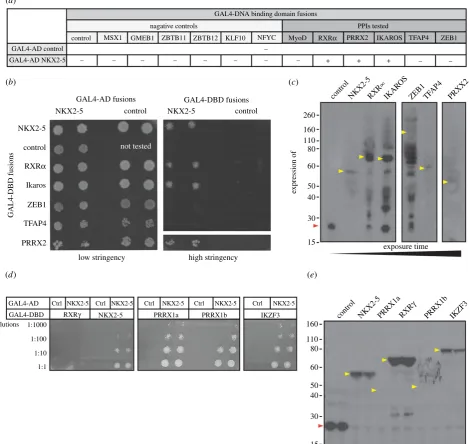
To test whether unexpected motifs predicted in NKX2-5 targets correlate with novel NKX2-5 protein–protein interactors, we used the Y2H assay [16]. We fused NKX2-5 to the GAL4-activation domain (GAL4-AD) and its potential protein interactors to the GAL4 DNA-binding domain (GAL4-DBD).
We initially tested six predicted and potentially novel PPIs from the knowledge-based model (RXRa, PRRX2, IKZF1, TFAP4, MyoD and ZEB1) and compared results to a set of TFs derived from randomly selected PWMs from the 1132 motifs used in this study (msh homeobox MSX1; glucocorti-coid modulatory element binding protein 1 GMEB1; zinc finger and BTB domain containing 11 and 12 ZBTB11/12; Kruppel-like factor 10 KLF10; and nuclear TF Y-gNFYC). We also included control vectors for expression of the GAL4-DBD and -AD alone. Using the Y2H assay under selective conditions, we confirmed that NKX2-5 fused to GAL4-AD bound specifically to GAL4-DBD fusions containing NKX2-5 itself, RXRa, PRRX2 or IKZF1/LYF, but not TFAP4/AP-4, ZEB1, MyoD or to any of the negative controls (figure 4a,b; elec-tronic supplementary material, figure S4a). GAL4-DBD fusion expression was assessed by western blot using an antibody specific to the c-MYC tag present in the DBD fusions, which con-firmed that RXRa, PRRX2, IKZF1 and TFAP4, as well as all negative controls tested, were expressed at the expected molecu-lar weight (MW) in yeast (figure 4c; electronic supplementary material, figure S4b). ZEB1, however, showed little if any full-length protein and several degradation products, possibly due to its larger size (approx. 144 kDa). We therefore sub-cloned five overlapping sub-fragments of ZEB1/AREB6 spanning the whole protein (electronic supplementary material, figure S4c). Although expressed at the expected MWs, the N- and C-terminal ZEB1/AREB6 fragments, which contain the Zinc-finger clusters, failed to interact with NKX2-5 (electronic supplementary material, figure S4c,d). When fused to the GAL4-DBD, all the fragments encompassing the ZEB1 homeo-domain resulted in background yeast growth, even when expressed with GAL4-AD alone. Therefore, PPIs between NKX2-5 and fragments containing the ZEB1 homeodomain could not be assessed properly in this system. Our results validated direct PPIs for three of the six TFs newly predicted from the knowledge-based model to bind to NKX2-5 targets, expanding the known NKX2-5 PPI network by 10% in this small validation screen. When considering previously known NKX2-5 PPIs also present in the model, we estimate that our predictive performance is in the range of approximately 60% (when including those untested as negative) to 80% (when not considering those untested).
2.6. Testing paralogues of novel NKX2-5 PPIs
Paralogous TFs are often reported to bind the same TFBS [41]. We therefore hypothesized that the motifs predicted by our model could represent binding of paralogous TFs for which no PWM was currently available, and so we extended our NKX2-5 PPI screen to paralogues of RXRa, PRRX2 and IKZF1. We found that NKX2-5 fused to GAL4-AD interacted with GAL4-DBD fusions containing transcript variants PRRX1a and PRRX1b, which are overall approximately 60% identical and paralogous to PRRX2 (figure 4d,e). Further-more, IKZF3 (also known as Aiolos; figure 4d,e) and IKZF5 (also known as Pegasus; electronic supplementary material, figure S4e), which are overall 55% and 22% identical, respect-ively, to IKZF1, could also bind NKX2-5. These interactions are likely to occur through the first zinc-finger of the C-term-inal dimerization domain (electronic supplementary material, figure S4e). However, while NKX2-5 interacted with RXRa, it did not interact with its paralogue RXRg, which is overall 60% identical to RXRa.
rsob.r
oy
alsocietypublishing.org
Open
Biol.
6
:
160183
2.7. Disease relevance of novel NKX2-5 PPIs
Having identified novel PPIs, we next determined whether known CHD-causing mutations in NKX2-5 demonstrated impaired or altered binding to these PPIs. Mice lacking RXRa
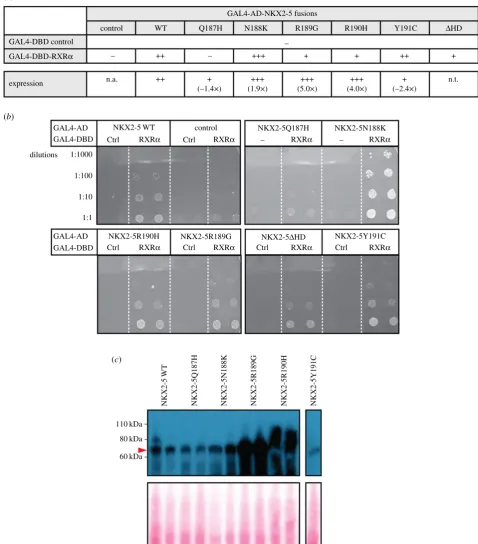
display a large spectrum of severe cardiac defects, including abnormal septation, ventricular phenotypes resulting from lack of expansion of the compact zone of myocardium and dys-regulated trabecular morphogenesis [42], and these overlap with defects seen in NKX2-5 heterozygous and hypomorphic models [43–45]. We therefore tested a panel of five NKX2-5 point mutations in the homeodomain associated with heart disease: Q187H, N188 K, R189G, R190H and Y191C [46–48]. Three of the five mutants (Q187H, R189G and R190H) demon-strated a decreased interaction with RXRa when compared with NKX2-5 WT (figure 5a,b). For Q187H, this could be
attributed to the lower expression observed in yeast as determined by western blotting (figure 5a,c). However, for R189G and R190H, expression in yeast was higher compared with that of WT, indicative of a true impairment of the PPI. Sur-prisingly, N188K interacted more strongly with RXRa than NKX2-5 WT, possibly because it showed increased expression or stability (figure 5a,c). These results suggest that the novel NKX2-5 PPI with RXRa identified here is critical for normal heart development and is disrupted in CHD caused by NKX2-5 homeodomain mutations.
3. Discussion
The ability to accurately predict DNA targets and interacting cofactors of transcriptional regulators from genome-wide
160
control Ctrl
GAL4-AD GAL4-DBD
Ctrl Ctrl Ctrl Ctrl
NKX2-5 NKX2-5
NKX2-5 NKX2-5 NKX2-5 NKX2-5 NKX2-5
PRRX1a
PRRX1a RXR
g
RXRg PRRX1b IKZF3 PRRX1b IKZF3
control
control
NKX2-5
NKX2-5
NKX2-5
NKX2-5 control control
not tested GAL4-AD fusions
GAL4-AD control
control MSX1 GMEB1
– – – – – – – – + + + – –
–
ZBTB11 ZBTB12 KLF10 NFYC MyoD RXRa PRRX2 IKAROS PPIs tested nagative controls
GAL4-DNA binding domain fusions
TFAP4 ZEB1
GAL4-AD NKX2-5
GAL4-DBD fusions
GAL4-DBD fusions ZEB1
ZEB1
TFAP4
TFAP4 RXR
µ
PRRX2 RXRa
Ikaros
IKAR OS
PRXX2
110 80
60
50 40
30
15 160 260
110 80
60
50 40
30
exposure time high stringency
low stringency
expression of
15
dilutions 1:1000
1:100
1:10
1:1 (a)
(b)
(d) (e)
[image:7.595.65.536.47.491.2](c)
Figure 4.
Validation of predicted PPIs by yeast-2-hybrid assay (Y2H). (
a
) Yeast transformed with the GAL4-activation domain (AD) alone, control, or fused to NKX2-5
and the GAL4-DNA-binding domain (DBD) alone (control) or fused to potential NKX2-5 protein interactors. Positive signs (þ) show interaction as growth on selective
medium (high stringency, -Leu/-Trp/-Ade/-His). (
b
) Representative picture of PPIs tested. Transformants were grown on non-selective (low stringency, -Leu/-Trp)
before two clones were picked onto plates containing low or high stringency medium. (
c
) Detection of GAL4-DBD-Myc fusions by western blotting with anti-Myc
antibodies. (
d
) Representative picture of PPIs tested with paralogues of novel NKX2-5 PPIs fused to the GAL4-DBD and grown on plates containing selective medium
at four dilutions. (
e
) Detection of GAL4-DBD-Myc fusions by western blotting with anti-Myc antibodies. Coloured arrowheads indicate the expected molecular weight
of control (red) or potential interactors (yellow).
rsob.r
oy
alsocietypublishing.org
Open
Biol.
6
:
160183
data can significantly advance our understanding of GRNs and processes underlying disease. Here, we sought to determine if DNA regions detected as bound by NKX2-5, a TF essential for heart development, could be used to predict novel NKX2-5 protein interactors. We then syste-matically tested novel candidate PPIs and their paralogues for binding to NKX2-5, and, in the case of RXRa, for binding to NKX2-5 mutants using the yeast two-hybrid assay.
Exploiting NKX2-5 DNA-binding experiments that were repeated 2 years apart [16], we first investigated reproducibi-lity by applying machine-learning algorithms to explore TFBS patterns in each experiment. This led to the develop-ment of a knowledge-based method for variable selection (i.e. model shrinkage), based on our assumption that a minimal model should contain NKX2-5 itself. Our knowledge-based method significantly improved model concordance between 110 kDa
NKX2-5
WT
NKX2-5Q187H
NKX2-5Q187H
NKX2-5N188K
NKX2-5N188K
NKX2-5R189G
NKX2-5R189G
NKX2-5R190H
NKX2-5R190H NKX2-5 WT
GAL4-AD GAL4-AD
dilutions 1:1000
1:100
1:10
1:1
GAL4-DBD GAL4-DBD GAL4-DBD control
GAL4-AD-NKX2-5 fusions
GAL4-DBD-RXRa
expression
Ctrl Ctrl
Ctrl Ctrl Ctrl
RXRa
RXRa Ctrl RXRa control
control WT Q187H N188K R189G R190H Y191C DHD
–
–
n.a.
– ++
++
+++ +
+ (–1.4×)
+++ (1.9×)
+++ (5.0×)
+++ (4.0×)
+ ++ +
+ (–2.4×)
n.t.
RXRa RXRa
RXRa
– – RXRa
RXRa
NKX2-5Y191C
NKX2-5Y191C NKX2-5DHD
80 kDa
60 kDa (a)
(b)
[image:8.595.56.535.51.596.2](c)
Figure 5.
Testing PPIs between RXR
a
and NKX2-5 wild type (WT) or mutant yeast two-hybrid assay (Y2H). (
a
) Yeast transformed with the GAL4-activation domain
(AD) alone (control) or fused to NKX2-5 proteins and the GAL4-DNA-binding domain (DBD) alone (control) or fused to RXR
a
. Positive signs (þ) show interaction as
growth on selective medium (high stringency, -Leu/-Trp/-Ade/-His). (
b
) Representative pictures of PPIs tested. Transformants were grown on non-selective (low
stringency, -Leu/-Trp) before two clones were picked onto plates containing high-stringency medium. (
c
) Detection of two clones expressing GAL4-DBD-Myc fusions
by western blotting with anti-Myc antibodies. The red arrowhead indicates the expected molecular weight of NKX2-5 proteins. The expression was quantified using
I
MAGEJ and the fold change relative to NKX2-5 WT is indicated in (
a
) (n.t., not tested).
rsob.r
oy
alsocietypublishing.org
Open
Biol.
6
:
160183
the repeat experiments. Models generated for each experiment correctly predicted bound regions of the other experiment with up to 80% accuracy compared with randomly selected peaks, far greater than the approximately 55% overlap of genomic coordinates (figure 2a). Concordance of our knowledge-based models from each experiment (figure 3a) reflected an underlying consistency of motif grammar, consistent with our previous finding of identical enriched GO terms between NKX2-51 and NKX2-52 target gene sets [22]. This suggests
that each repeated experiment captures a unique subset of NKX2-5 binding sites that nonetheless have similar underly-ing motif composition. It is plausible that cells could have been exposed to slightly different environments (e.g. culture serum batch), representing a cell non-autonomous influence, albeit one that does not alter the binding logic of NKX2-5 or instigate global changes in GO terms of targeted genes. It has been proposed that alternative states exist within GRNs that contribute to robustness [49]. Typically, this concept has been used to explain variability inherent in signal transduction cir-cuits [50], gene or protein expression variability [51] and, conversely, constraints or non-robustness that lead to disease [52]. Lack of complete overlap from our repeated DNA-binding experiments, but with an underlying concordance of GO and motif grammar, indicates that we need to consider whether variation between different DNA-binding experi-ments or platforms indeed reflects noise or alternatively different biologically relevant GRN ‘states’. These findings shed light on the topical issue of the poor reproducibility of DNA-binding experiments, typically assessed through simple overlap metrics [53,54].
Our knowledge-based models identified a number of pre-viously described NKX2-5 PPIs (GATA, HAND and TBX factor families) as being important features, supporting our hypothesis that these data could be used to predict novel NKX2-5 protein interactors. However, the majority of our pre-dictions had not been previously described to interact with NKX2-5. We went on to test these predictions using the Y2H assay and validated 50% of the tested TFs as true NKX2-5 protein interactors: RXRa, PRRX2 and IKZF1/LYF-1. Of the PPIs that did not validate (TFAP4/AP-4, ZEB1 and MyoD), we found that this could be explained by motif redundancy. For example, the ZEB1/AREB6 motif is the reverse comp-lement of that for FOXO4 (M00472) (figure 3a,b). FOXH1, a FOXO4 paralogue, has been previously described to interact with NKX2-5 [55]. MyoD could not be tested using the Y2H system, having a large amount of non-specific activity in the controls (data not shown). However, the MyoD and TFAP4 motifs clustered together and represent the canonical E-Box ‘CANNTG’ recognized by basic-helix–loop–helix (bHLH) proteins (figure 3a,b). It is possible that other bHLH TFs, such as HAND proteins, bind to the detected motif and interact with NKX2-5 through PPIs, as shown previously for HAND2 [56]. For confirmed novel PPIs, we also tested their paralogues, which we hypothesized could share the same motif. PRRX1a and PRRX1b, paralogues of PRRX2, as well as IKZF3 and IKZF5, paralogues of IKZF1, were confirmed as NKX2-5 inter-actors. However, we did not validate RXRg, a paralogue of RXRa, suggesting that overall homology or the presence of PPI domains within paralogues is not necessarily a predictor of binding. This is consistent with previous findings that NKX2-5 could interact with NF1-B1 and NF1-B3 but not para-logous factors NF1-A or NF1-X [16]. The evolutionary significance of these PPIs in the context of NKX2-5 cardiac
developmental biology and the conservation of their predicted genomic sites of interaction would benefit from further study. Of the novel NKX2-5 PPIs predicted and validated, the homeodomain protein PRRX2 and retinoic acid receptor RXRaare expressed in the heart and play a role in heart devel-opment [42,57]. IKZF1 has not been associated with cardiac development and is better known for its role in haematopoietic differentiation, tumour suppression and chromatin regulation [58–60]. However, in the developing embryo, heart and haemoangiogenic progenitor territories have close physical relationships and share network regulators, which can act sup-portively as well as antagonistically to define territory boundaries [61–65]. Thus, it is conceivable that NKX2-5 and IKZF1 interact in the establishment and/or maintenance of these lineages, although further work is required to examine this. Both RXRaand IKAROS (LYF-1) are novel NKX2-5 PPIs that contain zinc-finger domains. NKX2-5 has been demon-strated to interact with other zinc-finger domain proteins, such as GATA4 [34], ZAC1/PLAGL1 [66] and CAL/FBLIM1 [67]. However, as observed in our Y2H assays, zinc-finger pro-teins ZBTB11/12 and KLF10 did not interact, so binding to zinc-finger domain proteins is not a generic feature of NKX2-5. Perturbation of vitamin A (retinol) levels has long been known to affect mammalian embryo development, with the heart being the most sensitive organ [68,69]. Retinoic acid (RA), a derivative of vitamin A, is an essential signalling mol-ecule that controls many aspects of embryo development by binding to RA receptors (RAR) and Retinoid X receptors (RXR). Changes in RA concentrations in retinal dehydrogenase (Raldh2)-deficient embryos leads to severe cardiac abnormal-ities [70], and removal ofNkx2-5inRaldh22/2
mice rescues some of these defects [71], suggesting genetic cross-talk between the RA and NKX2-5 pathways. Mice lacking RXRa
in the germline or conditionally in epicardium [72] display a spectrum of cardiac defects arising from lack of expansion of the myocardial compact zone and dysregulated trabecular morphogenesis [42]. Defects in mice lackingRxraandRaldh2
overlap with those reported in Nkx2-5 heterozygous and hypomorphic mice, raising the possibility that physical inter-action between NKX2-5 and RXRa at early stages of heart development could be important for orchestrating normal morphogenesis. Disruption ofRXRawas recently associated with the cardiac malformation tetralogy of Fallot [73], pre-viously associated with mutations in NKX2-5 [46,74]. We tested interactions between RXRa and five disease-causing NKX2-5 homeodomain mutants [46–48], observing a weaker interaction between RXRaand three of these (Q187H, R189G and R190H; figure 5). This work shows that NKX2-5 homeo-domain mutations causative for CHD may critically intersect with RXRapathways governing heart morphogenesis. Future studies assessing the role of these novel NKX2-5 protein interactions during normal development, evolution and in the context of disease models will further allude to their functional significance.
4. Conclusion
Using a knowledge-based machine-learning approach, we identified and validated a number of novel NKX2-5 protein interactors, RXRa, PRRX2 and IKZF1/LYF-1, and their para-logues PRRX1a, PRRX1b (two isoforms of PRRX1), and IKZF3 and IKZF5. Furthermore, we have established a
rsob.r
oy
alsocietypublishing.org
Open
Biol.
6
:
160183
potential CHD mechanism, whereby chamber and septal defects seen in patients carrying heterozygous NKX2-5 home-odomain mutations may in part be due to disrupted PPIs between NKX2-5 and RXRa. As far as we are aware, this is the first study to systematically validate predicted PPIs of TFs from DNA sequence alone.
Our study brings to light some key considerations. Com-paring replicated experiments using a model-based approach supported our previous findings of conserved gene ontologies and indicated that motif grammar of NKX2-5 binding was conserved in repeated experiments. Thus, variation of binding sites identified between repeated experiments is not simply noise. In the light of NKX2-5 being a highly studied and criti-cal TF for heart development, we identified and validated novel NKX2-5 PPIs from genome-wide DNA-binding data, demonstrating the utility of machine-learning approaches for systematic detection of TF binding partners. We propose that these interactions represent but a small proportion of the com-plex NKX2-5 PPI landscape that is difficult to probe using traditional methods. Identifying novel TF-TF PPIs has the potential to shed light on the complex gene regulatory pro-cesses underlying normal development and, as we observed for RXRa, provide new insights into disease processes.
5. Material and methods
Bioinformatics analyses were performed in R v. 3.1.2 (www. r-project.org) [75] using Bioconductor [76] packages unless stated otherwise.
5.1. Datasets
BED files corresponding to the mm9 coordinates of N-terminal NKX2-5 DamID peaks were downloaded from NCBI GEO Accession, GSE44902 [16]. We name repeated experiments, NKX2-51[GSE44902, GSM1093634] and NKX2-52[GSE44902,
GSM1328466]. A random dataset was generated of the same set size and length distribution as NKX2-5 peaks using the per-mutation strategy implemented in bedtools [77] and sampling constrained to promoter regions represented on the micro-array. Data were randomly partitioned for each NKX2-5 and random dataset into 75% for training and 25% for testing.
5.2. Motif detection and counting for generating
feature matrices
DREME [23] was used for de novo motif discovery using only training sets. All motifs discovered according to default settings were reported. As DREME uses a one-way Fisher’s exact test, we performed pairwise comparisons for NKX2-51, NKX2-52and random peaks.
For generating motif feature matrices, we first add the PWMs of the de novo motifs discovered using DREME to a motif (PWM) library derived from Transfac and Jaspar public repositories, in addition to motifs from literature as previously described [16]; n(motifs)¼1132, bringing the total number of motifs used for analysis to 1202. All motifs are provided in electronic supplementary material, file S2.
CLOVER [27] was used to score PWM matches and each peak normalized to motif per kilobase to account for differ-ences in motif numbers and length. A motif instance was recorded if it had at least the default minimum CLOVER
score of 6. Formatting of data into feature matrices for input into R was performed using custom Perl scripts. Fea-ture matrices, Mnp, used for classification were comprised
ofnpeaksbypmotifs/kb.
5.3. Machine-learning algorithms and performance
assessment
For generating lasso models, we used the ‘glmnet’ R library (v. 1.9) [78]. The lasso selects features by shrinking less relevant coefficients to zero through application of alpenalty (via L-1 regularization; the shrinkage parameter). Ten-fold cross-validation was used to determine the value ofl and unless stated otherwise we used thelwithin 1 s.e. of the maximum AUC. For SVM models, we used the ‘e1071’ R library (v. 1.6) [79] and the linear kernel function. The penalization parameter,
C, was tuned using 10-fold cross-validation and a grid search space of 1025to 1 (identifying a C of 1024for models with
and 1023 without de novo motifs). For random forests, we
used the ‘randomForest’ R library (v. 4.6) [80] with default par-ameters. For generating receiver operator characteristic (ROC) curves and calculating AUC, we used the ROCR package (v. 1.0) [81]. Sensitivity and specificity analysis considered the proportion of correctly classified true positive and true negative peaks as per equations (5.1) and (5.2):
sensitivity¼ true positive
true positiveþfalse negative ð5:1Þ
specificity¼ true negative
false positiveþtrue negative ð5:2Þ
The positive predictive value (PPV) was calculated as follows:
positive predictive value¼ true positives true positivesþfalse positives
ð5:3Þ
The false discovery rate (FDR) of predictions was calculated as follows:
false discovery rate¼ P false positives
predicted positives ð5:4Þ
5.4. Yeast two-hybrid assay
Sequences coding for murine TFs MSX1, GMEB1, ZBTB11/12, KLF10 and NFYC were amplified from HL-1 cell cDNA. CMV AP-4 was a gift from Robert Tjian (Addgene plasmid # 12101) [82]; pLuc-CDS was a gift from Kumiko UiTei (Addgene plasmid # 42100) [83]; pBABE puro human RXRawas a gift from Ronald Kahn (Addgene plasmid # 11441); PRRX2-pSG5 was a gift from Corey Largman (Addgene plasmid #21009) [84]. A coding sequence was obtained from Origene for IKZF1 (MR227509), IKZF3 (MR227380), PRRX1a (RC213276), PRRX1b (RC210393) and RXRg (MR225349). The vectors NpGBT9-AiolosF5-6 (M1-1 B9), NpGBT9-Eos-364-400 (M1-1 E9), pGBT9-Eos364-518 (M1-1 H6), pGBT9-Eos358-532 (M1-1 H8), NpGBT9-Pegasus (M1-1 I3), NpGBT9-Pegasus221-420 (M1-2 A1) and NpGBT9-PegasusF4-5 (M1-2 A2) were a gift from Merlin Crossley [85].
All sequences were cloned into pGADT7 AD or pGBKT7 DBD expression vector backbones (Clontech), which were modified to contain a Gateway cloning cassette (gift from
rsob.r
oy
alsocietypublishing.org
Open
Biol.
6
:
160183
Jacqueline Stoeckli). pGADT7-AD and pGBKT7-DBD fusions were co-transformed into chemically competentS. cerevisiae
strain AH109 (Clontech). Double transformants were selected for growth on ‘low stringency’ -Leu/-Trp selection plates, before being selected for interaction on ‘high stringency’ -Ade/-His/-Leu/-Trp selection plates.
The monoclonal antibody 9E10 developed by Michael J. Bishop was obtained from the Developmental Studies Hybridoma Bank, created by the NICHD of the NIH and main-tained at the Department of Biology, University of Iowa, Iowa City, IA 52242, USA.
5.5. Western blots
For protein extraction and western blotting, yeast colonies selected on ‘low stringency’ (-Leu/-Trp) plates were grown in 1.5 ml of liquid ‘low stringency’ medium at 308C for 48 hours under agitation. Cultures were then transferred directly to 10 ml of fresh yeast extract protein peptone dex-trose (YEPD) medium and further grown at 308C for 4– 6 hours under agitation until the OD600 reached 0.4–1.0.
Protein extraction was then performed following the post-alkaline extraction method [86]. In accordance with this method, cultures were pelleted and resuspended in 100ml of distilled water per 2.5 OD600. Then, 100ml of 0.2 M
NaOH was added per 2.5 OD600 and suspensions were
incubated at room temperature for 5 minutes. After centrifugation, yeast cells were lysed in 50ml of SDS sample buffer (0.06 M Tris-HCl, pH 6.8; 5% glycerol; 2% SDS; 4%
b-mercaptoethanol; 0.0025% bromophenol blue) per 2.5 OD600 and boiled for 2 minutes. 20mL of lysed samples
were loaded on NuPage 10% bis-tris gels (Invitrogen).
To detect GAL4-activation (AD)-HA fusion proteins, a rabbit anti-HA antibody was obtained from Cell Signalling (C29F4). To detect the GAL4-DNA-binding domain (DBD)-c-Myc protein fusions, the monoclonal antibody 9E10 devel-oped by Michael J. Bishop was obtained from the Developmental Studies Hybridoma Bank, created by the NICHD of the NIH and maintained at The University of Iowa, Department of Biology, Iowa City, IA 52242. After chemiluminescent detection, membranes were stained using a Ponceau S solution to visualize the total protein levels in each lane and control for equal loading. IMAGEJ (Rasband, W.S., US National Institutes of Health, Bethesda, Maryland, USA, http://imagej.nih.gov/ij, 1997– 2016) was used to quantify protein expression detected by western blotting.
Data accessibility. Datasets are available at NCBI GEO: GSE44902
(GSM1093634) and GSE44902 (GSM1328466) and supporting data have been uploaded as part of the electronic supplementary material.
Authors’ contributions.A.J.W. conceived the project and carried out
statisti-cal and bioinformatics analyses. B.H., S.M. and R.B. generated constructs and performed Y2H assays. A.J.W., R.B. and R.P.H. wrote the manuscript and interpreted results. All authors read and approved the final manuscript.
Competing interests.We have no competing interests.
Funding.This work was funded by grants from the National Health and
Medical Research Council, Australia (NHMRC: 573703, 1061539). R.P.H. held an NHMRC Australia Fellowship (573705); R.B. held a University of New South Wales Vice Chancellor’s Research Fellowship and an Australian Research Council Australian Postdoctoral Fellowship (DP0988507).
Acknowledgements. The authors thank Dr Gavin Chapman and Sam
Bassett for their contributions and Prof. Merlin Crossley for vectors.
References
1. Davidson EH, Erwin DH. 2006 Gene regulatory networks and the evolution of animal body plans. Science311, 796 – 800. (doi:10.1126/science. 1113832)
2. Waardenberg AJ, Ramialison M, Bouveret R, Harvey RP. 2014 Genetic networks governing heart development.Cold Spring Harb. Perspect. Med.4, a013839. (doi:10.1101/cshperspect.a013839) 3. Barolo S, Posakony JW. 2002 Three habits of highly
effective signaling pathways: principles of transcriptional control by developmental cell signaling.Genes Dev.16, 1167 – 1181. (doi:10. 1101/gad.976502)
4. Bolouri H, Davidson EH. 2003 Transcriptional regulatory cascades in development: initial rates, not steady state, determine network kinetics.Proc. Natl Acad. Sci. USA100, 9371 – 9376. (doi:10.1073/ pnas.1533293100)
5. Spitz F, Furlong EE. 2012 Transcription factors: from enhancer binding to developmental control.Nat. Rev. Genet.13, 613 – 626. (doi:10.1038/nrg3207) 6. Siggers T, Duyzend MH, Reddy J, Khan S, Bulyk ML.
2011 Non-binding cofactors enhance DNA-binding specificity of a transcriptional regulatory complex.Mol. Syst. Biol.7, 555. (doi:10.1038/msb. 2011.89)
7. Yu X, Lin J, Zack DJ, Qian J. 2006 Computational analysis of tissue-specific combinatorial gene regulation: predicting interaction between transcription factors in human tissues.Nucleic Acids Res.34, 4925 – 4936. (doi:10.1093/nar/gkl595) 8. Narlikar L, Sakabe NJ, Blanski AA, Arimura FE, Westlund JM, Nobrega MA, Ovcharenko I. 2010 Genome-wide discovery of human heart enhancers. Genome Res.20, 381 – 392. (doi:10.1101/gr. 098657.109)
9. Busser BW, Taher L, Kim Y, Tansey T, Bloom MJ, Ovcharenko I, Michelson AM. 2012 A machine learning approach for identifying novel cell type-specific transcriptional regulators of myogenesis. PLoS Genet.8, e1002531. (doi:10.1371/journal. pgen.1002531)
10. Ahmad SMet al.2014 Machine learning classification of cell-specific cardiac enhancers uncovers developmental subnetworks regulating progenitor cell division and cell fate specification.Development 141, 878 – 888. (doi:10.1242/dev.101709) 11. Jin H, Stojnic R, Adryan B, Ozdemir A, Stathopoulos
A, Frasch M. 2013 Genome-wide screens forin vivo Tinman binding sites identify cardiac enhancers with diverse functional architectures.PLoS Genet.9, e1003195. (doi:10.1371/journal.pgen.1003195)
12. Gordan R, Hartemink AJ, Bulyk ML. 2009 Distinguishing direct versus indirect transcription factor-DNA interactions.Genome Res.19, 2090 – 2100. (doi:10.1101/gr.094144.109) 13. Kassouf MT, Hughes JR, Taylor S, McGowan SJ,
Soneji S, Green AL, Vyas P, Porcher C. 2010 Genome-wide identification of TAL1’s functional targets: insights into its mechanisms of action in primary erythroid cells.Genome Res.20, 1064 – 1083. (doi:10.1101/gr.104935.110) 14. Lyons I, Parsons LM, Hartley L, Li R, Andrews JE,
Robb L, Harvey RP. 1995 Myogenic and morphogenetic defects in the heart tubes of murine embryos lacking the homeo box gene Nkx2-5.Genes Dev.9, 1654 – 1666. (doi:10.1101/ gad.9.13.1654)
15. Elliott DAet al.2003 Cardiac homeobox gene NKX2-5 mutations and congenital heart disease: associations with atrial septal defect and hypoplastic left heart syndrome.J. Am. Coll. Cardiol.41, 2072 – 2076. (doi:10.1016/S0735-1097(03)00420-0)
16. Bouveret Ret al.2015 NKX2-5 mutations causative for congenital heart disease retain functionality and are directed to hundreds of targets.Elife4, e06942. (doi:10.7554/eLife.06942)
rsob.r
oy
alsocietypublishing.org
Open
Biol.
6
:
160183
17. Claycomb WC, Lanson , NAJr, Stallworth BS, Egeland DB, Delcarpio JB, Bahinski A, Izzo NJJr. 1998 HL-1 cells: a cardiac muscle cell line that contracts and retains phenotypic characteristics of the adult cardiomyocyte.Proc. Natl Acad. Sci. USA 95, 2979 – 2984. (doi:10.1073/pnas.95.6.2979) 18. Brown , COIII, Chi X, Garcia-Gras E, Shirai M, Feng
XH, Schwartz RJ. 2004 The cardiac determination factor, Nkx2-5, is activated by mutual cofactors GATA-4 and Smad1/4 via a novel upstream enhancer.J. Biol. Chem.279, 10 659 – 10 669. (doi:10.1074/jbc.M301648200)
19. He A, Kong SW, Ma Q, Pu WT. 2011 Co-occupancy by multiple cardiac transcription factors identifies transcriptional enhancers active in heart.Proc. Natl Acad. Sci. USA108, 5632 – 5637. (doi:10.1073/pnas. 1016959108)
20. Paige SLet al.2012 A temporal chromatin signature in human embryonic stem cells identifies regulators of cardiac development.Cell151, 221 – 232. (doi:10.1016/j.cell.2012.08.027)
21. Wamstad JAet al.2012 Dynamic and coordinated epigenetic regulation of developmental transitions in the cardiac lineage.Cell151, 206 – 220. (doi:10. 1016/j.cell.2012.07.035)
22. Waardenberg AJ, Basset SD, Bouveret R, Harvey RP. 2015 CompGO: an R package for comparing and visualizing Gene Ontology enrichment differences between DNA binding experiments.BMC Bioinform. 16, 275. (doi:10.1186/s12859-015-0701-2) 23. Bailey TL. 2011 DREME: motif discovery in
transcription factor ChIP-seq data.Bioinformatics 27, 1653 – 1659. (doi:10.1093/bioinformatics/ btr261)
24. Matys Vet al.2006 TRANSFAC and its module TRANSCompel: transcriptional gene regulation in eukaryotes.Nucleic Acids Res.34(Database issue), D108 – D110. (doi:10.1093/nar/gkj143)
25. Mathelier Aet al.2014 JASPAR 2014: an extensively expanded and updated open-access database of transcription factor binding profiles.Nucleic Acids Res.42(Database issue), D142 – D147. (doi:10.1093/ nar/gkt997)
26. Mori ADet al.2006 Tbx5-dependent rheostatic control of cardiac gene expression and morphogenesis.Dev. Biol.297, 566 – 586. (doi:10.1016/j.ydbio.2006.05.023)
27. Frith MC, Fu Y, Yu L, Chen JF, Hansen U, Weng Z. 2004 Detection of functional DNA motifs via statistical over-representation.Nucleic Acids Res.32, 1372 – 1381. (doi:10.1093/nar/gkh299)
28. Tibshirani R. 1996 Regression Shrinkage and Selection via the Lasso.J. R. Stat. Soc. Series B Stat. Methodol.58, 267 – 288. (doi:10.1111/j.1467-9868. 2011.00771.x)
29. Cortes C, Vapnik V. 1995 Support-vector networks. Mach. Learn.20, 273 – 297. (doi:10.1023/ A:1022627411411)
30. Breiman L. 2001 Random Forests.Mach. Learn.45, 5 – 32. (doi:10.1023/A:1010933404324)
31. Chen CY, Schwartz RJ. 1995 Identification of novel DNA binding targets and regulatory domains of a murine tinman homeodomain factor, nkx-2.5.
J. Biol. Chem.270, 15 628 – 15 633. (doi:10.1074/ jbc.270.26.15628)
32. Mahony S, Benos PV. 2007 STAMP: a web tool for exploring DNA-binding motif similarities.Nucleic Acids Res.35(Web Server issue), W253 – W258. (doi:10.1093/nar/gkm272)
33. Sepulveda JL, Vlahopoulos S, Iyer D, Belaguli N, Schwartz RJ. 2002 Combinatorial expression of GATA4, Nkx2-5, and serum response factor directs early cardiac gene activity.J. Biol. Chem.277, 25 775 – 25 782. (doi:10.1074/jbc.M203122200) 34. Lee Y, Shioi T, Kasahara H, Jobe SM, Wiese RJ,
Markham BE, Izumo S. 1998 The cardiac tissue-restricted homeobox protein Csx/Nkx2.5 physically associates with the zinc finger protein GATA4 and cooperatively activates atrial natriuretic factor gene expression.Mol. Cell. Biol.18, 3120 – 3129. (doi:10. 1128/MCB.18.6.3120)
35. Kojic S, Nestorovic A, Rakicevic L, Protic O, Jasnic-Savovic J, Faulkner G, Radojkovic D. 2015 Cardiac transcription factor Nkx2.5 interacts with p53 and modulates its activity.Arch. Biochem. Biophys.569, 45 – 53. (doi:10.1016/j.abb.2015.02.001) 36. Bruneau BGet al.2001 A murine model of
Holt-Oram syndrome defines roles of the T-box transcription factor Tbx5 in cardiogenesis and disease.Cell106, 709 – 721. (doi:10.1016/S0092-8674(01)00493-7)
37. Orchard Set al.2014 The MIntAct project—IntAct as a common curation platform for 11 molecular interaction databases.Nucleic Acids Res.42(Database issue), D358–D363. (doi:10.1093/nar/gkt1115) 38. Keshava Prasad TSet al.2009 Human Protein
Reference Database—2009 update.Nucleic Acids Res.37(Database issue), D767 – D772. (doi:10.1093/ nar/gkn892)
39. Szklarczyk Det al.2015 STRING v10: protein-protein interaction networks, integrated over the tree of life.Nucleic Acids Res.43(Database issue), D447 – D452. (doi:10.1093/nar/gku1003)
40. Chatr-Aryamontri Aet al.2015 The BioGRID interaction database: 2015 update.Nucleic Acids Res.43(Database issue), D470 – D478. (doi:10.1093/ nar/gku1204)
41. Hollenhorst PC, Shah AA, Hopkins C, Graves BJ. 2007 Genome-wide analyses reveal properties of redundant and specific promoter occupancy within the ETS gene family.Genes Dev.21, 1882 – 1894. (doi:10.1101/gad.1561707)
42. Gruber PJ, Kubalak SW, Pexieder T, Sucov HM, Evans RM, Chien KR. 1996 RXR alpha deficiency confers genetic susceptibility for aortic sac, conotruncal, atrioventricular cushion, and ventricular muscle defects in mice.J. Clin. Invest.98, 1332 – 1343. (doi:10.1172/JCI118920)
43. Prall OWet al.2007 An Nkx2-5/Bmp2/Smad1 negative feedback loop controls heart progenitor specification and proliferation.Cell128, 947 – 959. (doi:10.1016/j.cell.2007.01.042)
44. Biben Cet al.2000 Cardiac septal and valvular dysmorphogenesis in mice heterozygous for mutations in the homeobox gene Nkx2-5.Circ. Res. 87, 888 – 895. (doi:10.1161/01.RES.87.10.888)
45. Elliott D, Kirk E, Schaft D, Harvey R. 2010 InHeart development and regeneration.(eds N Rosenthal, R Harvey), pp. 111– 129. Boston, UK: Academic Press. 46. Gutierrez-Roelens I, Sluysmans T, Gewillig M,
Devriendt K, Vikkula M. 2002 Progressive AV-block and anomalous venous return among cardiac anomalies associated with two novel missense mutations in the CSX/NKX2-5 gene.Hum. Mutat. 20, 75 – 76. (doi:10.1002/humu.9041) 47. Benson DWet al.1999 Mutations in the cardiac
transcription factor NKX2.5 affect diverse cardiac developmental pathways.J. Clin. Invest.104, 1567 – 1573. (doi:10.1172/JCI8154)
48. Kasahara H, Benson DW. 2004 Biochemical analyses of eight NKX2.5 homeodomain missense mutations causing atrioventricular block and cardiac anomalies. Cardiovasc. Res.64, 40 – 51. (doi:10.1016/j. cardiores.2004.06.004)
49. Barkai N, Leibler S. 1997 Robustness in simple biochemical networks.Nature387, 913 – 917. (doi:10.1038/43199)
50. Gong Y, Zhang Z. 2005 Alternative signaling pathways: when, where and why?FEBS Lett.579, 5265 – 5274. (doi:10.1016/j.febslet.2005.08.062) 51. Raj A, Rifkin SA, Andersen E, van Oudenaarden A.
2010 Variability in gene expression underlies incomplete penetrance.Nature463, 913 – 918. (doi:10.1038/nature08781)
52. Mar JC, Matigian NA, Mackay-Sim A, Mellick GD, Sue CM, Silburn PA, McGrath JJ, Quackenbush J, Wells CA. 2011 Variance of gene expression identifies altered network constraints in neurological disease.PLoS Genet.7, e1002207. (doi:10.1371/ journal.pgen.1002207)
53. Waldminghaus T, Skarstad K. 2010 ChIP on Chip: surprising results are often artifacts.BMC Genomics 11, 414. (doi:10.1186/1471-2164-11-414) 54. Yang Y, Fear J, Hu J, Haecker I, Zhou L, Renne R,
Bloom D, McIntyre LM. 2014 Leveraging biological replicates to improve analysis in ChIP-seq experiments.Comput. Struct. Biotechnol. J.9, e201401002. (doi:10.5936/csbj.201401002) 55. von Both Iet al.2004 Foxh1 is essential for
development of the anterior heart field.Dev. Cell.7, 331 – 345. (doi:10.1016/j.devcel.2004.07.023) 56. Thattaliyath BD, Firulli BA, Firulli AB. 2002 The
basic-helix-loop-helix transcription factor HAND2 directly regulates transcription of the atrial naturetic peptide gene.J. Mol. Cell. Cardiol.34, 1335 – 1344. (doi:10.1006/jmcc.2002.2085)
57. Leussink B, Brouwer A, el Khattabi M, Poelmann RE, Gittenberger-de Groot AC, Meijlink F. 1995 Expression patterns of the paired-related homeobox genes MHox/Prx1 and S8/Prx2 suggest roles in development of the heart and the forebrain. Mech. Dev.52, 51 – 64. (doi:10.1016/0925-4773(95) 00389-I)
58. Dijon M, Bardin F, Murati A, Batoz M, Chabannon C, Tonnelle C. 2008 The role of Ikaros in human erythroid differentiation.Blood111, 1138 – 1146. (doi:10.1182/blood-2007-07-098202)
59. Li Z, Song C, Ouyang H, Lai L, Payne KJ, Dovat S. 2012 Cell cycle-specific function of Ikaros in human
leukemia.Pediatr. Blood Cancer59, 69 – 76. (doi:10. 1002/pbc.23406)
60. Schwickert TAet al.2014 Stage-specific control of early B cell development by the transcription factor Ikaros.Nat Immunol.15, 283 – 293. (doi:10. 1038/ni.2828)
61. Caprioli A, Koyano-Nakagawa N, Iacovino M, Shi X, Ferdous A, Harvey RP, Olson EN, Kyba M, Garry DJ. 2011 Nkx2-5 represses Gata1 gene expression and modulates the cellular fate of cardiac progenitors during embryogenesis.Circulation123, 1633 – 1641. (doi:10.1161/CIRCULATIONAHA.110.008185) 62. Ferdous Aet al.2009 Nkx2-5 transactivates the
Ets-related protein 71 gene and specifies an endothelial/endocardial fate in the developing embryo.Proc. Natl Acad. Sci. USA106, 814 – 819. (doi:10.1073/pnas.0807583106)
63. Bussmann J, Bakkers J, Schulte-Merker S. 2007 Early endocardial morphogenesis requires Scl/Tal1.PLoS Genet.3, e140. (doi:10.1371/journal.pgen.0030140) 64. Schoenebeck JJ, Keegan BR, Yelon D. 2007 Vessel
and blood specification override cardiac potential in anterior mesoderm.Dev. Cell13, 254 – 267. (doi:10.1016/j.devcel.2007.05.012)
65. Van Handel Bet al.2012 Scl represses cardiomyogenesis in prospective hemogenic endothelium and endocardium.Cell150, 590 – 605. (doi:10.1016/j.cell.2012.06.026)
66. Yuasa Set al.2010 Zac1 is an essential transcription factor for cardiac morphogenesis.Circ. Res.106, 1083 – 1091. (doi:10.1161/CIRCRESAHA.109.214130) 67. Akazawa H, Kudoh S, Mochizuki N, Takekoshi N,
Takano H, Nagai T, Komuro I. 2004 A novel LIM protein Cal promotes cardiac differentiation by association with CSX/NKX2-5.J. Cell Biol.164, 395 – 405. (doi:10.1083/jcb.200309159) 68. Zaffran S, Robrini NE, Bertrand N. 2014 Retinoids
and cardiac development.J. Dev. Biol.2, 50 – 71. (doi:10.3390/jdb2010050)
69. Rosenthal N, Harvey RP. 2010Heart development and regeneration. Amsterdam, The Netherlands: Elsevier.
70. Hoover LL, Burton EG, Brooks BA, Kubalak SW. 2008 The expanding role for retinoid signaling in heart development.ScientificWorldJournal8, 194 – 211. (doi:10.1100/tsw.2008.39)
71. Ryckebusch L, Wang Z, Bertrand N, Lin SC, Chi X, Schwartz R, Zaffran S, Niederreither K. 2008 Retinoic acid deficiency alters second heart field formation. Proc. Natl Acad. Sci. USA105, 2913 – 2918. (doi:10. 1073/pnas.0712344105)
72. Merki Eet al.2005 Epicardial retinoid X receptor alpha is required for myocardial growth and coronary artery formation.Proc. Natl Acad. Sci. USA102, 18 455– 18 460. (doi:10.1073/pnas.0504343102) 73. Amarillo IE, O’Connor S, Lee CK, Willing M,
Wambach JA. 2015 De novo 9q gain in an infant with tetralogy of Fallot with absent pulmonary valve: patient report and review of congenital heart disease in 9q duplication syndrome. Am. J. Med. Genet. A167, 2966 – 2974. (doi:10. 1002/ajmg.a.37296)
74. Schott JJ, Benson DW, Basson CT, Pease W, Silberbach GM, Moak JP, Maron BJ, Seidman CE, Seidman JG. 1998 Congenital heart disease caused by mutations in the transcription factor NKX2-5.Science281, 108– 111. (doi:10.1126/science.281.5373.108)
75. Ihaka R, Gentleman R. 1996 R: a language for data analysis and graphics.J. Comput. Graphical Stat.5, 299 – 314.
76. Gentleman RCet al.2004 Bioconductor: open software development for computational biology and bioinformatics.Genome Biol.5, R80. (doi:10. 1186/gb-2004-5-10-r80)
77. Quinlan AR, Hall IM. 2010 BEDTools: a flexible suite of utilities for comparing genomic features. Bioinformatics26, 841 – 842. (doi:10.1093/ bioinformatics/btq033)
78. Friedman JH, Hastie T, Tibshirani R. 2010 Regularization paths for generalized linear models via coordinate descent.J. Stat. Softw.33, 1 – 22. (doi:10.18637/jss.v033.i01)
79. Dimitriadou E, Hornik K, Leisch F, Meyer D, Weingessel A. 2010e1071: Misc Functions of the Department of Statistics(e1071). Vienna, Austria: TU Wien.
80. Liaw A, Wiener M. 2002 Classification and regression by randomForest.R News2, 18 – 22. 81. Sing T, Sander O, Beerenwinkel N, Lengauer T. 2005
ROCR: visualizing classifier performance in R. Bioinformatics21, 3940 – 3941. (doi:10.1093/ bioinformatics/bti623)
82. Hu YF, Luscher B, Admon A, Mermod N, Tjian R. 1990 Transcription factor AP-4 contains multiple dimerization domains that regulate dimer specificity.Genes Dev.4, 1741 – 1752. (doi:10.1101/ gad.4.10.1741)
83. Mazda M, Nishi K, Naito Y, Ui-Tei K. 2011 E-cadherin is transcriptionally activated via suppression of ZEB1 transcriptional
repressor by small RNA-mediated gene silencing. PLoS ONE6, e28688. (doi:10.1371/journal.pone. 0028688)
84. Stelnicki EJ, Arbeit J, Cass DL, Saner C, Harrison M, Largman C. 1998 Modulation of the human homeobox genes PRX-2 and HOXB13 in scarless fetal wounds.J Invest. Dermatol.111, 57 – 63. (doi:10.1046/j.1523-1747.1998.00238.x) 85. Evan GI, Lewis GK, Ramsay G, Bishop JM.
1985 Isolation of monoclonal antibodies specific for human c-myc proto-oncogene product.Mol. Cell. Biol.5, 3610 – 3616. (doi:10. 1128/MCB.5.12.3610)
86. Kushnirov VV. 2000 Rapid and reliable protein extraction from yeast.Yeast16, 857 – 860. (doi:10. 1002/1097-0061(20000630)16:9, 857::AID-YEA561.3.0.CO;2-B)
rsob.r
oy
alsocietypublishing.org
Open
Biol.
6
:
160183
![Figure 3. Knowledge-based model features. (as a feature, black not present. Hierarchical clustering was performed in STAMP [32] using default parameters, except trimming was disabled](https://thumb-us.123doks.com/thumbv2/123dok_us/150858.28002/5.595.66.536.43.506/knowledge-features-hierarchical-clustering-performed-parameters-trimming-disabled.webp)