Distance learning at times and
places chosen by the learner:
Adapting resources and learning behaviours
for working with mobile digital devices
dehub Report Series 2013
dehub Innovation in distance education University of New England
NSW 2351 Australia
Email: [email protected]
Worldwide web: http://dehub.edu.au/publications/reports/
First Edition 2013.
National Library of Australia in Publication Data
A catalogue record of this monograph series is available from the National Library of Australia
ISBN: 978-1-921597-45-9 ISSN:
Note from the editor:
This research was not completed within the project timeframe. Nor did the authors have time to respond to or address the reviewer’s comments and suggestions; they may want to provide an updated report in the future. Nonetheless, this final project report had to be published as part of the deliverables under the DEHub Project conditions of grant.
Series editor: Dr Rosalind James (Director DEHub) Edition copyeditor: Dr Miriam Verbeek
Copyright © dehub, University of New England, 2013
With the exception of the Commonwealth Coat of Arms, all logos, any material owned by a third party, protected by a trademark or where otherwise noted, all material presented in this document is published under the terms of the Creative Commons Attribution- NonCommercial-ShareAlike 3.0 Australia (CC BY-NC-SA 3.0 AU) License (http://creativecommons.org/licenses/by-nc-sa/3.0/au/). Excluded material owned by third parties may include, for example, design and layout, images or video that we have obtained under license from third parties, or where we link via URL to material on external, third-party sites. We have made all reasonable efforts to identify and label material owned by third parties.
Under this license, you are free to share (to copy, distribute and transmit the work), to remix (to adapt the work) and build upon the work non-commercially, under the following conditions:
You must attribute the dehub, University of New England, as the copyright holder of the work in compliance with our attribution policy outlined below.
You use this work with the understanding that:
• Waiver—Any of the above conditions can be waived if you get permission from the copyright holder.
• Public Domain—Where the work or any of its elements is in the public domain under applicable law, that status is in no way affected by the license.
• Other Rights—In no way are any of the following rights affected by the license:
— Your fair dealing or fair use rights, or other applicable copyright exceptions and limitations;
— The author’s moral rights;
— Rights other persons may have either in the work itself or in how the work is used, such as publicity or privacy rights.
• Notice—For any reuse or distribution, you must make clear to others the license terms of this work. The best way to do this is with a link to the following web page: http://creativecommons.org/ licenses/by-nc-sa/3.0/au/
To view a copy of the legal code for this license, visit http://creativecommons.org/licenses/by-nc-sa/3.0/ au/legalcode or send a letter to: Creative Commons, 171 Second St, Suite 300, San Francisco, CA 94105, USA.
ATTRIBUTION POLICY
Under the terms of this license, you are required to attribute the dehub, University of New England in a form specified by this policy. However, you may not attribute the dehub, University of New England in a way that would create an impression that the dehub, University of New England endorses you, your organisation, your work or your use of this work.
Unmodified material
Where you are distributing or using material ‘as is’ and have not modified the material in any way, shape or form, you must attribute the dehub, University of New England by citing this publication in the following way:
Source: Jamieson-Proctor, R., Albion, P., and Larkin, K. (2013). Distance learning at times and places chosen by learner: Adapting resources and learning behaviours for working with mobile digital devices. Final Report 2012. dehub Report Series 2013, Armidale NSW, Australia: University of New England, dehub. Available from http://dehub.edu.au/publications/ reports/
You must also include the following statement/acknowledgement: Support for the original work was provided by the Australian Government Department of Industry, Innovation, Science, Research and Tertiary Education (DIISRTE) through the dehub Project.
Modified material
Where you have modified, transformed or created derivative works based upon the dehub, University of New England material (such as, for example, creating graphs or charts or presentations based on data/text from this publication) you must attribute the dehub, University of New England by citing this publication in the following way:
Based on material from Jamieson-Proctor, R., Albion, P., and Larkin, K. (2013). Distance learning at times and places chosen by learner: Adapting resources and learning behaviours for working with mobile digital devices. Final Report 2012. dehub Report Series 2013, Armidale NSW, Australia: University of New England, dehub. Available from http://dehub.edu.au/publications/reports/
You must also include the following statement/acknowledgement: Support for the original work was provided by the Australian Government Department of Industry, Innovation, Science, Research and Tertiary Education (DIISRTE) through the dehub Project.
Final Report June 2012
Report authors:
Jamieson-Proctor, R., Albion, P., & Larkin, K.http://wikiresearcher.org/DEHub_Research_Projects/University_of_Southern_Queensland
University of Southern Queensland (USQ)
CQUniversity
Project Team Members
USQ:
A/Prof Romina Jamierson-Proctor (Education), Prof Peter Albion (Education),
Dr Kevin Larkin (Education), Dr Petrea Redmond (Education), A/Prof Trudy Yuginovich (Sciences), Ms Julie Harris (Sciences),
Dr Andrew Maxwell (Engineering and Surveying),
CQ University:
Teresa Sander (Sciences, Engineering & Health), Wendy Fasso (Education).
List of acronyms
(CoLL) – Contextual Life-long Learning – this term suggests that learning is an
activity not confined to pre-specified times and places and
that traditional education cannot provide people all the knowledge and skills that they need to prosper throughout their life-time. CQUniversity – Central Queensland University
DE – Distance Education
eLearning – E-learning involves the use of a computer or electronic device (e.g. a mobile phone) in some way to provide training, educational or learning material
ICT – Information and Communication Technologies
LMS – Learning Management System
mLearning - Learning that happens when the learner is not at a fixed,
predetermined location, or learning that happens when the learner takes advantage of the learning affordances by mobile technologies
USQ – University of Southern Queensland
The Distance learning at times and places chosen by the learner: Adapting resources and learner
behaviours for working with mobile digital devices, was a collaborative project between
the University of Southern Queensland (USQ) and CQUniversity, supported by the DEHub and funded by the Australian Government Department of Industry, Innovation, Science, Research and Tertiary Education (DIISRTE) through the DEHub Project. The project’s main aim was to investigate the affordances and constraints associated with small mobile wireless handheld devices (WHDs), namely the 4th generation iPod Touch, for enhancing distance and online
student learning opportunities. The study addressed the following specific research questions:
1. How does the introduction of the iPod Touch affect distance learners’ interactions with course content?
2. How does the introduction of the iPod Touch affect distance learners’ patterns of communication with instructors and peers?
3. Which capabilities of the mobile devices are valued by distance learners and for what purposes?
4. What constraints are evident in the use of the mobile devices to support distance learning?
5. What modifications to university study resources are necessary or desirable to optimise their use on the iPod Touch or similar mobile devices?
6. What adjustments to course design would enable most effective use of the iPod Touch or similar mobile devices to support learning?
7. What costs and associated issues need to be addressed at an institutional level for scalability
The small-scale study (N=47) used Activity Theory (Engestrom, 1999) to underpin the mixed-method, case study methodology. Student participants were enrolled in nursing and education courses at either USQ or CQUniversity. Two semester-long trials of the iPods were conducted
and data were collected using a variety of quantitative and qualitative tools as listed in Table
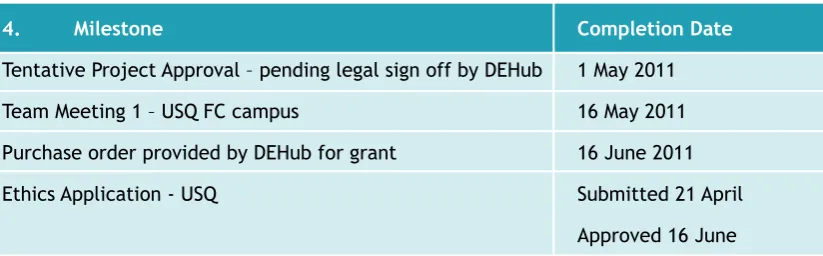
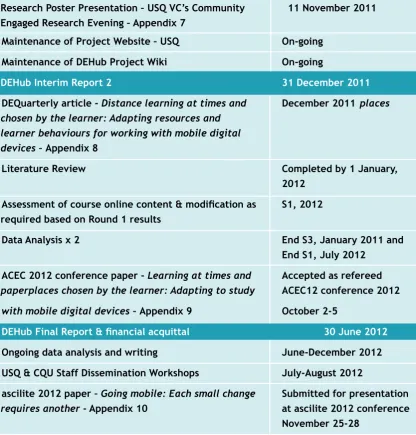
1. The round 1 trial results form the basis of this report. The activity timeline for the project is displayed in Table 2. The research has highlighted the following key points in relation to the
seven research questions:
Outcome 1 - How does the introduction of iPod Touch affect distance learners’ interaction with course content?
The project has identified a wide range of difficulties in access to course material via iPod
Touch devices that affect distance learners’ interaction with course content.
Students reported the main affordances to be anytime, anywhere access to content related to the mobility of the device, immediacy and convenience. However, course material needs to be (re)formatted in a manner that makes it easily accessible from mobile devices. Without due
attention, and institutional support to achieve this, students reported difficulties in viewing
resources and accessing material through the online course management system (Moodle).
Outcome 2 - How does the introduction of iPod Touch affect distance learners’ patterns of communication with instructors and peers?
The project identified connectivity problems in the use of iPod Touch devices that can affect
distance learners’ patterns of communication with instructors and peers.
Where online access was available, students were able to use the devices for email and skype communication with lecturers. However, communication tools such as Moodle, Wimba and
Blackboard Collaborate have not been modified adequately for mobile access. The use of a
primarily asynchronous device with intermittent online access to support distance education course communications was problematic in many instances. The project highlighted that the
introduction of a communication device to support specific course communication outcomes
needs to be well planned into course designs and effectively facilitated with internet access.
Outcome 3 - Which capabilities of the mobile devices are valued by distance learners and for what purposes?
The project identified, through pre and post trial surveys, a range of reasons why mobile devices
were either valued or not valued by distance learners, and for what purposes mobile devices were used.
Students reported access, mobility, immediacy, engagement and convenience as key themes in relation to the affordances of the devices. These are represented in Figure 4. However, the study also highlights a need for institutions to make students aware of the value that mobile devices can make to their studies and to ensure that planning is undertaken systemically to integrate the WHDs into course design. Course materials and existing systems need to facilitate online access by mobile devices.
Outcome 4 - What constraints are evident in the use of mobile devices to support distance learning?
From a student perspective, the screen size was the main limiting feature of the iPod Touch. Students are increasingly familiar with larger format tablets (i.e. iPad) and further trials could consider comparing a wider range of devices and formats. Likewise, Internet connectivity was seen as a limiting factor.
In general, the most significant constraint on students was that the devices were not an
essential tool to support their learning in the courses involved in the trial. Students considered the device to be an ‘aside’ or an ‘optional extra’. This is likely to have impacted negatively on the research results. The study has been effective in identifying a range of constraints and has progressed some solutions to overcoming these constraints.
Outcome 5 - What modifications to university study resources are necessary or desirable to optimise their use on the iPod Touch or similar mobile devices?
The project identified a range of modifications to university study resources necessary to
optimise their use on the iPod Touch or similar mobile devices.
Chief among these is the need for formal workflow processes, quality assurance, and institutional support to prepare course material for use on mobile devices. The study has identified that this
process is a substantial and important undertaking for institutions to take to make distance education more effective on mobile devices.
Outcome 6 - What adjustments to course design would enable most effective use of the iPod Touch or similar devices to support learning?
The project identified that adjustments to course design would enable more effective use of the
iPod Touch or similar devices to support learning. A structured process is recommended, that
doesn’t necessarily rely on individual academics with limited understanding of the requirements for effective delivery on mobile devices to prepare course materials. The study has identified course design workflow and quality assurance as key factors in preparing distance education
courses to effectively use mobile devices.
Outcome 7 - What costs and associated issues need to be addressed at an institutional level for scalability?
The project identified several costs and associated issues needing to be addressed at an
institutional level for scalability.
Issues identified in this project which need to be addressed include:
• Course development, • Technical support,
• Integration with existing systems (LMS, Lecture Capture, Online Communication Tools), academic training, and
These are important issues that need to be addressed at an institutional level. Simply providing
students and academics with the provision of mobile devices is not sufficient to ensure success,
and this project has highlighted that these issues need to be addressed, as the impact can result in negative effects on student use of the devices for learning.
Scalability issues also need further development as the project only looked at four courses with small cohorts that were manageable within project funding and staff time commitments. Wider implementation might identify further issues relating to complexity associated with scalability
Acknowledgements 5
List of acronyms used 6
Executive summary 7
Table of Contents 11
Tables and Figures 13
Tables 13
Figures 13
Chapter 1: Background and Context 14
Introduction 14
mLearning 15
Context 17
Aim and Research Questions 18
Disclaimer 18
Chapter 2: Literature Review 19
Introduction 19
Millennials and university students 20
WHD – Affordances and Limitations 22
mLearning 24
Research on WHDs in educational contexts 24
Nursing and Nursing Education 27
The case for WHDs in medical contexts 27
Access to information promoting accuracy and efficiency 29
WHDs at the Point of Care 30
Clinical decision making and student self-efficacy 30
Activity Theory: A Brief Synopsis 31
Activity as Mediated by Tool / Artefact Use 31
Human Agency in a Socio-cultural Context 32
Activity Systems 32
Appropriateness of Activity Theory to conceptualise use of WHDs 33
Conclusion 35
Chapter 3: Methodology 36
Introduction 36
Chapter 4: Results 42
Pre- and Post-survey 42
Key Survey Results from Round 1 42
Qualitative data collection Round 1 49
Facilitators’ summaries from round 1 51
Chapter 5: Discussion and Conclusion 54
Discussion 54
Limitations of round 1 57
Future Directions 58
References 59
Appendix 1: Participant Information and Consent Form 69
Appendix 2: Introductory Support Materials 74
Appendix 3: Ethics Approval 77
Appendix 4: Student Pre- and Post-Survey 78
Appendix 5: Focus Group Interview Questions 88
Appendix 6: Reflective Journals 90
Tables
Table 1: Data collection timetable and instruments used to address each
of the research questions each semester 38
Table 2: Activity timeline 40
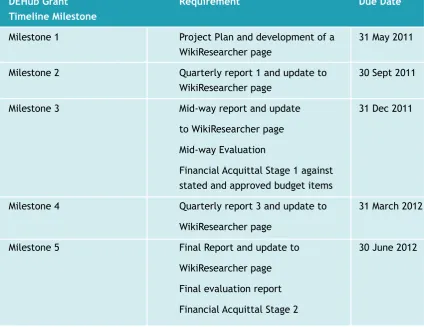
Table 3: Required milestones 41
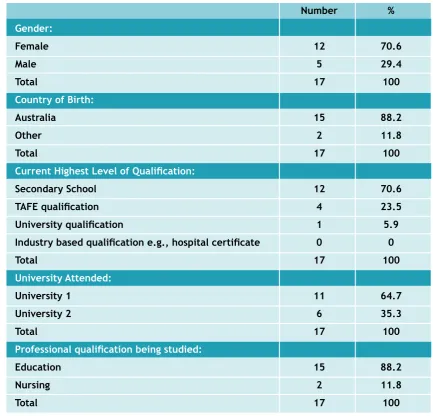
Table 4:Demographic Data Round 1 43
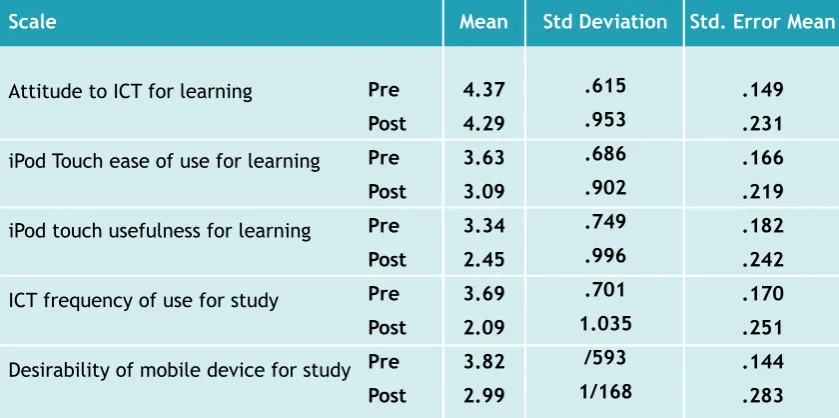
Table 5: Pre-test and post-test mean ratings on key scales (N = 17) 44
Table 6:Analysis of changes in ratings on the 5 key scales (N = 17) 44
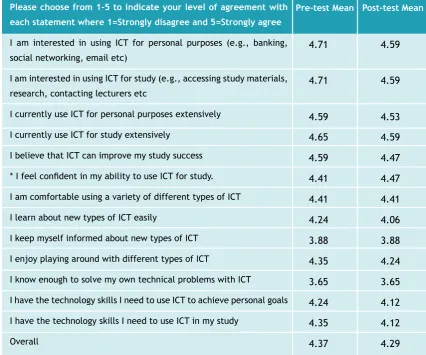
Table 7:Interest in and attitudes toward using ICT 45
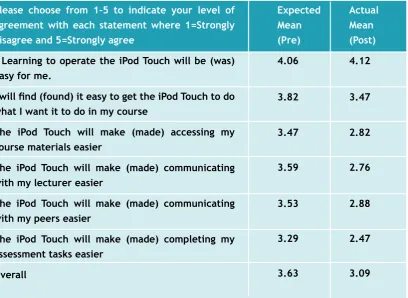
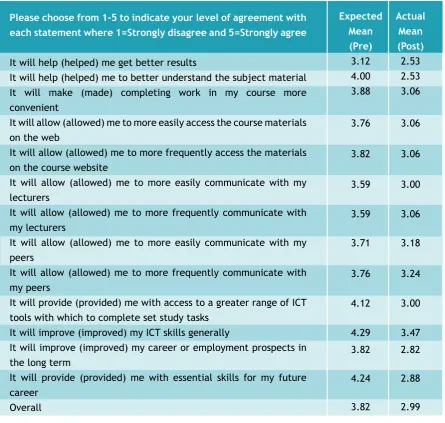
Table 8: Expected and actual ease of use of the iPod Touch for learning 46
Table 9:Expected and actual usefulness of the iPod Touch for learning 46
Table 10:Frequency of use of ICT (or iPod) for study purposes 48
Table 11: Reasons to use mobile ICT devices (such as an iPod Touch)
for study purposes 49
Figures
Figure 1: Categorisation of computing devices as wireless, handheld or
wireless handheld devices (WHD) 16
Figure 2: Categorisation of computing devices as wireless, handheld or wireless handheld devices (WHD) (adapted from Seppala & Alamaki,
2003; Cheung & Hew, 2009) 23
Figure 3: An Activity System (Engeström, 1987, p. 37) 33
Figure 4: Radar plots of key themes from student interview data 49
Figure 5: Activity systems experienced by students and academic facilitators54
Introduction
Fulltime study through attendance at classes on campus is no longer the preferred mode for many university students. Busy lifestyles with family and work commitments are among the major reasons students are increasingly opting to study all or part of their degree by distance
or online mode. The flexibility of those options is limited by the use of bulky printed materials
or media that must be displayed on computers.
Norris and Soloway (2011) suggested that we live in an age of mobilism and that by 2015 every school child in the USA will use a personal mobile computing device. Widespread adoption of
such devices would overcome many of the barriers to the flexibility that seems to be increasingly
preferred by Australian university students. Although digital devices that meet the expectations of Norris and Soloway for mobility, that is being small enough to be ‘always’ carried by the user, have up till now been targeted at business and entertainment applications, recent devices
are sufficiently powerful general purpose computers to be capable of running applications for
education.
Smartphones are particularly significant mobile devices because of the convergence of telephone,
Internet-connected computer, camera (still and video), audio recorder and player, and ebook reader. Smartphones are rapidly penetrating the Australian population. Of the 89% of Australian adults owning a mobile phone in April 2011, 37% had a smartphone and the number of users going online with their mobile phone increased by 63% from June 2010 to June 2011 (ACMA, 2011). Smartphones, and similar mobile devices, offer learners more options for ‘anywhere, anytime’ learning than are available with larger portable devices such as laptop computers. Such devices can store learning materials for access or, depending on network connections, support remote interaction with content and other class members. As more current and potential students have
access to such devices and a desire for more flexible learning, it is important that universities
investigate the potential of such devices to support learning, as well as the changes that may be necessary to facilitate such use.
Undergraduate students in Australian universities include a variable proportion of mature-age students many of whom are seeking career change opportunities. Of undergraduate students enrolled in Australian universities during 2009, 24% were aged 25 or older and 15% were older than 30 years (DEEWR, 2010). The proportion varies across universities and disciplines, with a
survey of final year teacher education students reporting 45% aged 25 or older and 10% aged 40
or older (DEST, 2006). Many of these students will have commitments to family and employment that affect their availability to engage with conventional classes.
One study reported that, in 2006, the typical Australian university student was undertaking substantial paid employment during the semester (James, Bexley, Devlin, & Marginson, 2007). As many as 70% of full-time undergraduates were working almost 15 hours per week on average, with 15% working more than 20 hours per week, and almost 5% working full-time. It is not
surprising that many students seek flexible options to meet individual needs for balancing
study, family and work commitments.
National data for Australia indicate that, during the decade from 2001 to 2010, the proportion of undergraduates studying part-time has declined from 27% to 21% (DEEWR, 2011). Over the same period the proportion of undergraduates studying in internal mode has remained steady at 83% to 84% while external enrolments have decreased from 13% to 8% and multi-modal
enrolments (defined as study units taken partially internally and partially externally) have risen
from 4% to 8%. For the university represented in this study, from 2006 to 2010 undergraduate enrolment density (ratio of enrolments to load) decreased slightly from 1.99 to 1.86 indicating a slight increase in the proportion of full-time students. Over the same period internal and external enrolments reduced from 15% and 75% to 13% and 74% respectively while multi-modal enrolments rose from 10% to 13%. The number of web-based subjects offered rose from 119 to 198 and web-based student enrolments rose from 2676 to 12485, an increase of more than 400% (USQ, 2012). These discernible trends are supported by the observation that in 2012 up to 70% of Bachelor of Education students are studying at least some of their subjects online. Moreover even students studying on campus are very likely to access some of their study materials and
activities from online sources. The evidence suggests that flexibility of study is likely to be
increasingly important to students and that mobility will be part of the solution. Hence, it is important to understand both the potential and the implications of adopting and adapting mobile technologies for learning.
mLearning
Technologies have always mediated the student experience in education. In distance education, they have included paper transmitted via post, email and online interaction with instructors and peers (Taylor, Dawson, & Fraser, 1995). The adoption of mobile digital technologies has given rise to the term, “mLearning”, which has been variously described in the literature.
One source defines mLearning as “any service or facility that supplies a learner with general electronic information and educational content that aids in acquisition of knowledge regardless of location and time” (Jueming Chen, 2005, p. 1), which is sufficiently general to encompass a variety of technologies and pedagogies and preferable to more restrictive definitions. Further,
Figure 1: Categorisation of computing devices as wireless, handheld or wireless handheld devices (WHD)
WHDs exhibit properties, including portability, potential for social interactivity, context sensitivity, connectivity, personal ownership and ease of use, that facilitate collaborative mobile learning (Naismith, Lonsdale, Vavoula, & Sharples, 2004). They are a comparatively inexpensive means for students to access multimedia content and communicate, but are subject to constraints imposed by physical, logical and socio-cultural factors (Song, 2011).
Physical constraints include screen size, slow processors, difficulty with text input and limited
functionality. Logical constraints include availability and price of appropriate programs,
difficulties in ending programs, and system instability. Socio-cultural factors include user
expectations and preferences. The affordances of WHDs make them potentially useful for
learning, but determining their suitability requires understanding of the pedagogy appropriate
to such devices.
Because this study investigates students engaging with courses “from a distance”, that is, not attending on campus, it is useful to review the praxis between distance education and mobile technologies. mLearning was initially understood as a subset of distance education, which occurred at any place and time, whereas conventional education occurred at a set place
and time (Keegan, 2005). The flexibility of distance education was curtailed by online learning because students were required to access information from a computer (Dye, Fagerberg & Rekkedall, 2005). Mobile devices restore flexibility to the distance learner.
Distance Education has been conceptually refined to encompass Contextual Life-long Learning (CoLL), which holds that learning is not confined to specified times and places and that traditional
education cannot provide all the knowledge and skills people need to prosper throughout life (Sharples, 2000). Technologies to support CoLL need to be portable, individual, unobtrusive, available anywhere, adaptable to context of learning, relevant to the learner’s evolving skills and knowledge, persistent, useful and easy-to-use (Jueming Chen, 2005). WHDs, as described
above, meet these requirements.
iPods, graphing calculators, data capture, bar code readers, mobile phones
iPad, Galaxy Tab, Tablets, Netbooks, Kindles, Laptops
3G/4G Smartphones (e.g. Android, Blackberry,
iPhone), iPod Touch
Handheld Devices Wireless Wireless Devices Handheld
As technologies change, so does pedagogy. Recent thinking recognises that the process has not been one of new generations replacing what has gone before, but one in which layers have been added for a more complete experience, embracing elements of behaviourism, constructivism,
and connectivism (Anderson & Dron, 2011). Recent expansion of online learning raises questions
about the nature and role of interaction in distance education. Moore (1993) suggested that ‘distance’ in distance education is about psychological rather than geographical distance. In
an earlier paper, he clarified understanding of interaction in learning as being of the learner
with content, instructor and other learners (Moore, 1989). WHDs have potential to make all three forms of interaction more conveniently available at diverse times and places, thereby enhancing learning by reducing transactional distance. However, for this to be achieved, it is important to understand how the introduction of WHDs affects the interactions of university learners and teachers.
Context
This project trialled the 4th generation iPod Touch, equivalent to a smartphone other than for
connection to the telephone network, with 80 students in education and nursing courses at USQ and CQUniversity in two different semesters, to evaluate the potential of WHDs to enhance student learning by increasing time on task for learning at times and locations more convenient
for the learner. While the project was device specific the findings should be applicable to
other mobile device platforms (e.g. iOS, Android, Symbian, RIM and Windows Mobile) that offer similar functionality.
The research investigated the use of the iPod Touch in three main areas of student use for learning:
1. accessing pre-loaded or downloadable course materials and resources including text, images, audio and video,
2. engaging in learning activities through peer to peer and teacher interactions, and
3. making personal records of learning and/or for sharing media in interactions to enhance learning.
These three areas of focus were measured and monitored using a variety of mixed-methods
data collection techniques. Key deliverables of the project are:
1. Research reports and publications addressing the utility of the iPod Touch device, student engagement, use and time, engagement with peers and teachers and identification of other barriers and opportunities to enhance student learning;
2. Recommendations for USQ and CQUniversity for scalability or otherwise of mobile devices to enhance the curriculum; and
Aim and Research Questions
The major aim of the project was to investigate the affordances and constraints associated with the 4th generation iPod Touch, a WHD, for enhancing distance and online student learning
opportunities. The study addressed the following specific research questions:
1. How does the introduction of the iPod Touch affect distance learners’ interactions with course content?
2. How does the introduction of the iPod Touch affect distance learners’ patterns of communication with instructors and peers?
3. Which capabilities of the mobile devices are valued by distance learners and for what purposes?
4. What constraints are evident in the use of the mobile devices to support distance learning?
5. What modifications to university study resources are necessary or desirable to optimise their use on the iPod Touch or similar mobile devices?
6. What adjustments to course design would enable most effective use of the iPod Touch or similar mobile devices to support learning?
7. What costs and associated issues need to be addressed at an institutional level for scalability
Disclaimer
At the time of publication of this report, the project was still ongoing. The commencement of
the research was delayed until 9 September, 2011 by internal university legal requirements and processes beyond the control of the research team. Hence, the first round of data collection with the first cohort of students was undertaken between December 2011 and February 2012.
The second round of data collection with the second student cohort occurred between February
2012 and June 2012. Data from the first round were analysed and these analyses form the basis
of the results reported in this report, as well as the three publications that have arisen from the project to date (Appendices 9, 10, 11). It is anticipated that the round 2 data and the combined
data sets will be analysed and reported in subsequent conference and journal publications later
Introduction
The major aim of the Distance learning at times and places chosen by the learner: Adapting
resources and learner behaviours for working with mobile digital devices project was to
investigate student learning associated with the use of an iPod Touch in distance education courses for Bachelor of Nursing and Bachelor of Education/Learning Management students. Although our focus was student use of iPod Touches, this review examines the research literature pertaining to wireless handheld devices (WHDs) more generally, which include Personal Digital Assistants (PDAs), Smartphones (iPhone, Blackberry, Nokia) and mp3 players (iPods and iPod Touch), but exclude larger devices such as Tablets, iPads, Netbooks or Laptops (Dieterle &
Dede, 2006). A search of educational journals and educational databases identified limited
scholarly research available on the educational uses of iPod Touches or iPhones; however, a
significant amount of research concerning the educational uses of PDAs is available, albeit
largely conducted in K-12 settings. The extant research focuses on the potential of WHDs to i) encourage mLearning; ii) enhance student-student communication and collaboration; iii) foster the reshaping of educational structures; and iv) be appropriate as a 1:1 computing tool.
The categorisation of WHDs according to their use by Chueng & Hew (2009) is a useful organising framework for this discussion. The authors suggest seven major categories which emerge from the literature concerning the use of WHDs in education. The seven categories are:
(a) multimedia access tool, (b) communication tool, (c) capture tool,
(d) representational tool, (e) analytical tool, (f) assessment tool, and (g) task managing tool.
The broad applicability of these devices perhaps prompted Fung, Hennessy and O’Shea (1998) to suggest that their use could be a ‘paradigm shift’ towards portable computing in education, with the devices acting as a catalyst for interactive learning paradigms outside the traditional formal learning settings (Schwabe & Göth, 2005). Cochrane (2005) suggests a “Copernican Revolution in teacher instruction” occurring in learning environments deploying these devices. Selwyn (2003) supports the view of Cochrane and argues that WHDs may revolutionise education in ways not previously experienced with earlier technological innovations because they afford two distinct kinds of participation in the same time and in the same space: the normal social participation in face to face learning contexts and a new informatic participation among students mediated by geographically disparate yet connected devices. The latter informatic participation is
critical to university students studying at a distance. In order to establish a context for this research project, a brief examination of the literature in relation to “millennials” and distance education was conducted. Following the context setting, the review will present a number
of definitions for mLearning which demonstrate the conceptual developments in this learning domain over time. Included in this “definition” of mLearning is an examination of the particular
affordances of WHDs that make them appropriate to use as a mLearning tool and impact on
the interaction between the devices and the learners using the devices. Research findings
will then be presented in relation to mLearning initiatives in school and university contexts.
Although many of the research findings, based largely on school or school related educational activities e.g. teacher education, relate equally to Education Studies and Nursing contexts, there are substantive and specific findings in relation to Nursing and Nursing Education that
will be dealt with separately in this review. The overall review concludes with a discussion on Activity Theory, a socio-cultural theory that is used to conceptualise this research.
Millennials and university students
Students attending universities in the second decade of the 21st century are labelled in the
literature in terms which refer to their apparent familiarity with digital technologies. The most common terms describing these students are ‘digital natives’ (Prensky, 2001), ‘net generation’ (Tapscott, 1998) and ‘millennials’ (Pardue and Morgan, 2008). Selwyn (2009) summaries various commentators who have coined other terms for these students including ‘born digital’, ‘homo-zappiens’, ‘net savvy’, and ‘new millennium learners’. According to these depictions, ‘millennials’ (which is the term used henceforth to describe these students) are technologically competent and effortless with mobile phones, PDAs, iPhones, mp3 players and iPods. They are often described as optimistic, assertive, positive, friendly, co-operative team players who gravitate to group activities and who prefer multi-tasking (Pardue and Morgan, 2008).
Despite the broad interest in the notion of millennials, until recently, there has been very little empirical research into their ICT skills and experiences. Various authors, based on published empirical research, are beginning to doubt the rhetoric of a universal “millennial student”. Kennedy et al. (2009) suggest that while millennial access to and use of computers and some ICTs may be high, this does not necessarily mean that these students want to use these technologies constantly and in all the contexts of their lives. Selwyn (2009), after conducting a review of recent research into millennials and their ICT use, notes that we should be “wary of claims that a digital generation is overthrowing culture and knowledge as we know it and that its members are engaging in new media in ways radically different from those of older generations” (p. 375). Margaryan, Littlejohn & Vojt (2011) go further and suggest that the generational divide implied in the use of terms such as millennials or digital natives is a myth and that ICT use by students is determined by a range of factors including, but not limited solely to, age. Other authors suggest that the discourse around millennials is driven by political
or economic concerns (Jones & Shao, 2011). It appears that a significant cause of the current
(2007, p. 84) describes university technology use as ‘‘sporadic, uneven, and often ‘low level’’. In summary, the global empirical evidence indicates that university students prove to be an eclectic mixture of individuals with various interests, motives, and behaviours, who “never cohere into a single group or generation of students with common characteristics” (Jones & Shao, 2011, p. 12) and that it is imprudent to rely on the rhetoric surrounding the millennials as a rationale for the use of new and emerging technologies in higher education (Kennedy, et al., 2009).
While mindful that the technological and informational needs of young people have changed this century, it appears clear that educational institutions need to avoid the rhetoric of the millennial debate and, instead, focus on an enhanced understanding of the realities of technology use in contemporary society (Selwyn, 2009). This is also true in relation to the student use of WHDs, where there is a danger in assuming universal student competency with such devices. A study by Cochrane (2008) determined that whilst ownership and internet access
were virtually ubiquitous, the experience of using the devices as a Web 2.0, user-generated tool
was low (20%). Cibulka and Crane (2011) reported that over 40% of nursing students in their
study required substantial technical support in the use of a WHD. Likewise, Olney, Herrington
and Verenikina (2008) reported a level of research naivety on their behalf after discovering in their study of mp3 player usage by university students that “many students had either not
used the digital devices, or they required assistance with other aspects such as the use of the microphone, or file transfer between the computer and the device” (p. 698).
These latter comments indicate the importance in our research of ensuring that appropriate levels of technical support are offered to the students prior to and during the periods of iPod Touch use. Our research context is different from many of the contexts researched previously in that there is no face to face contact with the students. All students using the devices study
at a distance and, thus, it is important to briefly note some specific implications of this mode
of study, particularly in relation to use of WHDs.
mLearning can be understood as a subset of distance education. The educational domain can be divided into two halves known as conventional education (set place; set time) and distance education (any place; any time). Most of the goals that today characterise just-in-time learning, or life-long learning, were anticipated by distance learning (Keegan, 2005). Distance education, to some extent, took a step backwards when it converted from paper-based to
online learning, where students largely were required to study at a place (and at a time)
where a computer with access to the Internet was available. Dye, Fagerberg and Rekkedall
(2005) argue that the use of mobile technologies increases the flexibility of distance education
and returns the any place; any time option to the distance learner. The concept of Distance
Education has been further refined to encompass the concept of Contextual Life-long Learning (CoLL), which postulates that learning is an activity not confined to pre-specified times and
places and that traditional education cannot provide people all the knowledge and skills that
they need to prosper throughout their life-time (Sharples, 2000). The general requirements for technologies to support contextual life-long learning require them to be highly portable,
individual, unobtrusive, available anywhere, adaptable to the context of learning, relevant to the learner’s evolving skills and knowledge, persistent, useful and easy-to-use (Jueming Chen,
2005). WHDs appear to meet the requirements of (CoLL) as they can provide a “pervasive
Technologies of various kinds have always mediated the student experience of distance education. These technologies include printed materials posted to and from students all the way through to email and online interaction with lecturers, tutors and fellow students (Taylor, Dawson & Fraser, 1995). Just as the technologies used in distance education have changed, so have the pedagogies used in this domain. Recent thinking has emphasised either the importance of students making links with content and with each other (Anderson & Dron, 2011), which builds on the concept of connectivism (Siemens, 2004) or a social constructivist approach (Vygotsky, 1978) where students co-create knowledge via the mediation of course materials, the tutor and
each other (Blin & Munro, 2008). The recent expansion of online learning prompts the question as to whether interaction in distance education is equivalent to interaction in face-to-face
learning contexts. Rather than physical distance being the determining factor in the level of interaction between lecturer and learner, Moore (1993) suggests that Transactional Distance, the psychological and communication gap between any learner and teacher, is the critical
factor in determining levels of interaction. Moore (1989) identified three forms of interaction;
that is, learner with content, learner with instructor and learner with other learners. Increased knowledge of any effects of WHDs on Transactional Distance was a research outcome of this project. The use of iPod Touches in distance education is relatively new, but builds on existing contributions about the positive outcomes associated with mobile technologies (Koole, McQuilkin & Ally, 2010; Park, 2011). Regardless of technological or pedagogical approach, a key challenge for distance education is to ensure the provision of appropriate learning experiences that make the most of available materials, technologies and pedagogies.
WHD – Affordances and Limitations
WHDs are a specific subset of computing devices with particular affordances which render them, according to Soloway, Norris, Blumenfeld and Fishman (2001), a potential quantum leap
in computational availability and highly appropriate as learning tools in distance education.
In this review, we adapt the definition of ‘mobile handheld devices’ by Cheung and Hew
(2009) and suggest that WHDs are small machines that can be carried easily in one’s palm and provide computing, as well as information storage and retrieval capabilities. The particular affordances of mobile devices can change how students perceive the worth and limitations of the technology (Swenson, Young, McGrail, Rozema & Whitin, 2006). The interaction between humans and tools is a central aspect of Activity Theory (Vygotsky, 1978; Wertsch, 1981), the theoretical framework underpinning our research, which claims that all human action is mediated by tools including technologies and artefacts, such as WHDs; semiotic systems, such as language including diagrams; social interactions, such as those between student and class or student and class teacher; and institutional structures, such as ICT usage policies (Wishart, McFarlane, & Ramsden, 2005).
Figure 2: Categorisation of computing devices as wireless, handheld or wireless handheld devices (WHD) (adapted from Seppala & Alamaki, 2003; Cheung & Hew, 2009)
Various authors (Abernathy, 2001; Naismith, Lonsdale, Vavoula, & Sharples, 2002; Roschelle, 2003)
identify a range of properties of WHDs that produce unique educational affordances facilitating
collaborative mLearning environments. These properties include portability / mobility, social interactivity, context sensitivity, connectivity, individuality / sense of ownership and ease-of-use. The suggestion is that WHDs are an inexpensive way to engage students in developing technology skills and in bridging the digital divide (Johnson, 2005). There are, however, a number of constraints in the use of WHD that can be summarised using themes suggested by Song (2011); namely, physical constraints, logical constraints and cultural / social factors.
Physical constraints include screen size, slow processing speeds, difficulty with inputting text and limited functionality (see also Serif & Ghinea, 2005). Logical constraints include difficulties
in ending programs, availability and price of appropriate programs (especially medical programs) and system instability (see also Oliver & Barrett, 2004; Koeniger-Donohue, 2008). Cultural and social factors include lecturer / student expectations of the devices and user preferences in relation to phone / SMS / email device use. Particular to nursing contexts are also the issues of sensitivity to personal data and protocols about disinfection control of the devices (see Phillippi and Wyatt, 2011).
On balance, the technical and social affordances of WHDs seem to indicate their appropriateness as a computing device in educational contexts. More important is their potential suitability as an educational device to support student learning, particularly for our context as university
lecturers and tutors. Determining their suitability requires an understanding of the underpinning
pedagogy regarding the use of such devices. This pedagogy is generally referred to in the literature as mLearning.
iPods, graphing calculators, data capture, bar code readers, mobile phones
iPad, Galaxy Tab, Tablets, Netbooks, Kindles, Laptops
3G/4G Smartphones (e.g. Android, Blackberry,
iPhone), iPod Touch
Handheld Devices Wireless Wireless Devices Handheld
mLearning
mLearning has been variously described in the literature. Jueming Chen (2005) suggests that mLearning is “any service or facility that supplies a learner with general electronic information
and educational content that aids in acquisition of knowledge regardless of location and time”
(p. 1). Vavoula and Sharples (as cited in Jueming Chen, 2005) indicated three ways in which learning can be considered mobile - “learning is mobile in terms of space; it is mobile in different areas of life; and it is mobile with respect to time” (p. 1). Scanlon, Jones and Waycott
(2005) suggest that mLearning can be defined as “any educational provision where the sole or dominant technologies are handheld or palmtop devices” (p. 2). Abernathy (2001) defines
mLearning as
the intersection of mobile computing and e-learning that includes anytime, anywhere resources; strong search capabilities; rich interaction; powerful support for effective learning; and performance based assessment (p. 1).
The thrust of these definitions is toward the affordances of the devices that enable mLearning;
for example, the mobility of the devices, the access to information from various locations etc.
More recent definitions of mLearning suggest that the focus needs to shift from the nature of
the device, or even the nature of the learner, to a focus on changing contexts for learning and maintaining continuity of learning across these contexts. In this conceptualisation, meaningful learning is fostered when the interactions with technology are learner initiated (Song, 2011) and determined by the context in which the learning takes place. Sharples (cited in Cochrane,
2008) suggested that mLearning is best defined by reference to its contextual and informal
learning characteristics.“ The processes of coming to know through conversations across multiple contexts amongst people and personal interactive technologies” (p. 177). This notion aligns with the socio-cultural perspective of our research project, which recognises that WHDs are powerful learning tools, but only in the sense that they mediate the experience of the
learner across a wide range of collaborative learning environments. In summary, definitions
of mLearning initially focussed on the technology, then on the enhanced mobility of the user
utilising the technology, and finally arrived at an understanding that learning now occurs,
mediated by the device, as the learner changes contexts.
Research on WHDs in educational contexts
The majority of research conducted in relation to WHDs has been completed in K-12 settings. This body of research has documented changes in pedagogy with teaching styles being more student-centred (Norris & Soloway, 2004); project-oriented (Norris & Soloway, 2004; Swan et
al., 2007) and more inquiry-based (Norris & Soloway, 2004). As is the case with research into
laptop use, research into use of WHDs indicates that teachers are becoming more constructivist
and flexible in the organisation of classroom activities (Swan et al., 2005). In terms of specific
whether the findings applicable to school-aged students, the context in which much of the
previous research was conducted, transfer to university contexts. It may be the case that university students who engage extensively with mobile technology to enhance their learning
outcomes are independent learners who would learn equally as well without WHDs.
As there has been limited research thus far into university use of WHDs, and barely any in relation to their use in distance education (Waycott, 2002 being an exception) or into the use
of mp3 players such as iPods (Olney, Herrington & Verenikina, 2008), it is difficult to fully gauge
their usefulness in supporting student learning in university contexts. In addition, much of the available research reports on trials at universities in the United States, such as Duke, Berkeley, Stanford, Carnegie, North Carolina (Kim, Mims & Holmes, 2006), where their use seemed primarily to be a marketing strategy to attract future students. As noted in the previous section, and common to K-12 research on WHDs, the most interest and activity in terms of the use of WHDs in universities to date has been on practical and administrative functions (Bird & Stubbs, 2008) rather than pedagogical purposes (Herrington, Mantei, Herrington, Olney & Ferry, 2008).
Findings from peer-reviewed literature concerning WHDs in university settings mirror many
of the findings from K-12 usage in relation to the affordances and limitations of the WHDs. These include anytime, anywhere access, less wiring, simplicity of use, installation flexibility,
reduced cost, scalability and improvement of communication (Kim, Mims & Holmes, 2006). In two studies which involved custom designed software for WHD use by university students; Bull, Cui, Robig and Sharples, (2005) and Corlett, Sharples, Bull and Chan (2005) noted that that the students appreciated the ability to be able to use the devices for interstitial learning – i.e. learning that occurs in the short time periods between other activities. Students reported that they could use the devices whilst using public transport or during breaks between lecturers or waiting for friends (Bull, et al., 2005). The students also reported positively on the ability to use a range of organisational tools on the devices for communication, time-management and access to content (Corlett, et al., 2005). The communicative affordances of WHDs were also
identified in a study of student teachers and their supervisors by Seppälä and Alamäki (2003).
In this study, students were provided a Smartphone and were able to communicate with each other and their lecturers, via SMS, during their professional practicum experience. In addition to communication, these students also used the devices as a data collection device for their digital ePortfolio. Cheung and Hew (2009) report on a number of university projects where the devices are used as a student response system tool. In these projects student input is aggregated and displayed during lectures and tutorials to guide the direction of student learning (Jackson, Ganger, Bridge & Ginsburg, 2005).
usefulness of PDAs in accessing course materials in an Open University Information Technology
course. This study found that the main benefit of the devices was their portability and the
opportunity for ‘anytime, anywhere’ access to the materials
Particular to our context is a study using an earlier version of the iPod Touch by (Richardson, Dellaportas, Perera & Richardson, 2010) involving Accounting students at an Australian
university. The findings reflect those of other studies using a range of WHDs in that the mobility
of the devices allowed students to use them for study at times and locations, such as travelling on public transport, where they might not otherwise have studied. Disadvantages related to
the difficulty in reading text on a small screen and the ability to move to particular parts of a
recorded lecture with precision.
Almost universal to each of these studies were common constraints of the WHDs and again
these mirror the K-12 research findings. The most common limitations of the devices were
usability of the hardware, limited memory and battery life (Corlett, et al., 2005); lack of available software (Wishart, et al., 2005) and of particular concern to Waycott (2002) due to the heavy reliance on access to course materials, were the issues of screen size, poor screen
quality and lack of contextual clues such as page numbers and paragraphing on the devices. At
a broader conceptual level, beyond the affordances of the devices themselves, were concerns regarding the mismatch between the technology itself and university organisations in terms of lecturer skills, IT support, ethical usage agreements and Quality Assurance (Bird & Stubbs,
2008). A final concern was the lack of student investment in the projects in terms of ownership
of the devices. Corlett, et al. (2005) noted that in many of the projects cited, and in their own study, the devices were to be returned at the end of the trial (be that one term, one semester,
or one year). As a consequence, students were unlikely to invest heavily in learning how to use
the devices or in personalising and extending their use more widely across their studies.
By way of summary, it is suggested, based on the extant literature, that the use of mobile computing devices, owing largely to their size and portability, can increase both collaborative and independent learning, as well as enabling a “transition from the occasional, supplemental
use associated with computer labs, to frequent and integral use of portable computational
technology” (Roschelle, 2003, p. 260). Their usage places appropriate computing power and versatility into the hands of students. When this is coupled with access to wireless networks, opportunities for collaboration and communication are expanded (Grimes & Warschauer, 2008).
We have also proposed a definition of mLearning which is based less on the mobility of the
devices and more on the contexts in which the devices are used to support student learning. The focus of the review thus far has dealt with the use of WHDs in school learning contexts and what might be termed university Educational Studies courses. This section of the review focuses on the use of WHDs in Nursing and Nursing Education. Whilst much of what has been claimed
Nursing and Nursing Education
In terms of Nursing Education, our research investigates a range of contexts in which nursing students may use the devices throughout their nursing program – be that in their coursework, in communicating with their peers, or in clinical placement. Our emphasis on the use of WHDs throughout the entire course is in contrast to the emphasis of the limited research into the use of WHDs in nursing education which relates to their use in clinical settings. The review of current research involving WHDs in nursing education was initially guided by four themes
identified by Jeffrey and Bourgeois (2011) namely, medication administration, self-efficacy,
professional nursing judgment and clinical reasoning. Further interrogation of the literature
resulted in the following themes being identified for further discussion – access to information enabling greater accuracy and efficiency, point of care use of WHDs, student self-efficacy, and
clinical decision making. Prior to examining these themes it is useful to provide a contextual background to the use of WHDs in a range of medical environments.
The case for WHDs in medical contexts
The use of WHDs (initially PDAs and more recently Smartphones) in medical contexts is prominent. Studies conducted early this century report that clinicians rapidly adopted PDAs into their daily practice. In one study, more than half of all doctors younger than 35 years in developed countries used a PDA in 2003 and this percentage rises to 40-50% of all US physicians
using a PDA (Baumgart, 2005). More recent research confirms this trend of the rapid uptake of
mobile technology with two-thirds of American physicians using smartphones as of late 2009 with the percentage expected to rise to 81% in 2012 (Sarasohn-Kahn, 2012). Kho, Henderson, Dressler, and Kripalani, (2006) report that 60% to 70% of medical students and residents use PDAs for educational purposes or patient care. The creation of applications related to health
and health care is also moving quickly with nearly 6,000 health care apps available from the
Apple App Store (Sarasohn-Kahn, 2012).
Ducut and Fontelo (2008) suggest that in the last decade, handheld computers or PDAs have
become standard equipment for medical students and clinicians to cope with an increasingly
complex and expanding information base. Jackson, Ganger, Bridge and Ginsburg (2005) note
that physicians and hospital administrators find the devices to be invaluable tools for generating
patient databases, prescription writing, and information retrieval. Koeniger-Donohue (2008) recognised the importance of Nursing educators addressing the issue of WHDs to respond to the growing demand for usage of handheld technology by nursing students and nurses as the adoption of handheld devices for clinical practice by nurses has lagged behind that of physicians by approximately two years.
The extensive use of mobile technologies, and indeed computer technologies in general, has
prompted a number of regulatory bodies to call for improvements in the quality of nursing
in health care environments which require increasingly sophisticated use of technology and
recommend that core competencies for nurse practitioners include the incorporation of current technology into practice, thus necessitating mastery of mobile technologies (Cibulka and Crane-Wider, 2011).
The necessity for nursing students to develop clinical reasoning skills mediated by digital
technologies is also reflected in the literature. The 21st century organisation and delivery
of health care has changed significantly due to an aging population contributing to a more
complex illness presentation and also the changing role of patients from a traditional passive relationship with healthcare professionals to that of an informed consumer (Jeffrey and Bourgeois, 2011). In addition to the rapidly changing population, nursing knowledge gained throughout an undergraduate program, due to the rapid turnover in health care information
and technology, may well be outdated within five years of graduation. Nursing educators must
therefore keep pace with advances in technology and also adopt effective strategies to enhance the learning experience of the students (Ducut & Fontelo, 2008) to ensure, where possible,
that students graduate with the technological proficiency to operate effectively in increasingly
technological rich medical environments (Jackson, et al., 2005). The emphasis therefore shifts
from just equipping nursing students with foundational nursing knowledge and clinical skills, to also equipping them with the skills required to foster self learning. WHDs may have a place in such a schema by extending learning beyond the confines of a classroom (Jeffrey & Bourgeois,
2011). Wu and Lai (2009) suggest that these advanced technologies must be integrated into the
nursing curricula to foster students’ proficiency in adapting to varied and expanding complex
information systems.
If changes to curricula and nursing education practices are to improve the technological ability of students, then such improvements need to be based on empirical research into student use of technology; however, research into the use of WHDs is limited in clinical education. What research has been conducted has dealt with PDA use. A study published in 2009 found that 70% of medical students used PDAs or PDA-like devices while learning. The use of PDAs has been associated with high levels of student satisfaction (Phillippi & Wyatt, 2011) and student feedback suggests that PDAs are useful in clinical settings with more than 79% of the students using their PDAs at least weekly, and 50% using them daily (George, et al., 2010).
Although the PDA research indicates that students are almost uniformly positive in regard to their use, there is little to no research on how to implement, support, and sustain the use of WHDs more broadly across a total nursing education program (Koeniger-Donohue, 2008). A systematic literature review by Jeffrey and Bourgeois (2011) highlights the paucity of literature
currently available and suggests the subsequent need for primary quantitative studies examining
the effect of WHDs in developing undergraduate nursing students’ clinical reasoning skills. For example, Cibulka and Crane-Wider (2011) report that the provision of informatics content,
resources, and skill-building experiences throughout the nursing programs were insufficient to prepare nurses to practise proficiently in a progressively technical and digital health care
It was noted earlier that an analysis of the literature resulted in the following themes being
identified for further discussion – access to information / point of care / accuracy and efficiency, student self-efficacy, and clinical decision making. Research findings will now be synthesised
according to these themes.
Access to information promoting accuracy and efficiency
Medicine, and the way that it is taught, has undergone major changes in the past few years (Ducut & Fontelo, 2008) and a major component of this change is the need to access and process increasingly complex and vast amounts of data (Johansson, Petersson, & Nilsson, 2011). Health practitioners are expected to be able to demonstrate high-level information literacy skills
including “accessing, evaluating, analysing, and synthesising immense quantities of medical
information” (Ducut & Fontelo, 2008, p. 1). WHDs may provide the means for nursing students to extend their capacity to deal with substantial amounts of information and to base their decisions on up to date information (Murphy, 2005). The popularity of WHDs for the medical community lies in the ability of medical practitioners, researchers, and students to transport multiple textbooks, manuals, dosage calculators, and other reference texts literally in the palms of their hands (Carney, Koufogiannakis, & Ryan, 2004). As indicated earlier, there are over 6 000 health applications available for iPhones / iPods (Sarasohn-Kahn, 2012) with more
than 600 applications specifically designed for medical professionals (Phillippi & Wyatt, 2011).
Given this vast availability of computing resources, nursing students can retrieve information
quickly in relation to drug formularies, laboratory, and diagnostic manuals as well as textbook or journal information and reference library material (George, et al., 2010). A subsequent effect
of access to medical information is that such access will prepare the students for their future work context. Giving students accurate sites for reference will help prepare them for future practice and encourage self-directed learning (Phillippi & Wyatt, 2011) with the potential that use of such devices will become a core component of their future routine care planning for patients (Berglund, Nilsson, Revay, Petersson & Nilsson, 2007).
A direct outcome of the access to up to date information provided by WHDs is an improvement
in the accuracy and efficiency of nurses and nursing students in clinical settings. (George, et
al., 2010) suggest that WHDs can result in error reduction, increased valuing of accurate and
current information, and enhanced efficiency. In a study of undergraduate nursing students
by Jeffrey and Bourgeois (2011), t-test analysis of data revealed that undergraduate nursing students using WHDs (n=37) performed better in medication accuracy with a resulting mean score of 4.1 by comparison to students using textbooks and calculator resources (n= 50) who scored a mean of 3.5 (p = 0.037). It is therefore suggested that students using WHDs “may be
more accurate in calculating medication dosages‟ in the medical–surgical clinical environment… and more time efficient in the simulated experience of administering medications than students
WHDs at the Point of Care
A reported positive outcome of WHD use is that they provide excellent access to information at any time and place and that they function as a support tool for when students immediately
needed access to information, from verified approved sources (Johansson, et al., 2011). Cibulka
and Crane-Wider (2011) reported that 86% of the Nursing Practitioner students in their study used WHDs to retrieve data, and 82% used their device to interpret data. Furthermore, 91% used their device to guide prescribing medications, 50% used it to research diagnoses, and 32% used it to interpret laboratory or diagnostic tests. Of particular importance is that 78% of the
students indicated that they used their WHDs on most clinical days to enhance the quality of
their practice at the point of care juncture with patients.
The importance of WHDs for nursing students at the point of care is reflected in a number
of studies. Ducut and Fontelo (2008) suggest that student nurses and residents use WHDs as portable sources of information at the point-of-care to improve patient management and augment learning; Wu and Lai (2009) note the use of WHDs not only saved students’ time, but also that students spent more time with patients because it was not necessary to leave the patient’s room to look up information as the portability of the devices facilitated information retrieval at the point of patient care (Dee, Teolis, & Todd, 2005; Koeniger-Donohue, 2008).
McLeod and Mays (2008) suggest that the ubiquitous wireless connectivity of WHDs, which
enables access online databases of clinical logs, health records, evidence-based guidelines, and peer-reviewed journals, can be leveraged by nursing students to support real-time, evidenced based practice at the point of care.
Clinical decision making and student self-efficacy
The availability of ready access to current information at the point of care suggests that the use of WHDs may assist students with clinical decision making (Wu and Lai, 2009). Jeffrey and Bourgeois (2011) suggest that putting WHDs in the hands of students can “help demonstrate the importance of mobile resources in enhancing clinical decision making” (p. 49). Johansson et al. (2011) report that WHDs supported student clinical learning and decision-making. Lai and Wu (2009) recommend WHDs as an effective learning resource for students as they facilitate the application of evidence-based knowledge to clinical practice. Importantly, for students studying nursing in a distance education context, where geographic distance can pose further challenges for faculty and students in relation to timely responses to student clinical needs, WHDs may provide a mechanism whereby students and lecturers can communicate over distance in real-time (Wu & Lai, 2009). In addition to functioning as an educational tool used to access information, WHDs can serve as psychological support for students whilst in clinical environments (Jeffrey & Bourgeois, 2011). Studies among nursing students showed an increased
self-efficacy after using a WHD in clinical placements (Johansson, et al., 2011) as well as increased confidence in medical–surgical environments by students using WHDs rather than
The studies cited in this review of literature on WHDs in nursing contexts suggest that they are an important tool in nursing environments undergoing rapid technological change. Preferred treatments, drug dosages, postsurgical care, and preventive healthcare regimens continually
change and WHDs allow students to rapidly confirm information which fosters active learning
and safe behaviours (Phillippi & Wyatt, 2011). In conclusion, nursing students are positive about the use of WHDs in clinical contexts and their use appears both technologically appropriate and pedagogically sound (Wu & Lai, 2009). What still remains to be determined is the usefulness of WHDs to support student learning across a whole semester of study as opposed to just their use in clinical placement or practical experience contexts and this research provides further
empirical evidence to address this research question.
Activity Theory: A Brief Synopsis
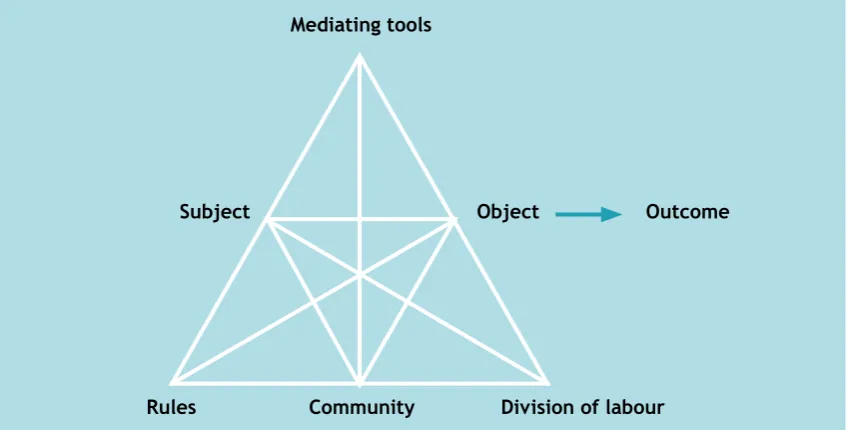
Activity Theory is the conceptual and methodological framework underpinning this research. Activity Theory is a body of theorising and research initiated in the 1920s and 1930s by Lev Vygotsky and Alexie Leont’ev, the founders of the cultural-historical school of Russian psychology (Engeström, Miettinen & Punamaki, 1999). This synthesis of the Activity Theory literature builds on the doctoral work of one of the researchers. Activity Theory is an approach that aims to understand individual human beings in their natural, daily circumstances and understanding is developed through an analysis of the genesis, structure, and processes of their activities. Human activity is always oriented to the achievement of goals and motives (Nardi, 1996) and in this sense activity implies an action done in order to transform some object (Engeström, 1999). Activity is understood as a purposeful interaction of the subject with the world, a process in which mutual transformations between the poles of ‘subject–object’, via the use of tools, are accomplished (Kaptelinin & Nardi, 2006; Martek, 2008).
Activity as Me