PROCEEDINGS OF THE 26th NORDIC SEMINAR
ON COMPUTATIONAL MECHANICS
Oslo, 23–25 October 2013
A. Logg, K.-A. Mardal, and A. Massing (editors)
Anders Logg
•Kent-Andre Mardal
•Andr´e Massing
Editors
Proceedings of the 26th Nordic Seminar
on Computational Mechanics
Editors
Anders Logg
Mathematical Sciences
Chalmers University of Technology
SE-412 96 Gothenburg
Sweden
[email protected]
Kent-Andre Mardal
Simula Research Laboratory
PO Box 134
1325 Lysaker
Norway
[email protected]
Andr´e Massing
Simula Research Laboratory
PO Box 134
1325 Lysaker
Norway
[email protected]
ISBN 978-82-92593-12-7
Proceedings of the 26th Nordic Seminar on Computational Mechanics
A. Logg, K.A. Mardal, A. Massing (Eds.) c
�Oslo, 2013
Stress-strained state and the stability of a spherical
seg-ment under the in
fl
uence of a load with a
fl
at base.
Ermakov A. M.
Department of Theoretical and Applied Mechanics, Faculty of mathematics and mechanics St. Petersburg State University, Saint-Petersburg, Russian Federation, [email protected]
Summary. In this paper the problem of the buckling of the transversal-isotropic segment of spherical shell with the different thicknesses under the influence of the load with a flat base is studied. The spherical segment has a rigid support on the edge and previously has been loaded by internal pressure. The solution of this problem is based on the theory of the shell of moderate thickness by Paly-Spiro. This theory takes into account the influence of the cross section shear and change of the shell thickness. For modelling such large deformations the method of consequent loading is used. In this method, due to the use of linear physical relations, it is possible to trace the non-linear problem at each separate stage to the solution of a linear system. The comparison of the results which were obtained with the use of the method of linearization of non-linear equilibrium equations and the method of minimization of elastic potential of the shell has been done. The problems of stress-strain state of soft and close to soft shells that are under the influence of a load with a flat base are important for analyzing the data related to measuring a very important in ophthalmology characteristic of intraocular pressure.
Key words: nonlinear shell theory, stability, load with aflat base
The problem statement
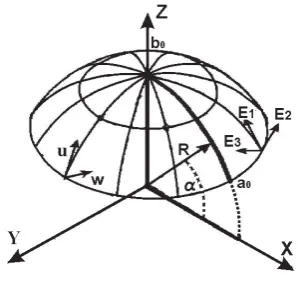
[image:4.595.229.381.561.704.2]Let us consider the problem of state-strain state and the loss of stability of the transversally isotropic segment of a spherical shell under the influence of the load with a flat base, seefigure 1. The spherical segment has a rigid support on the edge and previously has been loaded by the internal pressure.
Figure 1. The dual structure of continuum mechanics.
The deformation and loss of stability are considered to be axisymmetric therefore we can take into account only the half of the arc created by the vertical cross section. On the pole point
and the edge the boundary conditions of the symmetry and rigid support were introduced. Thus all the values depend only on one spherical coordinate, α ∈ [a0,π/2], where a0 – characterizes
the angle of segment opening.
The elastic moduli of the considered shell differ by an order, therefore the theory of anisotropic shells of moderate thicknesses by Paly-Spiro [1] is used. This theory takes into account the
in-fluence of cross section shear and the deformation into the direction of the normal to the middle surface and is based on the following hypotheses:
1) a rectilinear element normal to the middle surface of a shell remains rectilinear after the deformation;
2) the cosine of the angle of inclination of the shell of these fibers to the middle surface of the deformed shell equals to the averaged angle of the cross displacement.
The mathematical formulation of the accepted hypotheses resolves to the following equations:
u1 =u+φ·z, u3 =w+F(α, z),
φ=γ1+φ0, φ0=−
1
A1
∂w
∂α +k1u,
(1) whereu1 andu3– tangential and normal displacements of the shell,uandw– displacements
of the middle surface, ϕ – turning angle of the normal in plane (α, z); ϕ0 – turning angle of
the normal to the medial surface; γ1 – shear angle. The function F(α, z) characterizes length
change of the normal to the medial surface.
The methods of solution
The deformations which appear under the influence of the load with a flat base are large and we need the geometrical non-linear shell theory to describe them. However, the construction of the solution of the non-linear theory equations presents a significant difficulty [2, 3]. Therefore the solution of this problem is based on the method of consequent loading.
In this method pressure P is presented as the sum of monotonous consequent loadings:
P =ΔP1+ΔP2+...+ΔPn (ΔP >0, n >>1). (2)
Thus the geometrically non-linear problem is reduced to a consequent solution of linear problems for a previously loaded shell of revolution. The original stress strain state of the shell was defined by the results of the previous loadings�Ni=1ΔPi.
At each stage only the part of all the loadingΔPi is applied to the shell so that the deforma-tions should stay small. We take into account the fact that at previous stage of the loading each point of the original surface changed its own position and thickness. It needs recalculating Lame coefficientsA1,A2, curvatures k1, k2, the new law of distribution of function of thicknesses h.
Besides, the values of the stress strain state of the shell obtained at the previous stages of the loading are included in the resulting equation. The adding loadsΔP1,ΔP2,ΔP3 must be small
in comparison with that values which the upper critical load corresponds to.
In this work the method of consequent loading is presented in two ways. Thefirst of them is the method of linearization of non-linear equilibrium equations [1] and the second - the method of minimization of elastic potential of the shell [4]. These ways of the problem solution give us the different approaches to the estimation of the critical load.
In thefirst method the system of differential equations of the equilibrium of shell is solved at the each separate stage of the loading. The right part of the system except the next addition of the load ΔPi takes into account the forces and deformations from the previous step of loading.
We presume that the critical load corresponds to the case whenΔPi=0 the system ceases to be
an identical. Non-trivial solutions appear due to the influence of the internal forces.
In the second approach the solution is obtained by minimization of elasticity potential of the shell with use of the Ritz numerical method. The displacements are represented as the
functional series which satisfy the boundary conditions. Having the partial derivatives of the elasticity potential for the each member of the series of the displacement functions, we obtain the system of non-linear differential equations. To solve the obtained system of non-linear algebraic equations, the continuation method by the loading parameter ΔPi is used. In the result all
solution is reduced to the system of linear algebraic equations for the members of the series of the displacement functions. The loss of stability takes place when the resulting matrix of this system becomes degenerate. In this case the post–critical state is obtained by the change of the parameter.
The comparison of the results which were obtained with the use of these methods is done. For both methods we defined the dependence of the load contact area on the influence of the internal pressure, thickness and the curvature radius of the spherical shell segment. The distributions of the stress strain state for different values of the load are constructed. The possible appearance of exfoliation in the area of the contact with the flat base is studied. This problem may have a biomechanical application.
Numerical simulation
Let us introduce the comparison of the results which were obtained with the use of considered methods for the problem of deformation of the cornea of the eye. In the Maklakov method of tonometry a human eye is deformed byflat base load of the bar. The diameter of the contact zone with cornea is measured and the measured diameter length is used in estimating the intraocular pressure (IOP). When the intraocular pressure is not very high and the thickness of an eye shell (cornea) is small (for example, after refractive surgery) the cornea may buckle and detach from tonometer. It leads to errors in estimates of intraocular pressure[5].
The cornea average curvature radius R=8 mm, its foundation radius is constant and equal
Ros=5.25 mm, thickness h changes linearly from ha=1 mm at the edge of segment to hb=0.5
mm at the pole point. For elastic modulus, cross–section shear, and poisson’s ratios these values was taken [6, 7] : E1 =E2 =7·104 Pa,E3 =7·102 Pa, G=7·103 Pa,ν21 =ν31 =ν12=ν32 =0.4,
ν13 =ν23=0.01.
We consider that these geometrical parameters correspond to the case when the cornea is under the influence of IOP of 22 mm.Hg. (1 mm.Hg.= 133.3 Pa). Therefore firstly we consider the shell of a smaller height. It is loaded by negative IOP. The geometry of obtained form is considered to be initial. The forces which act in it are equated to zero and it is loaded by the similar but positive load. The new shell is higher than a previous one but it is taken into account the influence of internal pressure.
For modelling the influence of the bar we introduce the function which takes into account that the load acts only in straightened area on the top. In the case of appearance of displacement which leads to exfoliation of the shell from the bar the negative load starts acting. This negative load takes offthe part of the overall load from the exfoliated surface [8].
Conclusions
Let us consider deformations and the distribution of normal stress in the contact area corre-sponding to them. It should be noted that the general views of the distribution of normal stress of reviewed methods is almost similar.
a) Under the influence of the small load 0.75 gm the main stress is concentrated in the vicinity of the pole and decreases exponentially towards the edges.
b) In the case of load increase up to 3.5 gm the normal stress redistributes and the unloaded area in the vicinity of the pole appears.
c) For the given value of load of 10 gm, we can see a slightly loaded ring area. The main surface stresses act only at the edge of the loaded area and at the pole point.
Table 1. The comparison of the radiuses of contact area .
Thickness at the pole pointhb (mm) 0.5 0.465 0.43 0.395 0.36
The method of minimization Rout 3.00 3.04 3.08 3.12 3.17 The method of linearizationRout 2.97 3.00 3.05 3.10 3.15
d) When the loading is being continued (15 gm), the distribution of the load obtains a more complex shape.
e) In the case of solving this problem with the use of the method of lineralization the shell may lose the stability as this method takes into account the forceΔT1 evidently. Also the system
corresponding to it has the higher order. The forceΔT1 reaches significantly large values in the
vicinity of the pole point. This can make the shell fall down inside – lose the stability.
The table 1 presents the values of radiuses, of the contact area of the shell with a bar of 10 gm. Routfor different values of the thickness in the vicinity of the polehbmm. curvature radiuses
which are equal to R=8.5-hb mm. These calculations may help to model the consequences of
keratometric operations, because in the course of these operations a layer of tissue is cut offthe top the cornea. As one can see, the reduction of the value of thickness hb at the pole leads to
the increase of the contact areaRout. It may contribute to error in measurement IOP. Radiuses
received by method of linearization are less then radius received by method of minimization of elastic potential, which can be explained by direct accounting of effort functionΔT1 in the first
method. When the linearization method is used, unloaded or slightly loaded areas appear earlier (at a lower level of pressure), then in the case when the minimization method is used.
References
[1] O.M. Paliy and V.E. Spiro.Anisptropic shells in shipbildung. Theory and analysis. Sudostroe-nie, Leningrad, 1977.
[2] V.I. Feodosev. On a Method of Solution of the Nonlinear Problems of Stability of Deformable Systems. Journal of Applied Mathematics and Mechanics Russian Academy of Sciences, 27(2):265–274,1963.
[3] E. Lavendelis.Design of Rubber-Technical Construction Elements. Mashinostroenie, Moscow, 1997.
[4] V.V. Karpov, D.A. Baranova and R.T. Berkaliyev.The program complex for studying stability of shells. SPbGASU, Saint-Petersburg, 2009.
[5] S.M. Bauer, B.A. Zimin and P.E. Tovstik. The program complex for studying stability of shells. St. Petersburg State University Press, Saint-Petersburg, 2000.
[6] S.E. Avetisov, I.A. Bubnova and A.A. Antonov. The study of the effect of the corneal biome-chanical properties on the intraocular pressure measurement.State research institute of eye diseases RAMS, 4:30–33,2009.
[7] E.N. Iomdina. Mechanical properties of human eye. Modern problems in biomechanics, 11:183–201,2006.
[8] B. Ya. Kantor. Contact Problems of Nonlinear Theory of Shells of Revolution. Naukova Dumka, Kiev, 1990.