USER - THESAURUS INTERACTION IN A
WEB-BASED DATABASE: AN EVALUATION OF USERS'
TERM SELECTION BEHAVIOUR
Ali Asghar Shiri, Crawford Revie
Department of Computer and Information Sciences, University of Strathclyde, 26 Richmond Street, G1 1XH Glasgow, Scotland, UK
[email protected] [email protected]
In: Proceedings of the Infotech Oulu International Workshop on Information Retrieval, Oulu, Finland, September 19-21 2001.
Abstract. A major challenge faced by users during the information search and retrieval process is the selection of search terms for query formulation and expansion. Thesauri are recognised as one source of search terms which can assist users in query construction and expansion. As the number of electronic thesauri attached to information retrieval systems has grown, a range of interface facilities and features have been developed to aid users in formulating their queries. The pilot study reported here aimed to explore and evaluate how a thesaurus-enhanced search interface assisted end-users in selecting search terms. Specifically, it focused on the evaluation of users' attitudes toward both the thesaurus and its interface as tools for facilitating search term selection for query expansion. Thesaurus-based searching and browsing behaviours adopted by users while interacting with a thesaurus-enhanced search interface were also examined.
1. Introduction
Thesauri have been important information and knowledge organisation tools for more than three decades. While initial proposals to utilise thesauri focused on their ability to ensure consistent analysis of documents during input to information retrieval systems, they have increasingly become vital as aids to effective retrieval. Milstead [18] commented that in the near future thesauri will be used more in retrieval than for indexing and that although the mode of use is changing, this change actually represents an expansion rather than a contraction of their utility. Aitchison et al.[1] have also noted that the role of thesauri is changing, but that they are likely to remain an important information retrieval tool.
The present study adopted a user-centred approach to evaluate end-users' search term selection for query expansion on a thesaurus-enhanced search interface.
2. Related research
A number of studies have reported on the use of thesauri for query formulation and expansion. Some of these investigations adopted laboratory type experiments which elicited real information requests from users and required them to provide relevance judgements, but the actual search term selection and expansion process was carried out by the researcher [13-15]. These efforts focused on retrieval performance, query structures and the ways in which thesauri affect the search outcome rather than on the search process itself. The findings of these studies demonstrated the effects of thesaurus-assisted query expansion in improving retrieval performance and search results.
Other investigations applied more user-based approaches to thesaurus-aided query expansion with different levels of user involvement in the term selection and query expansion process. In a series of investigations, Fidel [5-8] studied the search key selection behaviour of 47 professional online searchers while performing job-related searches. Thesaurus terms selected by searchers for query formulation or expansion constituted a major part of their information searching behaviour.
Interaction between users and intermediaries to select search terms was studied and thesaurus was considered as one of five major sources of search term selection for query expansion in a real situation with real users and requests [19]. The research undertaken by Jones et.al.[12] adopted different and more user-based approach to term selection for query expansion since the thesaurus-aided query expansion was examined in a relevance feedback environment with real users with the aim of finding some patterns for building intelligent rule or weight-based algorithms.
The use of thesaurus by experienced and less-experienced searchers has also been investigated to evaluate the impact of thesaurus on information retrieval [11]. It provides some evidences on search term and search result satisfaction by both searcher groups. However, thesaurus browsing and searching behaviours of the searchers were not the focus of the study. Greenberg [9,10] examined the impact of semantic and lexical structure of thesaurus and various thesaurus-assisted query expansion on retrieval performance. This study approached end-users for eliciting real requests, relevance judgement on the search results, and end-users’ comment on query expansion term list. It did not look into the thesaurus searching and browsing behaviours of the users and how they interacted with thesaurus as a source of term expansion. Rather, it aimed to explore how users’ query terms mapped to thesaural terms and what benefits these terms could have as possible candidate terms for automatic and interactive query expansion.
As can be observed very few studies have reported the end-user search term selection behaviour using an online thesaurus as a source of search terms for query expansion. Some of the studies reviewed here have looked at searchers or end-users selecting terms from printed thesauri rather than electronic ones. User interaction with thesaurus and the ensued changes in end-user’ knowledge of terms and the reasons for selecting query expansion terms are among the areas which call for more research.
during query expansion, a thesaurus could be used for displaying the relationships of the selected terms to other terms for example by displaying the hierarchical tree to which the term belongs (as in INSPEC or MESH tree displays) or by presenting broader, narrower or related terms on the screen for user to browse and select from. He also emphasised the need for research into the process of term selection by users because of its importance for understanding the users’ searching behaviour.
Having determined the need for more research on the topics discussed above, the pilot study reported here examined the process of search term selection for query formulation and expansion by end-users interacting with and browsing an online thesaurus. Since most of the studies on the use of thesauri during the search process have focused on the behaviour of search specialists, this study evaluates the use of thesauri by researchers as experienced end-users with subject domain knowledge. It evaluated the ways in which a thesaurus affects their selection of terms, including their likelihood to using new terms. Users' impression of the online thesaurus interface were also elicited within the study.
3. Experimental design
The following is a brief account of the experimental design utilised to evaluate users' attitudes toward the thesaurus and its interface as an aid for query formulation and expansion.
3.1. The Information retrieval system
The web-based interface to the CAB Abstracts database provided by Ovid Technologies was used in this study as it provided the system features required for this experiment. The system provides a thesaurus-based searching facility in its advanced search mode which maps users' search terms to the thesaurus descriptors. It also caters for browsing and selecting terms during the query construction process.
3.2. The subjects
The purpose of the study requires the participation of genuine users with real information needs. Faculty and researchers were selected from the departments of veterinary medicine and biology at Glasgow University as these two subject areas are well covered in the CAB Abstracts database.
3.3. Search requests
Search requests were elicited based on information needs of the researchers prior to running the experiment. Each researcher was asked to provide three search topics of interest. This decision was made on the assumption that evaluation of search term selection can effectively be carried out only if users having genuine information requests take part in the study.
3.4. Data gathering techniques
4. Analysis of data
The quantitative and qualitative data collected through the experiment were analysed to explore the thesaurus-based browsing and searching behaviours of the users. Pre-search questionnaires and post-search interviews provided the qualitative data, while screen-capturing software served as a tool for quantitative data gathering.
4.1. Characteristics of the participants
All users were faculty and researchers having experience in using word processors, the World Wide Web, computer applications such as Excel, Power Point, and databases such as Dialog, Web of Science, and BIDS. Two users had experience of using computers for between 4-10 years and the other two had more than 10 years of experience. Their intentions of using the information they searched for were: research project, publication, and teaching. Users were asked whether their search could be characterised as “broad” or “narrow”. Three users chose to carry out broad searches while the other user decided to perform narrow searches. Two of the four users already had experience of using the OVID interface to the CAB abstract database.
4.2. Searching and browsing behaviours
The data gathered through screen-capturing techniques were analysed to assess various levels of user - system interaction. To identify thesaurus-based search behaviours and patterns, a number of process measures were used to quantitatively analyse all individual search process characteristics. These measures are as follows: state, move (step), and
search term.
State: major stages or conditions a user goes through while conducting a search;
Move (or step): characterises any action a user takes while interacting with the system;
Search term: a general characterisation of all types of terms used during the entire search, provided either by the user or the system.
Based on the above measures, the following quantitative data can be derived to evaluate various layers of user-system interaction: total number of states, total number of moves, total number of search terms, number of search terms viewed, number of search terms selected, total number of mapped and unmapped thesaurus terms, total number of reformulations, total number of records viewed.
To provide a basis for analysing the data, a classification of the moves and states in the thesaurus-based search process had to be developed to identify different steps a user takes while performing a thesaurus-based search. There are a substantial number of studies focusing on information seeking and searching behaviours, most of which have investigated the general search process while the emphasis of the present study is on user behaviours while interacting with a thesaurus facility as a source of term selection.
Begin search state
Mapping
state Thesaurusstate Combinestate Resultdisplay
Figure 1. States in the thesaurus-based search process
[image:5.595.68.549.265.469.2]Five states and ten move types were defined to represent typical search stages and moves in a thesaurus enhanced search environment. The five states, illustrated in Figure 1, characterise major stages which users pass through during the search process. Moves are detailed accounts of actions taken and system features employed by users while interacting with the system. The ten moves defined to describe these steps and actions are listed in Table 1. The 12 searches conducted by four researchers were analysed using this framework to shed light on various aspects of the browsing and searching behaviours of participants, and the results are provided in Table 1.
Table 1. Number of moves of different types per search
Moves S1 S2 S3 S4 S5 S6 S7 S8 S9 S10 S11 S12 Total for
all searches
Term input 2 1 1 1 3 2 5 5 2 4 4 5 35
Perform search 2 1 2 1 3 2 6 6 2 5 6 6 42
Browse initial mapped
terms 2 1 2 2 3 2 4 4 2 4 7 5 38
Browse thesaurus 2 1 2 0 2 1 2 1 3 2 5 5 26
Select terms 2 1 2 2 4 2 4 6 3 4 7 5 42
Combine terms 1 0 0 3 3 1 2 2 1 3 3 3 22
Continue search 3 1 3 3 7 3 8 7 4 7 9 9 64
Search reformulation 1 0 1 2 3 1 1 1 0 3 1 2 16
Browse titles 1 0 1 1 0 1 1 2 0 1 3 4 15
View complete records 0 0 1 2 1 1 1 5 1 1 2 2 17
Total moves per search 16 6 15 17 29 16 34 39 18 34 47 46 317
Two main types of moves were identified in order to analyse user interaction behaviour in more detail:
a) conceptual moves in which users perform some kind of conceptual analysis of terms and documents;
b) moves associated with using system features such as perform search, combine terms, and continue search.
Users made a total of 317 moves of which 189 (60%) were of a conceptual nature, the rest being associated with the use of system features. On average users made 26.4 moves per search. Conceptual moves can be broken down into three types i.e. moves related to entering search terms, moves dealing with thesaurus browsing and term selection or query reformulation, and moves connected with the retrieved results such as browsing titles and viewing complete records. Of the 189 conceptual moves 106 (56%) were associated with browsing the thesaurus, viewing mapped terms, and term selection. This means that one third of all moves are connected with browsing and choosing search terms from mapped and thesaurus terms.
4.3. Search term selection
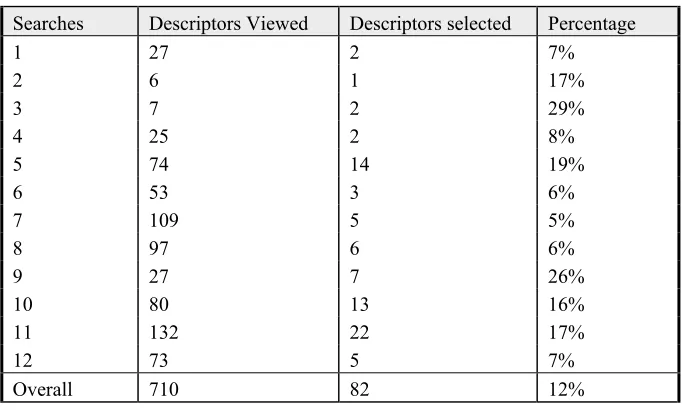
[image:6.595.118.459.239.444.2]Selection of search terms is a dynamic and challenging activity which forms a key element of the search process. A number of studies have stressed the importance of some kind of terminological assistance in aiding the search term selection process [2,4,12,16,17]. As this study deals with the selection of search terms in a thesaurus-enhanced environment, effort was made to analyse and calculate all thesaurus descriptors users browsed and selected in different stages of the search process.
Table 2. Details of descriptors viewed and selected by users
Searches Descriptors Viewed Descriptors selected Percentage
1 27 2 7%
2 6 1 17%
3 7 2 29%
4 25 2 8%
5 74 14 19%
6 53 3 6%
7 109 5 5%
8 97 6 6%
9 27 7 26%
10 80 13 16%
11 132 22 17%
12 73 5 7%
Overall 710 82 12%
[image:6.595.119.459.242.442.2]In total users browsed 710 descriptors, selecting 82 of these for use during the 12 searches as shown in Table 2. Thus on average around 12% of descriptors browsed were actually selected though there is clearly significant variability, with specific search selection figures ranging from 5 to 29%.
Table 3. Average number of initial, browsed and selected terms per search
Initial search terms 2.8
Browsed thesaurus terms 59.2
Selected thesaurus terms 6.8
As the Ovid database maps the terms entered by users to the descriptors in the CAB thesaurus, the proportion of mapped and unmapped terms was also investigated. Of the 34 initial search terms entered, 28 were mapped to the thesaurus while 6 were not matched to any descriptors. The finding that around 80% of users’ initial query terms were mapped to thesaurus descriptors is comparable to results in an investigation undertaken by Fidel [7].
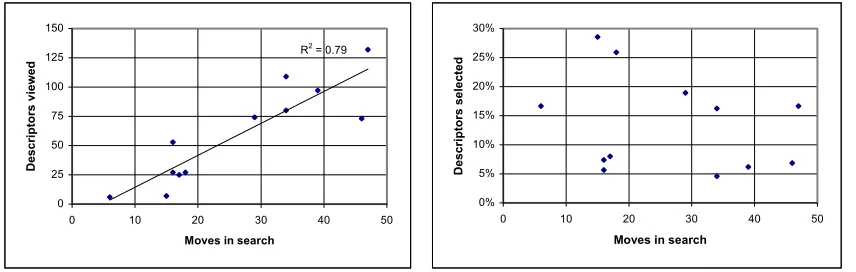
Figure 2a/b. Scatterplots showing the relationship between the number of moves in the search process and: (a) the number of descriptors viewed; (b) the percentage of
descriptors selected
Using the framework outlined above and the state/move/descriptor definitions it is possible to summarise the impact of users interactions in a number of ways. For example, the graph in Figure 2a illustrates the fact that as the number of moves made by the user increases so does the number of descriptors viewed. This in itself is not particularly surprising as these variables are not entirely independent though the strength of the relationship is perhaps significantly higher than might be expected (coefficient of correlation, R=0.89). On the other hand, the graph in Figure 2b illustrates the fact that the number of moves made by the user does not have any significant relationship to the percentage of terms selected. Both of these graphs require a larger data set than was available from the pilot study to begin to provide confidence that important patterns are being observed. However, if for example, the lack of any relationship apparently demonstrated in Figure 2b was confirmed this may have implications for the extent to which the thesaurus interface design attempted to encourage the user to carry out additional browsing and reformulation.
4.4. Search term and search results satisfaction
In the post-search interview users were asked about the selection and usefulness of search terms. All users mentioned that the thesaurus provided them with useful alternative terms. One user noted that the thesaurus was useful because it suggested alternative terms that she recognised immediately but which she did not necessarily think of at the beginning of the search process. It was very helpful when the user entered a term without any confidence and the mapped term was the exact term the user was looking for. Another user commented that in addition to providing extra useful terms, the thesaurus offered options for narrowing down the search as well as giving different perspectives of the same subject.
R2 = 0.79
0 25 50 75 100 125 150
0 10 20 30 40 50
Moves in search
Descriptors viewed
0% 5% 10% 15% 20% 25% 30%
0 10 20 30 40 50
Moves in search
[image:7.595.78.506.177.313.2]Two users felt very satisfied with the number and content of the search results whereas the other two users stated that they were fairly satisfied. One of the users pointed out that since the topic for which he was searching was relatively novel, he had not expected a large number of results. Another user mentioned that he had obtained more results than he had previously retrieved when carrying out a similar search. On the whole, two users judged their searches with CAB and its thesaurus as very successful and the other two considered their searches to have been fairly successful.
4.5. Users’ general impression of the system and its interface
The users' overall assessment of the learnability and usability of the system and its interface was elicited. Users were asked about problems and difficulties they experienced during the search process. All users stated that using the system in general was straightforward and they did not have significant problem in using it.
One user commented that the point and click features of the system were easy to learn and use. Click boxes and hypertext features associated with thesaurus descriptors together with the way in which individual searches could be combined, were mentioned by all users as easy to use and intuitive. A number of users mentioned that the location of the
continue search button, one of the most frequently used system features, was a problem as the user had to change his position and look up the whole page to find the button.
Another user pointed out that while there was an option for choosing between the operators AND or OR when combining descriptors in the thesaurus, user did not have the choice to select both operators for more complex Boolean manipulation. One user stated that the thesaurus hierarchy was useful in showing her terms related to the search topics but that in some cases it was a little confusing as she became lost in deeper levels of the hierarchical structure.
5. Conclusion
This paper has reported a pilot study undertaken to evaluate how an online thesaurus, provided as an integral part of a web-based database, affects the behaviour of users in their formulation and expansion of queries. A number of states and steps associated with thesaurus-based browsing and searching were defined to analyse in detail different levels of interaction. Initial analysis of the data gathered during the pilot study suggests that the framework developed will provide a solid basis for investigating various aspects of users’ interactions with the thesaurus and its interface. The findings show that users in general considered the thesaurus to be a useful feature of the system through which they could find alternative search terms and different perspectives of the search topics. Users expressed their satisfaction with search term selection using the thesaurus and mapping facility. There were also a number of interface features for which the users suggested improvements. Future work will involve a larger study for evaluating detailed user -thesaurus interaction in order to explore -thesaurus browsing and searching behaviours as well as issues affecting users' attitude in selecting search terms for query formulation and expansion.
Acknowledgement
References
[1] Aitchison J, Gilchrist A, Bawden D (1997) Thesaurus construction and use: a practical manual. ASLIB, London.
[2] Brajnik G, Mizzaro S, Tasso C (1996) Evaluating user interfaces to information retrieval systems: a case study on user support. Proceedings of the 19th Annual International ACM/SIGIR Conference on Research and Development in Information Retrieval, Germany, Hartung-Gorre Verlag Konstanz, 128-136.
[3] Efthimiadis E N (1994) End-users' understanding of thesaural knowledge structures in interactive query expansion. Proceedings of the 3rd International Conference of the International Society for Knowledge Organisation (ISKO), Frankfurt, Indeks Verlag, 295-303.
[4] Efthimiadis E N (2000) Interactive query expansion: a user-based evaluation in a relevance feedback environment. Journal of the American Society for Information Science 51: 1-25.
[5] Fidel R (1986) Towards expert systems for selection of search keys. Journal of the American Society for Information Science 37: 37-44.
[6] Fidel R (1991a) Searcher's selection of search keys: I. The selection routine. Journal of the American Society for Information Science 42: 490-500.
[7] Fidel R (1991b) Searchers' selection of search keys: II. Controlled vocabulary or free-text searching. Journal of the American Society for Information Science 42: 501-514.
[8] Fidel R (1991c) Searchers' selection of search keys: III. Searching styles. Journal of the American Society for Information Science 42: 515-527.
[9] Greenberg J (2001) Automatic query expansion via lexical-semantic relationships. Journal of the American Society for Information Science and Technology 52:402-415.
[10] Greenberg J (2001) Optimal query expansion (QE) processing methods with semantically encoded structures thesauri terminology. Journal of the American Society for Information Science and Technology 52:487-498.
[11] Harrison L D (1998) The impact of thesauri on information retrieval (Query formulation). Unpublished doctoral dissertation, Rutgers, the State University of New Jersey, Ph.D. Dissertation, New Jersey.
[12] Jones S, Gatford M., Hancock-Beaulieu M., Robertson S E, Walker W, Secker J (1995) Interactive thesaurus navigation: intelligence rules Ok? Journal of the American Society for Information Science 46: 52-59.
[14] Kristensen J, Jarvelin K (1990) The effectiveness of a searching thesaurus in free text searching of a full-text database. International Classification 17: 77-84.
[15] Kristensen J, Jarvelin K (1998) The impact of query structure and query expansion on retrieval performance. Proceedings of 21st Annual International ACM SIGIR Conference on Research and Development in Information Retrieval, Melbourne, New York, ACM Press, 130-137.
[16] Marchionini G (1989) Information-seeking strategies of novices using a full-text electronic encyclopaedia. Journal of the American Society for Information Science 40: 54-66.
[17] Meadow C, Wang J, Yuan W (1995) A study of user performance and attitudes with information retrieval interfaces. Journal of the American Society for Information Science 46: 490-505.
[18] Milstead J L (1998) Use of thesauri in the full-text environment. Visualising Subject Access for 21st Century Information Resources. Proceedings of the 34th Annual Clinic on Library Applications of Data Processing, Graduate School of Library and Information Science, University of Illinois, 28-38.