Exploiting a Graphplan Framework in Temporal Planning
Derek Long and Maria Fox
University of Durham, UK [email protected],[email protected]
Abstract
Graphplan (Blum & Furst 1995) has proved a popular and successful basis for a succession of extensions. An extension to handle temporal planning is a natural one to consider, be-cause of the seductively time-like structure of the layers in the plan graph. TGP (Smith & Weld 1999) and TPSys (Gar-rido, Onaind´ıa, & Barber 2001; Gar(Gar-rido, Fox, & Long 2002) are both examples of temporal planners that have exploited the Graphplan foundation. However, both of these systems (including both versions of TPSys) exploit the graph to rep-resent a uniform flow of time. In this paper we describe an alternative approach, in which the graph is used to repre-sent the purely logical structuring of the plan, with tempo-ral constraints being managed separately (although not inde-pendently). The approach uses a linear constraint solver to ensure that temporal durations are correctly respected. The resulting planner offers an interesting alternative to the other approaches, offering an important extension in expressive power.
Introduction
Graphplan (Blum & Furst 1995) has proved an influen-tial planning system, even if its performance has been su-perceded for many of the classical benchmark problems. Amongst its many adaptations is one of the first domain-independent planners (not using hand-coded control knowl-edge) to manage temporal planning, TGP (Smith & Weld 1999). In that system, the structure of the graph was ex-ploited to represent the flow of time and durations were at-tached to actions, using a very strong constraint on interac-tions between concurrent acinterac-tions. In particular, any propo-sition that is changed by the action is effectively locked to that action for the interval of its execution. This means that it is impossible to express actions in which the desired ef-fect is something that is true precisely for the duration of the action. For example, if one needs to cross the basement and replace a fuse, then the light to achieve these actions might be provided by striking matches. The light begins when the match is struck and ends after the duration of the match burning action. Potential for this kind of concurrency is captured in PDDL2.1 (Fox & Long 2002). Durative ac-tions in that model use the end points of durative acac-tions
Copyright c 2003, American Association for Artificial Intelli-gence (www.aaai.org). All rights reserved.
to capture the behaviour that occurs in the interval of the durative action, allowing more sophisticated exploitation of concurrent activity, including the consultation of proposi-tions that are changed by durative acproposi-tions. This model is founded on an underlying principle that duration is attached to state and that transitions between logical values of state-describing propositions should be instantaneous at the level of the model, since otherwise it is necessary to complicate the model of state updates by introducing a third value repre-senting undefined which must be used for propositions that are in flux. It was, in effect, to handle the consequences of a conservative model of undefined values that Smith and Weld (Smith & Weld 1999) introduced such a tightly con-strained mutual exclusion relation between concurrent ac-tions, preventing any activities from attempting a concurrent access of a proposition that might be undefined because of the transitional activity in a parallel durative action.
actions, the end of the shortest action and, finally, the end of the longest action.
The objectives of this work are:
1. to modify Graphplan to perform temporal planning in a language that allows both initial and final effects of a du-rative action to be exploited in a plan;
2. to construct an architecture that is as simple an extension or modification of Graphplan as possible, since Graphplan is a widely and well-understood foundation, making this approach more accessible;
3. to demonstrate the relationship between mutex relations in Graphplan and the interactions between concurrent du-rative actions.
We proceed to describe the way in which a PDDL2.1 do-main is converted into a form that allows Graphplan plan-ning to be used. Several constraints must be satisfied by the domain for this transformation to be possible and they are described. We then go on to describe the modifications to the Graphplan algorithm that allow correct temporal planning behaviour to be achieved and the mechanisms by which the temporal durations of states are introduced into the planning structure. We present some results and discuss the shortcom-ings of the approach. Finally, we make some observations about the relationship between the Graphplan model of con-currency and the PDDL2.1 model of concon-currency.
Treatment of PDDL2.1 domains
In this section we discuss the preprocessing of a PDDL2.1 durative actions domain model to achieve a form that can be used for Graphplan planning. The core idea is to translate durative actions into standard simple actions that can be used to simulate the original semantics of the durative-actions.
PDDL2.1 extends PDDL in several important ways. In this paper we consider only the temporal extension. The treatment of numeric values has been explored in the Graph-plan framework (Koehler 1998), but we have not considered it further in this work. PDDL2.1 offers the opportunity to use different kinds of durative actions: the simplest are those in which the durations are fixed, possibly as a function of the parameters of the action. Since we are not considering numeric values in any other context, we can only allow du-rations that are a fixed function of the parameters, defined in the initial state. Thus, for example, a fly action that takes time that is a function of the start and end of the flight is possible, but we cannot capture fuel use or flight time that is a function of how much fuel the plane is carrying. PDDL2.1 represents durative actions by describing the transitions that occur at the end points of the interval of activity, using an essentially classical pre- and post-condition model of these transitions, together with a collection of invariant conditions that must hold over the duration of the action. The invari-ants are an essential element that bind together the start and end points of the actions into a coherent durative activity. The other element is the duration itself, which governs the separation of the start and end points.
In the following discussion, we are motivated by the in-tention to modify the underlying Graphplan behaviour as
lit-tle as possible. This offers several possible advantages, in-cluding that the wide array of Graphplan extensions and al-gorithmic improvements that have been considered could be applicable to the temporal form. There is a trade-off to be considered. On one hand it is possible to use mechanisms in a carefully constructed domain encoding that will force a standard Graphplan system to simulate our intended se-mantics of durative actions. On the other hand, some mech-anisms cause such a deterioration in Graphplan behaviour that it is impractical to avoid making modifications to the algorithm to achieve the intended behaviour.
A straightforward conversion of PDDL2.1 actions into ac-tions that can be used by a standard Graphplan planner is to create the simple actions representing the end points of the durative actions. This is a good starting point, although we shall see that there are some complications that must be ad-dressed. The first of these is that we want to ensure that the start and end point actions are always managed as a pair. To achieve this, we add a new effect to the start action that is required by, and deleted by, the end action. Thus, the end action cannot be executed without also executing the start action. The converse case raises an interesting ques-tion about the nature of plans: if a plan contains the start of a durative action, without seeing it through to successful completion, should it be considered a valid plan? This ques-tion is discussed in detail elsewhere (Long & Fox 2001), but in the current work we adopt the view that durative actions carry an intention to complete them, and it is therefore in-appropriate to construct a plan exploiting the initial effects of a durative action without confirming that the obligations for successful completion can be met. Therefore, if a plan contains the start action it must also contain the end action. This is a constraint that cannot be imposed using pre- and post-conditions of the actions alone. It can be achieved by adding a delete effect to the start action that is reachieved by the end action, and then adding this proposition to the initial state of the problem and to the goal state, for every action instance. Thus, use of the start action will prevent the goal from being reached unless the end action is used to restore the equilibrium. This mechanism is a relatively expensive one to use, since it requires a large number of new artificial facts and also creates a large number of artificial new choice points. The alternative is to prevent start actions from be-ing used to achieve goals unless their correspondbe-ing end ac-tion has already been inserted into the plan (while searching backwards through the plan graph).
A-start A-invariantcheck A-invariantcheck A-end Pre: start
+initial effects Add: As
Pre: As, inv
Add: As, Ai
Pre: As, inv
Add: As, Ai
+ final effects Pre: As, Ai
Del: As, Ai
[image:3.612.137.474.53.198.2]with invariant: inv Durative action, A,
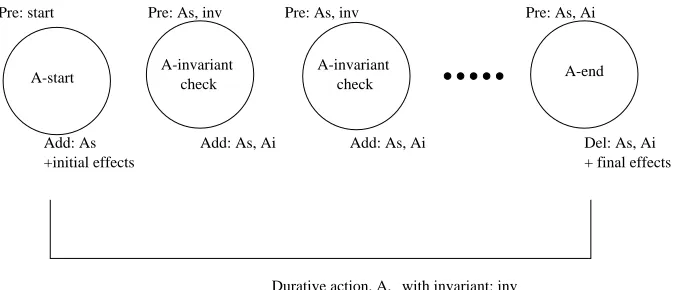
Figure 1: Modelling a durative action with a collection of simple instantaneous actions.
achieved by the start action and an effect required as precon-dition by the end action. However, there remains a problem: we want it to be possible for multiple happenings to occur in the interval between the end points, and in that case the in-variant should be rechecked following each such happening. This means that we must force the invariant checking action to be reapplied at each layer in the graph between the layer containing the start action and the layer containing the corre-sponding end action. Unfortunately, Graphplan will attempt to exploit noops to make the effect of the invariant action persist until the end point at which it is required, or the effect of the start action persist until the invariant action requires it, placing a single instance of the invariant checking action at whichever intermediate layer is least inconvenient. To pre-vent this we require two mechanisms, one being a modifica-tion of the Graphplan machinery itself and the other being an addition to the domain encoding. The latter is the require-ment to add an additional effect to the invariant checking action, which is the special proposition achieved by the start action and used as a precondition of the invariant-checking action itself. It can be seen that this action then behaves like a noop with additional preconditions — the invariant con-ditions of the durative action to which it corresponds. The modification in the Graphplan engine is not to generate the standard noop for either the special effect of the invariant-checking action or for the effect of the start action that acts as precondition for the invariant-checking action and the end action.
The way in which this collection of actions now fits to-gether to model the enactment of a durative action can be seen in Figure 1. An example of the actions generated for a durative action from PDDL2.1 can be seen in Figure 2.
The last requirement to harness Graphplan to our purpose is a means to communicate the durations of durative actions. This is really an implementation detail, but our solution is to separate the duration values out of the initial state and put them into a separate file, while adding a special dura-tion field to each of the start and end point acdura-tions. The transformed domain is therefore in a pseudo-PDDL syntax, representing a collection of almost classical STRIPS PDDL actions, but for this additional information. The transforma-tion can be performed automatically from a PDDL2.1 input,
(:durative-action debark
:parameters (?p - person ?a - aircraft ?c - city) :duration (= ?duration debarking-time)
:condition (and (at start (in ?p ?a)) (over all (at ?a ?c))) :effect (and (at start (not (in ?p ?a)))
(at end (at ?p ?c))))
(:action debark-start
:parameters (?p -person ?a -aircraft ?c -city) :duration (debarking-time)
:precondition (in ?p ?a) :effect (and (not (in ?p ?a))
(debarking-inv ?p ?a ?c)))
(:action debark-inv
:parameters (?p -person ?a -aircraft ?c -city) :precondition (and (debarking-inv ?p ?a ?c)
(at ?a ?c))
:effect (and (idebarking-inv ?p ?a ?c) (debarking-inv ?p ?a ?c)))
(:action debark-end
:parameters (?p -person ?a -aircraft ?c -city) :duration (debarking-time)
:precondition (idebarking-inv ?p ?a ?c) :effect (and (not (idebarking-inv ?p ?a ?c))
(not (debarking-inv ?p ?a ?c)) (at ?p ?c)))
PDDL2.1 Durative Action Domain Model
PDDL2.1 Problem
Translator (based on Validator code)
LPGP Simple Action set LPGP Problem LPGP Durations
Action Grounding
Graph Construction
Graph Search Linear Programming Solver
[image:4.612.83.264.54.197.2]Plan Final Processing Valid PDDL2.1Plan LPGP: Modified GraphPlan Engine
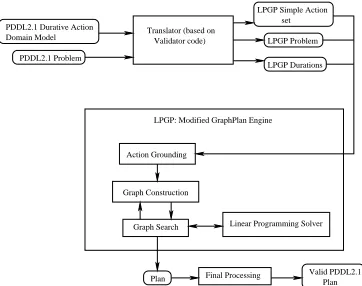
Figure 3: The architecture of the temporal Graphplan vari-ant, LPGP.
so should not be seen as introducing a new language, but simply as a compilation into an internal representation for-mat.
An important question arises in determining the treatment of start actions as possible achievers. When an end action is used to achieve a goal the corresponding start action will be forced into the plan in order to satisfy the preconditions of the end action. On the other hand, if a start action could satisfy a goal then the corresponding end action should
al-ready have been placed in the plan. This organisation
fol-lows from the backward sweep search that is used to con-struct a plan in Graphplan. Unfortunately, it is very difficult to return to a previously visited layer in the search and insert additional actions, so using a start action to achieve a goal is very problematic. This problem does not arise in TGP because the action representation precludes durative actions achieving anything at the start of their execution. A further encoding can be used to handle this situation. We add a spe-cial effect to the end action that also appears as a goal and in the initial state. This means that the goal can be achieved by
noops from the initial state, or it can be achieved using the
end action encoding the durative action. The consequence of this construction is to allow the search to insert the end ac-tion into the plan at any layer in the search. In addiac-tion, we ensure that start actions can only be selected if their corre-sponding end point is already in the plan. The special propo-sition acts as a catalyst to allow insertion of the end action when the release of the start action is necessary for the con-struction of a plan. It is possible to use some analysis to determine when the start effects of an action could be re-quired to achieve the goals, based on the reachability within the plan graph. This allows us to limit use of this construc-tion to cases where it might play a useful role.
The process by which our Graphplan variant, which we call LPGP (Linear Programming and Graph Plan), plans with a PDDL2.1 domain is shown in Figure 3. The durations file produced in the translation conveniently separates the in-formation required for managing the durative actions from the initial state information required for the usual grounding of actions.
Modelling Time Flow in the Planning Graph
In TGP and TPSys, the plan graph is adapted to perform temporal planning by attaching duration to actions, where actions are represented by a single structure as with the orig-inal Graphplan. The disadvantage of this approach is that the layers containing actions can then no longer be treated as uniform, since they can contain actions of different dura-tions. As a result, the structure of the graph is complex to construct and to search.
In the LPGP planner we invert the way in which time is attached to states and actions and we do not use the graph layers to measure time in uniform increments. In TGP and TPSys states are instantaneous, while time flow is at-tached to the actions. Actions can span several layers of the graph between the point at which their preconditions must be achieved and the end point at which they have their ef-fects. TGP actions do not have initial effects and actions are mutex with any other actions that might attempt to access the propositions used or changed by them. This is a strong mutex relationship, and prevents any attempt to model, for example, executing an action to wash ones hands while a sink is being filled — the sink-filling action must end before the water is accessible.
During search, TGP must attach a length with noop ac-tions. To ensure that an optimal length plan is found, this must be set to be the GCD of the lengths of actions in the domain, which can result in an expensive search process. However, this technique has an important benefit which is that the optimality of the plan length in terms of graph layers searched is equivalent to the optimality in terms of execution time. However, the price is very high: any plan that has a long execution time relative to the lengths of any of its ac-tions will require a very large graph structure to be searched, even if the plan requires relatively few actions.
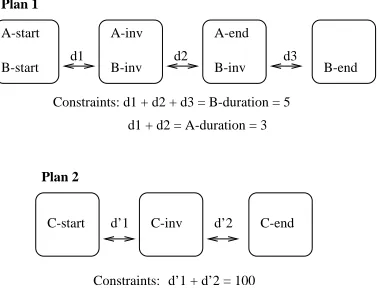
In LPGP we attach duration to states, so each fact layer is associated with a duration. The layers are used only to capture the points at which events occur within the execu-tion trace of the plan, rather than uniform passage of time. By separating the graph structure from the flow of time in this way we gain the benefit that plans with few events only require short graph structures. However, it is not always true that a plan that requires fewest distinct points of activity will be the shortest in duration. For example, if two goals can be achieved by the parallel execution of actionsAandB, with durations3 and5 time units respectively, or by the single actionCwith duration100units, the plan in whichAand
B are used will require more distinct levels of activity (the simultaneous start ofAandB, the end ofAand then the end ofB) than the plan usingC alone. In fact, this example is slightly simplified because of the need to insert the special actions to check invariants. The complete plan structure is illustrated in Figure 4.
A-inv
B-inv
A-end
B-inv A-start
B-start B-end
Constraints: d1 + d2 + d3 = B-duration = 5 d1 + d2 = A-duration = 3
C-end C-inv
C-start d’1 d’2
d’1 + d’2 = 100 Constraints:
d1 d2 d3
Plan 1
[image:5.612.81.271.56.200.2]Plan 2
Figure 4: Two alternative plan structures showing how a temporally longer plan can have a simpler activity structure, being represented in fewer plan graph layers.
Modification to Graphplan
The architecture of Graphplan can be divided into three components: the grounding of actions, the construction of the plan graph and the subsequent search for a plan. In prac-tice, of course, graph construction and search are interleaved (leading to an iterated depth-first search), but it is convenient to consider these three components separately in order to ex-plain how LPGP modifies the original Graphplan algorithm.
Action Grounding
During grounding of actions we prune out start and end ac-tions if their duration field is undefined in the duraac-tions file. These actions are not legally applicable. Also during the in-stantiation phase we attach the correct duration values to the instances of the start and end point actions, looked up from the values to be found in the initial state. The final mod-ification in the instantiation phase is to mark actions with their type (derived from an examination of the suffix in their names): start, end and invariant-checking actions. Only one instance of each of these actions is required (including the invariant-checking action), even though multiple instances might be applied in a plan. Where a durative action spans multiple layers, requiring several instances of the invariant-checking action to be applied, the instances are all copies of the same action instantiation, each attached to its own layer of the graph.
Thus, the only modification to a standard Graphplan algo-rithm required during the grounding phase is the addition of extra information to the ground action structures that can be inferred from the names of the actions.
Graph Construction
The graph construction phase is modified in two ways. Firstly, a stronger mutex relation is enforced between ac-tions than the classical Graphplan mutex. In Graphplan, two actions are permanently mutex if the delete effects of one in-tersect with the preconditions or add effects of the other. In PDDL2.1 there is a stronger requirement to ensure that ac-tions do not interfere with one another, called the “no
mov-ing targets” rule. This insists that two actions cannot be ex-ecuted concurrently if they add the same effect or delete the same effect, in addition to the possible sources of interfer-ence identified in Graphplan. We discuss the implications of this in the context of a temporal plan in Section . The second modification is that no noops are constructed for the facts that have an-invsuffix. This forces the invariant checking actions to be used to propagate these facts between layers, ensuring that the invariants are checked as the propagation is carried out.
Graph search
This phase of the Graphplan algorithm is the one most af-fected by the introduction of time. The original Graph-plan search algorithm is shown in Figure 5, annotated with the modifications required to support LPGP. Underlying the modification is the introduction of a linear programming problem, with constraints derived from the durations of ac-tions. This problem can be maintained during the search so that, at all times, a solution to the linear constraints will provide a consistent allocation of durations to the fragment of the plan that has so far been constructed. If the problem is ever unsolvable then the plan is invalid and search must backtrack.
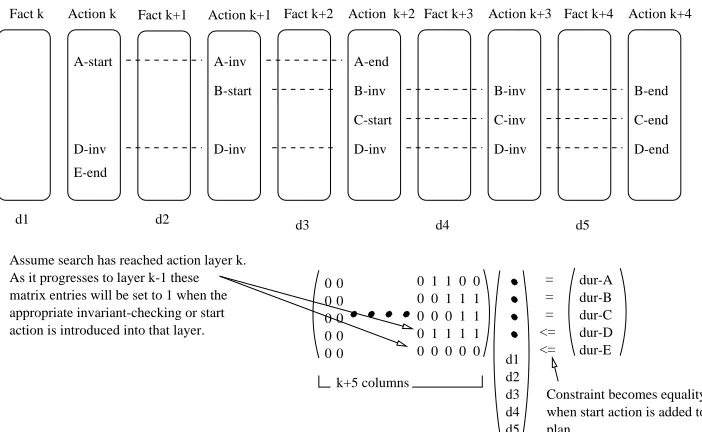
When an end action is selected to act as the achiever for a goal fact we introduce a temporal constraint. This constraint will assert that the total duration of the fact layers between the start and end actions of the durative action must equal the duration of the action. However, when the end action is first introduced we cannot yet know when the start action will appear. Therefore, the constraint is initially an asser-tion that the layers between the current layer and the layer containing the end action must have total duration less than the duration of the associated action. The two forms of con-straints, then, are simply linear constraints on the durations of the fact layers and the equations must be solved for these durations, minimizing the total duration of the plan. This means that it is possible to use a linear programming algo-rithm (such as the simplex algoalgo-rithm) to solve the equations. The form of the constraints for such a solver is best given as a matrix of the coefficients for the linear combinations of the variables (which are the durations attached to the fact layers). The matrix contains as many columns as there are fact layers in the graph and as many rows as there are dura-tive actions in the (current) plan. New columns are added to the matrix as the graph is extended, prior to searching from each new layer. As an end action is introduced into the plan a new row is added to the matrix. When an invariant-checking action is added, the column denoting the fact layer succeed-ing the action layer containsucceed-ing the invariant check is set to
0 1 1 0 0 0 0 1 1 1 0 0 0 1 1 0 1 1 1 1 0 0 0 0 0
= = =
<= <=
dur-A dur-B dur-C dur-D dur-E 0
0 0 0 0 0 0 0 0
0 d1
d2 d3 d4 d5 k+5 columns
As it progresses to layer k-1 these matrix entries will be set to 1 when the appropriate invariant-checking or start action is introduced into that layer. Assume search has reached action layer k.
Constraint becomes equality when start action is added to plan.
Action k
Fact k Fact k+1 Action k+1 Fact k+2 Action k+2 Fact k+3 Action k+3 Fact k+4 Action k+4
A-start A-inv A-end
B-start B-inv B-inv B-end
C-start C-inv C-end
D-inv D-inv D-inv D-inv D-end
E-end
[image:6.612.126.477.51.267.2]d1 d2 d3 d4 d5
Figure 6: The matrix of constraints associated with an example partially complete graph search.
An important decision is when to check the equations. One possibility would be to check them whenever the ma-trix is modified. However, the inequality constraints are typ-ically less difficult to satisfy than the equality constraints, so we choose to carry out checks only when start actions are added to the plan, which convert inequality constraints to equality constraints. This has the benefit of reducing the number of calls to the linear constraint solver, but the cost of not always discovering that the equations are unsolvable un-til several choices after the point of failure. Other schemes would be possible, such as checking the constraints at each layer in order to avoid developing bad choices into the next layer.
This approach is similar to that taken in Zeno (Penberthy & Weld 1994), but in that planner the underlying architec-ture was a partial order planner. In the Graphplan framework we gain all of the benefits that have been associated with Graphplan in comparison with partial order planners (and all of the weaknesses), and we are able to construct a com-plete collection of constraints at all points in the planning process. In contrast, Zeno was unable to invoke the numeric constraint solver until the constraints were properly instanti-ated, preventing it from identifying flawed plans as early as might be hoped. Of course, Zeno was handling a richer lan-guage, including numeric effects, presenting a harder prob-lem than a treatment of duration constraints alone.
An interesting additional factor in our treatment is con-nected to an important consequence of the mutex relation-ships that we use to govern the validity of plans in PDDL2.1. The “no moving targets” rule forbids actions from being ex-ecuted simultaneously if they could possibly interfere with one another’s pre- or post-conditions. Therefore, actions that do interact must be separated by a small, but non-zero, in-terval. Typically, the only constraint we have to satisfy is that the duration of separation must be positive. This gives
rise to the need to introduce very small values into a plan. In the validation of plans, as we discuss elsewhere (Long & Fox 2001), we introduce a small constant that dictates the minimum degree of separation allowed between actions, in order to avoid the problem that one plan might be judged bet-ter than another simply because it used smaller separations than the second, possibly otherwise identical, plan. This bound must be introduced into the equations we construct as a lower bound on the values of the variables (the fact layer durations). It will be observed that the first fact layer can never be constrained by any constraint other than this lower bound, since it can never appear between a start and end ac-tion. This leads the constraint solver to assign the minimum duration to the first fact layer in every case, which is a di-rect reflection of the decision in the semantics of PDDL2.1 to begin the initial state at time0, while insisting that states are always associated with intervals that are half-open on the right. That decision prevents the first actions in a plan from being executed at0and forces them to begin at a small, non-zero time after0. The value of the small, non-zero time that is used is selected by the programmer in the current imple-mentation (we set it at 0.001), but it would be easy to set if from the command line, or, as we discuss in (Long & Fox 2001), from a value communicated in a problem description.
Results
effi-boolean find-plan(GoalSet G,Level n) // Finish when reach initial state. if(n == 0) return true;
if(G is empty)
then Set H = preconditions of active actions at level n; // Recursively satisfy goals at next level
extend M with an extra column; return find-plan(H,n-1); else select goal g in G;
// There are no noops for inv conditions if(g has a noop at level n)
then make noop active at level n; remove g from G;
if(find-plan(G,n)) return true; deactivate noop for g at level n; for each achiever, a, of g at level n do;
if(a is not mutex with active actions at n) then if(a is an end action)
then add a new row to M;
set row bound to duration of a; set row constraint to≤; set M[a,n] = 1; if(a is an invariant action) then set M[a,n] = 1; if(a is a start action) then set M[a,n] = 1;
set row constraint for a to be =; if(not solve(M))
then deactivate a;
set constraint row a to≤; restart loop with next a; activate a at level n;
if(find-plan(G,n)) return true; deactivate a at level n; if(a is start, invariant or end) then reverse modifications to M; loop;
return false;
Figure 5: The original Graphplan search algorithm and in
italics the modifications required for LPGP. M is the matrix
of LP constraints. We use M[a,n] for the entry in M at the row for the durative action from which a is derived and the column for layer n.
ciency.
To solve the linear constraints we used the lp solve
library originally developed by Michel Berkelaar (Berkelaar 2000). This we connected as a library to the LPGP code, and used its API to manage the constraint matrix. This solver attempts to solve modified problems from the same basis that solved the problem before the modification, which is an excellent strategy in the context of our exploitation: most often new constraints do not have a dramatic impact on the constraint solution, since most durative actions span few fact layers.
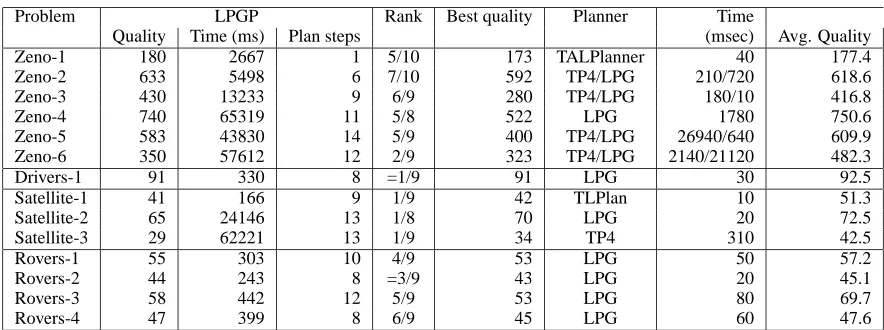
We compared the performance of LPGP with planners competing in the 3rd International Planning Competition. The results of most interest are summarised in Figure 7.
The results suggest the following interpretation: a basic Graphplan architecture is, as is now well-known, not com-petitive with more recent technologies on larger problems. On the other hand, the quality of the plans produced is com-petitive with those produced by other planners on these do-mains, including hand-coded planners. We found this par-ticularly interesting, since, as discussed previously, the al-gorithm optimises the number of distinct happenings rather than makespan. It is not clear whether the implication is that these domains yield good correlation between numbers of happenings and makespans, or whether the results of the other planners are significantly sub-optimal. There clearly remains considerable work to be done to make this approach competitive across a wider set of larger problems.
A final and important result is the demonstration that LPGP can indeed work with actions that have initial effects. We constructed a domain in which an executive must fix a fuse in a basement, using matches to provide light to cross the basement and to fix the fuse. The problem is simple, but we noted in informal tests that we could not manage to produce a plan for the domain using LPG (Gerevini & Se-rina 2002) or MIPS (Edelkamp 2001). VHPOP (Younes & Simmons 2002) was able to work with actions of this kind, producing equivalent plans to those constructed by LPGP. It is interesting to observe that VHPOP uses a partial order planning strategy as its underlying mechanism and this is well-suited to adaptation to the initial-and-final effects dura-tive actions model of PDDL2.1.
Concurrency and Graphplan Mutex
Problem LPGP Rank Best quality Planner Time
Quality Time (ms) Plan steps (msec) Avg. Quality
Zeno-1 180 2667 1 5/10 173 TALPlanner 40 177.4
Zeno-2 633 5498 6 7/10 592 TP4/LPG 210/720 618.6
Zeno-3 430 13233 9 6/9 280 TP4/LPG 180/10 416.8
Zeno-4 740 65319 11 5/8 522 LPG 1780 750.6
Zeno-5 583 43830 14 5/9 400 TP4/LPG 26940/640 609.9
Zeno-6 350 57612 12 2/9 323 TP4/LPG 2140/21120 482.3
Drivers-1 91 330 8 =1/9 91 LPG 30 92.5
Satellite-1 41 166 9 1/9 42 TLPlan 10 51.3
Satellite-2 65 24146 13 1/8 70 LPG 20 72.5
Satellite-3 29 62221 13 1/9 34 TP4 310 42.5
Rovers-1 55 303 10 4/9 53 LPG 50 57.2
Rovers-2 44 243 8 =3/9 43 LPG 20 45.1
Rovers-3 58 442 12 5/9 53 LPG 80 69.7
[image:8.612.85.527.51.216.2]Rovers-4 47 399 8 6/9 45 LPG 60 47.6
Figure 7: Results for problems drawn from the 3rd IPC problem set. Comparison drawn with other systems completing these problems. In each case we report the actual quality (makespan), time and size of the LPGP plan, the ranking in quality of the LPGP plan across all the systems completing plans for those problems (including planners using hand-coded rules) and the best plan produced for the problem. We also report the average quality of plans produced. Planners reporting results on these problems include IxTeT, TPSYS, TP4, VHPOP, MIPS, LPG, TLPlan, SHOP2 and TALPlanner. In the batches that these problems are drawn from, IxTeT reported 8 results in total, TPSYS 10, TP4 precisely the 14 problems listed, VHPOP 54, MIPS 57 and the other planners solved all 102. Note: The LPG results for Rovers were generated after the competition.
(:durative-action transmitData
:parameters (?x - transmitter ?d - data) :duration (= ?duration 3)
:condition (and (at start (calibrated ?x)) (over all (calibrated ?x)) (at start (holding ?d))) :effect (and (at end (sent ?d))
(at end (not (holding ?d))) (at end (not (calibrated ?x)))) )
Figure 8: A transmission action.
As we have described, in LPGP the standard Graphplan mutex is extended to a stronger form, in which even ac-tions that agree on the deletion or addition of proposiac-tions are considered mutex. We now consider an example which highlights why this is an appropriate modification. Consider a durative action transmitData which requires that the transmitter that is being used should be calibrated at the start and, with an invariant, throughout the transmission, but at the end of the action the transmitter loses its calibration sta-tus (see Figure 8). If the executive must transmit two blocks of data then it is possible, using the standard Graphplan mu-tex relationship, to construct a plan in which the transmis-sions are concurrent, provided they end at exactly the same instant. This is because the delete effects do not then inter-fere with the invariants. It is counter-intuitive to suppose that it would be plausible to actually synchronise the activities in such a way that they ended at precisely the same moment. The correctness of the plan depends absolutely on the end points being simultaneous. We propose that a more robust plan is one in which the transmissions are sequentialised, recalibrating the transmitter between transmissions. To
en-sure this the two end points must be considered mutex, even though they agree about the deletion of the same condition. It is examples such as this that motivate our extension of the Graphplan mutex relationship.
Conclusions and further work
This paper has described a successful attempt to exploit the Graphplan architecture to construct temporal plans, but us-ing a different approach to that used in TGP or TPSys (in either of its versions (Garrido, Onaind´ıa, & Barber 2001; Garrido, Fox, & Long 2002)). Where those systems use the graph itself to represent the flow of time, and to solve the associated constraints on the ways in which the durations of actions must interlock in a successful plan, we use the graph to capture only the distinct points of activity and the logi-cal relationships between them, while handling the duration constraints in a separate linear constraint solver. This of-fers the significant benefit of reducing the necessary graph size during search for most problems. It has the disadvan-tage that optimisation of temporal duration is then separated from the optimisation of graph length and this prevents the planner from claiming temporal-optimality. Despite this, the results we have managed to produce suggest that the perfor-mance is, in practice, not significantly harmed by the po-tential sub-optimality. Nevertheless, we are continuing to explore possible enhancements of the search to favour better quality plans.
points represents a much greater burden. This is because the end points of actions are assumed to abut (as in TGP), and then the separation is handled in post-processing.
Although the Graphplan framework offers a convenient one in which to manage time, it is rather less convenient for the management of other numeric values. Some work has explored the introduction of resource management into a Graphplan framework (Koehler 1998), but it is not easy to see how to generalise these ideas to handling more com-plex numeric expressions. In contrast, the heuristic for-ward state-space search planners have already been shown to offer some opportunity for extension to handle tempo-ral planning with numeric expressions (Kambhampati 2001; Haslum & Geffner 2001; Edelkamp 2001). It remains an op-portunity for further work to determine whether the Graph-plan framework can be extended to handle these richer ex-pressive languages.
Many extensions and modifications to Graphplan have been explored, including extensions to ADL fea-tures (Nebel, Dimopoulos, & Koehler 1997), filtering irrelevancies (Koehler et al. 1997), efficient search be-yond the fix-point (Long & Fox 1999), exploitation of symmetry (Fox & Long 1999) and handling sensory actions (Anderson & Weld 1998). The modifications we have explored in LPGP seem to be orthogonal to many of those extensions, since the underlying Graphplan be-haviour is largely unchanged. It remains for future work to explore which of these extensions could be successfully integrated with the mechanisms discussed in this paper. We have observed that the EBL/DDB modification proposed in (Kambhampati 1999) cannot be easily integrated with our extension. The key problem is in constructing a conflict set at a layer. This is the set of goals that cannot be solved altogether in a given layer of the graph. In the original algorithm a goal is identified to “blame” for the failure of an action being considered as an achiever for a current goal. This works well when the reason for rejecting an action can be identified with a mutex relationship between it and some other action. In the extended algorithm we have described this is no longer possible: sometimes an action will fail because it causes a violation of the temporal constraints, but this does not lead to identification of a single point of blame in the current layer. In fact, the blame might lie with a choice that was made long before — the choice of the end action, coupled with the failing action, as achiever for a goal in an earlier layer of the search. If the temporal constraints cannot be solved it is potentially expensive to go back through them, determining which is the most recent constraint that could be modified to make the temporal constraints satisfiable. Furthermore, since we check the constraints only when a start action is added, the violation might be the consequence of choices made at a preceding layer in the search. The safest decision is to treat the entire collection of goals so far considered at the current layer as the conflict set. This effectively disables the DDB behaviour when failure results from violation of temporal constraints, but we believe this behaviour can be improved.
A critical extension to the PDDL language introduced in PDDL2.1 is the ability to express plan metrics. Most real
planning problems require solutions to be judged by qual-ities other than simply the number of steps or even their temporal makespan. One of the most significant challenges for the Graphplan architecture, if it is to remain relevant to future developments of planning, is to find ways to mod-ify the search to take into account such plan metric infor-mation. The first step in addressing this challenge is to find a convincing means by which to combine efficient be-haviour with, at least heuristically, minimising the temporal makespan of the plan. Clearly it would be possible to im-plement an anytime behaviour in which plans continue to be generated after the first has been found, using the best plan so far as a bound on the continued search. However, we are also concerned with achieving a more efficient per-formance and we are exploring alternative search strategies as a way to improve the underlying Graphplan search em-ployed in LPGP.
References
Anderson, C., and Weld, D. 1998. Conditional effects in Graphplan. In AIPS-98, 44–53.
Berkelaar, M. 2000. Lp-solve. Technical report, ftp://ftp.es.ele.tue.nl/pub/lp solve/.
Blum, A., and Furst, M. 1995. Fast Planning through Plan-graph Analysis. In IJCAI.
Edelkamp, S. 2001. First solutions to PDDL+ planning problems. In Proc. 20th UK Planning and Scheduling SIG. Fox, M., and Long, D. 1999. The detection and exploita-tion of symmetry in planning problems. In Proceedings
of the International Joint Conference on Artificial Intelli-gence.
Fox, M., and Long, D. 2002. PDDL2.1: An extension to PDDL for expressing tempo-ral planning domains. Technical Report Dept. CS, 20/02, Durham University, UK. Available at
www.dur.ac.uk/d.p.long/competition.html.
Garrido, A.; Fox, M.; and Long, D. 2002. Temporal plan-ning with PDDL2.1. In Proceedings of ECAI’02.
Garrido, A.; Onaind´ıa, E.; and Barber, F. 2001. Time-optimal planning in temporal problems. In Proc. European
Conference on Planning (ECP-01).
Gerevini, A., and Serina, I. 2002. LPG: A planner based on local search for planning graphs. In Proc. of 6th
In-ternational Conference on AI Planning Systems (AIPS’02).
AAAI Press.
Haslum, P., and Geffner, H. 2001. Heuristic planning with time and resources. In Proc. of European Conf. on
Plan-ning, Toledo.
Kambhampati, S. 1999. Improving Graphplan’s search with EBL and DDB techniques. In Proceedings of
IJ-CAI’99.
Kambhampati, S. 2001. Sapa: a domain independent heuristic metric temporal planner. In Proc. of the European
Conference on Planning, Toledo.
1997. Extending planning graphs to an ADL subset. In
ECP-97, 273–285.
Koehler, J. 1998. Planning under resource constraints. In
Proc. of 15th ECAI.
Long, D., and Fox, M. 1999. The efficient implementation of the plan-graph inSTAN. JAIR 10.
Long, D., and Fox, M. 2001. Encoding temporal planning domans and validating temporal plans. In Proc. 20th UK
Planning and Scheduling SIG.
Nebel, B.; Dimopoulos, Y.; and Koehler, J. 1997. Ignoring irrelevant facts and operators in plan generation. In
ECP-97, 338–350.
Penberthy, J., and Weld, D. 1994. Temporal planning with continuous change. In Proc. of the 12th National
Confer-ence on AI.
Smith, D., and Weld, D. 1999. Temporal Graphplan with mutual exclusion reasoning. In Proceedings of IJCAI-99,
Stockholm.
Younes, H., and Simmons, R. 2002. On the role of ground actions in refinement planning. In Proc. 6th International