GOVERNMENT OF THE REPUBLIC OF MACEDONIA
PRE-ACCESSION ECONOMIC PROGRAMME 2008 - 2010
Table of Contents
1 MACROECONOMIC TRENDS IN 2006 AND THE FIRST HALF OF 2007...5
1.1 Macroeconomic Framework ...8
1.2 Inflation...13
1.3 Monetary and exchange rate policy...14
1.4 External Sector ...16
2 PUBLIC FINANCE ...19
2.1 Fiscal movements in 2006 ...19
2.2 Fiscal trends in first half of 2007 ...20
2.3 Medium-term Fiscal Framework ...21
2.4 Public Debt Management ...27
3 STRUCTURAL REFORMS...35
3.1 Enterprise sector...35
3.1.1 Privatisation ...35
3.1.2 Industrial Policy and Strategy ...35
3.1.3 Business environment and SME’s ...37
3.1.4 Competition policy ...39
3.1.5 State Aid ...40
3.1.6 Energy Sector...41
3.1.7 Tourism and Catering Industry...48
3.2 Financial sector...51
3.2.1 Banking System...51
3.2.2 Capital market...54
3.2.3 Reforms of the Pension Insurance System...56
3.2.4 Insurance...57
3.3 Labour Market ...59
3.3.1 Social Security...60
3.4 Education and Science...61
3.5 Agriculture ...67
3.5.1 Agriculture land reforms...67
3.5.2 Rural development...69
3.6 Transport and communications...74
3.6.1 Road transport...74
3.6.2 Rail transport ...77
3.6.3 Air transport ...80
3.6.4 Electronic communications ...82
3.6.5 Post ...84
3.7 Administration reforms...85
3.7.1 Institutional improvement of the administration structures and strengthening of the administration capacities...85
3.7.2 Improvement of the transparency and responsibility of the administration...86
3.7.3 Implementation of the Strategy on Government Cooperation with the Civil Sector...88
3.7.4 Economic area...88
3.7.5 Quality of Public Finances ...89
3.7.6 Decentralization and local self government reform...92
3.7.7 Regional policy ...94
3.8 Additional reform areas...95
3.9 Judiciary System Reform...99
3.10 Protection of ownership rights...104
3.11 Foreign Direct Investments...106
3.12 Environment...107
3.13 Health ...111
4 MATRIX OF ECONOMIC REFORMS...113
5 FISCAL IMPLICATIONS ...144
6 MATRIX OF SUCCESSFUL IMPLEMENTATION OF THE REFORMS DEFINED IN THE 2007-2009 PEP ...168
Introduction
Basis for preparation of Pre-Accession Economic Programme
By acquiring the status of a candidate country in November 2005, the Republic of Macedonia undertook the obligation to submit to the European Commission, annually, a medium-term economic programme. The 2008-2010 Pre-Accession Economic Programme (PEP) is the second document prepared by the Government of the Republic of Macedonia, covering the macroeconomic trends and projections in the country, precisely presenting the public finances and the policies for their improvement, as well as the structural reforms necessary for attaining dynamic economic growth.
Basis for the preparation of this document is the 2007-2009 PEP, with a special attention to the comments submitted by the European Commission, as well as to the activities defined in the 2007 Accession Partnership. In addition, strong attention is paid to the fiscal sphere in terms of better presentation of data and trends, as well as improvement of the process of fiscal planning necessary for more purposeful and efficient utilisation of public finances. 2008-2010 PEP also contains Action Plan for implementation of ESA 95 Accounting Standards. In order to ensure continuity It has been analysed that policies, measures and activities, proposed in PEP 2006, were realised.
Contents
Pre-Accession Economic Programme is a comprehensive document on economic policy of the Republic of Macedonia, prepared by the institutions in the country and coordinated by the Ministry of Finance. The Programme focuses on the development and improvement in public finance management, as well as on the numerous structural reforms the Government of the Republic of Macedonia undertakes, all aimed at intensifying the economic growth and development, as well as improving the living standard of the citizens.
The 2008-2010 PEP is aimed at areas being of key importance for development of a functional market economy, mainly in the area of the labour market, including improvement in the active and passive measures, judicial reforms where main objective is the provision of legal safety and acceleration of the court procedures and the work of the regulatory bodies and inspectorates.
The document comprises 6 sections.
First section covers the macroeconomic trends and medium-term projections, including detailed analysis of the growth factors.
Second section shows the current trends in the field of public finances, as well as the expected medium-term trends in line with the three-year Fiscal Strategy and the Public Debt Strategy. Analysis of the cyclical trajectory of the Macedonian economy is an integral part of the document, as well as the cyclical budget component. Sustainability of public finances is also covered, as well as the improvement of the institutional capacity in this area.
Third section encompasses the structural reforms necessary for creating better business climate, as well as the reforms necessary for achieving higher economic growth, i.e. labour market reforms, reforms in the education, judiciary reforms, reforms aimed at strengthening public administration capacity, etc.
Fourth section includes specific measures and activities, summarised in a reform matrix, while the fifth section covers the fiscal implications, i.e. the necessary financial resources to fulfil the structural reforms.
The last (sixth) section in 2008-2010 PEP shows the successful implementation of PEP 2007-2009.
1 MACROECONOMIC TRENDS IN 2006 AND THE FIRST HALF OF 2007
In 2006, as in the previous period, the macroeconomic situation in the Republic of Macedonia was stable, which was reflected through the GDP growth, the fiscal discipline, low inflation rate, balanced external accounts, downward trend of the interest rates, all of which were a solid basis for improved economic growth in the next period. The closer relations with the European Union were also a strong impetus for the institutional capacity strengthening, acceleration of the reforms and achievement of a more dynamic economic growth.
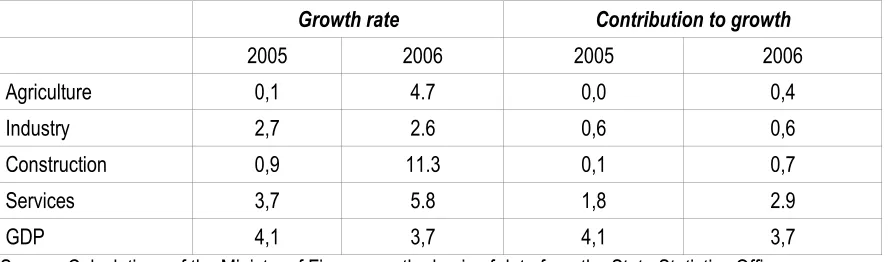
[image:5.595.72.516.261.392.2]In 2006, gross domestic product grew by 3.7%, which is 0.3 percentage points lower than the projections, i.e. a slight slow-down of the economic activities in the Republic of Macedonia. Economic growth was confirmed by the leading indicators, i.e. high export growth (17.6%), strong growth of credits to the private sector (30%), 8% average monthly growth of salaries, the largest investment growth in machines and equipment in the past three years (18%), etc.
Table 1: Gross Domestic Product
Growth rate Contribution to growth
2005 2006 2005 2006
Agriculture 0,1 4.7 0,0 0,4
Industry 2,7 2.6 0,6 0,6
Construction 0,9 11.3 0,1 0,7
Services 3,7 5.8 1,8 2.9
GDP 4,1 3,7 4,1 3,7
Source: Calculations of the Ministry of Finance on the basis of data from the State Statistics Office
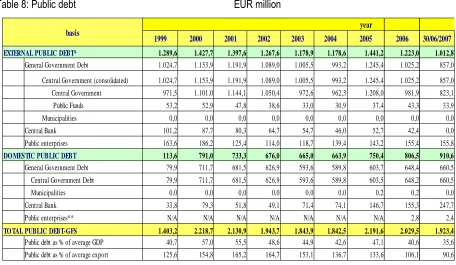
Economic growth in 2006 was accompanied by positive trends in the fiscal area. The general government budget deficit in 2006 was 0,6% which is a significant success taking into account that it was an election year when the public expenditures are usually higher. Such policy was strong support to the monetary policy, aimed at a stable foreign exchange rate and further reduction of the interest rates, including the reference rate (interest rate of the central bank bills) and lending interest rates of the commercial banks. At the same time, the debt of the Republic of Macedonia in 2006 significantly declined, whereby the general government debt was 33.6% at the end of the year, a 6.2 percentage points decline.
Growth of the economic activity in 2006 also led to an increase in the volume of the commodities traded, whereby in the analysed period, the export of goods grew by 17.6%, with a simultaneous import growth by around 16.5%. Such trends contributed to an increase of foreign trade deficit compared to 2005. Such situation was largely initiated by the significant rise of oil price on the world stock markets, i.e. the share of oil in the trade deficit is approximately 51%. Significant inflow on the basis of private transfers in 2006 contributed to a reduction of the current account deficit to US$ 24 million which is a decline by US$ 55 million compared to last year.
Greater import activity and the high inflow of private transfers in the previous period led to reduced deficit of the current account and pressures for appreciation of the denar exchange rate on the foreign exchange market. In order to maintain the stability of the nominal denar exchange rate to the euro, the NBRM made net redemption of foreign currency on the foreign exchange market through foreign exchange transactions.
Such positive trends in the external sector positively reflected on the level of the foreign exchange reserves as well. At the end of 2006, foreign currency reserves amounted to EUR 1.4 billion, which compared to the same period in 2005 grew by 25% and is equal to 5.5-month import coverage.
whereby in 2006 the principle “interest rate tender“ was applied, meaning market-based interest rates of central bank bills, by bank offers. In conditions of relatively high level of liquidity and higher average demand than the offer of central bank bills, interest rates on the central bank bills declined (average weighted interest rate on central bank bills at the end of 2006 was 5.5%, compared to 8.5% at the end of 2005).
Average inflation, measured through the costs of living, was 3.2% on an annual level, which shows certain dynamics of the economic activity (in 2005 the inflation rate was 0.5%). Thus, the Republic of Macedonia continues to maintain a low inflation rate, necessary for a conducive business environment and high-quality projections of macroeconomic trends.
CPI trends in 2006 were different by consumption groups. Growth was noted in the following groups: tobacco and beverages (17.8%), culture and leisure (6.4%), food (2.2%), housing, hygiene and health (2.0%), transport vehicles and services (1.8%) and clothes and footwear (0.2%).
With regard to the performance of the banking system, total deposit potential of the banks grew by 26% in 2006, which contributed in exceeding the projected level of М4 money supply. Higher deposit potential of the banks, coupled by the proactive credit policy when utilizing foreign currencies, led to realizing an annual growth rate of credit to the private sector of 27% in 2006. Thereby, it was of great significance that long-term credit to enterprises, i.e. credit aimed at investment activity, realised a high increase.
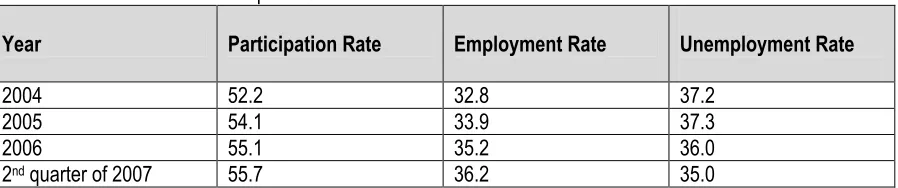
Real sector performance and economic activity intensification positively reflected on the social sector, i.e. on the employment. In 2006, employment (according to the Labour Force Survey) grew by 4.6% compared to 2005, which is in accordance with the data from the Employment Agency, according to which almost 150,815 new working contracts were signed in 2006, 2% more compared to last year. The unemployment rate (ILO definition) was 35.0% at the end of 2006, which was a decline by two percentage points compared to the end of 2005. Economic performance in the Republic of Macedonia in 2007 is the best in the transition period so far, whereby positive trends are also recorded in all sectors of the economy. Such positive trends point out that the ambitious economic programme of the Government of the Republic of Macedonia, supported by disciplined fiscal policy and consistent monetary policy has already started to give results. In fact, the GDP growth rate in the first half in 2007 was 5.5%, emphasising the importance of diversified growth, i.e. all sectors in the economy realised growth. However, growth was most evident in the service sector, i.e. transport and communications (11.1%), retail and wholesale (14%), civil engineering (5%) and financial intermediation (4.5%).
It is also important to point out that the positive economic trends occurred in conditions of low and stable inflation, which was 1.4% in the first nine months in 2007, being 1.1 percentage point lower than the expected. Such deviation is a result of the reduction of the prices of oil and oil derivatives at the beginning of 2007, an unrealised planned increase of the electricity price, a reduction of the price of the central heating, as well as the unchanged price of tobacco products despite the harmonisation of the excise for domestic and foreign cigarettes. Real sector growth is reflected in the external sector as well, whereby in the first seven months in 2007 exports surged by 44.7%, while imports grew by 29.2%, pointing out the real reduction of the trade deficit. Both in the real and the external sector, growth is broad-based, with highest growth achieved in the base metals (93.5%), construction materials (50%), food and beverages (12.5%), clothes (9.3%), production of base metals (83.7%), production of machines and devices (35.1%) and so on. Decline was only noted in the production of oil and oil derivatives as a result of the closing of the Kosovo market for the OKTA Refinery, a problem that had already been overcome by meeting the European standards on oil production. Positive economic trends are also underpinned by the strong increase in the import of investment products and intermediary goods of 33.5%, indicating higher production activity.
Positive trends in the real sector were also supported by the movements in the monetary sphere. In fact, in the first seven months of 2007, there was a low, but continuous reduction of the average weighted lending interest rates of the commercial banks, and long-term credit to the corporate sector (funds used for investments) significantly increased (23% in July 2007 compared to the end of 2006), contributing to a great extent to the economic activity.
With regard to the performance of the banking system, total deposit potential of the banks grew by 17% in the first half of 2007, whereby higher deposit potential of the banks, coupled by the greater competition in the banking sector (entry of Societe General) and the proactive credit policy led to an annual growth rate of credit to the private sector by 23%. Thereby, long-term credit to businesses grew the most.
Regarding the public finance, in the first six months there was stable and prudent administration of the fiscal policy, in line with the concluded arrangement with the International Monetary Fund. Moreover, a significant fiscal reforms were undertaken in 2007, that is the introduction of the 10% flat tax, reduction of VAT for agricultural products from 18% to 5%, as well as, tax cuts for certain products, such as pharmaceuticals and medical aides, computers and computer equipment, sun collectors and public transportation. However, despite the significant tax reforms and cuts in this period, collected tax revenues were by 12%1 greater than the projections, whereby the profit tax revenues exceeded the projected level by 50%. Such increase in the tax revenues is due to several factors, such as: a significantly increased economic growth at the beginning of the year, a high increase in the profitability of the companies in 2006 (29.7%), as well as the decisive efforts by Public Revenue Office and the Customs Administration for better collection of tax revenues.
Thus, it is quite certain that the highest GDP growth rate in the whole transition period will be realised in 2007 despite the deteriorated terms of trade, i.e. increased prices of raw materials, including the energy, on the world markets. According to the projections, the same trend will continue in the next three years, with positive effects on the living standard of the citizens on the medium term.
The Republic of Macedonia and the Maastricht Criteria
The analysis of the fulfilment of the criteria for accepting the euro as part of the European Economic and Monetary Union presented below, shows that the Republic of Macedonia has a relatively good performance and has achieved considerable macroeconomic stability. More specifically, according to Maastricht Criteria of monetary integration with the Euro zone, a country should have:
• sustainable price stability, in terms of its average annual inflation rate not exceeding 1.5 percentage points of the average rate of the three countries with the lowest inflation;
• sustainable fiscal position, in terms of:
- planned or current fiscal deficit not exceeding 3% of GDP; and - public debt not exceeding 60% of GDP.
• exchange rate stability (secured via membership in the ERM II) in a period of at least 2 years before the membership into the EMU, without devaluation pressures on the domestic currency in relation to the euro or any other currency of a Member State;
• converging long-term interest rates, as a result of the membership in the ERM II, defined as average nominal interest rate to 5 or 10-year government or corporate bond, not exceeding 2 percentage points of the rate of the three EMU members with the lowest inflation.
The analysis of their fulfilment by the Republic of Macedonia is presented in the Table below:
Table 2: Republic of Macedonia and Maastricht Criteria
Criterion Fulfilled
1. Price stability
- three countries with the lowest inflation in 2006 Finland 1.3%
Austria 1.7% Netherlands 1.7%
average 1.6% + 1.5 p.p. = 3,1% - inflation rate in Macedonia in 2006 3.2%
х
2. Fiscal position
• fiscal deficit / GDP = 0.5%
• public debt / GDP = 36.8%
√
3. Exchange rate
• pegged to the Euro (Deutsch Mark) since October 1995 √
4. Long-term interest rate
• long-term government bond (10 year) – average rate of the three countries with the lowest inflation 3.9% + 2 p.p. = 5,9%
• long-term government bond (3 year)* - RM 9.6%
х
* The bond with the longest maturity period in 2006 has 3-year maturity period. Hence, the comparison is not appropriate.
1.1 Macroeconomic Framework
The Government of the Republic of Macedonia in 2006 adopted an ambitious economic programme for structural reforms, which is being intensively implemented. The programme is actually a continuity of the reforms set by the previous government, but with a faster pace. Such a programme confirms that despite that the political parties in the Government of the Republic of Macedonia changed, the reform orientation has not only been kept, but also intensified. A fundamental priority of the Government is to stimulate economic growth through development of the private sector, improvement of the investment climate, job creation and ihence achieve mprovement of the standard of living. Activities resulting from the Accession Partnership were significantly intensified, so as to continue on the road to the full fledged European Union membership.
The Government programme is being implemented through specific and intensive structural reforms, i.e. reforms in the business environment, so as to improve the entry in and exit from the market and creating free competition, strengthening the capacity of the institutions, judiciary reforms so as to accelerate court procedures, health system reforms, labour market reforms, education reforms, as well as public finance management. There is a general consensus among the political parties on the economic reforms in the Republic of Macedonia, and also a confirmation for theeconomic performance and reforms by the international financial institutions among which the IMF (confirmed with the arrangement with the IMF which is being successfully implemented), the World Bank (confirmed in the Doing Business Report), as well as Transparency International (progress by 20 positions in 2007).
Such an economic programme has already yielded specific results confirmed with the preliminary data on the Macedonian economy for the first two quarters of 2007.
Real Sector
2,8%, while the average projected annual growth was 4.1%, so this underperformance of industry led to a lower than projected GDP growth for the high share of industry in GDP. The largest contribution to GDP within the industrial production was in the sector of production of other non-metal products (construction materials) with 1.2 percentage points, the sector for production of base metals (0.7 percentage points), and production of oil and oil derivatives. Significant growth was noted in the sector for extracting ore and stone by 28%, as a result of the production resuming in several mines. In 2007, the industrial production grew by 11% in the first quarter and was reduced by 2,8 in the second quarter, therefore the industry growth for the first half of 2007 is 3.7%. Contribution to the growth was again the highest in the industry for base metals and the industry for non-metal products, whereas due to structural problems (loss of one of the key markets by the refinery), the oil and oil derivative sector had a negative contribution to growth.
Chart 1: Industrial production seasonally adjusted
Industry - seasonally adjusted
80,0 85,0 90,0 95,0 100,0 105,0 110,0 115,0 120,0 2004 :01 2004 :03 2004 :05 2004 :07 2004 :09 2004 :11 2005 :01 2005 :03 2005 :05 2005 :07 2005 :09 2005 :11 2006 :01 2006 :03 2006 :05 2006 :07 2006 :09 2006 :11 2007 :01 2007 :03 2007 :05 2007 :07
Source: Ministry of Finance
The analysis of the expenditure side of GDP shows that again, the largest contributor to the GDP growth in 2006 was domestic consumption with 4.3 percentage points, as well as gross investments with 1.5 percentage points. Within the total consumption, personal consumption grew in real terms by 5.0% (in accordance with higher salaries by 7.3%) and contributed to total growth by 3.9 percentage points, while public expenditure grew in real terms by 2.3% (in accordance with the higher budget deficit by 0.6% which is a decline in regards to the previous year when a 0.3% surplus was registered) and contributed with 0.4 percentage points in the total GDP growth. What was especially positive is that gross investments have a significant share in the contribution to the GDP growth in 2006, whereby, taking into account the high import component of the investments in the Republic of Macedonia as a developing country, the negative contribution of the net import in 2006 grew and was –3.2 percentage points. There are no available data for expenditure componenets of GDP for the first half of 2007, but leading indicators again point to a high growth of private consumption (nominal net salary growth by 6.1%, strong growth of trade and credit to the private sector by 30%). Gross investments are expected to grow by 15%, in accordance with the growth achieved in the first half of 2007 (12% growth), as well as the ambitious programme of the government for attracting foreign direct investments. Improved foreign trade in the first half of 2007 (higher export growth compared to import growth) points to the fact that there will be a less negative contribution of net export in 2007 compared to 2006.
Total factor productivity
The analysis of economic growth in a country is of special importance for the creation and implementation of economic policies. According to the theory of economic growth, it depends on three factors:
● capital growth in the economy (i.e., the accumulated capital in the economy plus the investments in the current year, reduced by the depreciation according to weighted rate);
● growth of the total factor productivity (TFP), which is a total level of efficiency by which production factors – capital and labour - are utilised.
To calculate the total factor productivity in Macedonia, we assume that the capital stock depreciated by a weighted depreciation rate of 10%, and we used the LFS data for the number of employed persons. In the calculation, we used the assumption that the portion of the revenues from capital is 0.4, and the remaining is revenues from labour.
[image:10.595.77.520.208.254.2]Cumulatively, for the period 1997-2006, the share of the production factors and the total factor productivity of growth were as follows:
Table 3: Contribution and share of the production factors and the TFP to growth in Macedonia (1997-2006)
Growth of GDP Capital Labour TFP
0,9% 0,4% 1,1%
2,4%
(37,7%) (17,8%) (44,5%)
Source: Ministry of Finance calculations
The table points to the conclusion that in a longer term (10-year average); contribution of total factor productivity to growth is around 45%, which is a significant indicator of the efficiency of using labour and capital. The capital share is also significant, which is comparable to the share of physical capital in the GDP growth in the developed and developing countries. As a comparison, the table below shows the average for three groups of countries: Table 4: Contribution and share of the factors and the factor productivity to growth in three groups of countries
Growth of
GDP Capital Labour TFP
2,1% 0,5% 1,3%
Developed countries (1960-1990) 3,9% (54%) (13%) (33%)
2,4% 1,3% 1,2%
Latino-American countries (1940-1980) 4,9%
(48%) (28%) (24%)
4,4% 3,2% 1,2%
Eastern Asia countries (1966-1990) 8,8%
(50%) (36%) (14%)
Source: Barro and Sala-I-Martin, Table 10.8., pp. 380-381
Although in 2006 total factor productivity is negative, this number in the next period is expected to improve and to quickly approximate to the average number. In particular, the growth of the TFP in the previous period can be mainly attributed to the reallocation of resources during the establishment of a market economy, a source which is probably already fully exploited. Hence, in the forthcoming period, TFP increase is assumed to come from the expected higher FDI inflows as they presumably bring into the economy improved corporate governance, standardisation, and more efficient utilisation of labour force.
Expectation for medium-term macroeconomic trends
In the period 2008-2010 the average GDP growth rate is expected to be somewhat higher than in 2007, between 6 and 6.5%. Thereby, a driving force in the economic growth from the aspect of the expenditure side of GDP will be personal consumption and investments (especially FDIs). From a production aspect, the main driving force will be the services (see Chart 2) due to their dominant share in GDP, and somewhat lower growth is expected in the industrial production, which would lead to a further shift of the domestic production to services, similar to the situation in the Western developed countries.
The contribution of the personal consumption to GDP is expected to be 3.5 and 4 percentage points in the period 2008-2010 (see Chart 3). Such projection is based on the following:
• projected growth of the net salaries by 7.5% in the coming period, as a result of the growth of salaries in the public sector by 10% and the growth of salaries in the private sector that would follow the productivity growth;
• growth of credit to the citizens by 30% p.a.;
• expected stable level of private transfers.
[image:10.595.76.520.341.451.2]Chart 2: Contribution to the GDP growth, production method
0.0 1.0 2.0 3.0 4.0 5.0 6.0 7.0
2005 2006 2007 2008 2009 2010
Services
Construction
Industry
Agriculture
GDP
Source: State Statistics Office and the Ministry of Finance
In line with the commitment of the Government of the Republic of Macedonia to disciplined fiscal policy, (general government budget deficit not exceeding 1.5% of GDP), share of public consumption in GDP in the period to come will range between 1.5% and 0.5 percentage points, and in the coming period we expect a greater percentage of utilisation of capital investments that would contribute to more intensive GDP growth. In the coming period, in line with the intensive reform agenda of the Government of the Republic of Macedonia, the improved business climate, the expected membership in NATO and the expected initiation of the negotiations with the EU, investment activity is expected to intensify. The reduction of the profit tax from 15% to 12% in 2007 and to 10% as of 2008 as well as the exemption of reinvested profits from taxation is an additional impetus for greater investment activity, according to the projections, by around 15%. Thus, in the period 2008-2010, gross investments are expected to grow on average between 13% and 16% and to contribute to the growth by around 2 to 2.5 percentage points. (see Chart 3). Taking into account the import dependence of the Macedonian economy, the significantly high inflow of foreign direct investments (Johnson Controls, Johnson Matthey , Agrokor, ERA City etc.) as well as the expected expansion of the personal consumption, contribution of the net export is envisaged to be negative in the coming period, but stabilised to a level of –1.5 to –2.0 percentage points. High import growth is necessary so as to achieve higher economic growth rates, a trend present in all advanced countries in transition.
Chart 3: Contribution to growth, expenditure method
-4.0 -2.0 0.0 2.0 4.0 6.0 8.0 10.0
2005 2006 2007 2008 2009 2010
Net expo rt
Gro ss capital fo rmatio n Go vernment co nsumptio n Ho useho ld final co nsumptio n GDP
Source: State Statistics Office and the Ministry of Finance
reduction of the unemployment rate. Also, high economic growth would enable further fiscal and structural reforms so as to improve the business environment, infrastructure and public institution’s capacity.
Potential growth and cyclical position of the Republic of Macedonia
One of the main parameters used in projecting the basic macroeconomic aggregates is the potential growth of GDP in the Republic of Macedonia. This growth is calculated and measured by applying the Hodrick-Prescot trend estimation, where trend value (s*) is estimated by minimizing the real domestic production gap (s) and the trend and the variability thereof for the whole sample (T):
T T-1
Min Σ (Yt-Yt*)2 + α Σ ((Y*t+1 - Yt*) - (Yt* - Y*t -1))2,
t=0 t=2
where α is a parameter for smoothing the time series. According to literature, the assumption is that the value of the parameter is 30. Thereby, we would like to point out that having in mind the many structural disturbances that occurred in the past period, as well as the external shocks which the Republic of Macedonia was exposed to, together with the long period of transition (i.e. significant decline of the economic activity by 1995), there is a great probability that the Hodrick-Prescot method produces biased results in the case of Macedonia.
Table 5: Potential output
2006 2007 2008 2009 2010
GDP 3,7 6,0 6,0 6,5 6,5
Potential growth 4,80 5,00 5,20 5,60 5,90
Output gap -4,80 1,00 0,80 0,90 0,60
Source: Ministry of Finance
The estimate shows that potential GDP growth in the period 1999 - 20102 is 3.7%, whereby the GDP gap is negative and is -0.2 percentage points, having in mind the current (and the projected) economic growth in this period is 3.5%. The country’s economic growth was below its potential in 2002 (-1.1 percentage point) when the economy was recovering from the 2001 crisis, and in 2006 (-0.6 percentage points), when the growth pace declined to 3.7% after the results achieved in 2004 and 2005 when the growth was 4.1%.
Taking into account the ambitious and expansive economic programme of the Government, according to the projections until 2010, GDP growth is expected to be above the potential. This is due to the reforms that would reduce the labour costs, improve labour education structure, thus increasing the FDIs, increasing employment and the consumption, including public consumption (with an emphasis on capital expenditures). As a verification of these projections is the upward trend of the industrial production cycle in 2007. Such trends in the industry, supported by the positive trends in the service sector, are a verification that the ambitious economic programme of the Government has already started to show specific results.
Chart 4: Industrial production cyclical component
Cyclical component 0,940 0,950 0,960 0,970 0,980 0,990 1,000 1,010 1,020 1,030 2004 :01 2004 :03 2004 :05 2004 :07 2004 :09 2004 :11 2005 :01 2005 :03 2005 :05 2005 :07 2005 :09 2005 :11 2006 :01 2006 :03 2006 :05 2006 :07 2006 :09 2006 :11 2007 :01 2007 :03 2007 :05 2007 :07
Source: Ministry of Finance
In order to discover the effect of the cyclical fluctuations over the budget balance, we will calculate the cyclical component of the budget, i.e. assume what would have happened with the budget balance should the real GDP had been within its growth trend line, i.e. that there is no gap between the realised (projected) and potential output3. Thus, if we remove the cyclical component from the current (projected) budget balance, we add the cyclical adjusted budget balance, i.e. the balance that shows more realistically the fiscal policy implemented by the government. Taking this into account, the results point to the following: the cyclical budget component is negative in 2006 since the economic growth was below the potential, whereby the cyclical adjusted deficit is (0.3%) lower than the actual (see Chart 5). In 2007 the cyclical component of the budget is positive (0.2 percentage points), which constantly increases (in 2010 it is 1.5 percentage points), which indicates the conditions in the economy. In this period, the economy is expected to grow by higher rates than the potential economic growth. The expansionary nature of the budget is a support to this. Thus, in the period 2008 - 2010 a fiscal deficit of 1.5% of GDP was projected. Taking into account that the economy enters into expansionary periods, the cyclical adjusted deficit is higher, i.e. it would be between 2.5% in 2008 and 3% in 2010 whereby even in the case the expansion is not realised, the budget deficit would not exceed the Maastricht criterion (-3% of GDP).
Chart 5: Cyclicaly adjusted balance
Source: Ministry of Finance 1.2 Inflation
Inflation, measured through the costs of living in 2006 was 3.2% at an annual level, which shows certain dynamics of the economic activity (in 2005 the inflation rate was 0.5%). In the first half of 2007, the inflation rate was measured via the cost of living was 0.9% and is relatively lower than the projected. Such deviation is a result of the non-increase of the electricity price, reduction of the oil price in early 2007 as well as the reduction of the customs tariffs in accordance with the membership of the Republic of Macedonia to the WTO and the SAA. CPI trends in 2006 were different by consumption groups. Growth was noted in the following groups: tobacco and beverages (17.8%), culture and leisure (6.4%), food (2.2%), housing, hygiene and health (2.0%), transport vehicles and services (1.8%) and clothes and footwear (0.2%). In the first half of 2007, the highest share in the inflation rate was in food and housing, while the only sector registering downward trends was the transport communication sector, in accordance with the reduced prices of mobile telephony.
The inflation rate, according to the projections, on the medium term, will be a low, single-digit and in accordance with the expected employment growth, salary growth and personal consumption, as well as with the projections on the trends in the prices of energy sources on the global markets. The inflation rate in the analysed period is expected to be between 2.5 and 3.5%, at a planned annual employment growth by 4% and productivity growth by 4-5%. Monetary policy will be aimed at further maintenance of price stability in the economy, as a main monetary goal. At the same time, strategy of targeting nominal Denar exchange rate to the Euro will continue to be applied, thus the maintenance of the Denar exchange rate stability will be an indirect monetary goal. Money
demand will increase in line with the inflation and GDP growth, and more intensive crediting to the private sector is expected, in accordance with the greater competition in the banking sector, as well as the growth of the average salary in the Republic of Macedonia.
1.3 Monetary and exchange rate policy
The contribution of the monetary policy to fundamental macroeconomic goals is recognized as delivery and maintenance of the price stability, the latter being a primary condition for sustainable economic growth. As the monetary strategy is concerned, the National Bank of the Republic of Macedonia (NBRM) continues with implementing the strategy of targeting the nominal Denar exchange rate against the Euro, which has proved as nominal anchor for formation of the inflation expectations of the economic agents in the last decade. From operational point of view, in 2006 and 2007 the monetary policy was mainly facing a challenge for sterilization of the effects of foreign exchange transactions on the one hand, and on the other for further deepening of the short-term securities market in order to improve the monetary transmission. The reserve money growth, together with increased foreign exchange inflows, intensified economic activity and the permanent propensity to safe, contributed to further growth of the banks’ deposit base. The increased deposit potential of the banking sector, together with the financing from foreign sources, resulted in further intensification of the banks' credit activity under declining trend of the interest rates.
In the first nine months of 2007, the average rate of inflation was 1.4%, which in comparison with the 3.2% inflation rate in 2006 determined by non-monetary factors, implies stabilization of the prices in the economy. Additionally, in this two year period the core inflation is relatively low, implying stable long-term inflation component. Food prices, which are dominant inflation component, are expected to be main determinant of inflation dynamics till the end of 2007 and also in 2008, mainly due to the reduced domestic supply because of the drought period and world market movements. On average, an inflation rate of around 2% is expected for 2007 and for the forthcoming year inflation rate of around 3% is expected.
Foreign exchange market in the last few years is characterized by increased foreign exchange inflows, mainly as private transfers, foreign direct investments and portfolio investments. The positive perceptions of the foreign investors regarding the economy, favorable developments in the foreign trade, as well as positive expectations of the banking sector for the macroeconomic policy orientation, resulted with an increase of the supply on the foreign exchange market. The pressures for appreciation of the domestic currency were neutralized by net-purchase of foreign exchange by the NBRM on the foreign exchange market, which enabled the maintenance of the exchange rate stability. The Exchange Market Pressure Index (EMPI) indicates an extremely low percentage of pressures on the foreign exchange market during 2006 (only 4.8% from the whole sample of daily observations), which means that during the entire year in general there were no extreme and long-lasting changes in the monetary policy set up, the NBRM intervention policy or in the nominal exchange rate.
The net-purchase of foreign exchange by the NBRM, given the excess of foreign exchange on the foreign exchange market, led to a sustained increase in the gross foreign reserves and sufficient, average, monthly coverage of the imports of goods and services. Hence, gross foreign reserves at the end of 2006 reached EUR 1,417 millions, which is an increase of EUR 294 millions. The same trend continued in 2007, when the gross foreign reserves at the end-September have increased by EUR 105 millions in comparison with the end of 2006, despite the significant outflow of foreign assets due to the early repayment of the public debt.
liquidity, as well. The average CB-bills interest rate in December 2006 was 5.74% and it declined by 2.8 percentage points. A decreasing trend is present in 2007 as well, therefore in September 2007 this interest rate went down to 4.83%.
The fall in the CB-bills interest rate was followed by a decrease in the banking sector interest rates, but with a lower intensity. Hence, in 2006 the average interest rate of the Denar credits has fallen by 1.4 percentage points and at the end of the year it was 10.7%, whereas the average interest rate of the Denar deposits has declined by 1.2 percentage points and at the end of the 2006 it was 4.4%. Additionally, in 2006 the real interest rates were on the historically lowest level. In August 2007, the average weighted lending and deposit interest rate were 10.1% and 5%, respectively, which led to a reduced interest rate spread of 5.1 percentage points. Under situation of liquidity surplus in the banking sector, the interest rate of the Central Bank acts more like an opportunity cost rather than a financing cost for the banks, which further, adversely affects the monetary transmission. Therefore, NBRM makes efforts for further development of the short-term securities market, which is expected to enhance the interest rates transmission channel. On the other hand, the increased competition in the banking sector is becoming an important determinant of the interest rates developments, mainly in favor of further reduction of the interest rates, considering the intentions of the banks to keep and enlarge their market segments.
The enhanced confidence of the economic agents and the greater propensity to save in the banking sector, as well as the increased economy's potential for additional creation of disposable income led to an continuous growth of the banks deposit base, the latter being main generator of the credit activity. Thus, in 2006 the total deposits, expressed as a percent of GDP, were 33.1%, which, in comparison with the end of 2005, is a 5.7 percentage points growth. This positive trend of the deposit base continued in the first seven months of the 2007 determining an annual growth rate of the private sector's total deposits in August 2007 of 33.3%. According to the analysis of the maturity structure short-term deposits have dominant share in the total deposits (around 94%), which indicates that economic agents still prefer short-term saving. The analysis of the currency structure has shown a reduced share of the foreign currency deposits in the total deposits, from 61% at the end of 2006 to 56.2% at the end of August 2007, which is an essential positive structural change. As the change is primarily caused by the reduced households’ propensity to save in foreign currency, it indicates a greater confidence in the domestic currency and in the monetary authorities (the share of the households’ foreign currency deposits in the total deposits of this sector is 60.1% in August 2007, whereas it was 66.7% at the end of 2006).
Banks' credit activity in the last four years has proved as a significant source of additional financial assets for the private sector. Hence, credits to private sector have accounted for 29.6% of GDP in 2006 which in comparison with the previous year is higher by 5.4 percentage points. This indicates a permanent deepening of the financial intermediation, even though it is relatively low if compared to credit growth in more advanced economies due to the initially low level of financial intermediation in the period from the monetary independence of the Republic of Macedonia until 2003. In August 2007, total credits to the private sector increased by 36.2%, on annual basis. Worth noting is the qualitative improvement of the credit growth as suggested by the decreased share of non-performing credits in the total placements. As for the sources of financing of the credit activity, the increased deposit potential remains as a main source of banks' financing, having in mind the gradual and moderate increase of the foreign credit lines withdrawal, which results with injection of the adequate amount of liquidity in the economy. The credit growth is providing a significant support of the domestic personal and investment consumption, so far without significant impact over imports (considering current developments in the trade balance), while the price stability has been sustained.
with 50.2% in the total cumulative growth for the January - August 2007 period. Such a trend is expected to continue in the forthcoming period in accordance with the banks' expectations for an increase in the demand for credits by households and corporate sector, as well as with gradual relaxation of the credit requirements. Consequently, regular monitoring of the impacts of the credit growth is of great importance in order to maintain the financial stability.
Given the positive perceptions regarding the potential growth prospects of the domestic economy, as well as the gradual process of capital account liberalization, the monetary policy in the forthcoming years will focus on activities aimed towards successful operational implementation of the exchange rate targeting strategy, which additionally requires further active monetary-fiscal policy coordination. The analyses of the current monetary policy strategy by many different criteria continue to justify its further implementation. However, dynamic changes in the financial system imply a need of continuous monitoring of the effectiveness and eventual changes in the monetary policy transmission channels, as well as efforts for building institutional capacities for macroeconomic forecasting, in order to be able to face the possible challenges arising from the dynamic environment in the future.
1.4 External Sector
In 2006, favorable developments have been registered in the external sector, reflected notably in the relatively low current account deficit of 0.4% of GDP. The narrowing of the current account deficit mainly resulted from the high inflows of private transfers (reaching 18.7% of GDP) which have remained being a stable source of trade deficit financing with 90.6% coverage of the trade deficit. Moreover, the surplus in the services and the small deficit in the income (having in mind the delayed payment of dividend of one bigger domestic company to its foreign investor) positively contributed to the narrowing of the current account deficit. The only component with negative contribution to the current account balance was the trade balance, which due to the higher increase of the imports of goods relative to the one of the exports registered larger deficit (the deficit grew by 2.3 percentage points of GDP). Regarding foreign trade, it is important to point out favorable developments reflected by improved diversification of exports of goods, and at the same time higher concentration of imports of goods (according to the Herfindahl-Hirschman index). The increasing trend in productivity of the tradable goods sector is as well an indicator of the gradual improvement of the competitiveness and performances of the export-oriented sector. The developments of the real effective exchange rate of the Denar, which is continuously depreciating mainly due to the lower domestic prices relative to the foreign prices, are to be considered as additional evidence in favor of the competitiveness of the domestic producers on the foreign markets. Still, high import-dependency, in particular on energy products, remains as a key point that implies a necessity of measures and activities aiming at improvement of the trade balance.
The main sources of net inflows in the capital and financial account in 2006 were the foreign direct and portfolio investments. FDIs amounted 5.8% of GDP (annual growth of 4.1 percentage point), mostly due to the inflow based on privatization of the electric power company '"ESM-Distribution" in March 2006. Regarding the debt developments, the net outflows registered an increase, mainly due to the prepayment of the debt to the London club of creditors in January 2006 (using the inflows based on Eurobonds issuance). The favorable developments in some of the mentioned categories from the current account, as well as in the capital and financial account in 2006, contributed for increase of the gross foreign reserves, which as of 31.12.2006 equaled EUR 1,416.7 millions, enabling 4.1 months coverage of the expected imports of goods and services for 2007 (based on estimates from November 2007).
In line with the intensified economic activity, in 2007 in the external trade positive trends are registered. Therefore, in the first eight months of 2007 the value of exports of goods registered an annual increase of 31.7%, primarily determined by the higher exports of iron and steel and their products (combined effect of both, the higher export volume and favorable developments of nickel prices on the world market). At the same time, the total imports of goods registered a lower annual rate of 18.4%, contributing towards reduction of the negative external trade balance by 3.8% compared with the same period of the previous year, while export / import coverage ratio equaled 69.5% and it was higher by 7 percentage points.
The integration of the Republic of Macedonia into the original CEFTA (Macedonia, Croatia, Bulgaria and Romania) is considered to be one of the most important issues occurred in 2006, in the domain of the external trade. The integration is aiming at strengthening of the regional economic cooperation, further liberalization of the external trade and compliance of the trade rules with the EU standards. CEFTA membership is seen as very important step ahead in the process of European integration, i.e. a kind of a test for the fulfillment of political, economic, security and judicial criteria within the integrative processes with the European Union. Considering the importance of the CEFTA, the international community initiated contracting of a new single free trade agreement (CEFTA 2006), which is about to play the same role (as the original CEFTA did) for the South Eastern European countries. The implementation of this agreement started on July 26, 2007, and its major benefits are considered to be: liberalization of the custom duties; imposing discipline on non-custom barriers in the bilateral trade; abolishment of export subsidies (this particular obligation will have a positive impact on the bilateral trade between the member countries in general, but still most pronounced effect would be seen upon the trade of agricultural and food products for which the protectionism in terms of export subsidies is most largely extended); compulsory implementation of the WTO rules; introduction of additional stipulations regarding several new areas in the trade (services, public procurements, investments and intellectual property rights protection); and apart from that, as notably important are perceived to be the possibilities for ascertaining clear rules of origin.
The entrance of Bulgaria and Romania into the EU at the beginning of 2007 implied changes in their bilateral trade regime with the Republic of Macedonia. These changes should have positive impacts on Macedonian economy, arising from the asymmetric treatment of the exports and imports of goods originating from the EU. These changes already gave results with respect to the bilateral trade balance between the Republic of Macedonia and Bulgaria towards shrinking of the Macedonian trade deficit with this country. Namely, already in the first eight months of 2007 the bilateral trade deficit, on annual basis, has been reduced by 96.8%, as a result of simultaneous increase of the exports of goods and decrease of imported goods from this country.
In the first half of 2007, the capital account registered net-inflows of EUR 10.2 million, which is almost entirely attributed to the concession payments from the third mobile operator. In the same period, the financial account registered net-outflows in amount of EUR 106.4 million, which is mainly due to the prepayment of the external public debt, as well as to the net-outflows related to the trade credits. The relationships with the foreign creditors are in accordance with the public debt strategy, which apart from the public debt reduction, aims as well at improvement of its currency, maturity and interest rates structure. Therefore, the reduction of the external public debt during 2007 has initially started with prepayment of the debt towards Paris club of creditors, which was done within couple of months, through gradual repayments of the debt towards individual countries within the Paris club. In May and June 2007, prepayments of the debt obligations to the IMF and to the IBRD were realized, respectively. Thus, the external sector public debt as of August 31, 2007 equaled EUR 1,013.1 million (18.7% of GDP) and it was decreased by 17% (or by 5.9 percentage points of GDP) compared to December 31, 2006. Consequently, the share of the public sector external debt in the total external debt was 56.3% at end of August, which is a reduction of 10.3 percentage points compared to end-December 2006. On the other hand, private sector external debt has an upward trend and at the end of August compared to end-December 2006 it was higher by 28.8%. These particular debt developments were expected, considering the gradual liberalization of the capital flows, the country's favorable credit rating and consequentially improved access to the international capital markets, and as well considering the entrance of foreign investors which usually accelerates the integration into the international financial flows. As of August 31, 2007 country's total external debt equaled EUR 1,798.9 million, which is lower by 1.7% relative to end-December 2006.
year), which is to a large extent a reflection of the efforts made for the improvement of the business environment. The breakdown of FDIs by sectors shows that they are primarily concentrated in the financial sector (entrance of the prominent French bank), transport and communications sector, and in manufacturing industry. In the same period, portfolio investments registered an annual growth of 80.5%, indicating continuous foreign investors' interest and also existing potential of the Macedonian stock exchange. The foreign investors are mainly oriented towards investing in shares issued by the domestic companies, which is in line with the investors' positive perception regarding the growth perspectives of the companies. The purchased foreign exchange by the NBRM based on foreign portfolio investments is by 3.3 times higher then the sold amount of foreign exchange related to withdrawal of invested funds by non-residents, which indicates continuous net inflows of foreign exchange upon foreign portfolio investments.
2 PUBLIC FINANCE
2.1 Fiscal movements in 2006 General Government Budget revenues
In 2006, actual General Budget revenues amounted to Denar 105.782 million, financed by the revenues realised in the amount of Denar 104.078 million.
In 2006, total revenues of the General Budget of the Republic of Macedonia, compared to last year, were higher by 3,2%. Tax revenues reached the level of Denar 59.575 million, participating with 57,2% in the total budget revenues in 2006.
The share of the value added tax (VAT) in the structure of total tax revenues was 45.7%, the share of excises was 20.4%, personal income tax participated with 14.1%, customs duties and other import duties with 11.8% and profit tax with 7.9%.
In 2006, revenues on the basis of personal income tax amounted to Denar 8,414 million, which is by 3.8% higher compared to last year. Regarding the structure of these revenues, as usual most of them were realised on the basis of the payroll tax – 75.3%, as well as on the basis of tax on income received from contractual agreements (9.5%), while the share of revenues on other basis was relatively low.
Collected revenues on the basis of profit tax in 2006 amounted to Denar 4,708 million, which is by 66% higher compared with the profit tax revenues in 2005. High growth of revenues in 2006 was due to the better performance in the economy, as well as due to the reduction of the profit tax exemptions from 50% to 30% in 2006.
Domestic taxes on goods and services (VAT and excises) as usual had the highest share in the structure of total revenues by 61.6%.
VAT revenues in 2006 equalled Denar 27,239 million which is slightly higher compared to last year (0.6%), though they under-performed projected revenues in the Supplementary Budget by 4.5%. This can be explained by the new Customs Law, regulating the deferred payment of the customs debt and the reduction of VAT tax rate from 18% to 5% for agricultural products, in force since 1st October 2006. Collected VAT on imported goods in the country amounted to Denar 26,385 million, and compared to last year, increased by 12.0%.
Excise revenues grew by 3.9% in 2006 compared to 2005, while they exceeded the projected level in the supplementary budget plan by 4.6%. This increase of excise revenues was mainly due to increased revenues on the basis of excise on tobacco processing - by Denar 306 million, the sale of passenger vehicles - by Denar 109 million and revenues on the basis of excise on oil derivatives - by Denar 52 million.
Other tax revenues in the amount of Denar 1,620 million grew by almost 2.5 times on annual level. This increase was due to the inclusion of the fees, introduced in 2006 pursuant to the Law on Environment Protection, Law on Tobacco and the Law on Health Care.
Non-tax revenues dropped by almost 2 times in 2006 compared to 2005, mainly due to the unpaid dividend by AD Macedonian Telecommunications.
Capital revenues amounted to Denar 948 million in 2006, being an increase by 1.6% compared to 2005. Capital revenues were mainly received by the sale of construction land.
General Budget expenditures
In 2006, total general budget expenditures amounted to Denar 105.782 million, an increase of 5.6% compared to the last year which was achieved by the increase of almost all expenditure items.
The cost of wages and salaries and allowances amounted to Denar 23.421 million in 2006, an increase of 2.6% compared to 2005. The increase was mainly due to the application of the collective agreements regarding the salary-related expenditures, because of the salary decompression, as well as the continuity of the principle of adequate and equitable representation in public administration of representatives from ethnic communities. Still, costs related to salaries, wages and allowances as percent of the total expenditures were lower by 0.6 percentage points compared to 2005.
Regarding goods and services, Denar 12.903 million was spent in 2006, i.e. 0.6% more compared to last year. Funds for transfers, which include subsidies, current transfers and social benefits, were realised in the amount of Denar 56.675 million in 2006, which is an increase of 9,8% compared to 2006. This increase in 2006 was mainly due to the higher benefit payments to the Pension and Disability Insurance Fund (by 13.7% compared to the last year) to cover the transitional deficit of the Fund regarding the introduction of the second pillar.
In 2006, Denar 2,862 million were spent for social , which, compared to 2005, was a drop by 5.0%. Transfers for child allowance remained almost the same (an increase by only 0.9%).
Regarding the reforms in the Ministry of Defence, Denar 211 million was spent, which is by 55.2% more than in 2005.
Within the public administration reforms, Denar 501 million was spent in 2006, or 3.3% more compared to 2005. Regarding interest payments, there was an increase of 20,1% in 2006 compared to 2005. The increase was mainly a result of the increased payments on the basis of interest on external debt by Denar 518 million or by 33.7% compared to last year. Interest payments on the basis of domestic debt remained almost stable.
Capital costs reached the amount of Denar 9.260 million or 8,8% of the total budget expenditures in 2006. This was by 1.4 percentage points lower compared to the performance in 2005. A major part of the capital expenditures (96.3%) was related to costs for purchasing capital funds and for capital transfers.
General Budget deficit
In 2006, the General Budget deficit amounted to Denar 1.704 million or 0,6% of GDP.
The realised budget deficit in 2006 was lower than the envisaged one in the Supplementary Budget by Denar 734 million.
Budget deficit financing in 2006 and regular servicing of liabilities on the basis of the both domestic and foreign debt were fully provided from domestic sources, mainly from the privatisation proceeds and the issuance of government securities. In fact, inflows from the sale of the majority capital of ESM contributed to around 75% to the total privatisation revenues. In addition, there were inflows from the sale of the state capital in AD Macedonian Telecommunications, banks and other institutions.
2.2 Fiscal trends in first half of 2007
In the first half of 2007, total revenues of the general government budget amounted to Denar 54.279 million, an increase by 10% compared to the same period last year.
Tax revenues in this period accounted for Denar 32.269 million, an increase by 16.3% in relation to the same period last year, and 10% more than the planned.
dropped by 4.5% compared to the same period last year.
During the first six months in 2007, total expenditures of the general government budget amounted to Denar 50.112 million, an increase by 0.6% in relation to the same period in 2006.
The highest expenditure item was the transfers (Denar 27.950 million), salaries and allowances (Denar 12,137 million). Expenditures related to salaries and allowances participated with 24.2% in total expenditures of the general government budget during this period, and they increased by 4.4% in relation to the same period last year.
Expenditures related to goods and services amounted to Denar 5.813 million, i.e. there was higher realisation by 5.0% compared to 2006.
Regarding transfers, 2.2% more funds were spent in this period compared to 2006. Transfers to the Pension and Disability Insurance Fund were made in the amount of Denar 13.848 million or by Denar 811 million more (6.2% increase). Interest was observed in the amount of Denar 1.434 million, a drop of 6.0%.
During the analysed period, funds related to capital expenditures accounted for Denar 2.778 million, a decline of 13.4% compared to the same period in 2006.
Increased collection of public revenues, in conditions of lower spending of budget funds contributed to the creation of surplus of the general government budget in the amount of Denar 4.167 million in the period January-June 2007, whereby the central budget surplus accounted for Denar 3,322 million.
2.3 Medium-term Fiscal Framework
Medium-term planning of public finance actually provides fiscal framework for the total public revenues and expenditures of central and local governments and is a basic control mechanism for further implementation of disciplined budget policy. Fiscal framework is defined on the basis of clearly set guidelines for the Government activities and it creates a real basis for designing the economic policies in the next medium-term period, having in minded the pending challenges posed by integration process. In addition, foreseeable and credible medium-term fiscal policy is important from the point of view of the expectations of the economic entities that, undoubtedly, influence the final economic outcome.
The 2008-2010 fiscal policy is designed so as to accomplish the following strategic objectives:
• acceleration of economic growth and creation of assumptions for sustainable economic development and employment;
• maintenance of macroeconomic stability by supporting the monetary policy in fulfilling the ultimate goal – low inflation;
• support to the policies aimed at poverty and unemployment reduction;
• continuation of the existing and commencement of new medium- and long-term structural reforms, whereby the role of the fiscal policy will be emphasized especially in the support to the reforms in primary health care and financing of mandatory secondary education, as two inputs for achieving accelerated economic growth and development on both medium and long term;
• Support in achieving the strategic government priorities and accelerate the integration process to the EU and NATO.
• Thereby, implementation of the planned medium-term fiscal policy is directly conditioned by the realisation of the planned economic policies and the projected macroeconomic indicators, including the achievement of the following challenges and assumptions:
• Achieving accelerated and long-term sustainable economic growth and development in the Republic of Macedonia, mainly through increasing labour productivity. Building institutions that underpin market environment, promoting the transfer of ideas and technologies, as well as increasing investments, will provide for a more efficient utilisation of the available labour force and capital, having its effect over the economic development.
environment, being necessary for the achievement of the two most important objectives – increase of the growth of the Macedonian economy and sustainable growth 5-6.5% in the long run, as well as mitigation of the unemployment problem;
• Successful implementation of reforms in the tax area that would ensure regular and full collection of revenues, reduce costs of the companies, provide for reduction of a grey economy and an increase of budget revenues in the medium run. This is especially important in conditions of trade liberalisation and reduction of revenues on the basis of import taxes, as well as reduction of revenues on the basis of social contributions as a result of the pension reform;
• Adhering to the principle of budget discipline and rational and efficient utilisation of public revenues, which ensure sustainability of low level of deficit. Improvement of the budget structure so as to reduce non-discretionary costs and ensuring greater space for development investments and co-financing projects financed from the European funds, as well as reorganisation of government functions so as to create new institutions that would respond to the priorities for EU membership;
• Efficient utilisation of credit funds earmarked for the cadastre reforms, reforms in the judiciary, social protection, health and education, municipal development, irrigation rehabilitation and improvement of business environment, as well as the available resources from EU pre-accession funds.
Projected fiscal policy in conditions of meeting the indicated assumptions will ensure further strengthening of fiscal consolidation, expressed through reduction of the level of public consumption and tax burden, which will provide for fiscal sustainability on the medium run and support to the development of both the economy and the private sector.
Table 6: Consolidated general government budget
CONSOLIDATED GENERAL GOVERNMENT BUDGET 2007 2008 2009 2010
(Denar million)
Consolidated general government budget – Revenues 125,515 136,484 145,985 154,860
% of GDP 37.6 37.4 36.7 35.7
Consolidated general government budget – expenditures 129,011 142,025 151,849 161,368
% of GDP 38.6 39.0 38.2 37.2
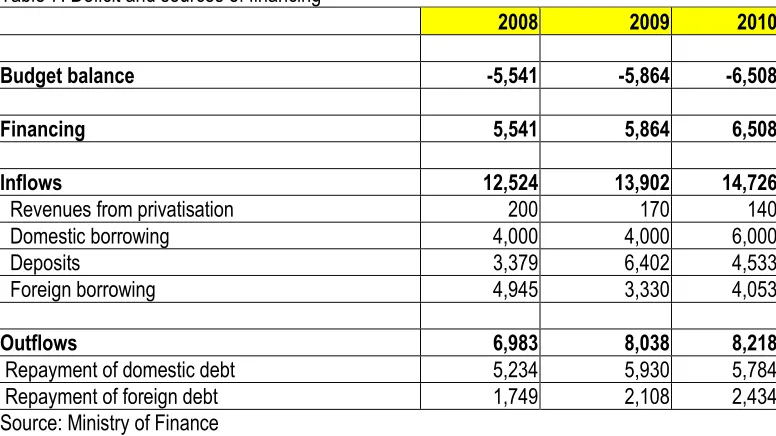
Consolidated general government budget – deficit -3,496 -5,541 -5,864 -6,508
% of GDP -1.0 -1.5 -1.5 -1.5
Central Budget – revenues 77,507 83,454 84,700 88,870
% of GDP 23.2 22.9 21.3 20.5
Central Budget – expenditures 79,999 87,651 90,424 94,878
% of GDP 24.0 24.0 22.7 21.8
Central Budget – deficit -2,492 -4,197 -5,724 -6,008
% of GDP -0.7 -1.2 -1.4 -1.4
Extra budgetary funds – revenues 33,804 35,854 38,965 42,366
% of GDP 10.1 9.8 9.8 9.8
Extra budgetary funds - expenditures 34,808 37,198 39,105 42,866
% of GDP 10.4 10.2 9.8 9.9
Extra budgetary funds - deficit -1,004 -1,344 -140 -500
% of GDP -0.3 -0.4 0.0 -0.1
Local government budget - revenues 14,204 17,176 22,320 23,624
% of GDP 4.3 4.7 5.6 5.4
Local government budget - expenditures 14,204 17,176 22,320 23,624
% of GDP 4.3 4.7 5.6 5.4
Local government budget - deficit 0 0 0 0
% of GDP 0.0 0.0 0.0 0.0
Gross Domestic Product 333,845 364,492 397,888 434,345
Revenues of the consolidated government budget in the next three-year period decline relatively, as a share of the GDP, from 37.6% of GDP in 2007 to 35.7% in 2010.The projected decrease is mainly a result of the reduction of the tax burden, which will provide space for freeing available resources in the private sector and their focusing on a higher level of investments and new jobs that would directly accelerate development of the domestic economy.
Total expenditures in the period 2008-2010, in conditions of rational management with public finances at all government levels, according to the planned policies and low level of budget deficit, are declining as a share of the GDP from 38.6% in 2007 to 37.2% in 2010.
Such determined basic postulates of the fiscal policy actually mean further maintenance of the low level of deficit at around 1.5% of the projected GDP, which is mainly financed from domestic sources.
Medium-term projections of the Budget of the Republic of Macedonia
Regarding the coming medium term, projected revenues and expenditures maintain the low level of budget deficit of around 1.5% of the projected GDP. Maintaining this level of deficit, as clearly defined fiscal anchor, will provide greater credibility for the country, benefiting from the sound economic expectations and significant support to the fixed exchange rate regime.
Projected revenues in the Budget of the Republic of Macedonia
Intensifying the economic activity, together with increased investment activity, which leads to the improvement of economic performance, and the imposed need to re-assess the expected revenue projections on medium term, whereby the current 2007 is taken as a base.
Within the total budget revenues, tax revenues have the largest share, which account for around 57% in the coming medium-term period.
Estimates regarding the tax revenues are based on the projected revenues in certain years when macroeconomic parameters were applied, having a different influence on the amount of tax revenues.
As part of the tax reforms, starting in 2007, and flat tax was applied, i.e. an equal tax rate of 12% at profit tax and personal income tax, which will be further reduced to 10% in 2008, as well as zero rates on re-invested profit, thus the Republic of Macedonia will become one of the countries with lowest taxes.
What is important to be pointed out regarding the introduction of the flat tax in 2007 is that it supports private sector development, providing for reduction of the tax burden, simplification of tax procedures, job encouragement, and in particular attracting foreign direct investments.
Such reform activities in tax policy are only one of the commitments of the Government to directly expedite economic growth, which in the next period are expected to ensure growth of gross domestic product up to 6.5% and 4% employment growth.
Tax policy in the next medium-term period envisages continuation of the process of harmonisation of legislation with the modern tax systems of the developed market economies and thus the tax reforms in the overall tax area will continue. In parallel with this process, all measures and activities will continue in ensuring efficiency in calculating and collecting taxes and stronger fight against tax frauds. Cooperation among the Public Revenue Office, Financial Police and Customs Administration will be intensified in terms of detecting tax evasion and illegal import and their eradication, as well as enforcement of sanctions for the perpetrators will provide for increase in the revenues on the basis of taxes and customs.