1
Going to Brussels.
A Population Perspective on Interest Representation in the EU
Joost Berkhout1 Caelesta Poppelaars2
Paper prepared for
11th Biennial EUSA Conference
Panel 9E Interest groups in EU studies and comparative politics Los Angeles, April 23-25 April
1
Department of Public Administration, Leiden University; [email protected]
2
2 Abstract
In this paper, we propose a new research strategy to better link interest representation studies to the study of European Integration. To assess the role of interest groups in European integration, we need comparative research designs to systematically vary contextual factors that shape the role of interest groups in a democracy. We develop a new comparative research strategy by focusing on organizational diversity of interest group populations. We define organizational diversity in terms of a policy orientation (i.e. the exercise of influence) and the means employed (i.e. participation of members). Based on a comparison of EU and a Dutch sample of interest groups, we find that membership orientation seems to be more important at the national level and that a policy orientation is more important at the EU level. We find that interest group activity is important throughout a wide range of policy domains and varies in terms of interests across national and European areas of competence. The business bias at the EU-level may be less normatively problematic given the inherent systemic characteristics of the EU. Our results confirm the usefulness of our research strategy in developing comparative designs in interest representation research and may be a start in building bridges between two important yet separate studies of EU policy making.
Introduction3
Studies of EU interest representation have become more numerous and sophisticated over recent years (Beyers, Eising and Maloney 2008; Coen 2007; Eising 2008; Lowery, Poppelaars, and Berkhout 2008; Dur 2008, Naurin 2007). These recent developments immensely contributed to our knowledge about the role of interest groups in European policy making. Yet, we still grapple with one of the most fundamental theoretical and normative question specifically related to interest group activity in the EU. That is, we still (or again) find it difficult to include interest representation in theories of European integration and, in relation, we can only speculate about whether and how interest groups contribute to the democratization and politicization of Europe.
We argue that this omission is a result of two trends in EU research. First, interest group research is decreasingly included in theories of regional integration. And, second, EU interest groups scholars rarely engage in a normative evaluation of EU democracy and the role of interest groups therein. Consider the first trend – the limited examination by EU interest group researchers of theories of regional integration (but see Eising, 2004, Wessels, 2004). This is surprising because in the two most important integration theories, intergovernmentalism and neofunctionalism, groups have a centre stage position: that is,
3
3
preferences and demands of interest groups are important explanatory factors for, respectively, country positions in EU negotiations (Moravcsik, 1998) and for European integration and policy spillover (Haas 1958, Scheingold and Lindberg 1970, Schmitter 2005). Instead of examining these integration theories, group researchers have chosen other paths of theory construction. On the one hand, we welcome the turn away from siu generic notions inherent in integration theories because it allows for comparative research designs and the construction of research program around interest representation (Woll, 2006, Lowery ea 2008). However, on the other hand, European integration should not be theorized in such a way that it only indirectly addresses group politics. This is what Hooghe and Marks (2008 18-19) do when they argue that interest groups decreasingly matter. They note that European issues are increasingly politicized in mass arenas and increasingly understood as an ‘identity’ issue that is outside of (economic) group politics (Discussed by: Kriesi, 2009).4 Marks and Hooge consequently propose a ‘post-functionalist’ theory of European integration that is very much focused on ‘identity’ questions and the related strategic interaction of political parties in relation to public opinion. While this is important, especially for integration or constitutionalisation of the EU, ‘regular’ European public policy processes also shape EU integration. Put differently, their assertion of decreasing relevance of interest group activity could partially be a result of a bias toward or exaggeration of only salient issues of EU integration rather than being applicable to the entire range of EU policy making. If these other kinds of less salient issues are nonetheless important, research findings on activities of interest organizations in relation to the whole of the EU policy process should contribute to the construction of the ‘postfunctionalist’ middle range theory on European integration that Hooghe and Marks propose. Most likely, interest group activity as such has not diminished but will vary across salient and non-salient issues, or more generally, across policy domains (cf. Borzel and Risse 2008). As a start in assessing this expectation, we examine in this paper the relation between level of policy competence and the number of interest organizations active in these policy fields (and further briefly suggest that, contrary to Hooghe and Marks implicit assumption, a sizable number of groups work on ‘non-economic’ issues).
Second, research on EU interest representation insufficiently engages in a normative evaluation of European democracy. The recent discussion on the ‘democratic deficit’ and the institutional ‘cures’ thereof almost exclusively deal with electoral competition, parties and
4
4
parliament (Schmitter, 2000, Hix, 2008, Bartolini, 2006, Magnette and Papadoulos, 2008). There are of course, good reasons for this focus. Political parties are at the centre of crisis of democracy more broadly (Mair 2006), and European level parties are a challenging starting point as the ‘non-barking dogs’ of European democracy (Schmitter, 2009). Still, interest group researchers could engage in this important debate in three ways. The first is by evaluating the management and regulation of access of lobbyists to EU institutions as a ‘constitutional issue’ that organizes certain conflicts into politics and others not (e.g. Balme and Chabanet 2008). Second, a normative contribution could be made by a critical examination of the policies of European Commission in relation to ‘civil society’ (on strategic rhetoric related to this term: Monaghan, 2008, Smismans, 2008, Kohler-Koch, 2008). That is, we know that early European policy makers had to rely on interest groups to provide them the necessary information and political support to foster the evolving European project (Streeck and Schmitter 1991). This seems to have resulted in a sustained bias towards business associations and individual firms that were drawn to Brussels (Coen 2007, Pollack 1997, Mahoney 2008). At the same time, the commission pursues an active outreach and subsidy strategy so as to diversify to include other types of organizations (COM 2002; Mahoney and Beckstrand 2008; Greenwood, 2007). Third, scholars of interest organizations could evaluate the extent and character to which these organizations deliver certain political functions, such as citizen participation, interest aggregation and effective political voice, thereby evaluating whether organizations live up to alleged beneficial contribution of civil society organizations to democratic societies (Halpin 2006, Jordan and Maloney 2007). Among others, if parties have problems in aggregating and articulating both latent and salient interests in society, could interest organizations do that better? And could interest organizations in that way provide a representative link to society, in addition to elections, in European level policy making? In this paper we examine whether the organizational infrastructure of EU interest groups is sufficiently situated so as to take such a ‘beneficial’ role.
5
comparative research is necessary to better assess the sui generic aspects of EU interest representation, it is precisely these aspects that may inhibit sound comparative research. For example, the multi-national and diverse membership of European interest associations is of a different nature than nationally federated interest organizations and thus to at least some extent incomparable. Second, the theoretical state of the art of interest representation does not help to advance comparative research either. Lowery, Poppelaars and Berkhout (2008) argue that framing interest group activity in functional terms of an ‘influence production process’ generally helps to segment the process of interest representation in meaningful substantive topics. This conceptualization thus facilitates the construction of middle-range theories on any given stage in aggregating and articulating salient interests and makes the linkages between the individual segments more explicit. Most of the existing challenges in contemporary interest group research indeed require theoretical linking of various aspects of interest representation (Lowery 2007). This is, for example, the case when examining political bias, the relation between political cleavages and interest representation and the ways interest groups combine organizational maintenance and political strategy, to name a few of such contemporary challenges (Beyers, Eising and Maloney 2008). What is even more important, such linkages arguably vary across political systems, making the use of a comparative research design an important – even necessary – strategy to advance our knowledge on EU interest representation.
6
representation and, at the same time, our results speak to the normative and empirical debates on EU integration.
We proceed as follows: first, we present our way to evaluate organizational diversity of a community of interest groups. We suggest a typology of organizations based on two dimensions. Second, we formulate expectations about this diversity in the EU and the Netherlands. We follow with the description of our mixed-sampling method and website-based data. Then we evaluate several factors such as policy domain, political system, and policy competence, that may explain variation in the organizational typology and in the interest represented (business or not). We conclude with a short summary and implications for further research.
2. Examining organizational diversity
7
We therefore propose a different strategy. Comparative research in general benefits from a careful conceptualization strategy that relies on functional variation rather than the idiosyncracies of individual political entities (Sartori 1970; Dogan and Pelassy 1990). Our conceptualization strategy consists of two parts: first, we follow Lowery and Gray (2004) and differentiate various stages in the ‘influence production process’, second, we follow Streeck and Schmitter (1999), and differentiate various political functions that populations of interest organizations perform to varying degrees.5
Segmenting interest representation in meaningful functional stages advances theory development and comparative research design. That is, by studying a single stage in the influence production process, explanatory variables related to another stage can serve as constants (Lowery, Poppelaars, and Berkhout 2008). While comparative research on EU representation can benefit by segmentation of functional parts of the influence production process, conceptual and empirical breakthroughs will lie on the fine lines that separate these segments. For example, research indeed has shown that community characteristics such as the density of the interest population may affect both mobilization ratios as well influence tactics (Lowery and Gray 1995; Browne 1990). In this paper, we focus on the organizational configuration of interest groups as a potentially fruitful starting point for examining the linkages between the population and strategic stages of the influence production process.
Rather than focusing on system variation in any of the abovementioned organizational categories, we build upon the classic distinction of Streeck and Schmitter (1999) to distinguish between individual interest organizations along two dimensions. The first dimension addresses the organizational environment and the relative importance of political institutions vis-a-vis organizational members. The second dimension evaluates the types of (internal) organizational means that could be used in interaction with these environments.
First, the key contribution of Streeck and Schmitter is that ‘the organizational dynamics of intermediary organizations derive from their simultaneous involvement in two environments, the social group from which they draw their members (membership environment) and the collective actors in relation to which they represent these (influence environment)’ (Streeck and Kenworthy, 2005, 451). It is assumed that these two environments operate according to two logics of exchange, the often contradictory ‘logic of membership’ and ‘logic of influence’ (Schmitter and Streeck, 1999). On the one hand, the
5
8
socio-economic context provides support in terms of members, information and collective activities in exchange for the articulation of interests in the institutional environment. On the other hand, the political institutional context provides policies favorable to members and some sort of representational monopoly in exchange for compliance or political support. These exchanges matter for the individual organizations but are also characteristic of various systems. That is, the ways in which interest groups balance different demands defines a group system as pluralist or corporatist: ‘Striking a balance between members-responsive but weakly organized, fragmented, and competitive pluralism on the one hand and corporatist institutionalization in their target environment on the other is the central political and organizational problem of neocorporatist interest intermediation.’ (Streeck and Kenworthy 2005, 452).
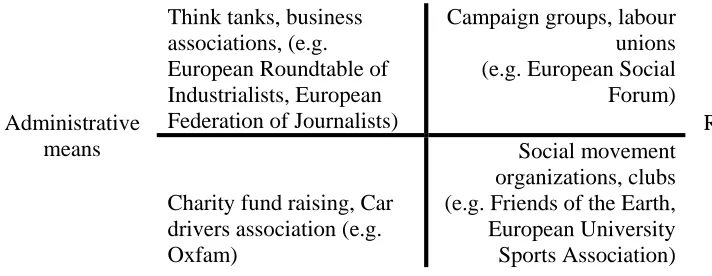
Second, a less developed dimension that Streeck and Schmitter use to distinguish organizations is what they label the tension between the ‘logic of effective implementation’ and ‘logic of goal formation’. In contrast to the first dimension these logics do not involve an exchange relationship. Therefore we will not use their terminology here. Instead we speak of administrative and representative means.6 The first refers to the efficient operation of internal affairs, such as professional management and specialization, whereas the second refers to ‘widespread membership involvement’ so as to aggregate varying interests. The extent to which organizations choose any of these sometimes contradictory alternatives depends on environmental constraints and determines the function the organization provide, or as they say: ‘the mix of participation, representation, provision of services and control over members (…) is limited by the often competing logics of membership and influence.’ (1999 22) The figure represents the types of organizational tasks in relation to the two dimensions.7
[Figure 1 about here]
More recently, Kriesi (1996) conceptualizes organizations along two similar dimensions when he proposes a typology of the organizational environment of social movements. First, he differentiates political organizations between those oriented towards authorities and those oriented to clients. This is similar to the tension between the logic of influence and the logic on membership. However, he does not explicitly relate this to corporatist or pluralist systems.
6
This is in line with the original terminology that Schmitter and Streeck (1999 19-20) derive from Child ea (1974). Child ea use administrative rationality and representative rationality.
7
9
In addition to this ‘orientation’ of organizations, he distinguishes the extent to which organizations seek to mobilize their constituents to participate in collective action. This is similar to the second dimension that we label the administrative and representative organizational means. Similar to Streeck and Schmitter, the two dimensions lead to four types of political organizations: social movement organizations that combine a strong orientation toward political authorities and direct participation of their constituency. Supportive organizations combine a limited focus on membership with a limited focus on political authorities. These are what Kriesi calls service organizations. Self-help or altruistic organizations actively engage their members and are more oriented towards than members rather than toward political authorities. Voluntary organizations or clubs belong to this category. And, finally, the category that Kriesi terms political representation comprises organizations that do not actively engage their members in their organizations but are dominantly oriented toward political interest groups. Labor unions and business associations belong to this category (Kriesi 1996, 152-154). Each type of organization thus engages in different types of activities and has a different political function. Again with some adaptations in terminology, figure 2 presents the typical organizational forms with several EU examples. Organizations and populations of organizations mix various forms and evolve over time. We use the term ‘logic of exchange’ and ‘orientation’ interchangeably to indicate the dimension relating to authorities’ orientation or logic of influence versus constituency orientation or logic of membership. We use ‘organizational means’ to refer to Kriesi’s participation dimension.
[Figure 2 about here]
These functional distinctions are useful for theorizing on the linkages of the influence production process. Indeed, what distinguishes interest groups from regular private firms is that they combine organizational survival with political clout. Organizational survival is not only about financial resources but concerns active membership as well (Gray and Lowery 1996). Interest groups may, however, do so or only be capable of combining these different, often conflicting requirements to different degrees.
10
we expect the configurations of organizations to vary along the corporatist-pluralist continuum. In this regard, we have several specific expectations with regard to the EU that slightly deviate from some theoretical claims. A strong membership orientation is theoretically related to pluralism. Thus we may expect the ‘semi-pluralist’ EU to have large proportions of organizations that are dominantly oriented to their members. However, considering the multi-layered character of Euro-groups we do not expect the members-orientation to manifest itself clearly at that level. We expect high scores on the policy influence scale. At the same time, considering the high level of professionalization needed for policy access at the EU-level, we expect that the participation dimension does not differentiate (economic) interest groups from social movement organizations. The two scales are not expected to be correlated.
In the traditionally corporatist Netherlands, we expect that, in contrast to the EU, we observe a clear tension between the logic of influence and the logic of membership. So, we expect more variation in the policy influence score that, additionally, positively correlates with the organization score. This means that we expected to find organizations that combine both high levels of policy orientation with the organizational characteristics to organize for collective action. This would be a direct result of the logic of corporatist systems to aggregate interest representation by requiring both representativeness of a given set of organization and professionalization in terms of policy orientation. For instance, the Dutch government actively encourages individual patient organizations to collaborate under the heading of one or two umbrella organizations so as to have a professional deliberation partner that can mediate between various interests (Poppelaars 2009a).
Second, such organizational configurations arguably vary along policy domains as well. Messer, Berkhout and Lowery (2009) show how the density of the EU interest population significantly varies across functional policy domains (measured by the NACE codes of economic activity). Including policy domain as full variable in interest population theories is complicated by its conceptual vagueness and the inconclusiveness of its impact over time.8 Therefore, solid theorizing on how ‘natural’ characteristics of policy domains
8
11
affect interest group behavior goes beyond the scope of the paper. Yet we assume that the combination of political and membership orientation is likely to vary across policy domains. For instance, policy domains may vary in type and level of government attention as a direct result of different competencies related to different governance levels, i.e. national versus EU-level. By varying such contextual factors systematically across policy domains, we should be better capable of explaining variation across EU member states and across national and EU level governance. More to the point, and given the relation between government action and increasing levels of interest group activity, we expect that organizations in our EU sample dominantly work on policies of EU competence. Further, we expect that organizations in our Dutch sample tend to focus on policies of national competence. We also hypothesize that business interests tend to focus on policies of EU competence. However, we think that this is irrespective of the level of government of these policies. So, also in the Netherlands we expect to find higher proportions of business interests working on policies of EU competence.
In addition, we expect to find variation across different substantive types of interest groups. Usually, classifications of interest groups rely on a substantive variation relating to the type of interest they represent: NGO, business associations, and so on (Beyers and Kerremans 2004; Mahoney 2004: Poppelaars 2009). How individual organizations combine maintenance and political behavior requirements is likely to vary within as well as across such substantive categories as well. For instance, environmental NGO’s may vary considerably in the extent to which they actively engage their members. Greenpeace may rely more on checkbook membership (Jordan and Maloney 2007) than an ad hoc environmental protest organization while they both belong to the same substantive category. Generally, however, NGO’s are likely to more actively engage their members than business associations will do. We will therefore include a substantive distinction between NGO’s and business interests in our analyses to verify these assumptions and to provide a comparison with the scales we developed.
3. Design
To examine how organizational configurations of interest groups vary, we used several censuses to construct our samples of NLD and EU-level interest groups. Studying interest group populations in the Netherlands is challenge of its own kind as there is no census of the
12
existing interest groups from which to draw a random sample. The important or ‘big players’ among the interest groups are often well-known to policy makers in the Netherlands. But beyond this familiar collection of interest groups, however, it is hard to get an overview of other relevant interest groups. Recent studies of membership organizations in the Netherlands also restrict themselves to the largest ones (Hart de 2005, 2008) concern sector specific studies (Akkerman 2005; Huitema 2005), or study a particular type of organizations, such as professional associations (Visser and Wilts 2006). Such studies do not accumulate and thus fail to provide a full overview of the interest group population. We thus need to develop another strategy to study interest group populations and apply proper sampling methods.
We use the association and foundation database generated by the National Chamber of Commerce in the Netherlands (NCC) as starting point for generating a database of the Dutch interest group population;9 Their trade, association and foundation registers are available online and accessible via a NCC coding system. We use this system to make a crucial selection step, because it provides codes for associations and activities related to interest groups. Based on these codes we produced a database of 7,565 organizations (Poppelaars 2009a; Poppelaars 2009b). From these 7,565 organizations, we randomly sampled 1582 organizations. Then we took a second important selection step based on the website-information of the organization;10 380 turned out to be nationally active interest groups with online presence.
This way of sampling can be termed as bottom-up sampling in the sense that we used a census of all organizational activity in the Netherlands and selected the type of organizations that could be classified as interest groups. This arguably results in a different set of organizations than those organizations that interact with the government. Theoretically, we would expect the proportion of civil society organizations to be higher in the total population compared to the proportion in the subset of organizations that interacts with the government. In general, we could assume that the organizations that interact with the government are a subset of the total population.
Sampling EU interest organization is not troubled by a lack of data as in the Dutch case. Yet EU sampling has to address the variation in multiple data sources that are available
9
The NCC is an autonomous public agency (in Dutch: zelfstandig bestuursorgaan (zbo)) under the auspices of the Ministry of Economic Affairs. The NCC not only administers the trade register, but also administers an association and foundation register (Register Act 1997). Essentially, every citizen in the Netherlands either planning to establish his or her own company or start any type of foundation or association needs to register with the NCC.
10
13
to avoid sampling bias. Therefore, the sample of EU organizations is drawn from a combination of data sources. Apart from the register of Interest Representatives that the Commission started in June 2008, they are CONECCS (August 2007, n=749), the register of lobbyists accredited to the European Parliament (April 2008, n=1534) and the Public Affairs Directory by Landmarks (online version July 2007, n=2522 after deletion of duplicates). Each of these lists is produced for different aims and thus lists varying types of organizations. For example, the frequently used (Mahoney 2008, Eising 2007, Wessels 2004, (Greer, da Fonseca, and Adolph 2008; Wonka 2008) but discontinued voluntary register kept by the European Commission, CONECCS, only registers Euro-groups that are ‘considered representative by the Commission’. Because these lists only partly overlap, a more or less encompassing sample requires a combination of sources (Berkhout & Lowery, 2008). These data sources have been merged and the duplicates have been removed by Arndt Wonka (2008).11 A random sample of 400 organizations is drawn from this merged list that combines three different data sources.
This mixed database provides the most diverse snapshot of interest organizations active at the EU level. However, the database has some downsides. It is not a fully up-to-date list and will not continue to be available in its current form because its constituent sources undergo substantial changes. First, CONECCS is no longer available. Second, Public Affairs Directory has recently changed ownership to Dod’s that may lead to editorial changes. Third, the EP register is frequently up-dated and the most straight forward. That is, every lobbyist that enters the EP building needs a doorpass and consequently ends up in the register for the subsequent year. However, small changes in the implementation affect the types of organizations on the list. For example, the recently introduced ‘express’, two-week pass system may have lead to a decline of national associations on this list.
We have added a random sample of 100 organizations from the new register of Interest Representatives kept by the European Commission to properly address these challenges.12 Apart from getting more up-to-date data, this allows us to compare this source to the other sources and thus examine the usefulness of this data source for future interest group research. After removal of seven duplicates we have a sample of 493 organizations.
We adapt our samples in such a way that it maximizes the comparability of the results of the two samples. First, the Dutch sampling method is explicitly ‘bottom-up’. That is, we
11
We thank him for providing this database
12
14
sample organizations that are likely to be organized for collective action but do not necessarily have contacts to the government. The bottom-up nature of the Dutch sampling procedure increases the likelihood of this expected outcome we described earlier. Namely, as a result of the bottom-up sampling we may find more organizations that are oriented toward their members rather than political authorities and actively engage their members rather than not. In other words, the Dutch sample may be biased towards civil society organizations. We correct for this: remember that we have selected organizations on keywords that refer to some sort of political association and that we have excluded organizations that could not be considered interest groups. This produces a sample that is largely similar to top-down samples. In order to check the validity of this procedure we produced this figure for different sub-samples of our Dutch sample.13 We present the full sample but we exclude recreation, voluntary and sport groups. These exclusions serves as an additional correction to potential sample bias. So, by taking several selection steps, with key words and internet searches, we make our sample more like a ‘top down’ sample.
Second, for the EU sampling method we work exactly the other way around. We take a top down strategy and consequently adapt the resulting selection. We select organizations for which we know that they actively seek to influence policies. Either, they open an office in Brussels and consequently end up the Public Affairs directory. Or, they enter the EP building and end up in the EP lobby register. However, we additionally use data sources that allow for voluntary registration irrespective of policy activities, such as the new register. This is a bottom up effect. Further, we select only those organizations that could have ended up in the Dutch sample as well. That is, we focus on organizations that are specifically designed to allow for collective action. In sum, have adapted, via stratification, filtering and oversampling, the Dutch and EU samples in order to maximize comparability of the samples. Thus, differences between the organizations in these samples should therefore be largely ascribed to real-world phenomena.
3.1 Data collection and measurement
To collect the data, we used a website search, which is a method that is well suited to gather this type of data. Limits of using a website search include a bias to organizations with online presence and a strong reliance on the information offered by the websites. This is particularly
13
15
disadvantageous to collecting more sensitive data such as on interactions with the government or receiving government grants. Yet, in general, a website search provides a first solid starting point to collect data on interest group characteristics and activity (Berkhout 2008).
We use several classification schemes to collect data on type of interest groups, the relation between policy domains and interest group activity and, most importantly, on the organizational diversity in terms of organizational means and policy orientation.14 To indicate the type of interest groups, we use a substantive typology of organizations.15 Additionally, we gathered data on membership,16 economic sector,17 substantive interest18 and policy topic.19
Further, to explore the impact of policy domains on interest group communities and behavior, we used a combination of economic and policy classifications. First, we included the major topic areas of the NACE coding system to account for economic activity in detail. A second classification we used is a policy issue classification that is widely used in the international agenda setting literature (Baumgartner and Jones 1993; (Breeman et al. 2008). These codebooks include detailed descriptions per topic. We allowed for coding both a main topic and several additional topics. However, we found that about 80 per cent of the organizations could be easily classified in a single policy field. Most interest organizations hardly span different policy fields. So, we only use the first topic code. We recoded the nineteen main topic codes into three levels of competence. That is, we distinguished between national level of competencies, shared level of competencies and an EU level of competencies.20 Including the agenda-setting classification to classify interest group behavior
14
Our coding system did allow for (1) choosing multiple categories of the nominal classifications rather than restricting the coding to only one category and (2) in an additional variable forced the coder to choose the most important category. Allowing for multiple categories allows us , for example, to address the fact that interest groups may be relatively heterogeneous in terms of membership as well as in terms of functional orientation (being a religious organization active in development aid, for instance) (Brasher, Lowery, and Gray 1999)
15
Based on a combination of Beyers (2004) and Mahoney (2004); see Poppelaars (2009): individual corporations, small and medium enterprises (SME), employer's peak organizations, employer's sectoral organizations, labour unions, public institution, association of public institutions, research group/ think tank, advisory council, NGO environment, NGO development, NGO consumer, NGO education, NGO health, NGO minorities, NGO religious /philosophy of life, NGO idealistic, NGO cultural/sports/recreation
16 NL: Local / Regional association, Public institution, Private institution, Affiliate / similar organisation /
association, Supporting / sponsoring member, Other, Mixed public/private institution, Membership Group, Individuals, no members (i.e. in case of individual corporation / institution)
EU: (National) Associations with individual members / contributors, (National) Associations of public institutions, e.g. municipalities, social insurance agencies, (National) Associations of companies, (National) Associations of mixed public/private organizations, e.g. hospitals, universities, airports, Individual members / contributors, Public institutions, Companies, Mixed public/private organizations,(European) Associations, e.g. sub-sector associations, Other types
17
According to main NACE codes: < http://ec.europa.eu/competition/mergers/cases/index/nace_all.html>
18
According to Gray and Lowery (1993, 90).
19
According to Policy Agendas Codebook.
20
16
is novel in itself as this classification is normally used to track variation in issue-attention over time, rather than revealing individual-level presence (and thus implicitly individual-level activity).
We employ two typologies of interest organizations and both rely on a combination of variables. First, a combination of substantive characteristics (NGO’s, employers) and membership: We combine two classifications to address the type of interest groups, namely, a classification to account for the type of membership and a classification to account for substantive variation. Second, as discussed in section 2, we evaluate organizations on two dimensions: (1) a scale that indicates to what extent they are oriented to lobby activities / policy making (logics of exchange) and (2) a scale that refers to the extent to which organizations certain exhibit organizational characteristics to perform tasks in a administrative or representative manner (organizational means). Both scales consist of five-point scales that we included in our web-site based coding scheme.
For the policy orientation scale, we assign high scores to organizations that seem dominantly oriented at the political institutions. For example, when we find references to legislative processes or when we observed activities that directly seek government recognition for some sort of social problem. In addition to this policy orientation scale, we have coded, also on a five-point scale, the types of organizational means to further the aims of the organization. For this second scale, we looked for and coded accordingly organizational mechanisms to facilitate representation of members, such as annual members’ meetings and members’ recruitment activities. The rationale of this second scale relates to opportunities for participation for citizens and mechanisms that may increase the representative character of the organization. Using such scales may be a good starting point for linking organizational aspects and political aspects intrinsic to interest representation. That is, how to combine organizational maintenance and survival and political influence. And, as such, the combination of these two scales is a new research strategy in comparing interest group populations across national and EU levels of governance.
In order to identify different types of organizations in terms of collective action potential and orientation toward political authorities, we conducted a cluster analysis. Cluster
Union): National: Civil Rights, Immigration, and Integration, Healthcare, Education and Culture, Housing and City Planning, Democracy and Government
Shared: Macro-Economics and Taxes, Labour, Energy, Traffic and Transport, Law, Court Rulings, Crime, Social affairs, Defense, Scientific Research, Technology, and Communication, Foreign Affairs and Foreign Aid, Spatial Planning, Public Nature and Water Conservation
17
analysis is a helpful tool in exploratory research design to help identify several groups in the data which share similar characteristics. That is, cluster analysis maximizes between-group variation and minimizes within-group variation. In our case, we used cluster analysis to identify sets of organizations that share similar degrees of collective action potential combined with a certain degree of authority orientation (Aldenderfer and Blashfield 1984). More specifically, we used two-step cluster analysis as this technique can handle relatively large databases and a combination of categorical and continuous variables. In this respect, we were informed by the design used by Minkhoff, Aisenbrey, and Agnone (2008) to identify organizational diversity in the US advocacy sector. Two-step cluster analysis is dependent on the sequence of the cases in the dataset and the outcomes may thus vary across datasets with a different order of cases. We checked for this by conducting a stability analysis, i.e. we ran different cluster analyses for various randomized orders of the observations. The four clusters which appeared originally appeared to be stable throughout the different datasets.21
4. Explaining organizational diversity of interest populations in the EU
In this section, we empirically examine the variation in internal (organizational means) and external (logic of exchange) dimensions of interest organizations in the Netherlands and the EU. We first use a descriptive empirical assessment of how the two scales vary across the EU and the Dutch population. Second, we use a different typology to examine how the percentage of business associations versus NGO’s varies across policy domains. We then unravel how the combination of policy and collective action orientation result in different clusters or groups of interest organizations via a cluster analysis. And, finally, we test whether variation in interest representation regimes, policy domains and types of interest groups can explain cluster membership. Taken together these empirical strategies offer a first testing of a comparative research strategy based on organizational diversity across policy domains and different levels of governance.
How organizational diversity varies across the Netherlands and the EU
We start with a comparison of the two scales across the EU and the Netherlands. The figures below show the scores for the organizations in our samples in the EU and the Netherlands.
21
18
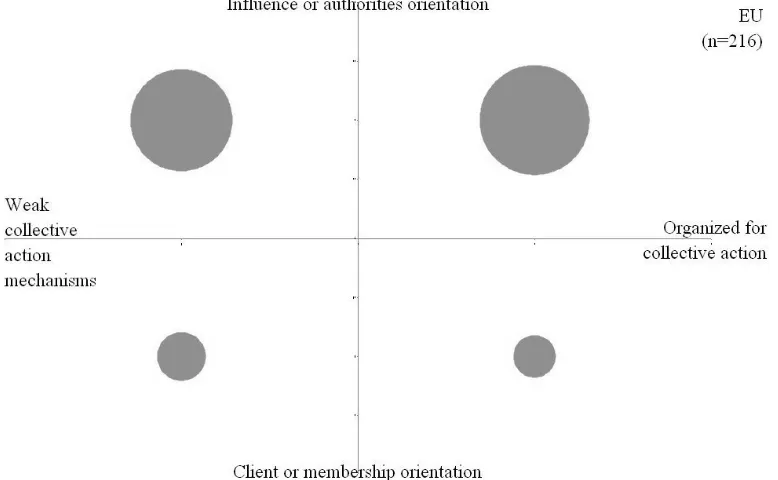
The scales are recoded into three categories and the middle category is removed. The x-axis represents the ‘organizational means-scale. The y-axis shows the scores on the ‘logic of exchange’-scale. The circles in each quadrant represent the proportion of organizations with the corresponding scores. As with the other figures, we use a subset of the EU sample that includes only EU and national associations with sufficiently informative websites.
[Figures 3 and 4 about here]
In the EU, as expected, we observe generally high proportions of organizations that at the policy influence side of the logic of exchange scale, the y-axis. About 75 per cent of the organizations seem to be actively aiming to influence European public policies. The high EU scores on this scale are supported by the more precise coding on interaction and cooperation with government actors. In the EU, only about four per cent of the organizations do not seem to have some sort of interaction. In the Netherlands, only about half of the organizations show on their websites interest in contact with government.
The focus on public policies and the parallel lack of orientation towards clients and members is uncharacteristic of pluralist systems. It is assumed (Salisbury 1968, Schmitter and Streeck 1999) and shown (Walker 1991) that competitive pressures for members necessitate stronger client-orientation than in corporatist systems. With this seemingly weak logic of membership the EU may not be as pluralist as has been claimed (Eising 2007, Greenwood 2007; Schmidt 2006).
19
from a constituency that is usually nationally defined rather than in supra- or international terms.
In the Netherlands, we observe, on the one hand, large proportions of organizations with high scores on both scales and, on the other hand, large proportions of organizations with low scores on both scales. This implies that both scales matter and that they correlate. This confirms our expectation. That is, Dutch interest groups involved public policy making seem to combine a strong policy orientation with several organizational mechanisms to organize collective action and serve their members via representative means. These organizations conform to the traditional neo-corporatist expectation of functioning as an intermediary between citizens and government. Umbrella organizations in the Netherlands, for instance, combine a strong policy involvement orientation with heavy emphasis on their added value for their members by offering them a variety of membership services and collective action mechanisms.
The other large proportion of the Dutch interest group community does not have organizational mechanisms to relate to members and are only limitedly active on policies. Such organizations tend to be oriented towards bringing people together to advance a certain cause, such as in the areas of development aid and environmental issues, without the immediate aim to influence policies. They use administrative means of checkbook involvement and professional management. These are also organizations that bring together experts to facilitate exchange of expertise on a certain matter. In this sense they clearly engage in collective action to pursue a common yet private cause and will only occasionally intersect with public policy. We did not find such groups at the EU level. It is unclear in what way this type of organizations fits corporatist discussions. That is, because of a lack of traditional political organization and only indirect, ad-hoc attempts to interact, these groups do not have an immediate political function. These service-minded groups are usually out of the scope of neo-corporatist theory.
20
How interest group activity varies across different areas of competence
In the previous section we showed how organizational diversity in terms of collective action and policy orientation varies across national and EU levels of governance. In this section, we examine whether different areas of competence attract different types of interest groups. We use this variation in competence in three ways: first, we evaluate, similar to analysis in federal systems such as the US (Baumgartner, Gray, and Lowery 2007), the relative presence of interest organizations at varying levels of competence. Second, while correcting for the variation in competence we examine the relative proportion of organizations representing business interests. Third, we evaluate whether the regularities observed at high levels of aggregation are also observed in specific policy fields.
In order to evaluate our expectations concerning variation of interest group activity across different areas of competence (see section 2), we combine and recode the information that we coded from the interest organizations’ website. We use the policy topic classification of the Policy Agendas project.22 We only evaluate the variation between business interest associations and other organizations. We combine the functional (ie employers- and professional associations) and membership-based classifications (companies as member) of business interest groups. This is thus the most encompassing definition of organizations representing business interests. Figure 5 shows the proportion of organizations per sample per level of competence in the EU and the Netherlands. For instance, at the EU level, we see that almost 45 percent of the interest groups is active in policy area of EU competence.
[Figure 5 about here]
In general, the figure supports our expectations. That is, we indeed find higher numbers of interest organizations in policy fields that are the main competence of the respective level of government and vice versa. Between policy fields of EU and national competence, we observe variation between about 20 and 45 per cent. More detailed analysis is needed to evaluate the factors underlying the magnitude of this variation. That is, among others, we observe substantial numbers of organizations that lobby the EU in policy fields that are formally national competence. This may be an indication of a preference to shift a certain
22
21
policy to the EU level. Or it may be that the EU provides a more favorable political environment for certain activities.
[Figure 6 about here]
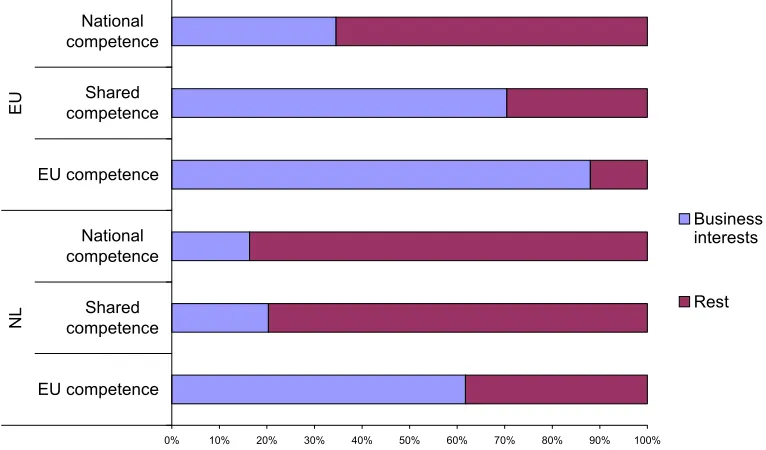
Figure 6 shows the relative proportion of business interests within the same categories as in the previous figure. The figure shows the general proportion of business interest and the variation across policy fields. In case there was no correlation between policy fields of EU competences and policy field that attract business interests, we would observe similar proportions per category. These proportions could, of course, then, vary between the Netherlands and the EU.
First, in general, compared to the Netherlands, we find relatively large proportions of organizations that represent business interests in the EU (75 per cent relative to 27 per cent). The business dominance in the EU is not a new finding (Coen 2007; Mahoney 2008). However, the Netherlands is probably not the best benchmark in this regard. In light of its corporatist tradition, business interests relative to other interests, are likely to use a relatively small number of organizations to act collectively. That may be due to professionalization, the number of specialized interests they represent, and their presence in consultation bodies. However, due to the bottom-up sampling technique we, to a certain extent, correct for this phenomenon. Bottom-up sampling results in a higher percentage of business interests as it also includes the individual business associations that are a member of the umbrella organizations. The latter are usually the focus of interest representation studies in the Netherlands.
22
the state of business influence/bias at the national level. And, second, that there is hardly any spill-over from the business bias in certain policy fields to other fields (e.g. from foreign trade to health care). The examination of specific policy fields below suggests that we cannot automatically assume the latter.
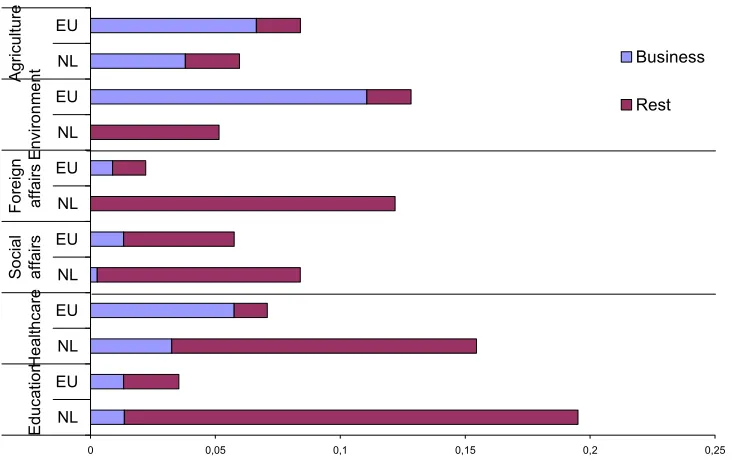
When we observe the figures for the Netherlands, we note some interesting variation as well. Business interests are overrepresented in areas with an EU competency, while other interests, organized in what we for now label NGO’s, make up a larger proportion of the organizations involved in shared and national competences. This confirms the earlier trends we discussed as related to the figures above. A general implication we could derive from these pictures is that NGOs are apparently less active in areas of shared and EU competence levels, which could indicate that the threshold for them to become active in these areas may be bigger and that policy involvement in the Netherlands in these areas is relatively confined to business interests. Figure 7 illustrates this point further.
[Figure 7 about here]
23
probably relates to the strong tradition of development aid in the Netherlands. A final striking feature is the difference in the area of environmental policy. Organizations active at the national level all are other types of interest, while at the EU-level this area is dominated by business interests. These, for example, work on issues such as the REACH legislation. Again, this reflects within policy domain variation across national and EU level competencies. Comparing policy domains across different levels of government thus provides an additional perspective on variation across types of interest groups active in various fields.
Identifying groups of interest organizations
Four models of different combinations of political orientation and organizational means emerged from the cluster analysis. We label the varying roles that the typology implies as follows: service providers, clubs, policy experts and interest representers. In table 1 several descriptive statistics are reported including the percentage of each cluster of the total population and mean values of the scores on either the membership or the political authority scale. Figure 8 positions the typology in the same manner as described in section 2.
[Table 1 and figure 8 about here]
24
organizations in Kriesi’s terms (1996). In general, these clusters of organizational diversity resemble both Kriesi’s typology and reflect Streeck and Schmitter’s (1999) distinction between the logic of influence and the logic of membership.
Explaining variation in organizational diversity of interest groups
We have seen that variation in interest representation regimes and policy domains results in variation in organizational diversity. In this section we test whether these variables explain cluster membership. To do so, we conducted a multinominal regression analysis including the category ‘interest representers’ as reference category. Further, we included an EU/NLD dummy to represent variation in interest representation regimes, and included categorizations to measure variation in type of interest groups and different competence levels. We also included the NACE-codes to show which of these classifications can better predict variation across policy domains.
[Table 2 about here]
When we observe the results we see some interesting variation. At EU level, the categories of ‘service providers’ and ‘clubs’ seem less likely than at the national level in the Netherlands. In contrast, it is more likely at EU level to find ‘policy experts’ than in the Netherlands. This confirms our earlier findings that the political orientation at the EU level seems to be more important than the orientation toward membership and actively engaging members in the organization.
In terms of theory, the relatively limited client orientation in the EU, (service providers and clubs) contradicts the usually pluralist conception of the EU. In the Netherlands we found large proportions of these service or solidarity minded organizations that have not been within the scope of neo-corporatist scholars. This is probably the case because these organizations are not officially or frequently in interaction with government.
25
the validity of a dimension. This dimension directly addresses some of the more normative claims of the participative benefits to democracy of organizations active in ‘civil society’ especially in the EU case. Although termed as relatively pluralist, a relative lack of membership orientation across different types of interest groups would suggest a more nuanced conclusion about the level and type of pluralism that characterizes EU interest representation. We could thus easily echo the US criticism on pluralism when it comes to membership participation (Skocpol 2003).
Second, we observe interesting results in terms of the distinction between NGO’s and business associations. As opposed to the category of ‘other organizations’, we find significant variation in terms of ‘clubs’ and ‘service providers’. However, the category ‘service providers’ is not significant, indicating that NGOs may be more membership oriented than until now is assumed. The different levels of competence, finally, do not explain much. Only in the case of political orientation membership, national competence results are likely to be associated with lower levels of political orientation. This basically reflects the variation in areas of competence we found earlier. NGO’s seem to be more active in areas of national competence and shared competences.
5 Conclusion
We have argued that focusing on organizational diversity is a fruitful way to start explaining aspects of the EU integration process and assess the extent to which interest groups are helpful in democratization of EU policy making. Furthermore, we have shown that a comparative research design that focuses on functional aspects of political organizations helps to relate population-level research with behavioral aspects of interest representation.
26
of different interest groups representing specialized interests but less pluralist in its orientation toward citizen and individual participation. Second, a large proportion of organizations characterized by low levels of policy involvement and collective action potential in the Netherlands may suggest that corporatist systems may be more fragmented than until now is assumed in the literature. That is, we found substantial numbers of organizations that do not immediately aim to influence policies and survive by providing services or solidarity goods. These organizations could be seen as representing latent interests and could perform some functions attributed to be beneficial to society (social capital, ‘schools for democracy’, integration of society). Third, if we assume that these beneficial effects are real, than the EU does not score so well. So, supporting these functions, via subsidies for instance, seems an answer to this ‘deficit’. However, considering the strong scores in the upper-left quadrant in figure 4, our impression is that this leads to even stronger orientation to the policy process. For now, alternative policy instruments may be more effective in reaching this aim.
Second, across policy domains we found expected variation in interest group activity and in the relative proportion of business interests. By focusing on the differences between the EU and the Netherlands, and across varying level of legal competence, we observed that government action seems to attract interest group activity. Business interests seem to prevail at national and EU level related to policy domains that are salient to them. So, given these natural tendencies, and assuming that business influence at the national level is considered democratically appropriate, than the overrepresentation of business interests in the EU is less problematic than seems to be the case when solely evaluating the EU. Differences between the type of organizations in areas such as health care and environmental affairs warrant a somewhat different conclusion, however. Given the high level of NGOs active at national level versus the small or absent proportion at the EU level do suggest a bias towards business that may be more problematic, but may also relate to within policy domain variation in competencies. Further, it suggests that business influence in specific fields (e.g. foreign trade) spills over to other policy areas that commonly or nationally characterized by a mixture of citizen groups, labor unions and a smaller proportion of business interests (environment, health care). This is more problematic and requires further scrutiny. So, an explicit focus on policy domains and areas of competence may result in a more nuanced picture of the role of interest groups in European policy making.
27
Although the areas of competence are not a significant explanatory factor for cluster membership, our earlier analyses indicate that the type of interest groups vary along the areas of competences. Further, the type of interest groups is an important explanatory factor for cluster membership. Put concretely, group membership of ‘service providers’ and ‘clubs’ is most likely to be related with NGOs. We thus can cautiously infer that the organizational configuration varies across these levels of competence as well. In other words, EU areas of competence are likely to be associated with group membership of those clusters of organizations that are strongly oriented toward political influence. Further research is required to determine the extent to which organizational diversity exactly varies across these policy domains or areas of competence.
More generally, our results have two implications that warrant further research and require normative evaluation. First, they seem to confirm that a focus on organizational diversity related to areas of competence and policy domains is a fruitful comparative research strategy to better assess the sui generic aspects of EU interest representation. Further research should more explicitly hypothesize how interest groups combine the political and constituency related logics of exchange and specify the context-dependent aspects of these logics. This could then help us explain why in certain systems interest organizations provide different political functions and influence the policy process in different ways.
Second, by relating policy orientation and organizational means, we not only provide a first solid step on theorizing between different stages of the influence production process, we have also have empirical evidence of interest group activity that speaks to EU integration theory and the debate on the ‘democratic deficit’. Put differently, a focus on organizational diversity may be a good attempt to build bridges between EU interest representation and EU integration studies. For instance, we find a relatively large proportion of groups at the EU level that has a strong political orientation but cannot meet the representative demands, so as to perform as intermediate organizations between state and society. This is problematic in terms of their democratic contribution and shows that policy making in the EU is a matter of elite pluralism.
28
to democratize or further politicize the EU we need to seriously think about the type of group system that we want or need. Also, or especially, if the main challenges for institutional reform need to address political parties, elections and political competition more generally, as is suggested in the recent debates in the area (e.g Hix, 2008).
29 References
Akkerman, Agnes. 2005. Verhoudingen tussen de sociale partners in Nederland anno 2005: Corporatisme of lobbyisme. Beleid en Maatschappij 32 (4):187-198.
Aldrich, H.E., C. Zimmer, U. Staber, and J.J. Beggs. 1994. Minimalisation and Organizational Mortality: Patterns of Disbanding Among U.S. Associations, 1990-1983. In
Organizational Evolution: New Directions, edited by J. V. Singh. Newbury Park (CA): Sage.
Balme, R., & Chabanet, D. (2008). European governance and democracy: power and protest in the EU. Lanham, MD: Rowman & Littlefield.
Balme, Richard, and Didier Chabanet. 2008. European governance and democracy: power and protest in the EU, Governance in Europe. Lanham, MD: Rowman & Littlefield. Baumgartner, Frank R., and Beth L. Leech. 1998. Basic interests. The importance of groups
in politics in political scientists. Princeton (NJ): Princeton University Press. Baumgartner, Frank R., and Bryan D. Jones. 1993. agendas and instability in American
politics. Chicago: the university of Chicago press.
Baumgartner, Frank R., Grant Jordan, John McCarthy, Shaun Bevan, and Jamie Greenan. 2008. Tracing Interest-Group Populations in the US and UK. In Annual Meeting of the American Political Science Association. Boston.
Baumgartner, Frank, Virginia Gray, and David Lowery. 2007. Federal Policy Activity and the Mobilization of State Lobbying Organizations. In Annual meetings of the American Political Science Association. Chicago.
Berkhout, J., and D. Lowery. 2008. Counting Organized Interests in the European Union. A Comparison of Data Sources. Journal of European Public Policy 15 (4):489-513. Berkhout, Joost. 2008. Who? Says what? To whom? Organized interests shaping the
European Union online sphere. In UACES annual conference. Edinburgh.
Beyers, J., R. Eising, and W. Maloney. 2008. Researching Interest Group Politics in Europe and Elsewhere: Much we Study, Little we Know? West European Politics 31 (6):1103-1128.
Beyers, Jan. 2002. gaining and seeking access. the European adaptation of domestic interest associations. European Journal of Political Research 41 (5):585-612.
Beyers, Jan. 2004. Voice and Acces. Political Practices of European Interest Associations. European Union Politics 5 (2):211-240.
Blom-Hansen, Jens. 2000. Still Corporatism in Scandinavia? A survey of recent empirical findings. Scandinavian Political Studies 23 (2):157-181.
Brasher, Holly, David Lowery, and Virginia Gray. 1999. state lobby registration. the anomalous case of Florida (and Minnesota too)! Legislative studies quarterly 24 (2):303-314.
Breeman, G., D. Lowery, C. Poppelaars, S. Resodihardjo, A. Timmermans, and J. Vries de. 2008. Political Attention in a Coalition System: Analyzing Queen's Speeches in the Netherlands 1954-2007. Acta Politica:forthcoming.
Broscheid, A., and D. Coen. 2007. Lobbying Activity and Fora Creation in the EU: Empirically Exploring the Nature of the Policy Good. Journal of European Public Policy 14 (3):346-365.
Browne, W.P. 1990. Organized Interests and Their Issue Niches: A Search for Pluralism in a Policy Domain. Journal of Politics 52 (2):477-509.
Chari, Raj, and Gary Murphy. 2008. Examining and Assessing the Regulation of Lobbyists in Canada, the USA, the EU institutions, and Germany: A Report for the Department of the Environment, Heritage and Local Government. Dublin: DCU.
30
Coen, D. 2007. Empircal and Theoretical studies in EU lobbying. Journal of European Public Policy 14 (3):333-345.
Coen, David. 1998. The European Business Interest and the Nation State: Large-firm Lobbying in the European Union and Member States. Journal of Public Policy 18 (1):75-100.
COM. 2002. General Principles and Minimum Standards for Consultation of Interested Parties by the Commission: European Committee.
Dür, Andreas. 2008. Interest Groups in the EU: How Powerful Are They. West European politics 31 (6).
Eising, R. (2004). Multilevel Governance and Business Interests in the European Union. Governance, 17(2), 211-245.
Eising, R. (2009). The Political Economy of State-Business Relations in Europe: Interest Mediation, Capitalism and EU Policy Making: Routledge.
Eising, R. 2007. The Access of Business Interests to EU institutions: Towards Elite Pluralism. Journal of European Public Policy 14 (3):384-403.
Eising, Rainer. 2004. Multilevel Governance and Business Interests in the European Union. Governance: an international journal of policy, administration, and institutions 17 (2):211-245.
Eising, Rainer. 2008. Interest groups in European Union policy-making. Living Reviews in European Governance (LREG) http://europeangovernance.livingreviews.org. Eising, Rainer. 2009. The Political Economy of State-Business Relations in Europe:
Routledge.
Fairbrass, J. (2003). The Europeanization of Business Interest Representation: UK and French Firms Compared Comparative European Politics, 1(3), 313-334.
Gormley, William, T. 1983. Policy, Politics, and Public Utility Regulation. American Journal of Political Science 27 (1):86-105.
Gray, V., and D. Lowery. 1996. A Niche Theory of Interest Representation. Journal of Politics 58 (1):91-111.
Greenwood, J. (2007). Organized Civil Society and Democratic Legitimacy in the European Union. British journal of political science, 37(2), 333-357.
Greenwood, Justin. 2007. Organized Civil Society and Democratic Legitimacy in the European Union. British journal of political science 37 (2):333-357.
Greer, Scott L., Elize Massard da Fonseca, and Christopher Adolph. 2008. Mobilizing Bias in Europe: Lobbies, Democracy and EU Health Policy-Making. European Union Politics 9 (3):403-433.
Grote, Jürgen R., and A. Lang. 2003. Europeanization and the organizational change in national trade associations - an organizational ecology perspective. In The politics of Europeanization, edited by K. Featherstone and C. M. Radaelli. Oxford: Oxford University Press.
Haas, E. B. (1958). The uniting of Europe : political, social, and economical forces 1950-1957 Stevens.
Hannan, Michael T., and John Freeman. 1977. The population ecology of organizations. the American Journal of Sociology 82 (5):929-964.
Hart de, J. 2005. Landelijk Verenigd. Grote Ledenorganisaties over Ontwikkelingen op het Maatschappelijk Middenveld, Civil Society en Vrijwilligerswerk IV. Den Haag: SCP. Hix, S. (2008). What's wrong with the European Union and how to fix it: Polity Press. Hooghe, L., & Marks, G. (2009). A Postfunctionalist Theory of European Integration: From
31
Huitema, Dave. 2005. In een groen, groen polderland: de mix tussen corporatisme en
lobbyisme in het Nederlandse milieubeleid. Beleid en Maatschappij 324 (4):199-210. Imig, D., & Tarrow, S. (Eds.). (2001). Contentious Europeans: protest and politics in an
emerging polity. Lanham: Rowman & Littlefield.
Imig, Douglas, and Sidney Tarrow, eds. 2001. Contentious Europeans protest and politics in an emerging polity, Governance in Europe. Lanham MD [etc.]: Rowman & Littlefield. Jordan, A.G., and W. Maloney. 2008. Democracy and Interest Groups. Enhancing
Participation? Basingstoke: Palgrave MacMillan.
Jordan, G., & Maloney, W. A. (2007). Democracy and interest groups : enhancing participation? . Basingstoke [England] ; New York :: Palgrave Macmillan.
Kohler-Koch, B. (2007). The Organization of Interests and Democracy in the European Union In B. Kohler-Koch & B. Rittberger (Eds.), Debating the democratic legitimacy of the European Union. Lanham: Rowman & Littlefield.
Kohler-Koch, B., & Quittkat, C. (2009). What is civil society and who represents civil society in the EU? – Results of an online survey among civil society experts. Policy and Society, 28(1).
Koopmans, Ruud. 2007. Who inhabits the European public sphere? Winners and losers, supporters and opponents in Europeanised political debates. European Journal of Political Research 46 (2):183-210.
Kriesi, H. (2009). Rejoinder to Liesbet Hooghe and Gary Marks, A Postfunctional Theory of European Integration: From Permissive Consensus to Constraining Dissensus. British Journal of Political Science, 39(01), 221-224.
Kriesi, Hanspeter. 1996. The organizational structure of new social movements in a political context. In Comparative Perspectives on Social Movements. Political Opportunities, Mobilizing Structures, and Cultural Framings, edited by D. McAdam, J. D. McCarthy and M. N. Zald. Cambridge: Cambridge University Press.
Lahusen, C. (2004). Joining the Cocktail Circuit: Social Movement Organizations at the European Union. Mobilization, 9(1), 55-71.
Lahusen, Christian. 2003. Moving Into the European Orbit: Commercial Consultants in the European Union. European Union Politics 4 (2):191-218.
Leech, Beth L., Frank R. Baumgartner, Timothy M. La Pira, and Nicholas A. Semanko. 2005. Drawing Lobbyists to Washington: Government Activity and the Demand for Advocacy. Political Research Quarterly 58 (1):19-30.
Lindberg, L. N., & Scheingold, S. A. (1970). Europe's would-be polity : patterns of change in the European Community: Prentice-Hall.
Lindberg, L. N., & Scheingold, S. A. (1971). Regional integration : theory and research Harvard University Press
Lowery, D. (2007). Why Do Organized Interests Lobby? A Multi-Goal, Multi-Context Theory of Lobbying. Polity, 39, 29-54.
Lowery, David, Caelesta Poppelaars, and Joost Berkhout. 2008. The European Union Interest System in Comparative Perspective: A Bridge too far? West European politics 31 (6):1231-1250.
Lowery, David., and Holly Brasher. 2004. Organized Interests and American Government. New York: McGraw HIll.
Lowi, Theodore J. 1964. American Business, Public Policy, Case-Studies, and political Theory. World Politics 16:677-715.
Magnette, P., & Papadopoulos, Y. (2008). On the politicization of the European consociation: A middle way between Hix and Bartolini. European Governance Papers