Rochester Institute of Technology
RIT Scholar Works
Theses Thesis/Dissertation Collections
11-1-2007
Experimental and numerical evaluation of single
phase adiabatic flows in plain and enhanced
microchannels
Akhilesh V. BapatFollow this and additional works at:http://scholarworks.rit.edu/theses
This Thesis is brought to you for free and open access by the Thesis/Dissertation Collections at RIT Scholar Works. It has been accepted for inclusion in Theses by an authorized administrator of RIT Scholar Works. For more information, please [email protected].
Recommended Citation
Experimental and Numerical Evaluation of Single Phase Adiabatic
Flows in Plain and Enhanced Microchannels
by
AKHILESH V. BAPAT
A Thesis Submitted in Partial Fulfillment of the Requirements for the
MASTER OF SCIENCE IN
MECHANICAL ENGINEERING
Approved by:
Dr. Satish G. Kandlikar
Department of Mechanical Engineering (Thesis Advisor)
Dr. Jeffrey Kozak
Department of Mechanical Engineering
Dr. P. Venkataraman
Department of Mechanical Engineering
Dr. Edward C. Hensel
Department Head of Mechanical Engineering
DEPARTMENT OF MECHANICAL ENGINEERING ROCHESTER INSTITUTE OF TECHNOLOGY
THESIS REPRODUCTION PERMISSION STATEMENT
PERMISSION GRANTED
TITLE:
“Experimental and Numerical Evaluation of Single Phase Adiabatic Flows in Plain and Enhanced Microchannels”
I, Akhilesh V Bapat, hereby grant permission to the Wallace Library of the Rochester Institute of Technology to reproduce my dissertation in whole or in part. Any reproduction will not be for commercial use or profit.
ABSTRACT
Thermal Dissipation is a critical issue in the performance of semiconductor devices. The current practice is to use forced convection by air over a heat sink which is bonded to the microelectronic device. With increased packing density of the circuits inside a chip, large amounts of heat is generated and air cooling is no longer sufficient. Forced liquid convection using microchannels is considered to be a viable option for cooling of these microprocessor chips. This work deals with the evaluation of the single phase pressure drop in microchannels.
There are two types of microchannels under consideration. Plain microchannels which have basically long uninterrupted flow channels while the enhanced channels which have the interrupted flow lengths. Enhanced microchannels, because of their offset strip fin geometry, significantly increase both the heat transfer as well as the pressure drop. This work deals with the evaluation of single phase flow pressure drop in both plain and enhanced microchannels.
For plain microchannels there have been a few investigations in the literature which suggest that the microchannel performance can generally be predicted using the classical fluid flow equations. However there are some experiments that still show departure from the classical theory that cannot be explained. It is proposed in this work that the reason for this discrepancy can be traced to the effects due to flow maldistribution in plain microchannels. A systematic experimental investigation is performed to study the effects of slight variations in channel dimensions and their influence on the flow maldistribution in an attempt to validate the applicability of classical theory to microchannel flows. Enhanced microchannels however have not been investigated thoroughly. There is very few data available in the literature. FLUENT is a CFD software which can be used as a tool to design and optimize these enhanced channels. However it has to be first validated with experiments. Thus pressure drop experiments are carried out on an offset strip fin silicon microchannel and the data is predicted using FLUENT, which is CFD software. Also existing predictive models for friction factor in offset strip fin minichannels are tested to check their validity for microchannel flows.
For plain microchannels, it seen that with uniform flow assumption, the friction factor is either underpredicted or overpredicted using the theory depending upon the reference channel dimension. However by accounting flow maldistribution in plain microchannels, friction factor can be accurately determined using theoretical equations. For enhanced microchannels it is observed that FLUENT can predict the pressure drop within 10%.
TABLE OF CONTENTS
List of Figures ... vi
List of Tables ... viii
List of Symbols ... ix
1.0 INTRODUCTION ...1
1.1 Brief History of Microchannel Heat Sinks ...5
1.2 Thesis Outline ...6
2.0 LITERATURE REVIEW ...10
2.1 Plain Microchannels ...10
2.2 Enhanced Microchannels ...15
2.3 Objectives ...18
3.0 EXPERIMENTAL SETUP FOR PLAIN MICROCHANNELS ...20
3.1 Flow Loop ...21
3.2 Test Section Design ...22
3.3 Channel Dimensions ...24
3.4 Instrumentation and Data Acquisition ...25
3.5 Experimental Uncertainties ...26
3.6 Experimental Procedure ...27
4.0 EXPERIMENTAL SETUP FOR ENHANCED MICROCHANNELS ...28
4.1 Flow Loop ...28
4.2 Test Section Details ...30
5.0 NUMERICAL SETUP OF ENHANCED MICROCHANNELS ...33
5.1 Flow Geometry ...33
5.2 Zone Specifications ...37
5.3 Mesh Generation ...38
5.4 Mesh Quality ...39
5.5 Mesh Size Dependence ...41
6.0 MALDISTRIBUTION ANALYSIS FOR PLAIN MICROCHANNELS ...43
6.1 Estimating Flow Maldistribution ...43
6.2 Friction Factor Prediction ...46
7.0 ENHANCED MICROCHANNELS – FRICTION FACTOR ANALYSIS ...49
7.1 Enhanced Microchannel Data Reduction ...49
7.1.1 Experimental Friction Factor ...49
7.1.2 Numerical Friction Factor ...51
7.2 Enhanced Minichannel Correlation Data Reduction ...51
8.0 RESULTS ...54
8.1 Plain Channels ...54
8.2 Enhanced Channels ...64
8.2.1 Minichannel Correlation Validity for Existing Microchannel Data .64 8.2.2 CFD Results for Enhanced Microchannels ...69
9.0 CONCLUSIONS AND FUTURE WORK ...71
9.1 Conclusions ...71
REFERENCES ...74
LIST OF FIGURES
Figure 1.1: Schematic of Air Cooled Microprocessor, Steinke (2005) 2
Figure 1.2: Schematic of Flow in Plain Microchannels 3
Figure 1.3:Schematic of “Enhanced” Microchannels 4
Figure 1.4 (a): Flow Chart for Experimental Evaluation of Plain Microchannel Flows 7
Figure 1.4 (b): Flow Chart for Numerical Evaluation of Enhanced Microchannel Flows 8
Figure 2.1: Manifold images from side facing the channel and
channel chip, Colgan et al(2005) 17
Figure 3.1: Flow Loop for Investigation Single Phase Flows Plain Microchannel 21
Figure 3.2: Photograph of Copper Block Test Section with Parallel Microchannels 22
Figure3.3: Photograph of cover plate with inlet and outlet manifolds 23
Figure3.4: Assembly of the cover plate, test section and the insulating base 24
Figure 4.1: Schematic of the Flow Loop for Enhanced Microchannels 29
Figure 4.2: Enhanced Silicon Microchannel 30
Figure 4.3: Text Fixture Housing the Silicon Microchannel 31
Figure5.1: 1000X magnified image of offset strip fins from KEYENCE microscope 34
Figure5.2: Schematic of Unit Cell and Computational Domain 35
Figure5.3: Image of Unit Cell created in GAMBIT 36
Figure5.4: Meshed Unit Cell of Enhanced Channel 39
Figure 6.1: Schematic of multiple channels with inlet and outlet manifold configuration 42
Figure 8.1: Plot of dimensionless pressure drop
using maldistribution for channels 1(a) to 6(f) 56
Channel 1 (a) and 5(b) reference 58
Figure 8.3: Static Pressure Variation across the Centre Plane
Of The Unit Cell for Re 47 Flow 65
Figure 8.4: Inlet and Outlet Velocities for Re 162 66
Figure 8.5: Velocity Vector Plot Over the Fin at Re 162 67
Figure 8.6: Comparison of Experimental and Numerical Poiseuille Number 68
LIST OF TABLES
Table 1.1: Heat Transfer Coefficients for Forced Convection, Holman (1976) 1
Table 2.1: Summary of Investigation on Single Phase Flows In Microchannels 11
Table 3.1: Individual channel dimensional variability 24
Table 5.1: Mesh Size Sensitivity 41
Table 8.1: Estimated Channel Flow Rates and Measured Pressure Drop
for Plain Microchannels 55
LIST OF SYMBOLS
a channel width m
A area m2
b channel height m
Cp specific heat J kg-1 K-1
D diameter m
Dh hydraulic diameter m
f Fanning friction factor = ρ Δp Dh / 2 L G2
G mass flux kg m-2 s-1
k thermal conductivity W m-1 K-1
K loss coefficient
L channel length m
Lh hydrodynamic entrance length m
L+ non-dimensional entrance length
n number of channels
Pw wetted perimeter m
Re Reynolds number = G Dh / μ
s fin thickness m
x+ non-dimensional flow distance
x* non-dimensional thermal flow distance
Greek
αc microchannel aspect ratio = a / b
αc fin aspect ratio = s / b
Δ difference
μ viscosity N s m-2
ρ density kg m-3
Subscripts
app apparent
avg average b bulk or mean c cross section FD fully developed
i inlet
LMTD log mean temperature difference
m mean
o outlet
s surface
CHAPTER ONE
INTRODUCTION
Thermal management of VLSI chips is very important. The reliability of these chips
decreases dramatically as the chip temperature increases beyond 110°C. Considering various
thermal resistance paths, it is customary to limit the temperature of the back side of an IC chip to
around 80 or 85 °C. The current industry practice employs a heat sink which is bonded to the
back side of the chip. A fan is placed on top of the heat sink which forces air through the
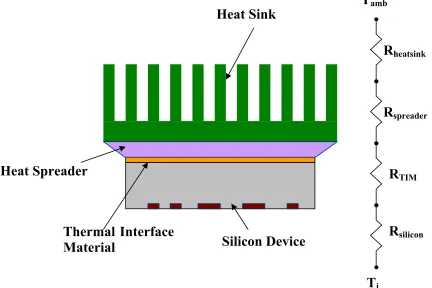
extended surface. Figure 1.1 shows a typical heat sink setup for cooling computer chips as
depicted by Steinke (2005). As shown in the fig. 1.1, the heat sink is typically made of copper or
aluminum. It is bonded using a Thermal Interface Material to the silicon device, to accommodate
for unequal thermal expansion. Heat Spreader is used to uniformly increase the heated surface
area for better uniform cooling. With the advances in microelectronic industry, the cooling
requirements are increasing and forced air cooling is no longer a viable option. Table 1.1 lists the
estimates of heat transfer coefficients for different mechanisms.
Table 1.1 Heat Transfer Coefficients for Forced Convection, Holman (1976)
HEAT TRANSFER MECHANISM h (W/m2°C)
Forced Convection, Air ~100
Forced Convection, Water ~15000
T
amb [image:14.612.79.511.195.483.2]Heat Sink
Fig. 1.1: Schematic of Air Cooled Microprocessor, Steinke (2005)
For cooling requirements in excess of 100 W/cm2, liquid cooling seems to be the right
solution. Heat transfer coefficients in the order of 100000 W/m2°C can be achieved with flow
boiling of water. However employing flow boiling also requires additional components like a
condenser. The overall cooling system gets very complicated and bulky. However it is possible
to achieve heat transfer coefficients more than 10000 W/m2°C with forced convection of water
by using microchannels as shown by Colgan et al. (2005). Jet impingement and evaporative
T
jR
siliconR
TIMR
spreaderR
heatsinkHeat Spreader
Thermal Interface
spray cooling are also attractive options which are considered for electronics chip cooling.
Microchannel performance is evaluated in this thesis.
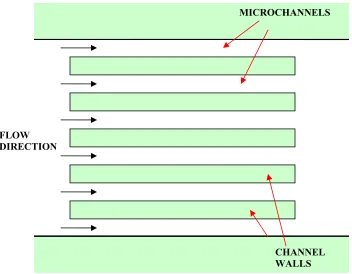
Microchannels have very small hydraulic diameters in the order of 200μm. Figure 1.2
shows a schematic of plain microchannels.
CHANNEL WALLS FLOW
DIRECTION
[image:15.612.110.462.229.503.2]MICROCHANNELS
Fig. 1.2: Schematic of Flow in Plain Microchannels
The small flow cross sectional area associated with microchannels presents a large
surface area to the volume ratio which is responsible for increased heat transfer. This inherent
characteristic of microchannels enables them to be used for high heat flux cooling. The
microchannels falls in the range of 10-200µm. Further increase in heat transfer can be achieved
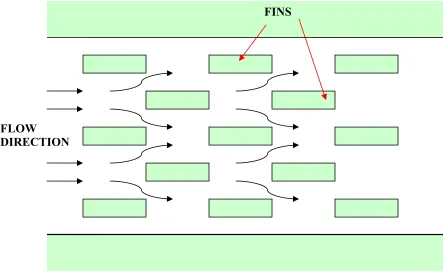
by modifying the path of the flow of the fluid in the microchannels. The fin walls, which run
continuous along the flow length for plain channels, are periodically spaced and also offset.
Figure 1.3 shows the schematic of an enhanced microchannel which has a offset strip fin
configuration.
FLOW DIRECTION
[image:16.612.91.534.281.557.2]FINS
Fig. 1.3: Schematic of an “Enhanced” Microchannel
Each new fin interrupts the flow and in the process there is a formation of boundary layer
is very high. This enables the offset strip fin microchannels to push the heat transfer coefficient
even higher than plain microchannels. However, the enhanced heat transfer also comes with
additional pressure drop. Pressure drop is increased because of boundary layer formation and
frictional form drag losses. This makes the hydraulic prediction of these channels very important.
Because of the complexity of the flow in these channels, it is very difficult for an analytical
solution. This work deals the evaluation of flows through both these configurations of
microchannels – plain and enhanced.
1.1 Brief History of Microchannel Heat Sink
The first concept for using microchannels as a heat exchanger device for VLSI circuits
was conceived by Tuckerman and Pease (1981). It was found that the microchannels are very
effective in heat dissipation. The reason for very high heat removal was associated with the fact
that microchannels have very small hydraulic diameters ranging to up to a few hundred microns.
This was in conjunction with the significant area enhancement due to the finned surface. Because
of smaller free flow areas, the power needed to pump fluid through smaller passages also
increased a lot. Thus increased pressure drop was a concern. Very high pressures required to
maintain the flow through these channels assured that microchannels predominantly operated in
the laminar regime. Although microchannels promised to be very effective, initially
microchannel research did not receive an impetus. Intel developed the 80286 microprocessor
which had significantly reduced the power consumption of the microelectronic device which
implied less waste heat.
By mid 90’s increased complexity and density of microelectronic circuits gave rise to
increase in the thermal dissipation requirements. Microchannel cooling was widely researched by
the academia and industry. Microchannels were a viable option for the practical implementation
conventional equations to predict the thermo-hydraulic performance of these microchannels.
There have been many papers in the literature with different views. Steinke and Kandlikar (2006)
carried out an exhaustive review of investigations dealing with microchannel cooling.
Other viable configurations which would utilize the potential of microchannels
investigated. It was found that the enhanced channels were the most promising for high heat flux
removal. These enhanced microchannels exhibit an interrupted fin design with the fins offset.
This causes periodic destruction of the boundary layer which accounts for very high values of
heat transfer coefficients. This type of configuration is widely used in the heat exchanger
applications like automotive cooling. Researchers have gathered data spanning over few decades
and come up with correlations to predict the pressure drop and heat transfer in offset strip fin
heat exchangers. However for offset strip finned microchannel no predictive models have been
developed.
The present work deals with the evaluation of single phase fluid flow in microchannels.
Both plain and enhanced microchannels have been investigated. The single phase predictions
would be evaluated for plain and enhanced channels.
1.2 Thesis Outline
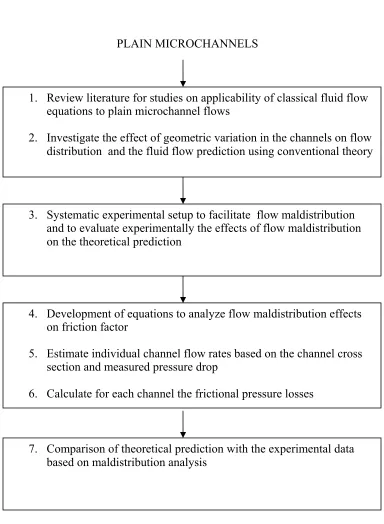
This work deals with the experimental and numerical evaluation of single phase adiabatic
flows for both plain and enhanced microchannels. An outline is laid out in this section to
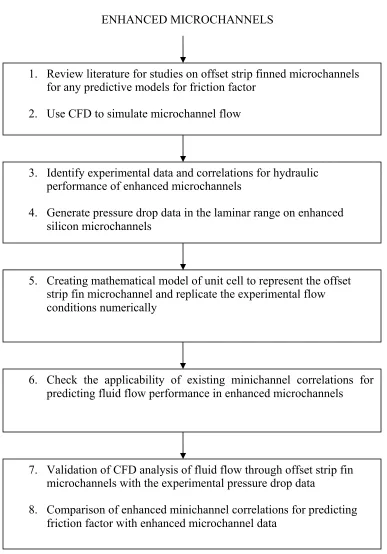
1. Review literature for studies on applicability of classical fluid flow equations to plain microchannel flows
2. Investigate the effect of geometric variation in the channels on flow distribution and the fluid flow prediction using conventional theory
3. Systematic experimental setup to facilitate flow maldistribution and to evaluate experimentally the effects of flow maldistribution on the theoretical prediction
7. Comparison of theoretical prediction with the experimental data based on maldistribution analysis
4. Development of equations to analyze flow maldistribution effects on friction factor
5. Estimate individual channel flow rates based on the channel cross section and measured pressure drop
6. Calculate for each channel the frictional pressure losses PLAIN MICROCHANNELS
[image:19.612.126.510.48.572.2]1. Review literature for studies on offset strip finned microchannels for any predictive models for friction factor
2. Use CFD to simulate microchannel flow
3. Identify experimental data and correlations for hydraulic performance of enhanced microchannels
4. Generate pressure drop data in the laminar range on enhanced silicon microchannels
6. Check the applicability of existing minichannel correlations for predicting fluid flow performance in enhanced microchannels
5. Creating mathematical model of unit cell to represent the offset strip fin microchannel and replicate the experimental flow conditions numerically
ENHANCED MICROCHANNELS
7. Validation of CFD analysis of fluid flow through offset strip fin microchannels with the experimental pressure drop data
8. Comparison of enhanced minichannel correlations for predicting friction factor with enhanced microchannel data
[image:20.612.123.510.72.626.2]Figure 1.4 (a) shows the outline for the experimental evaluation of flows in plain
channels. Plain channels have been extensively investigated in the literature. A brief review is
conducted in Chapter Two. However there exist a lot of contradictory views about the validity of
classical fluid flow equations to the microchannel flow. It is seen that the conventional theory
either over predicts or underpredicts the microchannel pressure drops. These predictions are
based on equal flow distribution. Flow maldistribution introduced due to slight geometric
variation is thought to be the reason for discrepancy in the literature. In this work,
maldistribution analysis is developed to test the validity of the classical equations for
microchannel data and explain the discrepancy in the literature. The analysis involves accurate
estimation of individual channel flow rates based on the channel dimensions. This flow rate is
then used to calculate the experimental and theoretical channel friction factor. Friction factor
predictions using uniform flow distribution are also made. By comparing the predictions based
on uniform flow assumption and maldistributed flow assumption, the effect of geometric
variation in the channel dimension on the fluid flow prediction using classical equations are
analyzed.
For offset strip fin microchannels however, there is not a large pool of data sets available
in the literature. Figure 1.4 (b) is the flow chart with the outline for numerical evaluation of
adiabatic flow in enhanced microchannels. Because of the complexity of flow involved in
enhanced channels, no analytical model has been developed. Many researchers have developed
correlations based on experimental data for enhanced minichannels. However for enhanced
microchannels there are no predictive models developed yet. In this work, CFD is tested as a tool
to predict the flow in enhanced microchannels. The CFD analysis is carried out in FLUENT and
correlations for minichannel offset strip fins are also compared with the pressure drop data on the
CHAPTER TWO
LITERATURE REVIEW
Plain microchannels have been investigated extensively. Many researchers have
compared the classical theory to the microchannel data. There are conflicting views on whether
the conventional theory can predict the friction factor in microchannels. A brief review of few
articles dealing with predictive models on microchannel friction factor is presented. The
enhanced microchannels, with offset strip fin configuration however have not been tested
experimentally. There is hardly any experimental data in the literature. For enhanced
minichannels however there are many data points which have been generated for over 40 years
and many correlations have also been developed to predict minichannel performance for
enhanced channels. No predictive model has been developed for enhanced microchannels yet.
Following the literature review on plain microchannels, review of work on offset strip fin
configuration channels is presented.
2.1 Plain Microchannels
Many researchers over the years have investigated the microchannel performance. The
highlight of this work is to evaluate the microchannel performance in regards to the conventional
fluid flow theory. In the literature review for plain microchannels, few relevant investigations
dealing with the pressure drop predictions of microchannels have been highlighted. A brief
summary of previous investigations on single-phase flow in microchannels and their
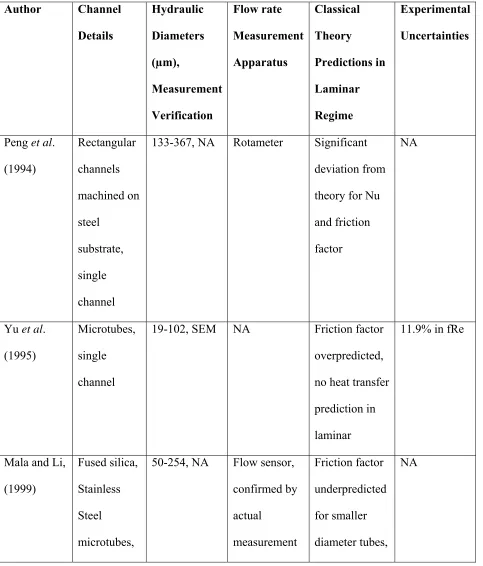
presents a summary of some of the important investigations in this area. Many investigations
[image:24.612.68.551.150.716.2]have reported aberrant behavior of flow and heat transfer in microchannels.
Table 2.1: Summary of investigation on single phase flows in microchannels
Author Channel Details Hydraulic Diameters (µm), Measurement Verification Flow rate Measurement Apparatus Classical Theory Predictions in Laminar Regime Experimental Uncertainties
Peng et al.
(1994) Rectangular channels machined on steel substrate, single channel
133-367, NA Rotameter Significant
deviation from
theory for Nu
and friction
factor
NA
Yu et al.
(1995)
Microtubes,
single
channel
19-102, SEM NA Friction factor
overpredicted,
no heat transfer
prediction in
laminar
11.9% in fRe
Mala and Li,
(1999)
Fused silica,
Stainless
Steel
microtubes,
50-254, NA Flow sensor,
single
channel
no heat transfer
study.
Hegab et al.
(2001) Milled Aluminium plates, multiple channels 112-210, digital dial calipers
Flowmeter Agreement for
friction factor,
no heat transfer
study
3-23% for
friction factor
Bucci et al.
(2003)
Microtube,
Single
channel
172-520, NA Friction factor
agreement
below Re
800-1000, heat transfer coefficient higher than thermally developing flow theory Solomon and Sobhan, (2005) Milling copper plates, multiple channels
280-3670, NA Rotameter fRe
underpredicted, Nu over predicted NA Steinke and Kandlikar, Etched Silicon
222, SEM Rotameter Agreement for
fRe and Nu
(2005) channels,
multiple
channels
Rands et al.,
(2006) Fused silicon microtubes, single channel
16-30, SEM Graduated
flask and stop
watch
Agreement
with theory for
fRe, no heat
transfer study
16-29 % for
fRe Hrnjak and Tu, (2007) Machined in PVC substrate, single channel 69-304, Stylus surface profilometer Rheotherm® mass flow meter Agreement for friction factor,
no heat transfer
study
±3.5% for f
Peng et al. (1994) began investigating into the microchannel performance in comparison
to the conventional theory. They found a discrepancy in the two. They experimentally
investigated heat transfer in rectangular microchannels with hydraulic diameters of 133-367µm.
Their experiments indicated early transition to turbulent regime and fully developed flow was
observed for Re 400-1500. Nusselt number in the laminar regime was found to be dependent on
Re0.62. Fluid properties were calculated at the fluid inlet temperature. The relationship between
friction factor and Nusselt number was observed to be significantly different for the laminar
flow. The authors stated that for microchannels the friction factor in the laminar regime was
that the experimental friction factor was higher than the classical prediction. The laminar to
turbulent transition was found to be a strong function of the hydraulic diameter.
Mala and Li (1999) investigated water flow through tubes of diameters ranging from 50
to 254μm. The flow characteristics for smaller tubes deviated significantly from the conventional
theory. Material dependence on the friction factor was observed and the values obtained
experimentally were higher than the predictions. At lower flow rate the results were in rough
agreement with the theory however, significant deviation was noted at higher Re flows. Two
possible explanations were discussed. One was that there was early rise to transition flow and
hence laminar flow equations cannot be used. The second reason which also explained the early
transition was the surface roughness which might be thought to play an important role. It was
however apparent that the early transition seemed to be the prominent reason for the discrepancy.
Harms et al., (1999) applied the developing flow theory for both single channel and
multiple channel systems to characterize flow and heat transfer in minichannels. The channels
were 1000µm deep and 251µm wide. They experimentally observed that the local Nusselt
number agreed well with the classical developing flow theory. However, for multiple channel
design, agreement was reasonably well at higher flow rates but deviated significantly from
theory at low flow rates. Authors reported this deviation to the flow bypass in the manifold. But
it was concluded that the classical theory does apply to plain microchannels as well
Hegab et al. (2001) found that the friction factors values were consistently lower than
values predicted by macroscale correlations in the transition and the turbulent regime. R-134a
was used as the test fluid for 112-210 μm hydraulic diameter rectangular channels. For the heat
transfer calculations at lower Reynolds numbers, the uncertainties reported were as high as 67%.
Hrnjak and Tu (2007) investigated fully developed liquid and vapor flow through
rectangular microchannels with hydraulic diameters of 69 to 304μm. For low surface roughness
the flaminar approached the conventional values for all the channels tested. No heat transfer studies
were performed.
Steinke and Kandlikar (2005) conducted an exhaustive survey of literature and
experimentally investigated friction factor and Nusselt number in silicon microchannels. They
used the simultaneously developing flow condition since the channel lengths were small, and
compared the data with the developing flow theory. It was reported that the developing flow
theory was in very good agreement with the data. It may be noted that the individual channel
dimensions were measured and were very close to each other.
It is observed from literature that there are contradictory findings, especially as related to
the applicability of the laminar flow theory for microchannels flows. However, there seems to be
a consensus building up in the recent years which agree that fluid flow in microchannels in the
laminar regime is not different from macroscale phenomenon in some of the carefully conducted
experiments with same size channels. Although the continuum assumption is widely accepted for
microchannels, the effect of individual channel size variations is believed to be a factor
responsible for these deviations in parallel microchannels. This work attempts to analyze the
effects of flow maldistribution on the single phase flow predictions in microchannels.
2.2 Enhanced Microchannels
Enhanced microchannels mentioned here on refer to the offset strip fin configuration.
This type of minichannel configuration has been widely researched for many decades for its very
high heat transfer surface area. For the design of such a heat exchanger it is very essential to be
cooling, not many papers have dealt with rectangular offset strip fins microchannels. Recently
Kosar and Peles (2006), Prasher et al (2007) have investigated offset pin fin geometry. Steinke
and Kandlikar (2006) and Colgan et al (2005) are the two publications with data on enhanced
microchannels. However, for mini channel offset strip fin geometry, various researchers have
collected data and many correlations have been developed. The scope of current work is
extended only towards adiabatic flow in microchannels.
Kays (1993) developed a very simple analytical model for predicting hydraulic
performance of enhanced channels. This earliest model was based on the forced convection on a
plate with an additional term which included the drag coefficient. Weiting (1977) obtained
correlations from curve fits to data from over 20 core geometries covering laminar and turbulent
ranges. Sparrow and Liu (1979) investigated numerically the heat transfer and pressure-drop
results for laminar airflow through arrays of inline or staggered plate segments. Joshi and Webb
(1987) presented analytical models to predict the heat transfer coefficient and the friction factor
of the offset strip fin heat exchanger surface geometry in the laminar and turbulent flow regimes.
They also studied the transport of energy and momentum in the boundary layers of the fins
because of the oscillating velocities developed from the wakes. Thus the wake distribution was
also studied by them to take into considerations the effect of fin length, fin thickness and the fin
spacing on the wake flow pattern. This was done to accurately determine the transition flow. The
models developed are very complicated. Manglik and Bergles (1995) gave an exhaustive
summary of the existing correlations for minichannels. They also developed a correlation with a
consistent definition of hydraulic diameter. The equations for friction factor were a continuous
Fig. 2.1: Manifold images from side facing the channel and channel chip, Colgan et
al (2005)
All this work has been carried out at the minichannel level, with the flow ranges
occurring in the practical application of around 200-4000 Reynolds number. Also almost all the
predictive models developed are based on multiple regression analysis. The application of these
correlations for microchannel data needs to be ascertained.
Colgan et al (2005) obtained data on enhanced microchannel for laminar flow regime
with the Reynolds number in the range of 20-300. They obtained cooling of over 300 W/cm2
with very little pressure drop. This was achieved by designing an intricate manifold structure
interconnected to each other rather than just an elongated opening which serves as the inlet.
Figure 2.1 shows the photograph of the manifold facing the chip. The result of the multiple inlet
and outlet inlet vias leads to a complex and short flow lengths which significantly enhance the
performance. As a result this data cannot be used as a comparison to test the minichannel
correlations due to heavy cross flows caused by the multiple inlets and outlets.
Bapat and Kandlikar (2006) investigated the minichannel correlations used to predict
offset strip fin heat exchanger performance. The correlations were compared with experimental
microchannel data on offset strip fins obtained by Colgan et al (2005). Two reasons were cited
correlations are based on series of experimental data collected on various geometries. The flow
ranges employed in gathering that data were in the practical limits of 200-4000 Reynolds number
range. For laminar flow which is normally used in microchannels, the range is around 20-200
Reynolds number. Thus the correlations should be tested with large data sets on various aspect
ratios. The second reason cited was that the experimental data used for comparison is not a good
reference. The microchannel coolers are very advanced with very short flow lengths and multiple
inlets and outlets which are responsible for a complex flow path. Thus the data may not be
represe
ed microchannels. Fluid flow in enhanced microchannels is
predicted using CFD in this work.
2.3
predicted using CFD. FLUENT, commercially available CFD software is used to predict the ntative of simple offset strip fin microchannels.
Enhanced microchannels with offset strip fin configuration provide an attractive
alternative for electronics cooling application. However no predictive model has been developed
to predict the fluid flow in enhanc
Objective
This work addresses two points evident in the literature review. For plain channels it is
seen that although there are few investigations which show that the classical equations can
predict the microchannel flow, there are some experiments which show that there is deviation
from the theoretical prediction. Flow maldistribution in parallel plain microchannels is believed
to be one of the reasons for this discrepancy. This premise is experimentally investigated by
analyzing frictional pressure losses in parallel microchannels. Also, for enhanced channels, it is
seen that there is no analytical model developed yet to predict the fluid flow performance. Also
the existing correlations based on minichannels are not applicable to the microchannel data. The
performance. Experiments are also carried out to validate the computer simulations. Following
are the objectives of the thesis
• To estimate flow maldistribution in parallel microchannels induced by channel size
variation
• Experimentally evaluate the effect of flow maldistribution on the friction factor
prediction using classical fluid flow equations
• Predict the fluid flow performance in enhanced microchannels using CFD analysis
• To experimentally validate the CFD results on adiabatic flows in enhanced
microchannels
• Test the validity of existing enhanced minichannel correlations to predict the
CHAPTER THREE
EXPERIMENTAL SETUP FOR PLAIN MICROCHANNELS
It is identified from the literature that there is discrepancy in the validity of the classical
equations for plain microchannels. Maldistribution is thought to be one of the reasons for this
deviation from theory. The typical test setup consists of a common inlet and outlet header
feeding parallel channels. Slight variation in the dimensions of the channel could lead to flow
maldistribution. This work investigates the effects of flow maldistribution on the friction factor
prediction for microchannels. This is experimentally investigated by machining six parallel
microchannels with different cross sectional areas to introduce flow maldistribution. This chapter
describes the design of the experimental setup for investigating the effects of flow
maldistribution on friction factor predictions in microchannels. The setup consists of a storage
tank, water pump, digital flow meters, a set of parallel microchannels and a receiver tank. The
following sections describe in the detail the flow circuit, instrumentation and data acquisition
circuit and the experimental procedure for the investigation for flow maldistribution on the
3.1 Flow Loop
Tin°C
Water Tank
Test Section
Δp
Water
[image:34.612.111.562.103.381.2]Pump Digital Flowmeter Receiver
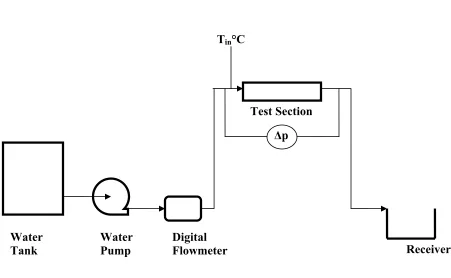
Fig. 3.1: Flow loop for investigation single phase flows in plain microchannels
A schematic of the experimental loop is shown in Fig. 3.1. Degassed water is stored in
the tank. The pump directs the water from the tank to the test section through a set of digital flow
meters. Two flow meters one with 0-100ml/min and other with 100-1000ml/min capacity are
used in parallel. This is an open loop and the heated water is led into a receiver where the flow
3.2 Test Section Design
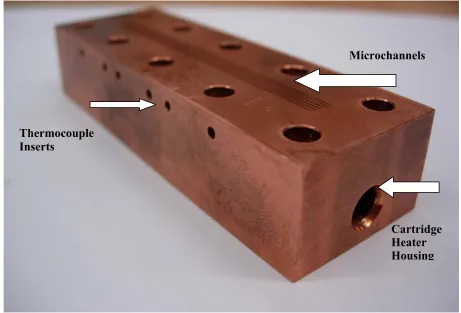
Microchannels
Thermocouple Inserts
[image:35.612.109.570.101.414.2]Cartridge Heater Housing
Fig. 3.2: Photograph of Copper Block Test Section with Parallel Microchannels
Figure 3.2 shows the actual photograph of the test section. It is a copper block with 6
parallel microchannels milled on the top surface. It has a hole below the microchannels which
houses a cartridge heater which is used to heat the surface of he channels. It has two layers of
thermocouples inserted on either sides of the copper block. The two layers are underneath the
copper surface at two different heights so that heat flux normal to the surface of the channel
Pressure Tap
Fig. 3.3: Photograph of cover plate with inlet and outlet manifolds
Figure 3.3 shows the header made of polycarbonate with the inlet and outlet manifolds.
The water flow is marked on the diagram. It enters through the inlet manifold into the
microchannels and then exits through the outlet header. The passage which connects the two
manifolds with the inlet and outlet connections also has a provision for inserting thermocouples.
E- type thermocouples are used. This ensures accurate inlet and outlet manifold temperatures.
Also taps are provided on the inlet and outlet passage for measuring the pressure drop across the
channel.
Pressure Tap Hot Water Out Cold Water In Thermocouple
Acrylic Header Plate
Copper Test Block
Phenolic Base
Fig. 3.4: Assembly of the cover plate, test section and the insulating base
Fig. 3.4 shows the three layer assembly of the test section. The bottom of copper block is
attached to a phenolic base. This acts as an insulating block. This assembly is mounted on a
3.3 Channel Dimensions
Table 3.1 Individual channel dimensional variability
CHANNEL 1 2 3 4 5 6
Mean Height µm
209.3 207.3 194.0 190.1 208.4 210.1
Mean Width
μm
268.5 264.6 265.8 262.3 236.9 266.4
Cross Section Area Acx102
μm2
560 546 514 498 492 559
The current test section has six parallel long channels. The individual channel dimensions
are measured using a surface profilometer at 11 different locations along the flow length. Table
3.1 gives the height and width of each channel along with the cross sectional area of each
channel. It is seen from the cross sectional area that channel one and five have the maximum and
minimum cross sectional area respectively. Thus actual flow in these channels is going to vary
the most for same pressure drop across these channels. Later when comparison will be made to
check the effects of flow maldistribution, these two channels are considered for comparison
purpose.
Fin Top Surface
3.4 Instrumentation and Data Acquisition
Pressure is measured using a differential pressure transducer. The pressure transducer is
a PX-26 series from Omega. The transducer is a silicon diaphragm that uses a wheat-stone
output is from 0 to 100 mV. The pressure transducer range is selected to give the highest level of
accuracy, with a range of 0 to 6.8 atm. The pressure transducers are calibrated using known
pressures and the measured response of the transducer. A pressure calibrator from Omega is
used to apply a known value of pressure. The range of the pressure calibrator is -100 to 200 kPa.
The high side pressure port on the differential pressure transducer is exposed to the known
values of pressure. Over twenty points are taken within the range of the specific pressure
transducer. A linear curve fit is assumed and used to generate the calibration equation. If the
range of the pressure transducer is 690 kPa, the transducer is calibrated up to 200 kPa and linear
behavior is assumed thorough the remainder of the range.
A gear pump manufactured by Micropump, Inc., model: GA-V23.J9FS.G, is used to
pump the working fluid. The maximum allowable pressure setting is 172 kPa, and it can deliver
a flow rate ranging from 42 mL/min to 350 mL/min. The pump has a pulsation of 1.5%. Water
is pumped through this pump. LabVIEW is also used to control the pump output by sending 0-5
DC voltage.
Two digital flowmeters (FLR 1007 and FLR 1010 from Omega) are used to accurately
measure the flow rate. The FLR 1007 model measures flow rate from 10-100 ml/min while the
FLR 1010 is for 100-1000 ml/min. The excitation voltage is 12.8 volts DC. The flow rate is
measured by a miniature turbine wheel housed inside the flow meter. The wheel rotates with a
speed proportional to volumetric flow rate of the fluid. The output signal of the flowmeters is
compared with the set point for the flow rate and the pump is controlled according to the
3.5 Experimental Uncertainties:
The uncertainty is determined by the method of evaluating the bias and precision errors.
The following equation is used to calculate the uncertainty in the experimental results which is
based on Kline and McClintock (1953).
2 2 2 2 2 1
1 ⎟⎟⎠
⎞ ⎜⎜ ⎝ ⎛ ∂ ∂ + ⎟⎟ ⎠ ⎞ ⎜⎜ ⎝ ⎛ ∂ ∂ + ⎟⎟ ⎠ ⎞ ⎜⎜ ⎝ ⎛ ∂ ∂ = n n U v R U v R U v R U K (3.1)
where U, R, and v are uncertainty interval, result, and variable, respectively.
The pressure transducer has an uncertainty of ±0.69 kPa. The temperature reading has an
uncertainty of ±0.1°C. The power supply used to provide input power within ±0.05 V and current
within ±0.005 amps uncertainty. The flow meter uncertainty in the volumetric flow measurement
is ±0.0588 cc/min. The power measurement has an accuracy of ±0.5 Watts. The temperature
difference measurements have an uncertainty of ±0.2°C. The resulting uncertainties are
calculated for the pressure drop is 7.19%, and friction factor is 4.80%, at a median flow case.
The major source of error is the temperature reading. This uncertainty is based on Steinke and
Kandlikar [14] as the same instrumentation setup is used.
3.6 Experimental Procedure
Water is first degassed to ensure homogeneity of the medium. This is done by boiling the
water in the storage tank and increasing the pressure to around 15 psi and then venting the
pressure. This is repeated twice. Water at atmospheric condition and over 90 °C releases all the
dissolved gasses. This degassed water is then allowed to cool down to room temperature. The
current study focuses on the classical equations based on the laminar flow regime. Thus the
A pump is used to direct the flow from the storage tank to the test section through flow
meters. The flow rate is recorded in LabVIEW and flow rate is compared with the set point. This
feedback is used to control the pump in order to push the exact quantity of water through the
circuit. The pressure drop across the inlet and outlet header is measured by the differential
pressure gage. Inlet temperature of water is also measured for determining the viscosity of fluid.
Readings are recorded only after the flow has been stabilized.
Pressure drop readings and the corresponding flow rates are recorded and are used to
calculate the apparent friction factor in each channel. Apparent friction factor includes the
pressure drops due to both developing and fully developed flow. The experimental value is
compared with the theoretical value to compare the effects of maldistribution on flow prediction
CHAPTER FOUR
EXPERIMENTAL SETUP FOR ENHANCED MICROCHANNELS
There has been very few data on enhanced microchannels. Enhanced Microchannels are
capable of dissipating very large quantities of heat because of periodic interruption of boundary
layer. However very high pressure drops are also encountered in this flow. Because of the
complexity of the flow caused by the flow over the fins, there has been no analytical solution to
predict the performance. In such a situation, predictive models are basically based on numerical
models or correlations which need lot of experimental data. For minichannels, of similar
configuration, there has been extensive research and many correlations have been developed
based on the existing data. However, there has been no predictive model yet developed for
enhanced microchannels. In this study, the pressure drop data is numerically modeled using
CFD. Also, experiments are also carried out to validate the numerical results and existing
minichannel correlations are tested on this data. Simple pressure drop experiments are carried out
on one offset strip fin silicon microchannel for the above purpose.
Experiments on an enhanced silicon microchannel are carried out for flow range of
20-200 Reynolds number in order to validate the numerical scheme. The following sections will
describe the flow loop and experimental procedure.
4.1 Flow Loop
A simple flow circuit is used which includes a pump, different pressure sensor and the offset
ΔP
Data Acquisition Peristaltic
Pump
Temperature Probe
Water Receiver
Enhanced Microchannel
[image:43.612.79.351.75.447.2]Test Section
Fig. 4.1 Schematic of the Flow Loop for Enhanced Microchannels
Flow rates up to 80ml/min for water can be circulated through the enhanced
microchannels using the peristaltic pump. This roughly translates to around 250 Reynolds
number. Pressure drop is measured using a pressure deferential transducer. Temperature of the
water is also recorded before it enters the channel. This value of temperature is used to calculate
4.2 Test Section Details
The actual silicon microchannel is shown in fig. 4.2. The overall dimensions of the chip
are 10X10 mm. There are 80 channels with channel width of 50 µm and height of 200 µm across
the flow length while along the flow length; there are 40 rows of fins with fin length of 250 μm.
Fins have smooth entry and exit passages. The silicon chip is housed inside a cavity which is
then covered with an acrylic plate. Figure 4.3 shows the cover plate with the chip underneath it.
Chip Header
Parallel
[image:44.612.109.458.258.576.2]Microchannels
Fig. 4.3: Text Fixture Housing the Silicon Microchannel
The pump outlet connection is made with the inlet connection for the test fixture. The
path takes a 90° bend to reach the header on the chip. Similar path is taken by the fluid while
exiting the channels. Pressure drop is measured across the inlet and outlet feed lines. This
pressure drop does include entry and exit losses associated with the area changes. These losses
are deducted from the measured pressure drop.
For the enhanced channels only adiabatic flow is investigated just like plain
microchannels. Experiments are carried out for flow in the laminar flow regime and the pressure
drop across the channels is calculated. This data is then compared with the minichannel
microchannels, numerical modeling is carried out in order to predict the microchannel pressure
drop data. The next chapter deals with the setup for the simulation of microchannel flows in
offset strip fin configurations.
4.3 Test Procedure:
Very high pressures are observed in enhanced channels. Experiments are carried out in
the laminar flow regime and at very flow Reynolds number range of 20-200. This range is
selected as because of the large frictional losses encountered in microchannels, laminar flow
regime is employed in practice. The pressure drop across the channels is measured with a
differential pressure gage while the volumetric flow rate is given by the peristaltic pump. Steady
CHAPTER FIVE
NUMERICAL SETUP FOR ENHANCED CHANNELS
Enhanced microchannels with offset strip fin configuration have not been extensively
researched in the literature. There have been no predictive models developed yet for the same.
Since performance of these microchannels is not evaluated, a numerical modeling is carried out
to verify whether the enhanced microchannel flow can be modeled using the classical flow
equations. The pressure drop is this numerically predicted using numerical modeling based on
finite volume method. Commercially available Computational Fluid Dynamics Solver FLUENT
is used for the computer simulations. It involves first recreating the flow geometry with the
region of interest, assigning correct boundary conditions, meshing of the geometry, and then
solving the Navier-Stokes Equation along with the continuity equation for prediction the pressure
drop in the flow. This chapter discusses in detail the problem setup for the numerical modeling
for pressure drop in enhanced microchannel. Heat transfer is not modeled in this work.
5.1 Flow Geometry:
The geometry is created and meshed using GAMBIT. The enhanced chip as described in
the above section contains 80 of fins in the transverse direction with fin lengths of 250 μm. The
total flow length is 10000μm which implies around 40 fins along the flow length. This type of
repeated geometry makes the flow also repeatable after initial few rows of fins. Since the number
of fins along the flow length is very large, it is a safe assumption to model the flow after a steady
flow has been established. This is called as the periodic flow condition which is different than
create identical flow path. Figure 5.1 shows a highly magnified image of the fin structure for the
[image:48.612.108.556.149.488.2]chip under consideration.
Fig 5.1: 1000X magnified image of offset strip fins from KEYENCE microscope
The numbers marked in the snapshot have the following values; 1-50µm, 2-50µm,
4-100µm. It is clear from the figure that the fins do not have flat front faces. There is a smooth
entry and exit for the fluid into the channel. This geometry is very difficult to create in
GAMBIT. An approximation is used to create this geometry. Marked on the above figure you
see the dimensions which are used to make the geometry. Figure 5.2 shows the schematic of the
Fig. 5.2 Schematic of Unit Cell and Computational Domain
Computational
Domain/ Unit Cell
Flow
Direction
Fig. 5.3 Image of Unit Cell created in GAMBIT
Figure5.3 shows the actual 3D model which is created in GAMBIT which is the graphical
representation of the schematic of the computational domain. The symmetry and periodic nature
of the flow which is inherent in the flow is the reason for modeling on part of geometry in
FLUENT. The boundary conditions which are applied to this geometry are discussed in detail in
the following section.
Fin Walls
Fin Walls Fin Walls
Inlet
Outlet Symmetry
Surface
5.2 Zone Specifications
The physical and the operating characteristics of the computational model at its
boundaries are given by the zone type specifications. There are basically two types; Boundary
Type and the Continuum Type.
The Continuum Type is set to fluid for the current setup. This enables to characterize the
unit cell within the domain as a fluid. The momentum and continuity equations are applied to the
nodes or the cells that exist within the volume. Since the unit cell is a 3D representation of the
enhanced channels, the boundary conditions are specified for the faces of the model. Each face
or boundary of the model needs to given a boundary condition. Following are the conditions
specified.
Wall Boundary Condition: The no slip boundary condition is given by assigning the faces
as wall and giving the zero velocity. The top, bottom and fins are given the no slip condition
Symmetry: The unit cell is the representation of the complete enhanced channel. The unit
cell can be replicated along the symmetry lines. The symmetry faces are marked on the fig. 5.3.
By specifying symmetry boundary condition, the flow and pressure gradients are identically zero
along these faces. Because of this the physical conditions in the regions immediately adjacent to
either side of the edge are identical to each other.
Periodic Boundary Condition: The inlet and the exit faces of the domain are marked as
periodic. The mesh on these faces also need to be linked. When these faces are hard linked,
GAMBIT associates the faces with each other. And any operation applied to one face is linked
with the other face. In other words, the flow characteristics are at the exit face are replicated at
the inlet wall. This leads to a “fully developed” flow condition. The term fully developed does
not assume the conventional meaning. For the present case, the term fully developed refers to the
same flow pattern is obtained in the preceding and following unit cells. This is one of the
assumptions which is used while modeling the flow in enhanced channels. The boundary
conditions for the unit cell are clearly marked on the faces as shown in fig. 13.
5.3 Mesh Generation
The enhanced channel is approximated using all rectangular faces. Since the geometry is
computational very straightforward, Quad Elements are used for meshing. This specifies that the
mesh includes all quadrilateral mesh elements. For each mesh element have a range of meshing
schemes that can be used. A Quad-Map Meshing scheme is used which creates a regular,
structured grid of mesh elements. Quad-Map meshing scheme is applicable primarily to faces
that are bounded by four or more edges and also the face should be logically rectangle [FLUENT
docs ref]. As the geometry satisfies both these conditions a Quad Map Meshing Scheme is used.
163200 mesh volumes are created for the geometry. Figure 5.4 shows a top view of the meshed
Fig. 5.4: Meshed Unit Cell of Enhanced Microchannel
5.4 Mesh Quality
It is important before the simulations are run that the mesh quality be checked. If the
choice of meshing scheme is not correct, the results of the numerical modeling may not make
any sense. EquiAngle Skew and MidAngle Skew are used to test the mesh quality. EquiAngle
Skew is a normalized measure of skewness. QEAS=0 suggest a equilateral element while QEAS=1
represents a completely degenerate or poorly shaped element. The MidAngle Skew or QMAS
applies only to quadrilateral and hexahedral elements. By definition of QMAS its value also lies in
documentation. It is assumed that in general high quality meshes contain elements that possess
average QEAS values of 0.1 for 2D element and 0.4 for 3D element.
For the current Quad-Map Meshing Scheme, 100% of total mesh elements have QEAS
value between 0 and 0.3 with worst element having a value of 0.295 while 90% of the total mesh
elements have QMAS value fall in the range of 0 and 0.3 with the worst element having value of
0.41. Thus overall for the type of geometry under consideration, the mesh quality is very good.
5.5 Mesh Size Dependence
Trial runs are performed on the meshed geometry to check the mesh size sensitivity.
Mass flow rate of 2.4732e-6 kg/s is given to the unit cell for 3 different mesh sizes. The pressure
gradient computed by FLUENT to maintain the specified flow rate is compared. Table 5.1 gives
the mesh size, the value of pressure gradient for above given flow rate and the percent change in
[image:54.612.70.544.456.666.2]the pressure gradient.
Table 5.1: Mesh Size Sensitivity
Mesh Size
µm
Pressure Gradient
Pa/m
% Change in Pressure
Gradient
2 2206444 0.3
2.5 2213288 0.1
3 2217718 -
It is seen from the Table 5.1, that by reducing the mesh size from 3 µm to 2.5 µm, there is
only 0.1 % change in the value of the pressure gradient, while changing the mesh size further
down to 2 µm, there is a change of 0.3 % in the result. Thus mesh size of 2.5 µm is selected as
the final mesh size. For 2 µm mesh size, the computational time increased a lot and since there is
negligible change in the result, mesh size of 2.5 µm was selected to save computational time.
Any further reduction in mesh size was not possible because of the processor limitations. For
mesh size of 2.5 µm a total of 163200 mesh volumes are generated.
This meshed mathematical model is simulated in FLUENT. The objective of this
simulation is to confirm if flow in enhanced microchannels can be predicted. Experiments in the
Reynolds number range of 20-200 are performed as described in chapter four. Hence for
numerical modeling, the same flow conditions are simulated which were used for the
experiments.
In Chapters Three, Four and Five, the setup for experimental and numerical analysis for
both plain and enhanced microchannels has been explained. The development of maldistribution
CHAPTER SIX
MALDISTRIBUTION ANALYSIS FOR PLAIN MICROCHANNELS
In the literature it is seen that there are contradictions on the applicability of conventional
fluid flow equations on the microchannel data. It is thought that flow maldistribution in multiple
channels could lead to this discrepancy in the literature. In this chapter, the maldistribution
analysis is explained in detail. This includes estimating the flow in each channel and then
estimating the friction characteristics and comparing it with theory. The following section
describes the logic behind the estimation of the maldistribution and the data comparison with the
theory.
For comparing the predictions based on maldistribution analysis with the uniform flow
assumption, the uniform flow calculations are similar except for non uniform analysis, individual
channel dimensions are considered while for uniform flow calculations each channel is assumed
to have the same dimension, which ensures that there is no flow maldistribution. The calculations
described below are for one with maldistribution. Same procedure is followed for uniform flow
analysis.
6.1 Estimating Flow Maldistribution
Figure 6.1 illustrates the test section designed to investigate the effects of flow
maldistribution on the prediction of friction factor using the classical equations. As described in
the Chapter Four, the copper block has 6 parallel channels machined on the surface and water is
shown in the schematic. Since for all parallel channels have the same pressure drop across its
end, the flow is uniformly distributed only if all the channels have the same dimension. However
as shown in the fig. 6.1 six channels of varying dimensions are shown. This results in flow
maldistribution in the channels.
m
1, A
c1m
2, A
c2m
3, A
c3m
4, A
c4m
5, A
c5m
6, A
c6T
inInlet
Header
Δ
P
Outlet
Header
[image:57.612.161.544.188.569.2]Flow
Fig 6.1: Schematic of multiple microchannels with the inlet and outlet manifold
Mass flow rate can be expressed in terms of pressure drop Δp, apparent friction factor fapp
and Reynolds number Re by the following eq. (6.1).
(6.1) 2 . h c D A p
m Δ ρ
Re) (
2 fapp μ L
=
&
2
hi ci
i A D
m α
hi
D Aci
total
i m
m
where Ac and Dh are the channel cross sectional area and hydraulic diameter respectively,
fapp represents the apparent friction factor which includes the pressure drops due to developing
flow as well as fully developed flow.
For a channel with fixed cross section, the variables involved which would determine the
mass flow rate are fapp.Re and Δp. The channel length is around 55mm and for the flow rates
under purview of this study, the developing flow length is not significant and for fully developed
flows, the product fapp. Re is constant. The flow rate is hence dependent on the pressure drop and
the channel dimensions. From the above equation, mass flow rate in each channel for the
measured pressure drop can be found to be proportional to the product of cross sectional area and
the square of hydraulic diameter as shown in eqn. (6.2)
(6.2)
Where and are the hydraulic diameter and cross sectional area of the ith channel
and mi is the mass flow rate in that channel
The total flow rate is measured accurately using two digital flow meters. If mi is the flow
through channel i, then
∑
& = & (6.3)total hi ci hi ci i m D A D A
m 2 .
2
∑
= (6.4)
This flow rate is considered henceforth while predicting the friction factor for the
individual channels.
6.2 Friction Factor Prediction
Once the mass flow in each channel is estimated, friction factor is found for each channel
and it is compared with the theory. Using the individual channel flow rate and the measured
pressure drop is used to calculate the experimental friction factor is each channel using the
following eqn. (6.5)
L m
D A p
fapp expt ci hi
. . . 2 . . . Re 2 & μ ρ Δ
= (6.5)
For theoretical value fapp,Re, table developed by Phillips (1987) for flow in rectangular
microchannels is used. It takes into account the pressure drop due to developing flow as well as
fully developed flow. However, in the present case, because the flow is nearly fully developed,
the value of fapp,Re tends to be same as fully developed flow for rectangular channel of that
aspect ratio. The expression for fappRe is given by Eq. (6.6). and the values of the constants a-f
are obtained from Kandlikar et al.(2005).
5 . 0
Re= a+cx+ +ex+
where the non-dimensional hydrodynamic entry length is represented by x+ given by the following equation: h D L x . Re =
+ (6.7)
The above calculated value represents the theoretical friction factor in the channel for the
measured pressure drop and for the estimated flow rate in that channel. This theoretical friction
factor, eqn. (6.6) is compared with experimental friction factor given by eqn. (6.5) for all 6
channels. There are thus 6 different plots. However for the uniform flow analysis only one plot is
employed since all the six channels are of same dimension, same flow rate is used in each
channel and hence same theoretical and experimental flow rate for each channel. The plots are
presented in Chapter Eight.
Throughout the above mentioned calculations, the pressure drop was measured across the
inlet and outlet manifold. It includes the losses in the 90° bends and the expansion and
contraction losses. Equation (6.8) is used to calculate the pressure losses; K90, Kc and Ke
represent the coefficients for losses in the 90° bends, contraction and expansion losses. The
values for these coefficients are based on Phillips (1987).
ρ 2 2 90 2 2 2 . c e c p c l A m K K K A A p & ⎥ ⎥ ⎦ ⎤ ⎢ ⎢ ⎣ ⎡ + + ⎟ ⎟ ⎠ ⎞ ⎜ ⎜ ⎝ ⎛ =
The pressure drop Δp is referenced in this paper henceforth after deducting the pressure
losses from the actual measured pressure drop and represents the net pressure drop in the
microchannels. The apparent friction factor fapp is the non dimensional form representating the
same pressure drop.
The analysis presented here is applicable only to plain channels. For enhanced channels,
there is no analytical solution to predict the performance. Existing minichannel correlations are
tested with the new experimental data and the numerical modeling is validated by the data. The
next chapter details the minichannel correlations which are used to predict the enhanced
CHAPTER SEVEN
ENHANCED MICROCHANNELS – FRICTION FACTOR ANALYSIS
Minichannel offset strip fin heat exchangers have been used for a long time. As the name
suggests, these are called enhanced channels because of the enhancement in the heat transfer
achieved by periodically interrupting the fluid flow length. However, as a result of fins
interrupting the flow, wakes are formed and fluid mixing occurs. This makes it very difficult to
analytically predict the performance. All the predictive models developed so far for minichannels
with offset strip configuration have been based on either numerical modeling or correlations
which are based on experimental data collected on different aspect ratio channels. For
microchannels however neither numerical study has been carried out nor have any correlations
been developed. This work aims to evaluate the flow in enhanced microchannels by numerically
modeling the flow as well by generating experimental data and testing the validity of
minichannel correlations for this data. There are few correlations which have been widely used
for predicting performance in the minichannels. This chapter presents those correlations which
would be used to analyze the microchannel data.
7.1 Enhanced Microchannel Data Reduction
7.1.1 Experimental Friction Factor
Experiments were carried out an enhanced silicon microchannel for low Reynolds
number flow as described in Chapter Four. Table 7.1 gives the values of flow rates and the