EUROPEAN COMMISSION
Brussels, 21.11.2011 SEC(2011) 1426 final
COMMISSION STAFF WORKING PAPER
TABLE OF CONTENTS
Introduction ... 3
1. GENERAL CONTEXT AND OUTLOOK FOR 2012 ... 3
2. POLICY PRIORITIES... 4
3. OPERATIONAL PRIORITIES... 7
3.1. Priorities reflected in the budget allocation ... 7
3.2. Africa ... 12
3.3. Middle East and Mediterranean countries ... 18
3.4. Asia, the Pacific and Caucasus ... 20
3.5. Latin America and the Caribbean ... 23
3.6. Worldwide intervention tools ... 24
3.7. Complementary activities ... 26
4. DELIVERY, COORDINATION AND CONTROL OF HUMANITARIAN AID... 28
4.1. Ways and means of delivering aid... 28
4.2. Coordination of humanitarian funds... 28
4.3. Monitoring of use of funds ... 29
5. CONCLUSION... 30
Annexe
INTRODUCTION
The Directorate General for Humanitarian Aid and Civil Protection (DG ECHO) is the Commission department responsible for formulating the EU humanitarian aidpolicy and for funding humanitarian aid to the victims of conflicts or disasters, both natural and man-made, in non-EU countries. Its mandate is to save and preserve life, to reduce or prevent suffering and to safeguard the integrity and dignity by providing relief and protection for people affected by humanitarian crises. DG ECHO also helps to facilitate coordination with and among EU Member States on humanitarian assistance. The overall priority is to ensure that the aid is managed in the most effective and efficient way possible so that the help the EU delivers to people in need has the maximum effect, whilst respecting the principles of international law and the humanitarian principles of impartiality, neutrality, humanity and independence.
DG ECHO is also responsible, since February 2010, for the management of the civil protection policy. The Civil Protection Instrumentcovers interventions in Member States, as well as in non-EU countries. The two policy areas, humanitarian aid and civil protection, are linked and under the responsibility of the same Commission department and Commissioner. The present document drawn up under Article 16(1) of Council Regulation (EC) No 1257/96 covers the humanitarian aid operations for the year ahead, involving both policy areas, with an emphasis on humanitarian aid. Civil protection activities are described in the annual work programme for actions to be financed in 2012 pursuant to Council Decision No 2007/162/EC.
1. GENERAL CONTEXT AND OUTLOOK FOR 2012
In 2011, the global humanitarian context remained challenging, with the intensity and range of crises surpassing the levels encountered in 2010, with an increase in the overall total of people affected and in need of international assistance. The trend of identified humanitarian needs outstripping available resources continues, against a backdrop of a global economic downturn. In 2011, the United Nations launched its biggest consolidated funding appeal ever (€5.7 billion) for humanitarian needs. The impact of the triple disaster caused by the 9.0 magnitude earthquake in Japan; of the internal conflict in Libya, and of the famine provoked by the drought and complicated by conflict in the Horn of Africa, which alone is affecting more than 14 million people, coming on top of many protracted humanitarian crises has stretched the international humanitarian community to its limits. The mismatch between global humanitarian needs and the resources available, together with chronic vulnerability in many parts of the world, continues to have a direct bearing on the lives of millions of people in need of assistance. It also means that donors have to re-double their efforts to respond to disasters in a more efficient and effective manner.
Pakistan floods are illustrations of how crucial it is to adequately address longer-term rehabilitation and development needs even at the earliest stages of a humanitarian response. EU solidarity with people facing crisis remains strong. In June 2011, the European Commission launched its proposals for the future EU budget: the 2014-2020 'Multiannual Financial Framework'.
The efforts to improve the coordination and transition from humanitarian to other external action financial instruments currently being revised, will contribute to increasing aid effectiveness.
The EU as part of the overall international humanitarian system has a key role in encouraging other countries and regions to step-up in playing their part in humanitarian preparedness and response.
2. POLICY PRIORITIES
DG ECHO will put particular emphasis on selected horizontal policy priorities, in line with the commitments of the EU's 'European Consensus on Humanitarian Aid'1 and shaped in response to the field-based operational reality, as well as to EU and international developments. The European Consensus on Humanitarian Aid gives substance to humanitarian aid chapter of the Treaty on the Functioning of the European Union (Article 214) and it remains the strong overall policy foundation for the EU common vision and commitments on humanitarian aid. The accompanying Consensus Action Plan, which moves into its final year of implementation in 2012, has served well to frame the policy priorities and to translate those commitments into practical action aimed at ensuring appropriate, high-quality provision of humanitarian assistance from the EU. The EU's continued commitment to implementing the Consensus proactively as a basis for its future work and advocacy on humanitarian aid was confirmed in 2011 as a result of the Mid-Term Review of the Consensus Action Plan. Priorities identified for immediate follow-up include:
a more even burden-share arrangement to ensure active engagement from EU Member States on different humanitarian aid issues taking into account variable capacities and the benefits of complementary action;
a better dissemination of the Consensus as part of continued efforts to advocate strongly for respect of the humanitarian principles and protection of humanitarian space;
a further efforts on 'outreach' to a wider-range of countries, regional organisations and 'non-traditional' donors on humanitarian needs and response, framed within multilateral and good donorship approaches.
DG ECHO will continue in 2012, the preparation for legislative follow-up to the two strategic initiatives begun in 2011:
Implementing the Commission's Communication 'towards a stronger European Disaster Response' (COM (2010) 600), which includes in late 2011 a planned proposal to revise the EU's civil protection legislation and practical measures to enhance European
1
Emergency Response Capacity and to strengthen coordination through the establishment of the Emergency Response Centre.
A legislative framework will be proposed establishing the European Voluntary Humanitarian Aid Corps (Art. 214.5 TFEU) which will build on the 2011 public consultation, the Impact Assessment and the first results of the pilot projects implemented with the preparatory action 2011. Communication efforts will be increased in order to raise awareness and build support amongst European citizens and decision-makers.
Linking relief, rehabilitation and development (LRRD) and the transition from one policy area to another remains a challenge for humanitarian and development actors. The transition should be prepared with the set of instruments deployed on the ground (Instrument for Stability programmes, European Development Fund, …), each of them responding to their objectives and principles but reinforcing a EU comprehensive approach. Transition are complex situations where different actors in the areas of humanitarian aid, recovery, development, peace keeping work side by side for a long time.
Building resilience should be ever present in humanitarian and development interventions in fragile countries both in pre- and post-crisis situations. Further follow-up at the level of programming, guidelines and multiannual programmes of the different instruments (mainly the Development Cooperation Instrument and the European Development Fund), and the development of joint frameworks for analysis and planning will be given priority in 2012. In order to improve the effectiveness of the humanitarian activities and in coordination with the Development and Cooperation Directorate General (DG DEVCO), good practices and lessons learned will be systematically disseminated. Looking further ahead, the discussions in the context of the next Multi-Annual Financial Framework and the upcoming recast of development instruments present an occasion to better integrate transition and preparedness elements in development and humanitarian strategies.
Equally, disaster risk reduction (DRR) and adaptation to climate change will continue to be a focus for EU humanitarian activities in 2012. DG ECHO will further develop its policy for Disaster Risk Reduction, defining a strategic and coherent framework for the Commission's activities in this area. Coordination with development actors, mainstreaming of DRR activities in emergency response and development aid, and improved local capacities of our partners and national structures in disaster-prone countries will be key issues.
With a view to securing and sustaining the humanitarian space, helping ensure compliance with international law, and in particular, international humanitarian law (IHL), will remain high on DG ECHO's agenda in order to ensure humanitarian access and protection of both humanitarian workers and affected populations. The promotion of training and dissemination of IHL and related norms outside the EU will continue through the reinforcement of the respective capacities of relevant NGOs, by targeting as beneficiaries armed non state actors, local civil society actors and local media, as well as by global IHL advocacy and awareness-raising. A specific gender policy has been a somewhat weak link in Commission/ECHO policies, which should be remedied by finalising a policy paper and starting the development of an Action Plan in 2012; This action plan will include work on dissemination and implementation of the policy, notably through the use of a number of practical tools such as a gender marker. Sexual and gender-based violence, including as a weapon of war, will be a strong focus of analysis.
Sectoral policies, in many respects the backbone of humanitarian aid strategies, will continue to be a focus of DG ECHO's work. Apart from the ongoing work of implementing the food assistance policy, the two other main sectors of DG ECHO funding, i.e. health and WASH (water, sanitation, hygiene), will be subject of in-depth analysis, including developments in the international humanitarian response system. The appropriate tools and guidelines are under development, which will serve as very practical and pragmatic guidelines for action in the field.
A strong engagement with the leading agencies in the field of logistics will continue via the Enhanced Humanitarian Response Capacity programme of 2011, enhancing the capacity of key partners such as WFP's United Nations Humanitarian Air Service (UNHAS) to deploy long-range and last-mile transport means as emergency response anywhere in the world. ECHO will equally continue work aimed at improving the quality of logistics supply for humanitarian organisations in general.
On humanitarian food assistance and nutrition, DG ECHO continues to pursue a two-fold approach. On the one hand, the further development and roll-out of operationally-anchored policy initiatives and on the other hand, effective and efficient management of budget allocations. Funds will remain very limited in view of increasing needs, the rising number of vulnerable people facing food and nutrition insecurity, the persisting effects of the economic crisis and continuously high food prices. DG ECHO will enhance its approach on nutrition in emergencies and contribute to developing an overall nutrition policy, through raising awareness of this sector in the EU’s external aid. The implementation and further dissemination of its humanitarian food assistance policy will continue so as to ensure the most appropriate response to food insecurity needs in a given crisis context. Advocacy with EU Member States and partner organizations will also continue. The European Commission will remain actively involved in the finalization of the negotiations for a new Food Assistance Convention with the aim of modernizing the current Food Aid Convention and convert it into an international instrument which reaffirms the donor community’s commitment to address food assistance challenges through the most appropriate and effective means.
DG ECHO’s communication strategy will focus on the EU's policy priorities in humanitarian aid and civil protection for 2012 as outlined above, and on the EU's operational response to meeting the needs of people facing humanitarian crises.
globally and to support advocacy for the humanitarian principles and action including among the donor community, international organisations and partners. It is of key importance that the European tax payer is well-informed about the use of public funds in support of humanitarian action. A high level of transparency is of key importance for accountability.
The funding for DG ECHO's own communication activities is covered by Article 4 of Council Regulation 1257/96.
3. OPERATIONAL PRIORITIES
3.1. Priorities reflected in the budget allocation 3.1.1. General principles
In line with the Treaty, the Humanitarian Aid Regulation and the Consensus, the Commission, through DG ECHO, is committed to delivering aid to populations affected by natural or man-made disasters solely on the basis of need. In order to establish its priorities for intervention DG ECHO follows a three-pronged approach:
This first relies on the specific country/region evaluation of needs conducted by ECHO field experts and the respective geographical units of DG ECHO. This analysis by experts not only provides a first hand account of crisis areas, it also gives an insight into the nature and the severity of needs. DG ECHO field experts conduct such assessments for every crisis, as objectively as possible and in close cooperation with the Commission's implementing partners.
For DG ECHO's single largest aid sector – food assistance/nutrition - a specific food insecurity needs assessment is carried out in the countries/regions with food assistance/nutrition interventions. The specific needs-based analysis is reinforced with reports from field mission, nutrition and food indicators, an assessment of the potential funding from other donors and the possible capacity and access limitations faced by implementing partners. The sectoral analysis is validated by and dovetailed with the global needs assessment established by DG ECHO.
In parallel, a global evaluation is carried out centrally, which compares countries, in order identify the priority areas for DG ECHO interventions. This global evaluation has two dimensions: the global needs assessment (GNA) and the forgotten crisis assessment (FCA). Both the GNA and the FCA are invaluable tools in determining impartially and independently where the Commission's aid is most likely to be necessary. They also facilitate ensuring parity and consistency in the allocation of resources across continents and countries. The methodology and results for these assessments are explained in further detail in the next sections.
Network); Research institutes (Heidelberg Institute for International Conflict Research, Uppsala Conflict Database, Centre for Systemic Peace (CSP) attached to George Mason University, the Centre for Research on the Epidemiology of Disasters( CRED) etc.
In the final calibration of allocations, other considerations such as access restrictions or lack of handling capacity in the field will also be borne in mind. Throughout this exercise DG ECHO actively communicates and co-ordinates with other relevant actors (humanitarian aid organisations, EU Member States and other donors). DG ECHO is amongst the first among the donor community to establish and share detailed assessments and budgetary allocations for the countries/crises in which it intervenes for the year ahead. DG ECHO also seeks to engage actively in dialogue throughout the year with other donors, both at HQ and in the field, on funding intentions in different crises, not least in the context of the Good Humanitarian Donorship initiative.
3.1.2. Global needs assessment
The Global Needs Assessment categorises 139 developing countries (Low income countries as defined by the World Bank) on the basis of:
the existence of a recent crisis (caused by conflict, natural disaster, or presence of a large number of refugees or IDPs), and
the degree of vulnerability of the country's population.
The combination of crisis and vulnerability indices allows the identification of the high priority areas.
Following an extensive debate on trade and natural disasters, experimental trade, DRR and Food insecurity related indicators could be added in the revamped vulnerability index of the GNA methodology as of 2012
Using the GNA methodology, the Commission identified 52 countries or territories currently experiencing at least one humanitarian crisis. Out of these, 23 countries emerged as "extremely vulnerable", which is an increase compared to last year (out of 49 countries in crisis, 22 were identified as "extremely vulnerable"). 19 of these 23 countries and territories are in sub-Saharan Africa (Benin, Burundi, Central African Republic, Chad, the Democratic Republic of the Congo, the Republic of Congo, Djibouti, Ethiopia, Guinea, Kenya, Liberia, Niger, Nigeria, Sierra Leone, Somalia, Sudan, Uganda and Zimbabwe), the others being Afghanistan, Chechnya, Haiti and Yemen. A visual representation of the GNA results is to be found in Annex 1.
3.1.3. Forgotten crisis assessment
The Forgotten Crisis Assessment attempts to identify crises that have been overlooked or neglected by the international humanitarian community and/ or the global media and which need special attention from the Commission considering the lack of and even total absence of support. The forgotten crises often concern minorities, or specific groups of people within a country, which is not necessarily itself considered as being in crisis. Throughout the determination of forgotten crisis by DG ECHO, the assessment from the respective country desks serves as the main guiding feature.
▬ The Rohingya refugees and the Chittagong Hill Tracts crisis in Bangladesh; ▬ The Rohingya crisis and inter-ethnic conflict in Myanmar (Burma);
▬ The populations affected by the internal armed conflict Colombia;
▬ The conflict in the north of Yemen as well as the refugees fromthe Horn of Africa; ▬ The Sahrawi refugees in Algeria;
▬ The internal armed conflict in the Central African Republic; ▬ The Bhutanese refugees in Nepal;
▬ The populations affected by regional conflicts in India (Kashmir, north-east, Naxalite affected regions);
▬ The humanitarian crisis caused by violence from the Lord's Resistance Army (LRA) and covering the regions of Central African Republic, Democratic Republic of the Congo and South Sudan;
▬ A newly-identified forgotten crisis linked to returning IDPs to the North, Sri Lanka affecting 375.000 people.
Many of the forgotten crises are becoming chronic. They have been identified as a forgotten crisis for several years now and for most of them, there is no solution in sight.
At this stage, 15% of the planned geographical humanitarian and food aid budget allocation is being earmarked for these forgotten crises.
3.1.4. Food Insecurity Needs Assessment
The Food Insecurity Needs Assessment Template exercise (FINAT) is an in-depth analysis that allows the identification of countries and crises where the budget allocations for food assistance and nutrition may require adjustment (increase, decrease) based on identified and forecast needs. The analysis bases itself on food assistance/nutrition key indicators and risk factors (e.g. food availability, food access, livelihood, nutrition and health data, information on food price developments), as well as the absorption capacity of partners on the ground. Funding sources available from other donors are systematically taken into account and the analysis is complemented by information and field reports from country/regional experts. The results of the analysis for the food assistance/nutrition sector are factored into the overall allocations proposed per country/region so as to ensure coherence and be proportionate to the current level of response.
The analysis for 2012 covering 36 countries/crises indicates that, in comparison to 2011, some will have reduced or substantially reduced allocations reflecting the prognosis captured by the FINAT which includes the availability of potential funding from other donors, limitations in absorption capacity of implementing partners or phasing out of food assistance based on reduced need. The FINAT resource allocation model thus suggests, for example, that:
▬ In Pakistan, while significant additional funding has been provided in response to the 2011 floods, it cannot be assumed ex ante that floods will prevail to the same degree next year, hence the level of funding has been reduced for 2012.
also restricts effective deliveries to end-users (see below). The needs of the increased refugee population will continue to be high and is reflected in the planning.
The rebalancing of proposed aid based on need points to 20 countries/crises requiring modest or substantial increase in allocation. The principal countries/crises include:
▬ Yemen, where deteriorating food and nutrition indicators, capacity limitations and the predicted support from other donors requires a rapid boost of Humanitarian Food assistance and notably programs to address acute child malnutrition.
▬ The Sahel countries, where despite a relatively good situation in 2011, and owing to uncertainties linked to the performance of the rains, the allocation remains at a consistent level, with a view to cementing progress in preparing for transition to development donors.
3.1.5. Other considerations
DG ECHO aims to ensure availability of funding for as many crisis situations as possible and that there is a swift, efficient, comprehensive response. Whilst funding allocations are based on needs assessment and co-ordination with other donors, certain factors that are outside our control may reduce the volume of aid that can effectively be delivered to the beneficiaries. Such factors are in particular two: the presence and handling capacity of the implementing organisations in the field and access restrictions. Access restrictions faced by implementing partners are most prevalent in areas of conflict, a marked absence in the rule of law or due to political impediments (e.g.Somalia or Darfur).
DG ECHO’s funding under this operational strategy involves constant re-appraisal of humanitarian crises as they evolve. If the need for humanitarian assistance diminishes, often due to the start of rehabilitation and development activities, the Commission winds down its humanitarian work. The Commission puts a high priority on linking humanitarian aid and development activities.
The exit strategy for all areas of humanitarian intervention is reviewed twice a year, first, when funds are initially allocated, then, during a mid-term review. The latter is an opportunity to review priorities for remaining funds in accordance with evolving needs.
3.1.6. Budget planning
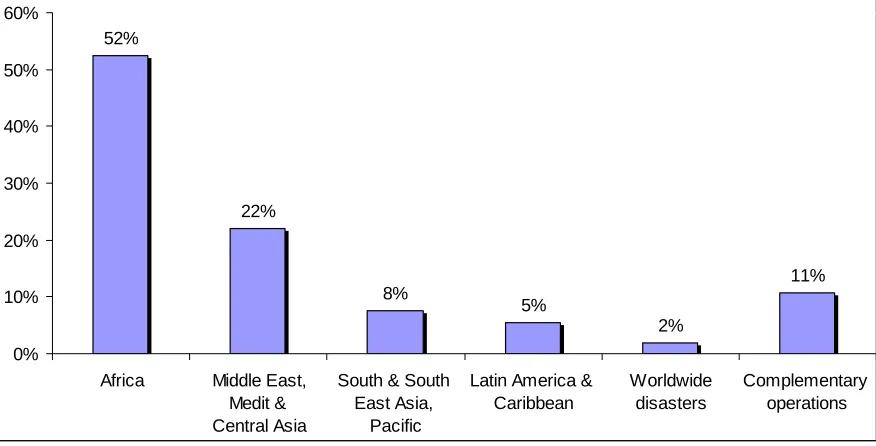
The general budget earmarked on the budget lines for humanitarian aid, food aid and Dipecho is €840 million.
52%
22%
8%
5%
2%
11%
0% 10% 20% 30% 40% 50% 60%
Africa Middle East, Medit & Central Asia
South & South East Asia,
Pacific
Latin America & Caribbean
Worldwide disasters
[image:11.595.75.513.65.288.2]Complementary operations
Figure 1 — Budget planned in 2012 by region
(1) includes technical assistance, enhanced response capacity
At this stage, 19 % of the budget remains unallocated, to allow scope for changing priorities and newly-emerging needs. In the event of a major new disaster in 2012, the Commission can ask the Budgetary Authority to release funds from the Emergency Aid Reserve included in the Commission's section of the EU budget that is over and above the original humanitarian aid budget.
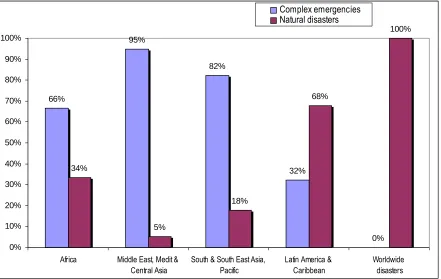
The chart below shows the response planned for complex emergencies and natural disasters based on budget per region.
66%
95%
82%
32%
0% 34%
5%
18%
68%
100%
0% 10% 20% 30% 40% 50% 60% 70% 80% 90% 100%
Africa Middle East, Medit & Central Asia
South & South East Asia, Pacific
Latin America & Caribbean
Worldwide disasters
[image:12.595.75.516.97.376.2]Complex emergencies Natural disasters
Figure 2 — Budget planning: response to complex emergencies and natural disasters
3.2. Africa
3.2.1. Sudan, South Sudan and Chad
Sudan and South Sudan
With 5 to 6 million people in serious humanitarian need, the Sudan and South Sudan programme will face severe challenges as a result of access limitations, logistical and administrative constraints, poor local capacity, climate and landmines. Advocacy for an increase in humanitarian space and for respect of humanitarian principles will continue to play a key role in DG ECHO's strategy in Sudan and South Sudan.
The 2012 funding will be focused on life-saving and life-preserving operations for the more than 5 million displaced people, refugees, returnees, host communities and nomads, in Sudan (Darfur, the Transitional Areas and the East) and in South Sudan. In Darfur, South Kordofan and potentially Blue Nile, assistance will continue to be critically dependent on the capacity to remotely manage through local organisations and will comprise emergency items (food, non-food and shelter), access to water, primary health care and nutrition. In South Sudan priority will be given to preparedness actions for rapid response to new emergencies and to enhancing communities' resilience to natural and man-made disasters. Priority areas will be those prone to conflict and emergencies, those suffering from high levels of malnutrition and those hosting large numbers of IDPs and returnees. A multi-sector approach will be adopted, integrating health, nutrition, water, sanitation and hygiene promotion, food aid and food security and protection. At the same time, the new political and development landscape will bring real opportunities to integrate development considerations within humanitarian operations and gradually transfer some humanitarian operations to development instruments. Common humanitarian services such as air transport, assessments, security training and coordination will continue to be funded.
The development of the humanitarian situation in Sudan and South Sudan in 2012 is highly unpredictable. Therefore DG ECHO stands ready to adapt its funding levels in accordance with the evolution of humanitarian needs in the two countries
Chad
In Eastern Chad, although security conditions improved in 2011, the 267,000 Sudanese refugees continue to depend heavily on humanitarian aid and have no immediate prospect of returning to Darfur. Of the 171,000 IDPs reported by OCHA in 2010, it is expected that 100,000 will have returned by the end of 2011. In the Sahel belt, the livelihood security of 1.6 million people recovering from the 2009/10 food and nutrition crisis has been further impacted by the Libyan crisis, with the return of over 80,000 migrant workers, the drying up of remittance payments and the disruption of trade routes.
In the East, DG ECHO will continue to provide essential life-saving services and livelihood recovery support for vulnerable refugees, IDPs, returnees and host populations, encouraging self-sufficiency as much as possible. Sustainable solutions for IDPs will be supported, through better knowledge of return and reintegration processes, support for pilot return operations and early recovery. In the Sahel belt the focus will be on treating malnutrition and helping populations recover from the cumulative effects of the 2009/10 food and nutrition crisis, the 2010 floods and the 2011 Libya crisis, with a focus on linking relief, rehabilitation and development (LRRD) and disaster preparedness and prevention. Multi-sectoral aid (protection, food security, nutrition, health, water and sanitation) will be provided to 1.8 million beneficiaries.
3.2.2. Central Africa
Democratic Republic of Congo (DRC)
There are still serious humanitarian situations in many parts of North and South Kivu and the Haut and Bas Uélé districts of Province Orientale, largely because of conflicts between various rebel groups and the government and MONUSCO2 offensives to counter them. In Equateur Province, urgent needs persist, although the humanitarian situation improved somewhat during 2011.
The crisis in DRC is first and foremost a protection crisis, with civilians plagued by generalised insecurity and impunity, both on the side of rebel groups and of the Congolese army. Rigorous data and figures are lacking but violence and especially sexual and gender-based violence, are known to be widespread. 1.7 million people remain displaced, harvests have declined because insecurity prevents access to lands, and vulnerable populations do not have adequate water, sanitation and medical care. Over 75% of LRA (Lords Resistance Army) attacks currently take place in DRC, and this remains a sub-regional forgotten crisis. In the areas not affected by conflict, malnutrition rates are often above emergency thresholds as a result of economic difficulties and instability. The whole country is regularly subject to epidemics, as a result of poor health and sanitation conditions. DG ECHO will continue to address urgent needs arising from population displacements in conflict zones and life-threatening situations in non-conflict areas. Protection will be at the core of its interventions, whether mainstreamed into funding for the restoration of food security and livelihoods, through improvements in basic social services, or through specific protection activities, especially for survivors of gender-based violence. DG ECHO will continue to support emergency preparedness to ensure response capacity in a volatile context. Disaster Preparedness will be mainstreamed.
Activities will be closely coordinated with development cooperation instruments. The Commission will continue to defend humanitarian space and promote respect for humanitarian principles and IHL through advocacy, coordination and active support for humanitarian logistics, in particular through the provision of an ECHO Flight service.
Great Lakes and DRC refugees
As a result of the instability in many parts of DRC, Congolese refugees have been present for many years in almost all of the neighbouring countries. DG ECHO will assist these refugees with a continuing focus on the 24,000 living in three camps in Burundi and the 60,000 in a camp in Tanzania. Assistance will also be given to repatriation operations. Aid will continue to be given to the 37,000 Burundian refugees living in a camp in Tanzania. DG ECHO will provide food, health and other relief items, and will support repatriation and reintegration processes, while seeking to ensure that refugees are given adequate protection, and are treated with dignity and in accordance with international law.
Central African Republic (CAR)
In a context of chronic poverty, structural collapse and absence of basic services, populations in CAR are pushed into humanitarian emergency by the frequent conflicts that break out, often in an unpredictable fashion. The North and the North-East continue to be affected by fighting between rebel groups or with government forces. The South East
2
continues to be a target for attacks by the LRA. CAR has a total of 200,000 IDPs and refugees and 1.6 million other people in need of urgent humanitarian assistance (out of a total population of four million). Donor interest is low, there are not enough partners working in the really difficult areas, and delivery of humanitarian aid is hampered by security constraints and logistical problems, justifying CAR's status as a forgotten crisis. DG ECHO will continue addressing the needs of refugees, IDPs, host populations and other highly vulnerable groups. It will encourage humanitarian agencies to set up operations in the most critical (and usually the most difficult) areas, and will support humanitarian logistics services and promote coordination.
ECHO Flight
Because of logistical and security-related access problems in a number of countries and the lack of flights operated by other humanitarian partners or by reliable commercial companies, the Commission operates a flight service focusing on DRC (and neighbouring areas) and Kenya. ECHO Flight provides an efficient and reliable service for staff and freight for humanitarian agencies funded by DG ECHO and for similar organisations supported by other EU funds. Without ECHO Flight, implementation of humanitarian projects in many remote regions would be impossible. Its flexibility also enables a prompt response to emergencies such as medical or security evacuations.
In view of the increased demands on ECHO Flight in Kenya, linked to the Horn of Africa famine, and in DRC, where all local companies are on the EU safety black list, flight levels were scaled up in 2011, and this increased level should be maintained in 2012. The service will continue to be closely coordinated with other humanitarian air services and will avoid duplication and competition with safe, viable commercial airlines.
3.2.3. Horn of Africa
While the humanitarian situation in the region is foreseen to improve in 2012, a further deterioration can also not be excluded. In this case, DG ECHO remains ready to further increase its funding to the region substantially.
Somalia
Somalia today represents the most serious humanitarian crisis in the world. More than four million people are affected by drought, food insecurity and conflict resulting in massive hunger and famine. From July 2011, widespread famine has been declared in six regions of south Somalia and the situation is expected to further deteriorate. Access and high insecurity represent major challenges for implementing aid agencies.
DG ECHO will focus on emergency response through life-saving activities in the South-Central zone of Somalia and in urban areas of Puntland and Somaliland. Mainstreaming of community-based drought-preparedness and disaster risk reduction initiatives will also be supported.
Ethiopia
4.5 million people need humanitarian assistance. The poor rainfall of the two last seasons led to extreme shortages of food, pasture and water, causing loss of livestock.
DG ECHO will focus on food assistance; health and nutrition; water, sanitation and hygiene (WASH), livelihood support, disaster risk reduction (DRR), refugees and IDPs. LRRD will continue to be pursued. Access restrictions and delays in the signing of operational agreements with humanitarian actors are expected to pose challenge during the implementation phase.
Kenya
In the arid lands, DG ECHO will support nutrition and livelihood activities. Early recovery will also be funded in the sectors of food and food security, water, and the health and management of livestock, while disaster preparedness will continue to be a strong component. Opportunities for LRRD will continue to be pursued, especially in the sectors of food security and livelihood. Health, nutrition and hygiene education will continue to be mainstreamed. In the Dadaab refugee camps, 450,000 people from Somalia live in extremely precarious conditions. DG ECHO will continue to address their most pressing needs. It will also be active in addressing protection needs, as well as in the education sector, in liaison with DG DEVCO.
Djibouti
DG ECHO will continue to support food assistance operations including the integrated management of acute malnutrition, but possibly also food aid or food security actions. Refugee operations may also be supported depending on needs. Opportunities to increase LRRD efforts will be explored. Continued attention will be given to disaster risk reduction initiatives aiming to increase the resilience of communities to the effects of drought.
Eritrea
Very little information on the humanitarian situation is available for Eritrea. No independent or objectively verifiable needs assessment has been conducted since 2006.
However, Eritrea is certainly also affected by drought. The limited information gathered points to critical food insecurity with a nutritional situation that is far beyond any commonly accepted emergency threshold. The humanitarian space in Eritrea keeps shrinking. DG ECHO is gathering more information and remains ready to respond if conditions allow. Regional disaster risk reduction (DRR)
DG ECHO will build on the achievements of the regional DRR/drought risk reduction approach supported in the Horn of Africa. Particular emphasis will be put on preparedness for response to drought with support to interventions in food assistance, nutrition, water, WASH, livelihood support and health. Support for humanitarian pilot interventions aimed at enhancing resilience and diversifying coping strategies of vulnerable local communities will be pursued. This will include cross-border DRR interventions, support to climate change adaptive strategies and mainstreaming of DRR into country-specific interventions. Furthermore, regional advocacy actions will use and disseminate the lessons learned, as well as the best practices identified, thereby intensifying LRRD efforts with the ultimate aim of integrating the disaster risk reduction approach into development aid frameworks.
3.2.4. Southern Africa and Indian Ocean
As the situation in Zimbabwe continues to move from the emergency to recovery phase, it is important to further strengthen the LRRD approach and build upon emergency achievements, in particular early recovery activities. Although obtaining food is still difficult for those without access to foreign currency (US dollars), the food security sector in general has shown improvements as a result of the economic liberalization measures of 2009. DG ECHO intends to phase out completely from this sector. The public health challenges remain. The collapse of services in the health and WASH sectors has resulted in a series of epidemic outbreaks sweeping the country (cholera, measles, typhoid). DG ECHO will therefore continue to address the most urgent needs in these sectors.
DIPECHO
South-east Africa and the south-west Indian Ocean region are particularly disaster-prone. Tropical storms and severe flooding regularly affect the region. The physical risk is combined with socio-economic factors, such as high population density, extreme poverty and, in Malawi and Mozambique, a high incidence of HIV and AIDS.
The combination of these factors results in very vulnerable communities with few coping capacities in the event of disaster. Also, due to their extreme poverty, these population groups have a very low capacity to recover from losses.
The most recent DIPECHO decision for Southern Africa expired in November 2011. There is a clear opportunity to continue and extend DIPECHO for Southern Africa in 2012 in the light of its positive impact on building resilience and disaster preparedness.
3.2.5. West Africa
The Sahel
In 2012, the region will remain heavily exposed to climatic hazards, food insecurity and malnutrition as well as to the potential humanitarian impact of growing insecurity in the region. DG ECHO will continue to focus on achieving a sustainable reduction in malnutrition-related mortality among children under five years of age in the Sahel through a comprehensive regional nutrition strategy. Negotiations with development partners will be undertaken to encourage the further mainstreaming of nutrition and food security into development planning.
Côte d'Ivoire
Despite marked improvement in 2011, the situation in Côte d'Ivoire will remain fragile in 2012. Due to the precarious political and security environment and slow progress in the resumption of basic services, over 300,000 IDPs and returnees and almost 200,000 refugees in Liberia and neighbouring countries still depend on humanitarian aid, notably access to health care , food assistance, shelter, water and protection. Close contact and dialogue is taking place with development partners and the local authorities to facilitate the LRRD transition from short-term humanitarian aid funding to longer-term and more sustainable development funding of essential services for those in need.
Liberia
While the transition from humanitarian aid to development has made good progress in the health sector, continued funding is needed, mainly for water and sanitation in urban and rural areas.The presence of a large humanitarian refugee caseload following the Cote d'Ivoire crisis and possible tensions around the end-2011 Liberian presidential elections are factors that could impact on continued stability in Liberia and on overall needs for humanitarian funding in 2012. DG ECHO humanitarian assistance for the care and maintenance of the refugees in neighbouring countries including Liberia will in principle be covered under the 2012 HIP in response to the Cote d'Ivoire crisis.
3.3. Middle East and Mediterranean countries
3.3.1. Middle East
Occupied Palestinian Territories and Lebanon
Isolation and fragmentation by the Israeli authorities of the occupied Palestinian territory (oPt), caused by systematic restrictions on movement and recurrent destruction of physical assets, continues to have a strong impact on the livelihoods of the Palestinian population. In this protracted crisis, access of the Palestinian people to basic services such as health, education and water is still severely hampered. LRRD is extremely difficult to implement in this particular context of unceasing "de-development" of large parts of Palestinian society. DG ECHO is working closely with the European External Action Service (EEAS) and DG DEVCO, seeking complementarity and handover strategies in interventions mainly in the food assistance, and water/sanitation sectors. DG ECHO will continue using protection of civilians as the key entry point for its strategy in the oPt, in order to focus on and satisfy the basic humanitarian needs of the populations living in the areas mostly affected by the Israeli occupation: Gaza, East Jerusalem, Area C, and those areas adjacent to Israeli settlements and the Barrier, including the so-called Seam Zone. DG ECHO will continue to intervene in the sectors of livelihood, water and sanitation, health, psychosocial support, protection and coordination. Advocacy notably on access, protection and IHL will be increasingly mainstreamed in all interventions.
Iraq
The humanitarian situation in Iraq continues slowly to stabilise despite a high level of violence and a large number of displaced persons. The International Organisation for Migration (IOM) estimates that approximately 2.76 million people are currently displaced inside Iraq, and UNHCR has registered 187,500 refugees in neighbouring countries as of 30 June 2011, in particular in Syria (127,400), Jordan (32,700) and Lebanon (9,500). Access and security problems in Iraq remain acute, which makes the delivery of humanitarian aid particularly difficult. Following an improved Government response and an LRRD strategy based on capacity-building support to the authorities to re-establish basic health, education and water services, ECHO will pursue its phasing down strategy inside Iraq, and will continue its efforts to assist the refugees. Protection will remain the priority, including within Iraq, with basic service provision, including cash and voucher assistance, for the most vulnerable Iraqi refugees.
Yemen
The humanitarian situation in Yemen has continued to deteriorate in 2011. The country has faced a series of complex emergencies and is now on the verge of fragmentation. The collapse of the State is a real threat that could lead to a major crisis. Moreover, the political instability and famine in the Horn of Africa, particularly in Somalia, has prompted an increasing number of refugees and asylum seekers to land on Yemen's shores.
As the country fragments and local fighting intensifies, internal population displacements are recurrent. With the overall economic and social situation deteriorating, and limited natural resources (notably water) the coping mechanisms of the most vulnerable people are being exhausted leading to destitution and forced economic displacement. A major humanitarian concern is the high likelihood of increasing malnutrition among a population that was already experiencing some of the world's highest malnutrition levels before the most recent crisis. Combined with the problems of access and security this makes the populations even more vulnerable.
The number of vulnerable people significantly increased in 2011. In addition to the million people affected by the conflict in North Yemen (including over 300,000 IDPs), more than 83,000 people in Southern Yemen were forced to flee the Abyan Governorate and seek refuge in neighbouring regions. The number of refugees exceeds 200,000. These are mainly Somali, the reminder being Ethiopians, Eritreans and Iraqis.
DG ECHO, through multi-sector assistance, will continue to support refugees and populations affected by the internal conflict and severe malnutrition.
3.3.2. Mediterranean countries
Libya
At this stage, the political and security situation in the country is still fluid and needs to be stabilized. Nevertheless, conditions are expected to improve as fighting diminishes, significant amounts of frozen funds in the USA, UK and France are released (as agreed by the UN Sanctions Committee), the main supply routes are reopened and commercial imports resume. DG ECHO will continue to address pockets of vulnerability while transitional strategies are implemented.
Sahrawi refugees
A typical example of a forgotten crisis requiring a political solution, the situation of Saharawi refugees remains unchanged, with no possibility to sustain their livelihood by themselves. Humanitarian aid will continue to be directed towards basic service provision: food aid including fresh products, health and nutrition, water and sanitation, and shelter. In the current context, an LRRD approach appears extremely difficult, if not impossible to implement. However, DG ECHO will continue advocating for sectoral coordination, local capacity building, mid-term programming and the reliability of food aid flows. It will also encourage United Nations organisations to expand their expertise for the refugees' wellbeing.
3.4. Asia, the Pacific and Caucasus
3.4.1. DIPECHO in Central Asia and Caucasus
DG ECHO has been phasing out its humanitarian activities in the Caucasus, mainly focused on protection, over the last year, due to security improvements in the North Caucasus and the stabilization of the South Caucasus. In Central Asia, DG ECHO has also phased out from its intervention in Kirgizstan.
Nevertheless, not least due to the impact of global warming, both the Caucasus and Central Asia are vulnerable to disasters caused by floods, landslides, mudflows and drought. These areas are also earthquake-prone. Disaster preparedness and disaster risk reduction, together with potential response to disasters, need therefore to remain a focus for the two regions. In 2012, it is proposed to join the two action plans for DIPECHO in the South Caucasus and Central Asia. This will effectively be a second phase for the South Caucasus, mainly targeting communities located in remote mountainous districts, while it will be the seventh round for Central Asia with a clear emphasis on lessons learned from previous cycles and exit strategies.
In both regions, the possibility to intervene through small scale interventions and the DREF will be maintained.
3.4.2. South Asia
3.4.2.1. South West Asia
Afghanistan
In Afghanistan, the constantly changing security situation and the consequences of ongoing extensive military operations, recurrent droughts and small-scale natural disasters, have provoked a sharp increase in humanitarian needs. In 2012, the first priority will be to respond to the consequences of the conflict, notably by supporting people affected by internal displacement as well as supporting, in the short term, refugees returning from Pakistan and Iran. Assessment of needs and response to natural disasters will also remain a priority in cases where the coping capacity of the authorities is exhausted. DG ECHO will only address humanitarian needs where security and access allow partners to intervene. The continuing aim will be to meet beneficiaries' needs for shelter, food, water, sanitation, hygiene education, health and nutrition, with protection and DRR as primary cross-cutting priorities.
DG ECHO will intensify its efforts towards a coherent LRRD approach that takes into consideration the challenges of the specific situation, as well as the importance of involving local communities. This is particularly the case for food security interventions, water and sanitation, and health programmes. Coordination and reinforcement of access by humanitarian organisations to people in need will still be high on the agenda. DG ECHO will therefore continue its support for security coordination and for humanitarian flights to remote locations.
Pakistan
In Pakistan, DG ECHO will direct its humanitarian interventions to assisting those suffering the consequences of the conflict in Khyber Pakhtunkwa (KPK) and the Federally Administered Tribal Area (FATA). These include IDPs, people returning to their areas of origin and local communities. Furthermore, DG ECHO will continue supporting needs linked to the large-scale flooding that began in July 2010 and affected almost all provinces of Pakistan. The consequences of flooding in 2011, even if on a smaller scale, may have also to be taken into consideration if access to the affected regions is granted to humanitarian actors.
Bangladesh
DG ECHO is most concerned about persistent restrictions on access to unregistered Rohingya refugees, and the deteriorating humanitarian situation that this entails. In particular, the nutritional status of those living in the non-official camps is very worrying. In order to deliver basic life-saving humanitarian aid to this stateless population, DG ECHO will adopt a comprehensive approach encompassing the treatment of acute malnutrition and the provision of basic health and water services in and around the camps, including the most vulnerable populations living in the surrounding area3. Protection activities remain a challenge in these camps. In parallel, discussions are ongoing with key stakeholders to find a durable political solution to this protracted crisis.
The 2011 monsoon had a significant humanitarian impact on communities living along riverbanks in Bangladesh. Some of the most vulnerable people involved will require further assistance, during 2012, to recover from the destruction caused by floods and water logging. DG ECHO intends to focus on rehabilitation of shelters and livelihood support that mainstreams DRR. A coordinated LRRD approach for the post-emergency situation will be initiated with development actors. In areas where water logging persists for a longer period, further emergency assistance for displaced people will be needed.
India
Violence in the Kashmir valley and in the State of Chhattisgarh continues to bear heavily on local populations, who often are prevented from pursuing their livelihood activities, while having no access to medical services, psychosocial support, or protection. In Chhattisgarh, the disruption of livelihoods and displacement are having a serious impact on the nutritional status of the population most affected by the conflict. DG ECHO intends to maintain its assistance to the most vulnerable among the conflict-affected households, addressing the most pressing needs. Opportunities for LRRD in both contexts are limited and much depends on access, itself linked to the intensity of the conflict.
Nepal
While negotiations for a comprehensive solution to the issue of the 57,000 Bhutanese refugees still living in camps are ongoing, DG ECHO will continue to contribute, in coordination with the EU Delegation in Kathmandu, by funding food assistance.
Regarding the post-conflict situation, DG ECHO phased out its intervention in 2011, as the country's structural problems must be addressed from a development perspective. However, the humanitarian situation remains fragile and pockets of vulnerability persist.
Sri Lanka
The Sri Lankan conflict ended two years ago, causing mass displacement and destruction in the north of the country. Reconstruction efforts have been underway and while significant progress has been achieved in rehabilitating infrastructure and returning displaced populations, protection concerns prevail, especially for the most vulnerable individuals, including female-headed households, the elderly and the disabled. Sustainable livelihood
3
options and access to basic services continue to be limited, and where they do exist, their design does not take account of the particular needs of the most vulnerable. DG ECHO will follow a focused approach, targeting the most vulnerable people living in the former conflict areas, with particular emphasis on protection and food assistance/livelihood recovery; It will also continue to pursue all opportunities for LRRD, although these may be limited by political constraints.
3.4.2.2. South East Asia and Pacific Burma/Myanmar – Thailand
Humanitarian needs are expected to remain significant in Myanmar in 2012. Following the elections in late 2010, and despite the installation of a new government and new parliament in 2011, the tension along the eastern borders increased, resulting in outbreaks of fighting between armed groups and the Myanmar army. In areas where the most severe fighting took place, such as the Kachin, northern Shan and Karen areas, significant human displacement is reported but access is challenging. Humanitarian assistance has to be ready to reach these populations once access is secured. The humanitarian situation in Northern Rakhine State also remains fragile for the stateless Muslim (Rohingya) population. In the Burmese refugee camps in Thailand, the need for humanitarian assistance will remain. This should, however, be coupled with increased efforts for improved beneficiary targeting in the camps, and advocating of durable solutions for the refugees. In 2012 DG ECHO will continue gradually to reduce its humanitarian aid to the refugee camps, while closely coordinating with other EU funding such as Aid to Uprooted People (AUP).
DIPECHO / Disaster Risk Reduction
A new DIPECHO Action Plan for South East Asia will be launched. Given the progress of Community Based Disaster Risk Reduction (CBDRR) over the past few years in South East Asia, partly as a result of DIPECHO but also because of the efforts made by some Governments, DG ECHO will engage in a steady phase-out strategy from community-based pilot programmes in that region. This will start with an exit strategy in Vietnam and the Philippines, which will focus on the establishment and promotion of dissemination mechanisms for CBDRR.
3.5. Latin America and the Caribbean
The Latin America and Caribbean region is among those most affected by natural hazards. In addition to tropical storms, recurrent floods and drought, the region is particularly vulnerable to earthquakes and to volcanic activity. It also has the highest levels of inequality worldwide, with reasonable macro-economic indicators masking the poor socio-economic situation of most of the population. Accelerating urbanization, high crime rates, and protracted poverty are widespread.
Regional Disaster Risk Reduction Activities
Through a new Action Plan of its DIPECHO programme for Central America, DG ECHO will further contribute to strengthening communities' preparedness capacity in rural and urban contexts, and foster an exchange of experience within the region. DG ECHO will seek to identify opportunities for effective LRRD and to promote the integration of DRR in response operations.
Colombia
Despite political efforts, the consequences of the armed conflict in Colombia continue to be felt. In 2010, between 125,000 and 280,000 people were displaced and similar figures may be expected for 2011. In neighbouring countries, UNHCR estimates that 400,000 to 500,000 people need international protection. IDP figures are also remarkably high: 3.7 million according to the government and 5.2 million according to local NGOs.
At the same time, a Directive of March 2009, which mandated the military to coordinate and develop activities with humanitarian organisations in the field, has imposed additional constraints on the humanitarian space.
DG ECHO emergency assistance and protection will be provided to conflict-affected populations who do not receive adequate assistance from the authorities. Assistance to IDPs will focus on recently displaced populations and rural communities facing restrictions on movement and/or access to basic goods and services. Particular attention will be paid to the most vulnerable groups, namely female-headed households, children, the elderly, indigenous people and the Afro-Colombian population. In Ecuador and Venezuela, DG ECHO will provide humanitarian assistance and protection to Colombians seeking asylum who have not yet received formal refugee status, as well as to recognised refugees.
Haiti
In Haiti, DG ECHO will continue to assist victims of the January 2010 earthquake, support the fight against cholera, respond to any possible natural disaster and foster the mainstreaming of disaster risk reduction, with an emphasis on identifying viable exit strategies.
DG ECHO plans to maintain its engagement at least until the end of 2012 by targeting a minimum of 450,000 people with multi-sector support. Priority will be given to shelter, WASH, health and protection actions, incorporating effective exit strategies. Another key area where DG ECHO will be involved is DRR. Here, the aim will be to implement, through partners, a comprehensive exit strategy with particular attention to the development of an urban risk reduction methodology, filling gaps in community-based disaster-preparedness and promoting advocacy through the systematization and consolidation of information systems.
3.6. Worldwide intervention tools 3.6.1. Small Scale response to disasters
In addition, in the context of larger disasters, even in countries with relatively developed disaster management capacity, there are sometimes gaps in the national response: needs that are not covered that may be related to social inequality, physical isolation, under-reporting of events or inadequate local capacity.
A recurrence of even small shocks can push vulnerable populations into a spiral of further vulnerability and destitution. This is true for countries which look relatively well off from a macro-economic perspective, but where inequity and vulnerability are concentrated in given geographical areas (rural, remote, urban shanty towns) or social groups (for example, indigenous or ethnic groups).
The objective of the Small Scale Response (SSR) tool is to provide rapid humanitarian assistance to victims of natural or man-made disasters where a small scale response is adequate to cover unmet needs and enhance preparedness. It improves the capacity to respond to isolated and relatively neglected disasters, where the local impact of the disaster is significant and the response capacities are overwhelmed.
In 2011, when the Small Scale Response decision had global coverage for the first time (the pilot decision was implemented only in Latin America and the Caribbean to test the approach), it allowed at least 370,000 beneficiaries to be assisted.
3.6.2. Epidemics
Epidemics pose great risks to the health, lives and livelihoods of people in developing countries. Communicable diseases that have appeared or reappeared in recent years have demonstrated their epidemic potential and their capacity to significantly exceed national resources and boundaries, causing major, even regional emergencies.
Factors that contribute to the growing high burden of endemic and epidemic-prone diseases include the concurrent existence of complex emergencies due to natural disasters, climate change, and conflict. Such crises result in increased vulnerability to infectious diseases alongside reduced ability of countries to respond to public health risks, especially if pre-existing health systems were already poorly resourced. Vaccination coverage in developing countries is generally low and the risk of transmitting infection is thus increased.
To reduce morbidity and mortality in disease outbreaks, early and effective action is required. Preparedness and response capacity are intimately linked, as effective response is only possible with a good degree of preparedness.
The rapid availability of funding through the epidemics decision was particularly effective in allowing a quick response to an outbreak of cholera in Abidjan, Cote d'Ivoire in 2011.
3.6.3. Support to the Disaster Relief Emergency Fund (DREF)
DG ECHO supports the International Federation of the Red Cross and Red Cresent's Disaster Relief Emergency Fund (DREF) through earmarkedcontributions. This is a useful additional way of responding to small-scale disasters. Funding is provided through the DREF for relief activities as well as preparedness for imminent disasters, in the context of small-scale emergencies for which an appeal is unlikely to be launched.
drought, fires, cold waves, earthquakes, volcanic eruptions, epidemics, food insecurity, population movements and civil unrest.
Most small-scale emergencies are responded to at local or national level. The Red Cross and Red Crescent National Societies, supported by IFRC, are often best placed to provide an immediate response, being rooted in the local community and mobilising community members as volunteers. The disaster preparedness/response capacity-building at local and national level, which results from DG ECHO's support of the DREF, adds a long-term sustainable aspect to this short-term response.
3.7. Complementary activities
3.7.1. Enhanced response capacity
Humanitarian needs continue to increase beyond the budgets available4, driven principally by the consequences of climate change and population growth. Consequently, the global humanitarian system needs to be strengthened to deliver more cost-effective humanitarian responses, allowing for better and broader humanitarian coverage.
It is for this reason that the European Consensus on Humanitarian Aid states that: "… supporting the development of the collective global capacity to respond to humanitarian crises is one of the fundamental tenants of our [EU] approach." Also, through the endorsement of the Good Humanitarian Donorship Principles, the Commission agreed to "allocate funding to strengthen capacities for response."5 Enhanced Humanitarian Response Capacity funding through this 2012 Decision is in line with the ERC Guidelines6 developed by DG ECHO following extensive consultations with fellow donors, humanitarian partners and other humanitarian actors throughout 2008 and 2009. These Guidelines identify both the overall objective, the main identified 'gaps' in the global humanitarian system, and key criteria on how DG ECHO funding should be applied to ensure the maximum impact. The 2012 decision will seek to respond to the major 'gaps' but while focussing in particular on enhanced global humanitarian architecture, and food assistance and nutrition.
This overall rationale includes recognition of the specificities of the food assistance and nutrition sectors for Enhanced Response Capacity building, and in particular the need to strengthen the capacity of the humanitarian system to deliver more efficient and effective forms of food and nutrition assistance.
Consequently Enhanced Response Capacity funding will strengthen the global humanitarian preparedness and response capacity of humanitarian partners by increasing the effectiveness and reinforcing the capacity of international humanitarian organisations and non-governmental organisations to assess, analyse, prepare and respond to humanitarian crises.
4
For natural disasters, an average of 270 million people are reported as affected each year (IFRC 2009 World Disaster report). Projections for climate-related natural disasters alone, thus excluding events such as earthquakes, show this rising to as much as 375 million by 2015 (Oxfam : Right To Survive report).
5
GHD principle 18, but also principle 8 on strengthening the capacity of affected countries and local communities and principle 10 to support and promote the central and unique role of the UN.
6
3.7.2. Information and communication
Effective communication about the values and impact of humanitarian aid is key to the continuing deployment of relief assistance in saving lives and alleviating suffering. The actions launched relate to public information and awareness actions in accordance with the fifth indent of Article 4 of Council Regulation (EC) N° 1257/96 of 20 June 1996. Such actions are also in conformity with the last indent of point 97 of the European Consensus on Humanitarian Aid (COM(2007) 317 final) that envisages communication, on the impact and importance of European humanitarian aid, to the European public.
The broad objective of DG ECHO’s communication work is to boost understanding, in the European Union and globally, of the importance of humanitarian aid and of the concrete contribution made by the European Union as one of the world's leading donors of humanitarian aid. The EU citizens are the priority target audience.
Apart from assuring efficient public information on emergency response in the upcoming disasters, particular attention will be paid to communicating disaster response, disaster preparedness and resilience; forgotten crises; and the European Voluntary Humanitarian Aid Corps.
Further developing efficient media approach in close cooperation with the spokesperson is an integral part of the strategy. DG ECHO will step up its web based approach in order to reach the widest audiences possible. Special attention will be paid to stakeholders and opinion makers in the Member States. Close cooperation with partners will be pursued with the aim to improve EU's visibility as the leading humanitarian donor.
Regional information officers in the field are an integral part of the communication approach. DG ECHO will also cooperate with the European Commission Representations in the Member States to better target the messages in Brussels, in the Member State capitals and in the field.
The 20th anniversary of the creation of ECHO in 2012 will be used as an opportunity to further promote these priorities.
3.7.3. Training initiative NOHA
The Network on Humanitarian Action (NOHA) is the first network of universities at European level that provides education (teaching and research) and training in humanitarian action. It has maintained a strong relationship with the European Commission's Directorate General for Humanitarian Aid and Civil Protection (DG ECHO) since its inception in 1994. NOHA continues to produce 154 Masters graduates each year. DG ECHO aims to increasingly shift the focus of the network to the provision of other educational products and to a much more results-oriented approach focusing on added value for the humanitarian aid environment.
committed to the implementation of those principles which underpin the vision of the European Union.
3.7.4. Pilot European Voluntary Humanitarian Aid Corps
Three pilot projects have been selected in the framework of the Preparatory Action 2011. Through these projects, around 90 European volunteers will be selected, trained and deployed in third countries.
The first group of volunteers were deployed at the end of 2011, while the remaining two groups will be deployed in 2012. In 2012 DG ECHO will launch a Call for Tender for a second round of pilot projects.
4. DELIVERY, COORDINATION AND CONTROL OF HUMANITARIAN AID
Humanitarian aid is often delivered in emergency situations in which access to beneficiaries is difficult due to logistical or security constraints. To make sure that public funds are well used under these circumstances, the Commission pursues an active relationship with its stakeholders and has put in place various monitoring and coordination mechanisms.
4.1. Ways and means of delivering aid Experts in the field
The Commission manages its humanitarian activities from its headquarters in Brussels via a network of more than 40 field offices all over the world. Following the post-tsunami action plan of 2005, the network has been consolidated with multi-sectoral rapid response teams, which enables field experts to be dispatched rapidly in response to new crises to carry out needs assessments and to help coordinate activities in the field. The network has been reinforced in response to the recent increase in the number of large-scale disasters. Cooperation with teams deployed via the EU Civil Protection Mechanism will be enhanced to maximise complementarities.
Relations with partners
The Commission implements its humanitarian aid mandate by funding projects proposed by around 200 partners. They include European non-governmental organisations, United Nations Agencies, other international organisations such as the International Committee of the Red Cross, the International Federation of Red Cross and Red Crescent Societies, the International Organisation for Migration, and specialised agencies from Member States. Having a diverse range of partners is important, as it allows comprehensive coverage of an ever-growing list of needs in different parts of the world and in increasingly complex situations. Grants and contributions are decided on the basis of the best proposals covering the needs of those most vulnerable. Partner organisations make a commitment to highlight the origin of EU aid.