Edited by
Miroslav Beblavý
Ilaria Maselli
Marcela Veselková
Let’s get to
Work!
The
Future
of Labour in Europe
www.ceps.eu
Foreword by
L
ET
’
S
G
ET TO
W
ORK
!
T
HE
F
UTURE OF
L
ABOUR IN
E
UROPE
V
OL
.
1
E
DITED BYM
IROSLAVB
EBLAVÝI
LARIAM
ASELLIM
ARCELAV
ESELKOVÁC
ONTRIBUTORS LÁSZLÓ ANDOR MIROSLAV BEBLAVÝIAIN BEGG BAPTISTE BOITIER VERENA DRÄBING MARINA FISCHER-KOWALSKI
WILLI HAAS FERRY KOSTER
JÁNOS MÁTYÁS KOVÁCS NICOLAS LANCESSEUR
ILARIA MASELLI NICOLE VAN DER GAAG
OLAF VAN VLIET MARCELA VESELKOVÁ
PAUL ZAGAMÉ
CENTRE FOR EUROPEAN POLICY STUDIES (CEPS)
research leading to constructive solutions to the challenges facing Europe. The views expressed in this book are entirely those of the authors and should not be attributed to CEPS, the European Union or to any other institution with which they are associated.
ISBN 978-94-6138-406-5
© Copyright 2014, Centre for European Policy Studies and the authors.
All rights reserved. No part of this publication may be reproduced, stored in a retrieval system or transmitted in any form or by any means – electronic, mechanical, photocopying, recording or otherwise – without the prior permission of the Centre for European Policy Studies.
Centre for European Policy Studies Place du Congrès 1, B-1000 Brussels Tel: (32.2) 229.39.11 Fax: (32.2) 219.41.51
E-mail: [email protected]
T
ABLE OF
C
ONTENTS
(
OVERVIEW
)
Foreword ... i
Acknowledgments...iv
1. The future of labour in Europe: An overview ... 1
2. Emerging megatrends and scenarios in the socio-ecological transitions ... 14
3. How much work will there be? Where is it going to come from? ... 29
4. Exploring the transformation of human labour in relation to socio-ecological transitions ... 56
5. Job quality in the European Union: Travelling back in time? ... 85
6. Workplace innovation in Europe ... 111
7. Future of skills in Europe: Convergence or polarisation? ... 131
8. The role of the state: Reform pressures and welfare reform towards social investment ... 159
9. Labour market institutions in Europe: Differences, developments, consequences and reforms ... 185
10. The future of labour in Europe: Key messages for policy-makers ... 207
List of Abbreviations ... 242
About the Editors ... 243
T
ABLE OF
C
ONTENTS
(
IN DETAIL
)
Foreword ... i
Acknowledgements ... iv
1. The future of labour in Europe: An overview ... 1
1.1 How many workers for how many jobs? ... 2
1.2 Skills, polarisation and inequality: The long-term pattern ... 6
1.3 What exactly do we mean by ‘work’? ... 8
1.4 What role for the state in the labour market? ... 9
1.5 The state as a service provider: The call for a social-investment approach to social policies ... 11
1.6 What’s next? And after that? ... 12
2. Emerging megatrends and scenarios in the socio-ecological transitions ... 14
2.1 Introducing global scenarios ... 15
2.2 Natural megatrends ... 18
2.2.1 Energy transition ... 18
2.2.2 Rising challenges to resource security ... 19
2.2.3 Stronger climate change impacts ... 19
2.3 Societal megatrends ... 20
2.3.1 Population dynamics ... 20
2.3.2 Shifting economic and political centres of gravity ... 20
2.3.3 Growing use of ICT and knowledge-sharing ... 21
2.4 European response strategies ... 21
2.4.1 Strategy 1: No policy change ... 22
2.4.2 Strategy 2: Ecological modernisation and eco-efficiency... 23
2.4.3 Strategy 3: Sustainability transformation ... 23
2.5 How to evaluate the European response ... 24
3. How much work will there be? Where is it going to come from? ... 29
3.1 Changes in population and labour force: Theoretical considerations and 2000-10 dynamics ... 30
3.2 Structural and behavioural aspects of labour supply: A look at the next two decades ... 34
3.3 Labour demand and wage adjustment: Fewer but better paid workers?... 38
3.4 Fiscal effects of demographic change: Public finances likely to find relief despite ageing ... 41
3.5 What jobs and for whom? ... 43
3.6 Labour supply projections: Strong divergence in the evolution of skill levels ... 44
3.6.1 Two contrasting macroeconomic pathways leading to employment disparities ... 44
3.6.2 Sectoral mutations: The explosion of private services ... 46
3.7 The rise of high-skilled workers… ... 49
3.8 ...without forgetting unemployment! ... 51
Bibliography ... 54
4. Exploring the transformation of human labour in relation to socio-ecological transitions... 56
4.1 The socio-ecological character of human labour ... 57
4.1.1 Quantitative characterisation ... 57
4.1.2 Qualitative characterisation ... 60
4.1.3 Characterisation by institutional form ... 61
4.2 Human labour in different socio-metabolic regimes ... 62
4.2.1 Work in the agrarian regime ... 63
4.2.2 Work in the coal-based industrial regime ... 66
4.2.3 Work during the rise of the oil-based industrial regime ... 68
4.2.4 Work in the transition phase from the early 1970s onwards ... 70
4.3 Speculation on the future of labour ... 72
4.3.1 Anticipated changes in economic activities ... 72
4.3.2 Implications for the future of labour ... 76
5.1 Putting some flesh on the bones of survey-based studies ... 87
5.2 ‘Retraditionalisation’ and rising flexibility... 89
5.3 Case studies: Industries, companies and job qualities ... 92
5.4 Job quality choices in the same industry ... 94
5.5 Job quality choices between industries ... 97
5.6 Hypotheses vs. conclusions: Which post-materialism? ... 102
5.7 Quantity and egoism win ... 105
Bibliography ... 107
6. Workplace innovation in Europe ... 111
6.1 No single metric measures workplace innovation ... 112
6.2 An uneven spread, both geographically and by country ... 113
6.3 Flexi-time, teleworking and alternative payment schemes in Europe ... 114
6.4 Increased worker autonomy and responsibility ... 117
6.5 Workplace innovation as a package ... 118
6.6 The slow diffusion of innovation in the workplace ... 119
6.7 Workplace innovation and the economy ... 120
6.8 Employees’ and employers’ perspectives ... 121
6.9 It is not all about technology: Barriers to innovation ... 124
6.10 The public sector as leader of workplace innovation ... 125
Bibliography ... 128
7. Future of skills in Europe: Convergence or polarisation? ... 131
7.1 What happens with the extension of upper secondary and higher education to the general population? ... 131
7.2 Is later tracking a necessary and a sufficient condition for equality of educational opportunities? ... 134
7.3 Job polarisation based on the skill content of tasks is happening in Europe ... 140
7.4 The surprisingly demanding nature of ‘low-skilled’ jobs ... 144
7.6 Moderate convergence accompanied by an impetus for
polarisation ... 152
Bibliography ... 153
8. The role of the state: Reform pressures and welfare reform towards social investment ... 159
8.1 The evolution of European welfare states ... 160
8.2 Social investment as a source of socio-economic development ... 161
8.3 Social investment in three types of welfare states ... 162
8.4 Measuring social investment ... 163
8.5 Overall trends in welfare expenditure ... 165
8.6 In which policy fields did most changes take place?... 170
8.7 Patterns in family policy by welfare regimes ... 171
8.8 Persistent disparities in active labour market policies expenditure .. 176
8.9 Trends in other capacitating policies ... 178
8.10 Is there a shift in social investment? ... 179
Bibliography ... 181
9. Labour market institutions in Europe: Differences, developments, consequences and reforms ... 185
9.1 Labour market institutions: Employment, income and labour market protection ... 186
9.2 Modest convergence between western and eastern European countries ... 188
9.3 Do labour market institutions influence innovation? ... 191
9.4 Are unemployment benefits and job protection substitutes? ... 192
9.5 Labour market regulation: Recent trends ... 195
9.5.1 Employment protection ... 195
9.5.2 Unemployment benefits ... 198
9.5.3 Labour market policies ... 201
9.6 Decline in spending on protection reversed by the crisis ... 202
10.1.1 The ‘crisis’ and its aftermath... 208
10.1.2 Is a paradigm shift on the horizon? ... 210
10.1.3 Key messages for policy-makers ... 210
10.2 Where the jobs will be ... 211
10.2.1 Scenarios ... 212
10.2.2 Key messages for policy-makers ... 214
10.3 Energy policy in anticipation of a socio-ecological transition ... 215
10.3.1 The evolving EU policy position ... 217
10.3.2 Key messages for policy-makers ... 219
10.4 Influences on the labour market ... 220
10.4.1 Workplace innovation ... 220
10.4.2 Labour market institutions ... 221
10.4.3 Job quality ... 223
10.4.4 Key messages for policy-makers ... 224
10.5 Skills demand ... 225
10.5.1 Is education the answer? ... 226
10.5.2 Key messages for policy-makers ... 226
10.6 The evolving welfare state ... 227
10.6.1 Social investment... 227
10.6.2 Whatever happened to flexicurity? ... 230
10.6.3 Key messages for policy-makers ... 231
10.7 Policy implications: Reconciling long-run goals with today’s agenda ... 232
10.7.1 Have long-run sustainability objectives been sidelined? ... 233
10.7.2 Governance at the EU and national levels ... 234
10.7.3 Dealing with the political challenges ... 236
Bibliography ... 238
List of Abbreviations ... 242
About the Editors ... 243
L
IST OF
F
IGURES
Figure 2.1 The socio-economic reproduction of Europe in a global context
shaped by the ongoing socio-ecological transitions ... 17 Figure 3.1 Annual average change in working-age population (aged 20-64),
2000-20 and 2020-30 under ‘friendly’ and ‘tough’ scenarios ... 32 Figure 3.2 Annual average change in labour supply due to changes in
working-age population, employment rate and annual average
hours per week per employee, 2000-10 ... 34 Figure 3.3 Decline of labour force (headcount) ... 35 Figure 3.4 Change in total hours worked ... 36 Figure 3.5 Between now and 2030: Reduction in hours is less severe than
the reduction in headcount ... 37 Figure 3.6 Wage adjustments due to demographic change ... 38 Figure 3.7 Average wage changes due to demographic changes and
the labour market response, ‘tough’ scenario ... 40 Figure 3.8 Average wage changes due to demographic changes and
the labour market response, ‘friendly’ scenario... 40 Figure 3.9 EU-27 employment growth between 2010 and 2030
under the ‘friendly’ and ‘tough’ scenarios (%) ... 46 Figure 3.10 Change in European total employment under the ‘friendly’
and ‘tough’ scenarios (millions) ... 47 Figure 4.1 Approximate daily working hours by socio-metabolic regime
for an average inhabitant ... 59 Figure 4.2 Share of urban population in settlements with 2,500 or more
inhabitants by world region in 1500 ... 64 Figure 4.3 Primary energy consumption (PEC) and working time (hours)
for Italy (left) and Germany (right), 1870 to 1998 ... 67 Figure 4.4 Annual working hours per employee (left) and per inhabitant
(right) in the US, Japan and EU-15 (1960-2005) ... 72 Figure 4.5 Variation of quality of work and its institutional form in Europe,
by past socio-metabolic regimes and speculation about changes
during the new transition ... 76 Figure 6.1 Diffusion of innovative practices in the workplace, by country,
average across nine items ... 114 Figure 6.2 Working time set by the company with no possibility
Figure 6.5 Innovative practices: Nordic vs. the southern countries ... 119 Figure 7.1 Effect of socioeconomic gradient for children of different
abilities in Austria, Belgium, Finland and Hungary ... 136 Figure 7.2 Job polarisation in the EU-27, 2000-10 ... 141 Figure 7.3 Demand and supply of work with respect to skills/tasks
in the EU-27, 2000-10 ... 142 Figure 7.4 Relative unemployment in the EU member states ... 147 Figure 7.5 Labour market status in the EU: Old vs. prime age ... 149 Figure 7.6 Training and ISCED upskilling: A comparison of European countries
with Austria ... 151 Figure 8.1 Compensating spending vs. capacitating spending
in 1997, 2007 and 2009: Social-democratic regime... 166 Figure 8.2 Compensating spending vs. capacitating spending
in 1997, 2007 and 2009: Christian-democratic regime ... 167 Figure 8.3 Compensating spending vs. capacitating spending
in 1997, 2007 and 2009: Liberal regime ... 168 Figure 8.4 Compensating spending vs. capacitating spending
in 1997, 2007 and 2009: Southern regime ... 169 Figure 8.5 Compensating spending vs. capacitating spending
in 1997, 2007 and 2009: New EU member states ... 170 Figure 9.1 Employment protection legislation... 196 Figure 9.2 Employment protection legislation for regular workers,
trend 1995-2013... 197 Figure 9.3 Employment protection legislation of temporary workers,
trend 1995-2013... 198 Figure 9.4 Net unemployment replacement rates
(average production worker), 2009 ... 199 Figure 9.5 URRs for average production worker (single), 1995-2009 ... 200 Figure 9.6 URRs for average production worker (couple), 1995-2009... 200 Figure 9.7 Spending on labour market policies as a % of GDP,
L
IST OF
T
ABLES
Table 2.1 Speculative game-theoretical payoffs of three European response
strategies under two scenarios of global conditions ... 25 Table 3.1 Population (in thousands) and labour market participation factors
contributing to labour supply ... 31 Table 3.2 Percentage change in public revenue between 2010 and 2030
with projected wage changes ... 42 Table 3.3 Scenarios based on assumptions on the general context
(situation in 2010 and 2030 or variations from 2010 to 2030) ... 43 Table 3.4 Average annual GDP growth rate (%) ... 45 Table 3.5 European employment by skill level in the tradable and
non-tradable sectors, difference in thousands ... 50 Table 3.6 European unemployment rate by skill level (%) ... 52 Table 4.1 Anticipated changes in economic activities and their consequences
for human labour ... 74 Table 6.1 Percentage of workers involved in innovative practices in their
workplace in Europe, 2010 ... 113 Table 6.2 Workplace innovation in western Europe, 2000 vs. 2010
(% of total respondents) ... 120 Table 7.1 Static and dynamic match between the labour demand and
labour supply by country ... 142 Table 8.1 Measurement of capacitating social spending and compensating
social spending ... 164 Table 8.2 Change in expenditure per head at constant (2000)
PPP-adjusted US dollars ... 172 Table 8.3 Spending per capita on family policies in 1997, 2007 and 2009
at constant (2000) prices and constant (2000) PPs ($) ... 173 Table 8.4 Spending on active labour market policies per capita,
at constant (2000) prices and constant (2000) PPPs($) ... 177 Table 8.5 Total public educational expenditure per pupil as a percentage
of GDP per capita, all levels ... 179 Table 9.1 Convergence of employment protection legislation and
active labour market policies ... 189 Table 9.2 Convergence of unemployment replacement rates (single and couple) 190 Table 9.3 Fixed effects regressions of net unemployment benefit
replacement rates, 1990-2009 ... 194 Table 10.1 Carbon dioxide emissions per kilowatt/hour of electricity
i
F
OREWORD
urope’s labour market has been caught up in the seven-year storm created by the financial and economic crises. Unemployment has grown to record-high levels in the EU and especially within the eurozone. At the same time, Europe has experienced unprecedented divergences in employment and social outcomes across the member states.
This long and complex crisis has deprived many people of meaningful economic and social opportunities, resulting in a waste of human capital. The ‘margins’ of Europe’s labour market are quite large today, with many people experiencing precariousness and underemployment, if they can find jobs at all.
As the financial, economic and fiscal crises reinforced each other against the backdrop of an incomplete Economic and Monetary Union, investors as well as citizens started to lose confidence in the EU project. Some governments have lost their ability to promote economic recovery and to address longer-term structural challenges affecting Europe’s labour markets.
Key among these challenges are the ageing and shrinking of our workforce, the polarisation of the labour market associated with the phasing out of routine jobs, growing resource scarcity and climate change, and increasing technological competition from other parts of the world. Tackling these challenges requires structural public policy responses and investments.
The sovereign debt crisis put pressure both on countercyclical public spending and on social investment through public services, human capital development and support for people's transitions into the labour market. The EU has striven to respond to the economic crisis, the social emergency and the longer-term structural challenges by developing a more robust repertoire of policy options as well as through stronger policy coordination.
The Europe 2020 Strategy, agreed in June 2010, established employment, social inclusion and environmental targets as core elements of Europe’s socio-economic development model. However, due to the eurozone crisis, the EU employment rate for 20-64 year-olds has actually fallen to 68.3% in 2013 instead of rising towards the 2020 target of 75%, and the risk of poverty and social exclusion has grown rather than diminished.
In 2012, the European Commission put forward an Employment Package that articulated an ambitious policy agenda for a job-rich recovery. Expanding upon the European Employment Strategy, the package outlined measures to boost demand for labour, plans to harness the job creation potential of the green, white and digital economy, as well as steps towards a genuine European labour market with easier and higher-quality labour mobility across countries.
A recommendation on establishing a Youth Guarantee was then agreed in 2013 as a major structural reform (and investment) focused on improving school-to-work transitions. The Social Investment Package of 2013 has shown ways of further modernising the welfare state, focusing on 'capacitating' expenditure and public services that enable people to maximise their participation in the labour market and society.
All these initiatives were guided by the concept of a dynamic and
inclusive labour market and by an awareness of the need for proactive public policy in helping integrate the less productive workforce into employment. This is necessary in view of the Europe 2020 employment target, but also in order to combat social exclusion and increase productivity in the longer run.
Compared to the pre-crisis years, the European Semester now provides a much stronger and integrated framework for employment policy coordination than the original open method of coordination. There is growing acceptance of the need for convergence towards certain quality standards in employment and social policies, even if these may not be enshrined in hard law. That said, a lot of progress still remains to be made in properly taking into account the synergies and trade-offs between fiscal, monetary and structural policies, including employment and social policies, both at European and national levels.
The NEUJOBS project has been very helpful in providing analytical background in the development of stronger employment and social policies in the first half of the 2010s, particularly because of its longer-term perspective on demographic, environmental and technological developments affecting Europe’s labour markets and the character of work. Seminars discussing interim NEUJOBS findings facilitated direct exchanges between researchers and policy-makers, enabling the project to make an impact in real time. Many valuable synergies emerged between the various strands of NEUJOBS and the in-house analytical work of the European Commission, particularly the annual reviews of Employment and
Social Developments in Europe.
As the NEUJOBS project approaches the final stages of its work programme and a new generation of policy-makers enters the European Parliament and Commission in 2014, the findings of NEUJOBS can certainly provide a lot of useful input in further adapting Europe’s economic, employment and social policies to the objectives of smart, sustainable and inclusive growth. This growth will inevitably need to be based on more dynamic and more inclusive labour markets.
iv
A
CKNOWLEDGMENTS
he editors would like to thank the entire network of the NEUJOBS project for the strong commitment shown throughout the project as well as in the preparation of this book.
They are particularly grateful for the enormous assistance provided by Elisa Martellucci in all stages of the book preparation, from its conception to its dissemination and they also wish to acknowledge her valuable contribution to the CEPS Special Report “Workplace Innovation and Technological Change”, on which chapter 6 in based. They would also like to thank CEPS Director Daniel Gros whose interventions are as valuable as they are infrequent and their former colleague Anna-Elisabeth Thum without whom much of this would not have happened.
The editors would also like to thank Amin Bahrami for diligent assistance in the last stages, Anil Shamdasani and Anne Harrington for patiently improving the text and Els Van den Broeck and John Hates for improving its appearance.
János Kovács thanks Christina Pössel and Manuel Tröster for the excellent coordination of the work package. Verena Dräbing thanks Anton Hemerijck, Barbara Vis, Franca van Hooren and Ilaria Maselli for their fruitful comments and support.
1
1.
T
HE FUTURE OF LABOUR IN
E
UROPE
:
A
N OVERVIEW
*
ork is not only an essential part of our daily lives, but also one of the top policy concerns across Europe. Unfortunately, the public debate of labour issues is all too often driven by political rhetoric and short-term concerns. In this volume, researchers from seven European countries attempt to explain in easily accessible language what the findings from various social sciences mean for the future of labour in Europe. Their findings are addressed not only to policy-makers, business persons, fellow academics and journalists, but to any concerned individual who is interested in the shape, size and character of the labour markets of tomorrow and beyond.
Since February 2011, the Centre for European Policy Studies (CEPS) has been deeply engaged as the coordinator of a major research project funded by the European Commission called NEUJOBS. This volume presents the results and policy recommendations distilled from the research and discussions that have taken place among the 29 partner institutes in the first half of the NEUJOBS project. A second volume will follow with a particular focus on employment in specific sectors, such as transport, energy and housing, and for specific groups in the labour force, notably women, elderly and migrants.
Our objective has been to analyse possible future developments in European labour market(s) under the main assumption that European societies are now facing or preparing to face profound transitions, or what we call ‘megatrends’, that will have a major impact on employment, particularly for some groups in the labour force or sectors of the economy. These natural and societal megatrends will reshape the global conditions
* Chapter 1 was drafted by Ilaria Maselli and Miroslav Beblavý with the objective
of providing a general overview of the book, writing in their capacity as Deputy Coordinator and Coordinator of the NEUJOBS project, respectively.
for Europe, posing numerous challenges to societies and policy-makers in the area of labour. ‘Societal megatrends’ take the form of demographic transition, the ongoing shifts in the economic and political centres of gravity worldwide, the growing use of information and communication technologies and the related new forms of knowledge-sharing. By ‘natural megatrends’, we mean the increasing volatility of climate change, the energy transition from fossil fuels to renewable energy sources and rising challenges to resource security, all of which can be expected to have far-reaching implications for production and consumption patterns of European societies.
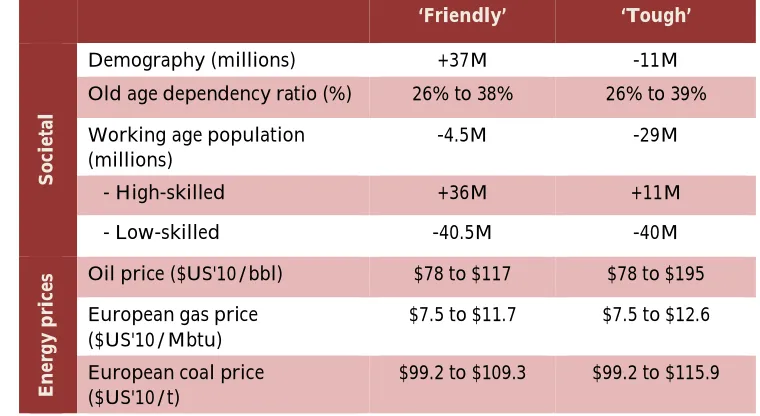
Since expectations for the severity of the changes vary, we distinguish between ‘friendly’ and ‘tough’ variants of each megatrend in two distinct time frames: by 2025 and by 2050. We then use these predictions to model global scenarios for Europe.
In chapter 2, we sketch three strategies for European policy-makers to cope with changing global conditions. Policymakers will react to the changes by choosing from scenarios ranging from ‘business-as-usual’ to ‘substantial transformation’ to ‘sustainability’. Not only the choice but also the success of the response strategies will largely depend on the global conditions that actually materialise in the future.
This introductory chapter presents an overview of the nine other chapters in this volume, which are themselves summaries of a multitude of research papers produced in the context of the NEUJOBS project. We have elected to highlight here only the most consequential and surprising of the findings, leaving the reader to discover the full story in the individual chapters. And, of course, all of the original research is freely accessible on the NEUJOBS website (www.neujobs.eu).
1.1
How many workers for how many jobs?
Among the major variables that are likely to transform European labour markets, demographic developments are expected to have the strongest impact. There is a consensus on three trends that will impact Europe’s labour market in the coming decades:
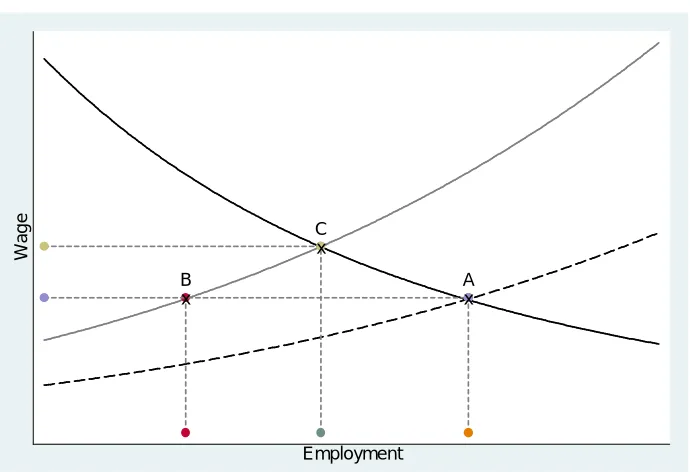
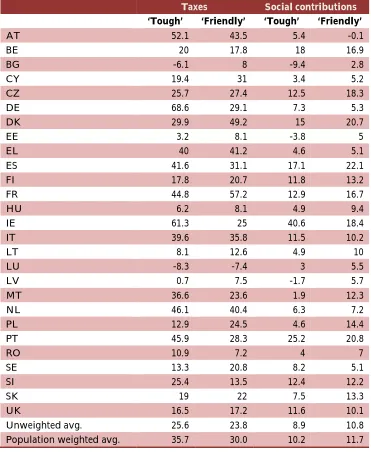
The decrease in the labour supply, combined with the upgrading of skills (‘upskilling’) of the population, will lead to wage increases. The projections in both the ‘tough’ and ‘friendly’ scenarios suggest that higher wages will provide relief for public finances and partially compensate for the increase in pension and healthcare bills.
Overall employment will be determined not only by demographic dynamics, but also by the macroeconomic health of the continent. Even under the assumptions implicit in the ‘friendly’ scenario – high fertility, extended life expectancy and increased immigration – most EU countries cannot escape the prospect in the short term of a declining working-age population, while improvements in life expectancy can have only a minor impact. Even though migration can bring about immediate changes in population growth, it is unlikely to be able to fully compensate for a decline in the working-age population due to aging (although different countries may have different opportunities to increase their labour supply).
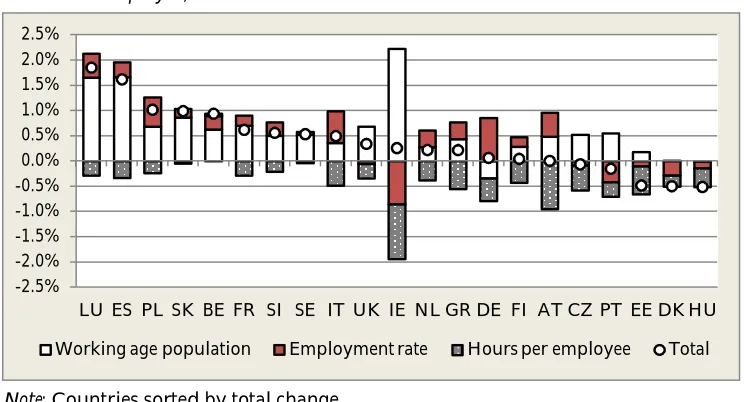
Marcela Veselková et al. explain in chapter 3 the importance of recognising that increasing or decreasing working-age populations will not automatically lead to changes in the number of workers or in the total number of hours worked, as labour supply also depends on labour market participation. Two more factors need to be taken into account: the labour market participation of this older population and the number of hours per week each individual is willing to work. Based on these factors, policies aimed at counterbalancing aging need to be targeted by country; for instance, labour market participation is still low in Hungary and Italy, while efforts to increase the number of hours worked may prove more effective in the Netherlands, Germany and Denmark.
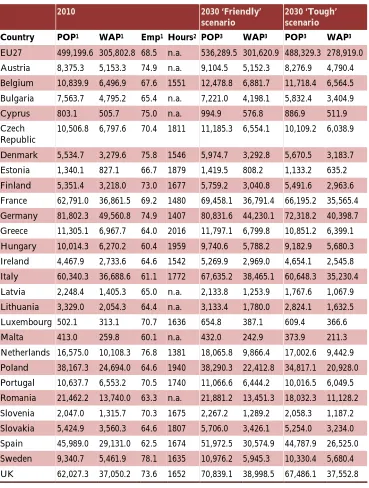
The authors found strong divergences in the evolution of skill levels in the labour supply projections for Europe. The evolution of the low-skilled labour supply is similar in both scenarios; the difference arises from the supply of high-skilled labour. In the ‘friendly’ scenario, the potential quantity of high-skilled workers reaches almost 105 million in 2030, but only 83 million in the ‘tough’ scenario (i.e. 20% lower). This decrease in the labour force in terms of both quantity and, in the ‘tough’ scenario, quality reduces long-term potential economic growth and makes the rebalancing of European public finances more painful.
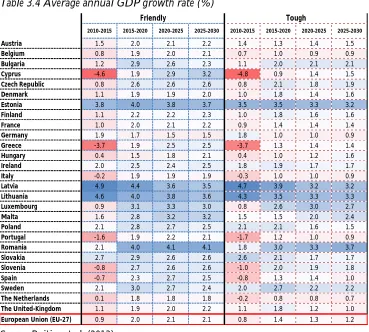
chapter 3. European GDP is expected to grow at an annual rate of 1.2% in the ‘tough’ scenario and 1.8% in the ‘friendly’ one. This translates into a net job creation that varies from no rise in employment in the ‘tough’ scenario to an annual creation of 1.5 million jobs in the ‘friendly’ scenario.
There is lasting destruction of low-skilled employment in the tradable sectors in both scenarios. In the non-tradable sectors, low-skilled employment is more protected, but the projections are still pessimistic compared to past trends. High-skilled employment in the non-tradable sectors is growing fast and is the major contributor to employment creation in both scenarios.
In the ‘friendly’ scenario, employment growth is mainly driven by the creation of an additional 15 million jobs in the private services sector between 2010 and 2030. The construction sector also exhibits non-negligible job creation, with 3.9 million additional jobs over the same period. In the ‘tough’ scenario, the fall in employment is large in the non-market services, with 3.1 million fewer jobs in 2030 compared to 2010. In the private services sector, employment creation of only 3.5 million jobs is estimated, which is much lower than in the more optimistic scenario. In both scenarios, most jobs are destroyed in the agriculture and industry sectors.
Technological progress also has a major impact on the evolution of the employment structure. The development of ICT enables the opening of a growing range of services to international competition, and can result in the replacement of workers in a factory by machines, or of workers in an office by a computer programme. This rising phenomenon induces polarisation of labour markets.
Rising fossil energy prices would also have an impact on sectoral employment; energy-intensive goods and services become less attractive as energy prices rise. For example, employment in the transport and equipment sector is reduced by 15% over the period. However, this price increase will stimulate demand in the energy renovation sub-sector, which is labour intensive, and thus boost employment in the construction sector.
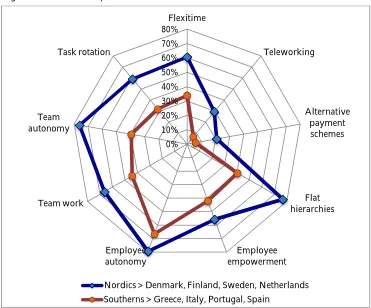
As the authors of chapter 6, we argue that the nature of work has also been changing. Workplace innovation can be a driver for changes towards sustainable forms of productivity gains. What does this mean in practical terms? In everyday working life, workplace innovation is translated into a number of specific actions such as flexi-time, teleworking, alternative payment schemes, employee empowerment and autonomy, task rotation and multi-skilling, team work and team autonomy. Evidence supports the notion that workplace innovation is beneficial for the economy as a whole, as well as for employees and employers. Despite the economic potential and more accessible technologies, we observe in the data that innovative practices still concern a minority of workers in most European countries. Moreover, only limited development has occurred over the last decade in this area. The authors suggest various explanations for this resistance, ranging from cost-related obstacles to a reluctance to move first and uncertainty about the results. New modes of working generate doubts and fears, which result in an uneven spread both geographically and across different practices.
Flexi-time, teleworking and alternative payment schemes still concern a minority of workers, whereas more qualitative elements, such as teamwork, team autonomy and task rotation, are more widespread.
The Nordic countries are in the lead when it comes to workplace innovation: Denmark, Sweden and Finland (as well as the Netherlands) rank highest in the diffusion of new ways of working, which are much more widespread in these countries than in the Mediterranean countries like Spain, Portugal, Greece and Italy. In between are the Baltic countries – Latvia, Estonia and Lithuania – which occupy the middle rank, creating a model of ‘post-communist, almost-Nordics’. The most interesting case is Slovenia, which ranks fifth – just after the Nordic countries and the Netherlands – and has the same widespread diffusion across all elements.
hostile to change could send an important message to the wider corporate world that workplace innovation leads to increased productivity, efficiency and sustainability.
1.2
Skills, polarisation and inequality: The long-term pattern
In an economy with a shrinking labour force, the main source of growth becomes productivity, which is (among other factors) a function of human capital. Therefore, Miroslav Beblavý and Marcela Veselková aim in chapter 7 to extract and synthesise the findings in NEUJOBS research on the relationship between education and labour markets. Their analysis is driven by the following research questions: What can we expect as higher education is extended to the masses? Which university degrees are worth pursuing? Is later tracking of students an answer to educational inequality and how likely is it to be politically successful? How can low-skilled individuals improve their skills in later stages of their lives – going back to school or learning on the job? What does it even mean to be a low-skilled worker?
In order to understand how the universalisation of higher education might take place and to explore its consequences, the authors conduct an in-depth study of the experiences of the universalisation of upper-secondary education in six European countries. Their findings are very interesting. The enrolment rates in upper secondary education expanded rapidly in the post-World War II period, although the pace of expansion differed: it was slower in the leading countries, such as the United Kingdom or Sweden, and laggards were able to catch up relatively quickly once the limiting conditions were removed. As a result, education systems are less selective today than they were 60 years ago. Nevertheless, there are still significant differences between countries. The authors confirm that later tracking and early childhood education might enhance the equality of educational opportunities. Despite this finding, elite forms of education stubbornly survive, even in the mass and universal stages of education systems.
eroded and we are witnessing an increasing privatisation of the public sphere. Free choice of school may undermine efforts to increase equality of educational opportunities, because freedom in the selection of schools by pupils and pupils by schools tends to lead to segmentation and segregation.
After finishing upper secondary education, those entering university tend to prefer the humanities and social sciences over the so-called ‘STEM’ (science, technology, engineering and mathematics) courses. The authors therefore examine whether it is more beneficial to study engineering or art. To answer this question, they calculate the net present value of university studies five years after graduation for five European countries: France, Italy, Hungary, Poland and Slovenia.
Surprisingly, it was not the STEM degrees that ensured the highest return on investment, but rather, the social science degrees. Graduates of art, the humanities and education obtained the lowest net present value. Based on this evidence, the expansion of enrolment in fields such as economics, business and law can be explained by rational choice. However, despite the different economic fortunes of university graduates, the authors found that with the exception of Italy, private investment in education largely repays itself after five years.
What about the prospects for the low-skilled? The ‘low-skilled’ label can hide a number of different situations: apart from dropping out of school early, it can also be caused by labour market detachment, migration, possession of obsolete skills, as well as macroeconomic structural changes. In other words, you can be ‘low-skilled’ after leaving school, but you can also become so during your working life. For this reason, the numbers of low-skilled workers in the labour force will fluctuate over time, depending on various circumstances.
differ widely from one country to another, these findings should sound a strong call to policy-makers, in both EU and national institutions, to take not only a differentiated view, but also a holistic and more sophisticated view of this phenomenon.
The likelihood of different societal groups acquiring skills and training differs in later stages of life. The results in chapter 7 imply that older cohorts are less likely to participate in training. Furthermore, lifelong learning is also determined by individual characteristics. Whereas men and immigrants are more likely to obtain an upper secondary education in their adult life, native-born citizens are more likely to achieve tertiary education. Contrary to the existing literature, results here imply that higher-educated individuals tend to participate less in training than those with other levels of education.
Overall, the different strands of work in the interplay between education and the labour market lead us to assess recent and future developments in terms of job polarisation based on skills. Rising demand at the upper and lower ends of the occupational skills distribution took place during the decade from 1998 to 2008. Job polarisation also occurred in 17 out of 25 EU countries between 2000 and 2010. The authors analysed labour demand and supply with respect to skills and tasks in an attempt to anticipate what types of skills mismatch EU countries will encounter over the next decade. The European Centre for the Development of Vocational Training (CEDEFOP) forecasts that this trend will continue until 2020; new jobs will be concentrated in higher and lower skill-level occupations, with slower growth in the mid-level ones. Simultaneously, it is expected that with the expanding education sector we will see a continuing replacement of low-skilled workers by medium-skilled workers. This means that the medium-skilled might temporarily assume positions for which they are overqualified. The call for policy-makers is therefore to tackle polarisation, as it is likely to increase socio-economic inequalities within societies along lines of ethnicity, gender, age and skill.
1.3
What exactly do we mean by ‘work’?
many jobs will be created or destroyed. In chapter 4, Marina Fisher-Kowalski and Willi Haas question what work actually means, and what it is likely to mean under a different pattern of interaction between nature and society (the so-called ‘socio-metabolic regime’).
In quantitative terms, it is observed that the share of time humans spend on reproduction, the household and their community/economy changes with the socio-metabolic regime. In mature agrarian systems, not only were the number of working hours very high but a great majority of the population was preoccupied with producing sufficient food for most of their lives. In the coal-based industrial regime, the availability of energy facilitated the use of additional labour provided cheaply by the first demographic transition. A change was observed after World War II: as oil becomes dominant, a substitution was observed between labour and technical energy. This pattern may soon be reversed due to the increases in the price of raw materials, which could substantially alter business strategies. We can expect a shift in the dominant mode of cost reduction from labour to resources. In this case, it is not the increase of labour productivity that would be the key measure, but rather the saving of resources, possibly at the expense of more labour.
Their chapter also considers qualitative characterisations of human labour, with attention paid to three basic capacities: physical power, knowledge, and rationality and empathy. The prediction is that the long-term decrease in the use of physical labour will be reversed due to an increase of labour demand in sectors such as energy, agriculture, construction and repair/renovation, which are notably labour intensive. In view of an aging and increasingly culturally heterogeneous and demanding population, the authors also assume an increase in the type of work that is based on empathy. This is embedded in all those services, such as caretaking, that are very difficult to substitute by ICT and almost impossible to outsource to other countries because they involve face-to-face contact with recipients of the services.
1.4
What role for the state in the labour market?
negative consequences it may have (namely, reducing unemployment risks, preventing income loss and enhancing the transition of the labour market). National regulators still hold most of the competencies in this field, with European integration progressing in first steps over the last decades. Western, central and eastern European countries have converged, albeit slowly, in terms of their labour market institutions. However, we cannot speak of a single ‘European social model’. The level of employment protection varies considerably across European countries, and some countries tend to put more emphasis on the protection of regular workers while others are more focused on protecting temporary workers. Furthermore, government spending on labour market policies varies considerably.
Labour market institutions also work differently, depending on the sector. Our research found that innovative sectors are much more sensitive to extensive protection of incumbents and labour market rigidity.
Another issue concerns the interplay between different institutions that protect income rather than employment and jobs. The results on this front are in line with the literature on ‘flexicurity’ in that employment protection legislation and unemployment benefits can be considered substitutes. The authors of chapter 9, Ferry Koster and Olaf van Vliet, also detected a general trend towards reduced employment protection legislation over the last decade, which may be the explanation for renewed calls from workers for job security.
1.5
The state as a service provider: The call for a
social-investment approach to social policies
An even more important role can be played by the welfare state. Our findings call for policy-makers to shift the functions of European welfare systems away from correcting the negative impacts of labour markets towards a social-investment perspective. As Verena Dräbing explains in chapter 8, the underlying assumption of social investment is that welfare spending on certain policies can contribute to economic development. Its core goals are to enable citizens to help themselves throughout their lives and to reduce their neediness. These policies are characterised by three areas of focus: societal development; human development and capacitating citizens; and the long-term reduction of neediness instead of short-term mitigation. The key areas of interest include education, quality childcare, training, job-search assistance and rehabilitation.
Although public perceptions may suggest otherwise, welfare states are not de facto immune to change. Following World War II, in an era of Keynesianism and predominantly male-breadwinner households, the focus of social policies was on the creation of jobs via public investment and on the increase in social expenditure on unemployment benefits, pension benefits, survivor and disability benefits, public healthcare and education. With the onset of the oil shocks in the 1970s, this model began to come under pressure. The rise of neo-liberalism as the dominant economic paradigm led to a series of privatisations, increased flexibility of the labour market and a retrenchment of public spending.
much welfare can be afforded and which productivity-increasing measures are available sparked the rise of the social investment debate. What are examples of social investment policies? And are they actually in place in European countries?
Social investment policies are also labelled ‘capacitating’ as they enhance labour market participation. Care services for the elderly and children are therefore included, as they facilitate female employment, along with leave policies. Expenditure on education and active labour market policies are included due to their strong focus on human capital development, as well as funding of public research. Data on public expenditure in this field suggest a tendency towards an increase in social investment expenditure on families, active labour market policies and education. However, a clear divide across countries is apparent: eastern and southern European welfare states continue to spend much less on social investment per capita. Nordic countries have been the forerunners of social investment, while Christian-democratic countries and, to some extent, Anglo-Saxon countries have been catching up. It is clear that investment in family policies is on the rise, especially in childcare services, but for the most part regime patterns still persist. A slow but general shift towards a stronger reconciliation of work and care is thus taking place, although overall levels of investment are still lower in southern and some eastern European welfare states.
1.6
What’s next? And after that?
What are our recommendations for policy-makers at the EU level? Iain Begg suggests in chapter 10 a clear line of action: the reconciliation of the short-term goals dictated by the crisis afflicting Europe and the long-term goals driven by the societal, economic and ecological challenges. These transitions are a common concern, so it is vital to stress the collective costs and benefits of policy action and to recognise that collective long-term gains will often exceed short-term cost savings. An implication is that policy-makers should consider a collective discount rate for assessing such long-term gains. For example, in its governance processes (notably the annual cycle of the European semester and the country-specific recommendations), the European Commission and the Council should place more emphasis on medium- and long-run objectives for labour market institutions, including proposing milestones for their evolution.
and the behaviour of stakeholders is complex, simplistic policies (whether neo-liberal or social-democratic) are likely to be unhelpful. There is also a strong risk of either unintended consequences or of outcomes that satisfy one set of goals or normative considerations at the expense of another. The reform agenda therefore needs to be sensitive to such tensions.
The success of the socio-ecological transition, however, will depend not only on policies, but also on how natural resources and societies evolve. Megatrends in the evolution of climate change, resource scarcity, population and knowledge-sharing will result in a more or less ‘friendly’ world, for which different response strategies will be appropriate. In a ‘tough’ world, the sustainability transformation strategy might be the most suitable because it provides the vision and social cohesion required to overcome the hardships and challenges of a world shaped by ongoing and future transitions. This strategy is better suited to dealing with international volatility and supply shocks by focusing on inter-European activities and adaptation, thereby inducing changes towards a resilient and sustainable socio-metabolic regime with an emphasis on societal welfare rather than on increasing economic activity.
14
2.
E
MERGING MEGATRENDS AND
SCENARIOS IN THE SOCIO
-
ECOLOGICAL
TRANSITIONS
*
his chapter will succinctly acquaint readers with the vision of the future on which the other chapters in this book are based. It is a vision of the future, or rather various possible futures, under the conditions of the socio-ecological transition and its consequences for employment overall, but also for key sectors and relevant groups. Specifically, the chapter describes the socio-ecological transition (SET) away from fossil fuels, which can be observed in two sets of megatrends. Megatrends in natural conditions include energy transition, rising challenges to resource security and increasing climate change impacts. Societal megatrends include demographic changes, shifting of economic and political centres of gravity, and growing use of information and communication technologies (ICT) and knowledge-sharing. The uncertainty and complexity associated with these megatrends are condensed into two alternative futures: a ’friendly’ and a ‘tough’ world. These two alternatives delineate European policy options. Although Europe cannot influence the speed and the intensity of the unfolding of the socio-ecological transition, it must be ready to address the challenges it brings. Three European response strategies are proposed: i) no policy change, ii) ecological modernisation and eco-efficiency and iii)
* Chapter 2 was compiled by Marcela Veselková and Miroslav Beblavý based on
the work of Marina Fischer-Kowalski, Willi Haas, Dominik Wiedenhofer, Ulli Weisz, Irene Pallua, Nikolaus Possanner and Ekke Weis (from the University of Klagenfurt) and Arno Behrens, Giulia Serio and Monica Alessi (from CEPS) in work package 1 (Socio-ecological transition and employment implications) of the NEUJOBS project.
The impact of human activity on natural systems has been accelerated by the ongoing industrialisation of emerging economies.
sustainability transformation. The effectiveness of these strategies will depend on the respective alternative future.
The challenges associated with the socio-ecological transition away from fossil fuels can be expected to have far-reaching implications for production and consumption patterns, as well as for many other features of society. A change in an energy regime induces changes in society and other modifications in natural systems that occur either as an unintended consequence (such as resource exhaustion or pollution) or as intentional change induced by society (such as land use). These patterns of interaction between society and nature are known as ‘socio-metabolic’ regimes.1
What drives socio-metabolic regime transitions? On such a broad and long-term scale, one cannot easily talk about actors and their deliberate efforts. What one can mainly analyse is structural change of interlinked social and natural systems, across a broad range of variables. The socio-metabolic approach thus shares with complex systems theory the notion of ‘emergence’: one state cannot be deliberately transformed into another, and neither can the process be fully controlled. One is confronted with self-organising dynamics to which orderly governance or steering cannot be applied.2 The socio-metabolic approach therefore focuses on a relatively
narrow set describing the society-nature interface for which quantitative measurements can be reliably obtained in very different contexts. The advantage of this restraint is that it is possible to empirically demonstrate the interconnectedness of socio-economic changes and changes in natural systems (between population growth, diets, land use and species extinction, for example).
2.1
Introducing global scenarios
Historical socio-ecological transitions, such as the fossil fuel-based industrialisation of Europe and elsewhere, led to a new type of society with unprecedented levels of natural resource extraction and energy and material consumption for approximately 15% of the world’s population. These were accompanied by an
equally unprecedented growth in scientific and technical knowledge and democracy. These transitions led to a ten-fold increase in global material use and a seven-fold
Between 1900 and 2009, industrialisation led to a ten-fold increase in global material use and a seven-fold increase in domestic energy consumption.
2009.3 During the same time, world GDP increased by a factor of 26 and the
global population quadrupled.4
This transition is not only historical but is still ongoing. Economists use the term ‘emerging economy’ to refer to a country in the take-off or acceleration phase of the socio-ecological transition from an agrarian to an industrial regime, following pretty much the same pathway that mature industrial countries took in the
centuries and decades before, based on the use of fossil fuels (increasingly, again, coal). Due to their much larger populations (comprising 60% of the world’s population), the ecological impact of
their transitions – in terms of climate; biodiversity; soil, air and water pollution; depletion of fish stocks in the oceans; and nutrient washout into the oceans – would be huge, much larger than the impact of the historical transitions of the mature industrial countries. From the point of view of resource scarcity, however, it remains questionable whether this process will indeed take place or whether it will be abruptly halted in the middle of its acceleration.
There is ample evidence provided by global change research that human activity caused, and continues to cause, major changes in the functioning of natural systems on every spatial scale – from local to global – and is transforming the earth’s system at an increasingly rapid pace.5 Such
changes are now being accelerated by the ongoing process of industrialisation in the populous emerging economies. Thus, imagining 2025, or even more so 2050, the expansive continuation of the industrial socio-metabolic regime for a majority of the world seems biophysically infeasible and threatens to further erode humanity’s natural base.
It is very hard to predict precisely how fast these changes will happen. What is not subject to debate, however, is that some of them will happen, such as the exhaustion of cheap fossil fuels and a number of other natural resources, and – to say the least – increasing volatility of the climate system. Indeed, some of these developments can already be observed. Fischer-Kowalski et al. refer to these developments as “global megatrends in natural conditions”, the biophysical part of the on-going socio-ecological transition.6 Still, these changes occur in response to, or as a consequence of,
socio-ecological transition on societies away from fossil fuels. The global megatrends in natural conditions include energy transitions (towards and away from fossil fuels), rising challenges to resource security and increasing climate change impacts. Furthermore, it is possible to observe elements of the social part of the socio-ecological transition that are related to social and technical achievements generated by the last transition. Fischer-Kowalski et al. call these ’global societal megatrends’, and they include the continuation of the global demographic transition, the ongoing shifts in the economic and political centres of gravity worldwide, and the growing use of ICT plus the related new forms of knowledge-sharing. These megatrends are fundamentally reshaping the global framework conditions for Europe. The speed of these megatrends and their magnitude are open to debate. Therefore, for each megatrend Fischer-Kowalski et al. distinguish between ‘friendly’ and ‘tough’ variants by 2025 and by 2050, and use these as global framework scenarios for the European policy option space.
Figure 2.1 The socio-economic reproduction of Europe in a global context shaped by the ongoing socio-ecological transitions
Source: Fischer-Kowalski et al. (2012, p. 77).
The energy transition will be accompanied by intensified global competition for scarce resources and, as a result, increasing and more volatile energy prices.
subject to global (and internal) conditions. It also requires a certain amount and quality of human labour, again depending on global and internal conditions. At the top of the figure is the European policy process – political, economic and technical response strategies in a changing world shaped by the ongoing as well as the beginning of the next socio-ecological transitions. As mentioned above, for each megatrend Fischer-Kowalski et al. distinguish between ‘friendly’ and ‘tough’ variants:
A ‘friendly’ future entails moderate changes that pose fewer challenges for European policy-making. It entails incremental global changes in the lower ranges of change found in the literature.
The sketch of a ‘tough’ global future is based on still quite likely, but rather severe changes that would be highly challenging for European policy-making, shifting into the higher ranges of change found in the literature, including possible abrupt changes.
2.2
Natural megatrends
The megatrends in natural conditions include increasing climate volatility, an energy transition from fossil fuels to renewable energy sources and rising challenges to resource security.
2.2.1
Energy transition
While fossil fuels enabled and still enable the transition away from agrarian regimes, high demand in mature economies, as well as rising demand in emerging economies will sooner or later be faced with peak oil, peak gas and peak coal. Various studies of peak oil have identified the peak as occurring between 2008 and 2037. This will fundamentally change the context for the ongoing fossil-fuelled socio-ecological transition, as well as for the next transition towards renewable energy sources.
In addition to future supply restrictions, climate change prompts global political responses, demanding mitigation policies that favour renewable energy sources and an overall reduction in fossil fuel consumption. Whether through
The transition away from fossil fuels will be accompanied by increasing and more volatile energy prices, as well as by higher energy investments to achieve the same amount of final energy supply, whether from renewables or from the remaining fossil fuel deposits (i.e. a declining energy return on investment, or EROI). While carbon capture and storage (CCS) technologies are seen as a glimmer of hope to mitigate these challenges, the feasibility of a large-scale rollout is under question and cannot safely be assumed in global scenarios. Finally, the bio-fuel demand of environmentally-oriented scenarios conflicts with food production, unless there is a major technological breakthrough.
2.2.2
Rising challenges to resource security
Enabled by increasing energy use, material consumption has increased tremendously in mature industrial countries and is currently stabilising at very high levels. As with energy, the overall global material demand will expand further, due to fast and rising growth in emerging economies. The overall rising global demand will encounter a deteriorating quality and a declining quantity of supply.
For the EU, several raw materials are considered critical since they are of high economic importance and pose high supply risks. Some of these critical raw materials are not produced within the EU, such as rare earth elements (REEs) and phosphorus, for which much of the world is dependent on a few mining countries such as China and Morocco. Intensified global competition for resources will lead to further price increases and could contribute to price shocks.
2.2.3
Stronger climate change impacts
Climate change is a product of the former transition from biomass-based to fossil fuel-based energy systems in the now mature industrial economies. Past emissions are already determining severe changes due to a strong time lag in the climate system between cause (emissions) and effect (warming). Greenhouse gas (GHG) emissions in the next decade will significantly determine the extent of future climate change, the risk of triggering irreversible damage to global ecosystems and their consequences for humankind.
assume that unabated climate change will cause large-scale changes in the earth’s system. In Europe, the Mediterranean countries will be hit the hardest with temperature increases, droughts, water scarcity, occasional flash floods and more forest fires leading to a loss of agricultural yields, with impacts on agriculture, tourism and health. Greece, Portugal and Spain, in particular, will be hot spots. A rise in sea levels is regarded as the greatest threat in the long term.
Climate change, regarded as a multiplier of existing environmental and social threats, is increasingly perceived as an international security risk. For example, intensified global competition for resources and the resulting price shocks might lead to armed conflicts over resources. Therefore in the long run, the severity of impacts depends highly on both effective mitigation at the global level and adaptive capacities.
2.3
Societal megatrends
Societal megatrends include demographic transition, the ongoing shifts in the economic and political centres of gravity worldwide, and the growing use of ICT plus the related new forms of knowledge-sharing.
2.3.1
Population dynamics
In mature industrial economies, the previous demographic transition was closely linked – via the increased availability of food and shelter and societal capacities to absorb a growing labour force – to the historical SET. This demographic transition has now been largely completed and led to a stagnating (or even declining) and ageing population. In emerging economies, present population growth is going hand in hand with growth in the use of fossil fuels and other resources, following a similar pattern – though fortunately not as steep – to that previously observed in today’s mature industrial countries. The global population size and structure are crucial factors for environmental concerns, since environmental impacts are closely related to both population size and affluence. The observed slowdown of global population growth will probably lead to a stabilisation of world population within this century, but at a challengingly high level. Increasing short-term migration and relocation movements due to climate change impacts in Europe need to be considered.
2.3.2
Shifting economic and political centres of gravity
Europe’s educated population and ICT create an opportunity to actively shape the unfolding of the transition away from fossil fuels.
industrialised countries has been able to dominate the rest of the world. However, the transition of emerging economies into a fossil fuel-based energy system has allowed for an economic development that increasingly makes the other four-fifths of the world’s population equal partners, if not the dominant players of the future. A shift of the political centres of gravity away from mature towards emerging economies will be a natural consequence of the faster growth of emerging economies. At the same time, global economic and political interconnectedness through trade, global production chains, international investments and media communications is steadily increasing. The next energy transition away from fossil fuels, issues of resource security, increasing climate change impacts and higher volatility of commodity prices will be important challenges for international collaboration. It remains an open question whether international relations will become more collaborative or more confrontational in the face of the challenges ahead.
2.3.3
Growing use of ICT and knowledge-sharing
This latest class of new technologies does not substitute – as most technologies before – for physical labour, but rather, it enhances and substitutes for intellectual labour and communications. It could provide crucial enabling tools for a next SET – enabling the handling of complex systems, speeding up the process of knowledge-sharing worldwide and across all areas, and creating a cheap communications space for the development of new world views and lifestyles. However, ICT tools are akin to a double-edged sword: analysing and managing complex systems are tasks performed by both democratic and dictatorial regimes. Transparency can help both enlightenment and surveillance, and social media may foster social innovation at the same time that it foments mass hysteria.
2.4
European response strategies
Considering the ongoing socio-ecological transitions and their global consequences, Europe has to be prepared for a more complex and challenging world than it has