Assessable online discussion groups as a student learning
tool
Jo Devine
University of Southern Queensland, Toowoomba, Australia [email protected]
Abstract: Online discussion groups were introduced in a second level construction engineering course to engage students with the high volume of course reading material. The aim was to improve students’ retention and understanding of the material through ongoing discussion and exploration of the material in a peer environment.
During the semester the groups were given several construction scenarios to discuss, these were structured so that students needed to critically evaluate and apply the relevant course material, identifying and making appropriate assumptions as they went, in order to answer a series of open ended questions. The outcome of each group discussion was submitted via an assessable report. Individual marks were allocated based on a combination of report content and individual contribution.
This paper will discuss the benefits and difficulties encountered with assessable online discussion groups, the steps taken to address problems and the measures that were used to evaluate their success.
Introduction
Online discussion group activities were introduced to the course CIV2605 Construction Engineering in 2004 as an assessable item. The discussions take place on electronic forums hosted by the university‟s learning management system (LMS). This system provides a course homepage which can be adapted to the needs of a particular course. For these discussions, each group is allocated a private forum. Course staff are able to monitor and if necessary moderate these forums but students only have access to their own forum.
The volume of material covered in the Construction Engineering course is quite high and is presented in three distinct parts. Nevertheless the student perception of the course material is that it is not difficult. The course material is not reliant on any prior learning and the small number of calculations required in the course is not dependent on any high level mathematics. The bulk of the course material is presented as printed text for the student to read.
Prior to 2004 the course was assessed by exam (70%), a major site report (20%) and a minor site report (10%). These reports were based on student visits to active construction sites. Self assessment questions were provided in the course materials, but there were no formal tutorial style course
requirements. The course is also a communications benchmark course, requiring a major portion of the assessment to be associated with the demonstration of communication skills.
Informal discussions and feedback from students about the course material showed that students who struggled to complete the course had several study traits in common, they;
left their study of this course until the last few weeks of semester
did not complete of the Self Assessment Questions provided in the course materials did not study all of the modules in the course
Background Literature
The integration of technology into higher education is increasing rapidly. This technology, when incorporated with a more learner-centered instruction, can improve student learning, as indicated by numerous studies e.g. Zhu & Kaplan (2002), Green (2000), Weisskirch et al 2003. Technology integrated into the pedagogy provides a new framework to engage with students.
The literature describes six components of the learning framework: lectures, tutorials, textbooks, e-libraries, web-based learning material and e-discussion groups (Smith and Kardaker, 2000 as cited by Weisskrich et al). It is the use of e-discussion groups in student engagement and assessment that form the basis of this paper.
Discussion groups (also known as discussion boards, discussion forums, newsgroups or online discussion areas) provide a electronic tool whereby users can post a message for others to read and respond to. Discussion forums are asynchronous and facilitate a discussion among people who can access the forum at different times. By encouraging students to engage in discussions with peers and academics they can “enrich and expand students‟ educational experience beyond the classroom” (Karayan & Crowe, 1997, p. 69) and for distance education students they can provide both the social and educational conversations which can be missing in traditional distance education settings. Students are able to reflect on course material in their own time, provide commentary and ask questions (Weisskirch et al 2003).
This interaction can lead to greater learning and skill development, but it must be introduced and framed in its function to students (Weisskirch et al 2003).
Objectives of online discussion groups
The tendency for students to just „read through‟ the course material during semester led them to think that they understood the material. However, as they had little opportunity to apply the material that they read in a summative assessment during semester they would often have only a shallow
understanding of the material and minimal recall of the details they had read. This was exacerbated by the tendency for pre-exam „cramming‟, the volume of material is too large to properly learn in a short intensive burst of study.
The nature of the material in the course means that traditional tutorial sessions (where students are given assistance to work through a series of problems) are of limited value, even for the on-campus cohort, and are not possible for the 75% of the class that are distance education students. Discussion groups were seen as an alternative means of providing all students but particularly external students, with an opportunity to engage with the study material in a peer environment.
The objectives of introducing discussion groups as a summative assessment were to; assist the students to engage with the course material throughout the semester, help them think critically about the course material,
motivate students to keep to the recommended study schedule
enable and encourage students to communicate any of their own relevant ideas and experiences increase student interaction with other students and with course staff
continue to address the requirement that a significant number of marks for the course be associated with the demonstration of communication skills.Finally, discussion groups were introduced with the intention of achieving these increased student benefits without increasing the staff workload associated with the course.
Methodology
Discussion group organisation
Each student group is allocated a discussion forum on the course website. They use this forum to discuss the topic in an asynchronous manner during the topic discussion period. Students are
discouraged from using other forms of communication, such as email or msn as the course staff do not have a record of these discussions. Being able to trace the discussion development and review the contributions made to the group submission is very important to the assessment and individual mark allocation process.
Each discussion topic is based on a selected module that students should have covered by that point in the semester. The primary focus is to have students discuss what they have studied, in the context of addressing an open ended question, and to work through some key numerical examples as a group. The emphasis is on participation and suggested solutions, with worked solutions for numerical questions, are provided after the discussion closes.
Team members must take turns to act as „group leader‟. The group leader was initially termed „group scribe‟ as their main function is to collate the results of the group discussion and take responsibility for submitting the group‟s response for assessment.
Discussion Topic design
Students are generally asked to consider a construction related scenario and develop a group response to a series of questions. The questions are deliberately open ended with no single correct response. Numerical calculations have different possible outcomes depending on the assumptions that the group decides to make along the way.
The scenarios and information provided for a particular discussion are presented in a different way to the reading material in the course. However they are structured so that they can be answered by applying the study material to the given scenario. This requires student to apply the course material rather than simply recall it. Students are encouraged to use other resources to add to their discussion but this is not necessary. In recent years the use of additional resources has not been emphasised as students were spending too much time „researching‟ and not enough time critically evaluating and applying the material that they already had.
The discussion questions are generally not as straightforward as they first appear. Students may have to use an unfamiliar chart to look up a variable that had been given numerically in previous worked examples, or they may have to make assumptions about the size or type of work being considered in a scenario. These variations are intended to cause the student to stop and think about the implications of the material they are working with before making a decision and proceeding with the question.
Assessment
Due to the poor uptake by students of formative assessment opportunities in previous years it was decided to allocate marks to the discussion topics in order to encourage participation. The marks associated with discussion group assessment are easy to achieve but dependent on a demonstration, though meaningful participation, that the student had completed their study of the particular module being discussed. The number of marks allocated to the discussion was kept fairly low (1) because ultimately the discussions are meant as a learning tool rather than an assessment of learning, (2) to minimise the exposure of students to the vagaries of working in groups and (3) because evaluation of „meaningful participation‟ is fairly subjective.
When introducing discussion groups it was important not to increase the staff workload associated with the course. So the minor site report, worth 10% of marks, was replaced by group discussions, worth a total of 10%. This meant that although there were more assessment items during the semester the number of items to be marked each time was divided by the number in the group. This effectively decreased the total number of assessment pieces to be marked during semester and spread the marking load over the semester. It does however mean that there is more work prior to semester setting up the discussion groups and writing the discussion topics.
parts of the question and looks for evidence of a reasonable use of the course material. Group submissions are essentially given full marks unless there are significant gaps in the submission or obvious errors in calculations that should have been picked up through proof reading.
The peer review process & individual weighting
Each time a group submission is made the group members are allocated a „percentage contribution‟ by group consensus. The percentage contribution is a weighting from 0-100% which indicates the level of individual contribution to that particular discussion. Groups are instructed that if all group members contribute about equally then they should all get 100%. If a member does not comment at all during the discussion they should get 0% and if an individual makes a lesser effort than others then they should be allocated a number in between. It is emphasised to the students that these numbers do not represent individual marks but are feedback to their peers and an indication to course staff regarding the relative contributions of group members.
The final individual mark for a discussion topic is decided by course staff. It is informed by the peer feedback but is decided after a staff review of the discussions. Students whose participation was flagged as less than 100% are reviewed against the average level of contribution across the class. Groups who allocate all members 100% are also reviewed closely against the class average since students are often hesitant to give negative feedback to their peers, particularly in the earlier discussion topics. Staff look for a demonstration of critical thinking or application of course material by students or a genuine attempt to add to the discussion or group submission.
Results
Failure to complete the course
A review of the course fail grades is shown in Table 1. The numbers „failing‟ include students who failed to complete and failed to participate in the course as well as those who simply failed to achieve the required marks in the assessment items.
Table 1: A summary of “Failed to complete the course” results for 2003 - 2008
Year 2003 2004 2005 2006 2007 2008
Total class number 78 63 82 99 130 180
Number of Fails 22 25 30 40 65 28
Percentage of Fails 28 40 37 40 50 16
The figures shown in Table 1 seem to indicate that course modifications, including the introduction of discussion groups, in 2004 have if anything had a negative impact on student completion rates.
It is possible that the additional workload associated with the introduction of discussion topics has proved to be too much for some students. However, a more detailed analysis of the reasons for the fail grades found that, with the exception of 2007, the percentage of students who did not complete the course remained fairly consistent (approx 5%). In 2007 there was a sudden jump in the percentage of students who did not complete the course, mainly due to unrelated problems with a particular part of the cohort. Unfortunately the number of outright fail grades increased after the introduction of discussion groups and then dropped again in 2008 after a change in the overall course assessment strategy.
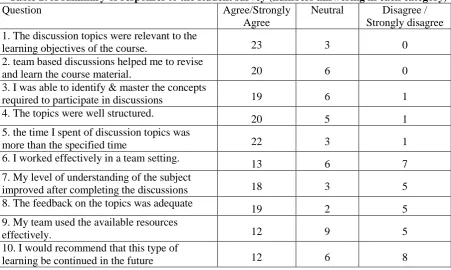
Student feedback Survey
Table 2: A summary of responses to the student survey (numbers answering in each category)
Question Agree/Strongly
Agree
Neutral Disagree / Strongly disagree 1. The discussion topics were relevant to the
learning objectives of the course. 23 3 0
2. team based discussions helped me to revise
and learn the course material. 20 6 0
3. I was able to identify & master the concepts
required to participate in discussions 19 6 1
4. The topics were well structured.
20 5 1
5. the time I spent of discussion topics was
more than the specified time 22 3 1
6. I worked effectively in a team setting.
13 6 7
7. My level of understanding of the subject
improved after completing the discussions 18 3 5
8. The feedback on the topics was adequate
19 2 5
9. My team used the available resources
effectively. 12 9 5
10. I would recommend that this type of
learning be continued in the future 12 6 8
Exam Question Results
Each year, including several years prior to the introduction of discussion groups, an optional exam question on a particular subject has been repeated in the same form. Since 2004 a discussion topic has been structured around this same subject, a larger percentage of students have chosen to complete this exam question and the resulting marks have improved for this particular question. This improvement has been attributed to an increased understanding of the subject following group discussions.
Unfortunately the overall exam results do not appear to have improved over most of the same period.
Staff / Student Interaction
Prior to the introduction of discussion groups the use of the course website by students was very low. There were very few questions or comments posted to the examiner and a large number of students never even logged onto the homepage. Most students who did log on would only view the pages and material posted by the examiner without wanting to make a post or comment of their own.
The introduction of discussion groups forced all students to interact with website. There has been an increase in the number of questions posted to staff about the course material, students now start unprompted discussion threads about the course material and assist one another with difficulties and questions about course material. Being forced to interact in the first instance seems to take away some of the fear of making their first post to a discussion board. The course website now usually hosts lively discussions of both a social and studious nature.
While part of the increase in the use of the website can probably be attributed to larger student enrolments in recent years and a growing comfort level amongst students with website based interaction, it has been noticed by the author that websites for similar courses that do not use formalised discussion groups have not enjoyed the same increase in student usage and interaction.
Discussion
Students spending too much time
staff usually have to re-issue guidelines as to how to approach the discussion topics after completion of the first topic in order to reduce student concern about time spent on discussions.
Perceived fairness in individual mark allocation
The most difficult part about assessment has been to ensure that individuals are not disadvantaged by the performance (or lack thereof) of other group members. Each year there are a few students who tend to feel that they are „doing all the work in their group‟. They complain that others will be gaining marks based on their work. This complaint usually emerges after closure of the first topic and is usually alleviated by staff reminding students that the group mark is not necessarily the individual mark. They are reminded that the examiner will be assessing individual contribution and one of the ways for students to air their concerns is through the peer “percentage contribution” allocation.
Active students are not expected to make up for the lack of participation by others in their group and the number of students actively contributing to a submission is considered when marking it. Students who actively participate are told that they are working for their own benefit in terms of gaining discussion topic marks but also in reducing their exam preparation time by increasing their own understanding and retention of the material.
Staff Resources
During the most recent offering of Construction Engineering (2008) the course staff encountered difficulties keeping up with the volume of traffic on the course website. The traffic included the formal discussion groups as well as unstructured discussions initiated by students.
The allocation of individual marks to students can also become an onerous and time consuming task. Unless the marker can easily view all of the posts made by an individual student and can easily move between student posts for comparison, then determining a relative contribution can become a time consuming and confusing exercise. There was a change of LMS software in 2008 which affected the structure of the discussion forums and this, together with an increase in student enrolments over previous years contributed to a significant increase in difficulties for the marking staff.
Conclusion
The objectives associated with the introduction of discussion groups have largely been achieved, however the expected flow on benefits in terms of improved grades and course pass rates have not eventuated. The main difficulties associated with the online discussions have been the time and effort required by both staff and students on an ongoing basis. The dramatic increase in the amount of time spent by staff managing and assessing the discussion groups as a result of increases in student numbers was largely unforeseen. The assessment must be carried out by skilled staff and unlike the marking of traditional assignments cannot be outsourced to part time assistants when class sizes grow.
The next offering of Construction Engineering in 2009 will use discussion groups as a formative assessment. A separate summative assessment based on the discussion topics will be introduced. These changes will mean a return to a greater reliance on students to undertake formative assessment pieces before attempting their summative assessment. However the staff workload for the course should be drastically reduced.
References
Green, K. C. (2000). Technology and instruction: Compelling, competing, and complementary visions for the instructional role of technology in higher education [Electronic Version]. Retrieved 1/2/09, from http://www.campuscomputing.net.
Weisskirch, R. S., & Milburn, S. S. (2003). Virtual discussion: Understanding college students' electronic bulletin board use. The Internet and Higher Education, 6(3), 215-225.
Zhu, E., & Kaplan, M. (2002). Technology and teaching. In W. J. McKeachie (Ed.), McKeachie’s teaching tips: Strategies, research, and theory for college and university teachers (pp. 204-224). Boston: Houghton Mifflin.