Department for Education and Skills
Research Conference 2004
Research in Education: What works?
DfES Research Conference 2004
DfES Research Conference 2004
Contents
Introduction
4
Keynote Speeches
Translating research into practice on a large scale: lessons from Success
for All (US)
5
Delivering research-informed practice: lessons from the crime reduction and
social care fields
13
Full papers
Methodological issues in the evaluation of interventions to promote
parenting and family support – the case of home visiting
19
Evaluating the impact of Playing for Success
30
Factors influencing the transfer of good practice
41
Research in teaching and learning: The NRDC Effective Practice Studies
54
Employer Training Pilots: a platform for progression
69
The evaluation of Aimhigher: Excellence Challenge
75
The impact of research evidence on running a university
92
Success for All in England: Implementation and outcomes of a
comprehensive literacy reform for primary schools
100
Time to be bold: mainstreaming models of educational research that
respond to user needs
112
Chair Summaries
Workshop: enhancing adoptive parenting: a randomised controlled trial
125
Workshop: what works in supporting parents?
126
Workshop: study support
128
Workshop: the school as a learning community
130
Workshop: influences on the decision to stay in learning post-16
133
Workshop: synthesising research
135
Workshop: research designs for complex social interventions
138
Workshop: lifelong learning
140
Workshop: research communication and utilisation in policy and practice
142
DfES Research Conference 2004
The Department for Education and Skills held its fourth annual research conference on 19th November 2004 at the QEII Conference Centre, Westminster.
The day's theme was Research in Education: What Works? Keynote speeches were delivered by Robert Slavin from Johns Hopkins University and Sandra Nutley from the University of St
Andrews. Robert Slavin discussed key issues in the development, evaluation and dissemination of the US Success for All programme, a comprehensive research-based reform model for primary schools. Sandra Nutley drew on the cross-sector work being undertaken by the Research Unit for Research Utilisation (RURU) at St Andrews to explore the delivery of research-informed practices. The main part of the day was spent in a series of 12 workshops which covered the main DfES policy areas from children, young people and families to schools, further and higher education and lifelong learning.
This report contains a selection of the papers presented at the workshops. Where full papers are not presented, a summary of the workshop and discussion has been offered.
The 2005 conference will take place on Friday 25th November. Fuller details will be available on the research pages of the DfES website (www.dfes.gov.uk/research) in July.
DfES Research Conference 2004
DfES Research Conference 2004
Translating research into practice on a large scale
Translating research into practice on a large scale:
lessons from Success for All (US)
Keynote address by Robert Slavin, Johns Hopkins University
Our experiences in the United States with the Success for All programme – in terms of how government policy can help to introduce educational innovations that have been proven in rigorous research – goes to the heart of how research can influence practice at scale. Needless to say, this is not the usual process of innovation.
Change in education
The way change takes place in education falls into several categories, none of them good. One is pure faddism. For example, at the height of what we call ‘whole language’ and you call ‘real books’, there was a fad in the US for bathtubs in classrooms. You could go anywhere in the US and find bathtubs in primary classrooms. Why? They would be outfitted with pillows, and there would always be a child in there reading. It looked very nice. It was a lot of fun. There is nothing wrong with reading, and nothing wrong with bathtubs. But it was striking that within just a couple of years bathtubs were everywhere. A couple of years after that, you never saw another bathtub.
Another way that change typically takes place is the adoption of new approaches based on a theory – often a crackpot theory – but one with a positive view of children that people wish were true. When I was a special education teacher, long ago, there was a popular theory that children with special needs had somehow skipped steps in the development of neural pathways. The theory was that if you took them back to teach them how to crawl, and repeated the
developmental steps they should have experienced, everything would then be fine. There was not the slightest shred of evidence to support this, but it was a very appealing theory. And so, every single day, the teacher in the classroom next to mine had all of her children – many of whom were rather large children with Down’s Syndrome – crawling all over the place in hopes of moving them forward.
Education also sometimes changes through well-meaning misapplication of good research. Educators often learn about the findings of good research in terms of isolated principles of practice. Then, rather than adopting something complete, well thought out and well designed, they implement their understanding of what that research is about. I have had a very long-standing and painful experience with this in the area of co-operative learning. Co-operative learning has long been known to have benefits for children’s learning, but as early as 1980 it was known that those benefits are not automatic. They depend on the inclusion of a group goal and individual accountability. Put another way, co-operative learning works when children are working to teach each other, to help each other, to prepare each other for something like an external assessment. It demonstrably does not work when the children are asked to produce a single project or product, and one child does it while three children watch her do it.
However, if you visit classrooms in the US or here, you will find a very large proportion of teachers using some form of co-operative learning. Nine times out of ten they are doing exactly what for 20 years the research has clearly shown is ineffective. And yet, people cite the research and claim they are doing things in accordance with evidence, because it looks vaguely like what the
evidence did support. And because, frankly, it offers a very positive view of children and how they learn. It also keeps the kids busy and out of the teacher’s hair, so there are multiple side benefits.
Research into practice is rarely a simple translation.
Translating research into practice
I want to talk to you today about one of the best cases in which good research actually has been translated into widespread practice, about the history of this development, the policies that promoted it, and how these policies could work if you were to do something of this kind again.
Our Success for All programme is a primary school intervention model to improve literacy achievement in high-poverty schools. It was developed in part as a strategy to make the
research-to-practice link much more solid than it had been. Basically, the programme came about because we carried out research reviews on each of many elements about instruction, curriculum, classroom management, parent involvement, assessment, and so on. We included in the
programme the elements that we felt had the strongest evidence of effectiveness and, over time, we have continued to update and change the programme in light of our developing
understanding of what is most effective in teaching children to read or teaching them other subjects. You might think of it as a sort of chocolate-box assortment of effective practices.
Success for All began in 1987, in one school in inner-city Baltimore. Today it is in about 1,400 schools in the US, serving about 800,000 children in 47 states. There are also 28 Success for All schools in England. It is an interesting model in terms of both incorporating research and being able to scale up to a substantial degree. It is also interesting in terms of the amount of research that has been done on the programme itself. More than 50 experimental controlled comparisons of Success for All have been done in the US, and a handful in Britain as well. A large-scale national randomised experiment evaluating the programme is now underway in the US. So it has been quite a story, not only in terms of the application of research, and research on the product of applications of research, but also in terms of dissemination.
DfES Research Conference 2004
How did this happen? And how should it have happened? Success for All came out of a group at Johns Hopkins University that had been working on co-operative learning and other instructional strategies at the classroom level in the 1970s and 1980s. We had begun in the 1980s to
assemble the principles learned from this work into programmes for classrooms. Initially, we created a mathematics programme for elementary schools that incorporated co-operative learning and other principles of practice, and later programmes for the teaching of reading and writing.
In the mid-1980s, we created something we called the ‘co-operative elementary school’ that began to put these together, and to deal with some of the issues of school organisation and school-wide practice.
In 1986, we were approached by the Baltimore city schools. Baltimore is a large, very
impoverished city near Washington, DC, with many children who are at risk. We were approached by the then Superintendent of Schools, who asked us – as the fancy university in our very
impoverished town – ‘What would you do if you had the opportunity to do whatever you thought necessary so that every child was going to succeed from the beginning of their time in school?’
The Superintendent had previously been the principal of an elementary school, and so she understood very well the progression that takes place for so many at-risk children. Children come into kindergarten (or reception), bright-eyed and eager to learn, full of ideas and enthusiasm, and smart as can be. And then, just a few years later, the very same children are in special education or falling behind or in serious difficulty. So her question to us, and our question to ourselves, was ‘How could you stop that progression? How could you have children start with success, and then move from success to success?’
In taking on this challenge, we began to review the literature in all areas that we thought were going to be important.
We looked at research on reading methods, on reading content, on pre-kindergarten and kindergarten programmes, on assessment, parent involvement, classroom management, what you can do with children who are falling behind despite good instruction, which meant we looked at the tutoring literature. And we looked at ways to keep children out of special education, and to help them if they are in special education, and so on. Out of this, we assembled the model, which we then trialled and evaluated. The results were astonishingly good, in terms of making a
substantial difference in the reading performance of children in some of the most impoverished schools in Baltimore.
We then revised the programme in light of our experiences and gradually expanded it, first within Baltimore and then in other districts. This is an important principle of a scale-up: don’t put all your eggs in one basket. We began to work in other cities and to respond to additional needs that became apparent as we began moving out from our base. For example, the Baltimore schools are overwhelmingly African-American, so almost everyone speaks some form of English. In Philadelphia, we found many children who spoke Spanish and other languages, so we then had to develop programmes to respond to children who are not speakers of English.
DfES Research Conference 2004
We recognised the need to develop programmes in writing as well as our reading base. Later we developed programmes in mathematics, and in Spanish (because many children in the US are taught in Spanish initially and then transitioned to English), as well as programmes to help children taught in English who are not speakers of English.
The policies that made Success for All possible are worth some attention. First, we had a research centre at Johns Hopkins that had funded our work over an extended period of time. Almost uniquely within the United States – and I’m sure it would be unusual in Britain – our people did research full-time, rather than as something they did when not teaching classes. This is important, because it is very difficult to do demanding field research and development work when you are also trying to do many other things. We had the opportunity to pursue big ideas rather than just produce the next publication to get tenure. We also had some limited funding from national foundations to help us develop some of our initial prototypes.
In 1991, something very significant happened. By then we were working in about 30 schools, and pleased at being able to work at scale. There are, however, 100,000 schools in the US, so 30 is not a significant number. But in 1991, the first Bush administration facilitated the assembly of a group of business leaders, who decided to do something serious about education reform. They formed the New American Schools Development Corporation, later shortened to New American Schools, and ultimately raised about $250 million from corporate sponsors. A lot of this money initially went to help various developers create effective comprehensive models to reform schools in high-poverty areas. Basically, they were saying ‘Let a thousand flowers bloom – you can have whatever model you think will be most effective. We’ll provide the resources to develop and pilot effective programmes, and then help with the process of scaling up and building up an
infrastructure to support this kind of work.’ This is necessary, because after you have proven something to be effective in your research, you have to acquire some of the wisdom of operating a small business. You have to deal with issues of capital and personnel and other things that academics typically don’t want to have anything to do with. So we had advice and assistance to help us deal with those kinds of issues.
New American Schools initially funded eleven programmes and then, by design, winnowed out programmes that didn’t seem to be going anywhere, and ultimately settled on seven that seemed to have potential. This happened in the early 1990s, and six of those seven programmes are still operating today, and collectively are serving about 3,000 schools across the US. This is really quite an extraordinary, unparalleled process, in terms of investing in the research and
development process at the front end, and then following it all the way through.
There was a big mistake, however, in the way that New American Schools proceeded. They did not insist that the programmes carry out research on the effectiveness of their programmes. They just assumed that, as they were wildly effective, any possible way of looking at them would show wonderful results. Therefore, in some ways, the programmes were developed to look effective, but because they weren’t subjected to that kind of test, it affected both the amount of research done on most programmes, and the way in which many programmes were designed. We were the exception. Because we were in a university setting, we felt this research was important, so uniquely among these seven, our programme built up a substantial set of valuable data.
DfES Research Conference 2004
In 1997, something came along that also made a huge difference. The US Congress established the Comprehensive School Reform (CSR) demonstration. This provided money to individual schools to enable them adopt programmes that were ‘both comprehensive and proven’. Unfortunately, because of the lack of evidence about many of these programmes, there was much more emphasis on ‘comprehensive’ than on ‘proven’. The latter standard would have limited investment to two or three programmes (mostly ours). CSR provided schools with $50,000 a year for three years to choose whatever comprehensive programme they thought was most beneficial to their particular circumstances. There were extra points for applications from high-poverty schools and, as a practical matter, almost all of the schools that have adopted these programmes have been in poverty areas.
The government also provided funding for development and capacity-building to help existing and new Comprehensive School Reform models establish themselves, become more effective, and learn how to work at scale. This was basically seed money, seeding the market. The amount of money provided was not enough for most programmes, but the concept was that schools would bring in other funding to enable them to implement the various models. At state level, design fairs were held to which schools sent representatives to learn about the programmes, and to make an informed choice among them. That process in itself was exciting: schools coming to grips with what they need, what is most important to them, their values and capabilities, so that they could choose programmes they felt could help them to achieve better results with their students.
In about 2000/01, the whole movement hit a plateau. Part of the problem was complaints about the lack of research for programmes other than Success for All, Direct Instruction and one or two others. And part of it was a pendulum swing away from site-based management, towards much more control by the district or the LEA. The Comprehensive Reform movement depended substantially on the idea that individual principals (or head teachers) would review the various programmes with teachers, and make a choice consistent with their philosophies and their needs. That might be a different choice from those made by other schools, even in the same area. The movement towards much more control by superintendents and much more consistency across school districts conflicted with this concept. In our own programme, as in most of these programmes, we have insisted that the teachers vote by secret ballot, with a positive vote of at least 80% in favour of taking on the model, so that there would be a clear mandate by the staff. That is very difficult to do when a school superintendent demands that everyone does the same thing.
We are now operating under a policy called No Child Left Behind, which has greatly changed the landscape of education in the US. It has got a wonderful element to it, which is of course
honoured more in the breach than in the observance. Nevertheless, it is wonderful to have the words there: something like ‘based on scientifically based research’. It’s not Shakespeare, but that formulation is in the No Child Left Behind Act 110 times. It refers to the kinds of programmes that should be used under any kind of government funding, and it means that schools should focus on programmes based on scientifically based research.
DfES Research Conference 2004
However, the policy-makers then asked what was meant by ‘based on scientifically based research’. It can mean two very distinct things. It can mean that the principles underlying this practice are scientifically valid, or that the programme itself had been rigorously researched. Many have pointed out that ‘based on scientifically valid evidence’ is something you could drive a lorry through. It is a very ‘squishy’ sort of definition. Anybody can claim that anything is based on some rigorous research that was done somewhere at some time. If, however, you required that the programme itself was rigorously evaluated, you would require the entire nation to use either Success for All or a programme called Direct Instruction. That was unacceptable, so they went with the squishy definition. This has been disastrous, because it has allowed each state to decide what is research-based. And the states do what they always do – they go for the bumpy lizard on the cover. Full circle, but worse. At national level, the commercial publishers are not terribly
powerful. At the state level they are extremely powerful because, not to put too fine a point on it, they are able to take people out to dinner, to form personal relationships, and this becomes the basis on which education innovation really takes place.
There are some positive stories about this as well.
The No Child Left Behind Act, which was intended to focus schools on scientifically based programmes, in fact ended up favouring the traditional textbooks that have always dominated practice in US schools. Is there rescue on the horizon? Well, maybe. The Institute for Education and Sciences (IES), the research branch in the US Department of Education, has a most extraordinary leader. Russ Widehurst truly believes that science must genuinely be the basis for educational practice, and somehow he has talked the Bush administration into letting him promote that idea. He has emphasised, in particular, the use of randomised experiments as a basis for rigorous evaluation, and he is trying to move toward requiring that programmes have been rigorously evaluated – not merely based on scientific principles, but actually rigorously evaluated in randomised experiments.
Why randomised experiments? There are, of course, methodological reasons why randomised experiments are preferable to other forms of evidence, but there is also an extremely important political reason. If you are going to ask Congress for money comparable to the funding that goes into research in medicine or agriculture, you’d better have methods as rigorous as those used in medicine and agriculture.
Education research in the US, as in England, doesn’t get a lot of respect. And therefore it doesn’t get a lot of funding. Because it doesn’t have much funding, it doesn’t get much respect. And because it doesn’t have much respect…
The concept was to break that cycle, and demand respect, by coming forward with randomised experiments of the highest quality that would qualify in any field as rigorous and conclusive. And so IES has begun to fund a large number of studies that use randomised designs, studies of practical programmes and practices in reading, in mathematics, in science, promoting graduation, even character education, and many other fields. The intention is that, as these studies begin to bear fruit, tighter definitions of what it means to be scientifically based will help to promote the widespread adoption of programmes that have strong evidence of effectiveness. A key aspect of this is the What Works Clearing House. This is a facility that reviews research in many areas on replicable programmes. Their first report, on mathematics in middle school, has just come out, and several more are due during 2005. We believe this will fundamentally change the discussion
DfES Research Conference 2004
about what works and about the relationship between research and practice. The reviews are intended to be definitive, using extremely high standards of evidence, and because it is supported by the government, it will be seen as noteworthy. It will affect policy.
Will this actually happen? It might. There are many many forces in opposition to it, but it could very well happen, and something like this has to happen sooner or later, if we are truly going to move education forward, and move good science into good practice.
So how do you do it right? If I had the opportunity to start all over again, for example in Britain, I would do the following:
• Fund development of many replicable programmes to solve the key problems in your education system;
• Engage in a process of identifying the problems;
• Identify the most important of these that can be solved through research;
• Invite proposals, perhaps from fields other than education, from anyone who has a solid idea, and a good theoretical reason to expect that something might be effective;
• Provide them with at least seed funding to begin the process of developing and piloting, and evaluating programmes.
I would have the expectation that:
• Programmes would be ready for evaluation in as few as three years;
• Funding should be sufficient to enable concentrated attention on each programme, so that each can be ready for evaluation in three years;
• Randomised evaluations would then be funded, and carried out first by the developers themselves if they are proficient in research, but then by third parties.
Within a reasonable period of time, we would know how effective these programmes are and which of them should be taken to the next level. Once proven programmes have been developed and researched, it will be important to provide schools with resources, like the Comprehensive School Reform resources, although perhaps more tightly focused than a whole-school reform model. The only criterion should be ‘does it work?’ Programmes with strong evidence of effectiveness, that respond to national priorities and standards, should be made available to schools without telling schools exactly which to choose. Part of the genius of the Comprehensive School Reform model was that schools weren’t told to use any particular programme; they were told to use something with strong evidence of effectiveness. ‘If you want to do something that we’ve never heard of, show us the evidence, but choose it based on your needs and your philosophy.’
The next step would be large-scale third-party evaluations. In the US we’re promoting the
concept of awarding grants to schools in pairs: each pair of schools comes forward from a given LEA, and it’s decided at random which one gets to use the programme right away, and which has to wait for a year. In the process of funding schools to use these programmes, you would thus be building large-scale, very high-quality evaluations. This process will continue indefinitely. There are always new ideas coming forward and new problems to be solved.
DfES Research Conference 2004
Government needs to develop a commitment over a long period to the constant development and evaluation of effective practices, moving them into as many schools as possible, and constantly improving the quality of programmes with strong evidence of effectiveness that are made available to schools.
DfES Research Conference 2004
DfES Research Conference 2004
Delivering research-informed practice
Delivering research-informed practice: lessons from
the crime reduction and social care fields
Keynote address by Sandra Nutley, University of St Andrews
This talk draws on the work of the Research Unit for Research Utilisation at the University of St Andrews, which is funded by the Economic and Social Research Council. The research unit is a cross-sector resource on research utilisation and it has contributed to several reviews of research use in different sectors, including a review of models of research impact for the Learning and Skills Development Agency. More recently, we have been involved in reviews that have
investigated the improvement of research use in social care, and the implementation of the Crime Reduction Programme. Lessons from the latter two reviews are the subject of this talk.
The research unit seeks to promote cross-sector learning, particularly across the boundaries of education, health care, social care and criminal justice. Put very simply, we are trying to
understand two things: Why does it take practice so long to adopt best evidence? And what can researchers do to increase research impact?
Improving research use in social care
To pull together some lessons from the social care and criminal justice fields, let me turn first to the review on improving the use of research in social care. We conducted this review, in
conjunction with Barnardo’s Research and Development Team, for the Social Care Institute for Excellence (Walter et al 2004). It was predominantly a literature review, which was supplemented by consultation seminars and some interviews with key people in the field in order to capture emerging activities and knowledge which may not yet feature in the published literature.
We found a great deal of activity around trying to increase research use in social care and a general commitment to the idea of research use was evident, even though in some people’s judgement current practice in social care is not well informed by research. We grouped the activities to promote research use under seven main headings:
• Ensuring a relevant research base:developing a research base that can inform policy
and practice in social care by commissioning research in specific areas and synthesising the results of existing research.
• Improving access to research:including efforts to improve research dissemination
channels and the provision of user-friendly databases of research findings.
• Making research understandable:an emphasis on moving from often rather turgid
research reports to accessible, easily understood summaries of research.
• Drawing out the implications for practice:for example Barnardo’s ‘what works for
• Developing best practice models:this involves developing pilot or demonstration projects based on findings from research.
• Requiring research informed practice:some initiatives require that individuals and
organisations demonstrate research-informed practice by specifying this in job descriptions and appraisal systems.
• Developing a research-minded culture.The areas of activity listed above are very
much about trying to get specific lessons from research into practice. This category is much more about selling the idea of research use, changing people’s attitudes to research rather than getting a particular research finding or product adopted.
As you would expect, many of the initiatives aimed at increasing research use combine activities from several of these categories. In order to understand these combinations, we explored the ways of thinking about research use that appeared to underpin them. In doing so, we developed three models of research use in social care, which seemed to capture the very different ways in which people were thinking about research use and how research use could be developed. These are: the research-based practitioner model, the embedded research model, and the organisational excellence model.
The research-based practitioner model
Here it is very much the role and responsibility of the individual practitioner to keep up to date with research. The model grew out of the evidence-based medicine movement. Research use is seen as a linear process: the research exists; you then need good systems for accessing it, appraising it, and applying it in day-to-day practice. Because the individual is responsible for the use of research, it is individuals that you target. It assumes that individuals have professional autonomy - that they can change their practice in line with research evidence, if they’ve accessed it and think it is appropriate. In putting this model into practice, the emphasis is frequently on initial professional education and continuing professional development.
The embedded research model
In this model, individual practitioners may remain totally unaware of the research that is guiding their practice. Research instead becomes embedded in the systems and processes within which they work and in the practice tools that they use, such as assessment checklists. The people who are responsible for embedding research in those systems, processes, guidelines and tools, work in policy roles at national or local levels. Hence the responsibility for research use lies with policy-makers, and to an extent with managers at a local level. Research use is still viewed as a linear process: the research exists, it is converted into systems and tools, and then applied. To encourage the use of guidelines and tools, performance management and scrutiny systems may be put in place.
DfES Research Conference 2004
The organisational excellence model
Here the responsibility for research use lies with local service delivery organisations. The
leadership and management of these organisations are seen as the keys to better research use. What is envisaged is not a linear view of research use, where the research exists and is then applied in practice. Instead, research use is viewed as an ongoing learning process, where research is commissioned locally and adapted locally. An important aspect of the model is developing a research-minded local culture and to promote this, local service delivery
organisations often work in partnership with universities and other intermediary organisations.
The organisational excellence model suggests that it is unhelpful to have a strict separation of roles, where research experts generate evidence and practitioners use that evidence. Instead, the idea is to work in partnership, where the whole process of knowledge creation, validation and adoption is shared between researchers and users. The ‘Success for All’ programme described by Robert Slavin fits within an organisational excellence model, certainly during its early years.
Given these three models, a crucial question is whether there is any evidence that one model is better or more appropriate than another for improving research use. We found that there was not enough evidence to suggest that any one model was better than the others. Furthermore, it seemed unlikely that any one model would ever be preferred over the others. The models seem to be suited to different situations, depending on issues such as the type of research evidence and the sort of staff group involved in applying that research evidence. The social care workforce is very diverse, 80-90% of whom are not professionally qualified, and what may be an appropriate model for professionally qualified staff may not be best suited to other staff groups. Hence there is a need to match research use models to circumstances.
If no one model fits all circumstances, there is a need to think about how one combines the three models. In the review, we did this by considering the whole system of social care and what each part of this system can and should be doing in relation to planning, undertaking and using
research. Our conclusion was that there is a need to think holistically about research use across the system, without being totally wedded to a particular model of research use.
Promoting research use in the crime reduction field
I now want to turn to the review of the implementation of the Crime Reduction Programme, as this programme was an attempt to engage a wide range of actors in whole-system change and in a more evidence-based approach to crime reduction.
The Crime Reduction Programme was incredibly ambitious. It ran for four years, but was originally planned as a three-year, £400 million cross-government commitment to reducing crime,
beginning in 1999. It was announced grandly as the biggest single investment in an evidence-based approach to crime reduction that has ever taken place in any country. Here was an attempt to get research to influence practice at scale.
This was to be a programme that would use existing evidence on what works, would develop that evidence base and would, simultaneously, deliver reductions in crime and meet government targets, such as a 30% reduction in burglary rates. The process started with a review of the
DfES Research Conference 2004
existing evidence base – a review of what was known about ways of reducing crime. This evidence was sifted into areas where there was strong evidence, areas where evidence was promising, and finally areas of weak or little evidence. On the basis of this evidence base, the programme sought to develop a portfolio of initiatives, which involved larger-scale testing where there was reasonably strong evidence, smaller-scale testing where there was promising evidence, and, innovative, evidence-building projects where there was weak or little evidence.
Eventually some 1,500 projects were funded under the Crime Reduction Programme. These fell into five main categories:
1. Working with families, children and schools to prevent young people becoming offenders of the future;
2. Tackling crime in communities, particularly high volume crime such as domestic burglary;
3. Developing products and systems that are resistant to crime;
4. More effective sentencing practices;
5. Working with offenders to ensure that they do not re-offend.
A ring-fenced budget of £400 million, was established to move the programme forward. This budget funded both the implementation and the evaluation of the portfolio of initiatives. Unlike the example cited by Professor Slavin, there was a major commitment to evaluation: 10% of the budget was set aside for evaluation purposes, from the outset.
Implementing and evaluating the programme was a twin-track process. On the one hand, the process involved engaging delivery organisations in the process of bidding for funds and getting things happening on the ground. On the other hand, there was the development of an evaluation strategy, which was itself very ambitious. The evaluation process was to assess not only the
effectiveness and cost-effectiveness of projects but also consider how successful initiatives could be transferred to mainstream programmes and at the sustainability of any benefits in the longer term.
The plan was that as a result of this twin-track implementation and evaluation process, initiatives would be refined during the course of the programme. At the end of the programme, the
accumulated learning would feed through to the mainstream programme and it would also extend the existing evidence base.
Implementation challenges
Clearly, a lot could be said about the successes and the failures of the Crime Reduction Programme, but that is beyond the scope of this talk. My focus here is on the challenges of implementing such a programme. Four of these are highlighted in the review report (Homel et al 2004):
• Translating research into practical projects
• Managing programme implementation and coherence
• Delivering financial and other resources
• Effective processes for evaluation, learning and change.
DfES Research Conference 2004
The first and last of these challenges are particularly relevant to this discussion, so I shall concentrate on those.
Translating research into practical projectswas an enormous problem for the programme. One should never underestimate the time it takes to put together an evidence-based bid,
especially when there is no seed funding available for developing bids. Delivery agencies, such as police services, needed to bid for funds to undertake programmes initiatives, such as targeted policing. However, in developing those bids, the process of translating what research really means – what needs to happen on the ground – was difficult. In seeking to address these difficulties, the programme took two main approaches. Firstly, it commissioned researchers (and subsequently NACRO) to work with prospective bidders on developing evidence-based bids and to advise on the implementation of successful bids. This approach is in line with the organisational excellence model described above. Secondly, there was a high degree of specification from the centre. In the case of the reducing burglary initiative, this entailed the development of a detailed prospectus for delivery agencies to bid against, and subsequently the central development of the Crime
Reduction Toolkit – a toolkit designed to support the translation of research into practice. The second approach, central specification approach, echoes the embedded research model referred to above, where practitioners do not need to engage directly with research findings because others have already translated these into practice tools. This centrally directed, embedded approach became the predominant approach to research translation within the Crime Reduction Programme.
Because of the enormous problem of translating research into practical projects, it is not
surprising that there was generally underbidding for projects. At the end of the programme’s initial three-year period, it had spent only 65% of the total funding available. Although there were many reasons for that, it was due in part to the difficulty of translating research findings into projects on the ground.
The challenge of developing effective processes for evaluation, learning and change
was another difficult area for the programme. In particular, it proved difficult to balance ‘in-programme’ and ‘from-‘in-programme’ learning and in the event, the balance was very much in favour of ‘from-programme’ learning. The evaluation strategy was constructed on the basis that evaluators should be independent of the projects they evaluated. Consequently, communication between evaluators and the projects they were evaluating was limited in the interests of
objectivity. This created problems for ‘in-programme’ learning.
A great deal of knowledge was nevertheless generated during the Crime Reduction Research Programme. The challenge was to accumulate and store that knowledge and get it to impact on mainstream practice. The Home Office is still trying to get to grips with developing an appropriate knowledge management system, so that the effort put into building up evaluation knowledge does not just dissipate within the system. This is not just knowledge about ‘what works’ but also ‘know-how’, which often gets lost when there is a high turnover of staff, as was the case in this programme.
Another learning challenge I want to mention is how to ensure that longer-term research
questions are addressed. Most of the programme’s projects were only funded for 12 months and many of these projects were only just finding their feet when their funding came to an end. As a result there were many stunted evaluations and lost opportunities for addressing important longer-
DfES Research Conference 2004
term research questions. Because of this, the review report recommends that action to research and develop the evidence base should be undertaken as a separate but related activity to the delivery of a policy programme.
Finally, I want to comment on the funding that was to have been allocated to innovative projects in order to build knowledge in areas where the existing evidence base was considered to be weak. In the event, very little funding was actually given to innovative projects. There is much that needs to be learned about how one ensures that innovation survives in a centrally-driven and top-down process of developing and delivering evidence-based policy.
Conclusions
What lessons can be drawn from these two reviews of social care and crime reduction? A whole-systems approach to research use makes sense. Individual researchers and practitioners do not operate in isolation; they are constrained by the systems within which they work. So, if we are going to encourage research use, we must consider what needs to happen across a whole system of activity. In planning activities, we also need to think about an appropriate balance between different models of research use, such as the three models outlined above. Activities underpinned by different models of research use are likely to be required at different times and in different places.
Seeking to direct whole-system change from the centre, as happened within the Crime Reduction Programme, poses major challenges. One should not underestimate both the investment and the time that this takes. A centralised, top-down approach to system change appears to over-emphasise the embedded research model, to the detriment of other models of research use. The embedded research model runs the danger of becoming too mechanistic if used wholesale. In thinking about system change, ‘re-engineering’ is not the metaphor we need – we are not dealing with mechanical systems. Instead, we should be thinking about how one works with and adapts to changes in living systems.
References
Homel P, Nutley S, Webb B and Tilley N (2004) Investing to deliver: reviewing the implementation of the UK Crime Reduction Programme,Home Office Research Study 281, London: Home Office
Walter I, Nutley S, Percy-Smith J, McNeish D and Frost S (2004) Improving the use of research in social care.Knowledge Review 7. London: Social Care Institute for Excellence/Policy Press
DfES Research Conference 2004
DfES Research Conference 2004
Methodological issues in the evaluation of interventions
Methodological issues in the evaluation of
interventions to promote parenting and family
support – the case of home visiting
Jane Barlow, Reader in Public Health, University of Warwick
The authors of the recent systematic review entitled What works in parenting support: the international evidence(Moran and Ghate 2004), were forced to conclude that we don’t currently know what works in a UK context because there is insufficient rigorous evidence available from which to draw any firm conclusions.
As a researcher working in the field of parenting support, I found this conclusion to be fairly salutary, and having joined in the call for more rigorous evaluation of parenting and family support interventions, it might not have been unreasonable to hail the randomised controlled trial (RCT) that is the subject of this paper as just such a beacon of rigour. However, I am going to use the findings of this study, alongside those of other similar UK evaluations of home visiting
programmes, to explore the problems of using this method to evaluate complex community-based interventions.
This paper addresses some of the methodological issues involved in the evaluation of interventions to promote parenting and family support, by describing an RCT we have been conducting to evaluate the effectiveness of an intensive home visiting programme. The results of that study are used to demonstrate some key methodological issues regarding the evaluation of parenting and family support programmes more generally.
Background to the research
While the use of structured and intensive home visiting programmes for pregnant and new mothers has been increasing in many countries over the past two decades, the UK has been cutting back on one of its main providers of home visiting – health visitors. The need for the further development and evaluation of home visiting in the UK has, however, recently been acknowledged by a number of important sources. Professor Acheson (1998), for example, clearly viewed home visiting programmes as an important factor in the fight to reduce inequalities in health, and at a recent public health conference, he lamented that he was disappointed not to see further development of regular visits by health visitors to mothers in the home.
The recently published Health Development Agency (HDA) review of reviews (Bull et al. 2004) showed that home visiting programmes can be effective in improving a range of important
Funding bodies are also beginning to address this lack of evidence. There have been four large-scale evaluations of the effectiveness of home visiting programmes in the UK during the past few years:
• In 2000, the British Medical Journal published the findings of an HTA-funded randomised controlled trial of the effectiveness of community post-natal support workers (Morrell et al. 2000);
• The Joseph Rowntree Foundation funded an evaluation of Home Start, the national scheme providing volunteer based home support to vulnerable families (McAuley et al. 2004);
• The Health Technology Assessment (HTA) has published the findings of a second study, comparing supportive listening visits by specially trained health visitors with eight
community-based interventions and a control group (Wiggins et al. 2004);
• Finally, we are about to publish the findings of an RCT of the effectiveness of an intensive home visiting programme, funded jointly by the Department of Health and the Nuffield Foundation.
All of these studies have two important things in common other than the fact that they are the first large-scale studies of home visiting programmes to be conducted in the UK:
• They all had to address some very difficult methodological issues;
• They all had problems demonstrating effectiveness.
Methodological issues
The following are just some of the many methodological problems of existing studies of home visiting programmes highlighted by both the HDA and the HTA reviews:
• No random allocation
• Small numbers – insufficient power
• Non-standardised measures
• Unblinded assessment of outcomes
• Multifaceted interventions – which part produced the outcome?
• Too many outcomes – Type 1 errors
• No detail about intervention
• No process outcomes assessed
• Substantial/differential attrition
• No theoretical framework
• Limited results reported
• Surveillance bias.
DfES Research Conference 2004
The list is rather long and includes all of the cardinal sins associated with the evaluation of interventions to promote parenting and family support more generally. Our four home visiting studies showed varying degrees of success in avoiding these. This was never going to be an easy task, however, because some of these methodological issues are rather difficult to avoid when evaluating complex, community-based interventions aimed at supporting parents. For example, while RCTs are currently accepted as the ‘gold standard’ in research, there are in reality many problems associated with the use of this methodology to evaluate family support
programmes, including practical difficulties of randomising participants, the fact that preference may play a part in intervention effectiveness, and the possibility of ‘contamination’ in which the control group are affected by some aspect of the intervention following randomisation.
These are not just issues for the research community. When, for example, we interviewed women who had refused to take part in our home visiting study, we discovered that the process of randomisation had itself been an important reason for some women refusing to take part:
Not to say to me – we’ll dangle this in front of you and you may or may not be able to have it. I mean, that’s ridiculous … not say to a vulnerable person, we’ve got this super duper help that you might be able to have, but there’s only a 50:50 chance that you can. I just thought, stuff that …
Another woman felt that she couldn’t receive such a personal service from someone that she had been randomised to, and whom she might not like.
… this is probably one of the most personal things that there is, and if you don’t feel there is a rapport with the person then you wouldn’t open up and there’d be nothing gained.
Other methodological problems include:
• Difficulties in operationalising broad aims such as ‘promoting better parenting’;
• How to measure outcomes such as ‘parenting capacity’;
• How to assess whether the intervention has prevented outcomes such as abuse, given the issue of surveillance bias;
• The fact that consequences of home visiting may take time to be realised;
• Difficulties in knowing which part of the intervention contributed to which outcomes.
Despite these problems, we set about trying to conduct a rigorous evaluation of the effectiveness of a professionally delivered home visiting programme here in the UK. The service we developed was built on existing evidence about what works, in terms of content, frequency and duration.
The home visiting service
In January 2001, we established a new home visiting service at 40 GP practices across Oxfordshire and Buckinghamshire. The service comprised weekly visits to women identified by midwives as being at risk of poor parenting, including abuse and neglect. The visits began during
DfES Research Conference 2004
the second trimester of pregnancy and continued for 18 months. They were conducted by health visitors who had received training in the Family Partnership Model combined with strategies for enhancing parent–infant interaction.
When we were thinking about how to go about intervening with families, we were clear that the intervention had to meet a range of criteria. It had to be ‘home grown’ in the UK, and be capable of being facilitated by generalist NHS professionals such as health visitors. We needed a
programme for which there was preliminary evidence of effectiveness for outcomes such as parental mental health, self-esteem, relationship with partner, and children’s emotional and behavioural well-being. It also had to be modifiable to meet the needs of vulnerable families, with mechanisms that would be effective in terms of the primary prevention of abusive or neglectful parenting.
The Family Partnership Programme (or Parent Advisor Programme as it was called then) appeared to meet of all these criteria (Davis et al. 2002). The intervention is primarily cognitive-behavioural. It assumes that parents and children make sense of their worlds by developing constructs, and that any change requires exploration and modification of these constructs. An example of such a construct is where a mother believes that her baby is behaving in a particular way in order to annoy her, which may result in the baby being punished.
The intervention also focuses on relationship building. The home visitors were all trained in the use of effective communication skills and methods of working in partnership with families such that the family’s agenda was given priority over the agenda of the professional. The home visitors were encouraged to work in a way that demonstrated factors that are important for relationship building, such as warmth, respect, genuinessness and empathy. They were also provided with training in four methods of improving mother–infant interaction:
• Infant massage (Onzawa et al. 2001)
• Baby dance (Maattanen 1999)
• Songs and music (Street 2002; PEEP 2000)
• A modified version of the Brazelton method (PIPPIN 2000).
The eight-day training programme was delivered using a training manual over eight consecutive weeks. In addition, home visitors received twice-monthly group-based supervision provided by two skilled psychotherapists trained in psychodynamics and with experience in infant mental health.
Evaluation
We used an RCT design to evaluate this new service. Our sampling frame consisted of pregnant mothers at 40 GP practices in Oxfordshire and Buckinghamshire, during 2001. Vulnerable mothers were identified and recruited using a two-stage recruitment process, described below. Consenting women were then randomly allocated either to the intervention group, who received weekly visits from a home visitor, or to the control group, who received standard services.
DfES Research Conference 2004
Recruitment involved a two-stage process. In stage one, midwives attached to the 40
participating GP practices screened all pregnant women at the booking-in visit to identify women meeting our entry criteria. Those women who agreed were referred to the trial researcher.
At stage two, women who were contactable were visited by a researcher to ensure that they were eligible to participate. Inclusion criteria were as follows:
• Homelessness/moved more than twice in last 12 months
• Severe debt/financial hardship
• Absence of support networks
• Aged 17 or under
• Mental health problems
• Substance misuse/addiction
• Major current parenting difficulties
• Child on Child Protection (CP) register
• Domestic violence
• Social worker involvement relating to children
• Non-specific serious concern of midwife.
Factors such as frequent moves in the last 12 months, being under age 17, mental health problems, substance misuse and addiction, a child on the CP register and domestic violence are all strong predictors of abusive and neglectful parenting. We excluded only women who were not able to understand spoken English or who did not meet at least one of the above criteria.
[image:22.595.91.462.177.432.2]All eligible women were then given oral and written information about the study, and allowed two weeks in which to make a decision about participating. At the next visit, consenting women were randomised using computer-generated allocations with sequentially numbered, sealed opaque envelopes for consecutive eligible mothers.
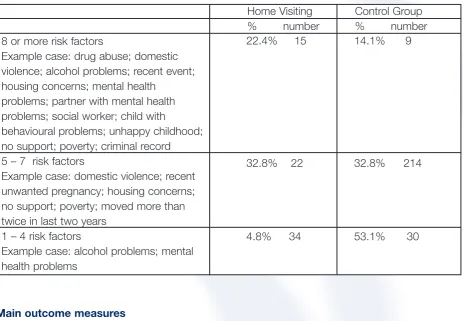
Table 1 demonstrates the high-risk characteristics of the sample that were recruited. The average participant had five risk factors; an example case was a woman experiencing domestic violence, an unwanted pregnancy, no support, poverty, and repeated moves in the last 12 months.
DfES Research Conference 2004
Table 1. Sample characteristics
Home Visiting Control Group
% number % number
8 or more risk factors
Example case: drug abuse; domestic violence; alcohol problems; recent event; housing concerns; mental health
problems; partner with mental health problems; social worker; child with
behavioural problems; unhappy childhood; no support; poverty; criminal record 5 – 7 risk factors
Example case: domestic violence; recent unwanted pregnancy; housing concerns; no support; poverty; moved more than twice in last two years
1 – 4 risk factors
Example case: alcohol problems; mental health problems
Main outcome measures
The main outcomes, measured at a 12-month follow-up for both mother and infant, were:
Maternal
• Mental health (GHQ)
• Parenting competence (PSOC)
• Parenting stress (PSI)
• Parenting attitudes (AAPI).
Infant
• Home environment (HOME Inventory)
• Mental development (Bayley scales)
• Social and emotional development (BITSEA).
Mother–Infant
• Maternal sensitivity and infant co-operativeness (CARE-Index).
The Home Inventory, Bayley Scales and Care Index were all measured by independent assessors who were blind to the intervention groups. The remaining measures are based on the parent’s report.
DfES Research Conference 2004
Methodological issues in the evaluation of interventions
22.4% 15 14.1% 9
32.8% 22 32.8% 214
We used these proxy measures of abusive parenting as primary outcomes because there is increasing evidence to suggest that it is not possible to evaluate the effectiveness of home visiting in reducing the incidence of abuse. This is due to the fact that the extra surveillance guarantees that cases are identified in the home visiting arm, whereas cases in the control arm are not picked up until much later.
We did, however, collect some objective measures of the effectiveness of home visitors in identifying abuse as part of our economic analysis, in addition to the mother and infant’s use of hospital and community-based services. The cost of the resources used was combined with our primary outcomes within a cost effectiveness analysis. A cost-benefit analysis using a discrete choice experiment was also undertaken.
Demonstrating effectiveness
The findings of this study raise some issues that are fundamental to the way in which we go about evaluating interventions to support families, and fundamental to the issue of evaluation itself. As I indicated at the beginning of this paper, the four recent studies that have evaluated the effectiveness of a home visiting programme in the UK have all shown problems demonstrating effectiveness using the primary outcome measures. I chose to use the term ‘problems
demonstrating effectiveness’ because a lack of evidence of effectiveness does not mean that something is ineffective, and also because it is hard to believe that programmes such as
Home- Start (i.e. one of the four home visiting programmes that was evaluated), aren’t making a difference to families. This issue is very clearly demonstrated if we compare the outcomes from the two types of data (i.e. quantitative and qualitative) that were collected as part of our evaluation of the effectiveness of a home visiting programme.
Very briefly1, the quantitative results at 12-months post-natal showed no significant differences
between the two arms for any of the parent-report measures, and for only one of three independent measures, the CARE Index, which showed improved sensitivity and infant co-operativeness for the intervention group. The findings from the qualitative data, however, tell a somewhat different story, and the remainder of this section provides further detail about what this data showed.
The qualitative data
The qualitative data was obtained from in-depth interviews with participating women and in-depth interview and focus groups with the participating home visitors. The aim was not only to examine process issues, such as whether both service providers and recipients complied, and whether they were satisfied with the intervention, but also to capture user and provider perceptions concerning the impact of the intervention on participants’ lives.
DfES Research Conference 2004
Methodological issues in the evaluation of interventions
Home visitors’ perceptions of the benefits of home visiting
The data from service providers showed quite clearly that all of the home visitors perceived there to have been important changes in their practice. They talked about using a preventive model, as opposed to the ‘crisis management’ that they felt characterised their standard practice. They described having more in-depth knowledge as opposed to ‘skimming the surface’; and this permitted better monitoring of the lives of high-risk babies. They talked about working holistically; being more client-centred and less directive; and focusing more on developing relationships and on helping the mother to get to know her baby.
Perhaps most importantly, they described a range of benefits resulting from their intervention, some of which are quite important:
• Building confidence;
• Improving parents’ ability to understand and appreciate their baby and its needs;
• Preventing family breakdown and improving mother-child relationships during child protection investigations;
• Enabling a mother to face her fears and deal successfully with psychological problems;
• Providing ongoing support to families while they receive temporary support from other agencies, thus providing continuity;
• Providing significant mental health support, which would normally require referral to a specialist service;
• Mediating on behalf of families who might normally be rejected by specialist services;
• Providing, for some women, the first stable relationship they may ever have experienced.
As one home visitor told us:
She managed to chuck her … partner out. He was violent towards her and he was getting the older sibling to beat up the study infant … the fact that there was a constant source of support there and I was listening to her side of the story gave her the confidence to do that.
Another home visitor said:
… her mental health was very low. I guess about 10 days after the baby was born, and at one point she did say ‘I can’t care for this baby, I want this baby fostered’. She didn’t really think that she could do it, and the relationship that she has with her son is just wonderful to see now, which is a sense of satisfaction. She is a really good mum, she is really responsive to him.
The evidence from the home visitors resonated very strongly with the evidence provided by the participating women. The in-depth interviews with 20 of the participating women showed that, despite considerable hostility towards professionals at the outset, the majority of the women interviewed developed strong trusting relationships with their home visitor. Many of the women
DfES Research Conference 2004
said that it had taken them a long time to trust their home visitor, but they had then really opened up, sometimes for the first time in their life.
There was also considerable evidence about the effects of the partnership model of working and, in particular, the value that these women placed on being treated with respect and helped to feel in control.
Like the home visitors, the participating women described multiple benefits. Similar themes emerged from the two sets of data: more confidence, better mental health, less domestic violence and so forth. One woman told us:
I have learned quite a few things with [the Home Visitor] like doing baby dance … that I had never heard of before and she used to love it. We do the movements and we sit and you know she encourages you to turn the telly off and read to her, which I do, and some other things, play with her and interact with her, that I would never have thought of doing … she really likes books so I do make the effort to read to her most days … but again, that is not something I would have thought to do.
Another woman said:
This study has made me feel so much more confident in myself and made me more assertive. I’m now able to cope with day-to-day activities and dramas – it has made me strong enough to see that I am worthy of having a happy life. I am really enjoying being a mother and if you were to see my baby you would see what a happy, loving little baby he is. I would like to take this opportunity to thank my health visitor for all her care and support over the last year.
Reasons for discrepancies
There are several possible reasons for the discrepancies between the quantitative and qualitative data. For example, it may simply be that we measured different things with the two sets of data. Some of the things that the women and health visitors talked about, such as domestic violence, were not measured using standardised instruments. However, this was not the case for all outcomes. So while many women who were interviewed reported improved confidence and better mental health, these improvements were not apparent using our standardised measures.
Was it the case, then, that our interviewees were in some way unrepresentative, and the next 20 women would have been wholly negative about the impact of the intervention on their lives? While this seems unlikely, it may be the case that we would we have obtained more interesting data if we had used the findings from the quantitative study to decide who to interview. In other words, instead of interviewing the first 20 cases, we might have selected those families that showed changes on our outcome measures and those that showed no change.
Perhaps there were problems with the standardised measures such that this particular population were unable to be honest because of their preoccupation with child protection issues and fears that they might lose their baby. Or perhaps they lacked insight about their problems, or failed to understand the questions.
DfES Research Conference 2004
Many of these issues could be untangled with further time and resources. For example, we could use cognitive debriefing methods to find out what our interviewees understand and think about when they answer questions from standardised questionnaires. We could also do case studies in which we examine more closely the outcomes on the standardised measures for the women who were interviewed and see if they are consistent.
Perhaps most fundamentally, we need to know which of our two stories is more accurate, whether our intervention is effective or not. I think the answer is that both types of data are accurate, and that the answer to whether these interventions are effective is ‘yes’ and ‘no’. They are effective for some of the people some of the time. The fact that they are not effective for everyone all of the time does not mean that they are ineffective.
The reason for this mixed result is that parenting and family support interventions are social and psychological interventions. They are delivered by people with a range of skills, to families with a range of backgrounds, with different levels of readiness for change and/or commitment to the process, and so forth – all of which determine whether an intervention is effective.
Conclusion
Where does this leave those of us whose lives are devoted to evaluating these interventions? I think it is time for a change of focus. We need to begin to focus more on context, mechanism and outcomes, or ‘realistic evaluation’ (Pawson and Tilley 1997). Fundamental to this approach is the recognition that, unlike many medical interventions, complex parenting and family support interventions do not work in and of themselves. Rather, it is the actions, motivations and desires of the participants and stakeholders that make them work.
Put briefly, this may mean that we invest more time in searching for answers concerning for whom an intervention works, and under what circumstances, rather than focusing on ‘effectiveness’ across groups in which we have tried to control for differences using randomisation, for example.
Discussion
The discussion focused initially on whether this study was under-powered. It was suggested that the effect of complex community-based interventions of this nature is likely to be small, and that a much larger study might be needed to detect the small changes that may have occurred.
There was also some discussion concerning the benefit of examining the data more closely to identify the characteristics of those families for whom the intervention may have been effective.
DfES Research Conference 2004
References
Acheson D (1998). Independent Inquiry into Inequalities in Health Report. London: The Stationery Office.
Barlow J, Davis H, Stewart-Brown S (2005). The Oxfordshire Home Visiting Study: Final Report.
University of Warwick.
Bull J, McCormick G, Swann C, Mulvihill C (2004). Ante- and post-natal home-visiting programmes: a review of reviews.HDA.
Davis H, Day C, Bidmead C (2002). Working in partnership with parents: the parent advisor approach.The Psychological Corporation.
Maattanen K (1999). Dialoginen auvatanssi psyykkisen kuntouttamisen menetelmana lastenkodeissa (Dialogical baby dance as a method of therapy for foster homes). Suomen Laakarilehti (Finnish Journal of Medical Doctors)99, 4022–4027.
McAuley C, Knapp M, Beecham J, McCurry N, Sleed M (2004). Evaluating the outcomes and costs of Home-Start support to young families experiencing stress: a comparative cross nation study.Joseph Rowntree Foundation.
Moran P, Ghate D (2004). What works in parenting support: the international evidence.Policy Research Bureau.
Morrell CJ, Siby H, Sewart P, Walters S, Morgan A (2000). Costs and effectiveness of community postnatal support workers: randomised controlled trial. British Medical Journal321, 593–8.
Onzawa K, Glover V, Adams D, Modi N, Kumar RC (2001). Infant massage improves mother-infant interaction for mothers with postnatal depression. Journal of Affective Disorders63, 201–207.
Pawson R, Tilley N (1997). Realistic evaluation. Sage Publications.
PEEP (2000). Learning together with babies. PEEP.
PIPPIN (2000). Your baby as a person,Training Notes. PIPPIN.
Street A (2002). The use of music in PEEP. PEEP.
Wiggins M, Oakley A, Roberts I, Turner H, Rajan L, Austerberry H, Mujica R, Mugford M (2004, in press). Postnatal support for mothers living in disadvantaged areas: a randomised controlled trial and economic evaluation. Health Technology Assessment.
DfES Research Conference 2004
DfES Research Conference 2004
Evaluating the impact of Playing for Success
Evaluating the impact of Playing for Success
Caroline Sharp, National Foundation for Educational Research
Playing for Success (PfS) was set up in 1997 to establish study support centres at professional sports clubs. Its main aims are to contribute to raising educational standards, especially in numeracy, literacy and ICT, and to improve pupils’ motivation to learn. It is targeted at young people in Key Stages 2 and 3, particularly those who are identified as struggling a little with skills in these areas and who are often demotivated at school. Pupils attend PfS centres after school for around 20 hours over ten weeks. The initiative began by establishing centres in professional football clubs, but went on to encompass sports other than football (including rugby league, rugby union, cricket and basketball). The number of centres has grown from six in 1997/98 to over 100 clubs signed up and 83 centres open.
The NFER was responsible for the national evaluation of PfS for four consecutive years, from 1998 to 2002 (Sharp et al. 1999, 2001, 2002a, 2003a). The NFER has also just carried out a study looking at the longer-term impact on pupils’ attainment (Sharp et al. forthcoming).
Aims and design
The two main aims of the fo