Synoptic Report
1
Audit of Internet Safety Practices in English Schools
Synoptic Report
This research project investigated and reported on current practices in teaching Internet Safety in schools in England. It followed and built upon the Internet Safety Survey of Local Education
Authorities conducted by NAACE in April 2002. One thousand and twenty schools (1020) from those in 27 LEAs across England were randomly selected for the investigation. Five hundred and seventy-seven (577) responses to questionnaires, mostly completed through telephone interview (367) or by post (197), were obtained from the schools during June and July 2002. Independent, state and special schools were included in the survey at both primary and secondary level. Thirty-eight (38) further questionnaires were obtained from schools that had volunteered for the Internet Proficiency Pilot scheme run by Becta. ICT advisers from the LEAs sampled and representatives of Internet Safety organisations were also invited to complete a linked questionnaire. Respons es were received from 18 LEA representatives and from representatives of three of the Internet Safety organisations.
Data was collected from the surveys, analysed and presented in the main report together with a literature survey and analysis.
The literature survey analysis revealed that there was a huge concern for the safety of young Internet users and that it was considered that schools should have a fundamental role in ensuring their safety. A conflict between the perceived and the actual risks of children using the Internet was highlighted where unsuitable material and paedophile activities were the greatest concern recorded in many studies, possibly overshadowing other equally damaging material that can be accessed via the web. The survey findings indicated that a thorough audit of Internet Safety practices was a vital stage in examining these practices and informing future planning.
As shown in Tables I to III below, the schools contacted as part of the audit represented a wide cross-section representative of the different types of school across England.
Table I. School Type Number
Community 332
Voluntary aided or controlled
125
Foundation 23
Special 27
Independent 58
No data provided 12
Table II. Age Phase Number
Middle (approx 8-13) 15 Prep (approx 5-12) 8 Primary (up to 11) 319 Secondary (11-16 or 18) 192 Through (3 or 5 -18) 40
Table III. Area Number
East Midlands 76
East of England 67
North East 58
North West 66
Outer London 56
South East 60
South West 73
West Midlands 48
Yorkshire and Humberside 62
Synoptic Report
2
Data analysis from the audit itself resulted in the following key findings.Only twenty schools (3.5% of those approached) did not have Internet access and these were excluded from the rest of the analysis. Of these twenty, fourteen were independent schools.
Physical measures of protection
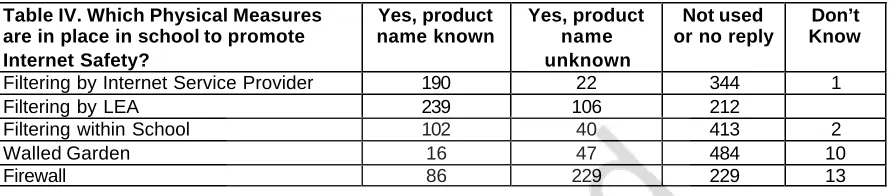
Five hundred and twenty-nine (95%) of the schools surveyed in the main study had Internet filtering arrangements in place though the respondents were not always aware where the filtering occurred nor how it operated. All the Internet Proficiency Pilot schools had filtering in place. Table IV shows the number of schools reporting filtering products.
Table IV. Which Physical Measures are in place in school to promote Internet Safety?
Yes, product name known
Yes, product name unknown
Not used or no reply
Don’t Know
Filtering by Internet Service Provider 190 22 344 1
Filtering by LEA 239 106 212
Filtering within School 102 40 413 2
Walled Garden 16 47 484 10
Firewall 86 229 229 13
Sixty-two per cent (62%) of schools report filtering taking place via the LEA, 38% report it taking place via the ISP and 25% of schools report that they had filtering systems in school. These total more than 100% as respondents have selected more than one option. Thus the vast majority of schools have filtering in place though there is confusion over where it is carried out, especially where the LEA acts as the Internet Service Provider (ISP).
[image:2.596.69.514.238.336.2]The 28 schools without a filter (5% of the total) are shown by school type in Table V below.
Table V. Type of Schools with no filter
Number with no filter
Total no. of Schools
Percent
Special 1 24 4
Independent 7 44 16
Voluntary aided or controlled 6 124 5
Foundation 0 23 0
Community 14 330 4
Independent schools were slightly more likely than other schools not to have filtering in place.
Filtering arrangements in state schools tend to be LEA dependent. Customised filtering systems with differing levels of access were recommended by all the representatives from Internet Safety organisations but by only four of the LEA representatives. They were not reported by many schools though this may well be due to a lack of knowledge of the filtering system rather than their absence.
There was a good deal of confusion in schools over the presence of walled gardens and firewalls. Walled gardens were strongly recommended by the Internet Safety organisations and firewalls were strongly recommended by both LEA advisers and Internet Safety organisations. However, of the 16 schools that named a walled garden, 15 gave the name of an Internet Service Provider (ISP) rather than referring to a genuine ‘walled garden’ product.
Synoptic Report
3
that there is no need to be aware of the detail, it is enough to know that filtering is being carried out, information gleaned from interviews suggests that 'not knowing' becomes a problem when other teachers or pupils are prevented from accessing a web page and promptly come to ask the ICT co-ordinator why.Resulting recommendations based on evidence gathered
• To make further guidance on filtering options available to schools, although as only 20% of schools referred to having used the NGfL Superhighway Safety materials, it may well be that they don’t know what is already available.
• To raise the profile of the Superhighway Safety materials in schools. This survey has made a start on this, pointing teachers to these materials and suggesting issues to be included in schools’ Internet Safety policies.
Frequency of breaches of Internet Safety and concerns
As shown in the chart (Figure 1) below, breaches of Internet Safety reported by schools in the main study were most likely to be pupils accidentally accessing inappropriate material. The LEA advisers also reported accidental access of inappropriate material as the most frequent breach of Internet Safety heard of by them; 5 of the 18 heard about it more than once a term, followed closely by deliberate access (4 of the 18 hearing about it more than once a term).
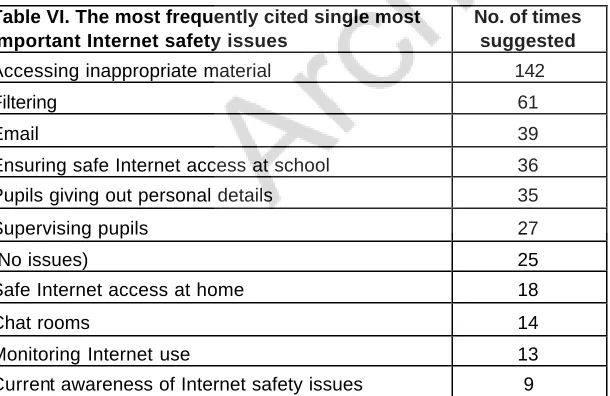
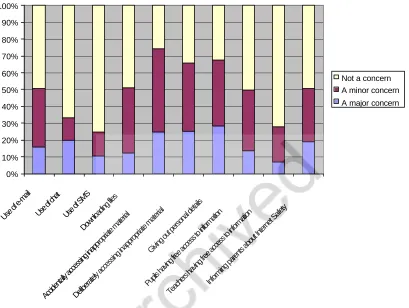
[image:3.596.75.380.430.628.2]In fact, as shown in Table VI below, accessing inappropriate material is the ICT co-ordinators’ single most important Internet Safety concern and the chart of ICT co-ordinators’ levels of concern over Internet Safety issues (shown in Figure 2 on the following page) indicates that accidental access is slightly more of a worry than deliberate access.
Table VI. The most frequently cited single most important Internet safety issues
No. of times suggested
Accessing inappropriate material 142
Filtering 61
Email 39
Ensuring safe Internet access at school 36
Pupils giving out personal details 35
Supervising pupils 27
(No issues) 25
Safe Internet access at home 18
Chat rooms 14
Monitoring Internet use 13
Current awareness of Internet safety issues 9
There was much less agreement amongst the LEA advisers as to what was their single most important Internet Safety concern, with fourteen different themes emerging. The most commonly reported concern from four LEAs referred to children’s abilities to interfere with the filtering systems; a further two reported potential for contact between children and strangers as their single most important Internet Safety concern and another two, Internet Safety awareness in schools.
Synoptic Report
4
Figure 2. Level of Concern over Internet Safety Issues amongst Main StudySchools
0% 10% 20% 30% 40% 50% 60% 70% 80% 90% 100%
Use of e-mail Use of ch
at
Use o f SM
S
Downloading files
Accidentally accessing inappropriate materialDeliberately accessing inappropriate material
Giving out personal details
Pupils having free access to information Teachers having free access to information
Informing parents about Internet Safety
Not a concern A minor concern A major concern
It appears that teachers feel a responsibility to act ‘in loco parentis’ and are worried about pupils viewing something that is out of their control. Deliberate access of inappropriate material is slightly less of a concern for schools who report “knowing” their pupils, their abilities and their motivat ions. The LEA advisers also considered deliberate and accidental access of inappropriate material to be their most serious Internet Safety concern though for them deliberate access was slightly more of a concern than accidental. However, the breaches of Internet Safety that were of most concern to all of the
representatives of Internet Safety organisations were inappropriate access of chat or SMS messaging, bullying via email and receiving inappropriate emails.
Thus education professionals’ concerns over Internet Safety can be seen to stem from the perspective of their role, with teachers and LEA advisers focusing on within-school experiences, whereas those of the Internet Safety professionals focus on the potential for harm from others.
Synoptic Report
5
Table VII. Supervising Internet access
Number of schools
Always by teacher/staff/helpers 347 In classroom or computer suite only 26
Usually/mostly 15
Younger pupils only 9
Remote monitoring 3
Some pupils only 5
Not used 83
No data 65
This emphasis on supervision may lead to both a lack of awareness of good Internet Safet y practice amongst children when surfing the Internet outside school and a lack of emphasis in school on
[image:5.596.70.477.308.498.2]developing independent search and evaluation skills. This is a particular issue with regard to learning to use chat and SMS messaging which, as shown in Table VIII below, are largely unavailable to pupils in schools. Only 32 schools (5%) allowed their use for school work and fewer, 24 (4%), allowed pupils to use them recreationally.
Table VIII. Numbers of schools allowing chat/SMS messaging
Allowed for school work
Allowed for recreation
All pupils 19 16
All in class / under supervision 2 3
In named site (MSN messenger, think.com, Not.OP, Sourceror)
3 0
All (internal chat site only) 2 0
Restricted range of pupils 6 5
None 509 517
No data/don’t know 16 16
Resulting recommendation based on evidence gathered
• To provide advice for LEAs on enabling chat in schools and support for schools aimed at teaching children about the use of chatrooms and SMS messaging safely.
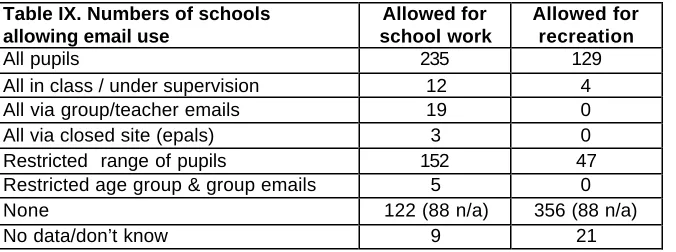
Email is used more widely than chat in schools, as shown in Table IX below, though facilities are still unavailable to pupils in 16% of schools and pupils are not allowed to use them in a further 6% of schools. The LEA representatives strongly advised the use of class emails with 14 of the 18 recommending their use for primary schools and 6 recommending them for secondary schools, but they were reported by only 4% of the schools in the study.
Table IX. Numbers of schools allowing email use
Allowed for school work
Allowed for recreation
All pupils 235 129
All in class / under supervision 12 4
All via group/teacher emails 19 0
All via closed site (epals) 3 0
Restricted range of pupils 152 47
Restricted age group & group emails 5 0
None 122 (88 n/a) 356 (88 n/a)
[image:5.596.69.407.598.724.2]Synoptic Report
6
Schools can also monitor the websites visited by pupils by using the history in the browser, site-logging software or by asking for records from their Internet Service Provider and, as shown in Table X below, 58% of schools do so regularly though 78% (14 of the 18) of the LEA advisers recommend doing so.Table X. Monitoring websites visited by pupils
Number of schools
Yes 246
Yes – at LEA/ISP 25
Yes – in school 52
Occasionally done 9
Can do so if needed or suspicious 7 Not used or no ‘yes’ answer ticked 200 Don’t know/ info. on supervising provided 18
Internet Safety Policies
[image:6.596.70.418.350.581.2]Eighty-nine per cent (89%) of schools in the main study have an Internet Safety policy in some form or another in school with about half of these expecting parents, pupils or both to sign to show their agreement to the statements in the policy. Topics covered in the policies are shown in Table XI below.
Table XI. Topics included in Internet Safety Policies
Percentage including this topic
Use of WWW in school 78
Use of email in school 67
Sanctions for misuse of the Internet 61
Details of filtering systems at school 60
Advice on not giving out personal information 59
Details of monitoring carried out 58
Strategy or policy for what to do if an incident/violation occurs
53
Other strategies for ensuring Internet Safety 42
Home-school liaison issues 37
Use of chat or SMS at school 35
Teaching or curriculum issues surrounding Internet use
35
Use of school email at home 18
Recommended teaching resources for Internet Safety 17
Other strategies for Internet Safety included in their policies by more than one ICT Co -ordinator are listed in Table XII below.
Table XII. Other Internet Safety strategies mentioned in policies
No. of times suggested
No photos and names on web site 6
Advice to keep username secret 4
Staff supervision ensures safety 4
Disk drives disabled 2
Synoptic Report
7
Schools (and their LEAs) tend to rely on the policy to disseminate Internet Safety information both within school and at home. As shown in Figure 2 earlier, just over half the schools reported they wereconcerned about parental awareness of Internet Safety issues, these schools, all the LEAs and Internet Safety organisations recognise they have a responsibility to work together to inform parents about Internet Safety and a number of requests were made for resources to support them in this.
Resulting recommendation based on evidence gathered
• To develop resources for schools to use to raise parental awareness of Internet Safety. Schools suggested PowerPoint presentations or video on CD-ROM, leaflets and photocopiable materials as well as a central on-line resource.
The percentage of schools already using guidance from other agencies to develop their Internet Safety policies is shown in Table XIII below.
Table XIII. Use of Internet Safety Policy Guidance in Schools
% of schools using their policy guidance
LEA 59
DfES Superhighway Safety pack 19
DfES Superhighway Safety Website 20
Becta Information sheets 32
Teaching Internet Safety
[image:7.596.84.406.286.407.2]Teaching Internet Safety was reported in 85% of the schools. It is most likely to take place solely within the subject area of ICT (66% of schools teaching Internet Safety) and, as shown in Table XIV below, is more likely to be delivered via an Internet induction programme or whole-class teaching and making use of the school’s acceptable use policy than through a specific scheme of Internet Safety work.
Table XIV. Types of schools and teaching methods (% of schools in each type shown)
Induction Programme
Policy Posters Whole class
Worksheets Discussion
Middle 67 47 33 53 7 20
Prep 75 38 38 63 0 38
Primary 39 50 45 67 17 49
Secondary 73 64 47 59 22 37
Through 41 29 24 29 9 26
Primary schools are more likely than schools with other age groups to use discussion activities and secondary schools are more likely to use their Internet Safety policy as a teaching vehicle. All through schools which tend to be special or independent are less likely to be teaching Internet Safety at all.
Use of worksheets was mentioned by 17% of primary and 22% of secondary schools but when teaching materials sent to the project team were looked at, this was found to mean more general Internet
worksheets than specific ones on Internet Safety.
Synoptic Report
8
Teaching Internet Safety as part of Net literacy was the single most important concern for all the Internet Safety organisations and for nearly a fifth of the Internet Proficiency Pilot schools, yet does not appear as a concern for schools in the main study. It does not appear that schools are really doing all that needs to be done to empower pupils to take responsibility for their own Internet Safety outside the schoolenvironment.
Resulting recommendation based on evidence gathered
• To develop teaching materials for schools to use with pupils in Key Stages 2 and 3 aimed at developing Net literacy and safe surfing practices that enable pupils to use the Internet responsibly and usefully both in and outside school.
As stated earlier, ICT co-ordinators would in general appreciate further guidance on Internet Safety and especially the emerging issues with most asking for resources they could use with other teachers, parents and pupils, with approximately equal numbers asking for electronic and paper-based resources.
Future concerns for Internet Safety
Synoptic Report
9
Table XV. Number of times Emerging Issues in Internet Safety were suggested
Schools in the Main Study
(n=557)
Internet Proficiency Pilot
Schools (n=38)
LEA ICT advisors (n=18)
Internet Safety Organisations
(n=3)
Increased use of email 84 10 4
Increased Internet access 36 4 1
Proliferation of unsuitable material 26 1 2
Effectiveness of filter 22 3 1
Increased IT capability of pupils 20 3
Safe Internet access at home 15 8 1
Safety in chatrooms 13 8 1
Implementation of effective policy 17 2
Giving out personal details 11 3
Keeping up to date on Internet Safety issues
11 1
Downloading (unsuitable material, games or viruses)
9 2 1
Internet Access via mobile devices
6 3
Hacking 5 3
Bullying emails 4 2
Access to video-conferencing 3 1
Raising awareness/Net literacy 3 1
Abuse of peer2peer networking 2
Both schools and LEA advisers largely focused on pupils’ use of email. They worried over how to monitor it and the ethics of doing so, how to control the use of web based email in school and were concerned over the time and network resources email used whereas the Internet Safety organisations had moved on to worries over Internet access from mobile phones and peer2peer networking.
Resulting recommendations based on evidence gathered
• To raise awareness in schools of the guidance on use of email in the Superhighway Safety materials.
• To provide an updating service to alert schools and LEAs to developments in technologies and new guidance on their use in school.
• To investigate means of filtering or monitoring Internet access for children using mobile technologies to surf the Web.
It was noted that the schools signing up to the Internet Proficiency Pilot scheme tended to be more aware of Internet Safety issues than the schools in the main study and more concerned about their Internet Safety practices in school. This could be explained by the fact that those schools involved in the Internet Proficiency pilot scheme were self nominating, therefore have already identified a need to teach this particular subject.
Synoptic Report
10
Resulting recommendation based on evidence gathered