This is the
Submitted Version
of a paper published in the
journal International Review on Public Health and
Nonprofit Marketing:
Kemp, Gillian, and Eagle, Lynne (2008)
Shared meanings
or missed opportunities? The implications of functional
health literacy for social marketing
interventions.
International Review on Public Health and
Nonprofit Marketing, 5 (2). pp. 117-128.
http://dx.doi.org/10.1007/s12208-008-0012-7
Meanings or Missed Opportunities? The Implications of Functional Health Literacy for Social Marketing Interventions
Gill Kemp and Lynne Eagle Bristol Business School
University of the West of England,
Coldharbour Lane, Bristol, United Kingdom
Telephone 01173283439 Fax 01173282289 Email: [email protected]@uwe.ac.uk
Key words: Health literacy Social marketing Health Communication Health promotion Word Count: xxxx (max 4,500)
Abstract
Social marketing is hailed as a key tool to help address the myriad health and overall population wellbeing issues facing societies. While there is evidence of the success of specific social marketing interventions, literacy problems within a considerable proportion of the population means that information provided as part of interventions may not be readily comprehended by all members of the target population. The substantial personal and social consequences of low functional literacy levels have been well documented, particularly within the health sector, for over twenty five years, yet information material continues to be produced that is written at a level well above people's average reading ability. The barrier is largely invisible as people with low literacy levels will go to great lengths to avoid
acknowledging their problem, due to feelings of shame and the desire to avoid potential embarrassment. There is an ethical responsibility for those involved in designing health-related interventions to improve information provision and comprehension. Without this, considerable numbers of people will be unable to benefit from interventions and may even be at risk due to a lack of comprehension.
Introduction
Andreasen (2002: 7) provides the following definition of social marketing, drawing on a definition originally provided by Kotler and Roberto (1989):
“A social change management technology involving the design, implementation and control of programs aimed at increasing the acceptability of a social idea or practice in one or more groups of target adopters. It utilizes concepts of market segmentation, consumer research, product concept development and testing, directed communication, facilitation, incentives and exchange theory to maximise the target adopter’s
response”.
Thus social marketing should be seen not as a specific theory, but rather as a process drawing on an interdisciplinary range of concepts and theories, within which communication is a core component. Social marketing has received increased focus as a result of an
acknowledgement that existing educational and communication strategies aimed at
improving population health and well being have not been effective (Department of Health, 2004).
A number of recent initiatives developed in several countries place effective communication as the central focus of public health interventions (Bernhardt, 2004) and it is recognised that pan-European and global solutions are being sought to issues affecting health and welfare (Commission of the European Communities, 2002). A UK government white paper
Choosing Health(Department of Health, 2004) specifically advocated the adoption of the principles underpinning social marketing in order to more effectively promote public health issues.
Detailed cross-EU data is somewhat difficult to obtain, however some indications of the magnitude of various health and lifestyle issues in the USA are shown in Table 1; we have no reason to believe that, in the absence of more specific data, the figures cannot be used as a crude indicator of the potential magnitude of similar issues in other developed countries. INSERT TABLE 1 ABOUT HERE
Social marketing activity is substantially, but not exclusively, focussed on health related issues such as safe sex (Dejong, Wolf, & Austin, 2001; Fishbein, von Haeften, & Appleyard, 2001), smoking cessation (Devlin, Eadie, Stead, & Evans, 2007; Vidrine, Simmons, & Brandon, 2007), immunisation (McDermott, 2000), medical screening (Briss et al., 2004; Cox & Cox, 2001), drug education (Yzer, Hennessy, & Fishbein, 2004) and nutrition / physical activity issues (John, Kerby, & Landers, 2004; Renger, Steinfelt, & Lazarus, 2002).
There is considerable scope for improving population health if effective and cost-efficient means of conveying information are used; indeed, the academic literature contains numerous examples of successful social marketing programmes (Fishbein & Yzer, 2003; Philip Kotler & Zaltman, 1971; McDermott, 2000; Stead, Gordon, Angus, & McDermott, 2007).
However, there is evidence of confusion and misunderstanding in some interventions (Cho & Salmon, 2007); part of the reason is lack of adequate functional literacy (Wallendorf 2001). We therefore firstly review the extant literature regarding the impact of health literacy levels on health outcomes and then report on a study of the relative readability of material from a range of UK health information sources.
Functional Health Literacy Levels
The Organisation for Economic Cooperation and Development (Gill: need reference)
the population of most developed countries have severe literacy problems and a further 20% have limited literacy (N. R. Adkins & Ozanne, 2005; Office for National Statistics, 2000). There also exists an additional group that could be classed as 'aliterate', in that they are able to read but choose not to, and rely on television rather than print media for news. More importantly, they learn through trial and error rather than by reading instructions (Wallendorf, 2001). The specific needs of these groups must be taken into account, acknowledging their difficulties but avoiding appearing condescending in the design and delivery of appropriate interventions (Guttman & Salmon, 2004).
The major consequence of health literacy problems is cost, as people with low levels of literacy use more health care resources than those with higher literacy abilities (Bar-Yam, 2002; Kefalides, 1999). Health care expenditure due to low health literacy in the USA is estimated at $US 73 billion and includes longer hospital stays and more frequent doctor visits (Bar-Yam 2002). Extrapolating these figures to the European Union on a simple population ratio basis (Internet World Statistics 2005) would indicate that the costs within the European Union may be in the vicinity of $US 115 billion, or €77.5 billion.
Table 2 presents the adult reading skill levels for the UK in relation to the primarily American literature (see, for example, Hoffman et al. 2004; Wallace and Lemon 2004; Mumford 1997) and the National Standards for literacy (Department for Education and Skills – DfES, 2003). The Skills for Life adult basic skills strategy, launched by the UK
Government in 2001, developed national standards for literacy. The literacy framework outlines what an adult should be able to achieve at entry level (divided into three sub-levels), level 1 and level 2 or above. The framework recognises that an adult may be classified at an overall level of literacy but have higher or lower levels of ability in different aspects of that skill. Furthermore, within this framework the skills levels and tests for literacy pertain primarily to reading skills, rather than writing.
INSERT TABLE 2 ABOUT HERE
level 3. The Basic Skills Agency's report (May 2000) reported that almost four out of ten adults in some parts of the UK are functionally illiterate. The Commons Public Accounts Committee (2006) reported that up to 16 million adults, nearly half the UK workforce, have reading skills no better than that of children leaving primary school (Guardian, 2006). One potential consequence with regards to health information is the possibility of patients or carers being unable to read, or misinterpreting prescription instructions. It is estimated that only 50% of patients suffering from chronic diseases in developed countries follow treatment recommendations, with older people identified as being most likely to be unable to
understand prescription instructions (Sabate, 2003; Roman (2004). Implications extend beyond the patient to the wider society in terms of externalities including treatment costs of complications from chronic diseases, formation of resistant infections, or untreated
psychiatric illness.
A challenge is identifying the ‘functionally illiterate’ as such people seldom admit they have a problem and will, over time, have developed numerous strategies to hide the problem (Aldridge 2004; Weir 2001) even from spouses or partners (Aldridge 2004; Roman 2004; Bar-Yam 2002). Known strategies include asking others to read material out, watching and copying the actions of others or stating that they have forgotten their reading glasses and / or will read the material later at home (Aldridge 2004; Bar-Yam 2002).
Despite awareness of the problem, health information materials continue to be produced at a level well above the average reading level (Hoffman et al. 2004(Eagle, Hawkins, Styles, & Reid, 2006)) placing patients at risk for problems due to incorrect or inappropriate
medication usage. People with low literacy levels are also more anxious about the possibility of developing cancer, yet are not diagnosed until cancers are advanced (Freidman and
Hoffman-Goetz., 2006), raising ethical issues regarding action that should be taken by those who develop material (Cho and Salmon, 2007). Readability is not only an issue related to health; for example, child safety seat instructions are also written at “a reading level that exceeds the reading skills of most American consumers” (Wegner and Girasek, 2003: 588)
(Esyenbach, 2000). However, there are concerns regarding the quality of health information on the internet (Cojera, 1998), including peoples’ understanding of internet-based health messages (Eysenbach & Deigpen, 1998). A study was therefore undertaken in order to determine the readability of a range of potential UK printed and Internet health information sources.
Study
This study seeks to determine the readability of a range of printed and Internet UK health information sources. A range of health information leaflets from pharmacies was analysed using the SMOG readability index (McLaughlin, 1969) to determine the reading level. The UK funded National Health Service (NHS) Direct website was selected as it has been at the forefront of e-health information services since 2004, with a specific self-help guide able to be interrogated by symptoms or by disease. The Patient UK web site offers free, up-to-date health information as provided by GPs to patients during consultations. In addition website searches were conducted using the Copernic Search Engine for simple search terms for major medical conditions such as asthma and cancer.
The SMOG index was selected because of its proven accuracy, correlation with other readability formulae and subsequent widespread use in the academic literature (Mumford, 1997; L. Wallace & Lemon, 2004). The method used for the SMOG calculations followed the methodology in the literature (Aldridge, 2004; Mumford, 1997; L. Wallace & Lemon, 2004). If SMOG calculations are calculated manually, three groups of 10 consecutive sentences at the beginning, middle and end of a document were selected, giving a total of 30 sentences. Following this, all words with three or more syllables within these selected sentences were counted and the square root of the total was then calculated and rounded to the nearest integer. Finally, the number 3 was added to the integer to obtain the grade level of the document.
However, the originator (McLaughlin, 1969) of the SMOG formula has also provided an internet-based version of the calculator at http://webpages.charter.net/ghal/SMOG.html; we compared manually calculated results with those derived from the internet version and found no difference between them. This calculation measures only the likely reading level
suitability which could be assessed using other tools such as the Readability Assessment Instrument (RAIN) (A. Adkins, Elkins, & Singh, 2001) or the Suitability Assessment of Materials measurement (SAM) (Doak, Doak, & Root, 1985). Issues of readability and suitability of wording are beyond the scope of this paper.
Findings
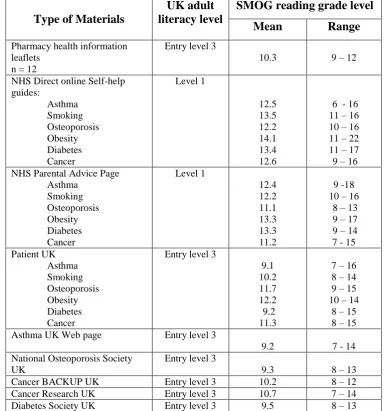
The readability of the material assessed within this study are summarised in Table 3 and range from primary school level (entry level 1, reading age 7) up to and beyond postgraduate level (level 2+, reading age 21). The majority of the health information sources assessed were at entry level 3, which means that the reader should be able to “understand short straightforward text on familiar topics accurately and independently and have the ability to obtain information from everyday sources” (The Skills for Life Survey, DfES 2003). The issue of ‘familiarity’ with the topic is of key importance within a health information context as the complexity of the language necessitates any written information being at a lower level than would be usual.
The NHS self-help guide and NHS parental advice page required people accessing the sites to have an average literacy level at level 1 or post secondary school level. The readability level was highest for information relating to symptoms and potential treatments for both of these sites. The treatment options in terms of obesity achieved a SMOG score of 22 (written at a post graduate level). This again raises the issue of terminology and the complexity of language used. In an attempt to address this issue the NHS Direct self-help guides have a ‘click through’ glossary of terms for unfamiliar medical terms. However, when the glossary itself was assessed for readability it was again found to be at level 1 or post secondary school level.
old and recognises the role of signs and symptoms in understanding and comprehension of text.
INSERT TABLE 3 ABOUT HERE
Conclusions and Managerial Implications
The findings should be of concern to designers of printed and Internet health information sources as much of the materials available is likely to not to be readily understood by a substantial section of the population. As noted previously, the result of misunderstanding or not fully comprehending health related information has the potential to be life threatening. The increased proliferation of health information generated from a variety of sources, such as pamphlets, self-help groups and the Internet, suggests that the demand from consumers for health information is growing. There is a need for mechanisms to be developed that check material is written at a level appropriate for the intended audience and to ensure it is
Directions for Future Research
There is an absence of cross- country studies of literacy challenges and potential solutions, both for conventional print and Internet-based material. There are a number of readability indices that are based around sentence length and number of syllables (e.g., Flesch – Kincaid grade level; Flesch reading ease index; The Fry Graph and SMOG readability indexl). However, these readability measures were designed for application to general text and not medical text, so there is a possibility that the use of such measures could be overestimating readability scores. In addition, there is a need for health information sources to be assessed for their suitability for the given target audience. An area for future consideration is the development of a suitable framework to assess content that considers the use of graphics, the reader’s level of prior knowledge and the implications of social and cultural appropriateness.
A further area for research is the appropriateness of readability measures developed for English material if it is used for other languages as there are in existence only limited foreign language adaptations, such as from the 1980s of the Flesch reading ease index (Spanish Language Huerta reading ease index) and The Fry Graph. (Contreras, Garcia-Alonso, Echenique, & Daye-Contreras, 1999) used the SMOG readability index on Spanish, English and French text.
References
Adkins, A., Elkins, E., & Singh, N. (2001). Readability of NIHM East-to-read Patient Education Materials. Journal of Child and Family Studies, 10(3), 279 - 285. Adkins, N. R., & Ozanne, J. L. (2005). The Low Literate Consumer. Journal of Consumer
Research, 32(1), 93 - 105.
Aldridge, M. (2004). Writing and Designing Readable Patient Education Materials.
Nephrology Nursing Journal, 31(4), 373 - 377.
Bar-Yam, N. B. (2002). Low Health Literacy: A Problem for All in the Health Care Circle.
International Journal of Childbirth Education, 17(3), 21 - 23.
Bernhardt, J. M. (2004). Communication at the Core of Effective Public Health. American Journal of Public Health, 94(12), 2051-2053.
Briss, P., Rimer, B. K., Reilly, B., Coates, R. C., Lee, N. C., Mullen, P., et al. (2004). Promoting Informed Decisions About Cancer Screening in Communities and Healthcare Systems. American Journal of Preventive Medicine, 26(1), 67 - 80. Cho, H., & Salmon, C. T. (2007). Unintended Effects of Health Communication Campaigns.
Journal of Communication, 57(2), 293 – 317.
Commission of the European Communities. (2002). Life Sciences and Biotechnology - A strategy for Europe. Retrieved 20 March, 2007, from
http://ec.europa.eu/biotechnology/pdf/com2002-27_en.pdf
Materials Written in Spanish, English and French. Journal of Health Communcation, 4(1), 21 - 29.
Cox, D., & Cox, A. D. (2001). Communicating the Consequences of Early Detection: The Role of Evidence and Framing. Journal of Marketing, 65(3), 91-103.
Dejong, W., Wolf, R. C., & Austin, S. B. (2001). U.S. Fedrally Funded Television Public Service Announcements (PSAs) to Prevent HIV / AIDS: A Content Analysis.
Journal of Health Communication, 6, 249 - 263.
Department of Health. (2004). Choosing Health: Making Healthy Choices Easier (White Paper). London: Department of Healtho. Document Number)
Devlin, E., Eadie, D., Stead, M., & Evans, K. (2007). Comparative Study of Young People's Response to Anti-smoking Messages. International Journal of Advertising, 26(1), 99-128.
Doak, C., Doak, L., & Root, J. (1985). Teaching Patients with Low Literacy Skills. Philadelphia, Pa.: Lippincott.
Eagle, L. C., Hawkins, J. C., Styles, E., & Reid, J. (2006). Breaking Through the Invisible Barrier of Low Functional Literacy: Implications for Health Communication. Studies in Communication Sciences 5(2), 29 - 55.
Fishbein, M., von Haeften, I., & Appleyard, J. (2001). The Role of Theory in Developing Effective Interventions: Implications from Project Safer. Psychology, Health & Medicine, 6(2), 223 -238.
Fishbein, M., & Yzer, M. C. (2003). Using Theory to Design Effective Health Behavior Interventions. Communication Theory, 13(2), 164 - 183.
Guttman, N., & Salmon, C. T. (2004). Guilt, Fear, Stigma and Knowledge Gaps: Ethical Issues in Public Health Communication Interventions. Bioethics, 18(6), 531 - 552. John, R., Kerby, D. S., & Landers, P. S. (2004). A Market Segmentation Approach to
Nutrition Education Among Low-Income Individuals. Social Marketing Quarterly, 10(3-4), 24 - 38.
Kefalides, P. (1999). Illiteracy: The Silent Barrier to Health Care. Annals of Internal Medicine, 130(4), 333 -336.
Kotler, P., Roberto, N., & Lee, N. (2002). Social Marketing. Improving the Quality of Life. Thousand Oaks, CA: Sage Publications.
Kotler, P., & Zaltman, G. (1971). Social Marketing: An Approach to Planned Social Change.
Journal of Marketing, 35(3), 3 - 12.
Lindau, S., T., Tomori, C., Lyons, T., Langseth, L., Bennett, C. L., & Garcia, P. (2002). The Association of Health Literacy With Cervical Cancer Prevention Knowledge and Health Behaviours in a Multiethinci Cohort of Women. American Journal of Obstetrics and Gynwcology, 186(5), 938 - 943.
McDermott, R. J. (2000). Social Marketing: A Tool for Health Education. Amercian Journal of Health Behavior, 24(1), 6 - 10.
McLaughlin, G. H. (1969). SMOG Grading: A new Readability Formula. Journal of Reading, 12(8), 639 - 646.
Mumford, M. E. (1997). A Descriptive Study of the Readability of Patient Information Leaflets Designed By Nurses. Journal of Advanced Nursing, 26(5), 985-991. National Social Marketing Centre. (2006). It's Our Health! Realising the Potential of
Effective Social Marketing. London: National Social Marketing Centreo. Document Number)
Office for National Statistics. (2000). International Adult Literacy Survey 2007, from
Petty, R. E., & Cacioppo, J. T. (1996). Addressing Disturbing and Disturbed Consumer Behavior: Is It Necessary to Change the Way We Conduct Behavioral Science.
Journal of Marketing Research 33(1), 1-8.
Renger, R., Steinfelt, V., & Lazarus, S. (2002). Assessing the Effectiveness of a Community-Based Media Campaign Targeting Physical Inactivity. Family & Community Health, 25(3), 18 - 30.
Rothschild, M. L. (1999). Carrots, Sticks, and Promises: A Conceptual Framework for the Management of Public Health and Social Issue Behaviors. Journal of Marketing, 63(4), 24-37.
Stead, M., Gordon, R., Angus, K., & McDermott, L. (2007). A Systematic Review of Social Marketing Effectiveness. Health Education, 107(2), 126 - 191.
Vidrine, J. I., Simmons, V. N., & Brandon, T. H. (2007). Construction of Smoking-Relevant Risk Perceptions Among College Students: The Influence of Need for Cognition and Message Content. Journal of Applied Social Psychology, 37(1), 91 -114.
Wallace, F. H., Deming, M. P., Hunter, S., Belcher, L., & Choi, J. (2006). More Than Just Words: A Model for Designing Effecticvde Health Messages for Those At Risk For HIV. Reading Research and Instruction, 46(1), 275 - 297.
Wallace, L., & Lemon, E. (2004). American Academy of Family Physicians Patient
Education Materials: Can Patients Read Them? Family Medicine Journal, 36(8), 571 -575.
Wallendorf, M. (2001). Literally Literacy. Journal of Consumer Research, 27(4), 505 - 511. Williams, M. V., Baker, D. W., Parker, R. M., & Nurss, J. R. (1998). Relationship of
Functional Health Literacy to Patients' Knowledge of their Chronic Disease. Archives of Internal Medicine, 158(2), 166 - 172.
Willimas, M. V., Baker, D. W., Honig, E. G., Lee, T. M., & Nowland, A. (1998). Inadequate Literacy is a Barrier to Asthma Knowledge and Self-Care. Chest, 114(4), 1008 - 1015.
Table 1 Magnitude (in USA) of Issues Social Marketing may Contribute Towards
(Philip. Kotler, Roberto, & Lee, 2002)
Issue Magnitude
Alcohol use during pregnancy Estimated 5,000 infants born with fetal alcohol syndrome each year
Sexually transmitted diseases 40% of sexually active high school students report not using a condom
Diabetes About 1/3 of the nearly 16 million people with diabetes are not
aware they have the disease
Skin cancer Approximately 70% of American adults do not protect
themselves from the sun’s dangerous rays
Breast cancer More than 20% of females aged 50 and over have not had
mammograms in the last two years
Prostrate cancer Only about half of all prostrate cancers are found early
Colon cancer Only about 1/3 of all colon cancers are found early
Seat belts An estimated 30% of drivers and adult passengers do not
always wear their seat belts
Fires Almost 50% of fires and 60% of fire deaths occur in the
Table 2: Reading Skill Level by Age Cohort as indicated in the literature and the National Standards for literacy (see, for example, Hoffman et al. 2004; Wallace and Lemon 2004; Department for Education and Skills – DfES, 2003).
School level Approximate Age Approximate Grade/ Reading Skill Level Expected UK National Curriculum Level UK Adult Literacy Level UK Population %
Nursery 3-5 1 1 Entry Level 1 3
Junior / Primary School
6 2 1
7 3 2 Entry level 2 2
8 4 2
9 5 2
10 6 2
Secondary School
11 7 3 Entry level 3 11
12 8 3
13 9 3
14 10 3
15 11 4
Further Education
16 12 5 Level 1
Upper secondary attainment
40
17 13 5
Higher Education (College / University 18 19 14 15
6 to 8 Level 2 or above
Table 3: SMOG reading level scores for the range of UK health information sources assessed.
Type of Materials
UK adult literacy level
SMOG reading grade level
Mean Range
Pharmacy health information leaflets
n = 12
Entry level 3
10.3 9 – 12
NHS Direct online Self-help guides: Asthma Smoking Osteoporosis Obesity Diabetes Cancer Level 1 12.5 13.5 12.2 14.1 13.4 12.6
6 - 16 11 – 16 10 – 16 11 – 22 11 – 17 9 – 16 NHS Parental Advice Page
Asthma Smoking Osteoporosis Obesity Diabetes Cancer Level 1 12.4 12.2 11.1 13.3 13.3 11.2 9 -18 10 – 16
8 – 13 9 – 17 9 – 14 7 - 15 Patient UK Asthma Smoking Osteoporosis Obesity Diabetes Cancer
Entry level 3
9.1 10.2 11.7 12.2 9.2 11.3
7 – 16 8 – 14 9 – 15 10 – 14
8 – 15 8 – 15
Asthma UK Web page Entry level 3
9.2 7 - 14
National Osteoporosis Society UK
Entry level 3
9.3 8 – 13
Cancer BACKUP UK Entry level 3 10.2 8 – 12
Cancer Research UK Entry level 3 10.7 7 – 14