Link Up Evaluation:
Final Report
Jo Cutter, Margot Clements, Charles Laxton, Kerry Marwood
and Marianne Rix
York Consulting Ltd
Research Report No 573
Link Up Evaluation:
Final Report
Jo Cutter, Margot Clements, Charles Laxton, Kerry Marwood
and Marianne Rix
York Consulting Ltd
The views expressed in this report are the authors’ and do not necessarily reflect those of the Department for Education and Skills.
Department for Education and Skills
Link Up Evaluation:
Final Report
Contents
Page
1 INTRODUCTION...1
2 VOLUNTEER PROFILE AND PROGRESSION ...12
3 LINK UP PILOT PROJECTS ...26
4 EMPLOYER ENGAGEMENT AND IMPACT ...43
5 VOLUNTARY AND COMMUNITY SECTOR ENGAGEMENT...51
6 FEEDBACK FROM PLACEMENT PROVIDERS AND LEARNERS ...55
7 SUMMARY AND CONCLUSIONS ...65
ANNEX A: THE SKILLS FOR LIFE TEACHING QUALIFICATIONS
ANNEX B: METHODOLOGY
ANNEX C: NATIONAL CONSULTATIONS
1
1 INTRODUCTION
1.1 This report sets out the findings of the evaluation of the Link Up programme, undertaken by York Consulting Limited (YCL) on behalf of the Department for Education and Skills (DfES) Adult Basic Skills Strategy Unit (ABSSU).
Link Up programme objectives
1.2 The Link Up programme is designed to:
• recruit, train and support 6,000 volunteer Adult Learner Supporters;
• engage 25% of Link Up Supporters aged 50+;
• engage Link Up Supporters in a range of roles and contexts including mentors, frontline workers and learner supporters;
• provide routes from Link Up training into community development or further Skills for Life teacher training;
• engage supporters from the most deprived communities in England.
Evaluation objectives
1.3 The objectives of the evaluation study are to:
• use management information to describe the profile of participants;
• report on participant progression through Link Up training and towards achievement of the Level 2 qualification, the certificate in Adult Learner Support;
• identify impact on ‘host’ employers where Link Up supporters work or volunteer and placement organisations in which Link Up Supporters support Skills for Life learners;
• identify the impact of Link Up support on learners;
Background to the Link Up Programme
1.4 Link Up seeks to recruit and train those interested in volunteering to support adults improve their literacy, language and numeracy skills. This aspect of volunteer support is not new. For many years, volunteers have given their time and energy to supporting others in this way. With the development of the
Skills for Life strategy in 2001, the DfES took the lead in seeking to ensure that adult literacy, numeracy and language were significantly improved. The
Skills for Life strategy notes “Volunteers can never take the place of trained professional teachers, but evidence indicates that learners of literacy and numeracy make more progress if they receive additional support from volunteers or paid assistants”1. The three main strands of the Skills for Life
strategy seek to boost demand, build capacity and improve quality of the provision. The Link Up project touches on all of these objectives:
• boosting demand through improving the skills and capacity of staff, in organisations that have clients with poor literacy, numeracy or language skills and to support Link Up volunteers to spot needs and encourage learners into provision;
• building capacity by increasing the volume of individuals and organisations able to support Skills for Life learners;
• improving quality by ensuring Link Up Supporters are working within the new national frameworks for adult literacy, numeracy or language teaching. Annex A shows the framework for the Skills for Life Teaching Qualifications, within which the Level 2 Certificate in Adult Learner Support sits.
1.5 The contexts in which Link Up Supporters are operating are highly diverse. A key aim of the evaluation is to understand the critical success factors, irrespective of setting. The research also provides an opportunity to share practice across Link Up projects and to help enable the Link Up model to be established in other parts of the country.
1.6 The Basic Skills Agency (BSA) tendered to DfES to deliver the Link Up programme, starting in November 2001. The pilot programme came to an end in March 2004. An extension period of April to the end of July 2004 was supported by the National LSC to help facilitate the transition from the national pilot programme to the development of locally based and integrated Link Up projects.
3 1.7 Relevant experience that fed into the design of the Link Up pilot included
experience from the delivery of the Adult Community Learning Fund and the National Voluntary Organisations Partnership Programme (NVOPP). This experience reinforced the need for the focus of activity to be on the effective combination of the following three elements:
• volunteer management;
• Skills for Life;
• community capacity building.
1.8 The criteria used to select pilot areas included analysis of deprivation indices, regional spread and areas in which Skills for Life needs were known to be high. Link Up’s national partners were Groundwork Trust, The Prince’s Trust, BBC, TUC, Birmingham Core Skills Partnership, City and Guilds, Tesco and the National Tenants Resource Centre. The partners sit on the national steering group along with the project funders and the National LSC, the Neighbourhood Renewal Unit, National Community Volunteer Organisation (NCVO) and Volunteer England.
1.9 Projects were identified in three phases:
• through the partners group (February 2002). This generated project proposals from Groundwork, The Prince’s Trust and Birmingham Core Skills Partnership;
• through Learning Partnerships (April 2002);
• national adverts in the education and regeneration press called for bids (June 2002). In addition, project bids were also developed with the Army and Prison Services.
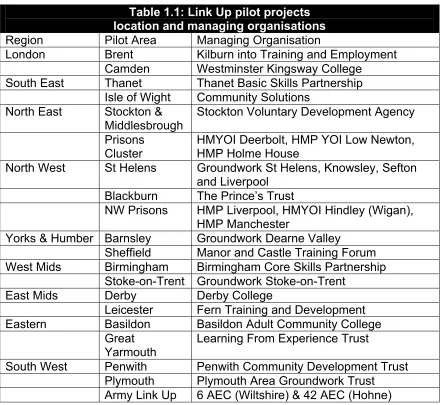
1.10 The community based projects were in the following 18 areas: Basildon, Birmingham, Blackburn, Brent, Camden, Dearne Valley (Barnsley), Derby, Great Yarmouth, Isle of Wight, Leicester, Middlesbrough, Penwith (Cornwall), Plymouth, Sheffield, St Helens, Stockton-on-Tees, Stoke-on-Trent and Thanet.
1.11 The Army project was based in Warminster (Wiltshire), Tidworth (Hampshire) and Hohne (Germany). The prison projects were located as follows: HMYOI Hindley, HMP Holme House, HMP Liverpool, HMYOI Deerbolt, HMP Manchester and HMP Low Newton.
Table 1.1: Link Up pilot projects location and managing organisations
Region Pilot Area Managing Organisation
London Brent Kilburn into Training and Employment Camden Westminster Kingsway College South East Thanet Thanet Basic Skills Partnership
Isle of Wight Community Solutions North East Stockton &
Middlesbrough Stockton Voluntary Development Agency Prisons
Cluster HMYOI Deerbolt, HMP YOI Low Newton, HMP Holme House North West St Helens Groundwork St Helens, Knowsley, Sefton
and Liverpool Blackburn The Prince’s Trust
NW Prisons HMP Liverpool, HMYOI Hindley (Wigan), HMP Manchester
Yorks & Humber Barnsley Groundwork Dearne Valley
Sheffield Manor and Castle Training Forum West Mids Birmingham Birmingham Core Skills Partnership
Stoke-on-Trent Groundwork Stoke-on-Trent
East Mids Derby Derby College
Leicester Fern Training and Development Eastern Basildon Basildon Adult Community College Great
Yarmouth Learning From Experience Trust
South West Penwith Penwith Community Development Trust Plymouth Plymouth Area Groundwork Trust
Army Link Up 6 AEC (Wiltshire) & 42 AEC (Hohne)
5
Accreditation processes
1.14 Many of the organisations managing Link Up pilots were not learning providers or did not have the City and Guilds approved centre status needed to offer Link Up Supporters the Level 2 ALS accreditation. In order to be able to offer accreditation, this group of organisations needed to work in partnership with learning providers that were a City and Guilds accredited centre or develop their own capacity to offer this. Whilst the development of partnerships or accredited centre status slowed accreditation in the early stages of the pilot, this process has enabled new organisations to become accredited as City and Guilds centres and increased their capacity and credibility as learning providers within their local community.
Capacity building support for pilot projects
1.15 The BSA resourced the Link Up Central team which provided monitoring and guidance to pilot projects, administered pilot programme funding and developed the Link Up training and resources. The capacity building support included a range of activities, as the diverse projects had a range of background and experience (some had little Skills for Life background, others had strong community and voluntary sector links, while others had strong project management experience). Support for local projects has included:
• quarterly briefings for project managers;
• two day residential;
• volunteer management handbooks;
• briefing on the training and role of the supporter;
• guidance on placements;
• guidance on the accreditation process;
• fast track guidance on how to run/offer a fast track/intensive course;
• MI template and database training;
• media training delivered by CSV, BBC partner;
• national promotional materials – posters, press, radio, display stands;
• grants for laptops/resources;
• support from BSA central team;
• reporting template;
• quarterly newsletters;
• kitbags;
Training for supporters
1.16 The BSA recruited a pool of trainers to deliver the Link Up training courses (Units 1, 2 and 3). In addition, local projects were encouraged to identify local trainers to undergo the Link Up Training the Trainers’ course. Projects were encouraged to develop their own staff as trainers if this was appropriate, or identify Skills for Life teaching staff from their local partners to undergo the training. These individuals would then deliver Link Up to the supporters recruited by the local project. Project managers were present during Module 1 and Module 4 of Unit 1. This was to ensure that the training reflected the local area situation and the needs of the group being trained. Those with relevant Skills for Life teaching experience could then deliver Unit 1 themselves. Those without Skills for Life experience could co-deliver modules 1-4.
Support for volunteers
1.17 The BSA has supplied a number of resources for Link Up Supporters (LUS). These have included:
• a range of publications; e.g. Basic Skills for Personal Advisors;
• training packs for Units 1 - 3;
• kitbag containing a calculator, notebook, pen and dictionary;
• celebration events and conferences for supporters;
• “Chainmail” quarterly newsletter;
• placement audits;
• other training: dyslexia (Stockton);
• a video about the role of the Adult Learner Supporter.
1.18 Projects have developed local support arrangements for volunteers and the evaluation study seeks to report on the effectiveness of these mechanisms in retaining supporters and encouraging progression.
Early Evaluation Findings
7
• initial delays in set up and resources created operational difficulties;
• networking strategies needed to be flexible and adaptive to ensure effective engagement of a wide range of LUS;
• projects were satisfied with the training and it was relatively easy to contextualise;
• projects were effectively targeting agencies that worked with specific groups to ensure that ‘non-traditional’ supporters were engaged in Link Up;
• concern was expressed about the capacity to establish and support placements;
• key strengths were recognised as the localised focus, skills, commitment and enthusiasm of project staff and supporters, and good communication between Link Up Central and the pilots;
• the need for more staff resource, especially to support the administration and monitoring of the project;
• the importance of support to help share good practice between projects;
• concern about lack of clarification on funding from April 2004;
Policy Context
1.20 In addition to underpinning the Skills for Life strategy, Link Up also generates volunteering and community development outcomes. Therefore, Link Up sits within a range of national policy agenda. This is a great strength, however as can be seen below it also creates difficulties for projects seeking continued funding. Those looking to continue to deliver Link Up need to develop their understanding of these wide ranging agenda, how to identify the mutual benefits for their own and partner organisations and specifically the funding opportunities available to take Link Up forward.
Volunteering and active communities
1.22 There is a wide range of national policy development underway seeking to develop and strengthen the capacity of the voluntary sector, and improve the ways in which public sector agencies work with it. The ‘cross-cutting review’ published by HM Treasury in the “Role of the Voluntary and Community Sector in Service Delivery”, outlines a range of measures to improve the relationship between government agencies and the voluntary sector.
1.23 The LSC’s response to the cross cutting review is set out in “Working together: a strategy for the Voluntary and Community Sector and the Learning and Skills Council”. This document sets out the LSC’s proposed strategy for working with the Voluntary and Community Sector in the following contexts:
• as an employer;
• as a provider of education and training;
• as a channel for networking;
• a source of expertise in planning.
1.24 A range of initiatives are also being developed by the Active Community Unit of the Home Office, notably the Futurebuilders programme which seeks to help voluntary and community organisations in their public service work.
1.25 Sections Two, Three and Five report on the profile of volunteers and community organisations engaged and the types of impacts reported in relation to:
• The community capacity developed as an outcome from the Link Up pilot activity
• The added value improved joint working between Skills for Life
providers and voluntary and community sector organisations.
Neighbourhood renewal
9 1.27 The Neighbourhood Renewal Unit’s (NRU) community participation
programmes are now merged into the single Community Programme which provides funding via Government Offices to support community engagement and empowerment. Neighbourhood Management Pathfinders (2004-05) are testing new ways in which to deliver local services within the target areas.
1.28 Neighbourhood Renewal is driven via the work of Local Strategic Partnerships, working to achieve ‘floor’ targets. Within these, Skills for Life
targets are not explicitly set out as a discrete measure. However, engaging a wider range of community based Link Up Supporters can be seen to assist learners in priority groups within the Worklessness, Health and Crime target areas.
1.29 The Office of the Deputy Prime Minister’s Learning Curve2 outlines strategies through actions to develop the skills, knowledge and behaviours needed for neighbourhood renewal. This includes support for professionals and practitioners working locally, and support for residents to develop their own skills in Neighbourhood Renewal.
1.30 Sections Four and Five report the feedback from employers and community organisations on the value of the Link Up pilot programme in their area.
Research questions
1.31 The following sets out the main research questions for the evaluation:
• (1) What is the profile of LUS volunteers? What are their characteristics in terms of age, gender, ethnicity, previous learning experiences and volunteer history?;
• (2) How have volunteers progressed at Unit 1, 2 and 3 and in achieving the Level 2 qualification? How many want to progress to Level 3 and 4 teaching qualifications, and what other skills have they developed? What factors affect progression? How is the National Test requirement viewed?;
• (3) What is the feedback from employers whose ‘frontline’ staff have had Link Up training? How has Link Up training added value to frontline services? What is the likelihood of sending staff on Link Up training in the future?;
2 The Learning Curve: Developing Local Skills and Knowledge for Neighbourhood Renewal:
• (4) What are the views of placement organisations where Link Up Supporters have been placed? What is the perception of the impact on their organisation? Are Link Up Supporters more beneficial? Has Link Up added value and widened participation? Will they continue to place supporters with learners?;
• (5) Has Link Up helped build capacity in community organisations? If so, how?;
• (6) How has Link Up had an impact on the learners referred by Link Up Supporters? How many learners have been referred through Link Up? How have learners found the referral process? What has been their learning experience and what are the benefits of being supported by a Link Up volunteer?;
• (7) What is the potential to sustain Link Up? How are pilot projects addressing this? Which pilot areas have done particularly well? What are the lessons learned for future roll-out?
Report Structure
1.32 The remainder of this report is structured as follows:
• Section Two – reports on the profile of volunteers from data taken from the management information reported by Link Up projects, and from the survey supporters undertaken by YCL;
• Section Three – outlines the profile of pilot projects, their characteristics and approach to the delivery of the Link Up programme. The good practice and lessons learned from the delivery of Link Up are reported in a separate guide that accompanies this report;
• Section Four – reports on the feedback from employers that have had ‘frontline’ staff trained by Link Up;
• Section Five – details the nature of engagement and impact on voluntary and community organisations involved in Link Up;
• Section Six – reports on the feedback from placement providers on the use and value of those trained by Link Up that have supported Skills for Life learners. This section also reports on the feedback from Skills for Life learners themselves on the value of Link Up Supporters;
11
Methodology
1.33 The evaluation programme included:
• visits to six case study pilot projects;
• telephone interviews with all pilot project managers;
• a survey of 1,233 LUS (from the six case study areas).
• qualitative interviews with:
− all Link Up pilot project managers;
− 44 Link Up signposters and supporters;
− 17 placement providers;
− 13 employers;
− 54 learners supported by Link Up Supporters;
• analysis of management information (November 2003, April 2004);
2
VOLUNTEER PROFILE AND PROGRESSION
Introduction
2.1 This section reports the results from a survey of volunteers and the data from the BSA’s Management Information (MI) database (as at 29th April 2004) under the following headings:
• programme targets;
• volunteer survey;
• LUS profile;
• progression;
• difficulties faced;
• LUS current status/activities;
• future expectations.
Programme targets
2.2 In relation to Link Up’s programme objectives, the BSA management information (MI) reports a total of:
• 6,090 supporters on the database, exceeding the target of 6,000;
• 18% of supporters profiled on the database are aged 50 or over, just below the target of 25% in this age group3;
• 41% of supporters are from the target wards4.
Volunteer survey
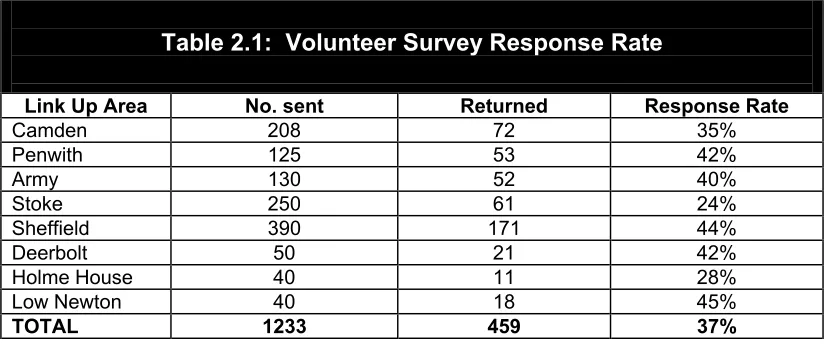
2.3 As part of the evaluation research a postal survey was distributed to the Link Up Supporters trained in the six case study areas. Table 2.1 below shows the number of surveys distributed to LU Supporters in each area, the number received and the corresponding response rate. Overall 37% of questionnaires were returned.
3 The 6 Prisons and 1 Army based projects were less able to address this target as their core target
groups of prison staff, prisoners and Army personnel had a much younger age profile.
4 The figure of 41% relates to the 18 ‘community based’ projects as the 6 Prisons projects were
13 Table 2.1: Volunteer Survey Response Rate
Link Up Area No. sent Returned Response Rate
Camden 208 72 35% Penwith 125 53 42%
Army 130 52 40%
Stoke 250 61 24%
Sheffield 390 171 44% Deerbolt 50 21 42%
Holme House 40 11 28%
Low Newton 40 18 45%
TOTAL 1233 459 37%
LUS Profile
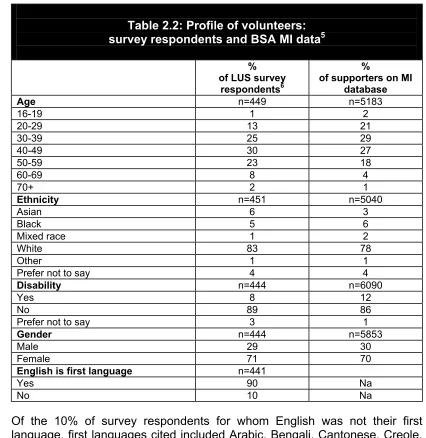
2.4 Table 2.2 shows the profile of the personal characteristics of those responding to the volunteer survey, and compares this to the profile of supporters reported to the BSA database by all pilot projects. Table 2.2 indicates that the profile of survey respondents (in terms of age, ethnicity and gender) is comparable to that of the 6,090 supporters that were profiled on the BSA’s database on 29th April 2004. The key characteristics of the LUS trained is as follows:
• around eight out of ten supporters’ ethnicity is ‘white European’;
• nearly one-in-eight supporters are reported to have a disability;
• just over two-thirds of supporters are female;
Table 2.2: Profile of volunteers: survey respondents and BSA MI data5
% of LUS survey
respondents6
%
of supporters on MI database
Age n=449 n=5183
16-19 1 2
20-29 13 21
30-39 25 29
40-49 30 27
50-59 23 18
60-69 8 4
70+ 2 1
Ethnicity n=451 n=5040
Asian 6 3
Black 5 6
Mixed race 1 2
White 83 78
Other 1 1
Prefer not to say 4 4
Disability n=444 n=6090
Yes 8 12
No 89 86
Prefer not to say 3 1
Gender n=444 n=5853
Male 29 30
Female 71 70
English is first language n=441
Yes 90 Na
No 10 Na
2.5 Of the 10% of survey respondents for whom English was not their first language, first languages cited included Arabic, Bengali, Cantonese, Creole, French, German, Greek, Hindi, Italian, Kurdish, Persian, Punjabi, Somali, Turkish and Yoruba.
Link Up Supporter labour market status
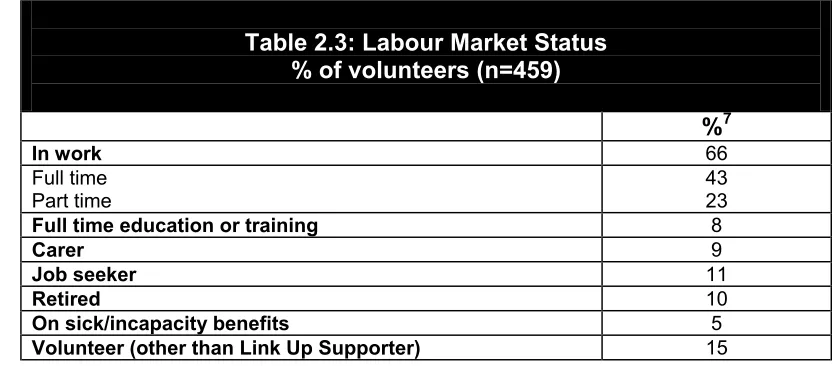
2.6 Table 2.3 shows the labour market status of those responding to the volunteer survey. Two thirds of respondents are in work, either full time or part time. The majority of the remaining third of respondents are volunteers in another capacity as well as being a Link Up Supporter.
5 Data rounded to the nearest percent.
15 Table 2.3: Labour Market Status
% of volunteers (n=459)
%7
In work 66
Full time Part time
43 23
Full time education or training 8
Carer 9
Job seeker 11
Retired 10
On sick/incapacity benefits 5
Volunteer (other than Link Up Supporter) 15
2.7 Survey respondents were asked about the main focus of, or the main client groups they support as part of their job or volunteering role. Responses were wide ranging, and included:
• adult learners;
• 16-19 year olds;
• children and families;
• adults from disadvantaged areas;
• community;
• forces personnel;
• clients with mental health problems;
• elderly;
• homeless;
• literacy/numeracy/ESOL/IT clients/learners;
• lone parents;
• refugees and asylum seekers;
• unemployed;
• young offenders;
• women prisoners.
Previous qualification levels
2.8 Just under one half of all respondents to the LUS survey already had Level 2 literacy/numeracy equivalents. Just under one quarter of all LUS were working towards the National Tests in Literacy and Numeracy. To date (end of March 2004) the pilots report that they have supported over 600 LUSs to take the National Tests.
2.9 The following shows the proportion of supporters that already have the Level 2 equivalent, those that do not but are working towards them, and those that do not and are not working towards them. This indicates that the pilot projects have encouraged almost half of those without Level 2 literacy or numeracy to work towards the National Tests:
• already have L2 literacy/numeracy equivalents 48%
• I am working towards the national tests 23%
• I do not have L2 equivalent and am not working
towards the tests 20%
• unknown/not given 9%
2.10 For some, the motivation to work towards the Tests was the requirement to achieve them in order to gain the Level 2 certificate in Adult Learner Support (ALS). For others (and many of those not seeking to achieve the Level 2) participation in the Link Up training raised awareness of their own literacy and numeracy skills. Furthermore, most pilot providers were able to signpost LUS to Skills for Life provision.
Previous experience of volunteering
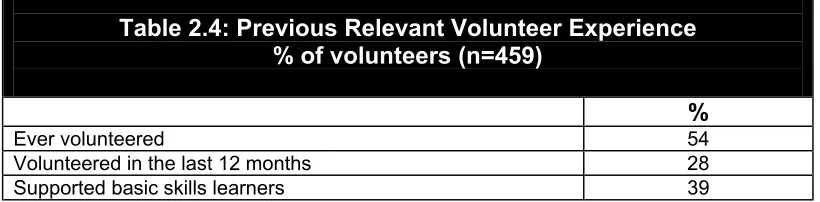
[image:21.595.98.508.516.617.2]2.11 Table 2.4 below shows that over half of the survey respondents had volunteered prior to their involvement in the Link Up project, with just under one third having volunteered in the past year. Thus a significant minority were new volunteers.
Table 2.4: Previous Relevant Volunteer Experience % of volunteers (n=459)
%
Ever volunteered 54
Volunteered in the last 12 months 28
17
Progress through training to date
2.12 Figure 2.1 gives an outline of the Link Up training units, hours of training and the qualifications that can be achieved at the end of each stage. Completion of the full qualification also requires supporters to undertake a minimum of 8 hours of placement supporting adults under the guidance of a specialist tutor.
[image:22.595.115.526.249.445.2]Annex A shows an outline of the training programme for the Level 2 Certificate. In the Link Up pilots, supporters had the option to work towards the full certificate, (become a classroom supporter) or just to take Unit 1 (be trained as a signposter).
Figure 2.1: Link Up Training Units
Unit Hours of training Recognition/
Qualification Role
Unit 1 12 hours Certificate of attendance Signposter/Frontline worker/Mentor
Unit 1 +
assignment 12 hours
City and Guilds certificate of Unit Recognition
Signposter/Frontline worker/Mentor Units 1, 2 and 3
+ relevant assignments and placement
42 hours
Level 2 Certificate in Adult Learner
Support
Adult Learner Supporter
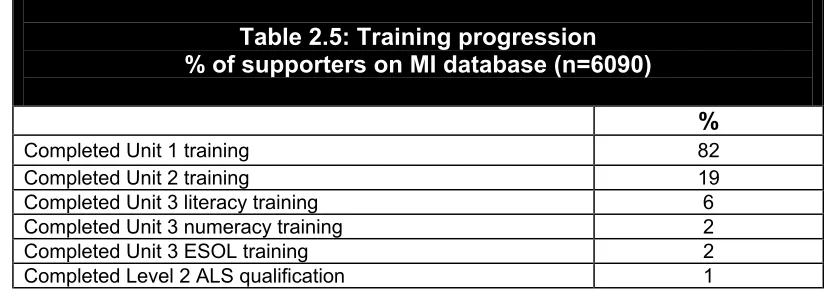
2.13 Table 2.5 below shows the progression made through the Link Up training units by the supporters profiled on the BSA’s database. This indicates that over 80% of Link Up Supporters have completed the Unit 1 only to date, with 19% progressing on to further Units.
Table 2.5: Training progression % of supporters on MI database (n=6090)
%
Completed Unit 1 training 82
Completed Unit 2 training 19
Completed Unit 3 literacy training 6
Completed Unit 3 numeracy training 2
Completed Unit 3 ESOL training 2
Completed Level 2 ALS qualification 1
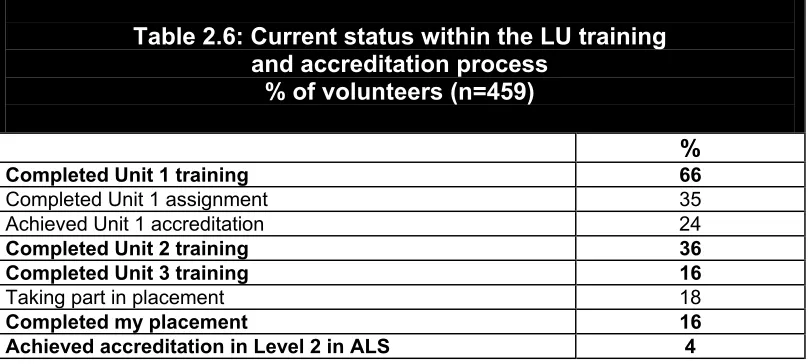
[image:22.595.107.520.528.674.2]• about two-thirds of survey respondents have completed Unit 1 training, with just over one third having gone on to complete their Unit 1 assignment, and nearly a quarter having achieved the Unit 1 accreditation;
• just over one third have gone on to complete the Unit 2 training and just under one fifth have completed the Unit 3 training;
• just under one fifth have taken part in a placement, with just less than that having completed their placement at the time of the survey;
[image:23.595.102.507.276.458.2]• 4% had achieved accreditation of the Level 2 certificate in ALS.
Table 2.6: Current status within the LU training and accreditation process
% of volunteers (n=459)
%
Completed Unit 1 training 66
Completed Unit 1 assignment 35
Achieved Unit 1 accreditation 24
Completed Unit 2 training 36
Completed Unit 3 training 16
Taking part in placement 18
Completed my placement 16
Achieved accreditation in Level 2 in ALS 4
2.15 The most frequently cited specialism that the respondents have opted for, or hope to take is literacy, with 54% reporting this option. Around one third of survey respondents have opted for, or hope to take the numeracy or ESOL options:
• Literacy 54%
• Numeracy 33%
• ESOL 32%
2.16 The survey feedback indicates that the proportion of supporters that have progressed on to Units 2 and 3 (from the case study areas) is higher than the data reported to the BSA by the projects. This could be due to:
• supporters in the case study areas being more likely to progress than in other pilot project areas;
19
Expected progression
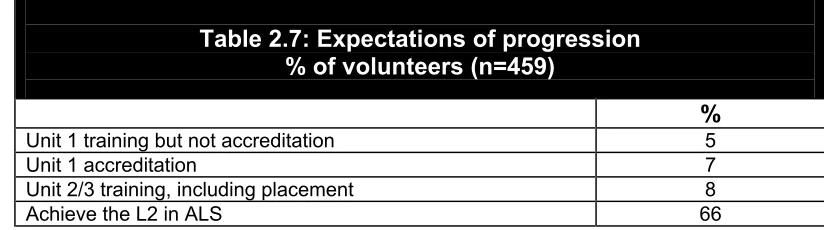
2.17 Supporters responding to the survey were asked which stages of the Link Up training programme they expected to complete. Table 2.7 shows their expectations of progression through the Link Up training programme. The majority (66%) of volunteers hope to achieve the Level 2 certificate in ALS. Very few respondents were interested in undertaking the training without working towards the Level 2 qualification.
[image:24.595.106.518.273.388.2]2.18 Twelve per cent of respondents expected to complete only Unit 1, i.e. hope to be “signposters”.
Table 2.7: Expectations of progression % of volunteers (n=459)
%
Unit 1 training but not accreditation 5
Unit 1 accreditation 7
Unit 2/3 training, including placement 8
Achieve the L2 in ALS 66
2.19 The expected achievement of the Level 2 certificate is expressed here as an aspiration. The actual rate of progression and achievement is much lower than this. The actual rate of achievement has been limited by a number of factors. This has included the initial planning assumptions, which assumed that the rate of progression from Unit 1 to 2 would be about 20%. In addition, the slower than anticipated process of accreditation has also hindered actual progression. Finally, the higher than expected level of progression has caused pressure on the demand for placements. Again this factor has lead some projects to slow down the rate of progression on to Units 2 and 3 until placements became available.
2.21 The gap between achievement and aspiration also raises the question of advice and guidance for LUS. All supporters have an informal interview or induction with project managers before they begin the Unit 1 training. In some cases the pilot projects have experienced staff able to offer information, advice and guidance (IAG) interviews to supporters, encouraging them to reflect on how the Unit 2/3 training fits within their own job role or personal aspirations, and how to plan future training and development to reach personal goals.
Impact of training on confidence to work with certain groups
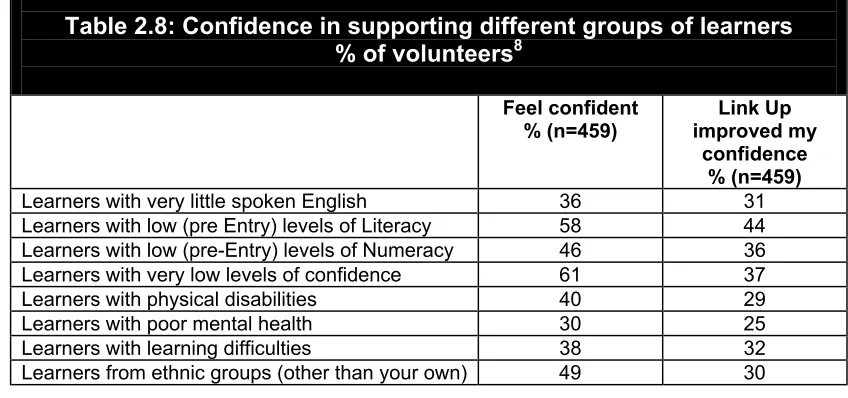
[image:25.595.94.518.334.533.2]2.22 Respondents were asked to state their level of confidence in supporting different groups of learners, and whether Link Up has helped to develop their confidence in this area. The responses are shown in Table 2.8 below.
Table 2.8: Confidence in supporting different groups of learners % of volunteers8
Feel confident % (n=459)
Link Up improved my
confidence % (n=459)
Learners with very little spoken English 36 31
Learners with low (pre Entry) levels of Literacy 58 44
Learners with low (pre-Entry) levels of Numeracy 46 36
Learners with very low levels of confidence 61 37
Learners with physical disabilities 40 29
Learners with poor mental health 30 25
Learners with learning difficulties 38 32
Learners from ethnic groups (other than your own) 49 30
2.23 The majority of respondents stated that they felt confident in supporting groups of learners with very low levels of literacy, and very low levels of confidence. Just under half of respondents stated they felt confident in supporting learners with low levels of numeracy, and learners from ethnic groups (other than their own). A smaller proportion of learners were confident in supporting learners with very little spoken English, physical disabilities, poor mental health or with learning difficulties.
21 2.24 Around one third of respondents stated that Link Up had helped them
improve their confidence in supporting learners with little spoken English, low levels of numeracy, very low levels of confidence and with learning disabilities. Only one quarter stated that Link Up had helped develop their confidence in working with learners with poor mental health. Of those who felt confident in supporting learners from each group identified, between 28% and 40% of these respondents felt that Link Up had helped them develop/improve this confidence, with a higher proportion saying that Link Up helped improve their confidence in supporting learners with low levels of literacy, and a lower proportion in supporting learners with poor mental health or physical disabilities.
Difficulties faced
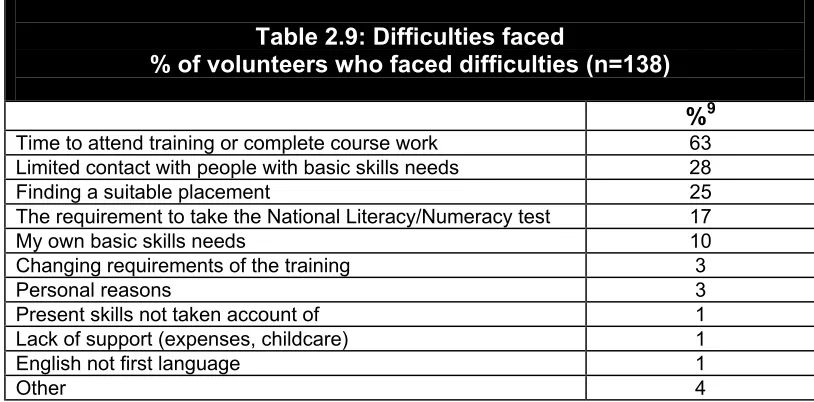
[image:26.595.111.518.370.571.2]2.25 Less than one third of LUS reported that they had faced difficulties in either the training process or in being a Link Up Supporter. Table 2.9 below shows the main difficulties faced by this group.
Table 2.9: Difficulties faced
% of volunteers who faced difficulties (n=138)
%9
Time to attend training or complete course work 63
Limited contact with people with basic skills needs 28
Finding a suitable placement 25
The requirement to take the National Literacy/Numeracy test 17
My own basic skills needs 10
Changing requirements of the training 3
Personal reasons 3
Present skills not taken account of 1
Lack of support (expenses, childcare) 1
English not first language 1
Other 4
2.26 The responses reflect that supporters are at different situations and stages in the training process, and that they operate in different contexts as signposters/supporters. The time needed to attend training or complete coursework is the most frequently cited difficulty faced, and 39% of those who cited this are in full-time work. About one quarter of those who faced difficulties, which represents less than 10% of LUSs responding overall, reported that this was due to limited contact with people with basic skills needs and finding a suitable placement, of whom one third are in full-time work. This indicates that future recruitment and selection needs to ask potential LUS to carefully consider how they will use their training, either in a work or community setting. Although at less than 10% of all those trained, this finding indicates that overall Link Up has been very successful at engaging those working in settings where they come into contact with potential Skills for Life learners.
2.27 An additional difficulty reported by supporters was their own literacy, language or numeracy skill needs. Overall six percent of all supporters responding to the survey noted that this was an issue faced that prevented progression towards achievement of the Level 2. However, as we see below, Link Up projects were generally successful in helping those without the required level 2 literacy or numeracy skills to access Skills for Life provision and achieve accreditation.
2.28 Other difficulties cited included:
• finding work/placement as a Link Up Supporter on a regular basis;
• the location of courses and placements;
• unnecessary paperwork.
2.29 Section 3 looks at the action taken by the case study projects to support LUSs in the development of their own literacy and numeracy skills, to deliver training in a range of different venues and at different times, and to source placements to try and be flexible to meet the needs of supporters.
23
Link Up Supporter – Current Status/Activities
[image:28.595.116.521.202.349.2]2.31 Respondents to the survey were asked to indicate if they were currently active as a Link Up Supporter. 59% indicated that they were acting as a Link Up Supporter. For those who were not currently a Link Up Supporter, the main reasons for this are shown in Table 2.10.
Table 2.10: Reasons not currently an active Link Up Supporter % of volunteers who were not a Link Up supporter (n=167)
%
I have changed job/situation and am no longer able to take part 28 Awaiting information about next steps, soon to start training or
further stages of training/placement 24
Personal reasons have made it difficult for me to continue 22
Training programme didn’t interest me/wasn’t relevant/didn’t
suit me 18
Other 8
2.32 Within this group, one quarter state that they are not active because they are awaiting next steps in terms of training or placement activity. Other reasons for not currently being a Link Up Supporter included difficulties finding the opportunity to use the training through work or volunteering. Thus, we can see that amongst those that self-report that they are not active, one quarter are potentially active – awaiting further training etc.
2.33 Overall these findings indicate that amongst those surveyed, 69% were still active or potentially active as Link Up Supporters. Suggesting a rate of drop out from the initiative of around 30% (over the 12-18 months of operation of the pilot in the case study areas).
2.34 Table 2.11 shows the activities of those currently active as a Link Up Supporter, the proportion signposting learners and those supporting learners. Just under one third of ‘active’ respondents are signposting people to provision. The remainder are active in supporting roles. However, this includes the majority of LUS that are currently on placement.
Table 2.11: Activities as a Link Up Supporter % of volunteers (n=459)
Currently involved in
%10
Expect to be involved in
%11
Signposting potential basic skills learners to provision 34 34
Supporting literacy learners 29 43
Supporting numeracy learners 20 30
Supporting ESOL learners 16 30
Other activities 3 7
2.35 “Other” learner support activities currently involved in and expected to be involved in include:
• basic IT support;
• family learning initiatives;
• basic life skills;
• social skills;
• dyslexia support;
• youth offenders/prison work;
• hospital programmes for learning support.
2.36 Figure 2.2 below shows the proportion of active Link Up Supporters that are currently supporting learners in Literacy, Numeracy and ESOL provision. Figure 2.2 also shows the proportion of Link Up Supporters that expect to be active in supporting learners in these course types in the future. Notably, there is an expected doubling of activity by supporters in ESOL provision.
25
0 10 20 30 40 50
[image:30.595.88.543.103.308.2]Currently Future
Figure 2.2:
% of active Link Up Supporters supporting learners in Literacy, Numeracy and ESOL
Literacy Numeracy ESOL
Future expectations
2.37 Respondents were asked if they expected to take part in further related training. Table 2.12 shows the responses.
Table 2.12: Future expectations % of volunteers (n=459)
%12
Continue training to achieve the Level 2 ALS 22
L3 Skills for Life teaching qualification 34 L4 Skills for Life teaching qualification 27
Other teaching assistant roles e.g. in schools 19
Other training (not teaching related) 7
Other volunteering in the community 10
2.38 Just under one quarter expect to take part in other training and development linked to supporting learners, or to complete the Level 2 ALS qualification in the future. Around one third have expectations to take part in Level 3 and Level 4 Skills for Life teacher training. One fifth expect to go on to become teaching assistants. A smaller proportion report that they expect to go on to training related to volunteering in the community (e.g. family support, mentoring), or other non-teaching related training (e.g. mentoring, youth community work, speech therapy).
[image:30.595.98.522.415.559.2]
3
LINK UP PILOT PROJECTS
Introduction
3.1 In this section we provide an overview of the key features of the six Link Up pilot area case studies, and initial feedback from projects to the main evaluation research questions.
3.2 A common factor emerging from all of the case study interviews to date is the commitment and passion that pilot project managers and staff have for the Link Up programme.
3.3 This section also reports on the following:
• project set up;
• delivery structures and partnerships;
• strategies for reaching target groups;
• supporter profile;
• Link Up training and supporting volunteers;
• progression;
• placement;
• accreditation;
• literacy and numeracy requirements;
• sustaining Link Up.
Project set up
3.4 The profile of providers leading the six case study pilots illustrates the range of organisations involved in the delivery of Link Up. Across these projects the strategic and service delivery context is very diverse. The case study projects are managed by:
• Army Education Services in Warminster (Wiltshire), Tidworth (Hampshire) & Hohne (Germany);
• Camden Neighbourhood Learning Unit, Westminster Kingsway College;
• Penwith (Cornwall) Community Development Trust;
27
• Manor and Castle Training, Sheffield;
• Groundwork, Stoke.
Previous relevant experience
3.5 Across the six pilot areas, four of the projects have previous experience in supporting literacy, language and numeracy skills development, some of which includes the delivery of Skills for Life provision and, for some of the projects, activity to raise Skills for Life awareness. Over the last three years the Army has been developing a strategy to deliver Skills for Life provision across the service
3.6 The Camden, Penwith and Stoke projects have a strong background in volunteer recruitment and management. In addition, one of the three prisons has extensive experience of recruiting volunteers to support their prisoner education service. Four of the projects have a range of community development experience.
Delivery structures and partnerships
3.7 The projects all have similar targets of engaging, training and supporting 300 Link Up Supporters. The staffing structures developed to meet these objectives have similar profiles, although there are some interesting differences:
• one project has a full time project manager. The Army and Prison clusters, and the Sheffield project have split the project management role to make two part time posts; The Army has one project manager in Warminster, England and another based in Hohne, Germany. Both work part time on Link Up, but on average more than half a week;
• in Penwith, the full time project manager changed the role to a part time post to enable the project to take on an additional development worker. The Penwith project also has a community development link worker who works for the project one day per week;
Strategies for reaching target groups
3.8 The projects have clearly stated volume and profile targets. With an average target of 300 LUS each, and targets for LUS by age (25% aged 50+) and locality (engaging supporters from deprived wards). Projects describe a range of intensive activity aimed at promoting Link Up and engaging supporters. Key promotional activities include the following:
• Army and Prisons: advertisements and articles in sector journals;
• all – advertisements and articles in local Skills for Life newsletters;
• newspaper and radio coverage;
• posters in community venues;
• briefings for partner networks;
• intensive mailshot and visits to community organisations including volunteer bureaux;
• participation in community festivals;
• internal promotion to frontline worker staff.
3.9 The pilot projects report that the most effective recruitment activities are as follows:
• working with established contacts/network links;
• briefings and (repeated) personal contact;
• local press advertising;
• for frontline staff – getting senior managers on the Unit 1;
• word of mouth.
3.10 In addition to the type of activity that has proved successful, projects reported on the key messages that were effective in engaging supporters. The following summarises the key emphasis placed on ‘selling’ Link Up to potential supporters:
• Army: nationally recognised training and accreditation;
• Camden: options for progression;
• Penwith: Link Up branding – a national initiative, LUS support;
• Prisons: for prisoners time and pay and a positive sentence report;
• Stoke: being part of a national initiative;
29 3.11 The approach taken by projects to present Link Up as a route to the Level 2
ALS qualification differed. Some project managers stress that this was a key feature of the way the programme was promoted and sold up front. Other projects note that they tended to focus more on engaging people in the Unit 1 as one project worker noted, ‘to hook them in, then, once they are on board, we open up the option of Unit2/3”.
Recruitment to Link Up
[image:34.595.109.520.350.599.2]3.12 Table 3.1 below shows the responses from the LUS survey regarding recruitment. The most frequently cited source of awareness of Link Up is through colleagues at work and press adverts, cited by 28% and 18% of respondents respectively. The least frequently cited sources are through Link Up events, radio adverts and word of mouth from people who are not Link Up Supporters. “Other” sources of information included the church, doctor and community or other projects.
Table 3.1: “How did you hear about Link Up?” % of volunteers (n=459)
%
At work through a colleague/manager 28
Press/newspaper advert 18
Info from the Link Up project 16
Link Up poster/leaflet 13
From another Link Up Supporter 12
FE/education/college 10
Advertising/information search 6
Volunteer bureau/organisation 4
Careers information 3
Radio advert 3
Link Up event 2
Word of mouth 2
Other source of information/encouragement 5
Table 3.2: “Reasons for getting involved” % of volunteers (n=459)
% % identify as
the most important
To learn more about Skills for Life issues 69 23
To get the Level 2 qualification in Adult Learner Support 44 14
To be part of the national Skills for Life strategy 37 6
To improve the quality of support I give to clients/service
users 30 11
To support client/service users at work 29 12
To support people in the organisation in which I
volunteer 21 8
To be part of a national programme 16 1
Supporter Profile
3.14 Link Up seeks to engage a wide range of supporters from different backgrounds, and with different objectives of becoming a signposter or supporter: the following outlines the ways in which the case studies define their current cohort of supporters:
• Army: military and civilian personnel – frontline workers and supporters;
• Camden: those interested in community volunteering, some interested in getting into teaching. Few frontline workers;
• Penwith: employees of local voluntary and public sector organisations;
• Prisons cluster: external volunteers (some interested in getting into teaching), prison staff (frontline workers) and prisoners (supporters);
• Sheffield: those interested in community volunteering and some interested in getting into teaching. Some frontline workers;
31
Age
3.15 In discussing the target profile for supporters, projects identify a number of activities undertaken to engage LUS aged over 50, including working with voluntary organisations that specialise in providing opportunities for this age group.
3.16 In the cases of the Army and the Prison cluster, the age target is felt to be less relevant to them in that their potential pool of supporters has a relatively young profile.
Target Wards
3.17 Feedback from the projects differed on how they engage LUS from target wards. Penwith and Stoke indicate that the majority of their activity is within target wards, and as such they are focused on this objective. In other cases, projects were not aware which wards were their target wards. The prison based projects did not have access to prisoners’ personal data and it was assumed that many of the LUS who were prisoners lived, or would move to Neighbourhood Renewal areas. Data from the BSA’s management information database reports that 41% of Link Up Supporters were from target wards13.
Black and Minority Ethnic (BME) LUS Recruitment
3.18 In Camden, the project recruited a BME outreach worker to progress recruitment in minority ethnic communities. Although positive development activities took place, including the development of resources for LUS with English as a second language, overall the project reports that this activity had limited impact on increasing the number of LUS from these communities. The project noted that there was a strong need to build understanding of the Skills for Life agenda (over and above ESOL) before interest could be generated in encouraging volunteers to engage in Skills for Life support. The BME focused project was relatively short (i.e. over a couple of months) and the feedback from this and other pilots developing similar initiatives noted the need for more sustained and long term strategies in order to be effective. Within this overall feedback the evaluation identified a number of specific examples of successful engagement of LUSs from BME communities (see Section 5).
13 The figure of 41% relates to the 18 ‘community based’ projects as the 6 Prisons projects were
3.19 Despite this feedback from projects indicates that specific initiatives aimed at reaching into BME communities to engage LUSs overall Link Up has been successful in recruiting a diverse range of supporters. 20% of LUSs identify themselves as being in a racial group other than ‘white European’. This compares to just over 8% of the population in the areas in which Link Up pilots have been operating.
Monitoring Recruitment
3.20 In terms of monitoring, projects report that they have not actively reviewed the profile of LUS in terms of age and ward to direct recruitment strategies to achieve the target profile. Case study projects note that, given the relative shortage of time (with a shortening of the delivery phase of the projects to, at most, 15 months and for the Army, less than a year) the approach taken to the engagement of volunteers has not been strategic. Rather, project managers describe their promotional activity as, typically “blitzing every avenue” or “a scatter gun approach”, using as many potential existing contacts, and developing new ones to generate interest in Link Up.
Link Up Training
3.21 Camden, Penwith, Sheffield and Stoke have used external trainers to deliver the Link Up course units. The prison and army projects have trained their own staff (who were already experienced basic skills teachers). Camden, Penwith and Stoke have mainly used trainers who work for their main college partner. Sheffield has used a number of freelance-external trainers. The Link Up projects are responsible for arranging the training. Some have faced difficulties in booking trainers at a time when a group was ready to train.
3.22 The feedback from project staff, and LUS on the Link Up training course is very positive. Small scale observation of Unit 1 delivery in two case study areas highlighted that the course:
• engages and motivates mixed groups of learners with different levels of awareness and understanding (as one participant noted “it is a great leveller”);
• is interactive, suiting all learning styles;
• the Link Up video is a key engagement tool for many in the group;
33
• uses high quality resources.
Feedback on training, support and resources
[image:38.595.102.522.232.372.2]3.23 Table 3.3 below shows the volunteers perceptions of the quality of training they received as part of the Link Up project. The majority of survey respondents described the quality of training as either excellent or good (85%), with the remaining few rating it as either OK, poor or very poor.
Table 3.3: “Training Quality” % of volunteers14
%
Excellent 36 Good 49
OK, neither good nor poor 12
Poor 3
Very poor 1
3.24 There were no significant differences between how Link Up Supporters from different projects viewed the quality of the training they received.
3.25 When asked about the most enjoyable aspects of Link Up training most comments referred to gaining an understanding of the literacy, numeracy or language difficulties faced by people, learning about Skills for Life and the learning environment in which they trained. Responses by the main themes are shown in Table 3.4.
Table 3.4: “What have you enjoyed most about the Link Up training?”
% of volunteers (n=459)
%
The teaching and learning experience 38
Meeting/networking with others 31
Gaining an understanding in / learning about basic skills 17
Personal/professional development 14
Gaining a qualification 1
Other 5
3.26 The following quotes illustrate these key themes:
[image:38.595.110.516.519.689.2]• “Positive fun learning environment – good variety of materials/exercises to cover diverse range of issues involved in basic skills volunteering.”
• “I enjoyed working as part of a group drawn from different backgrounds, and sharing ideas. I found having access to the core curriculum very valuable.”
• “A better understanding of the difficulty some people have to live with everyday.”
• “The feeling of becoming part of something much bigger than my ordinary work.”
3.27 When asked what should be changed about Link Up training, most comments focused on how the course is run, as opposed to the content of the course or the course teachers. Many of the comments referred directly or indirectly to the changing requirements of the training. The following quotes illustrate the main themes highlighted:
• “Before the training clarify how it is organised, where it leads, and spell out the links with levels and qualifications.”
• “Set out the whole programme and bring units closer. Give more continuity, the current training programme stretches over too long period of time.”
• “Differentiate more and give teachers more freedom to do so. We were a group of graduates mixed with people who just had GCSE level.”
• “A lot of the examples given were based on literacy classes. As someone thinking of teaching numeracy, I would have appreciated examples from this field.”
• “If I could change some things about Link Up training I would like to change it to a longer period and put more details on it.”
• “The need for Level 2 Numeracy has meant more of a commitment than I would've wanted (time-wise); seemingly little flexibility on this issue. I do not intend using numeracy skills in the classroom.”
Supporting volunteers
35
• Army: tutorials immediately after/day after course, then on regular (monthly) basis. Own newsletter;
• Camden: write to Unit 1 completers to explain next steps, active contact to check placements okay, pay childcare costs;
• Penwith: each training group attended by a development officer; LUS contacted if they miss a training session; development workers help encourage assignment completion; social events for supporters; own newsletter;
• Prisons: training and placements on site, project manager on hand full time; PMs make contact with prisoner LUS on a regular basis;
• Sheffield: regular supporter events including training exchange days for LUS to share practice;
• Stoke: regular LUS network/support events, 1-1 support from the project manager.
[image:40.595.97.528.436.575.2]3.29 Table 3.5 below shows how the survey respondents rated the quality of support they have received from the Link Up project. Most respondents described the quality of support as “excellent” or “good”, with just under one third describing it as “excellent”. Very few rated it as poor or very poor.
Table 3.5: “Quality of Support” % of volunteers15
%
Excellent 32 Good 44
OK, neither good nor poor 20
Poor 4
Very poor 1
3.30 Again, there were no significant differences between how Link Up Supporters from different projects rated the quality of support they received from the Link Up project.
Use and value of Link Up resources
3.31 Survey respondents were asked to rate the usefulness of the materials provided as part of Link Up. Table 3.6 below shows these results.
Table 3.6: Rating of usefulness of resources
% of
volunteers Of those volunteers who received resource (%)16
Not received /attended Extremely Useful Very useful Of some use Not at all useful
Kitbags (n=385) 7 30 37 28 4
Chainmail/newsletter (n=299) 22 10 30 52 9
Local supporters meetings
(n=191) 44 20 37 33 10
Training materials (n=393) 6 36 44 19 1
3.32 The results of the survey indicate that the majority of survey respondents received kitbags. In the main, the kitbags were described as being “very useful”. Over three-quarters of survey respondents had received the Chainmail newsletter. In the main, the newsletter was described to be “of some use”. Over half of the survey respondents reported to have not attended any local supporters meetings. Of those who had attended local supporters meetings, just over half described the local supporters meetings as “useful” or “very useful”. The majority of survey respondents had received training materials. On the whole these were described as either “very useful” or “extremely useful”.
Progression
3.33 A much greater proportion of LUS have wanted to progress to take Unit 2/3 training (and the Level 2 ALS qualification) than was originally assumed. Initial planning assumptions were that the progression rate would be 20%. Initial budgeting and project planning was made on this basis. The profile of LUS progressing from Unit 1 to Unit 2/3 to date across the case study pilots has been as follows:
• Army: 20% will progress (90% want to);
• Camden: 15%;
• Penwith: 50%;
• Prisons: Deerbolt 70%, Low Newton 10%, Holme House 10%;
• Sheffield: 80% wanting to progress;
• Stoke: 90% wanting to progress.
37 3.34 In three cases, projects report that they have ‘capped’ or stemmed the
demand from LUS to progress. This has been in response to funding and resource related issues. Notably in the Army cluster, the availability of placements within the Army Education Service is limited. This in turn limits the number of supporters that are encouraged to take Units 2/3 and seek accreditation.
3.35 Within the Prisons cluster, Low Newton has capped the rate of progression for budget reasons. At Holme House, a large proportion of LUS are either prisoners or frontline workers. Therefore there has been a greater emphasis on the Unit 1 training. This compares to Deerbolt where the majority of LUS are external volunteers, supporting prisoners in the classroom. The community based projects, notably Stoke, Sheffield and Penwith note that involvement in Link Up has generated significant interest amongst certain supporters to progress to L3 and L4 Skills for Life teaching qualifications.
3.36 Pilot projects note that in some cases they have not been able to support those wanting to progress on to the Level 3 or 4 courses. Projects reported that they sometimes lacked information about the Level 3 or Level 4 opportunities available locally, or perceived a lack of places available for those wanting to progress. This issue highlights a key consideration for the future of Link Up; the management of the supply and demand for both signposters and Level 2 qualified supporters. Some pilots are effectively linked into local LSC/professional development centres where dialogue about wider planning and resource can take place. However, at the time of survey these linkages existed in only a minority of cases.
Placement
3.37 A key role played by projects has been the identification of placement opportunities for those working towards the Level 2 ALS qualification. The following outlines the main sources of placements across the case study projects:
• Army: within army education service and 2-3 external providers;
• Camden: partners with placements in varied settings;
• Penwith: placements with the local adult education services who are also the trainers for Link Up;
• Prisons: on site at Prison Education service;
• Stoke: mainly in college and Groundwork programmes.
3.38 The identification and set-up of placements has been a key area of difficulty for most of the case study projects. Issues arising include:
• limited number of internal placement opportunities (Army);
• limited number of external opportunities (some college providers not able to offer placements as they also deliver their ‘own’ Level 2 ALS courses and the placements for these learners have taken precedence);
• a much larger scale of placements needed than originally planned17;
• some providers offering placements do not have suitably qualified staff;
• lack of experience of some Skills for Life providers in offering placements, and hence a lack of clear policy on this. In addition, some report that teachers have not welcomed the placement;
• lack of clarity on the role of the Link Up project vis a vis the Skills for Life provider in supporting/reviewing the progress of LUS on placement;
• LUS not able to attend placements at the time they are offered (during the day).
3.39 To respond to these barriers, projects have:
• capped the number of LUS progressing on to Unit 2/3;
• Sheffield has taken on a placement officer with a specific remit to develop placement opportunities including working with providers to develop placement policy and quality.
3.40 The delays in providing placement opportunities are felt to have had a significant impact on the actual progression rate and those going on to complete assignments and achieve accreditation. As one project manager noted, LUS have “drifted away waiting for placement and feedback on their assignments”.
17 Across the 6 pilots, project managers report a potential demand for placements of 1,350 for LUS (75% of Unit 1
39
Feedback on placements
[image:44.595.107.521.222.340.2]3.41 Of those volunteers who have progressed to Unit 2/3 of the training programme two-thirds (67%) had been on placement at the time of the survey. Supporters were asked to rate the quality of their placement on a four point scale. Table 3.8 below shows how those respondents who had been on a placement perceive the quality of their placements. The majority rate it as either “excellent” or “good”.
Table 3.8: Quality of Placement
% of volunteers been on placement (n=134)
%
Excellent 47 Good 45
OK, neither good nor poor 6
Poor 2
3.42 The types of learners supported on placement were wide-ranging, including:
• young offenders (including drug rehabilitation);
• women prisoners;
• soldiers;
• people with mental health problems;
• people who have dyslexia;
• people with learning difficulties and/or disabilities;
• people for whom English is theirsecond language.
3.43 The volunteers were asked to state the most enjoyable aspects of their placements. The following comments illustrate the responses, the majority of which related to the experience of working with the learners:
• “Enjoyed practical experience of working with real learners.”
• “Learning myself, whilst helping the learner.”
• “Gaining insight and experience – putting theory into practice.”
• “Working with students on a one to one basis. The teacher was very supportive.”
• “Teachers need a clearer briefing on Link Up and should have a skills and study pack to work through with the trainee.”
• “Greater direction, support and continuity of students”.
• “More clarity about what I was supposed to be doing – this was confused and so I did not get the best from it. More clarity is needed for both Link Up Supporters and teacher you’re working with.”
Accreditation
3.45 City and Guilds provide the accreditation for the Level 2 Certificate in Adult Learner Support (ALS). Some projects either needed to develop their own accredited centre status or work via a partner that could provide this role. Where pilot providers had C&G accredited centre status (particularly those based in FE colleges) they also had to get strand approval to run the 9296 ALS course. The majority of projects have needed to develop their systems and processes of tracking trainees and their progress in the submission of assignments and personal development journals. Even where the project was not the accredited centre, they have needed to develop these systems to ensure effective monitoring of progress.
3.46 The vast majority of projects report experiencing a considerable time lapse between the submission of portfolios for assessment and final feedback from City and Guilds. This slower than expected process of assessment has meant that several projects report that they have ‘lost’ some LUSs who were frustrated by the lack of progress. However, in most cases pilot areas have been able to maintain contact with LUSs to help maintain momentum.
3.47 Pilot projects also report that the delay in accreditation has caused them to hold back the progress of some LUSs, wanting to ensure that Unit 1 accreditation was achieved before allowing progression to the next stage in the training programme.
Literacy and Numeracy Requirements
41 3.49 Three of the six case study projects reported that the requirement for LUS to
demonstrate their own personal literacy and numeracy skills at level 2 had had an impact on the engagement and progression of some supporters who may have had personal skills below this level. In these cases, the need for the Level 2 personal skills requirement was also questioned by some, particularly in those organisations with less prior experience in skills for life
delivery.
3.50 The other three case study projects reported that the literacy and numeracy skills requirement was not an issue for their supporters and recognised such skills were important for supporting Skills for Life learners. At Deerbolt prison and the Stoke project, the project managers report that few LUS have needed to take the test. At Low Newton Prison the vast majority of LUS have taken the test and the requirement is promoted in a positive way within the programme in that “(it) also helps the supporters know what learners will be going though and how they will feel about the tests”.
3.51 Link Up Central has worked with the pilot projects to re-affirm the purpose of the Level 2 requirement and assist pilots to develop their own capacity to support and refer Link Up Supporters that need to demonstrate or develop their literacy and numeracy skills to Level 2. This has included improving awareness of and access to