0022-538X/05/$08.00⫹0 doi:10.1128/JVI.79.19.12455–12463.2005
Copyright © 2005, American Society for Microbiology. All Rights Reserved.
Virion Envelope Content, Infectivity, and Neutralization Sensitivity of
Simian Immunodeficiency Virus
Eloı´sa Yuste,
1Welkin Johnson,
1George N. Pavlakis,
2and Ronald C. Desrosiers
1*
New England Primate Research Center, Department of Microbiology and Molecular Genetics, Harvard Medical School,Southborough, Massachusetts 01772-9102,1and Human Retrovirus Section, Center for Cancer Research,
National Cancer Institute—Frederick, Frederick, Maryland 21702-12012
Received 5 May 2005/Accepted 14 July 2005
A truncating E767stop mutation was introduced into the envelope glycoprotein of simian immunodeficiency virus (SIV) strain SIV239-M5 (moderately sensitive to antibody-mediated neutralization and lacking five sites for N-linked carbohydrate attachment) and strain SIV316 (very sensitive to neutralization, with eight amino acid changes from the neutralization-resistant parental molecular clone, SIV239). The truncating mutation increased Env content in virions, increased infectivity, and decreased sensitivity to antibody-mediated neu-tralization in both strains. However, the magnitude of the effect on infectivity and neuneu-tralization sensitivity differed considerably between the two strains. In the context of strain SIV239-M5, truncation increased Env content in virions approximately 10-fold and infectivity in a reporter cell assay 24-fold. The truncated SIV239-M5 was only slightly more resistant to neutralization by polyclonal monkey sera and by monoclonal antibodies than SIV239-M5 with a full-length envelope glycoprotein. In the context of strain SIV316, truncation increased infectivity a dramatic 480-fold, while envelope content in virions was increased only about 14-fold. This dramatic increase in infectivity cannot be simply explained by the increase in envelope content and is likely due to an increase in inherent infectivity, i.e., infectivity per spike, that results from truncation. The truncated SIV316 was extremely resistant to antibody-mediated neutralization. In fact, it was not neutralized by any of the antibodies tested. When increasing amounts of SIV316 envelope glycoprotein (full length) were provided intransto SIV316, infectivity was increased and sensitivity to neutralization was decreased, but to nowhere near the degree that was obtained when truncated SIV316 envelope glycoprotein was used. Truncated forms of SIV239 and SIV239-M5 required higher levels of soluble CD4 for inhibition of infection than their nontruncated forms; truncated SIV316 did not. Our results suggest that envelope content in SIV virions, infectivity, and resistance to antibody-mediated neutralization can be increased not only by truncation of the cytoplasmic domain but also by provision of excess envelope intrans. The striking increase in infectivity that results from truncation in the context of SIV316 appears to be due principally to an increase in inherent infectivity per spike.
Human immunodeficiency virus (HIV) entry into cells is mediated by its envelope glycoprotein (41). The envelope gly-coprotein of the human immunodeficiency virus type 1 (HIV-1) is synthesized as a 160-kDa precursor, and it is pro-cessed during its passage through the secretory pathway by a host protease to yield the surface subunit (SU) and the trans-membrane subunit (TM). The SU (gp120) is responsible for binding to receptors and coreceptors, whereas the TM or gp41 anchors the envelope proteins at the membrane and induces membrane fusion during virus entry. Lentiviruses are unique among retroviruses in having TM glycoproteins with very long cytoplasmic tails (11). Simian immunodeficiency virus (SIV) and HIV, for example, typically express TM glycoproteins with cytoplasmic tails of approximately 170 amino acids. The func-tions of these gp41 cytoplasmic domains (CDs) are still being elucidated. The contribution of the HIV and SIV TM CD to virus replication appears to be species and cell type dependent. Truncations of the HIV gp41 CD in most cases severely inhibit viral replication in peripheral blood mononuclear cells,
mac-rophages, and most T-cell lines (13, 17), but there are some cell lines, including MT4 and M8166, that are permissive for rep-lication of HIV-1 mutants with a truncated TM (1, 39, 42). In contrast, the gp41 CD of SIV is not absolutely required for viral replication. When SIV strains are propagated in human T-cell lines, premature stop codons that result in a truncated TM CD are often selected (23). Viruses with such changes rapidly revert to restore the full-length gp41 CD during repli-cation in macaque peripheral blood mononuclear cells or in-fected animals (23, 30). The HIV and SIV Env long cytoplas-mic domains have been implicated in modulating Env expression on the cell surface (3, 5, 6, 18, 25, 49, 53, 56), targeting to specific membrane microdomains for assembly (10, 28, 29, 48, 54) and interaction with the viral matrix pro-teins, as well as interaction with other cellular proteins (9, 12, 15, 16, 55). Interacting cellular proteins include the clathrin-associated adapter complexes AP-1 and AP-2 (3), calmodulin (52), p115-RhoGEF (57),␣-catenin (22), the prenylated Rab receptor (14), and Tip-47 (4). These cellular proteins are all known to influence the trafficking of proteins to and from the plasma membrane. Truncations of the CD of SIV that increase cell surface expression to various degrees also increase spike density on virions in a directly proportional manner (56). In-creased envelope incorporation into virions has been
associ-* Corresponding author. Mailing address: New England Primate Research Center, One Pine Hill Drive, Box 9102, Southborough, MA 01772-9102. Phone: (508) 624-8002. Fax: (508) 624-8190. E-mail: [email protected].
12455
on November 8, 2019 by guest
http://jvi.asm.org/
ated with increased infectivity of SIV virions with mutations in the matrix (MA) protein (32). The extent to which Env content in virions of SIV and HIV can vary and its influence on dif-ferent biological properties such as infectivity and sensitivity to neutralization have not been extensively studied.
Neutralizing antibodies are a major component of the im-mune defense against viral infections (30). These antibodies bind to accessible surface determinants on virions to prevent infection (24, 35, 36, 40). Induction of neutralizing antibodies represents a central protective mechanism of most currently available antiviral vaccines. It will therefore be important to understand the physical basis for neutralization resistance. The structural features of the HIV envelope complex that contrib-ute to its poor immunogenicity include the presence of variable loop sequences on the exposed surface of the complex, the occlusion of protein surfaces by trimer formation, and the presence of extensive N- and O-linked glycosylation (2).
In order to study the influence of spike density on sensitivity to antibody-mediated neutralization, we introduced the trun-cating mutation E767stop, which has previously been associ-ated with increased levels of envelope incorporation in virions (56), into the gp41 transmembrane protein of different genetic backgrounds. The viruses that we used were chosen to repre-sent a broad range of neutralization sensitivities. The results of our studies indicate that the decreased sensitivity of SIV316 with a truncated CD to neutralization by antibodies results from two contributing factors: increased envelope content in virions and increased efficiency of virus entry into the cells.
MATERIALS AND METHODS
Site-specific mutagenesis and subcloning.Mutations inenvwere created by site-directed mutagenesis using the QuikChange site-directed mutagenesis kit (Stratagene, La Jolla, CA). The following mutagenic primers were used: for
E767stop, (8884 to 8926) 5⬘-CCTGGCCTTGGCAGATATAATATATTCATT
TCCTGATCCGCC-3⬘and (8926 to 8884) 5⬘-GGCGGATCAGGAAATGAAT
ATATTATATCTGCCAAGGCCAGG-3⬘. The primers were purchased from
Sigma-Genosys Biotechnologies, Inc. (The Woodlands, TX). Mutation E767stop
did alter the second exon ofrevby changing an AGA Arg codon to an AUA Ile
codon and the second exon oftatby changing a UAG stop codon to a Tyr codon,
adding six amino acids at the end of Tat (YNIPIS). Full-length versions of all the
3⬘mutants were generated by insertion of the clone p239SpSp5⬘using T4 DNA
ligase. For envelope complementation assays, expression-optimized SIV316open and SIV316 E767stop Env expression vectors were used. The SIV316E767stop optimized plasmid was generated by mutation of the
expression-optimized SIV316open envelope with the primers (3064 to 3088) 5⬘-TGGCAG
ATCTAATACATCCACTTTC-3⬘and (3088 to 3064) 5⬘-GAAAGTGGATGTA
TTAGATCTGCCA-3⬘. The RNA expression-optimized (codon-optimized)
SIV239 Env expression vector (64S) has been recently described (47).
DNA sequencing.Cloned fragments containing mutated envelope genes were sequenced with an ABI 377 automated DNA sequencer by using the dye termi-nator cycle-sequencing chemistry as specified by the manufacturer (Perkin-Elmer Inc., Foster City, CA).
Virus stocks and cell culture.The full-length mutants were used to transfect 293T cells using the calcium phosphate method (Promega, Madison, WI). 293T and LTR-SEAP-CEMx174 cells were maintained as previously described (37, 38). For virus stocks, 293T cells were transfected as described above. The culture medium was changed on day 2 posttransfection, and supernatants were harvested on day 3. Virus was quantified by determining the concentration of p27 capsid in the supernatant by an antigen capture assay (Coulter Corp., Hialeah, FL).
Envelope complementation assay.Five micrograms of SIV316open full-length
plasmids was used to cotransfect 293T cells with different amounts (10g to
0.039 g) of the envelope expression-optimized plasmids (SIV316open or
SIV316 E767stop) using the calcium phosphate method (Promega, Madison, WI). For virus stocks, 293T cells were transfected as described above.
Infectivity assay.Viral infectivity was measured using LTR-SEAP-CEMx174 indicator cells (34). A 96-well plate was set up with each row containing two
uninfected wells and two sets of five twofold dilutions of virus. To these wells, 4
⫻104
LTR-SEAP-CEMx174 cells were added, and the plate was transferred to
a humidified CO2incubator at 37°C. After 3 days, secreted alkaline phosphatase
(SEAP) activity was measured using the Phosphalight kit (Applied Biosystems, Foster City, CA).
Neutralization.The neutralization sensitivity of each virus was tested using the SEAP reporter cell assay previously described (34). Briefly, 96-well plates were
set up as follows. To the first three columns, 25l of medium (RPMI 1640–10%
fetal calf serum) was added. To each of the other columns (no. 4 through 12),
25-l aliquots of successive twofold dilutions of test antibody or plasma in RPMI
1640–10% fetal calf serum were added. Virus equivalent to 2 ng of p27 in a total
volume of 75l was then added to each well in columns 3 through 12. Virus-free
medium was added to columns 1 and 2 (mock). The plate was incubated for 1 h at 37°C. After incubation, 40,000 target cells (LTR-SEAP-CEMx-174) in a
vol-ume of 100l were added to each well. The plate was then placed into a
humidified chamber within a CO2incubator at 37°C for 3 to 7 days. SEAP activity
was measured on the earliest days, when levels were sufficiently over background to give reliable measurements. SEAP activity was measured according to the manufacturer’s recommendations, with modifications as described previously (34). Neutralization activity for all antibodies and plasma samples was measured in triplicate and reported as the average.
Viral pellets.Virus-containing supernatants were first clarified by two consec-utive centrifugations for 10 min at 3,000 rpm. Virus was then pelleted by cen-trifugation for 2 h at high speed (13,000 rpm) in a refrigerated microcentrifuge. The viral pellet was washed by resuspension in 1 ml of phosphate-buffered saline and pelleted again by centrifugation at high speed. After this second
ultracen-trifugation, the viral pellets were resuspended in 50l of phosphate-buffered
saline and the amount of p27 was quantified by antigen capture as described above.
Western blotting.Identical quantities of p27 were mixed with Laemmli buffer (27) and boiled for 4 min. The samples were then electrophoresed through an 8-to-16% polyacrylamide–sodium dodecyl sulfate gradient gel. Following elec-trophoresis, the proteins were transferred to a polyvinylidene difluoride mem-brane (Millipore, Bedford, MA). The memmem-branes were blocked with 5% skim milk in phosphate-buffered saline–0.05% Tween 20 for 1 h. Membranes were then incubated with antibodies recognizing the gp120 (3.11H [8]) and gp41 (KK41 [21]) subunits as well as p27 (2F12 [19]). A horseradish peroxidase-conjugated anti-rhesus immunoglobulin G was used to detect antibody 3.11H, and a horseradish peroxidase-conjugated anti-mouse immunoglobulin G was used to detect monoclonal antibodies 2F12 and KK41. The rhesus monoclonal antibody 3.11H was a gift of J. E. Robinson (Tulane University Medical School). The KK41 and 2F12 murine monoclonal antibodies were obtained through the NIH AIDS Research and Reference Reagent Program. The membranes were treated with a chemiluminescent substrate (Pierce, Rockford, IL). The bands were visualized and analyzed using a Fuji PhosphorImager.
RESULTS
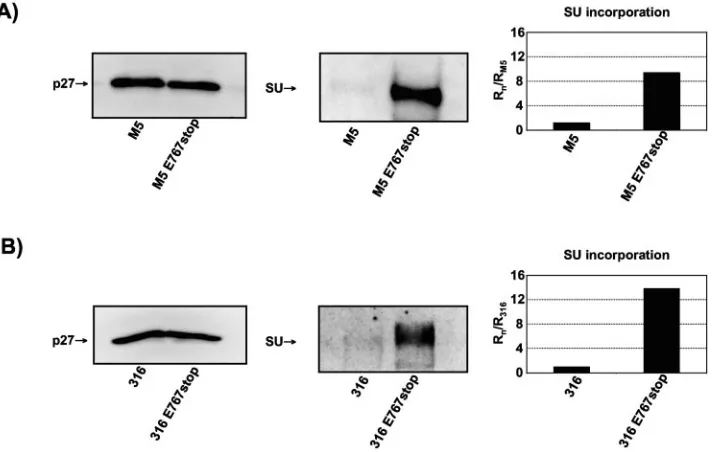
Truncation of the gp41 cytoplasmic domain results in an increase in envelope incorporation into virions.To investigate the effects of truncation of the cytoplasmic domain of TM, we used site-specific mutagenesis to introduce a stop codon at residue 767, resulting in the truncation of 119 residues from the C-terminal tail of SIV239-M5 and SIV316. This particular mutation was selected because truncation at this residue has been associated with a 25- to 40-fold increase in envelope incorporation in the background of SIV239 (56). SIV239-M5 and SIV316 viruses were selected to represent, together with SIV239, a broad range of neutralization sensitivities: SIV239 (difficult to neutralize), SIV239-M5 (moderately neutralization sensitive, lacking fiveN-glycans in gp120 sites [44, 45]), and SIV316 (macrophage-tropic and neutralization sensitive [37]). We used virus produced by transfection of cloned DNA into 293T cells to investigate the effect of mutation E767stop in different viral backgrounds. To assess Env incorporation into virions, we pelleted the virus from the supernatant of trans-fected cells. The amounts of p27 Gag antigen in pelleted viri-ons were assessed by an antigen capture assay, and normalized
12456 YUSTE ET AL. J. VIROL.
on November 8, 2019 by guest
http://jvi.asm.org/
amounts of p27-containing virions were analyzed by Western blotting for SU (gp120) content (Fig. 1). Truncated forms of TM in both viral backgrounds displayed similar elevated levels of Env incorporation into virions after transfection of 293T cells (10- to 15-fold) (Fig. 1). The increase in virion Env con-tent resulting from truncation of SIV316 and SIV239-M5 was slightly less than that observed previously for the same muta-tion in the SIV239 background (56).
Effects of gp41 cytoplasmic tail truncation on infectivity.
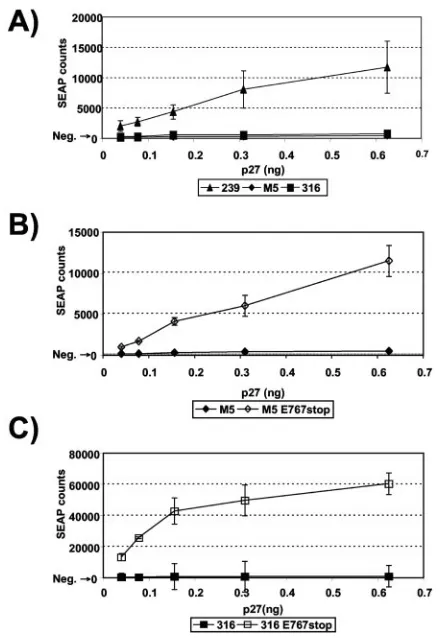
LTR-SEAP-CEMx174 cells were used to quantitate the infec-tivities of the viruses under conditions that approximated a single cycle of infection. LTR-SEAP-CEMx174 cells were in-fected with normalized amounts of SIV239-M5, SIV316, and the corresponding mutants with the truncation E767stop in the transmembrane protein. LTR-SEAP-CEMx174 cells secrete SEAP into the medium in response to infection by SIV. The amount of SEAP secreted correlates directly with the amount of infecting virus and can be sensitively and rapidly measured by a chemiluminescent assay. The results of a representative experiment are shown in Fig. 2. Mutation E767stop increased infectivity in both genetic backgrounds but to dramatically different degrees. Truncation of CD in SIV239-M5 increased infectivity approximately 24-fold, while truncation of CD in SIV316 increased infectivity approximately 480-fold. A sum-mary of the relative infectivities of SIV239, SIV316, SIV239-M5, and their truncated derivatives is shown in Table 1.
Effects of gp41 cytoplasmic tail truncation on sensitivity to antibody-mediated neutralization. Despite the fact that the sequences of these viruses differ minimally from one another, they displayed a wide range of susceptibility to neutralization by SIV-positive monkey plasma and monoclonal antibodies (20). SIV239 was routinely found to be resistant to antibody-mediated neutralization, with neutralization detectable only at
the lowest dilutions (1:20 to 1:40) of pooled plasma from SIV-positive monkeys (Fig. 3). In contrast, SIV316 and SIV239-M5 were found to be sensitive to neutralization by SIV-positive plasma. Fifty-percent neutralization of SIV316 and SIV239-M5 with pooled SIV-positive plasma is typically achieved at dilutions ⬎1,000 or ⬎100, respectively. Mutation E767stop decreased sensitivity to antibody-mediated neutralization by plasma from SIV-positive monkeys in the three viral back-grounds tested (SIV239, SIV239-M5, and SIV316), but the degree of decrease was different for each virus (Fig. 3). Trun-cation of the transmembrane protein in SIV239 changed the 50% neutralization dilution from 1:40 to 1:20. However, the same mutation (E767stop) in a SIV316 background had a more dramatic effect. Fifty percent neutralization of SIV316 with a full-length TM was achieved with a 1:3,000 dilution of the SIV-positive plasma, but no neutralization was observed at any dilution when the truncating mutation was introduced into SIV316. SIV239-M5 had an intermediate phenotype with a change in 50% neutralization from 1:360 to 1:70 when trunca-tion at positrunca-tion 767 was introduced in the transmembrane protein.
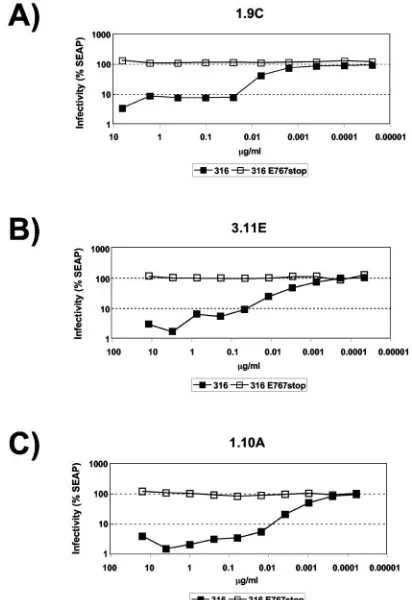
[image:3.585.117.473.71.297.2]We next measured neutralization of SIV239, SIV239-M5, SIV316, and their corresponding mutants with monoclonal an-tibodies derived from experimentally infected, SIV-positive rhesus macaques (RhMAbs). Three anti-gp120 RhMAbs from three different competition groups were used for this study (1.9C, 3.11E, and 1.10A). These monoclonal antibodies have been described previously (8, 20, 46). SIV239 and the corre-sponding truncated mutant were not effectively neutralized by any of the RhMAbs (Table 2). Consistent with the results with positive rhesus monkey sera, sensitivity to neutralization of SIV239-M5 and SIV316 by RhMAbs decreased when the transmembrane protein was truncated at position 767. Fifty
FIG. 1. Effect of mutation E767stop in Env on incorporation into virions in two different viruses: SIV239-M5 (A) and SIV316 (B). Viruses were produced by transfection into 293T cells, and virions were pelleted from the clarified supernatants. gp120 and p27 were detected by Western blotting using 3.11H and 2F12 monoclonal antibodies. Relative SU incorporation into virions was calculated by the ratios of gp120 to p27 using phosphorimaging analysis. Data from the mutants are presented relative to the ratio found for SIV239-M5 (A) or SIV316 (B).
on November 8, 2019 by guest
http://jvi.asm.org/
percent neutralization of SIV239-M5 by 3.11E decreased from 2.8 g/ml to 4.8 g/ml when mutation E767stop was intro-duced. Fifty percent neutralization of SIV239-M5 was achieved with a concentration of 12.5g/ml of 1.10A, but the corresponding mutant could not be neutralized by this RhMAb at any of the higher concentrations tested. The 1.9C monoclo-nal antibody could not effectively neutralize SIV239-M5 or
SIV239-M5 E767stop at the highest concentration tested (6.38
g/ml). The effect of the truncation in the transmembrane protein was more dramatic in SIV316. Fifty percent neutral-ization of the parental SIV316 was achieved at 0.004g/ml for 3.11E, 0.008g/ml for 1.9C, and 0.0009g/ml for 1.10A but, when mutation E767stop was introduced, the virus could not be neutralized at any of the concentrations tested (Fig. 4 and Table 2).
[image:4.585.301.543.68.400.2]The differences in levels of envelope incorporated into viri-ons are insufficient to explain the differences in infectivity and sensitivity to antibody-dependent neutralization of SIV316.In order to clarify if envelope incorporation is the only factor responsible for the increase in infectivity and the decrease in sensitivity to antibody-mediated neutralization observed with SIV316, we used envelope transcomplementation to incorpo-rate different levels of Env into virions. Virions obtained in this way may have different spike densities, but there will be no difference in sequence. 293T cells were cotransfected with in-creasing amounts (0.039g to 10 g) of the Env expression-optimized plasmids (SIV316open or E767stop) together with full-length SIV316 proviral DNA. To analyze the infectivity of these viruses with various amounts of Env provided intrans, we infected LTR-SEAP-CEMx174 cells under conditions that ap-proximated a single cycle of infection as described above. The
FIG. 2. Comparative infectivity of SIV239, SIV239-M5, SIV316, and the truncating mutants SIV239-M5 E767stop and SIV316 E767stop. SIV239, SIV239-M5, and SIV316 (A), SIV239-M5 versus SIV239-M5 E767stop (B), and SIV316 versus SIV316 E767stop (C) are compared. Virus stocks were obtained from transfection of 293T cells. Stocks were normalized for the amount of p27 and used to infect LTR-SEAP-CEMx174 cells. SEAP activity was measured by use of a Phosphalight kit according to the manufacturer’s recommenda-tions at 3 days postinfection.
[image:4.585.53.273.70.389.2]FIG. 3. Comparative neutralization of SIV239, SIV239-M5, SIV316, and their corresponding E767stop mutants by a pool of SIV-positive plasma. (A) SIV239 versus SIV239 E767stop; (B) SIV239-M5 versus SIV239-M5 E767stop; (C) SIV316 versus SIV316 E767stop.
TABLE 1. Strain comparisons
Comparison strain Env content in
virionsa Infectivityb
SIV239 1 1
SIV239 E767stop 25 2.5
SIV239-M5 0.2 0.04
SIV239-M5 E767stop 2 1
SIV316 0.5 0.05
SIV316 E767stop 7 24
aRelative to SIV239 (normalized as 1). SIV239 has been previously estimated
to contain 7 to 16 trimer spikes per virion (7, 53, 55).
bMeasured in LTR-SEAP-CEMx174 cells relative to SIV239 (normalized as
1).
12458 YUSTE ET AL. J. VIROL.
on November 8, 2019 by guest
http://jvi.asm.org/
[image:4.585.41.284.607.691.2]infectivities per nanogram of p27 are shown in Fig. 5 (notice the difference in scales in panels A and B). We observed an increase in infectivity when virus was produced by cotransfec-tion with the Env expression plasmid for both SIV316open and SIV316 E767stop envelopes. The increase in infectivity in both cases correlated with the amount of envelope provided intrans. However, the effect was much more dramatic when the Env incorporated intrans had the truncated cytoplasmic domain. When SIV316open envelope was incorporated in trans, the highest increase in infectivity achieved was 2.3-fold. However, when SIV316 E767stop was incorporated intrans, the amount of alkaline phosphatase secreted into the medium was in-creased over 30-fold (Fig. 5).
These viruses were also used to investigate effects on sensi-tivity to antibody-mediated neutralization. In this analysis we measured neutralization of the viruses with different amounts
[image:5.585.323.517.68.311.2]of envelope provided in trans (SIV316open or SIV316 E767stop) with a pooled SIV-positive plasma as described above (Fig. 6). In both cases a decrease in sensitivity to anti-body-mediated neutralization was observed when the amount of envelope provided in trans was increased. Percentage of SEAP activity at a 1:51,200 dilution of the SIV-positive plasma for the viruses with SIV316open Env incorporated intransand a 1:200 dilution for the viruses with SIV316 E767stop Env incorporated intransare shown in Fig. 6A and B. After neu-tralization of SIV316 with a 1:51,200 dilution of the SIV-pos-itive plasma, the percentage of SEAP activity was reduced to 48%. However, when the amount of SIV316open Env was increased by envelope expression in trans, the sensitivity to neutralization decreased and the virus could only be neutral-ized with a 1:51,200 dilution of the SIV-positive plasma when
FIG. 4. Comparative neutralization of SIV316 and SIV316 E767stop by rhesus anti-gp120 MAbs from three different competition groups. (A) 1.9C; (B) 3.11E; (C) 1.10A.
FIG. 5. Effects on infectivity of increasing amounts of envelope incorporated in virions intrans. Viruses were produced by cotransfec-tion of SIV316open full-length plasmid and two different envelope expression-optimized plasmids (SIV316 and SIV316 E767stop). (A) SIV316 Env expression-optimized plasmid incorporated intrans. (B) SIV316 E767stop Env expression-optimized plasmid incorporated intrans. Stocks were normalized to the amount of p27 and used to infect LTR-SEAP-CEMx174 cells. SEAP activity was measured by use of a Phosphalight kit according to the manufacturer’s recommenda-tions at 3 days postinfection. SEAP activity was normalized to the amount of p27.
TABLE 2. Neutralization by anti-gp 120 RhMAbs
MAb
Concn of MAb (g/ml) reducing infectivity by 50%a
SIVmac239 SIV239 E767Stop SIV239-M5 SIV239-M5 E767Stop SIV316 SIV316 E767Stop
3.11E — — 2.8 4.8 0.004 —
1.9C — — — — 0.008 —
1.10A — — 12.5 — 0.0009 —
aThe numbers indicate the concentration of MAb required to reduce infectivity of the indicated virus by 50%. —, 50% neutralization was not achieved at the highest
concentration tested (11.75g/ml for 3.11E, 6.38g/ml for 1.9C, and 15g/ml for 1.10A).
on November 8, 2019 by guest
http://jvi.asm.org/
[image:5.585.59.265.72.372.2]the lowest amounts of envelope were provided intrans (full-length SIV316 viral DNA cotransfected with 2.5 or less micro-grams of the Env expression-optimized plasmid in Fig. 6A). In contrast, sensitivity to neutralization was drastically reduced when SIV316 E767stop envelope was provided in trans. A reduction in the percentage of SEAP activity was only ob-served with the highest concentration of SIV-positive plasma tested (1:200) and only in the viruses with the lowest amount of envelope provided intrans. After neutralization of SIV316 with a 1:200 dilution of SIV-positive plasma, the percentage of SEAP activity was reduced to 7%. However, when SIV316 E767stop Env was provided intrans, some neutralization was achieved only with the viruses with the lowest amounts of envelope (full-length SIV316 viral DNA cotransfected with 0.156 or less micrograms of the E767stop Env expression-optimized plasmid) (Fig. 6B).
Truncation of the gp41 cytoplasmic domain in SIV316 re-sults in an increased affinity for soluble CD4.We next studied the effects of soluble CD4 (sCD4) on inhibiting infection by these viruses with and without a truncated CD. Viruses pro-duced by transient transfection in 293T cells were incubated with increasing concentrations of sCD4 for 1 h at 37°C prior to the infection of LTR-SEAP-CEMx174 SEAP cells. sCD4 ex-hibited a modest inhibitory activity against SIV239. Fifty per-cent inhibition of infectivity was achieved with 2.5g/ml of sCD4. Consistent with previous publications (33, 50), SIV316 was considerably more sensitive to inhibition by sCD4. Only 0.25g/ml was required to reduce viral infectivity by 50% (Fig. 7 and Table 3). No significant inhibitory activity was observed
against viruses with a truncated envelope protein in a SIV239 or SIV239-M5 background (Fig. 7 and Table 3). In contrast, when the truncating mutation was introduced in a SIV316 background, the inhibitory effect of sCD4 on infection with the resulting virus was similar to the effect observed for SIV316 with a full-length transmembrane protein (Fig. 7 and Table 3).
DISCUSSION
Our findings demonstrate that truncation at E767 results in increased envelope content in virions in all three SIV genetic
[image:6.585.69.259.66.291.2] [image:6.585.312.529.70.380.2]FIG. 6. Comparative neutralization of viruses with increasing amounts of envelope incorporated in virions intranswith a pool of SIV-positive plasma. Viruses were produced by cotransfection of SIV316open full-length plasmid and two different envelope expres-sion-optimized plasmids (SIV316 and SIV316 E767stop). (A) SEAP activity after neutralization with a 1/51,200 dilution of a pool of SIV-positive plasma when SIV316 Env expression-optimized plasmid was incorporated in trans. (B) SEAP activity after neutralization with a 1/200 dilution of a pool of SIV-positive plasma when SIV316 E767stop Env expression-optimized plasmid was incorporated intrans.
[image:6.585.300.541.601.691.2]FIG. 7. Comparative inhibition of SIV239, SIV239-M5, SIV316, and their corresponding E767stop mutants by soluble CD4. (A) SIV239 versus SIV239 E767stop; (B) SIV239-M5 versus SIV239-M5 E767stop; (C) SIV316 versus SIV316 E767stop.
TABLE 3. Inhibition of infectivity by sCD4
Virus
Concn of sCD4 (g/
ml) reducing
infectivity by 50%a
SIVmac239 ... 2.5 SIVmac239 E767Stop ...⬎12.5b
SIVmac239-M5... 3.3 SIVmac239-M5 E767Stop...⬎12.5b
SIVmac316 ... 0.25 SIVmac316 E767Stop ... 0.33
aThe numbers indicate the concentration of sCD4 required to reduce
infec-tivity of the indicated virus by 50%.
bA 50% inhibition was not achieved at the highest concentration tested (12.5
g/ml).
12460 YUSTE ET AL. J. VIROL.
on November 8, 2019 by guest
http://jvi.asm.org/
backgrounds tested: SIV239, SIV239-M5, and SIV316. These results are consistent with a number of earlier publications reporting increased envelope content in virions as a result of truncation (31, 51, 56, 59). The 767 truncation was used be-cause it occurred naturally in the lung compartment of a rhesus monkey during the course ofenvsequence evolution following infection by cloned SIV239 (37). The amount of envelope protein incorporated into virions varies with the location of the truncation (56) and correlates strictly with the level of enve-lope protein expression on the cell surface (56). This suggests that the rate or extent of endocytosis from the cell surface may be a critical determinant of the level of Env incorporated into virions, as suggested earlier by LaBranche et al. (26). Our previous estimate of 7 to 16 trimer spikes per SIV239 virion (56) agrees well with estimates by Chertova et al. (7), who utilized different biochemical methodologies, and with esti-mates of Zhu et al. (58) obtained using electron tomography analysis. The range of 7 to 16 reflects uncertainty in the num-ber of Gag molecules per virion on which the calculations are based. Here we show that SIV316 and SIV239-M5 have similar or slightly lower amounts of Env per p27 content than SIV239. Truncation at E767 increased envelope content in virions from 10-fold (SIV239-M5) to 25-fold (SIV239).
Two factors likely contribute to the increased infectivity as-sociated with the E767 truncation: increased virion Env con-tent and an increase in the inherent efficiency of viral entry on a per spike basis. Increased efficiency of productive entry ap-pears to be particularly prominent for SIV316E767stop. In contrast to SIV239 and SIV239-M5, truncation in the context of SIV316 produced an increase in infectivity that was far disproportional to the increase in Env content. Furthermore, when increasing amounts of SIV316 Env-open were titrated into SIV316, only modest increases in infectivity were ob-served. When increasing amounts of 316 Env-truncated were titrated into SIV316, dramatic increases in infectivity were observed. Truncation at E767 increased infectivity from 2.5-fold (SIV239) (56) to 480-2.5-fold (SIV316). Thus, the extent to which these two factors, virion Env content versus inherent efficiency of productive entry, contribute to the increased in-fectivity of truncated derivatives appears to vary with the SIV genetic context. Similar results have been described for SIV when a truncation of gp41 was introduced in the context of MA mutations (32). In this study, truncations of gp41 increased infectivity 13- to 18-fold. However, in the context of MA mu-tations that compromised infectivity, the truncation resulted in dramatic increases in infectivity, from 100- to 1,300-fold de-pending on the MA mutation.
Decreased sensitivity of truncated derivatives to antibody-mediated neutralization similarly appears to have two contrib-uting components: Env content in virions and inherent effi-ciency of entry. The shift to increased resistance to neutralization of truncated SIV239-M5 was modest with both polyclonal SIV⫹monkey plasma and with assorted monoclonal antibodies. The resistance of truncated SIV316 to antibody-mediated neutralization, in contrast, was dramatic. Although SIV316 with a full-length envelope transmembrane glycopro-tein is one of the most neutralization-sensitive strains we have studied (20), we were unable to detect any neutralization of SIV316E767stop with any of the antibodies we tested. The extreme resistance of SIV316E767stop is associated with its
extreme efficiency at productive entry into target cells: SIV316E767stop is 10 to 25 times more efficient at productive entry into CEMX174 target cells than SIV239 or SIV239E767 stop (Fig. 2 and Table 1). In support of a role for entry kinetics in neutralization resistance/sensitivity, Reeves et al. recently observed increased neutralization sensitivity in a subset of in-hibitor resistance mutants of HIV-1 that also display reduced fusion efficiency and delayed kinetics of entry (43).
The effects of virion Env content on sensitivity to neutral-ization have relevance for the interpretation of neutralneutral-ization tests that employenv-deleted provirus and HIV and SIV en-velope protein provided intrans, so-called pseudotype assays. Our results (Fig. 6) show that increasing the amount of enve-lope provided intranscan decrease the sensitivity to antibody-mediated neutralization. It is reasonable to think that provi-sion of lower, limiting amounts of envelope in trans in pseudotype assays will increase the sensitivity to antibody-me-diated neutralization. In effect, neutralization titers that are obtained using pseudotype assays will be dependent upon how much envelope protein is provided intrans.
Just as increased envelope content requires increased amounts of antibody to achieve the same level of neutraliza-tion, increased envelope content would be expected to require increased levels of sCD4 for neutralization. Thus, the higher 50% inhibitory concentration for sCD4 neutralization of trun-cated derivatives of SIV239 and SIV239-M5 can be explained by the increased envelope content of these strains compared to the parents from which they were derived. However, we cannot rule out a contribution of decreased affinity for sCD4 resulting from the truncation. The equivalent sensitivities of truncated and nontruncated SIV316 to sCD4 suggest that SIV316E767stop may have an even higher affinity for sCD4 than SIV316. If this indeed were the case, the impressive effi-ciency of productive entry by SIV316E767stop could be ex-plained at least in part by an increased affinity for its initial receptor CD4.
The increased infectivity of SIV316 virions when excess 316 Env (full length) is provided intrans(Fig. 5) is likely to result from increased envelope protein content in virions. Thus, the amount of envelope protein with a full-length cytoplasmic tail that is incorporated into virions can apparently be increased over that which occurs naturally when virions are produced from cells transfected with proviral DNA. However, questions still remain regarding the extent to which the long cytoplasmic domain may limit packing density in virions and the biological advantages that accrue to virions that naturally possess such a low envelope protein content.
ACKNOWLEDGMENTS
We thank James Robinson for the gift of monoclonal antibodies used for Western blot detection and neutralization. We also thank Jacqueline Bixby for technical support and Deborah Letourneau for assistance in preparing the manuscript. We thank Margherita Rosati and Barbara Felber for the RNA optimized vector SIV239env 64S.
This work was supported by U.S. Public Health Service grants R01AI50421 (R.C.D.), R01-AI057039 (W.E.J.), and RR00168 (New England Primate Research Center).
REFERENCES
1.Akari, H., T. Fukumori, and A. Adachi.2000. Cell-dependent requirement of human immunodeficiency virus type 1 gp41 cytoplasmic tail for Env
incor-poration into virions. J. Virol.74:4891–4893.
on November 8, 2019 by guest
http://jvi.asm.org/
2.Berger, E. A., P. M. Murphy, and J. M. Farber.1999. Chemokine receptors as HIV-1 coreceptors: roles in viral entry, tropism, and disease. Annu. Rev.
Immunol.17:657–700.
3.Berlioz-Torrent, C., B. L. Shacklett, L. Erdtmann, L. Delamarre, I. Bouchaert, P. Sonigo, M. C. Dokhelar, and R. Benarous.1999. Interactions of the cytoplasmic domains of human and simian retroviral transmembrane proteins with components of the clathrin adaptor complexes modulate in-tracellular and cell surface expression of envelope glycoproteins. J. Virol.
73:1350–1361.
4.Blot, G., K. Janvier, S. Le Panse, R. Benarous, and C. Berlioz-Torrent.2003. Targeting of the human immunodeficiency virus type 1 envelope to the
trans-Golgi network through binding to TIP47 is required for env
incorpo-ration into virions and infectivity. J. Virol.77:6931–6945.
5.Boge, M., S. Wyss, J. S. Bonifacino, and M. Thali. 1998. A membrane-proximal tyrosine-based signal mediates internalization of the HIV-1 enve-lope glycoprotein via interaction with the AP-2 clathrin adaptor. J. Biol.
Chem.273:15773–15778.
6.Bultmann, A., W. Muranyi, B. Seed, and J. Haas.2001. Identification of two sequences in the cytoplasmic tail of the human immunodeficiency virus type
1 envelope glycoprotein that inhibit cell surface expression. J. Virol. 75:
5263–5276.
7.Chertova, E., J. W. Bess, Jr., B. J. Crise, I. R. Sowder, T. M. Schaden, J. M. Hilburn, J. A. Hoxie, R. E. Benveniste, J. D. Lifson, L. E. Henderson, and L. O. Arthur.2002. Envelope glycoprotein incorporation, not shedding of surface envelope glycoprotein (gp120/SU), is the primary determinant of SU content of purified human immunodeficiency virus type 1 and simian
immu-nodeficiency virus. J. Virol.76:5315–5325.
8.Cole, K. S., M. Alvarez, D. H. Elliott, H. Lam, E. Martin, T. Chau, K. Micken, J. L. Rowles, J. E. Clements, M. Murphey-Corb, R. C. Montelaro, and J. E. Robinson.2001. Characterization of neutralization epitopes of simian immunodeficiency virus (SIV) recognized by rhesus monoclonal an-tibodies derived from monkeys infected with an attenuated SIV strain.
Vi-rology290:59–73.
9.Cosson, P.1996. Direct interaction between the envelope and matrix
pro-teins of HIV-1. EMBO J.15:5783–5788.
10.Deschambeault, J., J. P. Lalonde, G. Cervantes-Acosta, R. Lodge, E. A. Cohen, and G. Lemay.1999. Polarized human immunodeficiency virus bud-ding in lymphocytes involves a tyrosine-based signal and favors cell-to-cell
viral transmission. J. Virol.73:5010–5017.
11.Desrosiers, R. C.2001. Nonhuman lentiviruses, p. 2095–2122.InD. M. Knipe and P. M. Howley. (ed.), Fields virology, vol. 2. Lippincott Williams and Wilkins, Philadelphia, Pa.
12.Dorfman, T., F. Mammano, W. A. Haseltine, and H. G. Gottlinger.1994. Role of the matrix protein in the virion association of the human
immuno-deficiency virus type 1 envelope glycoprotein. J. Virol.68:1689–1696.
13.Dubay, J. W., S. J. Roberts, B. H. Hahn, and E. Hunter.1992. Truncation of the human immunodeficiency virus type 1 transmembrane glycoprotein
cy-toplasmic domain blocks virus infectivity. J. Virol.66:6616–6625.
14.Evans, D. T., K. C. Tillman, and R. C. Desrosiers.2002. Envelope glyco-protein cytoplasmic domains from diverse lentiviruses interact with the
pre-nylated Rab acceptor. J. Virol.76:327–337.
15.Facke, M., A. Janetzko, R. L. Shoeman, and H. G. Krausslich.1993. A large
deletion in the matrix domain of the human immunodeficiency virusgaggene
redirects virus particle assembly from the plasma membrane to the
endo-plasmic reticulum. J. Virol.67:4972–4980.
16.Freed, E. O., and M. A. Martin.1995. Virion incorporation of envelope glycoproteins with long but not short cytoplasmic tails is blocked by specific, single amino acid substitutions in the human immunodeficiency virus type 1
matrix. J. Virol.69:1984–1989.
17.Gabuzda, D. H., A. Lever, E. Terwilliger, and J. Sodroski.1992. Effects of deletions in the cytoplasmic domain on biological functions of human
im-munodeficiency virus type 1 envelope glycoproteins. J. Virol.66:3306–3315.
18.Haffar, O. K., G. R. Nakamura, and P. W. Berman.1990. The carboxy terminus of human immunodeficiency virus type 1 gp160 limits its proteolytic
processing and transport in transfected cell lines. J. Virol.64:3100–3103.
19.Higgins, J. R., S. Sutjipto, P. A. Marx, and N. C. Pedersen.1992. Shared antigenic epitopes of the major core proteins of human and simian
immu-nodeficiency virus isolates. J. Med. Primatol.21:265–269.
20.Johnson, W. E., H. Sanford, L. Schwall, D. R. Burton, P. W. Parren, J. E. Robinson, and R. C. Desrosiers.2003. Assorted mutations in the envelope gene of simian immunodeficiency virus lead to loss of neutralization resis-tance against antibodies representing a broad spectrum of specificities. J.
Vi-rol.77:9993–10003.
21.Kent, K. A., E. Rud, T. Corcoran, C. Powell, C. Thiriart, C. Collignon, and E. J. Stott.1992. Identification of two neutralizing and 8 non-neutralizing epitopes on simian immunodeficiency virus envelope using monoclonal
an-tibodies. AIDS Res. Hum. Retrovir.8:1147–1151.
22.Kim, E. M., K. H. Lee, and J. W. Kim.1999. The cytoplasmic domain of HIV-1 gp41 interacts with the carboxyl-terminal region of alpha-catenin.
Mol. Cell9:281–285.
23.Kodama, T., D. P. Wooley, Y. M. Naidu, H. W. Kestler III, M. D. Daniel, Y.
Li, and R. C. Desrosiers.1989. Significance of premature stop codons inenv
of simian immunodeficiency virus. J. Virol.63:4709–4714.
24.Kwong, P. D., R. Wyatt, J. Robinson, R. W. Sweet, J. Sodroski, and W. A. Hendrickson.1998. Structure of an HIV gp120 envelope glycoprotein in complex with the CD4 receptor and a neutralizing human antibody. Nature
393:648–659.
25.LaBranche, C. C., M. M. Sauter, B. S. Haggarty, P. J. Vance, J. Romano, T. K. Hart, P. J. Bugelski, and J. A. Hoxie.1994. Biological, molecular, and structural analysis of a cytopathic variant from a molecularly cloned simian
immunodeficiency virus. J. Virol.68:5509–5522.
26.LaBranche, C. C., M. M. Sauter, B. S. Haggarty, P. J. Vance, J. Romano, T. K. Hart, P. J. Bugelski, M. Marsh, and J. A. Hoxie.1995. A single amino acid change in the cytoplasmic domain of the simian immunodeficiency virus transmembrane molecule increases envelope glycoprotein expression on
in-fected cells. J. Virol.69:5217–5227.
27.Laemmli, U. K.1970. Cleavage of structural proteins during the assembly of
the head of bacteriophage T4. Nature227:680–685.
28.Lodge, R., H. Gottlinger, D. Gabuzda, E. A. Cohen, and G. Lemay.1994. The intracytoplasmic domain of gp41 mediates polarized budding of human
im-munodeficiency virus type 1 in MDCK cells. J. Virol.68:4857–4861.
29.Lodge, R., J. P. Lalonde, G. Lemay, and E. A. Cohen.1997. The membrane-proximal intracytoplasmic tyrosine residue of HIV-1 envelope glycoprotein is critical for basolateral targeting of viral budding in MDCK cells. EMBO J.
16:695–705.
30.Luciw, P. A., K. E. Shaw, B. L. Shacklett, and M. L. Marthas.1998. Impor-tance of the intracytoplasmic domain of the simian immunodeficiency virus
(SIV) envelope glycoprotein for pathogenesis. Virology252:9–16.
31.Manrique, J. M., C. C. Celma, J. L. Affranchino, E. Hunter, and S. A. Gonzalez.2001. Small variations in the length of the cytoplasmic domain of the simian immunodeficiency virus transmembrane protein drastically affect
envelope incorporation and virus entry. AIDS Res. Hum. Retrovir.17:1615–
1624.
32.Manrique, J. M., C. C. Celma, E. Hunter, J. L. Affranchino, and S. A. Gonzalez.2003. Positive and negative modulation of virus infectivity and envelope glycoprotein incorporation into virions by amino acid substitutions at the N terminus of the simian immunodeficiency virus matrix protein.
J. Virol.77:10881–10888.
33.Means, R. E., and R. C. Desrosiers.2000. Resistance of native, oligomeric envelope on simian immunodeficiency virus to digestion by glycosidases.
J. Virol.74:11181–11190.
34.Means, R. E., T. Greenough, and R. C. Desrosiers.1997. Neutralization sensitivity of cell culture-passaged simian immunodeficiency virus. J. Virol.
71:7895–7902.
35.Moore, J. P., Q. J. Sattentau, R. Wyatt, and J. Sodroski.1994. Probing the structure of the human immunodeficiency virus surface glycoprotein gp120
with a panel of monoclonal antibodies. J. Virol.68:469–484.
36.Moore, J. P., and J. Sodroski.1996. Antibody cross-competition analysis of the human immunodeficiency virus type 1 gp120 exterior envelope
glyco-protein. J. Virol.70:1863–1872.
37.Mori, K., D. J. Ringler, T. Kodama, and R. C. Desrosiers.1992. Complex determinants of macrophage tropism in env of simian immunodeficiency
virus. J. Virol.66:2067–2075.
38.Morrison, H. G., F. Kirchhoff, and R. C. Desrosiers.1993. Evidence for the
cooperation of gp120 amino acids 322 and 448 in SIVmacentry. Virology
195:167–174.
39.Murakami, T., and E. O. Freed.2000. The long cytoplasmic tail of gp41 is required in a cell type-dependent manner for HIV-1 envelope glycoprotein
incorporation into virions. Proc. Natl. Acad. Sci. USA97:343–348.
40.Parren, P. W., J. P. Moore, D. R. Burton, and Q. J. Sattentau.1999. The neutralizing antibody response to HIV-1: viral evasion and escape from
humoral immunity. AIDS13(Suppl. A):S137–S162.
41.Pierson, T. C., and R. W. Doms.2003. HIV-1 entry and its inhibition. Curr.
Top. Microbiol. Immunol.281:1–27.
42.Piller, S. C., J. W. Dubay, C. A. Derdeyn, and E. Hunter.2000. Mutational analysis of conserved domains within the cytoplasmic tail of gp41 from human immunodeficiency virus type 1: effects on glycoprotein incorporation
and infectivity. J. Virol.74:11717–11723.
43.Reeves, J. D., F. H. Lee, J. L. Miamidian, C. B. Jabara, M. M. Juntilla, and R. W. Doms.2005. Enfuvirtide resistance mutations: impact on human im-munodeficiency virus envelope function, entry inhibitor sensitivity, and virus
neutralization. J. Virol.79:4991–4999.
44.Reitter, J. N., and R. C. Desrosiers. 1998. Identification of replication-competent strains of simian immunodeficiency virus lacking multiple attach-ment sites for N-linked carbohydrates in variable regions 1 and 2 of the
surface envelope protein. J. Virol.72:5399–5407.
45.Reitter, J. N., R. E. Means, and R. C. Desrosiers.1998. A role for
carbohy-drates in immune evasion in AIDS. Nat. Med.4:679–684.
46.Robinson, J. E., K. S. Cole, D. H. Elliott, H. Lam, A. M. Amedee, R. Means, R. C. Desrosiers, J. Clements, R. C. Montelaro, and M. Murphey-Corb.
1998. Production and characterization of SIV envelope-specific rhesus monoclonal antibodies from a macaque asymptomatically infected with a live
SIV vaccine. AIDS Res. Hum. Retrovir.14:1253–1262.
12462 YUSTE ET AL. J. VIROL.
on November 8, 2019 by guest
http://jvi.asm.org/
47.Rosati, M., A. von Gegerfelt, P. Roth, C. Alicea, A. Valentin, M. Robert-Guroff, D. Venzon, D. Montefiori, P. Markham, B. K. Felber, and G. N. Pavlakis.2005. DNA vaccines expressing different forms of simian immu-nodeficiency virus antigens decrease viremia upon SIVmac251 challenge.
J. Virol.79:8480–8492.
48.Rousso, I., M. B. Mixon, B. K. Chen, and P. S. Kim.2000. Palmitoylation of the HIV-1 envelope glycoprotein is critical for viral infectivity. Proc. Natl.
Acad. Sci. USA97:13523–13525.
49.Rowell, J. F., P. E. Stanhope, and R. F. Siliciano.1995. Endocytosis of endogenously synthesized HIV-1 envelope protein. Mechanism and role in
processing for association with class II MHC. J. Immunol.155:473–488.
50.Schenten, D., L. Marcon, G. B. Karlsson, C. Parolin, T. Kodama, N. Gerard, and J. Sodroski.1999. Effects of soluble CD4 on simian immunodeficiency
virus infection of CD4-positive and CD4-negative cells. J. Virol.73:5373–
5380.
51.Shacklett, B. L., C. Denesvre, B. Boson, and P. Sonigo.1998. Features of the
SIVmactransmembrane glycoprotein cytoplasmic domain that are important
for Env functions. AIDS Res. Hum. Retrovir.14:373–383.
52.Srinivas, S. K., R. V. Srinivas, G. M. Anantharamaiah, R. W. Compans, and J. P. Segrest.1993. Cytosolic domain of the human immunodeficiency virus envelope glycoproteins binds to calmodulin and inhibits
calmodulin-regu-lated proteins. J. Biol. Chem.268:22895–22899.
53.Wyss, S., C. Berlioz-Torrent, M. Boge, G. Blot, S. Honing, R. Benarous, and M. Thali.2001. The highly conserved C-terminal dileucine motif in the cytosolic domain of the human immunodeficiency virus type 1 envelope
glycoprotein is critical for its association with the AP-1 clathrin adaptor
[correction of adapter]. J. Virol.75:2982–2992.
54.Yang, C., and R. W. Compans.1996. Analysis of the cell fusion activities of chimeric simian immunodeficiency virus-murine leukemia virus envelope
proteins: inhibitory effects of the R peptide. J. Virol.70:248–254.
55.Yu, X., X. Yuan, M. F. McLane, T. H. Lee, and M. Essex.1993. Mutations in the cytoplasmic domain of human immunodeficiency virus type 1 transmem-brane protein impair the incorporation of Env proteins into mature virions.
J. Virol.67:213–221.
56.Yuste, E., J. D. Reeves, R. W. Doms, and R. C. Desrosiers.2004. Modulation of Env content in virions of simian immunodeficiency virus: correlation with
cell surface expression and virion infectivity. J. Virol.78:6775–6785.
57.Zhang, H., L. Wang, S. Kao, I. P. Whitehead, M. J. Hart, B. Liu, K. Duus, K. Burridge, C. J. Der, and L. Su.1999. Functional interaction between the cytoplasmic leucine-zipper domain of HIV-1 gp41 and p115-RhoGEF. Curr.
Biol.9:1271–1274.
58.Zhu, P., E. Chertova, J. Bess, Jr., J. D. Lifson, L. O. Arthur, J. Liu, K. A. Taylor, and K. H. Roux.2003. Electron tomography analysis of envelope glycoprotein trimers on HIV and simian immunodeficiency virus virions.
Proc. Natl. Acad. Sci. USA100:15812–15817.
59.Zingler, K., and D. R. Littman.1993. Truncation of the cytoplasmic domain of the simian immunodeficiency virus envelope glycoprotein increases env
incorporation into particles and fusogenicity and infectivity. J. Virol. 67:
2824–2831.