Extending the Role of the Digital Library: Computer
Support for Creating Articles
Leslie Carr
1[email protected]
Timothy Miles-Board
1[email protected]
Gary Wills
1[email protected]
Guillermo Power
2[email protected]
Christopher Bailey
2[email protected]
Wendy Hall
1[email protected]
1Intelligence, Agents, Multimedia Group 2
Learning Technologies Group University of Southampton
Southampton, UK
Simon Grange
Royal College of Surgeons ofEngland London, UK
[email protected]
ABSTRACT
A digital library, together with its users and its contents, does not exist in isolated splendour; nor in hypertext terms is it merely the intertextual relationships between its texts. There is a cycle of activities which provides the context for the library’s existence, and which the library supports through its various roles of information access, discovery, storage, dissemination and preservation. This paper de-scribes the role of digital library systems in the undertak-ing of science, and in particular in the context of the re-cent developments of the Grid for computer-supported sci-entific collaboration and Virtual Universities for computer-supported education. This paper focuses on a specific frame-work, the Dynamic Review Journal, which supports the de-velopment and dissemination of documents by assisting au-thors in collating and analysing experimental results, or-ganising internal project discussions, and producing papers. By bridging the gap between the undertaking of experimen-tal work and the dissemination of its results through elec-tronic publication, this work addresses the cycle of activity in which a digital library rests.
Categories and Subject Descriptors
H.3.7 [INFORMATION STORAGE AND RETRIEVAL]: Digital Libraries; H.5.4 [INFORMATION INTERFACES AND PRESENTATION]: Hypertext/Hypermedia; I.7.4
Permission to make digital or hard copies of all or part of this work for personal or classroom use is granted without fee provided that copies are not made or distributed for profit or commercial advantage and that copies bear this notice and the full citation on the first page. To copy otherwise, to republish, to post on servers or to redistribute to lists, requires prior specific permission and/or a fee.
HT’04, August 9–13, 2004, Santa Cruz, California, USA.
Copyright 2004 ACM 1-58113-848-2/04/0008 ...$5.00.
[DOCUMENT AND TEXT PROCESSING]: Electronic Publishing; J.3 [Computer Applications]: LIFE AND MEDICAL SCIENCES—Medical information systems
General Terms
Human FactorsKeywords
EPrints, E-Science, Grid, Orthopaedics, Virtual Universities
1.
INTRODUCTION
1.1
Science, Publishing, Hypertext
The accepted role of scientific and scholarly publication is to record research activity in a timely fashion, keeping others in the research community up-to-date with current developments. Until very recently, it has been the case that printed journals were the most efficient method for the dis-semination and archival of research results. Technical ad-vances in the past decade have allowed the process of schol-arly communication to take other forms, particulschol-arly in the dissemination and storage of articles via the World Wide Web.
Similarly, it may not be simply the technical support for reproducing and distributing articles electronically (elec-tronic publishing, e-print archiving and digital libraries), but also the emergence of technical support for improving human communication in the form of highly collaborative, large-scale activities and analyses (the Grid, Virtual Universities) that is likely to precipitate significant change in the field of scientific communication and significant changes in the way its communications are produced, curated and dissem-inated [14]. For example, the old medium allowed a paper to be published as the summarisation of a scientific activ-ity - the discarded raw observations that led to the article’s conclusions are replaced by a description of the method for recreating the experiment. However, researchers are becom-ing more interested in the potential of the new medium for preserving experimental data as well as experimental con-clusion: the ability to provide hypertext links between the article and the data to create an audit trail for reviewers and thus facilitate further analyses and meta-analyses.
1.2
The Grid
The Grid is a computing infrastructure for undertaking ‘big science’ [5]. Beginning as a mechanism for applying sci-entific computation to large-scale experimental procedures, it has developed to encompass large-scale human collabo-ration [6], the kind of distributed collabocollabo-ration which now characterises many areas of scientific endeavour (from par-ticle accelerators to genomic experiments). This kind of support might be in the form of video-conferencing, meet-ing facilitation or even decision rationale and group mem-ory capture rather than simply large-scale computation and peta-scale data access.
In the UK, the accepted term for scientific activities aug-mented by the Grid is ‘e-science’. This paper will adopt that term when we wish to discuss the scientific activity without unduly focusing on the enabling computational technology.
1.3
Virtual Universities
A Virtual University is a distance education programme that is delivered across the Internet: education in which students and teacher are not in the same place or the same time [2]. Virtual universities are also about large scale short-to-medium term collaborations, composing groups of people with shared educational objectives. The particular role of education in the scientific process is discussed in the next section.
1.4
Open Archiving and Sky Writing
A third string to the e-scientists’ slowly evolving bow is becoming increasingly familiar within the digital libraries community. Open Archiving [12] started with the aim of in-creasing the dissemination of scientific information by pro-moting the development of inter-operable archives of scien-tific literature. The most prominent example is the High En-ergy Physics (HEP) archive which currently has over 220,000 articles and sees 12,000 users per day.
Running in parallel to the (sometimes lengthy) publica-tion process and avoiding the toll-based access of journal subscription, the HEP archive allows physicists to increase the tempo of their literature by reducing the delay between the appearance of an article and the appearance of a citation to it to less than a month [1]. This phenomenon is fanci-fully described assky writing[9], the potential of returning
the speed of scientific communication from the year-on-year turnover of journal articles to a tempo more closely related to human conversation.
2.
DIACHRONIC SCIENCE
These technological aids, wonderful as they are, suffer from being disjoint. The current vision for the Grid focuses only on the immediate aspects of E-Science — the experi-ments, analyses and meetings which occur over the duration of a project. As well as these synchronic aspects, any sci-entific effort (and E-Scisci-entific efforts in particular) will have diachronic features, those collaborative activities which ex-tend through time, enabling the influence of the project to carry on beyond its funded timescale and disseminating its knowledge beyond the boundaries of the original collabora-tion.
These activities are a well-known part of the scientist’s profession (publishing papers, publishing data, giving sem-inars, rerunning experiments and checking others’ results, comparing approaches from different projects, generalising or specialising the work of others, and, of course, teaching). Publishing activities (the writing of reports, workshop pa-pers, and refereed conference and journal articles) have a significant effect through time. The individual publications may be the result of the immediate collaboration, with work-ing drafts exchanged between each of the project partners; the collected (linked) publications of a project show signs of the extended collaboration, as more results, analyses and conclusions emerge building successively on each previous publication. The details (ordering and preferences) of how these processes result in a combination of reports, presen-tations, conference papers, journal articles and a publicly accessible record of preprints and reprints change with the discipline in which the project is being carried out, but the general pattern remains the same.
This immediate collaboration generates ‘the literature’ which is subsequently read by other scientists in other projects, and whose work it informs and inspires. These scientists may be minded to rerun the original experiments, perhaps adapting the process in some way, to check results, or to specialise or generalise a reported principle. They, in turn, write articles which link to the original work, thus demonstrating its impact, a quality prized by tenure com-mittees and funding organisations alike. This loose-coupled, diachronic collaboration afforded by publishing affords is a principal foundation of the scientific process, whereby we “stand on the shoulders of giants”.
This is where digital libraries stand, mediating hypertext access both to publishers’ postprint certified collections and the communities’ preprint archives. However, focused as they are on acquiring, maintaining and preserving collec-tions (within a strict budget) and then providing informa-tion discovery services to their clients, the researchers and academics, they are blind to (or neutral about) the pro-cesses by which this information is created, crafted, eval-uated1
, gathered, distilled, expressed, reviewed2
and then exploited3
.
Publication provides a mechanism to extend research col-laboration beyond the confines of the original activities,
in-1
researched
2
written and published
3
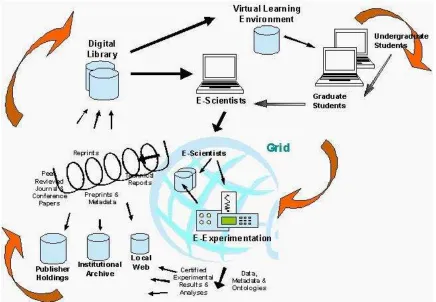
Figure 1: The E-Science Cycle
crementally advancing the scope of scientific knowledge. The current deployment of web technologies increases the effec-tiveness of this loose-coupled collaboration; the role of the digital library is to focus the various channels (archives, pub-lishers’ websites and aggregation agents) into a single portal which mediates these strands of diachronic collaboration.
There is also a looser coupling that exists between re-searchers as educators and their students, particularly in the context of higher education. Here the output of research ac-tivities is used to form and inform the next generation of scientists and E-Scientists. The deployment and adaptation of scientific materials into study packs, modules or learning objects is a crucial part of the educational process, and a rai-son d’etreof University education. It may be that the “dis-tance” between cutting-edge research and the classroom may be different for postdoctoral education (as demonstrated in a later section) and undergraduate education, but the goal of passing new information on is a kind of collaboration (in the extreme, an extended diachronic collaboration with a subsequent generation).
It seems reasonable that the accepted picture of e-science could be enlarged (see figure 1) from its current focus on experimentation and analysis to feature these processes of wider significance, since without these aspects of diachronic collaboration there would be no ongoing science and, indeed, no scientists.
3.
RELATED WORK
Dalgaard expands the notion of scholarly hypertext away from hypertext being merely intertextual relationships
be-tween articles to the relationship bebe-tween text and archive [4]. He points out that from its very inception, hypertext was thought of both at the level of the text and at the level of the network, arguing that in the context of the Web, hypertext has become the paradigmatic rhetorical structure of a global and distributed archive. Accordingly a scholarly archive is the collection of scholarly texts, and the catalogues and ref-erence works giving access to them. Dalgaard observes that most navigational options are presented as texts (lists of works, authors names, references, etc) — this is the hyper-textualization of the scholarly archive.
data and other datasets. Many e-science projects have col-lected a vast amount of data: if the next generation of e-scientists are to go beyond the present position it is essential that they have access to the raw data in their research and training. These early visions are slowly being realised, for example McGrathet al. have developed a system that will locate, browse and retrieve astronomy data across several databases [18], but there is still a need for those that have the technology skills, librarians, and users, to work together to provide appropriate tools for handling, manipulating and analysing these large datasets [20].
Marchionini and Maurer also suggested that digital li-braries should offer greater opportunities for users to de-posit information. There are projects beginning to do this, for example the Digital Library for Earth Science Educa-tion (DLESE) project allows students to explore geospatial materials and Earth data sets; groups of students can then manually create reports using this data, and discuss the re-ports [17]. Weatherley et al. have proposed a model that will aid reviewers in reviewing complex material or a digi-tal collection [22]. The peer review of collections and peer comment is a significant part of the disseminating process, which adds value to any collection. Lyon sees the digital library in the context of an information grid as consisting of a collection of resources for learning and teaching, data repositories for research purposes, or as archives of diverse cultural heritage materials [15]. While this is only a pro-posed scenario, Lyon recognises the need for researchers to undertake experiments, deposit raw data, and produce pre-prints using web services.
4.
THE DYNAMIC REVIEW JOURNAL
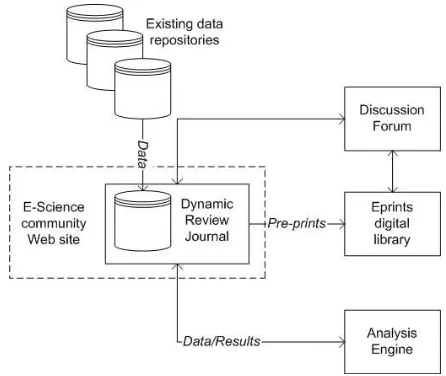
Recent advances in Web technologies allow such concepts to be realised. The Dynamic Review Journal (DRJ) has been implemented as a Web-based environment for support-ing a critical subset of the e-science cycle (figure 1): the col-lation and analysis of experimental results, the organisation of internal project discussions, and the production of appro-priate outline documents depending on the requirements of conferences and journals selected for dissemination. DRJ-Framework is the software which has been implemented to embody these process.Figure 2 illustrates the DRJ-Framework concept, in the context of an e-science community Web site and existing (in-tegrated) Web-based services. Implemented as a toolkit of generic Microsoft.NET4
components, DRJ-Framework can be integrated with existing Web sites. Although the DRJ-Framework itself provides data storage and management ca-pabilities, facilities have also been provided to help commu-nities integrate DRJ-Framework with existing data reposi-tories. Distributed eprint, discussion, and analysis services provide integrated support for document (e-print/reprint) management, communication, and e-experimentation respec-tively.
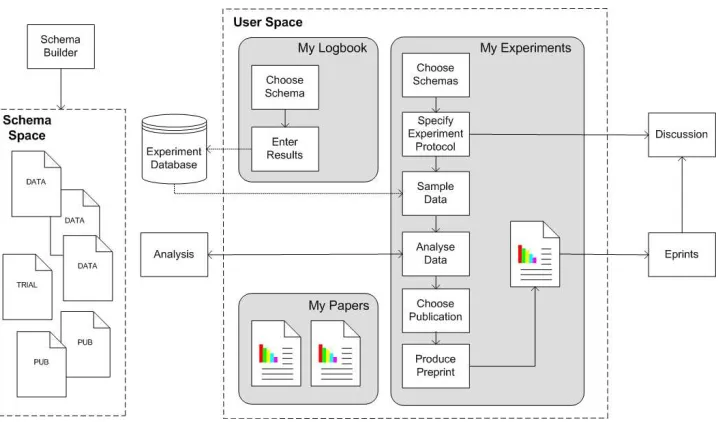
Figure 3 elaborates this picture in order to illustrate the major activity spaces in DRJ-Framework and the work-flow supported within these spaces.
4.1
Schema Space
The schema space is the mechanism by which the generic DRJ-Framework is specialised to a particular e-science
com-4
[image:4.612.324.547.52.240.2]http://www.microsoft.com/net/
Figure 2: Conceptual overview of DRJ-Framework.
munity, through the formal specification of e-experimentation procedures relevant to that community. This specification is currently achieved using three different types of schema:
Data schemas describe the exact nature of the experimen-tal data (for example, specification of variable names, types, and possible values).
Experiment schemas describe experimental procedures or
protocols. For example, a protocol could specify that any e-scientist conducting an experiment of type X
needs to record anexperiment description,statement of purposeand anoutcome hypothesis. Human-readable guidelines are also included, to help scientists meet the requirements of the protocol and to help reviewers to ensure that the requirements have been met. As a sim-ple examsim-ple, the e-scientist guidelines for the experi-ment description may state “summarise the content of the experiment”, whereas the reviewer guidelines ask “does the experiment description adequately sum-marise the content of the experiment?”.
Publication schemas describe the required format for sub-mitting experimental results to relevant journals or conferences (for example,Abstract,Introduction, Back-ground, Experimental Methods, Results, Conclusion). As with experiment schemas, human-readable guide-lines are also included in publication schemas. Where possible, the publication schema also describes map-pings with the experiment protocol (for example, spec-ifying that the experimenthypothesisshould appear in theExperimental Methodssection of the article preprint — this allows outline preprint ‘previews’ to be gener-ated semi-automatically without requiring the e-scientist to copy and paste information between protocol and preprint).
Figure 3: DRJ-Framework activity spaces and work-flow.
4.2
User Space
The user space is where e-scientists use the schema space to orchestrate practical data entry and collation,
e-experimentation, and dissemination. The user space is fur-ther subdivided into three personalised areas —My Logbook,
My Experiments, andMy Papers.
My Logbook is an experiment logbook, in which experi-mental results can be entered (in accordance with a selected data schema). Logbook entries are subsequently added to the DRJ-Framework community database, making data avail-able (anonymously) to other community members.
My Experiments is a workspace for e-experiments which the e-scientist works on. An e-scientist may be involved in an experiment in the capacity oflead investigator (initiates experiment and acts as coordinator and first point of con-tact for duration of experiment),associate investigator (as-sistant), orreviewer(monitor the progress of the experiment and review its outcomes according to guidelines). Reviewers have read-only access to the experiment protocol and set-up. When a new experiment is initiated, a discussion facility is automatically set up to facilitate and record communication between the e-scientists involved (this is also the means by which reviewers can give feed back to the practitioners).
Figure 3 outlines the work process facilitated byMy Ex-periments:
1. Choose experiment and data schemas— When an experiment is initiated, the lead investigator chooses from the schema space the experiment and data schemas which best describe the procedure to be carried out and the data to be collated (these may be existing schemas, or new schemas generated by the lead inves-tigator specifically for the experiment).
2. Specify experiment protocol — The lead investi-gator then enters the specifics of the experiment pro-tocol (in accordance with the chosen schema), includ-ing specifyinclud-ing which other community members will assist in the experiment in the roles of associate inves-tigators and reviewers. The experiment protocol may
subsequently be updated by any of the investigators, perhaps as a result of critical comment from the re-viewer.
3. Sample data — Investigators create a dataset for the experiment, either by importing their own records from theMy Logbook area, or by searching the com-munity database.
4. Analyse data — Investigators perform a series of analyses on the dataset, using a distributed analysis service, to test the experiment hypothesis.
5. Choose publication schema— To initiate the lication cycle, an investigator first chooses the pub-lication schema corresponding to the target confer-ence/journal. This produces a ‘template’ pre-print based on the conference/journal submission guidelines, which may be partially filled with data from the iment protocol (according to mappings with the exper-iment schema described in the publication schema).
6. Produce outline paper — The investigator ceeds to ‘flesh-out’ this publication template to pro-duce a basic pre-print, a process which includes select-ing which analysis results to include.
7. Submit to Eprints— The completed pre-print can be previewed before being automatically submitted to the Eprints digital library server. Subsequent versions of the pre-print leading to submission, peer review, and reprint are managed by the Eprints server. Investiga-tors continue to discuss the development of the paper in the discussion forum.
Figure 4: DRJ user space.
analyses, and produce many different pre-prints describing different aspects of the experiment.
Finally,My Papersprovides a simple shortcut allowing an e-scientist to quickly access all the papers produced by the various experiments worked on.
5.
APPLYING DRJ TO THE VOEU PROJECT
The Virtual Orthopaedic European University (VOEU) is a Virtual University dedicated to the ongoing professional education of orthopaedic surgeons across the European Com-munity. VOEU is developed by a consortium of orthopaedic surgeons drawn from six European countries with the aim of producing a system in which ‘e-surgeons’ can learn about and disseminate material on surgical techniques inOrthopaedics, especially Image Guided Orthopaedic Surgery. The VOEU-managed learning environment for training sur-geons consists of hypermedia educational material (includ-ing problem cases and assessment), interactive simulators, and communication tools (moderated and asynchronous mes-sage boards) together with the Dynamic Review Journal.
The objective of the project is to provide integrated com-puter support across the research and educational cycles be-cause these activities are intrinsically coupled as a part of the requirements of the surgeon’s Continuing Professional Development (research must be undertaken and papers pub-lished to achieve goals under the learning contracts with their Professional Colleges).
Within VOEU, a Dynamic Review Journal has two main functions; to aid surgeons in preparing findings for publica-tion, and to support the educational process. Orthopaedic surgical trials typically run for extended periods (up to 2 years), with postoperative assessment results being collected regularly. The collated results are then analysed and dis-cussed by a team of e-surgeons before being disseminated to the wider orthopaedic community. We have extended the UK arm of the VOEU Web site5
to incorporate the DRJ-Framework components and support this process. The fol-lowing procedures were necessary to achieve this integration:
• DRJ-Framework components combined with existing
VOEU “look and feel” and VOEU community vocab-ulary (for example, theMy Experiments work area be-cameMy Trials).
5
[image:6.612.102.238.51.206.2]http://voeu.ecs.soton.ac.uk/
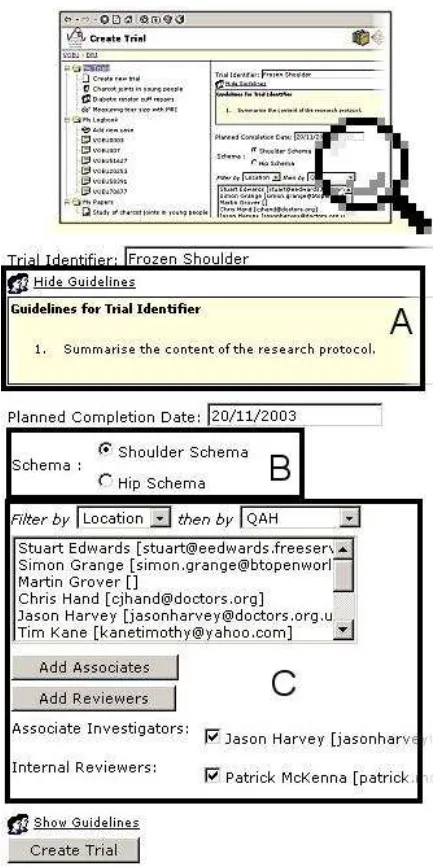
Figure 5: Entering trial protocol information.
• Experiment database initialised with a “Virtual
Ob-servatory” of orthopaedic cases.
• Schema space bootstrapped by community
represen-tatives:
Data schemas Shoulder and hip operation data, in-cluding post-operative mobility test scores.
Experiment schema Orthopaedic clinical trial pro-tocol.
Publication schemas Submission formats for the Jour-nal of Bone & Joint Surgery6
and the British Medical Journal7
.
6
http://www.ejbjs.org/
7
Figure 6: Searching the Virtual Observatory.
5.1
Managing E-Experiments:
Example Scenario
To illustrate the DRJ-Framework in the VOEU context, this section outlines the process of managing e-experiments from the perspective of a fictional e-surgeon, Eddie8
. Figure 4 shows Eddie’s view of the DRJ user space (note that this navigation menu is always available, but excluded from some figures for clarity — figure 5). Eddie is currently working on three trials, undertaking a different role in each (note that roles are depicted using icons next to each trial). Eddie is the lead investigator in the “charcot joints” trial, an associate investigator in the “rotator cuff” trial, and re-views the “tear size” trial. Eddie has also entered several experimental records in the personal logbook (patient de-tails, operative procedures, and assessment results), an so far has produced one pre-print.
Formalising Trial Protocol — To initiate a new trial, Ed-die first selects the orthopaedic clinical trial protocol from the available experiment schemas. DRJ-Framework then uses this schema to generate a number of data entry forms in which Eddie enters specifics of the trial (figure 5). Guide-lines for completing these forms are presented as “stretch-text links” [19] which can be viewed/hidden as required (fig-ure 5A). Eddie also specifies that the shoulder data schema will be used in the trial (figure 5B) and the associative in-vestigators and reviewers who will assist him on the trial (figure 5C). When created, the new trial will appear in Ed-die’s DRJ user space, and also in the user spaces of the associate investigators and reviewers.
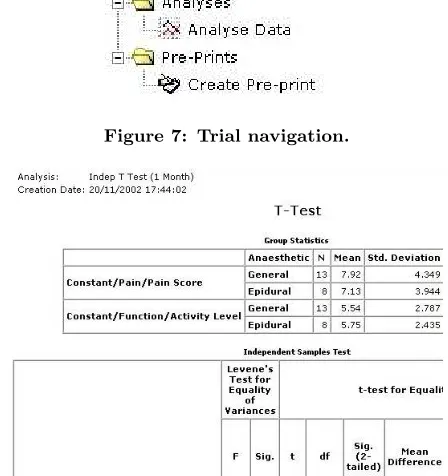
Creating a Dataset— To create a dataset for the new trial, Eddie searches the ‘Virtual Observatory’ for suitable cases. Since Eddie has already specified the shoulder data schema, only those cases matching this schema will be searched. DRJ-Framework also uses the shoulder schema to generate a search form, so that Eddie can search for specific shoul-der cases (figure 6). Eddie and associates subsequently add 42 different shoulder cases to the trial (see trial navigation menu in figure 7), which can be viewed in tabulated form for visual comparison.
Analysing the Dataset — To perform analyses on the dataset, Eddie and associates choose from statistical meth-ods offered by a distributed Analysis Engine. Using the shoulder data schema and metadata from the Analysis
En-8
[image:7.612.68.277.53.206.2]Eddie is a nickname for Edwina or Edward in the UK
[image:7.612.323.547.144.382.2]Figure 7: Trial navigation.
Figure 8: Viewing analysis results.
gine, the DRJ-Framework is able to generate an entry form for each statistical method, which Eddie can use to fine tune the analysis (specify test variables, groupings etc.). The Analysis Engine queues the requested analysis and notifies the DRJ-Framework when results are available. These re-sults then appear in Eddie’s DRJ user space, and can be viewed (Figure 8).
Disseminating Results — Having obtained some signifi-cant results from the statistical analyses, Eddie then decides to create a pre-print in order to disseminate the results to the wider orthopaedic community. When Eddie selects the JBJS publication schema, the DRJ-Framework generates a pre-print template using the information Eddie entered in the trial protocol. Eddie fleshes out this template, follow-ing the JBJS guidelines provided (figure 9), and specifies which analysis results should be included in the preprint. After previewing the pre-print, Eddie submits it: behind the scenes the DRJ-Framework submits the pre-print and its associated metadata to the community Eprints server (where it subsequently becomes available to the VOEU com-munity), and makes the paper available in the user space of Eddie and associates.
6.
VOEU EVALUATION
Figure 9: Preparing pre-print.
user’s general responses to the overall VOEU ‘experience’ rather than any specific features of the DRJ, the results nev-ertheless provide some useful insights into the applicability and utility of the DRJ, as we look ahead to a more in-depth user evaluation of the DRJ’s experimentation, analysis, dis-cussion, and publication tools.
The evaluation was carried out by 18 orthopaedic surgeons with a mean age of 30.2 (SD 4.6), and a mean of 5.1 years surgical experience (SD 4.3). The majority of the partici-pants responded to background questions in a way that in-dicated that they were ‘tech-savvy’ — they understood the benefits of electronic access to information, used the Web regularly at home and work, and preferred the electronic medium over traditional mediums. Even those who were less tech-savvy acceded the benefits of electronic access — only one participant, a self-confessed ‘techno-phobe’, maintained that paper-based materials were the easiest and preferred working medium.
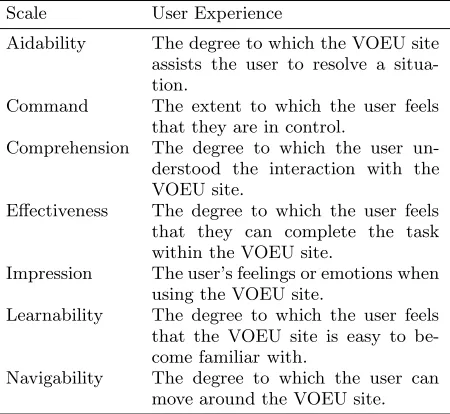
Each participant followed a tour through the VOEU Web site, with each area — Digital Library, Education (part of each surgeon’s Continuing Professional Development com-mitment), and DRJ — being demonstrated before allowing the participant to familiarise themselves with its function through ‘hands-on’ experimentation. Participants were also invited to carry out simple tasks, such as finding information in the VOEU digital library, and taking part in an interac-tive surgical simulation. In the case of the DRJ, each par-ticipant was given the opportunity to run through the entire process of setting up a clinical trial, carrying out data col-lection and analysis, and producing a targeted pre-print, as described in the e-experimentation scenario in Section 5.1. Each participant then completed a questionnaire designed to capture their responses to a number of different aspects of their VOEU ‘experience’, enabling us to measure the experi-ence in terms ofimpression,command,effectiveness, learn-ability, andaidability, based on the Software Usability Mea-surement Inventory (SUMI) [11], as well thenavigation and
comprehensionextensions to SUMI proposed by [3] for eval-uating hypermedia systems. Table 1 shows how each scale corresponds to a different aspect of the VOEU ‘experience’. The results of the evaluation are shown in Figure 10,
Scale User Experience
Aidability The degree to which the VOEU site assists the user to resolve a situa-tion.
Command The extent to which the user feels that they are in control.
Comprehension The degree to which the user un-derstood the interaction with the VOEU site.
Effectiveness The degree to which the user feels that they can complete the task within the VOEU site.
Impression The user’s feelings or emotions when using the VOEU site.
Learnability The degree to which the user feels that the VOEU site is easy to be-come familiar with.
[image:8.612.325.550.54.261.2]Navigability The degree to which the user can move around the VOEU site.
Table 1: Questionnaire scales in relation to the user’s ‘experience’ of using the VOEU site.
Rank Proposed Extension
1 (1) Automatic uploading of trial data to other records, such as the BOA logbook JCHST, GMC revalidation.
2 (3) Pervasive access from handheld devices (e.g. trial data entry from PDA).
3 (4) Heuristic support for users unfamiliar with statistics management.
4 (5) Journal submission templates for all leading journals.
5 (7) Enhanced trial data entry.
6 (9) Forwarding to national and international tri-als centres for analysis.
Table 2: Proposals for extensions to the DRJ, ranked by participants in order of relevance.
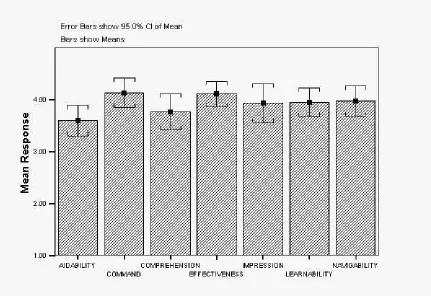
where a mean response value of 5.0 indicates an entirely pos-itive result, and a mean response of 1.0 indicates an entirely negative result. Initial indications from this trial therefore show a positive response to all aspects of the VOEU us-ability experience. The greatest positive responses were to the statements “I was able to move around the information in VOEU easily” (navigability), “learning to use the sys-tem was easy” (learnability), “I felt at ease trying different ways to get to the information I needed” (learnability), “the system help files provided enough information to use the sys-tem” (aidability), “VOEU could be of use to me in my job” (effectiveness), and “using VOEU allows me to accomplish tasks more quickly” (effectiveness). Areas which proved more controversial included “I often become lost/disoriented when using VOEU”, “it was difficult to learn more than the basic functions of the VOEU system”, and “the system was awkward to use if I wanted to do anything out of the ordi-nary”.
[image:8.612.320.554.304.449.2]Figure 10: Results of the VOEU usability trial, showing average participant responses for different areas of their VOEU ‘experience’.
extensions in order of relative importance to their day-to-day work. Table 2 lists the ranked proposals which are specific to the DRJ (with overall ranking shown in parentheses).
7.
CONCLUSIONS
In answer to the questionWhat is a digital library? the University of California Digital Library FAQ states ‘systems that support the collections of the University’9
.
In this paper we argue for a broadening of this view, out from the collections themselves, to the process of collecting and deploying. We have taken the position proposed by Dal-gaard that scholarly hypertext is not merely the intertextual relationships between papers but the relationships between these texts and the wider archive [4]. Parts of the Scientific Community (and the Computing Community) are currently obsessed by the idea of the Grid — in broad brush terms this amounts to the use of computers to make possible or to ease/improve scientific experimentation, analysis, and col-laboration. However, we argue that publishing, dissemina-tion, research, and learning are equally important (perhaps more important) parts of the scientific cycle of activities and should not be left to unaided ‘mandraulic’ effort.
We have presented our contribution to this ongoing effort, the Dynamic Review Journal, and described its integration and use within a Virtual University learning environment as an example of a system which deliberately crosses the barri-ers between these areas (experimentation, analysis,
publish-9
http://www.cdlib.org/about/faq/
ing, dissemination, discussion, and education). In providing support for the broader range of scientific activities, it is our hope that scientists can be made more effective in their work.
8.
REFERENCES
[1] T. Brody, L. Carr, and S. Harnad. Evidence of hypertext in the scholarly archive. InProceedings of the Thirteenth ACM Conference on Hypertext and Hypermedia, Maryland, USA, 2002.
[2] L. Carswell. The ’virtual university’: toward an internet paradigm? InThe 6th Annual Conference on the Teaching of Computing and the 3rd Annual Conference on Integrating Technology into Computer Science Education: Changing the Delivery of Computer Science Education, pages 46–50. ACM, 1998.
[3] R. Crowder, G. Wills, and W. Hall. Evaluation of a hypermedia maintenance support application.
International Journal Computers in Industry, 51(3):327–344, 2003.
[4] R. Dalgaard. Hypertext and the scholarly archive: Intertext, paratexts and metatext at work. In
Proceedings of the Twelfth ACM Conference on Hypertext and Hypermedia, Arhus, Denmark, pages 175–184, Aug. 2001.
[6] I. Foster, C. Kesselmann, and S. Tuecke. The anatomy of the Grid: Enabling scalable virtual organisations.
International Journal of Superconductor Applications and High Performance Computing, 2001.
[7] P. Ginsparg. Winners and Losers in the Global Research Village. InProceedings of the 1996 UNESCO Conference, Paris, Feb. 1996.
http://xxx.lanl.gov/blurb/pg96unesco.html. [8] S. Harnad. Electronic Scholarly Publication: Quo
Vadis? Serials Review, 21(1):70–72, 1995.
[9] S. Harnad. The future of scholarly skywriting. InI in the Sky: Visions of the Information Future, pages 216–218. ASLIB/IMI, 2001.
[10] S. Hitchcock, L. Carr, and W. Hall. A Survey of STM Online Journals 1990-95: the Calm Before the Storm. In D. Mogge, editor,Directory of Electronic Journals, Newsletters and Academic Discussion Lists, pages 7–32. Association of Research Libraries, Washington, D.C., 6 edition, 1996.http:
//journals.ecs.soton.ac.uk/survey/survey.html. [11] J. Kirakowski and M. Corbett. SUMI: The Software
Usability Measurement Inventory.British Journal of Educational Technology, 24(3):210–212, 1993. [12] C. Lagoze and H. V. de Somple. The open archives
initiative: building a low-barrier interoperability framework. Inthe First ACM/IEEE-CS Joint Conference on Digital Libraries, pages 54–62. ACM, 2001.
[13] D. M. Levy and C. C. Marshall. Going digital: a look at assumptions underlying digital libraries.
Communications of the ACM, 38(4):77–84, Apr. 1995.
[14] R. Lucier. Knowledge management: Refining roles in scientific communication.EDUCOM Review, 1990. [15] L. Lyon. Emerging information architectures for
distributed digital libraries. InInternational Conference of Digital Library–IT Opportunities and Challenges in the New Millennium., July 2002. [16] G. Marchionini and H. Maurer. The roles of digital
libraries in teaching and learning.Communications of the ACM, 38(4), Apr. 1995.
[17] M. Marlino, T. Sumner, D. Fulker, C. Manduca, and D. Mogk. The digital library for earth system education: building community, building the library.
Communications of the ACM, 44(5):80–81, May 2001. [18] R. E. McGrath, J. Futrelle, R. Plante, and
D. Guillaume. Digital library technology for locating and accessing scientific data. InProceedings of the Fourth ACM Conference on Digital Libraries, pages 188–194, 1999.
[19] T. H. Nelson.Computer Lib/Dream Machines. Tempus Books, 1987.
[20] C. Nevill-Manning. The biological digital library.
Communications of the ACM, 44(5):41–42, May 2001. [21] A. Schaffner. The future of scientific journals: Lessons from the past.Information Technology and Libraries, 13(4):239–247, Dec. 1994.