Efficient Static Compaction Techniques for Sequential Circuits Based on Reverse
Order Restoration and Test Relaxation
Aiman H. El-Maleh, S. Saqib Khursheed and Sadiq M. Sait
Department of Computer Engineering
King Fahd University of Petroleum & Minerals
Dhahran 31261, Saudi Arabia
emails:
{
aimane, saqib, sadiq
}
@ccse.kfupm.edu.sa
Abstract
In this paper we present efficient Reverse Order Restora-tion (ROR) based static test compacRestora-tion techniques for syn-chronous sequential circuits. Unlike previous ROR tech-niques that rely on vector-by-vector fault-simulation based restoration of test subsequences, our technique restores test sequences based on efficient test relaxation. The restored test subsequence can be either concatenated to the com-pacted test sequence, as in previous approaches, or merged with it. Furthermore, it allows the removal of redundant vectors from the restored subsequences using State Traver-sal technique and incorporates schemes for increasing the fault coverage of restored test subsequences to achieve an overall higher level of compaction. In addition, test relax-ation is used to take ROR out of saturrelax-ation. Experimental results demonstrate the effectiveness of the proposed tech-niques.
Keywords:Static Compaction, Test Relaxation.
1. Introduction
The length of a test set for testing System on Chip (SOC) crucially affects the Test Application Time (TAT) and mem-ory requirements of the tester. Therefore, test compaction focuses on reducing the length of a test set while main-taining its fault coverage. Test compaction algorithms can be classified into two main classes: dynamic and static compaction. Dynamic compaction algorithms incorporate heuristics aimed at producing shorter test length into the test generation process while static compaction algorithms are applied as a post-processing step to the test generation process. Static compaction is known to be more efficient for sequential circuits than dynamic compaction.
Several well known static compaction techniques are proposed in the literature, [1-11].
Vector restoration algorithms [1, 4-8] could suffer from a large number of fault simulations to restore a test sequence to detect the target faults, which makes it computationally expensive. Recently, an efficient Test Relaxation scheme was proposed for sequential circuits by El-Malehet al.[12]. The relaxation algorithm returns the relaxed assignments on inputs as well as on flip-flops of the circuit, considering a certain number of target faults.
In this work, we utilize the relaxation algorithm in ex-tracting a test sequence. This is achieved by stopping the relaxation process whenever the required values on all the flip-flops are either don’t cares (Xs) or are compatible with the states reached by previously restored test sequence. This gives an efficient way of restoring test sequences compared to the expensive vector-by-vector fault simulation based restoration technique. The restored test sequences using this scheme have the additional property of being relaxed, i.e., not fully specified, and therefore can be merged using schemes similar to those proposed in [11]. Furthermore, the test relaxation algorithm is used to take RX-LROR out of saturation.
In addition, we propose an efficient way to identify re-dundant vectors in a restored test subsequence based on a technique similar to State Traversal [2].
We also propose a technique that enhances the perfor-mance of RX-LROR by increasing the fault coverage of currently compacted test sequence before restoring a subse-quence for the next target fault(s). This is done by relaxing and randomly filling the compacted test set, and is found effective in drastically reducing the test size. Finally, we propose three hybrid compaction techniques that reduce the inherent limitation of vector restoration algorithms of quick saturation and offer a trade-off between compaction quality and CPU time.
con-cludes the paper.
2
Proposed Algorithms
In this section, different algorithms proposed in this work are described.
2.1 Relaxation based Reverse-Order-Restoration with State Traversal
Algorithm 1 illustrates our implementation of the Reverse-Order-Restoration technique based on test relax-ation. Let’s suppose that the size of the test set to be com-pactedW, is of lengtho. We denote the compacted test set as C; initiallyF=>. Given a time framel, we denote the set of faults detected atlbyIl. The Good and Faulty state of
the flip-flops is denoted byVjandVi, respectively. We also
denote the required flip-flop values for justifying the faults
Ilby(Vj@Vi)l.Iwdujhwholds all the faults detected byW.
LetVl andVm indicate the flip-flop values (required or
reached) at time framelandm, respectively. Then, the state justification requirements ofVmare covered by those ofVl,
ifVmVl. For e.g., letVmbe 1X andVlbe 10. Then,Vm
Vland this means that the required values onVmare satisfied
byVl. Finally, & is a concatenation operator.
Algorithm 1 starts by restoring a self-synchronizing se-quence of lengthnvectors, wherenis user-specified. Then, it starts the restoration process from the last time frame in the test sequence at which some faults are detected. Test restoration is shown in Algorithm 2. A test subsequence for a set of faults is restored by justifying the required val-ues for detecting the faults frame-by-frame. The restoration process of the test subsequence terminates if the required values on the flip-flops at a time-frame are all X’s or are covered by the flip-flop values reached by the previously restored sequence. Once a test subsequence is restored, an attempt to reduce its size is made by State Traversal algo-rithm, which is discussed in the next subsection. Finally, the reduced subsequence is concatenated to the previously restored sequence and only the concatenated sequence is fault simulated, and detected faults are dropped. The pro-cess continues until all the faults are detected.
2.2 State Traversal
During restoration, the algorithm stores for each fault theVj/Virequirements that have to be justified in previous
time frames. The state traversal algorithm is called after a sequence is restored and is shown in Algorithm 3. In Al-gorithm 3, it is assumed that the restored subsequenceY, consisting ofqvectors, detectsI faults. It is also assumed thatlandmare variables corresponding to time framesland
m, respectively.
Algorithm 1Reverse Order Restoration (RX-LROR) 1. Fault Simulate the circuit using the given test set.
Collect the detection time of each fault.
2. Restore the firstntest vectors as a synchronizing sequence from the given test set W.
F={y1,y2,y3,...yn}.
3. Fault simulate the restored sequenceFand drop all the faults detected fromIwdujhw. Store the (Vj/Vi)
values of all the flip-flops for all undetected faults. 4.if(Iwdujhw=>) ReturnFelseGo to Step 5.
5. Y = Test Restoration(q> Iq), where qis the last
time frame having undetected faults. 6.Y =State Traversal(Y> Iq> Iwdujhw)
7.F=F &Y; Go To Step 3.
Algorithm 2Test Restoration (q,Iq)
1. Letl=q, andY =>be the sequence currently restored.
2.(Vj@Vi)l=Justify(Il,i)and letm=l.
3.while(((Vj@Vi)m6=[)and((Vj@Vi)m+(Vj@Vi))){
Y =Ym&Y //add current time frame toV
m=m1 //move back single time frame
(Vj@Vi)m= Justify(Il,m) //get the required
//values for all flip-flops in this time frame
}//end while 4. Return(Y)
For each time framem, the algorithm checks for the earli-est possible time framelsuch that the justification require-ments of time framemare satisfied by the justification re-quirements of time framel. If such a time framelis found, then the vectors fromltom1are redundant and can be removed. Algorithm 3 removes these vectors if no fault is detected within these vectors. This heuristic was found experimentally useful in reducing the overall restored test sequence by state traversal and not resulting in longer test sequences.
Algorithm 3 is illustrated in Fig. 1. As shown in Fig. 1, the algorithm storesVj@Vi for each fault in a list. Since
(Vj@Vi)4(Vj@Vi)2for faulti1, the state requirements at time frame4 are satisfied by the state requirements at time frame2. Therefore, test vectors 2 and 3 can be re-moved from the restored subsequence without affecting the fault coverage. It should be observed that Algorithm 3 takes into account all the faults inIqwhen comparing(Vj@Vi)
Algorithm 3State Traversal(Y,Iq,Iwdujhw)
1. Letl=2 andm=q. 2.while(m A2){
if((for each fault k5Iq((Vj@Vi)l(Vj@Vi)m))&
(No fault5Iwdujhwdetected in Time Frames
ltom1)){
Clip VectorsYltoYm1fromY m=l-1 ;l=2}
else if(l ? m1)l+ + else{m ;l= 2}
}// End while 3. Return (Y).
f1 FF1 GV=1 FV=0
FF4 GV=X
FV=0
f1 FF4 GV=0 FV=1
FF5 GV=1 FV=0
f1 FF1 GV=1 FV=0
FF4 GV=1 FV=0 Redundant Vectors that are removed by State Traversal
1 4
After Clipping redundant Vectors
f = fault FF = Flip Flop GV=Good Value FV=Faulty Value
[image:3.612.72.294.69.393.2]1 22 33 4
Figure 1. Compaction by State Traversal Al-gorithm.
2.3 Merging Restoration
Merging Restoration (MR) follows the same flow as Al-gorithm 1. However, it takes advantage of the unspecified assignments at the inputs of the extracted subsequence and merges it with previously restored subsequences rather than concatenating it. In MR, step 7 of Algorithm 1 is replaced by first calling Algorithm 4 and then moving back to step 3. However in step 3, the states of flip-flops (Vj/Vi) are
not stored for the undetected faults. Furthermore, the while condition in step 3 of test restoration algorithm is replaced by only((Vj@Vi)m6=[))condition. Therefore in step 5 of
MR, Test Restoration algorithm returns the self-initializing subsequence for the target faults.
The idea of merging is similar to the one proposed by Royet al.[11]. The subsequences can be merged in dif-ferent ways. Merging from Top is shown by Algorithm 4. It checks the compatibility of the two test sequences (cur-rently restored Y and compacted test setF), and tries to
merge the two test sequences starting from the last test vec-tors ofY andFtowards the beginning of the test sequences. Merging from Bottom, on the other hand is exactly the op-posite, it checks the compatibility of the two test sequences
FandY, and tries to merge the two sequences starting from the first test vectors towards the end of the test sequences. Similarly, another scheme uses a more greedy heuristic and decides on merging the subsequence wherever savings are higher. However, experimental results showed that Merging from Top gave overall best results. Therefore, our work uses Merging from Top only. State traversal (ST) is not applied in MR as higher compaction is achieved without it.
A drawback of MR, compared to concatenating subse-quences (RX-LROR), is that the currently compacted test setFneeds to be fault simulated in contrast to fault simu-lating only the newly restored subsequence.
After a single run of MR Algorithm, there is a large per-centage of un-specified bits. These bits can be randomly filled for subsequent iterations.
Algorithm 4Merging from TOP (F,Y)
1. Letqfandqybe the number of test vectors inF
andY.
2.if(qf? qy) swapFwithY andqfwithqy.
3. Let i=last test vector inF, SM=i 4. Let j=last test vector inY
5.if(i1)
while(j1andi1){
if(F[l]andY[m]are compatible){j = j-1; i = i-1; if(i = 0ORj = 0) Merge C and V, starting from
F[VP]andY[qy]
}// end if
else{SM = SM-1; i = SM
goto step 4}//breaking the while loop
}// end-while 6.elseF=Y &F; 7. Return(F)
2.4 Subsequence Fault Coverage Increasing LROR
Ran-domly filling the un-specified inputs is essentially used for increasing the fault coverage as more faults can be detected, which could lead to reducing the number of restored test se-quences. These two steps, Relaxation followed by Random filling are done once each time a test sequence is restored and if the fault coverage of the compacted test sequence in-creases, the process is repeated. It is important to emphasize that the objective of subsequence fault coverage increasing is to achieve higher compaction rather than higher fault cov-erage, by the compacted test sequence.
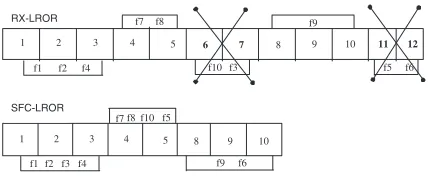
Fig. 2 illustrates the behavior of SFC-LROR in compar-ison with RX-LROR. RX-LROR restores the test sequence (6, 7) to detect faults f3 and f10, and the test sequence (11, 12) to detect faults f5 and f6. On the other hand, SFC-LROR detects these faults in earlier test sequences. SFC-LROR in-creases the fault coverage of the test sequence (1, 2, 3) to de-tect f3. Similarly, the test sequence (4, 5) dede-tects the faults f5 and f10, and the test sequence (8, 9, 10) detects the fault f6, in addition to previously detected faults. Hence, SFC-LROR restores lesser test sequences giving higher level of compaction.
1 2 3 4 5 8 9 10
f3 f10
f9
f5 f6 f1 f2 f4
f8 f7
6 7 11 12
1 2 3 4 5 8 9 10
f1 f2 f9 f6
f8 f7
f3
f10 f5
f4
RX-LROR
[image:4.612.77.292.314.402.2]SFC-LROR
Figure 2. Compaction by RX-LROR based on increasing the Fault Coverage Algorithm.
2.5 Hybrid Schemes
In this section, we propose three hybrid schemes that re-duce the inherent limitation of vector restoration algorithms of quick saturation and capitalize on combining the benefits provided by the different algorithms proposed in this work. Hybrid-I is composed of two primary steps. In the first step (step-I), the proposed RX-LROR algorithm (Al-gorithm 1) is run for two iterations and if there is any re-duction in test sequence length in any of these two itera-tions, the algorithm runs for one more iteration. The al-gorithm re-iterates by running an extra iteration as long as the last iteration reduces the test sequence length. This step is followed by Test Relaxation [12] and randomly filling the un-specified bits, which forms the second step II) of Hybrid-I. Test Relaxation and random filling (step-II) change the composition of test set, while maintaining its fault coverage. This helps moving the algorithm out of
Algorithm 5Subsequence Fault Coverage Increasing RX-LROR (SFC-LROR)
1. Fault Simulate the circuit using the given test set. Collect the detection time of each fault.
2. Restore the firstntest vectors as a synchronizing sequence from the given test set W.
F={y1,y2,y3,...yn}.
3. Fault simulate the restored sequenceFand drop all the faults detected fromIwdujhw. Store the (Vj/Vi)
values of all the flip-flops for all undetected faults. 4.if(Iwdujhw=>) ReturnFelseGo to Step 5.
5. Y = Test Restoration(q> Iq), where qis the last
time frame having undetected faults. 6.Y =State Traversal(Y> Iq> Iwdujhw)
7.F=F &Y;
8.while(fault coverage ofFincreases&Iwdujhw6=>){
F=Relaxation(F) RandomFill(F) } 9. Go To Step 3.
local minima and the search space is therefore increased. Furthermore, it allows RX-LROR to re-iterate far longer and partially replaces almost every test vector at a very low cost of CPU time. Step-II is again followed by step-I and the process continues (step-I followed by step-II) until four consecutive iterations are unable to reduce the test size.
Hybrid-II is based on the intuition that merging of re-laxed subsequences (MR) gives another level of freedom to test compaction, therefore it may further squeeze the size of test set, if applied after Hybrid-I. As mentioned previ-ously, MR requires comparatively larger number of fault-simulations than RX-LROR. This drawback makes it vul-nerable to large sized test set in terms of CPU time.
Hybrid-II is proposed to keep the advantages offered by MR, while restricting its limitations. It applies MR to the solution found by Hybrid-I. In this algorithm, MR is applied once and is re-iterated until one pass of MR does not further reduce the test size.
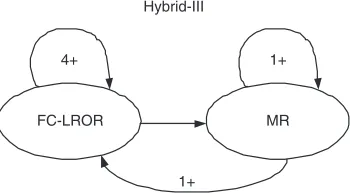
Hybrid-III is another powerful compaction scheme, which combines SFC-LROR and MR. The algorithm re-iterates SFC-LROR until 4 consecutive iterations are unable to reduce the test size. This step is followed by MR, which is reiterated until one iteration of MR does not reduce the test size. MR is again followed by SFC-LROR and the pro-cess continues as long as each pass (SFC-LROR followed by MR) reduces the test size. The idea is illustrated by Fig. 3.
3
Experimental Results
experi-FC-LROR MR
4+ 1+
[image:5.612.98.273.68.165.2]1+ Hybrid-III
Figure 3. Hybrid-III scheme.
ments on the ISCAS89 benchmark circuits using STRATE-GATE [13] and HITEC [14] test sequences. The experi-ments are conducted on an IBM P-IV 2.0 GHz processor, with 512 MB RAM and HOPE [15] is used as a fault simu-lator.
The RX-LROR version implemented in our work is sim-ilar to the one proposed by Guoet al.[5], as it doesn’t in-clude new faults into the target fault set during subsequence restoration for a group of faults in a single time frame. Therefore, our implementation of RX-LROR is compared with that proposed by LROR [5] for a fair comparison. This version of LROR [5] used 20 test vectors as synchronizing sequence in case of test size more than 300 vectors andl/16 otherwise. The number of vectors in a synchronizing se-quence are kept the same in our version of RX-LROR for the sake of comparison. The proposed Hybrid Schemes have shown better results and are also compared with the other best known compaction algorithms i.e., LROR [8], MISC [8] and SIFAR [6] to show their overall performance. It should be noted that LROR [8] uses a single test vector as a synchronizing sequence, therefore for fair comparison, Hybrid schemes and SFC-LROR have also used the same synchronizing sequence in their respective RX-LROR im-plementations.
During cost functions computation for flip-flops, our im-plementation of RX-LROR, RX-LROR-ST and Test Relax-ation applies a multiplicative weight of 10, while in SFC-LROR and Merging Restoration (MR), applies a multiplica-tive weight of 100. These weights were selected based on experiments.
The performance of compaction algorithms on STARATEGATE [13] test sequences, together with CPU time, reported in brackets are shown in Table 1. The results of LROR [5] are compared with the proposed algorithms. From Table 1, it can be seen that the proposed RX-LROR performed better than LROR [5] on 7 out of 10 circuits, with slightly better overall savings and comparable CPU time. These results are further improved by applying State Traversal to the newly restored subsequences in RX-LROR-ST algorithm. RX-RX-LROR-ST has further reduced the compacted test set against a small penalty of CPU time.
It has again performed better than LROR [5] on 7 out of 10 circuits. The next column (ITE-RX-LROR-ST) is the iterative version of the same algorithm. Although it shows comparable results to ITE-LROR [5], it can be noticed that ITE-RX-LROR-ST has suffered from quick saturation and for many circuits it is unable to reduce the test size.
It can be observed that for some circuits, e.g., s5378, the compacted test sequence length obtained by our proposed implementation of RX-LROR (Algorithm 1) is larger than the one obtained by LROR [5]. This is due to the current limitations of the justification algorithm, which will be ad-dressed in future work.
The next column in Table 1 shows the performance of Merging Restoration (MR). MR did not perform well com-pared to our implementation of RX-LROR. It has achieved better results on two circuits only (compared to our version of RX-LROR). This is due to the fact that the extracted test sequences are not fully specified, which reduces the num-ber of faults detected by the restored sequence compared to the fully specified one. This also results in extracting a larger number of test sequences, which affects the com-paction quality and CPU time. Despite these limitations, it has the potential of improving the compaction quality, if applied after RX-LROR as discussed earlier.
ITE-Hybrid-I is shown next in Table 1. It can be seen that ITE-Hybrid-I has significantly improved the results of RX-LROR-ST and has performed better than ITE-LROR [5] in 9 out of 10 circuits, with higher overall sav-ings.
The last column of Table 1 shows the performance of ITE-Hybrid-II. MR has shown the effect of further squeez-ing the size of test set, which is already reduced by Hybrid-I. Hybrid-II has performed better than ITE-LROR [5] on 9 out of 10 circuits and has given the highest overall savings, in comparison to all other algorithms shown in Table 1.
Based on the above results, ITE-Hybrid-II is compared with ITE-LROR [8], ITE-MISC [8] and ITE-SIFAR [6] on STRATEGATE test sequence [13], and on HITEC test se-quences [14] in Table 2.
Considering STRATEGATE test sequences [13], it can be noticed that ITE-Hybrid-II has performed better on 8 out of 10 circuits with higher overall savings than ITE-LROR [8]. When compared to ITE-SIFAR [6], ITE-Hybrid-II has again performed better on 7 out of 10 circuits, while 1 resulted in a draw. In terms of overall savings, ITE-Hybrid-II has shown higher savings than ITE-SIFAR. How-ever, ITE-MISC has performed better than ITE-Hybrid-II on 6 out of 10 circuits but the overall savings are compa-rable and the CPU time is significantly higher than that of ITE-Hybrid-II.
ITE-Hybrid-II gives better results than ITE-LROR [8] on 9 out of 13 circuits and significantly higher overall savings. While comparing to ITE-MISC [8], it shows better perfor-mance on 9 out of 13 circuits, with slightly better overall savings and lesser CPU time. The effect of ITE-Hybrid-II is even more pronounced for the circuits: s1196, s1238, s3271, s3384 and s4863.
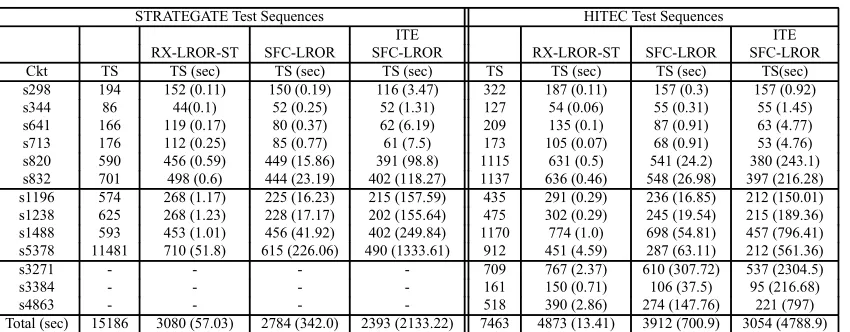
The performance of SFC-LROR is shown in Table 3. The one-shot version of RX-LROR-ST and SFC-LROR on STRATEGATE [13] and HITEC test sequences [14] is shown. It can be seen that SFC-LROR has made significant improvement on our implementation of RX-LROR-ST. It has shown higher level of compaction on 8 out of 10 cir-cuits with higher overall savings on STRATEGATE [13] test sequences. This trend is even more pronounced on HITEC [14] test sequences, shown next in the same ta-ble. On HITEC test sequences [14], SFC-LROR has per-formed better than RX-LROR-ST on 12 out of 13 circuits and achieved much higher overall savings. It is worth mentioning that this (fault coverage increasing) scheme is generic and can be applied on top of any static compaction scheme. These results demonstrate the strong potential of the scheme.
The performance of the iterative version of SFC-LROR (ITE-SFC-LROR) is shown in Table 3. ITE-SFC-LROR re-iterates SFC-LROR until 4 consecutive iterations are un-able to reduce the test size. It can be seen that in compari-son to SFC-LROR on STRATEGATE Test Sequences [13], it has further reduced the test size on 9 out of 10 circuits and achieved higher overall savings of nearly 400 test vec-tors. Similarly on HITEC Test Sequences [14], it has further squeezed the test size on 11 out of 13 circuits with nearly 900 test vectors higher overall savings.
ITE-SFC-LROR can also be compared with the other best known compaction algorithms shown in Table 2. On STRATEGATE Test Sequences [13], in comparison to ITE-LROR [8], ITE-SFC-ITE-LROR has performed better on 8 out of 10 circuits with higher overall savings. In comparison to ITE-SIFAR [6], it has again performed better on 6 out of 10 circuits with higher overall savings. Finally, in com-parison to ITE-MISC [8], it has performed better on 4 out of 10 circuits with comparable savings. The effect is more pronounced on s5378.
The performance of ITE-SFC-LROR can also be com-pared with all these algorithms (other than SIFAR [6]) on HITEC test sequences [14] shown in Table 2. It can be no-ticed that SFC-LROR has performed better than ITE-LROR [8] on 10 out of 13 circuits, while 1 resulted in a draw. It has shown more than 600 test vectors savings than ITE-LROR [8]. In comparison to ITE-MISC [8], it has per-formed better on 8 out of 13 circuits and achieved almost 200 test vectors savings more than ITE-MISC [8]. Some of the circuits like s713, s820, s1238, s1488, s5378 and s4863
are worth noticing.
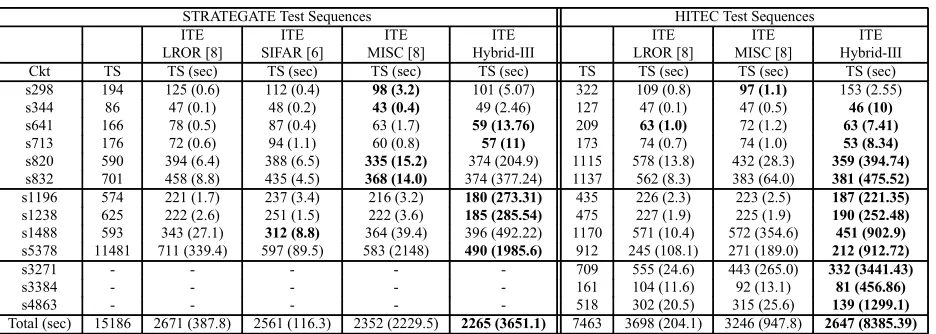
Finally, Table 4 shows the performance of ITE-Hybrid-III and compares it with the best known compaction al-gorithms on STRATEGATE [13] and HITEC [14] test se-quences. On STRATEGATE Test Sequences [13], in com-parison to ITE-LROR [8], ITE-Hybrid-III has performed better on 8 out of 10 circuits with significantly higher over-all savings. In comparison to ITE-SIFAR [6], it has again performed better on 8 out of 10 circuits with higher over-all savings. Finover-ally, in comparison to ITE-MISC [8], it has performed better on 5 out of 10 circuits with higher overall savings. The effect is more pronounced on s1196, s1238 and s5378.
ITE-Hybrid-III is compared next in the same table on HITEC test sequences [14]. It can be noticed that ITE-Hybrid-III has performed better than ITE-LROR [8] on 11 out of 13 circuits, while 1 resulted in a draw. It has shown more than 1000 test vectors savings than ITE-LROR [8]. In comparison to ITE-MISC [8], it has performed better on 12 out of 13 circuits and achieved almost 600 test vectors higher overall savings. Some of the circuits like s713, s820, s1196, s1238, s1488, s5378, s3271, s3384 and s4863 have achieved significantly higher savings than the other two al-gorithms.
4
Conclusion
In this paper, we have proposed several static compaction algorithms for sequential circuits based on efficient Test Re-laxation and Reverse Order Restoration schemes. The pro-posed work has the advantage of quickly restoring a test se-quence for a set of faults compared to vector-by-vector fault simulation based Restoration techniques. The restored sub-sequence is further compacted by state traversal algorithm, which allows the removal of redundant vectors without ad-ditional fault simulation. These restored subsequences can be either concatenated (having fully specified bits; making RX-LROR), or they can be subjected to increasing the fault coverage (SFC-LROR), and finally can also be merged (re-laxed input assignments, Merging Restoration). Merging Restoration is found to be more effective after applying RX-LROR and SFC-RX-LROR as demonstrated by ITE-Hybrid-II and ITE-Hybrid-III. Finally, we have also proposed an effi-cient way of taking any compaction algorithm out of satura-tion. This is achieved by using test relaxation and randomly filling the unspecified bits before re-iterating the algorithm, demonstrated by ITE-Hybrid-I.
Table 1. Compaction Results on STRATEGATE Test Sequences.
STRATEGATE Test Sequences
ITE ITE ITE ITE
LROR [5] LROR [5] RX-LROR RX-LROR-ST RX-LROR-ST MR Hyb-I Hyb-II
Ckt TS TS (sec) TS (sec) TS (sec) TS (sec) TS (sec) TS (sec) TS (sec) TS (sec)
s298 194 138 (0.14) 112 (0.74) 152 (0.09) 152 (0.11) 152 (0.15) 154 (0.05) 106 (0.96) 89 (1.16)
s344 86 62 (0.09) 51 (0.18) 44 (0.1) 44(0.1) 44 (0.13) 61 (0.04) 48 (0.26) 48 (0.31)
s641 166 118 (0.13) 117 (0.32) 133 (0.16) 119 (0.17) 118 (0.56) 148 (0.59) 68 (1.48) 68 (1.64) s713 176 139 (0.16) 103 (0.61) 115 (0.2) 112 (0.25) 111 (0.49) 140 (0.54) 64 (1.37) 64 (1.54) s820 590 489 (0.79) 471 (1.94) 469 (0.64) 456 (0.59) 428 (1.96) 531 (3.11) 377 (18.1) 376 (22) s832 701 543 (0.89) 443 (4.5) 534 (0.45) 498 (0.6) 460 (2.28) 568 (3.31) 418 (18.9) 406 (24.3) s1196 574 277 (0.28) 260 (1.2) 268 (0.59) 268 (1.17) 266 (1.21) 242 (1.79) 213 (37.4) 182 (41.5) s1238 625 285 (0.31) 270 (1.09) 268 (0.62) 268 (1.23) 266 (1.64) 248 (2.18) 222 (33.1) 196 (36.6) s1488 593 501 (1.79) 474 (14.89) 466 (0.71) 453 (1.01) 423 (4.0) 533 (5.38) 362 (17.4) 361 (24.5) s5378 11481 677 (38.71) 585 (71.55) 760 (50.0) 710 (51.8) 703 (74.46) 1549 (227.57) 637 (307.4) 637 (383.7)
[image:7.612.82.537.276.446.2]Total 15186 3229 (43.27) 2886 (97.04) 3209 (53.6) 3080 (57) 2971 (86.94) 4174 (244.6) 2515 (450.84) 2427 (539.7)
Table 2. Compaction Results on STRATEGATE and HITEC Test Sequences.
STRATEGATE Test Sequences HITEC Test Sequences
ITE ITE ITE ITE ITE ITE ITE
LROR [8] SIFAR [6] MISC [8] Hyb-II LROR [8] MISC [8] Hyb-II
Ckt TS TS (sec) TS (sec) TS (sec) TS (sec) TS TS (sec) TS (sec) TS (sec)
s298 194 125 (0.6) 112 (0.4) 98 (3.2) 89 (1.16) 322 109 (0.8) 97 (1.1) 143 (0.98)
s344 86 47 (0.1) 48 (0.2) 43 (0.4) 48 (0.31) 127 47 (0.1) 47 (0.5) 45 (0.53)
s641 166 78 (0.5) 87 (0.4) 63 (1.7) 68 (1.64) 209 63 (1.0) 72 (1.2) 66 (2.28)
s713 176 72 (0.6) 94 (1.1) 60 (0.8) 64 (1.54) 173 74 (0.7) 74 (1.0) 71 (1.77)
s820 590 394 (6.4) 388 (6.5) 335 (15.2) 376 (22) 1115 578 (13.8) 432 (28.3) 488 (27.4) s832 701 458 (8.8) 435 (4.5) 368 (14.0) 406 (24.3) 1137 562 (8.3) 383 (64.0) 493 (20.5) s1196 574 221 (1.7) 237 (3.4) 216 (3.2) 182 (41.5) 435 226 (2.3) 223 (2.5) 187 (38.8)
s1238 625 222 (2.6) 251 (1.5) 222 (3.6) 196 (36.6) 475 227 (1.9) 225 (1.9) 184 (51.8)
s1488 593 343 (27.1) 312 (8.8) 364 (39.4) 361 (24.5) 1170 571 (10.4) 572 (354.6) 648 (49.6) s5378 11481 711 (339.4) 597 (89.5) 583 (2148) 637 (383.7) 912 245 (108.1) 271 (189.0) 262 (107.3)
s3271 - - - 709 555 (24.6) 443 (265.0) 369 (103.2)
s3384 - - - 161 104 (11.6) 92 (13.1) 75 (20.1)
s4863 - - - 518 302 (20.5) 315 (25.6) 133 (430.1)
Total (sec) 15186 2671 (387.8) 2561 (116.3) 2352 (2229.5) 2427 (537.2) 7463 3698 (204.1) 3246 (947.8) 3164 (854)
Bold face highlights the best results
Table 3. Comparison of RX-LROR-ST and SFC-LROR on STRATEGATE and HITEC Test Sequences.
STRATEGATE Test Sequences HITEC Test Sequences
ITE ITE
RX-LROR-ST SFC-LROR SFC-LROR RX-LROR-ST SFC-LROR SFC-LROR
Ckt TS TS (sec) TS (sec) TS (sec) TS TS (sec) TS (sec) TS(sec)
s298 194 152 (0.11) 150 (0.19) 116 (3.47) 322 187 (0.11) 157 (0.3) 157 (0.92)
s344 86 44(0.1) 52 (0.25) 52 (1.31) 127 54 (0.06) 55 (0.31) 55 (1.45)
s641 166 119 (0.17) 80 (0.37) 62 (6.19) 209 135 (0.1) 87 (0.91) 63 (4.77)
s713 176 112 (0.25) 85 (0.77) 61 (7.5) 173 105 (0.07) 68 (0.91) 53 (4.76)
s820 590 456 (0.59) 449 (15.86) 391 (98.8) 1115 631 (0.5) 541 (24.2) 380 (243.1) s832 701 498 (0.6) 444 (23.19) 402 (118.27) 1137 636 (0.46) 548 (26.98) 397 (216.28) s1196 574 268 (1.17) 225 (16.23) 215 (157.59) 435 291 (0.29) 236 (16.85) 212 (150.01) s1238 625 268 (1.23) 228 (17.17) 202 (155.64) 475 302 (0.29) 245 (19.54) 215 (189.36) s1488 593 453 (1.01) 456 (41.92) 402 (249.84) 1170 774 (1.0) 698 (54.81) 457 (796.41) s5378 11481 710 (51.8) 615 (226.06) 490 (1333.61) 912 451 (4.59) 287 (63.11) 212 (561.36)
s3271 - - - - 709 767 (2.37) 610 (307.72) 537 (2304.5)
s3384 - - - - 161 150 (0.71) 106 (37.5) 95 (216.68)
s4863 - - - - 518 390 (2.86) 274 (147.76) 221 (797)
[image:7.612.98.523.491.657.2]Table 4. Hybrid-III in comparison to best known compaction algorithms.
STRATEGATE Test Sequences HITEC Test Sequences
ITE ITE ITE ITE ITE ITE ITE
LROR [8] SIFAR [6] MISC [8] Hybrid-III LROR [8] MISC [8] Hybrid-III
Ckt TS TS (sec) TS (sec) TS (sec) TS (sec) TS TS (sec) TS (sec) TS (sec)
s298 194 125 (0.6) 112 (0.4) 98 (3.2) 101 (5.07) 322 109 (0.8) 97 (1.1) 153 (2.55)
s344 86 47 (0.1) 48 (0.2) 43 (0.4) 49 (2.46) 127 47 (0.1) 47 (0.5) 46 (10)
s641 166 78 (0.5) 87 (0.4) 63 (1.7) 59 (13.76) 209 63 (1.0) 72 (1.2) 63 (7.41)
s713 176 72 (0.6) 94 (1.1) 60 (0.8) 57 (11) 173 74 (0.7) 74 (1.0) 53 (8.34)
s820 590 394 (6.4) 388 (6.5) 335 (15.2) 374 (204.9) 1115 578 (13.8) 432 (28.3) 359 (394.74)
s832 701 458 (8.8) 435 (4.5) 368 (14.0) 374 (377.24) 1137 562 (8.3) 383 (64.0) 381 (475.52)
s1196 574 221 (1.7) 237 (3.4) 216 (3.2) 180 (273.31) 435 226 (2.3) 223 (2.5) 187 (221.35)
s1238 625 222 (2.6) 251 (1.5) 222 (3.6) 185 (285.54) 475 227 (1.9) 225 (1.9) 190 (252.48)
s1488 593 343 (27.1) 312 (8.8) 364 (39.4) 396 (492.22) 1170 571 (10.4) 572 (354.6) 451 (902.9)
s5378 11481 711 (339.4) 597 (89.5) 583 (2148) 490 (1985.6) 912 245 (108.1) 271 (189.0) 212 (912.72)
s3271 - - - 709 555 (24.6) 443 (265.0) 332 (3441.43)
s3384 - - - 161 104 (11.6) 92 (13.1) 81 (456.86)
s4863 - - - 518 302 (20.5) 315 (25.6) 139 (1299.1)
Total (sec) 15186 2671 (387.8) 2561 (116.3) 2352 (2229.5) 2265 (3651.1) 7463 3698 (204.1) 3246 (947.8) 2647 (8385.39)
Bold face highlights the best results
Acknowledgements
The Authors would like to thank Dr. Ruifeng Guo for clarifying some of the concepts of Vector Restoration and Mr. Khaled Al-Utaibi for his help and support in the Test Relaxation algorithm. This work is supported by King Fahd University of Petroleum& Minerals under project #FT 2004/07.
References
[1] I. Pomeranz and S. M. Reddy, “Procedures for Static Com-paction of Test Sequences for Synchronous Sequential Cir-cuits,”IEEE Trans. Computers,vol. 49, pp. 596-607, June 2000.
[2] M. S. Hsiao, E. M. Rudnick and J. H. Patel, “Fast Static Compaction Algorithms for Sequential Circuit Test Vectors,”
IEEE Trans. Computers,vol. 48, pp. 311-322, March 1999. [3] M. S. Hsiao and S. T. Chakradhar, “State Relaxation Based
Subsequence Removal for Fast Static Compaction in Se-quential Circuits,”Proc. Design Automation and Test in Eu-rope,pp. 577-582, Feb 1998.
[4] I. Pomeranz and S. M. Reddy, “Vector Restoration Based Static Compaction of Test Sequences for Synchronous Se-quential Circuits,” Proc. Int. Conf. Computer Design, pp. 360-365, Oct 1997.
[5] R. Guo, I. Pomeranz and S. M. Reddy, “On Speeding-up Vector Restoration Based Static Compaction of Test Se-quences for Sequential Circuits,”Proc. IEEE Asian Test Sym-posium,pp. 467–471, 1998.
[6] X. Lin, W. u-Tung Cheng, I. Pomeranz and S. M. Reddy, “SI-FAR: Static Test Compaction for Synchrnous Sequential Cir-cuits Based on Single Fault Restoration,”Proc. IEEE VLSI Test Symposium,pp. 205-212, 2000.
[7] R. Guo, S. M. Reddy and I. Pomeranz, “PROPTEST: A Prop-erty Based Test Pattern Generator for Sequential Circuits us-ing Test Compaction,”Proc. Design Automation Conference,
pp. 653-659, June 1999.
[8] R. Guo, S. M. Reddy and I. Pomeranz, “Reverse-Order-Restoration-Based Static Test Compaction for Synchronous Sequential Circuits,”IEEE Trans. Computer-Aided Design of Integrated Circuits and Systems,vol. 22, pp. 293-304, March 2003.
[9] I. Pomeranz and S. M. Reddy, “Vector Replacement to Im-prove Static-Test Compaction for Synchronous Sequential Circuits,”IEEE Trans. Computer-Aided Design of Integrated Circuits and Systems,vol. 20, pp. 336-342, Feb 2001. [10] I. Pomeranz and S. M. Reddy, “Sequence Reordering to
Im-prove the Levels of Compaction Achievable by Static Com-paction Procedures,”Proc. Design Automation and Test in Europe,pp. 214-218, March 2001.
[11] R. Roy, T. Niermann, J. H. Patel, J. Abraham and R. Saleh, “Compaction of ATPG-Generated Test Sequences for Sequential Circuits,”Proc. International Conference on Computer-Aided Design,pp. 382-385, Nov 1988.
[12] A. El-Maleh and K. Al-Utaibi, “An Efficient Test Relax-ation Technique for Synchronous Sequential Circuits,”IEEE Trans. Computer-Aided Design of Integrated Circuits and Systems,vol. 23, pp. 933-940, June 2004.
[13] M. S. Hsiao, E. M. Rudnick and J. H. Patel, “Sequential Cir-cuit Test Generation using Dynamic State Traversal,”Proc. European. Design and Test Conf,pp. 22-28, March 1997. [14] T. M. Niermann and J. H. Patel, “HITEC: A Test Generation
Package for Sequential Circuits,” Proc. Eur. Conf. Design Automation (EDAC),pp. 214-218, 1991.