P5.3.1
Semantic Workflow Representation and Samples
Workpackage:
5
Grid Dynamics
Author(s):
Barbara Cantalupo
Ludovico Giammarino
Nikolaos Matskanis
Mike Surridge
Fabrizio Silvestri
DATAMAT
DATAMAT
IT Innovation
IT Innovation
ISTI – CNR
Authorized by
Mike Surridge
IT Innovation
Doc Ref:
P5.3.1
Reviewer
Neil P. Chue Hong
EPCC
Dissemination
Level
Public
Date Author Comments Version Status
19-07-2005 B. Cantalupo Documents structure and contents outlined
0.1 Outline 09-08-2005 B. Cantalupo First draft containing Datamat
and IT Innovation contribution
0.2 First Draft
31-08-2005 M. Surridge Added final suggestions and comments
(ed) samples added. Overall document updated according provided suggestions.
draft.
12-09-2005 B. Cantalupo and N. Matskanis
Minor adjustments 0.3nm+bc Complete Draft Revised 16-09-2005 B. Cantalupo Additional refinements 0.4 Draft for
internal QA
submission 04-10-2005 B. Cantalupo
and N. Matskanis
Changes after internal review 0.5 Draft for final submission
06-10-2005 B. Cantalupo Release version 1.0 Final
University of Southampton IT Innovation Centre, 2005
Executive Summary
This document describes the result of WP5.3 activity in the first 12 months concerning modelling and management of adaptive workflows and dynamic service orchestration. Activity was mainly focused on defining a Semantic Workflow Representation Model and Language to enable different kind of users in representing workflows at different architectural levels, e.g. application and business process. The Language Workflow Model was developed and integrated within an Enactment Model aimed at evaluating abstract workflows into concrete ones at runtime, using dynamic policy described, in turn, as workflows.
The initial step was clearly defining objectives for a workflow model definition within NextGRID framework. It was agreed that this model would specify a sort of “Grid Virtual Infrastructure Model” (Grid VIM) incorporating coherent evaluation and binding mechanisms, represented as workflow policies. Grid VIM would be able to enact application workflows according to different dynamic business processes, also implementing portability across NextGRID-compatible Grids.
A service-based workflow model was defined formalizing concepts like the relationship between workflow and services, definition of abstract vs. concrete services/workflows, service properties roles as constraints or capabilities. The main features for a Semantic Workflow Language enabling effective workflow representation within this model were identified as the needs for abstract workflows definition, semantic task description, workflow substitution and Higher-order workflows management.
In order to understand the current state-of-art of workflow technology and concept, a review in several research and business areas was performed, ranging from Business Process Management to Web Services, from Grid to Semantics. Taking into account different point of views like degree of maturity, standardization effort, functional properties, OWL-S ontology language was selected among other proposals as the most effective to respond our needs. Extensions to OWL-S were defined with the aim of specifying a Workflow and Service Ontology (OWL-WS) able to
effectively represent dynamic workflows according to our needs.
In order to validate OWL-WS capabilities, basic workflow management models were addressed considering both application and policy definition level. Sample models are also specified to show how basic services and workflows can be modelled and managed in OWL-WS. Ideas for defining actual policy workflows concerning co-allocation issues are finally reported.
University of Southampton IT Innovation Centre, 2005
Table Of Contents
1 Introduction... 1
2 Objectives ... 2
2.1 Workflow Overview ... 2
2.2 The Role of Workflow in NextGRID ... 2
2.3 Workflow Management Architecture ... 4
2.4 Workflow Language Requirements ... 6
3 Workflow-related Technologies Analysis ... 8
3.1 Technology Classification ... 8
3.1.1 Formal Models ... 8
3.1.2 Standard Languages ... 9
3.1.3 Graphical Process Modelling... 10
3.1.4 Workflow Patterns ... 10
3.1.5 Grid Workflow Languages ... 11
3.1.6 Semantics ... 12
3.2 Why we selected OWL-S... 12
4 OWL-WS Workflow and Service Model ... 15
4.1 Workflow and Service Model... 15
4.2 OWL-S Fundamentals ... 17
4.3 OWL-WS Language Model... 18
4.4 OWL-WS Control/Data Flow Constructs Analysis... 22
4.5 OWL-WS Profile Parameters Analysis ... 22
4.5.1 Attributes Definition ... 22
4.5.2 Functional Attributes ... 24
4.5.3 Non-Functional Attributes ... 24
5 Workflow Management Model and Samples ... 26
5.1 User-Provider Management Model... 26
5.1.1 Workflows representation in User-Provider scenarios ... 26
5.1.2 Workflows management in User-Provider scenarios ... 28
5.2 Simple User Application Sample... 30
5.3 Simple BIND Policy Sample ... 32
5.4 Co-allocation Policy Model ... 34
6 Workflow Enactment ... 36
6.1 Enactment Model Overview ... 36
6.2 Role of the Workflow Representation Language... 37
6.3 Evaluation Method... 38
6.4 The Metacircular Evaluator ... 41
6.5 Engine Requirements ... 42
7 Workflow Enactment Example... 45
7.1 Use Case Scenario... 45
7.2 Enactment of the Application ... 46
8 Conclusion and Future Work ... 51
9 References... 53
University of Southampton IT Innovation Centre, 2005
1 Introduction
This report describes NextGRID activity concerning the definition of a Semantic Workflow Language to be used for representing and enacting dynamic services. This activity is founded on the definition of a basic Workflow model that is at the core of a Grid Virtual Infrastructure Model and that will enable Grid dynamics within NextGRID architecture.
The report starts describing, in Section 2, the general concept of workflow and specifying the specific role it plays in NextGRID. In particular, we explain WP5 vision of a workflow-centric model of Grid execution and demonstrate the need of a semantic workflow language. We then summarize requirements that the language has to satisfy and that guided language definition.
In Section 3 a survey of several workflow-related technologies, like Business Process Modelling, Grid and Semantics, is reported, also providing critical analysis of the main proposal from our requirements perspective. Motivations, presented at the end of the section, for choosing OWL-S as the base for our language definition are supported by the survey analysis result.
Section 4 is the core of the document because it is where we specify our reference workflow and service model and we describe the related language OWL-WS. The model introduces several basic concepts like abstract and concrete services and the role of constraint and capability properties. The Language is the means to fully represent this model.
In Section 5, a simple User-Provider model is introduced in order to provide a practical reference environment to validate our language effectiveness. Samples of application and policy management are also provided, including ideas for co-allocation policy definition.
In order to demonstrate the actual role of the language in a NextGRID context, in Section 6 main concepts about the workflow enactment engine are presented. This is still in the analysis and design phase, but shows how the semantic workflow approach will bring together several other aspects of Grid Dynamics.
Section 7 briefly summarizes the activity performed and mainly presents the future work plan concerning workflow activity from the language and enactment perspective.
Finally, Section 8 lists references to other documents providing more detailed information on topics that have been discussed in this document.
University of Southampton IT Innovation Centre, 2005
2 Objectives
2.1 Workflow Overview
The aim of NextGRID is to design and develop components that will define the “Next generation grid architecture”[1]. The target is to broaden the use of grids from the research-academic domain to also support applications in the business world. The NextGRID architecture should be such that will extend the support of application domains and adapt to different organisations in a secure and economically viable way. Workflow is one of the grid technologies that can provide this adaptability to distributed business environments at runtime.
Still, workflow is a quite wide concept and technology whose meaning and usage can vary according to the different computational areas is applied on. Workflow Management Coalition provides the following traditional definition:
Workflow is the automation of a business process, in whole or part, during which documents, information or tasks are passed from one participant to another for action, according to a set of procedural rules. [2]
A more computational-oriented definition has been developed in Grid research area:
Workflow is a pattern of business process interaction, not necessarily corresponding
to a fixed set of business processes. All such interactions may be between services residing within a single data centre or across a range of different platforms and implementations anywhere [3].
Grid Workflow is a convenient way of constructing new services by composing
existing services. A new service can be created and used by registering a workflow definition to a workflow engine [4].While this Grid Workflow definition can be easily accepted and agreed it is still quite general and provides no restriction and suggestion on the role of the workflow in Grid architectures. Within OGSA description, references to workflow and orchestration mechanisms can be found at different levels but no clear interfaces and functionalities are specified for related service and capabilities.
NextGRID adopts a very similar definition of workflow also exploiting with example the different levels it can be applied on:
Workflow can be defined as the orchestration of a set of activities to accomplish a
larger and sophisticated goal. Examples of workflow include application processes, business processes, and infrastructure (e.g. “behind the scenes”) processes [6].
2.2 The Role of Workflow in NextGRID
University of Southampton IT Innovation Centre, 2005
NextGRID dynamics objective is defining a workflow-centric model of Grid execution (a Grid VIM) that will be capable of handling different business process models (expressed as workflow policies), and providing portability across NextGRID-compatible Grids that reflect different types of business process and architecture [7].
Allowing business processes to vary between Grid deployments implies the need to abstract them for end-user application developers introducing business processes as an architectural NextGRID component. This implies greater flexibility at runtime from the clients’ perspective that should not have to know before run-time how their actions will be mediated by registries, brokers. It also implies a need for a generic model of distributed workflow enactment, so the business workflow “plug-ins” can be resolved, bound and incorporated in a flexible and generic way.
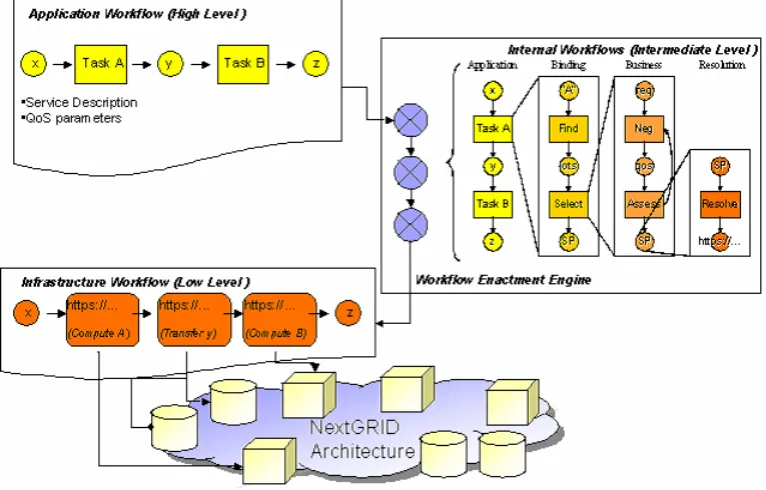
For example, we should be able to take an application-level workflow, and execute tasks by discovering, selecting and using services. However, each of these steps should itself be a flexible procedure (i.e. a business process), which can be successively incorporated into the overall workflow at run-time, allowing the application-level workflow to be resolved to specific services at specific endpoints, as shown in Figure 1.
Figure 1: Workflow-based Application Resolution
Looking at this simple example, it is suggested that both Application (the left-most one) and Business Process (all the expansions to the right) workflows could be represented and managed in uniform way. There is no structural constraint that could avoid this but only different semantic descriptions and meanings that could place these workflows in different semantic classes. We will name these Workflow classes as the following:
• Application, including workflows that are developed and managed by clients, like user
developers or application area expert, in order to be executed onto the Grid. With reference to the workflow definition by NextGRID, these are workflows that express “application processes”.
• Policy, including business process components represented as workflow developed and
University of Southampton IT Innovation Centre, 2005
the workflow definition by NextGRID, these are workflows that express business and infrastructure processes.
2.3 Workflow Management Architecture
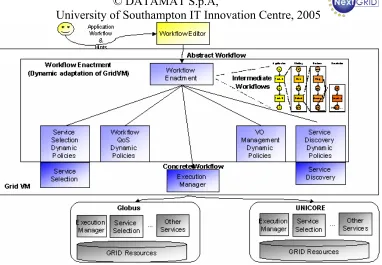
From a wider perspective (see Figure 2) we can observe that the Application Workflow could only provide an abstract description of the tasks that must be accomplished, composed by control and data flow constraints and likely augmented with information useful for service discovery and QoS assurance. The Enactment Engine will handle the Application Workflow according to the Policy that can be better applied following the application requirements, if any, and the target Grid architecture. Workflow management includes creating, modifying, substituting services and workflows according to an iterative process that ends with an entirely executable workflow. It is worth noticing that this is just a simplification example of both workflow evaluation and execution processes that will be explained in more details in Section 6.
[image:8.612.137.520.335.580.2]As a first step, the fundamental role played by all the different types of information, either structural and functional and semantic, that are linked at different levels to services and workflows must be clarified. There comes the need to specify an effective workflow model and representation language.
Figure 2: Application resolution basic steps
Keeping in mind the assumption that Policy workflows are the adaptation of the core functions of the Grid VIM, they should be considered as architectural components themselves according to the following architectural assumptions:
• Grid VIM handles composition by combining rules at run-time and constructing/enacting processes.
University of Southampton IT Innovation Centre, 2005
• Assessors, including QoS estimators and brokers, provide decisions.
• Service Providers and Application Developers provide respectively basic service components and application design request.
Figure 3 shows how these fundamental architectural components interact to implement the evaluation-apply model of the Grid VIM.
Eval Eval Apply Apply Registries Decision Services Bus/App Services Workflows/ Workflows/ Addresses Addresses QoS
QoS ssetsets priorities priorities mappings mappings Enactment Enactment Discovery Discovery Selection Selection Semantic Abstract Semantic Abstract Task/Workflow Task/Workflow Representation Representation Grid V
Grid VIIMM for Workflow for Workflow Workflows/ Workflows/ Addresses Addresses Registries Eval Eval Apply Apply Decision Services Bus/App Services QoS
QoS ssetsets priorities priorities mappings mappings Enactment Enactment Discovery Discovery Selection Selection Semantic Abstract Semantic Abstract Task/Workflow Task/Workflow Representation Representation Grid V
Grid VIIMM for Workflow
for Workflow
Figure 3: Grid VIM for Workflows
This approach allows adapting applications to fit distinctive Grid deployments from both the infrastructure and business process perspective. In effect, each time a Grid application is used, it can load an overall Grid VIM configuration policy, which tells it how to adapt the execution to fit the business environment.
University of Southampton IT Innovation Centre, 2005
Figure 4: Workflow-based Enactment Model
2.4 Workflow Language Requirements
The initial focus in Grid VIM definition has been on understanding the best approach to workflow enactment to support dynamic adaptation, and “run-time” binding of business processes according to the different models. As already explained, this approach should allow application developers to create applications that use services, and to provide application-specific hints on how it should be executed (e.g. “hint: co-locate tasks A and B”, or “hint: task C is expensive”, etc). It should not be necessary for application developers to encode specific business models into their applications because these will be applied at run-time based on process-oriented policies specified to the Grid VIM by other business stakeholders (end users, service providers, etc).
The language for specifying applications should not be constrained by the enactment model even if underlying support can obviously limit available functions. It should be possible to use “standard” workflow languages such as the BPEL proposal [8], and also simplified (non-standard) workflow languages such as the Simple Conceptual Unified Flow Language (Scufl) [9]. However, the language for specifying Policy such as service discovery, selection, accounting, etc., should be standardized, as it may be necessary for services to publish some of these processes so that application enactors can find and apply them [7]. In order to accomplish this objective, specification of the workflow representation language has been performed according to the following steps:
• Clearly specify workflow representation model and language requirements according to the objective raised by the Grid VIM concept vision.
University of Southampton IT Innovation Centre, 2005
• Specify a workflow representation model and language that fulfils the requirements and demonstrate its effectiveness providing representative description and management samples. From the beginning, the following general requirements were defined, derived from analysis of current state of workflow research areas and Grid architectural perspective:
• Not Another Workflow Language. The clear perception that workflow standards are still in flux and several projects, also in Grid areas, are continuing developing their own language and representation models convinced us to avoid definition of yet another brand new language. Selecting the most useful mechanisms for our objective among the most known standards and adapting them, if needed to our needs, should help us in specifying a language that is not reinventing the wheel and at the same time is easier to understand within and outside the project.
• Service Oriented Architecture as reference. SOA architecture is currently a kind of standard in distributed environment and, as OGSA approach demonstrates, the most innovative Grid reference architecture. It is also worth noting that considering services as computational units in the workflow model does not make constraints on the model in any way. A lower level of computational tasks, like executable programs or scripts, can be easily managed by defining service interface and execution template to encapsulate them.
More detailed requirements were then derived from the analysis and specification of the general concept of the Grid VIM. This analysis resulted in the need of a representation model providing the ability to perform the following functionalities:
• Abstract workflows definition. It must be possible to describe workflows without specifying a binding of each task to a service, so the bindings can be added at run-time.
• Semantic task description. Each task in an abstract workflow should carry a description, or at least a task type, allowing a service providing that task to be found at run-time.
• Workflow substitution. It must be possible to define bindings of abstract tasks to more detailed workflows that can be inserted into the enactment at run-time.
University of Southampton IT Innovation Centre, 2005
3 Workflow-related
Technologies
Analysis
3.1 Technology Classification
The ability to define suitable and effective workflow representations is strongly related to the role of workflow in NextGRID architecture and the requirements that have to be fulfilled while playing this role.
Firstly, general workflow investigation areas were identified (the ones underlined in Figure 5) and a general critical review of language/model proposals in these areas was performed. It is worth noticing that it was not our goal to perform a complete survey of the workflow technologies. Our interests were mainly focused in understanding the most relevant proposals in each area and analysing how they could satisfy our Grid VIM requirements.
Client Environment
Formal Models Process Modeling
Standard Languages
Grid Virtual Machine
Workflow
Patterns UML, BPMN, ... Semantics
BPEL, BPML, eBXML, XPDL, ...
Petri Nets, Pi Calculus, ...
OWL, OWL-S, ...
Grid Workflow
Projects
Client Environment
Formal Models Process Modeling
Standard Languages
Grid Virtual Machine
Workflow
Patterns UML, BPMN, ... Semantics
BPEL, BPML, eBXML, XPDL, ...
Petri Nets, Pi Calculus, ...
OWL, OWL-S, ...
Grid Workflow
Projects
Figure 5: Workflow Investigation Areas Diagram
Secondly, we derived a kind of workflow language/model classification according to a usage perspective with boundaries provided by a Client Environment, that is a user friendly programming environment where Workflows could be used to express complex applications, and a Grid VIM, where more formal language could be adopted to use Workflows as a base for Grid Programming.
3.1.1 Formal Models
Formal methods, basically process calculi, were developed in order to provide a theoretical foundation to the composition of task. They are basically mathematical representations of discrete systems and were first developed to cope with process concurrency and distributed system. In practice, they are to concurrency, what classical processing methods like the Turing Machine [10] and Lambda calculus [11] are to sequential and functional computation.
University of Southampton IT Innovation Centre, 2005
Even if some Business Process Languages (see section 3.1.2) state they have theoretical foundation on Petri Nets or Pi Calculus, we discarded the idea of selecting a purely formal method as a workflow representation language. We preferred adopting a more pragmatic than theoretical approach, most of all to ease the understanding and sharing of the selected model. Moreover, formal theories do not currently provide tools in workflow management that can be used as a starting point for our analysis and experiments.
3.1.2 Standard Languages
A review has been conducted by investigating two main classes of business process and choreography [1] languages: the Workflow Management class, typically concerning procedural workflow inside organizations, and the Web Services area, where several technology stacks have been provided to integrate already existing business process standards with orchestration and choreography layers [18].
Main proposals in the Workflow Management area are the following:
• XPDL [19] specifies a framework for workflow systems, operating inside organizations, to
define business processes according to a set of procedural rules.
• ebXML [20] is a modular suite of specifications, developed by OASIS [21], that enables
enterprises to conduct business over the Internet.
The approach and reference model of these languages are too far from our objective, since they only cover business aspects of our Grid VIM concept, and therefore they were soon discarded. Main proposals in the Web Services area are the following:
• BPEL4WS [22] provides a language for the formal specification of business processes and
business interaction protocols, extending the Web Services interaction model and enabling it to support business transactions. Specification V 1.1 was released on May 2003 (by mainly BEA, IBM, Microsoft), while standardization effort by OASIS is still in progress with the name of WSBPEL [8].
• XLANG [23] and WSFL [24] were proposed respectively by Microsoft, pioneering the
adoption of the Pi-Calculus model, and by IBM, following a more traditional Petri Nets approach. They are superseded by the BPEL4WS specification that represents a convergence of both specifications.
• BPML [25], released by BPMI.org in November 2002, is a strict superset of BPEL4WS
stating theoretical foundation on Pi-Calculus. It was abandoned with the adoption of BPEL in the BPM technology stack.
• WSCDL [26] is an XML-based language that describes peer-to-peer collaborations of
University of Southampton IT Innovation Centre, 2005
• WSCI [27], submitted by BEA, BPMI.org and others to W3C on August 2002, is an
XML-based interface description language that specifies the flow of messages exchanged by Web Services participating in choreographed interactions with other services. It was a key input for the work on WSCDL on which the Choreography work effort was moved.
Even if not yet standardized, the BPEL family (WSBPEL/BPEL4WS) emerged as a “common use” standard on top of the current Web Service technology stack that, in its highest layers, describes the technical interface for consuming a Web Service with WSDL [28], enables the exchange of messages between Web Services with SOAP [29], and supports the advertisement of Web Services in registries with, for instance, UDDI [30]. On this stack, Choreography [40], which is more focused on collaboration between partners, is usually placed on top of the Business Process Layer, which is aimed at expressing execution logic.
Our needs are strongly related to expressing the business logic of both Grid policy and application more than collaboration aspect. Thus, from this point of view the best candidate as the Grid VIM workflow language was surely BPEL and in fact it was the starting point for our work (see section 3.2).
3.1.3 Graphical Process Modelling
Besides classical graphical models like DAG and Petri Nets, little interest has been devolved towards the definition of a standard graphical notation for workflow.
The usual approach in developing tool that manage workflow languages, mainly workflow engines, is providing effective but not formally defined graphical representation of their own specific language.
BPMI.org released a Business Process Modelling Notation (BPMN) [32] specification on May 2004. This specification provides a graphical notation for expressing business processes in a Business Process Diagram (BPD) and for defining a binding between the graphical elements and block-structured constructs of languages such as BPML and BPEL4WS. However, the real standard in graphical modelling is still UML, the Unified Modelling Language provided by OMG. In fact, from this point of view much work has been done to demonstrate how UML can be used for graphically expressing BPEL models [33], Grid Workflow Applications [34] and service ontologies [35].
Our interest in the graphical models was limited to understand if any agreement was reached on workflow management at a higher processing level. Investigation on notations and tools aimed at providing user-friendly modelling of workflows is in charge of the client part of workflow management, which is in WP6.
3.1.4 Workflow Patterns
University of Southampton IT Innovation Centre, 2005
concept in the workflow context by defining 21 control-flow patterns and by recently adding data and resource patterns.
However, more than a method for expressing workflow components, this approach is a good evaluation model that helps in understanding features of different workflow models, and we thus decided to discard such approach for the actual representation mechanism.
3.1.5 Grid Workflow Languages
Workflow modelling has been addressed by several Grid projects [40] but neither a language nor a modelling approach has emerged over the others till now. The following is a list of several interesting languages addressing such problem:
• Grid Workflow Description Language (GworkflowDL) is being developed for the K-Wf Grid project (funded in EU FP6) [41] as an extension of the existing Grid Job Definition Language (GjobDL) [42], an XML-based language that makes use of the formalism of Petri Nets in order to describe the dynamic behaviour of distributed Grid jobs. Semantic description seems to be focused only on resources and is mainly based on OWL-S [43].
• AGWL (Abstract Grid Workflow Language) [44] is an XML-based language that allows a programmer to define a graph of activities that refers to computational tasks or user interactions. AGWL is the main interface to the ASKALON Grid application development environment.
• GridAnt (Globus) [45] is an Ant framework to develop a simple client side workflow system for Grids within the Java Cog Kit that is part of the Globus Toolkit 3 [46]. GridAnt evolved in a Java CoG Kit Workflow [48] framework also integrated in Globus Toolkit 4.
• Simple Conceptual Unified Flow Language (Scufl) [9], developed in the Taverna framework for the myGrid project, is an abstract language based on a simplification of WSFL. It allows modelling workflows by means of input, output, data links and different kind of processors, focusing on a simple set of workflow constructs that are intuitive for application users.
• Chimera Virtual Data System (developed in The GriPhyN Project) [49] combines a virtual data catalogue, for representing data derivation procedures and derived data, with a virtual data language interpreter that translates user requests into data definition and query operations on the database. Chimera contains the mechanism to produce a given logical file, in the form of an abstract program execution graph. These graphs are then turned into executable DAG.
• In Triana (GridLab Work Package 3) [50] workflows were represented by using an XML based WSFL like representation format. In current evolution of TRIANA GUI, task graph writers now include Petri Nets and BPEL4WS.
• In OpenMolGRID (a EU FP5 funded project) [51] an XML workflow description was developed to provide workflow support within the UNICORE client.
University of Southampton IT Innovation Centre, 2005
infrastructure (e.g. TRIANA, OpenMolGRID). Thus, due to the lack of standardization and generalization effort, we decided to discard these languages.
3.1.6 Semantics
Semantics is gaining more and more importance not only in the Web Service but also in the Grid environment.
The Semantic Web is an extension of the current web in which information is given well defined meaning, better enabling computers and people to work in cooperation [ ]. It 52 provides a common framework that allows data to be shared and reused across applications, enterprises, and community boundaries. It is a collaborative effort led by W3C with participation from a large number of researchers and industrial partners. This effort is mainly based on the Resource Description Framework (RDF) [53, 54] and, lately, on the Web Ontology Language (OWL) [55, 56]. RDF is used to represent information and to exchange knowledge in the Web whereas OWL is used to uniquely define, publish and share sets of terms called ontologies. Ontologies are currently the key of semantic web development but are a quite novel technology that is not really understood and standardized in all aspects of its specification and usage. Much work is currently focused on adding semantic information to Web Services:
• OWL-S [43, 57] is an ontology of services based on OWL. It can be viewed as a language for describing services, reflecting the fact that it provides a standard vocabulary to create service descriptions. It was submitted to W3C on November 2004.
• WSMO (Web Service Modelling Ontology) [58, 59] provides ontological specifications for describing the core elements of Semantic Web services and consists of four main elements: (1) ontologies that provide the terminology, (2) goals that state the intentions that should be solved by Web services, (3) Web services descriptions that define their various aspects, and (4) mediators which resolve interoperability problems. It was recently (June 2005) submitted to W3C.
• WSDL-S [60] defines a mechanism to semantically annotate Web services described using WSDL. Annotations can be provided with different ontology languages (e.g. OWL, UML). The original WSDL-S proposal is from the LSDIS laboratory at the University of Georgia that developed it in the framework of METEOR-S. On April 2005, a joint UGA-IBM Technical Note has been released.
Even more than in the Web Service field, no proposal for providing standard semantic description of Grid Services emerged. In the framework of EU FP6, OntoGRID is currently aimed at specifying the architectural components and tools forming the infrastructure of Semantic Grid. A Grid Resource Ontology Working Group has been also set up among FP6 Grid projects in order to define a shared ontology for representing Grid resources.
3.2 Why we selected OWL-S
University of Southampton IT Innovation Centre, 2005
previous sections, we also understood that semantic technology is no mature yet to provide a standard approach to the workflow management in Web Services and in Grid systems frameworks. From the other side, elements strictly related to manage the flow are well understood and classified, latest proposal being workflow patterns. The current focus in Business Process Management is defining means to specify role and interaction between processes and partners. BPEL has currently emerged as a standard and therefore we started our work investigating the approach of semantically extending service description, likely using OWL-S, within BPEL framework. This initial idea was abandoned due to the following considerations:
• BPEL does not fulfil all of the requirements of our representation language like, for instance, the ability to define higher order workflows. Changes would have been needed in the BPEL structure itself and this would have caused the loss of BPEL major feature that is being a well-known and used standard language.
• BPEL is by nature quite complex, offering a number of advanced features not necessary for our work. We evaluated the idea to start working on a subset of BPEL but then we considered more valuable to focus our effort mainly on the semantic innovative part of the work keeping the overall framework as simplest as possible.
“ s ema n ti cs ” OWL-S Roman
Complexity of component servic es
Comple xity of
glue la
nguage WSCL Mealy π-Calc CTR-S BPML BPEL CSP WSDL Commitment Protocols “ s ema n ti cs ” OWL-S Roman
Complexity of component servic es
Comple xity of
glue la
nguage WSCL Mealy π-Calc CTR-S BPML BPEL CSP WSDL Commitment Protocols OWL-S Roman
Complexity of component servic es
Comple xity of
glue la
nguage WSCL Mealy π-Calc CTR-S BPML BPEL BPEL CSP WSDL Commitment Protocols
Figure 6: Relative positioning of web-service composition technologies [61]
The second step was searching for a solution completely positioned in the semantic area and OWL-S resulted to be the best candidate to accomplish our task:
• Semantic issues are more focused on service than workflow description. OWL-S provides the ability to express also basic control and data flows, and therefore can be easily extended to fulfil our needs.
University of Southampton IT Innovation Centre, 2005
It is worth noticing that now WSMO is gaining wide consensus in the semantic research area while WSDL-S has received important support by IBM, therefore developing strong synergies with BPEL evolution. Nevertheless, our approach is still valid. Adopting OWL-S as a starting base, we are focusing our attention on defining a Service Ontology and in more details investigating parameters to describe service non-functional properties.
• WSMO is defining a framework for this but adding more restriction, for instance separating description of what the user wants from what the service provides or recommending use of specific vocabularies. We believe that a few restrictions and more extensibility are an added value while coping with very challenging objective like the Grid VIM, at least in the initial phase. Establishing clear rules and parameters for defining a workflow and service Ontology is the first goal of the Grid VIM activity. It is also worth noticing that the most important remark by W3C to WSMO submission is that even if it claims that it "supports XML and other W3C Web technology recommendations", the submission is not based on W3C recommendations in the Semantic Web area, such as OWL and RDF.
• WSDL-S is aimed at augmenting the expressivity of WSDL with semantics by employing concepts analogous to those in OWL-S while being agnostic to the semantic representation language. WSDL-S only refers to the OWL-S profile model (component of OWL-S that describes functionality of Web services) while the OWL-S process model (component of OWL-S that describes the interaction protocol of a Web services) is to be compared with BPEL4WS. Extending OWL-S allow us investigating aspects that are both needed for our goal in a more integrated framework.
University of Southampton IT Innovation Centre, 2005
4 OWL-WS Workflow and Service Model
4.1 Workflow and Service Model
With the aim to share a common base of understanding several basic definitions can be borrowed by OGSA Glossary [3]:
• A Service is a software component participating in a service-oriented architecture that
provides functionality and/or participates in realizing one or more capabilities. A component is a modular part of a system that encapsulates its contents and whose manifestation is replaceable within its environment. A component defines its behaviour in terms of provided and required interfaces.
• A Web Service is a software system designed to support interoperable machine- or
application-oriented interaction over a network. [40] A Web service has an interface described in a machine-processable format (specifically WSDL). Other systems interact with the Web service in a manner prescribed by its description using SOAP messages, typically conveyed using HTTP with an XML serialization in conjunction with other Web-related standards.
• (Informal) In its more general use, a Grid Service is a Web service that is designed to
operate in a Grid environment, and meets the requirements of the Grid(s) in which it participates.
As we already discussed, our work is in a context of a Grid architecture based on a SOA model and therefore we adopt Grid Services as the base for computational unit of our model providing them with semantic extension that will be used for service definition and management.
In our Workflow and Service (WfS) model, “Service” name will be used as a simplification of the following definition:
; A Semantic NextGrid Service (Service) is a Grid Service designed to operate in a NextGRID environment also using some kind of semantic information.
It is worth noticing that adopting Grid Services as a base for computational units does not limit the model itself. Different kinds of computational unit, like scripts, executable programs and data transfer could be also managed in this model providing them with a service interface.
The fundamental statement of our WfS is the following:
; Services and Workflows can be viewed as the same functional entity addressed from a different perspective and therefore can be managed in the same way.
University of Southampton IT Innovation Centre, 2005
; Services (and Workflows) can be described as Abstract or Concrete
• Concrete Service (CS) is a Service description providing both semantic and execution
information of the service.
Thus a CS provides both semantic description of the service properties and specific service handle with related IO parameters that allows actual service execution.
• Abstract Service (AS) is a Service description providing only semantic information about a
service.
It is easy to understand that there are two different types of semantic information:
o Constraint information, that is Abstract Service requirements description providing
information on required properties of the services. This is the description typically provided by an end-user looking for a service implementation.
o Capability information that is published Service description giving information on the
properties provided by the service. This is the description typically provided by a Service Provider advertising the service.
More information on the role of service parameters in the WfS model will be provided in section 4.5.
• Concrete Workflow (CW) is the description of a CSs composition, therefore providing
semantic and execution information both on the single CSs components and on the overall composition (e.g. dataflow bindings, control flow structures).
As in the general WfS model, a CW can be viewed as the implementation of a complex service composed, in turn, of simple services. At the same time a CS can be considered as the simplest form of a CW.
• Abstract Workflow (AW) is the description of an ASs composition providing semantic
information on how the workflow has been composed.
As in the general WfS model, an AW has its own description as a kind of “complex” service, e.g. its own name, IO parameters description. In this sense it can be considered as a “service” composed of simpler services, exhibiting “self similar” composition properties that we believe should be a fundamental architectural feature in NextGRID. At the same time an AS can be considered as the simplest form of an AW.
• Intermediate Workflow (IW) is the description of composition of Services that could be
University of Southampton IT Innovation Centre, 2005
We usually define Abstract Workflows to be any kind of Workflow that is not entirely concrete. From this point of view an Intermediate Workflow is a kind of Abstract Workflow.
Turning back to the example in Figure 2 and explaining it according to our WfM model, we can see that the Application Workflow is represented as a composition of Abstract Services where functional parameters, a Service description with data and control flow information, and non-functional parameters, e.g. QoS parameters, are provided. In this case, QoS parameters represent the Service Constraint that would guide in the choice of the best Concrete Services implementing the Application Workflow. The Enactment Engine will manage the Application Workflow by applying different kind of Policy Workflows that use “registry services” and “decision services” (see Figure 3) to produce increasingly concrete Intermediate Workflows, until a fully Concrete part appears that can be executed. The Concrete Workflow will be composed by Services with their own execution information that are, in practice, Grid Services provided by the underlying Grid Infrastructure and implementing the required abstractions of both Application and Policy level. The Internal Workflows at the different stages of evaluation and enactment process may be Intermediate Workflows containing more and more concrete information.
4.2 OWL-S Fundamentals
Our Language Model is entirely based on OWL-S and therefore it is important to have a clear knowledge of OWL-S basic concepts. It is not our objective to provide a complete review of this ontology that is clearly explained in [43]. We just summarize several basic concepts that will be useful to understand at least the terminology used to express the OWL-WS model and related samples:
• The class Service provides an organizational point of reference for a declared Web service;
one instance of Service will exist for each distinct published service.
• The Service Profile tells "what the service does". This form of representation includes a
description of what is accomplished by the service, limitations on service applicability and quality of service, and requirements that the service requester must satisfy to use the service successfully (capabilities/constraints).
• The Service Model tells a client how to use the service, by detailing the semantic content of
requests, the conditions under which particular outcomes will occur (I/O), and, where necessary, the step by step processes leading to those outcomes (Control/Data flows). That is, it describes how to ask for the service and what happens when the service is carried out.
• A Service Grounding ("grounding" for short) specifies the details of how the service can be
accessed. Typically a grounding will specify a communication protocol, message formats, and other service-specific details such as port numbers used in contacting the service. In addition, the grounding must specify, for each semantic type of input or output specified in the Service Model, an unambiguous way of exchanging data elements of that type with the service (that is, the serialization techniques employed).
• A Service Process is a subclass of the Service Model. A process is not a program to be
executed. It is a specification of the ways a client may interact with a service. An atomic
University of Southampton IT Innovation Centre, 2005
(e.g. WSDL document, operation and port type) specified. A composite process is one that
maintains some state; each message the client sends advances it through the process. Composite processes are decomposable into other (non-composite or composite) processes; their decomposition can be specified by using control constructs such as Sequence, Split and If-Then-Else.
It is important to take into account that a process can have two sorts of purpose. First, it can generate and return some new information based on information it is given and the world state. Information production is described by the inputs and outputs of the process. Second, it can produce a change in the world state. This transition is described by the preconditions and effects of the process. The set of inputs, outputs, preconditions, and effects is usually referred as IOPE.
Figure 7: OWL-S Upper Ontology
4.3 OWL-WS Language Model
Starting from OWL-S, we define two major changes, explained in the following, which allow us using OWL-S for expressing our WfS model. We call this OWL-S extended version OWL-WS that
stands for “OWL for Workflows and Services”.
; The complete OWL-S model is adopted as it is in OWL-WS to represent Concrete Services.
This means that a Concrete Services is represented by means of a Service with its own Profile (containing non functional information), Process (containing instruction for the sequence of service invocations) and Grounding (containing reference to the real endpoint for invocation).
• A main restriction is applied to OWL-S. Profile and Process Models must be consistent with each other.
University of Southampton IT Innovation Centre, 2005
The OWL-WS Workflow Model is based on the assumption that a workflow is a kind of complex service. Referring to OWL-S terminology, a workflow can be viewed from the functional perspective as a Service and therefore described by a Profile, providing information on its overall functionality. It can also be viewed as a service composition and therefore described by a Service Model Process (a Composite Process) that provides information on the composition structure and related components.
OWL-WS extension uses the concept of composite process for workflow modelling but while OWL-S focuses on modelling a workflow that is internal to a single service, i.e. a sequence of calls to the service operations, we extend this notion to comprise also inter services processes. In practice, while an OWL-S Process specifies the steps needed to interact with a service implementation, an OWL-WS Process specifies the steps needed to interact also with different services in order to perform the functionality described in the service Profile. This can be obtained allowing a Grounding being composed by components referring different services.
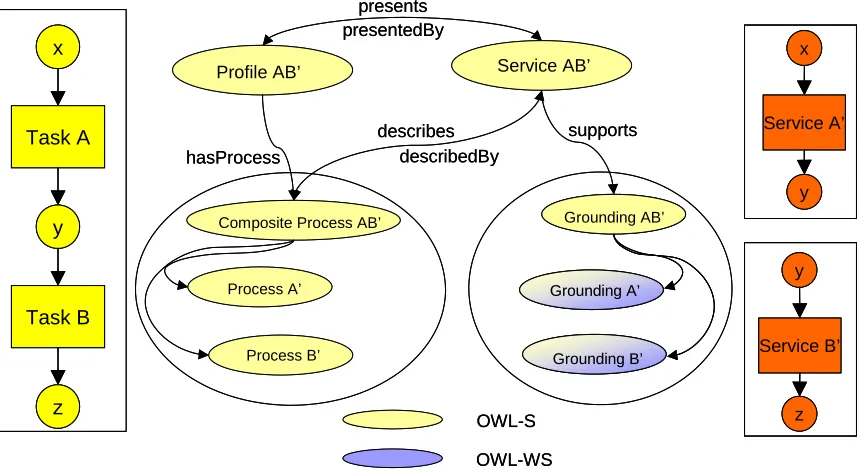
[image:23.612.115.545.389.624.2]; A Concrete Workflow is modelled as a Service with its own Profile, Composite Process and an extended Grounding, whose elements can refer to different Services.
Figure 8 shows a Concrete Workflow modelled in OWL-WS. This workflow implements the Abstract Workflow on the left, composed by Task A and B, by means of the service instances that are on the right, Service A’ and B’. The only OWL-WS extension is in the fact that Grounding A’ and B’ refers to operations related to different services.
x
y
z Task A
Task B
Composite Process AB’
Process A’ Process B’ Service AB’ Profile AB’ OWL-S OWL-WS describes describedBy hasProcess presents presentedBy supports Grounding A’ Grounding B’ Grounding AB’ x y Service A’ y z Service B’ x y z Task A Task B x y z Task A Task B
Composite Process AB’
Process A’ Process B’ Service AB’ Profile AB’ OWL-S OWL-WS describes describedBy hasProcess presents presentedBy supports Grounding A’ Grounding B’ Grounding AB’ Grounding A’ Grounding B’ Grounding AB’ x y Service A’ y z Service B’ x y Service A’ y z Service B’
Figure 8:OWL-WS Concrete Workflow
University of Southampton IT Innovation Centre, 2005
service, in an Abstract Service the model is only providing semantic description of the process. No assumption can be made on the control flow that need to be implemented and therefore the Service Process can only be Atomic.
In order to generalize this model to comprise also Abstract Workflows we need to define another fundamental OWL-WS extension that is called “Abstract Process”:
An Abstract Process is an Atomic Process having no link to any Grounding and provided with a new property “definedBy” that points to a Profile.
; An Abstract Service is modelled as a Service with its own Profile and an Abstract Process. In this case a new property “definedBy” points to the Service Profile itself.
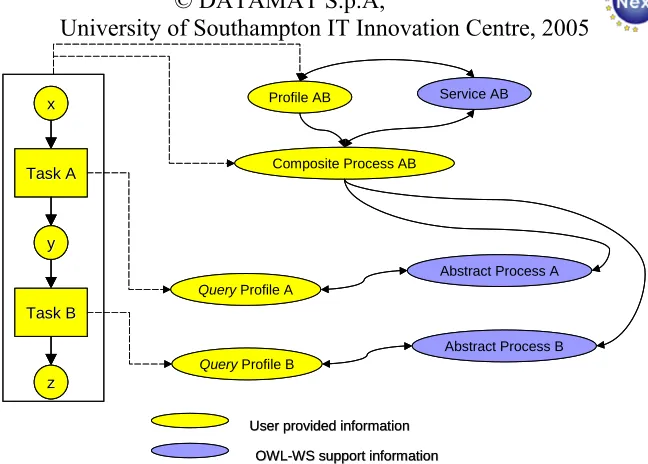
; An Abstract Workflow is modelled as a Service with its own Profile and a Composite Process, whose elements are in turn Abstract Processes each one with its own Profile.
The Profile referred by the Abstract Process contains Service constraint information describing the Process itself (that is its required functionality). We informally call it “Query Profile” just to make clear that it contains information useful to (query and) discover service instances matching the Abstract Service requirements. In practice, even if we have a single Profile structure, Profile parameters can model both constraints and capabilities:
• A Profile referred by an Abstract Process, and therefore modelling an Abstract Service, contains constraints information
• A Profile referred by a Service, and therefore modelling a Concrete Service, contains capabilities information
While in some languages, e.g. WSMO, there is a strong distinction between constraints and capabilities information, we prefer to keep it loose. This allows us to model complex structures like, for instance, Workflow Templates. A Workflow Template is an Abstract Workflow that models typical computational patterns composing Abstract Services whose implementation could be discovered at run-time. The Workflow Template could be saved and stored for further usage and retrieval and therefore it can be modelled with a main Profile defining the template capabilities (needed for template discovery) and component Abstract Services whose Profiles define single service constraints (needed for service implementation discovery).
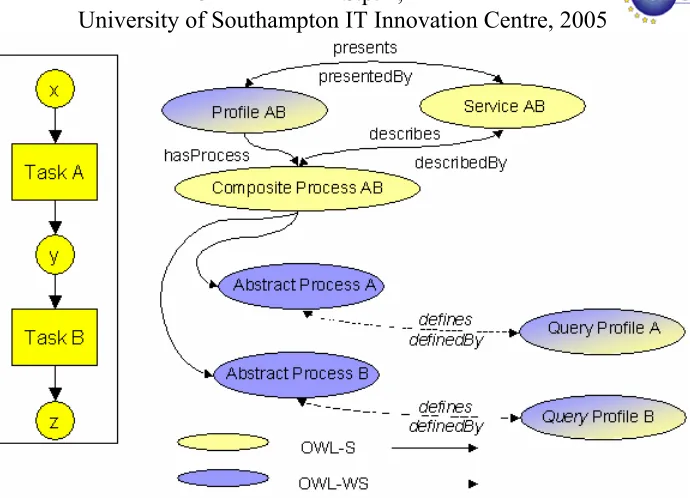
Figure 9 shows an Abstract Workflow composed by two Abstract Services A and B each defined by its own Profile A and B. It should be noticed that a global Profile AB is also provided. It may contain constraints related to the overall workflow (e.g. map this workflow providing global optimisation). This is an important feature of OWL-WS allowing us to support Service Grouping
University of Southampton IT Innovation Centre, 2005
Figure 9: OWL-WS Abstract Workflow
It is important that in the Abstract Workflow construction, e.g. in workflow editing, it must be assured that global and local Profile information is consistent.
According to the previous model we can state that:
• An Abstract Workflow is represented by an OWL-WS model where each process has its own Profile.
• A Concrete Workflow is represented by an OWL-WS model where each process has its own Grounding.
• An Intermediate Workflow is represented by an OWL-WS model where each process may have its own Grounding or Profile.
As a final note, it is worth noticing that in the OWL-WS model, Profile is the most important element in Service and Workflow definition and the real access point to the overall structure. For this reason we consider the Profile as the handle (or, from a programming perspective, as the pointer) for any Service and Workflow. Treating the Profile as any other OWL type we are also able to manage workflows as any other data type, even like input/output parameters. Ability to define higher-order workflows has been therefore ensured.
• The handle of any kind of Workflow and Service is the uppermost Profile.
University of Southampton IT Innovation Centre, 2005
4.4 OWL-WS Control/Data Flow Constructs Analysis
As it is initially stated, OWL-WS is completely based on OWL-S for all that concerns data and control flow. Therefore, analysis of OWL-S constructs can be directly applied to OWL-WS.
We adopt Workflow Patterns (see section 3.1.4) as parameters to identify the basic and advanced features a workflow language should support in order to be considered enough powerful for its purpose. The following table thus lists the supported workflow patterns from the OWL-S perspective. For each OWL-S control-flow construct an equivalent workflow pattern is provided. The corresponding workflow patterns1 have been taken from the Workflow Pattern website:
OWL-S CF Construct Workflow Pattern
Sequence Sequence
Unordered Parallel Split + Synchronization
Split Parallel Split
Split + Join Parallel Split + Synchronizing Merge
Choice Multiple Choice
If-then-else Exclusive Choice
Iterate Arbitrary Cycle
Repeat-until Structured Cycle (restriction of Arbitrary Cycle) Table 1: OWL-S control-flow constructs and their corresponding workflow pattern
This list clarifies how powerful OWL-S is for describing workflows. As it is clear from the table, OWL-S provides a native support to most of the basic control and data flow constructs necessary for specifying a workflow of services. It is also clear that OWL-S lacks support in more advanced workflow patterns. However, it can be argued that the set of workflow patterns natively supported are sufficient for OWL-S to be a Turing-equivalent language, thus capable of implementing such advanced workflow patterns if needed.
Nothing much needs to be said about the specific requirements of dataflow constructs as OWL-S natively supports the necessary binding constructs for linking outputs of a service operation to inputs of another (possibly different) service operation. Thus, we can state that OWL-S mechanisms for specifying the dataflow constructs and bindings are completely and natively supported by functionalities defined on its set of Inputs, Outputs, Preconditions, and Effects (IOPE). See section 4.2 for details. The only open issue is relative to the possibility of considering a particular ontology for describing specific types of entities to be used as I/O parameters for a dataflow. Note that, OWL-S, by the means of existing ontologies and languages, such as SWRL [62], already supports the conventional types used in I/O operations.
4.5 OWL-WS Profile Parameters Analysis
4.5.1 Attributes Definition
OWL-S provides a mechanism to define both functional and non-functional service properties. Starting from the OWL-S Profile analysis, a more detailed and customized Profile model should be
University of Southampton IT Innovation Centre, 2005
defined to fit NextGRID Semantic Language Requirements. To do so some terminology definitions need to be introduced:
• A service is defined by its attributes, specified in its Profile
• Attributes are partitioned into two categories: functional and non-functional
o Functional attributes: are used to describe what the service can do o Non-functional attributes: are used to describe all the other aspects
• Attributes are specified in a semantically enriched way, thus are considered meta-data of a service (in contrast, for instance, with the data specific to WSDL implementations found in Groundings)
• Meta-data are implemented in OWL-S as properties of a service’s Profile
A service’s Profile describes, in a semantically enriched fashion thus with meta-data, the attributes of its service. By the means of a Profile, one can identify all the necessary information about a service. We identified two lists of attributes, which will be presented in the following sections, that are fundamental to describe a service. These attributes were derived analysing the role of services in SOA and in Grid architecture. In particular, description of service registry for NextGRID applications, provided by WP7 [63], was also analysed to verify matching with our selected parameters. Attributes were grouped according to main functional categories.
[image:27.612.130.527.460.683.2]Figure 10 shows the OWL-S provided attributes to a service’s profile. On the left are shown the most important functional attributes related to a service whereas, on the right, properties that can be used to describe non-functional attributes are depicted. Note that the specification given by OWL-S for non-functional attributes is not complete nor even specific, instead these OWL-S data/object properties are the basic blocks to be used for describing all the necessary non-functional attributes that we will find useful.
University of Southampton IT Innovation Centre, 2005
Finally, it is worth mentioning that, for a semantic workflow language such as OWL-WS to be effective, it is fundamental to provide some way to specify the reference ontologies used for describing the different attributes. This way, the semantically enriched language doesn’t suffer the problem of sharing and adapting a single specific ontology to everyone wishing to use this language. Because of this important factor, OWL-S services will define a specific model to accommodate, when possible and useful, the ability to define information related to the ontology used for giving an unambiguous meaning to the attribute it refers to. OWL-S submission already provides examples to model industrial taxonomies by means of serviceCategory property. We think that this property could also be used to address any different kind of ontology.
4.5.2 Functional Attributes
This section provides a table listing the basic properties of a service’s Profile that can support model of its functional attributes. These are the attributes that will identify the service in the process of discovering it, by matching functional constraints provided by the service requestor with the functional capabilities advertised by the service provider. We provide for each attribute a simple description and the OWL-S properties to support attribute modelling in OWL-WS.
Attribute Description OWL-WS Property Support
Service Category
Semantic taxonomy providing a hierarchy of
categories (property available in OWL-S) Supported in OWL-S (serviceCategory + ontology) Service
Functionality
Semantic taxonomy specifying functionalities of a service in terms of its specific operations
Supported in OWL-S (serviceParameter + ontology)
Service I/O Semantic taxonomy specifying the possible IOPE entities used
Supported in OWL-S (IOPE + SWRL) Table 2: Service Functional Attributes
4.5.3 Non-Functional Attributes
This section proposes a list of non-functional attributes useful to describe some of the relevant characteristics related to service QoS, Security and management topics.
University of Southampton IT Innovation Centre, 2005
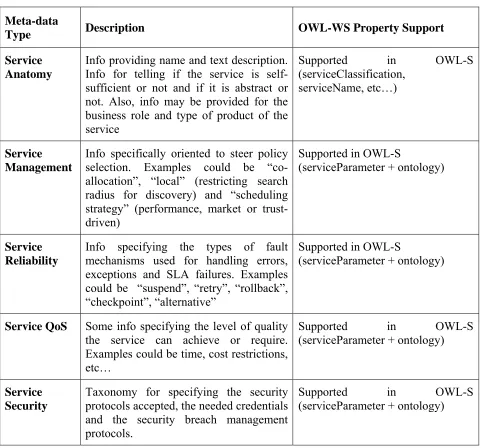
The following is a list of basic non-functional attributes we consider fundamental to provide additional information to a service description. We provide for each attribute a simple description and the OWL-S properties to support attribute modelling in OWL-WS.
Meta-data
Type Description OWL-WS Property Support
Service Anatomy
Info providing name and text description. Info for telling if the service is self-sufficient or not and if it is abstract or not. Also, info may be provided for the business role and type of product of the service
Supported in OWL-S (serviceClassification,
serviceName, etc…)
Service Management
Info specifically oriented to steer policy selection. Examples could be “co-allocation”, “local” (restricting search radius for discovery) and “scheduling strategy” (performance, market or trust-driven)
Supported in OWL-S
(serviceParameter + ontology)
Service Reliability
Info specifying the types of fault mechanisms used for handling errors, exceptions and SLA failures. Examples could be “suspend”, “retry”, “rollback”, “checkpoint”, “alternative”
Supported in OWL-S
(serviceParameter + ontology)
Service QoS Some info specifying the level of quality the service can achieve or require. Examples could be time, cost restrictions, etc…
Supported in OWL-S (serviceParameter + ontology)
Service Security
Taxonomy for specifying the security protocols accepted, the needed credentials and the security breach management protocols.
[image:29.612.85.567.103.551.2]Supported in OWL-S (serviceParameter + ontology)
Table 3: Service Non-functional Attributes
University of Southampton IT Innovation Centre, 2005
5 Workflow Management Model and Samples
In order to validate our workflow language and model we define a basic User-Provider management model to be applied both for application and policy definition and usage. We then provide evidence of how OWL-WS model can be used to represent and manage typical use cases in the User-Provider model, also introducing basic OWL-WS management operation. We finally provide Profile samples for simple application and policy examples.
5.1 User-Provider Management Model
We define a simple User-Provider model specifying actions for the two main roles. A User must be able to:
• Specify both services instances that are already known service implementations, and abstract services, that are functionality expressed by means of semantic information (e.g. standard service name).
• Compose Services in complex Workflow.
• Reuse previously defined Workflows and compose them in turn. A service Provider must be able to:
• Publish Services providing information on service discovery and execution (that is semantic, functional and implementation information)
• Publish workflows providing information on workflow discovery and execution.
It is worth noticing that these roles do not necessarily represent interaction between application end-user and application service provider but are really actors performing specific functions. For instance, a user building a workflow and storing it for further usage is acting the role of Provider. Also, a Grid service administrator publishing policies to be used as evaluation mechanisms in the Workflow Enactment (see section 6) plays the Service Provider role, with an Enactment Engine playing the User role.
5.1.1 Workflows representation in User-Provider scenarios
Several scenarios can be derived from the interaction between User and Provider roles according to their enabled actions.
University of Southampton IT Innovation Centre, 2005 x x y y z z Task A Task A Task B Task B
QueryProfile A
QueryProfile B
Composite Process AB
Abstract Process A
Abstract Process B Service AB Profile AB
User provided information
User provided information
OWL
OWL--WS support informationWS support information
x x y y z z Task A Task A Task B Task B x x y y z z Task A Task A Task B Task B
QueryProfile A
QueryProfile B
Composite Process AB
Abstract Process A
Abstract Process B Service AB Profile AB
User provided information
User provided information
OWL
[image:31.612.166.490.34.266.2]OWL--WS support informationWS support information
Figure 11: User Defined Abstract Workflow
Figure 12 shows a case in which the user already knows the instances implementing the services he is composing and want to use these instances for modelling a complex concrete workflow. In this case user does not need to provide service constraints, instead it provides capability information on the overall service he is composing. As already discussed, Grounding A’ and B’ could be related to different services instances. It is worth noticing that in this case, that is when a Concrete Workflow is composed, user does not provide information for each single component but global capabilities should provide enough information to describe features of the workflows. Moreover, single components are only considered as part of the global workflow and cannot be addressed here as single elements, as for instance in case each single service is published on its own.
User Provided Information
OWL-WS Support information
Process A’ Grounding A’
Process B’ Grounding B’ x
Service A
y
z Service B
Composite Process AB
Service AB Profile AB
Grounding AB
Provider Provided Information User Provided Information
OWL-WS Support information
Process A’ Grounding A’
Process B’ Grounding B’ x
Service A
y
z Service B
Composite Process AB
Service AB Profile AB
Grounding AB
Provider Provided Information
Figure 12: User Defined Concrete Workflow
University of Southampton IT Innovation Centre, 2005
functionality (e.g. service components and related control structure) and also fundamental information for Service execution (e.g. data flow binding). In order to avoid unnecessary complexity, we consider that only Profile information should be used for Discovery.
OWL-WS Discovery Information (Capability)
OWL-WS Execution information Profile A’ Service A’
Process A’ Grounding A’
Profile B’ Service B’
Process B’ Grounding B’ x
y Service A’
y
z Service B’
OWL-WS Discovery Information (Capability)
OWL-WS Execution information Profile A’ Service A’
Process A’ Grounding A’
Profile B’ Service B’
Process B’ Grounding B’ x
y Service A’
y
[image:32.612.187.466.107.280.2]z Service B’
Figure 13: Service Provider modelling service information with OWL-S
5.1.2 Workflows management in User-Provider scenarios
If we take into account scenarios introduced in previous section, we understand that fundamental workflow management operations need to be modelled in order to support workflow representation in User-Provider interaction. We are not providing formal definition of these operations but we just provide representation examples to show how the OWL-WS workflow should be managed to implement them.
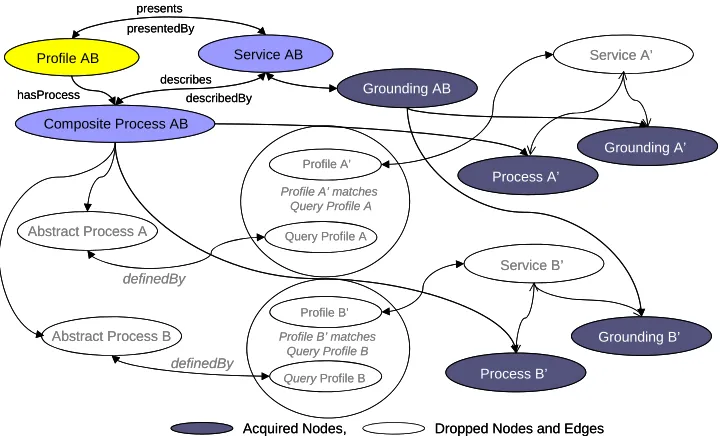
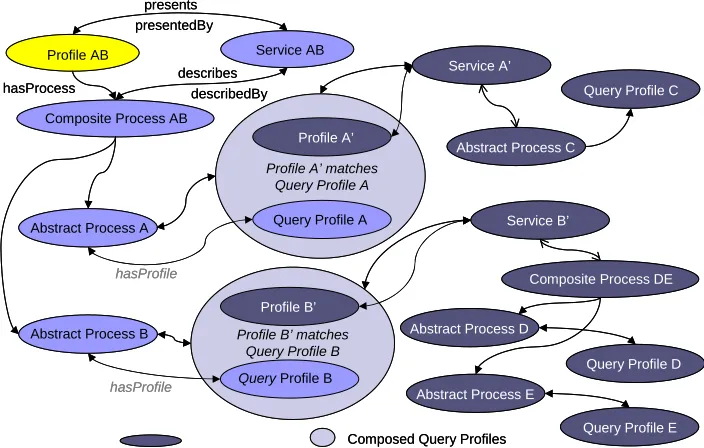
Service Discovery is the action of retrieving a Service, Abstract or Concrete, whose capabilities
match the constraints of the input Abstract Service. In case an Abstract Service is returned it is usually an Abstract Workflow e.g. a functionally equivalent workflow composed by more elementary services than the one provided as input. It is performed by means of Profile matching. Profile Matching gets a Query Profile and returns Capability Profiles whose properties match the Query Profile properties.