Analysis of seed processing by the distinct element method
Mehrdad Pasha, Colin Hare, Mojtaba Ghadiri, Patrick M. Piccione, and Scott TaylorCitation: AIP Conf. Proc. 1542, 931 (2013); doi: 10.1063/1.4812085
View online: http://dx.doi.org/10.1063/1.4812085
View Table of Contents: http://proceedings.aip.org/dbt/dbt.jsp?KEY=APCPCS&Volume=1542&Issue=1
Published by the AIP Publishing LLC.
Additional information on AIP Conf. Proc.
Journal Homepage: http://proceedings.aip.org/
Journal Information: http://proceedings.aip.org/about/about_the_proceedings
Top downloads: http://proceedings.aip.org/dbt/most_downloaded.jsp?KEY=APCPCS
Analysis of Seed Processing by the Distinct Element Method
Mehrdad Pasha
1, Colin Hare
1, Mojtaba Ghadiri
1, Patrick M Piccione
2, Scott
Taylor
21 The Institute of Particle Science & Engineering, The University of Leeds, Leeds, UK, LS2 9JT 2 Process Studies Group, Syngenta Ltd, Jealott’s Hill International Research Centre, Bracknell,
Berkshire, UK, RG42 6EY
Abstract. The undesirable breakage of seeds during processing may result in quality degradation. Seeds experience a portfolio of shear and impact stresses as they flow through various machinery, and this may cause surface damage as well as integral damage. An in-depth study and understanding of the microscopic mechanisms of the various processes is needed to investigate and address the problem of breakage. The main aim of this work is to carry out a parametric study of the effect of sliding and rolling friction on the flow field of seeds in a seed coater device by modeling particles motion using Distinct Element Method (DEM). It was found that sliding friction plays an important role in changing the flow pattern and particles solid fraction in a specified measurement cell. However, study of particle rolling friction showed that flow pattern and solid fraction of particles will not be affected once the coefficient of rolling friction exceeds a value of 0.1.
Keywords: DEM, Seed Processing, Coating, Granular Flow, Parametric Study.
PACS: 81.05.Rm; 83.10.Rs; 45.70.Mg;
INTRODUCTION
The majority of agricultural seeds in the market undergo a series of seed processing stages in order to improve their mechanical, physical and germination quality. Seed processing mainly involves cleaning, drying, size and shape classification, sorting and finally coating the seeds in order to improve their germination, immunity to insects and lifetime. As the seeds flow through various processing stages, they experience a portfolio of shear and impact stresses which may lead to surface and integral damage of the seeds. Therefore investigation of the flow fields and mechanical stresses is critical in order to quantify and minimise the level of stresses which the seeds experience. There exist a number of approaches in the literature for measuring the breakage of particles by impact [1] and bulk shear [2-3]. However, the existing methodologies need to be tailored for measuring seed breakage. In this work, the Distinct Element Method (DEM) is used to model the velocity fields within a seed coater based on which the damage to seeds may be assessed experimentally. A parametric study is carried out on the effect of rolling and sliding friction on the seed flow patterns in a seed coating device.
DEM SIMULATION OF SEED
COATING UNIT
FIGURE 1. Geometry of the seed coater unit in EDEM software.
In simulating particulate systems, spherical shaped particles are preferred due to the simplicity of contact detection, since contacts can be detected if the distance between two particles becomes equal or less than the sum of their radii. This would result in efficient detection of contacts and therefore leads to fast calculations of contact forces. In the literature, it has been reported that by introducing particle-particle rolling friction for spherical particles in DEM simulations, the effect of particles shape can be simulated [4]. Rolling friction acts as a resistive torque to the particle rotation, which in this paper is calculated by Equation 1.
i r n i i
M F R (1)
where μr is coefficient of rolling friction, Fn the normal
force, Ri the distance from the center of mass to the
contact point and ωi the unit angular velocity vector at
the contact point.
[image:3.595.307.524.107.259.2]In this paper, the sensitivity of particle velocity and solid fraction within a measurement cell to various rolling and sliding friction coefficients is investigated. Properties used in the simulation are summarised in Table 1.
RESULT AND DISCUSSION
The distributions of tangential and radial velocities are evaluated within a measurement cell (MC), which has dimension of 30 mm in all x, y and z-directions, during a 6 second period of operation in the coater. This measurement cell is parallel to the vertical plate and is located in front of it as shown in Figure 2.
FIGURE 2. Measurement cell in DEM simulations (indicated by red square).
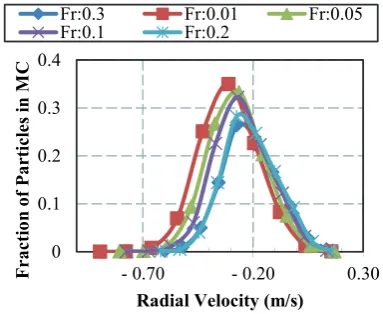
The total number of particles that experience a given velocity throughout a sampling interval of 5 ms within this 6s period is calculated. Figures 3 and 4 show the effect of particle-particle rolling friction on the tangential and radial particle velocity distributions, respectively.
0 0.1 0.2 0.3 0.4
1.20 0.70
0.20
Fracti
on
of
Parti
cl
es
in
M
C
Tangential Velocity (m/s)
[image:3.595.327.514.358.505.2]Fr:0.3 Fr:0.01 Fr:0.05 Fr:0.1 Fr:0.2
FIGURE 3. Effect of particle rolling friction on tangential particle velocity.
0 0.1 0.2 0.3 0.4
0.30 - 0.20
- 0.70
Fracti
on
of
Particl
es
in
M
C
Radial Velocity (m/s)
Fr:0.3 Fr:0.01 Fr:0.05 Fr:0.1 Fr:0.2
[image:3.595.320.512.541.698.2]TABLE 1. DEM simulation parameters
Poperty Rolling Friction Variation Sliding Friction Variation
Shear modulus (MPa) 1 1
Density (kg/m3) 1163 1163
Coeff. Restitution 0.4 0.4
Coeff. of rolling friction (particle-particle) 0.01 – 0.3 0.1 Coeff. of rolling friction (particle-wall) 0.01 0.01 Coeff. of sliding friction (particle-particle) 0.2 0.1 – 0.4 Coeff. of sliding friction (particle-wall) 0.2 0.2
Particle mean size (mm) 5 5
Particle size variation ratio ±5% ±5%
As the rolling friction is increased from 0.01 to 0.05, there is a notable decrease in the mean tangential velocity and an increase in the mean radial velocity. Further increase of the rolling friction causes a smaller change. Figure 5 shows the distribution of solids fraction within the measurement cell. An increase in the rolling friction from 0.01 to 0.05 causes a significant reduction in solids fraction. Further increase in rolling friction has a negligible effect on solids fraction. These simulations show that implementation of rolling friction using spherical particles does not provide a satisfactory account of particle shape for simulating their dynamics.
0 5 10 15 20 25 30
0 0.2 0.4 0.6
Fra ction of Ti m e (%) Solid Fraction
[image:4.595.89.280.405.549.2]Fr:0.3 Fr:0.01 Fs:0.05 Fr:0.1 Fr:0.2
FIGURE 5. Distribution of solids fraction for various particle rolling frictions.
Figures 6 and 7 show the effect of particle-particle sliding friction on tangential and radial particle velocity distributions, respectively.
0 0.1 0.2 0.3 0.4 1.10 0.60 0.10 Fr ac ti on o f Pa rt ic le s in MC
Tangential Velocity (m/s)
Fs:0.4 Fs:0.1 Fs:0.2 Fs:0.3
FIGURE 6. Effect of particle sliding friction on tangential particle velocity. 0 0.1 0.2 0.3 0.4 0.30 - 0.20 - 0.70 Fra ction of Particles in MC
Radial Velocity (m/s)
Fs:0.4 Fs:0.1 Fs:0.2 Fs:0.3
FIGURE 7. Effect of particle sliding friction on radial particle velocity.
[image:4.595.320.518.429.564.2]0 5 10 15 20 25 30
0 0.2 0.4 0.6
Fraction of
T
im
e
(%
)
Solids Fraction (-)
[image:5.595.85.281.113.252.2]Fs:0.4 Fs:0.1 Fs:0.2 Fs:0.3
FIGURE 8. Distribution of solids fraction for various particle sliding frictions.
CONCLUSION
A series of DEM simulations were carried out in order to investigate the effects of rolling and sliding friction on particle tangential and radial velocity distributions. Although, it has been reported in the literature that by introducing particle-particle rolling friction the effect of particle shape can be accounted for, the simulation of the seed coater showed that the coefficient of particle rolling friction is not significantly influencing the tangential and radial velocities. This suggests that it may be necessary to implement particle shape in the simulations to accurately describe the behavior of the real seeds. However, this needs to be validated by comparing simulation and experimental results.
It was shown that the mean average tangential and radial velocities remain constant with the variation of particle-particle sliding friction. However, this had a significant effect on solids fraction within the measurement cell, where the solids fraction increased as sliding friction was increased. Moreover, the DEM simulations showed that the coefficient of particle sliding friction has a significant effect on particles flow pattern and therefore could affect the coating performance of the coater. DEM simulations will be used to estimate the level of stresses which the seeds experience within the coating stage. Thereafter, seed breakage rates obtained in shear cell measurements will be coupled with the DEM stress analysis in order to predict the rate of seed breakage.
ACKNOWLEDGMENTS
Financial support from Syngenta Ltd for the first author is gratefully acknowledged.
REFERENCES
1. M. Ghadiri and Z. Zhang, Chem. Eng. Sci. 57, 3659– 3669 (2002).
2. M. Ghadiri, Z. Ning, S. J. Kenter, E. Puik, Chem. Eng. Sci. 55, 5445-5456 (2000).
3. Z. Ning, M. Ghadiri, Chem. Eng. Sci. 61, 5991-6001 (2006).