promoting access to White Rose research papers
White Rose Research Online [email protected]
Universities of Leeds, Sheffield and York
http://eprints.whiterose.ac.uk/
This is an author produced version of an article published in Social Science & Medicine.
White Rose Research Online URL for this paper:
http://eprints.whiterose.ac.uk/75805/
Published article:
Ward, V, Smith, SO, House, A and Hamer, S (2012) Exploring knowledge exchange: a useful framework for practice and policy. Social Science and Medicine, 74 (3). 297 - 304.
1 Manuscript Number: SSM-D-11-00917R2
Title: Exploring knowledge exchange: a useful framework for practice and policy
Authors: Dr Vicky Ward, PhD, Leeds Institute of Health Sciences, University of Leeds Dr Simon Smith, PhD, Leeds Institute of Health Sciences, University of Leeds
Professor Allan House, MD, Leeds Institute of Health Sciences, University of Leeds Dr Susan Hamer, EdD, Faculty of Medicine & Health, University of Leeds
Corresponding Author: Dr Vicky Ward, [email protected]
Acknowledgements: This study was funded by the Medical Research Council (grant no. G0601172). The authors would like to thank Dr Peter Trigwell and Professor Justin Keen who acted in an advisory capacity during the research. Final thanks go to all of our study participants and to the reviewers and colleagues who commented on this paper.
Keywords: Knowledge exchange; knowledge brokering; implementation; evidence-based policy; UK
Abstract
Knowledge translation is underpinned by a dynamic and social knowledge exchange process but there are few descriptions of how this unfolds in practice settings. This has hampered attempts to produce realistic and useful models to help policymakers and researchers
understand how knowledge exchange works. This paper reports the results of research which investigated the nature of knowledge exchange. We aimed to understand whether dynamic and fluid definitions of knowledge exchange are valid and to produce a realistic, descriptive framework of knowledge exchange.
2
process in more detail. This enabled us to refine our conceptual framework of knowledge exchange.
We found that knowledge exchange can be understood as a dynamic and fluid process which incorporates distinct forms of knowledge from multiple sources. Quantitative analysis illustrated that five broadly-defined components of knowledge exchange (problem, context, knowledge, activities, use) can all be in play at any one time and do not occur in a set order. Qualitative analysis revealed a number of distinct themes which better described the nature of knowledge exchange.
3 Context
Finding ways of translating research-based knowledge into healthcare policy and practice has become one of the most pressing concerns over the last decade or more (Nutley, Walter, and Davies 2007). This intense interest has been prompted by a range of
well-rehearsed arguments about the social and economic damage caused by failures to put research evidence to good use (Berwick 2003; Darzi 2008; World Health Organization 2004). In the wake of the current economic crisis arguments about wasted resources (in the form of funding for research whose outputs are not of practical use) and wasted opportunities (to implement cost-effective healthcare) are even more pertinent. These arguments have begun to be reflected in a range of policy imperatives and initiatives aimed both at research producers and potential users (Baker et al. 2009). Alongside this, knowledge translation-related research literature and the terminology used to describe it has continued to multiply (McKibbon et al. 2010).
As interest in knowledge translation has grown, conceptualisations of the process have diversified. For instance, it is becoming increasingly unacceptable to conceptualise knowledge translation merely as a linear, researcher-driven activity (Wilson et al. 2010). Instead, one of the most frequently-used definitions is that of the Canadian Institutes of Health Research:
… KT is defined as a dynamic and iterative process that … takes place within a
complex system of interactions between researchers and knowledge users which may vary in intensity, complexity and level of engagement. (http://www.cihr-irsc.gc.ca/e/29418.html)
4
practice. As such, the gap between research and practice is perhaps better conceptualised as being largely a knowledge exchange problem rather than an implementation or knowledge production problem (Van de Ven and Johnson 2006).
Although this type of definition is widely understood and accepted, recent reviews show that much of the research into knowledge translation focuses on understanding the barriers and enablers to the implementation of research in practice and policy settings and conceptualises implementation as a rational, cognitive, intellectual endeavour (Mitton et al. 2007; Best and Holmes, 2010). However, the pursuit of intellectual and cognitive
understanding of barriers and enablers de-emphasises the importance of interactive knowledge exchange and problem solving processes which are based on experience and induction (Lindblom and Cohen, 1979) and has unwittingly contributed to a limited technicist understanding of the value and applicability of formal interventions (Mitton et al., 2007).
The alternative is to refocus our attention on how knowledge exchange occurs within practice settings since this is likely to prove more useful for policymakers and researchers, both of whom need to understand more about the complex environment within which their policies and research findings are to be embedded. However, with a few notable exceptions (Ferlie et al., 2005; Van de Ven et al., 1999; Nonaka and Takeuchi, 1995), there are very few descriptions of how knowledge exchange unfolds in practice settings and, as Ferlie points out, even fewer of how it unfolds in healthcare settings (Ferlie, 2009). This has hampered attempts to produce realistic and useful models and frameworks which can help policymakers and researchers understand how knowledge exchange works and how formal knowledge translation interventions can add value.
5
knowledge exchange‟? Although this question has been extensively addressed theoretically,
there are few studies which have used empirical data to illuminate and demonstrate the nature of knowledge exchange. Undertaking such an empirical study has enabled us to investigate whether defining knowledge exchange as a dynamic and fluid process is valid and to
problematise and challenge some of the linear, technicist approaches to knowledge translation which are still evident in the literature. Whilst we recognise that knowledge exchange is not necessarily task oriented (see e.g. Weiss, 1979), our desire to challenge some of the abiding assumptions within the literature led us to focus on how knowledge is exchanged in order to bring about changes within a healthcare setting. A further aim of our research was to use our refined understanding to produce a realistic, descriptive framework of knowledge exchange which could be used to inform alternative approaches to knowledge translation. Importantly, the framework that we propose is designed to be a starting point for exploration and
evaluation of the knowledge exchange process and we recognise the necessity of developing and refining it as our understanding of knowledge exchange increases.
In this paper we present data on how the knowledge exchange process unfolded over time, a visual representation of the knowledge exchange process and discuss how this could be used to reorient thinking about knowledge translation and inform the development of alternative approaches.
Methods
Our research is an example of a small-N study which was designed to capture
6
and Tilley 1997). The research had three phases. First, we produced a single conceptual framework of knowledge exchange by synthesising 28 knowledge translation models into five loosely defined components (see Ward et al. 2009a):
problem identification and communication
analysis of context
knowledge development and selection
knowledge exchange activities/interventions
knowledge use
Second, we studied how knowledge exchange unfolded in real time using a
knowledge brokering intervention within a large mental health organisation in the UK. Our participants were members of management or service delivery teams which operated independently from each other but were all grappling with challenging organisational tasks. Our methods of recruitment and further details about the brokering intervention are outlined elsewhere (Ward et al. 2009b). Each of the teams had a different service delivery or
evaluation challenge which they wanted to address. The first team wanted to design an appropriate method for meeting the physical health needs of people with serious mental illness; the second team wanted to inform colleagues about how to choose and implement suitable psychological and vocational therapies; the third team wanted to systematically implement routine outcome measures across a mental health programme.
Our work with each team was based on the principle of interactive problem solving (Lindblom and Cohen, 1979) and we constructed our intervention using a „win-win‟ principle – each team gained information, help and advice which could contribute to addressing their
7
engagement broadly involved three types of knowledge exchange activity. These typify the roles traditionally performed by knowledge brokers - information management (helping teams find, package and disseminate information), linkage and exchange (facilitating discussions between the teams and relevant experts) and capacity building (helping teams develop their capacity to exchange knowledge into the future) (Ward et al. 2009c). Since the knowledge which healthcare teams draw on is not limited to research findings (Olsson 2007; Williams and Glasby 2010), our definition included ordinary and professionally-generated knowledge from research, expert opinion, recognised best practice and the current practices of other healthcare teams (Lindblom and Cohen, 1979). In this way, our study was able to capture the broader process by which knowledge is exchanged in the everyday worlds of healthcare teams.
8
of engagement and involvement with the knowledge broker and were invited to describe the knowledge exchange process from their own perspective (Wengraf 2001).
The third phase of the research involved using data from our fieldwork to revise our conceptual framework of the knowledge exchange process. We used a „process tracing‟ approach which involved constructing detailed narratives of how each team went about solving their particular challenges and comparing these with our conceptual framework of knowledge exchange (George and Bennett 2005; Vaughan 1996). Our aim was to retain the naturalistic observations from phase two of the research and use these to refine and extend our initial understanding of knowledge exchange. We began by using the knowledge broker‟s dated field notes to construct chronological descriptions of how each team addressed their challenges. Because this chronology was only a partial representation of what occurred within each team, we used interview data to add a complementary narrative to each of the chronologies by identifying passages that linked factually or thematically to the knowledge broker‟s account. This gave us a chronological description from multiple perspectives.
Constructing these narratives enabled us to produce synopses which provide a composite, inter-subjective story of what took place within each team [INSERT LINK TO ONLINE FILES].
We analysed our data quantitatively and qualitatively in order to determine and describe the nature of the knowledge exchange process in more detail. Qualitative analysis was carried out in two stages. First, we analysed each narrative against the conceptual
9
practical meanings and content of each of the components. This involved two researchers conducting an inductive thematic analysis of data coded at each of the five components (Boyatzis 1998). Quantitative analysis of the narratives involved calculating the cumulative frequencies for each component over the course of our fieldwork with each team. In order to retain our longitudinal perspective this was conducted as a time series content analysis based on the number of times that each component was coded within the dated fieldnote entries. Having carried out qualitative and quantitative analysis, cross case comparison of both sets of findings enabled us to refine our framework to better represent the knowledge exchange process in which these three teams were engaged.
Findings
Key components of knowledge exchange
Using an iterative process we defined the five components of our conceptual framework more tightly and applied these definitions to the data from each narrative. We found that all five components occurred on multiple occasions with each team and only identified 5 instances of data from the narratives which did not fit into one of the
components. These came from the personal reflections of the knowledge broker herself and were found to particularly relate to the challenges associated with knowledge brokering, many of which were picked up in the „intervention‟ component. This first phase of analysis suggested that our synthesised understanding of knowledge exchange was broadly correct.
Our second phase of qualitative analysis involved exploring the practical meanings of the five components by thematically analysing data which had been coded at each
10
represented specific activities. The following section explores these with examples from our fieldwork data.
Problem definition appeared to be a process in its own right which involved
identifying, clarifying, focusing, reviewing and evolving the problem over time. With all three teams, the initial problem was identified as part of a broader process of change and/or
improvement and was reviewed at various points during the knowledge exchange process. This review process often resulted in a refined understanding of the problem, thus altering the scope of the changes which a team was considering. For example, interviewees from team one described how they reflected on their initial idea of setting up a „health clinic‟:
[the knowledge broker] helped us identify some smaller steps that we might be able to build on to be able to work to that idea of having something like a clinic that service users could come to … but we had a long way to go before achieving that and so she helped us reflect on our ideas and work out what's realistic and what is manageable (leader, team one)
This led them to move their focus away from setting up a „health clinic‟ towards longer-term service planning and coordination. By contrast, the problem definition process for team three was truncated. The knowledge broker reflected on this at length and made links between the team‟s inability to reflect on and refine the problem and their inability to make the changes they had originally envisaged.
What has been the purpose of the last 12 months? The team leader is not happy that things have not moved forward. I am not happy and have reflected on this previously. We seem to have come full circle and it is probably because the real issue has not been identified (knowledge broker‟s field notes)
11
which narrowed the scope for problem revision. By the end of the process, the team were no further forward in finding suitable outcome measures to use across their service.
Actively exploring the influence of contextual characteristics was an essential knowledge exchange activity within all three teams. We found that the range of structural characteristics (personal, interpersonal, organisational and professional) were unique for all three teams but formed a vital background to the knowledge exchange process. For instance, it was important for team one to consider and understand the practical limitations, available skills, and organisational policies that constrained what options were realistic for addressing the physical health needs of their clients. These included their professional identities and skills as mental health nurses (which constrained their ability to monitor physical health) and their status as front-line practitioners (which constrained their ability to reflect on new knowledge):
because of the nature of the job, it's extremely difficult to put reading time or even reflective time aside from supervision in your working day and in your working week (leader, team one)
For this team the academic environment also imposed its own constraints on what could be done since the difficulties of accessing training resources through a local university, confounded their desire to implement a service innovation as soon as possible.
[The team leader] told me that they had not heard anything back from [the local university] about CPD training for using the health check tool. I agreed to chase this up and received an email explaining that the delay had been caused by the need to identify teaching colleagues who were willing to resource the sessions (knowledge broker‟s fieldnotes)
12
credibility and usefulness of various types of knowledge was also a key part of the process. We found that teams differed in the value they accorded to different forms of knowledge, and
classified and selected knowledge in relation to their professional backgrounds and training. [The team leader] talked about being very concerned with what is being used in
research papers as these usually have 'good validity and are standardised' (knowledge broker‟s fieldnotes)
We also found that these preferences are amenable to change through reflexive action by team members. This was particularly pertinent for team two, who began to broaden their scope of „knowledge‟ to include policy, service literature and the experiences of other service
delivery teams:
I think for me one of the things that became clearer as we went on was the different roles of the different kinds of literature. I think I'd been focussed on the research literature, but I think by the time I got to the end I knew there were these different kinds of literature and sometimes they were saying things that were in conflict so I had to make decisions…(leader, team two)
By condensing knowledge into short reports the knowledge broker was also able to help this team „turn research evidence into everyday talk‟, thereby overcoming some of the
practical limitations associated with assessing the relevance or transferability of knowledge. Themes within the „intervention‟ component fell into two types: the actions associated with selecting an intervention and the broad characteristics of interventions. General actions included clarifying and discussing the intervention, integrating it into the task at hand and ensuring that this is an iterative process:
13
The second set of themes indicates the various types of activities in which the teams engaged. These included information management (e.g. gathering, sharing and packaging information), linkage (e.g. bringing people together or facilitating dialogue), capacity
development (e.g. learning from the knowledge exchange process and ensuring sustainability) and decision and implementation support (e.g. advising as a critical friend/outsider).
Although many of the activities were carried out by the knowledge broker, all of the teams discussed how these should be developed and implemented before requesting them from the broker. Some teams also carried out activities themselves, as was the case with team two, who made plans to visit other service delivery teams in order to gather information.
I'm going to go down to south London in the autumn myself and I was thinking before I go I'll ring the contact down there and try and arrange to meet her while I'm down there to catch up (leader, team two)
Although dealing with the practical difficulties of using knowledge and spreading and
sustaining knowledge use were common to all three teams, there was no single dominant approach. Instead, knowledge was used in a range of different ways – directly (i.e. with little modification), conceptually (i.e. to change opinions) or politically (i.e. to confirm or
challenge practices or policies) (Weiss 1979). Different types of knowledge use were apparent both between and within teams at different points in time. For instance, team two incorporated summary documents provided by the knowledge broker into their framework for increasing access to psychological and vocational therapies (direct use) and used the same summary documents to inform their discussions about the structure and format of their framework (conceptual use).
14
An exclusive focus on one type of use appeared to constrain the spread and
sustainability of knowledge. This was apparent with team one, where an instrumental attitude to knowledge use gave them a clear sense of what they needed from the outset, but went hand in hand with a reluctance to disseminate their knowledge vertically towards senior
management in order to win political support for their innovation. Towards the end of the study the broker attempted to facilitate political use, noting:
I hope that attending this meeting showed [the team leader] the importance of sharing information they have more widely and the importance of staying abreast of developments elsewhere in the organisation. Her nervousness about presenting her work to groups might be a hindrance, but I hope that this meeting has shown that there is value in sharing (knowledge broker‟s fieldnotes)
Patterns within the knowledge exchange process
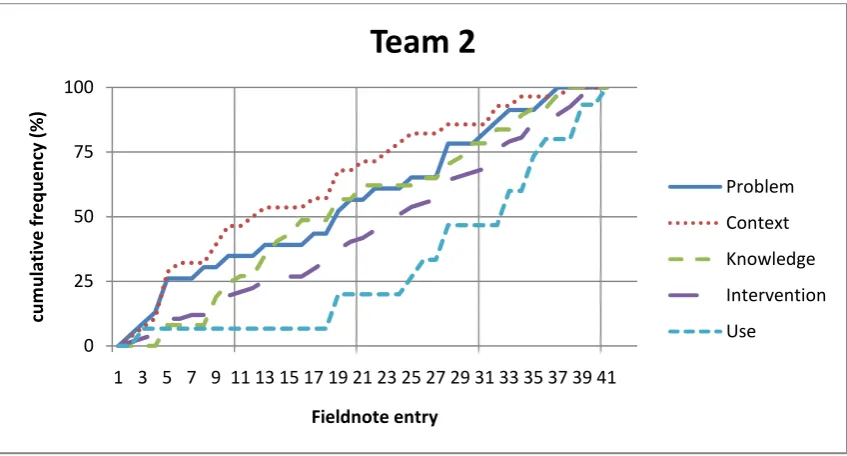
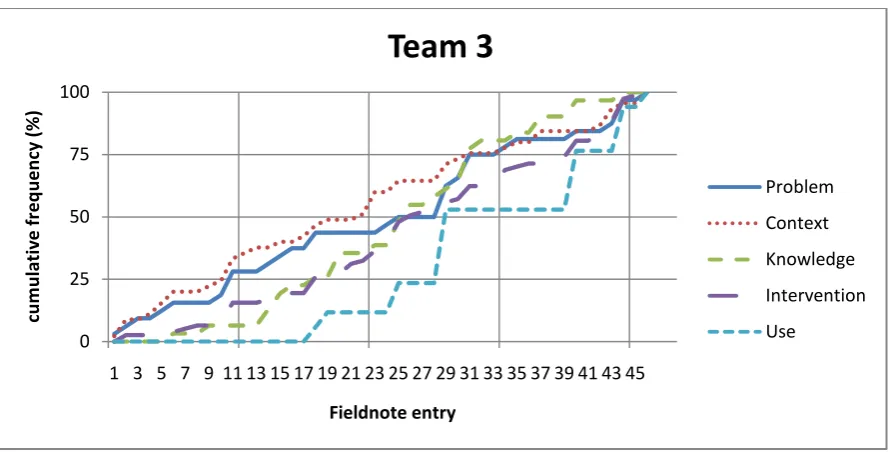
The quantitative phase of data analysis enabled us to further refine our understanding of the nature of the knowledge exchange process by examining how this unfolded over time. Using data from the knowledge broker‟s field notes (as the most complete chronological account) we calculated the number of times that each of the five components were coded during each of the broker‟s fieldnote entries and converted these into cumulative frequencies. A fieldnote entry typically reported a single meeting, interaction or event which occurred with the team but also included the knowledge broker‟s reflections on team activities which she had observed indirectly (e.g. by being copied into email discussions between members of a team). Since the knowledge broker‟s engagement (and therefore her fieldnote entries) was not evenly spread over the course of our fieldwork, cumulative frequencies were chosen as a way of representing the internal timeline of each team. Figures 1, 2 and 3 below chart the cumulative frequencies for each component for each of the three teams.
15
Our analysis showed that the five components did not occur as separate or discrete events. Instead, all five components occurred at the same time for teams two and three and there were also many instances of multiple components occurring at a single point in time for all three teams.
[FIGURE TWO HERE]
We also found that all five components continued to occur throughout the course of the knowledge exchange process. For instance, problem definition, which intuitively seems to be one of the initial stages in knowledge exchange, continued to occur even in the last quarter of the process as teams revisited and refined their knowledge exchange problem. Similarly, „use‟ occurred from the first quarter of the process for teams one and two, both of whom
developed satisfactory solutions to their knowledge exchange problems. In contrast, „use‟ was not considered until approximately half way through our engagement with team three, who were no further forward in solving their knowledge exchange problem 12 months after our engagement with them began. For this team a fragmented approach to knowledge use combined with an overtly selective use of knowledge appeared to constrain the problem-solving process. Although there were differences between the teams, our findings nonetheless suggest that our revised framework needed to illustrate that all five components occur
throughout the knowledge exchange process. [FIGURE THREE HERE]
16
two. Conversely, „use‟ mainly occurred during the latter half of the process for all teams, with very little occurring before the half way point. The analysis of context appeared to follow a similar pattern to problem definition for teams one and two, with the majority occurring during the first quarter of the process. The selection and adaptation of knowledge tended to start off relatively slowly before becoming more important during the central part of the process and finally tailing off during the latter stages. This pattern was common to all three teams. For two of the teams the selection and implementation of specific knowledge
exchange activities appeared to be fairly evenly distributed but for team three this component began rather more slowly than might be expected, with only 25% occurring during the first third of the process. This was borne out in our knowledge exchange narrative for team three, which showed that the role of the broker was never clearly established and the knowledge exchange activities remained fragmented and contested throughout the process.
I imagine that if there had been more engagement in the project, maybe if there'd been a bit more discussion, one would hope that there could have been some evolution in [the activities] (member, team three)
Revising our knowledge exchange framework
17
presume a particular relationship between the components). Second, the nature of the
components as determined through our qualitative analysis (our original model provided only loose definitions of the components).
[FIGURE FIVE HERE]
Drawing on our quantitative analysis, our framework shows that the five components can occur separately or simultaneously and do not occur in any set order. This is depicted by the fluidity of the five streams and the illustrative connections between them. It also draws on our quantitative findings to show that there may be a tendency for each component to occur with more or less intensity at different points in the process. This is depicted by the relative width of each stream at different points in the diagram. Drawing on our qualitative analysis, the framework shows the range of characteristics and activities associated with each of the five components. These are depicted by the additional words within each of the five streams, which occur in no set order.
Discussion
Having illuminated the nature of knowledge exchange across the three teams with whom we worked, we now return to the literature to consider the contribution of our findings and suggest how they can be used to reorient thinking about knowledge translation and exchange.
18
(PDSA) cycle encourage users to define their objectives, questions and predictions in advance of trialling specific changes and assessing their impact (Vos et al. 2010). These approaches provide limited scope for revising these objectives. Our experiences with team three suggest that an inability to revise and evolve knowledge exchange problems can hamper the desired change process. This leads us to suggest that those implementing PDSA cycles should consider how these can be adapted to better fit with the naturalistic process of knowledge exchange in their own contexts.
The importance of the context surrounding efforts to translate knowledge into healthcare policy and practice is widely recognised within the literature (e.g. Dobrow et al. 2006), but remains a particularly problematic concept. For instance, although we have some understanding of the different types of contextual features which may constrain or enable knowledge exchange, these tend to be relatively narrowly defined, frequently focusing on the behaviour and beliefs of individual knowledge users or on the characteristics of the
organisations in which those individuals operate (see e.g. Belkhodja et al. 2007; Michie et al. 2005). Efforts to assess and measure contextual features have been made, but are often similarly reductionist in nature (e.g. Taylor et al. 2011). These efforts have also tended to focus on knowledge translation as an implementation problem and, as Estabrooks et al. point out, are therefore limited in their ability to speak to the complex and disparate circumstances which surround the knowledge exchange process (Estabrooks et al. 2009). An alternative understanding of context is that defined by the Japanese concept of „ba‟ (Ray & Little 2001). This concept foregrounds interactions, shared experiences and networks and explains how these interact to produce shared spaces (and informal constraints) for knowledge exchange and creation (Nonaka & Konno 1998). This understanding is closer to our findings which suggest that knowledge exchange is a social and political rather than behavioural
19
beliefs. These norms can be the source of resistance to particular forms of knowledge exchange where the latter is perceived as a threatening or destabilising influence. Alternatively, fractions within a group may instigate knowledge exchange as part of a strategy of contesting professional norms and identities. By illuminating this aspect of „context‟, our findings suggest that knowledge translation approaches need to focus beyond
individual behaviour or specific organisational characteristics as barriers to knowledge exchange.
Many models of knowledge exchange conceptualise knowledge as the professionally packaged outputs of research or as a single evidence-based message which should be acted upon (see e.g. Eccles et al. 2005). In contrast, healthcare delivery and organisation is characterised by uncertainty and there are often no clear answers to the challenges which need to be faced. The knowledge which is needed to solve problems and bring about changes is likely to be distributed throughout organisations and to come from many different sources (Considine, Lewis, and Alexander 2009; Nonaka and Takeuchi 1995). Our findings
demonstrate that the knowledge which the teams drew upon did indeed come from a range of sources (including their own experience) and that although different teams and team members rated certain types of knowledge more highly than others they still managed to integrate different assessments in a way that enabled them to move through the knowledge exchange process. Our findings also showed a tendency for these teams to question their own pre-existing knowledge hierarchies, especially when confronted with differing opinions from colleagues. As such, our findings further call into question much of the formal knowledge translation literature which sidesteps many of the questions around „knowledge‟ (Greenhalgh, 2010) and suggest that naturalistic processes of reflexivity and discrimination could be
20
Similarly, knowledge exchange is sometimes viewed as peripheral to the business of healthcare and as an add-on to the research process (Tetroe et al. 2008). It also tends to be conceptualised as an activity which requires formal resources and skills (CHSRF 2003). Although we used knowledge brokering as a way of engaging with the teams, many of the knowledge exchange activities which we observed were an integral part of the process of change in which the teams were engaged. This leads us to suggest that the development of more effective, contextualised knowledge translation interventions could begin by focusing on these naturalistic knowledge exchange activities: not only could this increase the
willingness of employees and work teams to engage with them, it would also make
knowledge translation interventions more easily conceivable in the absence of resources for formal, external facilitation.
Conceptualisations of knowledge use have not been well-integrated into the knowledge translation and exchange literature. Knowledge use is frequently viewed as the outcome of knowledge exchange, rather than an integral part of the process (se e.g. Nieva et al. 2005). In contrast, our findings combine a growing understanding about the multifaceted, variable use of knowledge across settings (Nutley, Walter, and Davies 2007) with a clearer description of the fluid, dynamic nature of knowledge exchange. Comparisons can be drawn with real-world observations of the innovation process, which show that innovative changes are brought about via a fluid, dynamic process involving the proliferation and reinvention of ideas drawn from many different sources via an interactive, interpretive process (Lester and Piore 2004; Van de Ven et al. 1999). By depicting knowledge exchange as a dynamic process our revised model directly challenges linear, deterministic approaches to knowledge
21 Conclusion and implications
In this paper we have described how knowledge exchange occurred across three teams within a healthcare organisation and used this to develop a realistic and informative
framework which illustrates the nature of knowledge exchange. Our assumption throughout has been that the gap between knowledge and action is a knowledge exchange problem and that understanding how this process is enacted in particular contexts can inform the
development of more suitable approaches to knowledge translation. We have demonstrated that knowledge exchange is a process which incorporates distinct forms of knowledge from multiple sources. Whilst this view has been put forward in the academic literature multiple times, we have been able to add clarity by investigating it empirically. We have also been able to call into question implicit understandings about the nature of the „evidence‟ which healthcare teams can and should make use of and to problematise some of the technicist approaches to knowledge translation which are still evident in the literature.
In addition to highlighting the nature of the „knowledge‟ being exchanged in
healthcare settings, our findings also shed light on the dynamic and fluid nature of that process. By doing so, they directly challenge some of the linear, or even the relatively „neat‟ models of knowledge exchange which have been developed in recent years. Such clear descriptions of this fluidity and dynamism have been missing from the literature, particularly in relation to healthcare organisations.
The challenges of directly observing knowledge exchange processes were evident throughout our research. We sought to overcome some of these by embedding a knowledge broker within the teams. This afforded us a unique opportunity to observe knowledge exchange in action due to our emphasis on facilitation and participation in the teams‟ own
22
regarding the overall shape of the knowledge exchange process (depicted by the shape of the streams in our revised model). These findings were limited by the artificially-bounded nature of our observations and our reliance on the knowledge broker‟s representation of the
knowledge exchange process. Despite this, our quantitative findings have enabled us to illustrate a trend which is frequently discussed in the literature but rarely demonstrated empirically, and they provide some insight into how this dynamism is played out.
Although the overall aim of our research was to describe and gain a clearer
understanding of knowledge exchange, we also aimed to develop a framework which could be useful to policymakers, researchers and practitioners in their efforts to translate knowledge into action. Whilst our descriptive framework is unlikely to have widespread direct
applicability, having been developed in the context of a small-N study, the detailed
description we have provided of our study methods and context enable readers to assess its relevance in other contexts. Its principal value lies in its ability to reorient thinking about knowledge exchange and to act as a starting point for exploration and evaluation of the knowledge exchange process. We have demonstrated how this might be done by using our insights to propose a series of questions which researchers and practitioners might consider in relation to knowledge exchange (Ward et al., 2010). Communicating the dynamism of
knowledge exchange in a practical tool, however, has posed a real challenge which we and other research teams will need to face in future development work.
23
To conclude, many initiatives designed to translate research into action have been implemented over recent years, including the use of knowledge brokers in a range of settings. To date, these interventions have yet to prove their worth in terms of efficacy or
cost-effectiveness. By highlighting how knowledge exchange unfolds in practice settings, our framework calls into question the extent to which formal knowledge translation interventions can and should add value to naturalistic knowledge exchange processes. Careful
consideration of the latter in advance of planning or implementing formal interventions could ensure a better fit with the dynamic nature of knowledge exchange.
References
Baker, R., Robertson, N., Rogers, S., Davies, M., Brunskill, N., Khunti, K., Steiner, M., Williams, M., & Sinfield, P. (2009). The National Institute of Health Research (NIHR) Collaboration for Leadership in Applied Health Research and Care (CLAHRC) for
Leicestershire, Northamptonshire and Rutland (LNR): a programme protocol. Implementation Science, 4(72).
Belkhodja, O., Amara, N., Landry, R., & Ouimet, M. (2007). The extent and organizational determinants of research utilization in Canadian health services organizations. Science Communication, 28(3), 377-417.
Berwick, D.M. (2003). Disseminating Innovations in Health Care. Journal of the American Medical Association, 289(15), 1969-75.
Best, A., & Holmes, B. (2010). Systems thinking, knowledge and action: towards better models and methods. Evidence and Policy, 6(2), 145-159
24
CHSRF. (2003). The theory and practice of knowledge brokering in Canada's health system. Ottawa: Canadian Health Services Research Foundation.
Considine, M., Lewis, J.M., & Alexander, D. (2009). Networks, innovation and public policy: politicians, bureaucrats and the pathways to change inside government. Basingstoke:
Palgrave Macmillan.
Crabtree, B., & Miller, W. (1999). A template approach to text analysis: developing and using codebooks. In B. Crabtree & W. Miller.(Eds.), Doing qualitative research (pp. 163-177). Newbury Park, CA: Sage.
Darzi, A. (2008). High Quality Care for All: NHS next stage review final report. London: Department of Health.
Dobrow, M.J., Goel, V., Lemieux-Charles, L., & Black, N.A. (2006). The impact of context on evidence utilization: A framework for expert groups developing health policy
recommendations. Social Science & Medicine, 63(7), 1811-24.
Eccles, M., Grimshaw, J., Walker, A., Johnston, M., & Pitts, N. (2005). Changing the behaviour of healthcare professionals: the use of theory in promoting the uptake of research findings. Journal of Clinical Epidemiology, 58(2), 107-12.
Estabrooks, C., Squires, J. , Cummings, G., Birdsell, J., & Norton, P. (2009). Development and assessment of the Alberta Context Tool. BMC Health Services Research 9(234). Ferlie, E. (2009). Organizational Interventions. In S. Straus, J. Tetroe, & I. Graham (Eds.),
Knowledge translation in health care: moving from evidence to practice (pp.144-150). Chichester: Wiley Blackwell/BMJ
25
Greenhalgh, T. (2010). What is this knowledge that we seek to “exchange”? The Milbank Quarterly, 88(4), 492-499.
Grol, R., & Grimshaw, J. (1999). Evidence based implementation of evidence based medicine. Joint Commission Journal on Quality Improvement, 25, 503-13.
Havelock, R.G., Guskin, A., Frohman, M., Havelock, M., Hill, M., & Huber, J. (1969).A Comparative Study of the Literature on the Dissemination and Utilization of Scientific
Knowledge. Michigan: U.S. Office of Health, Education and Welfare.
Lester, R.K., & Piore, M.J. (2004) .Innovation - the Missing Dimension. USA: Harvard University Press.
Lindblom, C., & Cohen, D. (1979). Usable Knowledge: Social science and social problem solving. New Haven: Yale University Press.
McKibbon, K.A., Lokker, C., Wilczynski, N., Ciliska, D., Dobbins, M., Davis, D., Haynes, R.B., & Straus, S. (2010). A cross-sectional study of the number and frequency of terms used to refer to knowledge translation in a body of health literature in 2006: a Tower of Babel?
Implementation Science, 5(1), 16.
Michie, S., Johnston, M., Abraham, C., Lawton, R., Parker, D., & Walker, A. (2005). Making psychological theory useful for implementing evidence based practice: a consensus approach.
Quality and Safety in Health Care, 14(1), 26-33.
Mitton, C., Adair, C.E., McKenzie, E., Patten, S.B., & Perry, B. W. (2007). Knowledge Transfer and Exchange: Review and Synthesis of the Literature. The Milbank Quarterly,
85(4), 729-68.
26
Nonaka, I., & Takeuchi, H. (1995).The knowledge-creating company; how Japanese companies create the dynamics of innovation. Oxford: Oxford University Press. Nonaka, I., & Konno, N., (1998) The Concept of „Ba‟: Building a Foundation for Knowledge Creation, California Management Review, 40(3), 40-55
Nutley, S., Walter, I., & Davies, H. (2007). Using Evidence: How research can inform public services. Bristol: The Policy Press.
Olsson, T.M. (2007). Reconstructing evidence-based practice: an investigation of three conceptualisations of EBP. Evidence & Policy: A Journal of Research, Debate and Practice,
3(2), 271-85.
Pawson, R., & Sridharan, S. (2009).Theory-drive evaluation of public health programmes. In A. Killoran & A. Kelly (Eds.) Evidence Based Public Health (pp.43-62). Oxford: Oxford University Press.
Pawson, R., & Tilley, N. (1997). Realistic Evaluation. London: Sage.
Ray, T., & Little, S. (2001). Communication and Context: Collective Tacit Knowledge and Practice in Japan‟s Workplace ba. Creativity and Innovation Management, 10(3), 154-164. Taylor, S.L., Dy, S., Foy, R., Hempel, S., McDonald, K.M., Øvretveit, J., Pronovost, P.J., Rubenstein, L.V., Wachter, R.M., & Shekelle, P.G. (2011) What context features might be important determinants of the effectiveness of patient safety practice interventions? BMJ Quality & Safety 20(7), 611-617.
Tetroe, J.M., Graham, I.D., Foy, R., Robinson, N., Eccles, M.P., Wensing, M., Durieux, P., Legare, F., Nielson, C.P., Adily, A., Ward, J.E., Porter, C., Shea, B., & Grimshaw, J. M. (2008). Health Research Funding Agencies' Support and Promotion of Knowledge Translation: An International Study. The Milbank Quarterly, 86(1), 125-55.
27
Van de Ven, A.H., Polley, D.E., Garud, R., & Venkataraman, S. (1999). The Innovation Journey. New York: Oxford University Press.
Vaughan, D. (1996).The Challenger Launch Decision: Risky technology, culture and deviance at NASA. Chicago: University of Chicago Press.
Vos, L., Duckers, M., Wagner, C., & van Merode, G. (2010). Applying the quality improvement collaborative method to process redesign: a multiple case study.
Implementation Science 5(1), 19.
Weiss, C. (1979). The many meanings of research utilization. Public Administration Review,
39(5), 426-31.
Wengraf, T. (2001).Qualitative Research Interviewing. London: Sage.
Williams, I., & Glasby, J. (2010). Making `what works' work: The use of knowledge in UK health and social care decision-making. Policy and Society, 29(2), 95-102.
Wilson, M., Lavis, J., Travers, R., Rourke, S. (2010). Community-based knowledge transfer and exchange: Helping community-based organizations link research to action.
Implementation Science, 5(1), 33.
28 Figure 1
[image:29.595.74.498.377.605.2]Cumulative frequency chart for the five knowledge exchange components: team one
Figure 2
Cumulative frequency chart for the five knowledge exchange components: team two 0
25 50 75 100
1 3 5 7 9 11 13 15 17 19 21 23 25 27 29 31 33
cu m u lativ e fr e q u e n cy (% ) Fieldnote entry
Team 1
Problem Context Knowledge Intervention Use 0 25 50 75 1001 3 5 7 9 11 13 15 17 19 21 23 25 27 29 31 33 35 37 39 41
29 Figure 3
[image:30.595.76.489.391.672.2]Cumulative frequency chart for the five knowledge exchange components: team three
Figure 4
Revised knowledge exchange framework 0
25 50 75 100
1 3 5 7 9 11 13 15 17 19 21 23 25 27 29 31 33 35 37 39 41 43 45
cu
m
u
lat
iv
e
fr
e
q
u
e
n
cy
(%
)
Fieldnote entry
Team 3
Problem
Context
Knowledge
Intervention