City, University of London Institutional Repository
Citation
:
Secker, J. and Karnad, A. (2014). SADL project evaluation report. London, UK: Library, Technology and Innovation.This is the published version of the paper.
This version of the publication may differ from the final published
version.
Permanent repository link:
http://openaccess.city.ac.uk/17651/Link to published version
:
Copyright and reuse:
City Research Online aims to make research
outputs of City, University of London available to a wider audience.
Copyright and Moral Rights remain with the author(s) and/or copyright
holders. URLs from City Research Online may be freely distributed and
linked to.
SADL PROJECT
EVALUATION REPORT
September 2014
1 | S A D L E v a l u a t i o n r e p o r t
Introduction
SADL students were asked to complete a survey at the end of the project to help evaluate the project and to explore the impact it might have had on their research practices. This survey is presented in Appendix 1.
Responses
16 of the 20 ambassadors completed the end of project survey with an equal number coming from Statistics and Social Policy.
Student motivations
Students were asked about what motivated them to take part in the project and the majority stated it was to improve their information and digital literacy skills. They were also motivated to a lesser extent by the Amazon vouchers, the change to represent their department / peers and the ability to network with other students. The statement on PDAM was not considered important by most students.
Value of the workshops
Of the four workshops the final workshop on digital identity (which was attended by the lowest number of students) was ranked highest by the group. Workshop 1 which was an introduction to the project and covered finding information was also ranked highly. Workshops 2 on academic practices and Workshop 3 on managing and sharing information were less popular with students. Specific comments on each workshop were collected to provide further information on the aspects they liked and disliked.
Workshop 1: Introduction to the SADL project and finding information
Specific comments on what students liked about this session included:
"The value of learning to use Library Search. Google and Google Scholar"
"It was a good introduction, group activities as ice-breaker and good to meet fellow ambassadors – it helped to clarify what the purpose of SADL was."
"I found the different way of searching information very useful and I believe it should be available to all students. Before this workshop, I think most of us preferred Google Scholar or just using Google in general to search for information, but after this, it was surprising to find out that Summon was so powerful. This should be properly and fully utilised by all students in the LSE."
"Excellent coverage of sources, introduction to people and helping us become familiar with aspects of the project we were not yet clear on"
Students found some aspect less useful including one student who said they were already familiar with the search tools, another who felt the goals of the project were unclear and some technical problems
experienced at the start of the workshop were mentioned. The session included an opportunity to learn to write a blog post using the project blog. One student commented:
"It was good to set up a blog to let us write blogposts to be shared, but I found that the response was not very encouraging. Perhaps we can have 10-15 minutes after every session to get all ambassadors to write a paragraph about their reflections and thoughts about the workshop that day."
Workshop 2: Academic practices: Reading and research
Students liked several aspects of this session including:
"The time management strategies and research methods that were discussed"
"It was very useful to find readings for essays and see the different websites that could be used for academic purposes – also to see how other students did research."
"Learning about creative commons was very useful"
"Sharing tools for studying with other ambassadors"
2 | S A D L E v a l u a t i o n r e p o r t
Students found some aspects less useful and this session was clearly more relevant for some of the Social Policy students than Statistics students, several of whom commented that they didn’t have to write essays or deal with large reading lists.
Another student who was a third year commented that this information had come a little late for them and they would have found it more useful in their first year.
Workshop 3: Managing and Sharing Information
Workshop 3 had a number of aspects that students found helpful and in general students clearly found it helpful to discuss ideas about tools that help them share and manage information. Software including Endnote, Diigo and Wunderlist was mentioned by students as being valuable. One student comments that the session was interactive and it was “get involved in a topic that had potential to be slightly boring.” Another student said:
"The sharing of tools were incredibly helpful in my opinion. Most of us use normal cloud based storage or very basic apps to manage information, but listening from each other and the staff was very good. I am now actively using Wunderlist in my day to day activities. I found the plagiarism information extremely useful too! I learnt a lot about things that I wasn't aware of previously"
The ‘learning animal’ exercise was not considered helpful by one student. Another student felt this session might be less useful for Statistics students and perhaps a separate session could be run for this group. However, two students commented that it would have been useful to have more hands-on practice with a tools such as Endnote. They said:
"[It] could have been more useful to have like interactive parts of the session where we worked on the different programmes to get a sense of what they are and how they work."
Workshop 4: Managing your digital identity and the digital future
There were a number of highly positive comments about this final workshop which unfortunately had the lowest turn out due to it being held fairly close to the exam period. Comments included:
"Incredibly useful workshop as a whole on digital identity and the short section on making videos"
"Really, really, useful and relevant for today’s society, particularly the task where we tried to search for each other"
"This was my favourite workshop. Learning about managing my digital identity and also the digital future was very helpful. I think all students, not only in the LSE, should be taught about digital identity. Learning how to film and ways to make a good film was fantastic too."
Another student found it very useful to find out about online security and another found the tip on improving their digital identity very helpful.
In terms of improving the session, one student felt the workshop could have been longer than an hour and a half as there was a lot to cover. One student did feel the relevance of making a video to digital literacy needed to be more explicit, however they did enjoy the session.
Overall all the students said they WOULD recommend other students got involved in SADL.
Additional topics that could be covered by SADL
A number of other topics that could have been included in the workshops were mentioned by students including:
Using technology for time management
3 | S A D L E v a l u a t i o n r e p o r t
One student thought there would have been more emphasis on academic practices. Others wanted more time spent on learning how to write blog posts and the etiquette of blogging. Another student commented that they thought they would be taught to use specific software such as Endnote, that might be helpful for their studies.
Student ambassador role in the future
Students were asked to tell us about any changes that could be made to the student ambassador role in the future. It was clear that acting as an ambassador was something students did not feel was fully achieved during the project. Comments included:
"I believe the ambassador should be more heavily involved in spreading the knowledge obtained within the workshops to the rest of their peers, thus actually teaching more students about digital literacy"
"I think it would be beneficial to develop a clearer understanding of the role, especially the 'Ambassador part'"
"The role needs to have more way of distributing information to students, Im not sure how, but maybe making the departments aware and liasing with them to maybe set up a session for freshers week or a termly email updating and informing students within the department."
"more interaction with other students- although i personally learnt alot, i dont feel like i acted as an 'ambassador' so much"
Other ideas from students included:
"Can we hold our own workshops for students in the LSE to share the knowledge that we have learnt through the project?"
"More involvement in publicity, actual work for LSE"
"Developing the role to be a point of contact between students and staff so that the technology at LSE can be improved."
One student made an interesting point, which raised the issue about whether encouraging students to use social media was part of the remit of SADL:
"I think that if you really wanted people to intentionally blog and tweet about these things, you should specify and engage people who already have a strong online presence."
However, part of the rationale for encouraging the use of social media by students was that tools such as blogging and twitter were increasingly important in some academic disciplines as both a source of information and a valid way of communicating research findings.
Sharing their knowledge with peers
Feedback suggests that SADL did not enable students to effectively share what they learnt in the workshops with their peers easily. This also emerged some way into the project, during workshop 3 when students were asked to comment on their role as an ambassador. Many students commented on how they found it difficult to share what they had learnt and they mainly told their friends. One said:
"I've shared the information only with my peers and classmates. I believe we need more effective channels embedded into the school's system to share the knowledge that we have learnt."
Other students made very similar points saying they found it difficult to be an ambassador without a formal mechanism in place:
4 | S A D L E v a l u a t i o n r e p o r t
Students were also asked on the areas they made the biggest contribution and listed activities such as: contributing to the discussions in the workshops and sharing ideas with fellow ambassadors. One of the students mentioned the talk she gave to 6th form students and to the HEA as being her biggest contribution to the project. Another mentioned a blog post they had written and the video they made in workshop 4.
Timing of workshops
Students were asked about timing and if the ambassador role was more or less useful at certain points in the academic year. Summer term was clearly not a popular time to run workshops from the lower attendance, but also the comments from students reflected this. One student said of sessions in summer term:
"… I believe this is perhaps too late to educate students about digital literacy anyway as they have already gotten by throughout the year and will frankly be less likely to change their ways. As a result I think it might be more useful if the project was used to train ambassadors in digital literacy, and then these ambassadors could teach other students at the start of the following year, perhaps first years who are finding it difficult to adopt to university life. The ambassadors could even have a presence at fresher's fair."
Several students thought the role was much more useful in the Michaelmas and Lent term, but particularly at the start of the academic year before they had worked on any essays. Several students felt that
ambassadors could provide useful support for first year students who might be finding it difficult to adapt to university life, they said:
"A lot of things we have learnt through the project are extremely useful and students were only exposed to these in university, and having to cope with it immediately can be daunting."
Student Research Practices
Questions 12 to 17 asked students about their research practices. The same questions that had been asked at the outset of the project were repeated. The purpose of repeating the survey was to see if students’ research practices had changed noticeably since joining the SADL project. One caveat is that a smaller number of students completed the questions about their research practices in the end of project survey. However the findings suggest that SADL had led to some changes in students’ behaviour.
Beginning research
Students were asked when undertaking research for their course, what was the first thing they were likely to do. Comments in the post-project survey included:
Using their reading list
Carry out searching on LSE Summon, Google Scholar and Google
Use the Library Search
One student commented they previously would have used Google, but were now using Google Scholar and the Library Summon search. Prior to the project students frequently mentioned Google, Google Scholar Wikipedia, course reading lists and resources on Moodle. However they did also mention the library
database and search engine and books, so when starting out research there was no noticeable difference in their behaviour by the end of the project.
Importance of Resources
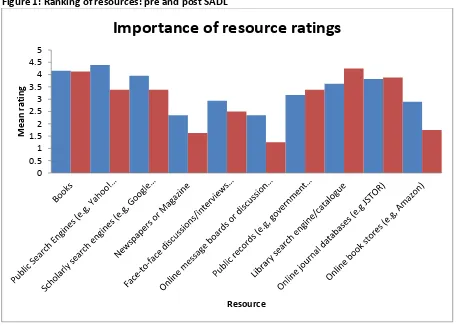
Students were asked to rank the importance of specific sources for research (See Figure 1). The blue bar shows how students rated resources before SADL and the red bar shows post-SADL. A t-test was conducted and while the changes are not shown to be significant, some observations include:
5 | S A D L E v a l u a t i o n r e p o r t
Library journal databases and the library search engine are now ranked slightly higher in the post-project survey.
[image:7.595.55.512.103.431.2]
Figure 1: Ranking of resources: pre and post SADL
Enjoyment of research
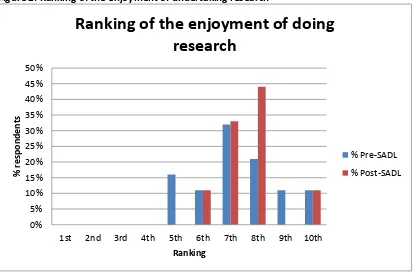
Students were asked how much they enjoyed doing research on a scale of 1 to 10 (10 being enjoy very much) and finding suggest in general they were positive about research. One student ranked it as 10. Most students choose 7 or 8 with just one student choosing 6. Figure 2 shows the differences in opinions pre and post SADL.
0 0.5 1 1.5 2 2.5 3 3.5 4 4.5 5
M
e
an
r
ating
Resource
6 | S A D L E v a l u a t i o n r e p o r t
Figure 2: Ranking of the enjoyment of undertaking research
Students’ strengths and weaknesses as a researcher
Students were asked to comment about what they saw their greatest strength and weakness as a researcher. The types of strengths listed by students in the pre-project survey included:
Their ability to find information and use lots of sources
Their critical appraisal of sources
Their ability to summarise and analysis information and data
Their ability to extract conclusions from information
Following completing the SADL project students also mentioned their ability to organise information as a strength. However no student in the post-project survey listed their ability to critically appraise sources as a strength.
In general students seemed to be more willing to describe their weaknesses as a researcher in the pre an post project survey. Some of the areas they highlighted as weaknesses included:
The time consuming nature of research and not having enough time or energy to complete it as thoroughly as they wished.
Being overwhelmed by the amount of information they found
Not knowing which search tools or sources to use
A lack of rigour in their approach, poor organisation and the tendency to be sidetracked
Not being open-minded about new sources of techniques
Poor writing skills
Following the SADL project students also highlighted difficulties in knowing how to evaluate sources as one of their weaknesses. This suggests that the project may have made students more aware of the
importance of evaluating information and the need for more support in this field.
Some comments included:
"My greatest strength is that once I have processed the information, if it is a topic I enjoy, I find it quite easy to link it to other information and build upon the argument from other modules or research." 0% 5% 10% 15% 20% 25% 30% 35% 40% 45% 50%
1st 2nd 3rd 4th 5th 6th 7th 8th 9th 10th
% r e sp o n d e n ts Ranking
Ranking of the enjoyment of doing
research
% Pre-SADL
7 | S A D L E v a l u a t i o n r e p o r t
"I love to learn new things so if I find a topic interesting I can spend hours researching and dedicate a lot of time to it. However on the other hand I can get very easily distracted and lose track of what I should be researching in the first place."
"Strengths: being able to put the information I have researched in a clear and concise manner. Weakness: I try to find as much information as possible and sometimes they contradict each other. I need a more effective way of assessing information."
"I'm good at finding lots of information but often find it difficult to pick out what is most relevant, I always have too much"
Evaluating library sources
Students were asked how they evaluate sources they find on the library catalogue and Summon.
Some of the techniques students used include to evaluate sources mentioned prior to SADL include:
Getting guidance from academic staff
Studying the source
Looking at relevance
Convenience
Trial and error
The provenance of a source
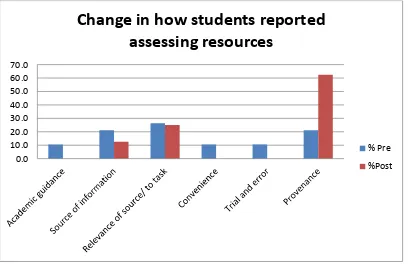
[image:9.595.57.465.436.700.2]Figure 3 shows how students approaches changed following the SADL project, where students were far more likely to consider the provenance or authority of a source and less likely to rely on convenience, trial and error or guidance from an academic.
Figure 3: How do you assess library resources
One student commented:
"I usually assess them by year (to see how relevant the articles/resources are) and also try to look at the general publication. Sometimes I'll Google the writer to see if they have written any other material."
0.0 10.0 20.0 30.0 40.0 50.0 60.0 70.0
Change in how students reported
assessing resources
% Pre
8 | S A D L E v a l u a t i o n r e p o r t
Evaluating internet sources
Students were also asked how they evaluated sources they found on the internet. Similar techniques to evaluating library resources were used prior to the SADL project including:
Studying the source
Looking at relevance
Convenience
Trial and error
The provenance of a source
However, no students commented that they would get guidance from academics when using internet sources. Following SADL it seems to again be more important to look at the source – what type of source it was such as a government website or whether it came from a reputable source, so again provenance was important. Comments included:
"I mostly just use common sense, if I'm doing research I will prioritise government documents and news stories, using the filter options to limit the dates I will see news stories from."
"I assess the credibility of the source, to exclude websites such as wikipedia, tabloid newspapers and see whether the website appears reputable (e.g. known think tank, gov.uk). If reputable I then scan to see if the source appears relevant and check the date as before."
Conclusions and recommendations
Overall the feedback from students about the value of the SADL project is extremely positive. Students stated that they had learnt new skills and they enjoyed the workshops. They also all said they would recommend friends to get involved in the project. Of the workshops, the fourth workshop on digital identity despite having the lowest attendance had the most positive feedback. Students gave constructive feedback on how the sessions could be improved, new topics that could be included and the timing of the workshops, which generally needed to be run earlier in the academic year. This feedback will be valuable when planning the content and timing of the workshops for SADL 2.
Students were more sceptical of their ability to act as ambassadors for other students. They felt that mechanisms were not in place to facilitate this role and it was something they had not managed to do to any great extent. This is an area that should be addressed in SADL 2 and the team need to consider if they wish students to act as ambassadors and peer mentors, how students can do this effectively.
9 | S A D L E v a l u a t i o n r e p o r t
Appendix 1: SADL Post- Project Evaluation Questionnaire
About you:
Please indicate your level of study • First Year
• Second Year • Third Year
Are you are student in:
• Department of Social Policy • Department of Statistics
SADL Programme evaluation
Of the four workshops we ran during the SADL project, please rank them in order of usefulness (please refer to the resources web page if you need a reminder of the content of each session)
• Workshop 1: Introduction to the SADL project and finding information • Workshop 2: Academic practices: Reading and research
• Workshop 3: Managing and sharing information
• Workshop 4: Managing you digital identity and the digital future
Please tell us about any aspects of the workshops that you found useful / less useful
Useful Less Useful Workshop 1
Workshop 2 Workshop 3 Workshop 4
Were there any additional topics you expected to be covered in the programme?
Would you recommend this to a friend to get involved in SADL?
Yes No Maybe
Please tell us about the benefits to you of being involved in the SADL project this year. Please include any thoughts about:
• The role of a student ambassador for digital literacy in the future • Suggestions about how this might work next year
• Areas you feel you could make the biggest contribution
• If the role is more / less useful at certain times in the academic year • Any other points not covered already
Research practices
At the outset of the SADL programme we asked you some questions about your research practices. We would like you to answer these questions again, in light of your involvement in the programme.
10 | S A D L E v a l u a t i o n r e p o r t
Rate the relative importance of each of the following resources in your coursework/research (1 being not important, 5 being essential)
• Books
• Public Search Engines (e.g, Yahoo! Google) • Scholarly search engines (e.g, Google Scholar) • Newspapers or Magazine
• Face-to-face discussions/interviews with people • Online message boards or discussion groups • Public records (e.g, government documents) • Library search engine/catalogue
• Online journal databases (e.g JSTOR) • Online book stores (e.g, Amazon)
On a scale of 1-10 (1 being dislike very much, and 10 being enjoy very much), how much do you enjoy doing research?
What would you say are your greatest strengths and weaknesses as a researcher?
When searching through the Library Catalogue or Summon, media articles and print resources, how do you assess which sources you will use?
When searching the internet, how do you assess which sources you will use?