ContentslistsavailableatScienceDirect
Journal
of
Computational
Science
j o u r n al ho me p a g e :w w w . e l s e v i e r . c o m / l o c a t e / j o c s
Droplet
dynamics
in
confinement
N.
Ioannou
a,
H.
Liu
b,
Y.H.
Zhang
a,∗aJamesWeirFluidsLaboratory,DepartmentofMechanical&AerospaceEngineering,UniversityofStrathclyde,GlasgowG11XJ,UK
bSchoolofEnergyandPowerEngineering,Xi’anJiaotongUniversity,Xi’an710049,China
a
r
t
i
c
l
e
i
n
f
o
Articlehistory:
Received26October2015
Receivedinrevisedform9March2016 Accepted12March2016
Availableonlinexxx
Keywords:
Dropletdynamics LatticeBoltzmannmethod Deformation
Breakup Confinement
a
b
s
t
r
a
c
t
Thisstudyistounderstandconfinementeffectonthedynamicalbehaviourofadropletimmersedinan immiscibleliquidsubjectedtoasimpleshearflow.ThelatticeBoltzmannmethod,whichusesaforcing termandarecolouringalgorithmtorealizetheinterfacialtensioneffectandphaseseparation respec-tively,isadoptedtosystematicallystudydropletdeformationandbreakupinconfinedconditions.The effectsofcapillarynumber,viscosityratioofthedroplettothecarrierliquid,andconfinementratio arestudied.Thesimulationresultsarecomparedagainstthetheoreticalpredictions,experimentaland numericaldataavailableinliterature.Wefindthatincreasingconfinementratiowillenhance deforma-tion,andthemaximumdeformationoccursattheviscosityratioofunity.Thedropletisfoundtoorient moretowardstheflowdirectionwithincreasingviscosityratioorconfinementratio.Also,itisnoticed thatthewalleffectbecomesmoresignificantfortheconfinementratioslargerthan0.4.Finally,the crit-icalcapillarynumber,abovewhichthedropletbreakupoccurs,isfoundtobemildlyaffectedbythe confinementfortheviscosityratioofunity.Uponincreasingtheconfinementratio,thecriticalcapillary numberincreasesfortheviscosityratioslessthanunity,butdecreasesfortheviscosityratiosmorethan unity.
©2016TheAuthors.PublishedbyElsevierB.V.ThisisanopenaccessarticleundertheCCBYlicense (http://creativecommons.org/licenses/by/4.0/).
1. Introduction
Emulsionsconsistofimmisciblefluidscommonlyfoundin pro-ductionprocessesinfood,chemical,andpharmaceuticalindustries. Sincethedropletsizeandshape determineimportantemulsion propertiessuchasstability,rheology,andparticlemorphology,it isimportant tounderstandthemechanismof droplet deforma-tionandbreakupduringemulsification.Inaddition,thestudyof dropletdeformation and breakupcan providevaluable insights intoimmisciblefluiddisplacementinporousmedia,whichplays animportantroleinenhancedoilrecovery,geologicCO2 seques-tration,andremediationofnonaqueous-phaseliquids.Inrecent years,thedropletdeformationandbreakuphavereceivedmore attentionbecauseofthegrowinginterestinmicrofluidic technolo-gies,wheredropletsarecirculatedinchannelsandtheirsizeisoften comparablewithorevensmallerthanchanneldimension.A signif-icantnumberoftheoretical,experimentalandnumericalstudies havebeenreportedregardingdropletdeformationandbreakupin ashearflowsincethepioneeringworkofTaylor[1].Themain fea-tureofshearflowisitsrelativesimplicity,whileitcontainsrich physics[2].
∗Correspondingauthor.
E-mailaddress:[email protected](Y.H.Zhang).
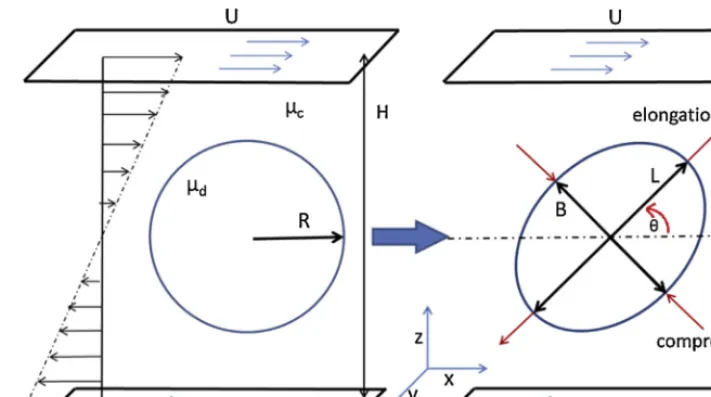
AssketchedinFig.1,asphericaldropletwithradiusRisinitially placedhalfwaybetweentwoparallelplatesthatareseparatedby adistanceH.Shearflowisintroducedtothissystembythe move-mentoftheplateswithequalbutoppositevelocitiesU,andthe resultingshearrateis˙ =2U/H.Thedropletandthecarrierfluid areassumedtohaveequaldensities,aconstantinterfacial ten-sion,andtheirdynamicviscositiesaredandm.Inthesimple
shearflow,twomostimportantforcesexertingonthedropletare: theviscousforces(mR˙ 2),leadingthedroplettodeformandturn
towardstheflowdirection,andthecapillaryforces(R),resisting thedropletdeformationandretainingthesphericalshapeofthe droplet.Consequently,thedropletundergoesanelongationinthe directionoftheL-axis,andacompressioninthedirectionofthe
B-axis(seetherightpanelofFig.1).Thecapillarynumber,which isdefinedasCa=R˙ m/,isusedtomeasuretherelative
mag-nitudeofviscousandcapillaryforces.Theinertialforcecanalso influencethedynamicalbehaviourofthedroplet,andits impor-tanceisdescribedbytheReynoldsnumber,definedastheratioof inertialtoviscousforcesi.e.Re=R˙ 2/
m.Inadditiontothe
capil-laryandReynoldsnumbers,theviscosityratio(=d/m)andthe
proximityofdroplettothewallsarefoundtoaffectstronglythe deformationandbreakupofthedroplet.Theproximityisevaluated bytheconfinementratio,definedas2R/H.Underconsiderationof lowcapillarynumberandconfinementratio,thedropletwill even-tuallybecomeellipsoidalintheStokesflowregime(Re<1).The http://dx.doi.org/10.1016/j.jocs.2016.03.009
Fig.1. Schematicillustrationofdropletdeformationinasimpleshearflow.
deformationparameterDcanbedefinedbythelengthsofthemajor (L)andminor(B)axesofthedeformeddroplet,i.e.
D=L−B
L+B. (1)
WithincreasingCa,thedropletcanreachasteadystatebut devi-atefromtheellipsoidalshape.Thiscausesdifficultyinobtainingthe correctvaluesofdeformationparameterandorientationangle(), whichisdefinedastheanglebetweenthedropletmajoraxisand thehorizontalplane.Asthecapillarynumberisfurtherincreased abovethecriticalvalue,thecapillaryforcescannolongerretain theshapeofdroplet;thedominantviscousforcesleadthedroplet toformalongthin neckand finallybreakupintotwo ormore fragments.Thecriticalcapillary number(Cacr),abovewhichthe
dropletbreakupwilloccur,isinfluencedbyboththeviscosityand confinementratios[3].
Theinterestindropletdeformationdatesbacktotheworkof Taylor(1934)[1],whoderivedatheoreticalexpressiontodescribe smalldeformationsinthebulkshearflowintermsoftheviscosity ratioandthecapillarynumber:
DT=
19+16
16+16Ca. (2)
Thisexpressionhasbeendemonstratedtopredictexperimental resultswellinavarietyofcases,wherethevalueofconfinement ratio was around 0.2. However, the influence of wall confine-mentis not taken intoaccount in Eq.(2).It wasreported that thepresenceofwallshasanegligiblecontributiontothedroplet deformationfortheconfinementratio2R/H≤0.4[4,5].Whenthe confinementratioishigherthan0.4,thedeformationcannotbe predictedaccuratelybyEq.(2).Moreover,Eq. (2)is notableto describethe dropletdeformation for very largeviscosityratios
[1,6].Morediscussionaboutthisequationcanbefoundinthese
reviewpapers[7–10].Taylorderivedhismodelusingsmall defor-mationperturbationproceduretothefirstorder,withCaasthe expansionparameter,soheobtainedaconstantorientationangle of45◦.Theperturbationprocedurewaslater tobeextendedto thesecondorderinCatoyieldanexpressionfortheorientation angle[11–14]:=(/4)−((16+19)(3+2)/80(1+))Ca[15].The orientationanglewasalsoformulateddifferentlyinthe phenomen-ologicalmodelsofMaffetoneandMinale[16]andMinale[17].
Toaddressthewallconfinementeffectondropletbehaviour, ShapiraandHaber[18]solvedtheStokesflowsaroundadroplet usingthemethodofreflection,whichtakesintoaccounttherelative
positionofthedroplettothewall.TheresultingSHmodelcombines theTaylordeformationandanadditionaltermaccountingforthe influenceofwallsonthedeformation:
DSH=DT
1+CS1+2.5 1+
R H3
, (3)
whereCSisreferredtoasashapeparameteranditsvaluedepends
ontherelativepositionofthedroplettothewalls.Foradroplet positionedhalfwaybetweenthetwowallsCSistakenas5.6996.
Topredictthedropletdeformationundertransientconditions, MaffettoneandMinale[16]proposedaphenomenologicalmodel, i.e.MMmodel,inwhichthedropletshapeisassumedtoremain ellipsoidal.AsecondordertensorS,whoseeigenvaluesreflectthe squaresofthesemi-axesofanellipsoid,isusedtodescribethe dropletshape.Basedonthisassumption,theyderivedanevolution equationforthetensorS,whichconsistsofaco-rotational deriva-tive,thecontributionsoftheviscousstressandthecapillaryforce. Thevaluesofthesemi-axesforseveraltypicalflowswerepredicted, includingthesimpleshearflow,theuniaxialextensionalflowand theplanarhyperbolicflow.Inparticular,forthesimpleshearflow, thedeformationparameterinasteadystateiscalculatedas
DMM=
m21+Ca 2−
m2
1+(1−m22)Ca 2
m2Ca ,
(4) where
m1=
40(+1)
(2+3)(19+16), (5)
and m2=
5 2+3+
3Ca2
2+6Ca2. (6)
[image:2.646.112.468.57.256.2]significantatlargecapillarynumbers.Inanattempttomatchthe experimentalresultsregardinglargedeformationatlargecapillary numbers(e.g.,Ca=0.3)withananalyticalexpression,two mod-elswereproposed.OneistheorientationanglescaledSHmodel. However,itsuffersfromthedifficultyofestimatingtheorientation angleathighconfinementratios[7].Theotherisacombination oftheaforementionedtwomodels(i.e.,SHandMM).Specifically, thetermDTintheSHmodelisreplacedbyDMMintheMMmodel,
leadingtoanewmodel,calledastheMMSHmodel:
DMMSH=DMM
1+CS1+2.5 1+
R H3
. (7)
SincetheMMSHmodeldoesnotneedtoestimatethedroplet ori-entationangleanditspredictionsagreewellwiththeexperimental data[6],itwillbeusedinSection3forvalidationofournumerical results.Inaddition,Minale[17]refinedthephenomenologicalMM model,byforcingthemodeltorecovertheanalyticallimitsofthe SHmodelformoderateconfinementratios,i.e.2R/H≤0.5.Forlarge confinementratios,theexperimentaldatafromSibilloetal.[19]
andVananroyeetal.[6],wereusedtore-evaluatethecoefficients
m1andm2intheMMmodel.
Complementingtheoreticalandexperimentalstudies, numer-ical simulations have been extensively used to investigate the droplet deformation and breakup in a simple shear flow
[3,4,20–24]. Among these works, Janssen and his co-workers
[3,23,24]usedtheboundaryintegralmethod(BIM)tostudythe
effectofviscosityandconfinementratiosondropletdeformation andthecriticalcapillarynumber.Itwasfoundthatthesimulated shape ofthedroplet andthecritical capillary numberare both inexcellentagreementwiththeexperimentalresults.However, theBIMisusuallyfor thesolutionof Stokesflow, inwhichthe fluidinertiaistotallyneglected.Also,itsuffersfromthe difficul-tiesofaccessingthelowviscosityratioregime[3],andofdealing withtopologicalchangessuchasbreakupandcoalescenceofthe interfaces[7,25,26].Thesedisadvantagescanbeovercomebythe latticeBoltzmannmethod(LBM),whichtracksevolutionofthe dis-tributionfunctionofanassemblyofmoleculesandisbuiltupon microscopicmodelsand mesoscopickineticequations.TheLBM cancapturemultiphaseinterfaceanddescribeinterfacial dynam-icssuchasphasesegregationandinterfacialtensionthroughthe incorporationofintermolecularinteractions.Anumberof multi-phase andmulticomponent modelshave beenproposed, which canbedividedintofourmaintypes:colourgradientmodel[27], free-energy model [28], interparticle-potential model [29], and mean-fieldtheorymodel[30].Althoughthedropletdynamicsina shearflowwassuccessfullysimulatedbytheformerthreemodels ortheirvariants[31–36],noneofthemhassystematically exam-inedtheimpactofviscosityandconfinementratiosonthedroplet deformationandbreakup,whichisthefocusofthiswork.In partic-ular,thecolourgradientLBMisusedherebecauseofitsadvantages suchaslowspuriouscurrents,highnumericalaccuracyandstrict massconservationforeachfluidwhichhavebeendemonstratedin ourrecentworks[37,38].
2. Numericalmethod
Weconsiderisothermalmotionoftwoimmisciblefluidsand adoptacontinuumsurfaceforce(CSF)model[39]todescribethe system.TheCSFformulationallowsustoconsiderthetwophases as a singlefluid with space-dependentproperties and replaces thejumpconditionattheinterfacewithanadditionalforcethat actsonlyintheinterfaceregion.Unlikeatwo-fluidformulation, itdoesnotneedtosolveamoving boundaryproblem, whichis computationallyexpensiveandextremelydifficulttoimplement especially when large topological changes occur around the
interface.IntheCSFformulation,theflowoftwoimmisciblefluids isgovernedbyasinglesetofNavier–Stokesequations(NSEs):
∇
· u=0, (8)∂
(u)∂
t +∇
·uu
=−∇
p+∇
·[(∇
u+∇
uT)]+ Fs, (9)wheretisthetime,uisthefluidvelocity,isthetotaldensity,p
isthepressure,andisthedynamicviscosity.ThelastterminEq.
(9)representstheinterfacialtensionforceactingattheinterface betweenthetwofluidsandisdefinedas
Fs=nı, (10)
whereistheinterfacialtension;,thelocalinterfacecurvature;
n,theunitnormaltotheinterface;andı,theDiracdeltafunction
usedtolocalizetheforceexplicitlyattheinterface,whichshould satisfy
∞
−∞
ıdz=1, (11)
inordertorecoverproperlythestressjumpconditioninthe sharp-interfacelimit.Herezisthespatiallocationnormaltotheinterface. AlthoughEqs.(8) and(9)allowcomputingthevelocityfield, an advection equation has to be additionally solved to cap-turetheevolution ofinterfaceintraditional multiphasesolvers, e.g.,thevolume-of-fluid(VOF)andlevel-setmethods,wherethe sophisticatedinterfacereconstructionalgorithmorunphysical re-initialization process is often required. In order toavoid these issues,weusethelatticeBoltzmanncolourgradientmodel,first proposedbyGunstensenetal.[27]andlaterimprovedby Halli-dayandhiscoworkers[40],tosimulatethedynamicalbehaviour ofa dropletsubjectedtoa simpleshearflow. Thecolour gradi-entmodelpossessesmany advantagesinsimulatingimmiscible two-phaseflows,includingtheabilityofcapturinginterface auto-matically,low spurious velocities, highnumericalaccuracy and strictmassconservationforeachfluid.Inthismodel,twosetsof distributionfunctionsfR
i and fiB areintroducedtorepresentthe
“red”and“blue”fluids.Thetotaldistributionfunctionisdefined byfi=fiR+fiB,whichundergoesaBhatnagar–Gross–Krook(BGK)
collisionstepas fi†(x, t)=fi(x,t)−
1
(fi(x, t)−f
eq
i (x,t))+i, (12)
wherefi(x,t)isthetotaldistributionfunctionintheithvelocity
directionatthepositionxandtimet,fieqistheequilibrium distri-butionfunctionoffi,fi†isthepost-collisiondistributionfunction,
isthedimensionlessrelaxationtime,andiistheforcingterm.
Theequilibriumdistributionfunctionisobtainedbya second-orderTaylorexpansionofMaxwell–Boltzmanndistributionwith respecttothelocalvelocityu:
fieq=wi
1+ei· uc2
s
+(ei· u)2
2c4
s
− u2 2c2
s
, (13)
whereiscalculatedby=R+Bwiththesubscripts‘R’and‘B’
referring totheredand bluefluidsrespectively, cs isthespeed
ofsound,ei isthelatticevelocityintheith direction,and wiis
theweightfactor.Forthethree-dimensional19-velocity(D3Q19) model,thelatticevelocityeiandtheweightfactorsaregivenby
ei=
⎧
⎪
⎪
⎨
⎪
⎪
⎩
(0,0,0)c, i=0;
(±1,0,0)c,(0,±1,0)c,(0,0,±1)c, i=1,2,...,6; (±1,±1,0)c,(0,±1,±1)c,(±1,0,±1)c, i=7,8,...,18,
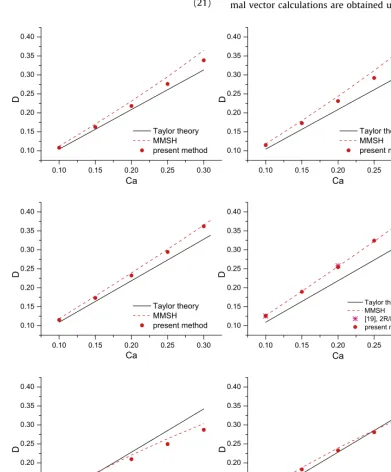
Fig.2.Thedeformationparameter(a),andtheorientationangle(b)asafunctionofthecapillarynumberfor=1.
wi=
⎧
⎪
⎪
⎨
⎪
⎪
⎩
1/3, i=0;
1/18, i=1,2,...,6;
1/36, i=7,8,...,18, (15)
andthespeedofsoundcs=c/√3=ıx/√3ıtwithıxandıtbeing
thelatticelengthandtimestep,respectively.
Thespatialdistributionofthetwofluidsisdescribedusinga colourfunction(orphase-fieldfunction),whichisdefinedas
N(x,t)=R(x, t)−B(x,t)
R(x, t)+B(x,t), −
1≤N≤1. (16)
Bydefiningn=−
∇
N/|∇
N|andı=|
∇
N|/2,Eq.(10)canbefur-therwrittenas
Fs=−
1 2
∇
N, (17)
wherethelocalinterfacecurvatureisrelatedtotheunitnormal totheinterfaceby
=−
(I− n⊗ n)·∇
· n=−∇
· n, (18)Fig.3.Deformationparameterasafunctionofthecapillarynumberfor=1and 2R/H=0.69.
[image:4.646.114.472.57.252.2] [image:4.646.149.543.294.716.2]andIisthesecond-orderidentitytensor.Withtheinterfacial ten-sionforcegivenbyEq.(17),theforcingtermithatisappliedto
realizetheinterfacialtensioneffect,readsas[41]
i=
1−21
wi
ei− uc2
s
+ei· u
c4
s
ei
· Fsıt. (19)
Accordingto Guo et al. [42], the local fluid velocity shouldbe defined to incorporate the spatially varying interfacial tension force,i.e.,
u(x,t)=
i
fi(x,t)ei+
1
2Fs(x, t)ıt. (20) UsingtheChapman–Enskogmultiscaleexpansion,Eq.(12)can reducetotheNSEsinthelowfrequency,longwavelengthlimitwith thepressureandthefluidviscositydefinedby
p=cs2, (21)
=cs2
−12
ıt. (22)Toallowforunequalviscositiesofthetwofluids,wedetermine theviscosityofthefluidmixturebyaharmonicmean,i.e.
1
N=1+N
2R +
1−N
2B ,
(23)
wherek(k=RorB)isthedynamicviscosityoffluidk.Ithasbeen
shownthatthechoiceofEq.(23)canensureaconstantviscosity stressacrosstheinterface,whichprovideshigheraccuracythan otherchoices[43].
The partial derivatives required for the curvature and nor-malvectorcalculationsareobtainedusingthe19-pointcompact
[image:5.646.109.500.246.718.2]finite-differencestencil[44].Forexample,foravariable ,its par-tialderivativescanbecalculatedby
∂
(x)∂
xa =1 c2
s
i
wi (x+ eiıt)eia. (24)
Althoughtheforcingtermgeneratesaninterfacialtension, it doesnotguarantee theimmiscibilityofbothfluids.Topromote phasesegregationandmaintaina reasonableinterface,the seg-regation(recolouring)algorithmofLatva-KokkoandRothmanis used[45].Itcanovercomethelatticepinningproblemandcreates asymmetricdistributionofparticlesaroundtheinterfacesothat unphysicalspuriouscurrentscanbeeffectivelyreduced. Follow-ingLatva-KokkoandRothman,thepost-segregation(recoloured) distributionfunctionsoftheredandbluefluidsare
fR
i(x,t)=
R
f
†
i(x,t)+ˇ
RB
wicos(ϕi)|ei|, fB
i(x,t)=
B
f
†
i(x,t)−ˇ
RB
wicos(ϕi)|ei|,
(25)
whereˇisthesegregationparameterandissettobe0.7for numer-icalstabilityandmodelaccuracy[46];ϕiistheanglebetweenthe
colourgradientandthelatticevectorei,whichisdefinedby
cos(ϕi)= ei·
∇
N|ei||
∇
N|.(26) Aftertherecolouringstep,theredandbluedistribution func-tions propagate to the neighbouring lattice nodes, known as propagationorstreamingstep:
fk
i(x+ eiıt,t+ıt)=fik(x,t), k=RorB, (27)
andtheresultingdistributionfunctionsarethenusedtocalculate thedensitiesofbothfluidsi.e.k=
ifik.
3. Resultsanddiscussion
Inallthecasesdiscussedbelow,asphericaldropletwiththe radiusR=20latticesisinitiallyplacedinthecentreofthe compu-tationaldomain,asillustratedinFig.1.Thecomputationaldomain hasa lengthof 71 latticesin they-direction.The lengthinthe
x-directionischosenas101inthestudyofdropletdeformation, whereas indroplet break-up this lengthcouldbe increasedup to401in somecasesinorder toavoidtheoccurrence thatthe droplettouchesitselfviatheperiodicboundaryconditionsbefore thebreakupoccurs.Inaddition,theheightofthecomputational
domainisvariedintherangeof51≤H≤223toobtaindifferent confinementratios2R/H.Periodicboundaryconditionsareapplied inthex-andy-directions,whilethehalf-waybounce-backscheme isusedonthetopandbottomwalls[47]:
fi(x,t+ıt)=fops† (i)(x,t)+6wi ei· uw
c , (28)
whereuwisthemovingvelocityofthesolidwallwithuw=(U,0,0)
forthetopwallanduw=(−U,0,0)forthebottomwall,andops(i)
standsforthedistributionfunctionwhichhasoppositedirection toei.Forthesakeofsimplicity,bothfluidsareassumedtohave
equaldensities.TheReynoldsnumberisfixedat0.1,whichissmall enoughtocharacterisetheflowasStokesflow.
3.1. Dropletdeformation
Thenumericalmethodisfirsttestedbysimulatingthedroplet deformation in a weakly confined shear flow. Simulations are conductedat=1andtheconfinementratio2R/H=0.18forthe capillarynumbersrangingfrom0.1to0.3.Fig.2(a)plotsthedroplet deformationparameterasafunctionofthecapillarynumber,in whichourLBM resultsarecomparedwiththeprevious experi-mentaldata[6,19],thenumericalresultsobtainedbytheboundary integralmethod(BIM)[4,48]andthevolumeoffluid(VOF)method
[20], as wellas thepredictionsfrom Taylor theoryand MMSH model.Notethatthedegreeofconfinementisnotexplicitly avail-ableforsomeofthedatasources,inwhichtheflowisconsidered tobeunbounded.Itcanbeseenfromthecomparison,theLBM resultsagreewellwiththeseexperimentaldata,numericalresults andmodelpredictions;andgoodagreementamongthemsuggests thatthewallshaveanegligibleinfluenceonthedropletbehaviour forthepresentconfinementratio,i.e.2R/H=0.18,consistentwith thepreviousnumericalandexperimentalobservations[4,8].
Inadditiontothedeformationparameter,wealsocalculatethe orientationanglesofthedeformeddroplet(),definedastheangle betweenthelongestaxisofthedropletandthex-axis,atvarious capillarynumbers,andcomparethemtothosereportedinRefs.
[4,20,24,48](seeFig.2(b)).Clearly,thereisfairlygoodagreement
especiallybetweenourresultsandthoseobtainedbythe exper-iment and theBIM at anexactly matched confinementratio, i.e.
2R/H=0.18.
Next,thesimulationswereconductedforahighconfinementof 0.69,whichisachievedbyadjustingtheheightofcomputational domainwhilstkeeping otherparameters thesame asin Fig.2.
Fig.3showsthecomparisonbetweenthesimulateddeformation
[image:6.646.114.474.540.728.2]Fig.7. VelocityvectorsandstreamlinesaroundthedropletforCa=0.2:thecolumnsareforthesameconfinementratio(left:0.4,right:0.7);andtherowsareforthesame viscosityratio(top:=0.3,middle:=1,bottom:=5).
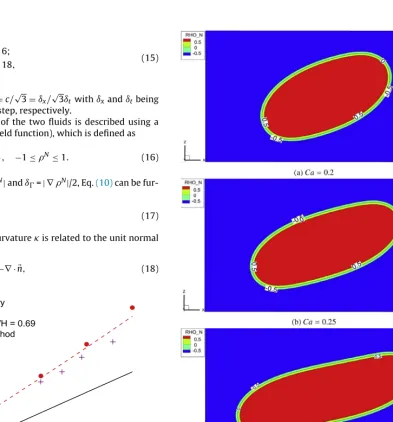
parameterandtheTaylortheory,theMMSHmodelandthe experi-mentalresultsofVananroyeetal.[6].Consistentwiththeprevious findings,theMMSHmodelcanprovideexperimently-matched pre-dictionsofthedropletdeformation,butthepredictionsfromthe Taylortheoryarenolongervalidforhighconfinementratios.Also, oursimulationresultsagainmatchquitewellwiththepredictions fromtheMMSHmodelandtheexperimentaldata,verifyingthatthe presentLBMcansuccessfullypredictdeformationofahighly con-fineddroplet.Fig.4showsthefinalshapeofthedeformeddroplet inthemiddlex–zplaneforCa=0.2,0.25and0.3,inwhichthe con-tourswithN=−0.5,0,and0.5aredisplayed.Itisobservedthat
thedropletdeviatesfromtheellipsoidalshapetosomeextentat highcapillarynumbers,e.g.Ca=0.25and0.3.Therefore,the con-finementratioandthecapillarynumberarerestrictedto2R/H≤0.7 andCa≤0.3,andboth ofthemwillnottakelargevaluesatthe sametimeintherestofthesimulationsinordertoensurethatthe deformeddropletmaintainsanellipsoidalshape.
Then, the effectof viscosity ratio ondroplet deformation is studiedattwomoderateconfinementratios,0.4and0.5.Foreach confinementratio,threedifferentviscosityratiosareconsidered, i.e.=0.3,1,and3.Thevariationofdeformationparameterwith thecapillarynumberispresentedinFig.5.Fortheviscosityratio of0.3,ourLBMresultsagreewellwiththeMMSHmodelatlowCa, butgraduallydeviatefromtheMMSHmodelwithincreasingCa.
Specifically,ourLBMresultsliebetweentheTaylortheoryandthe MMSHmodel.Thereasonforthedeviationremainsanopen ques-tionandneedsfurtherstudy.Notethatsimilarobservationswere reportedexperimentallybyVananroyeetal.[6].Forthe viscos-ityratioofunity,ourLBMresultsagreequitewellwiththeMMSH model,andtheexperimentaldata[19]wherethedatawereonlyfor
[image:7.646.111.497.54.452.2] [image:7.646.319.560.571.713.2]theconfinementratioof0.5.Fortheviscosityratioof3,theobtained resultsofdropletdeformationarealittlelowerthanthepredictions fromtheMMSHmodelfortheconfinementratioof0.4,whereas fortheconfinementratioof0.5onecanclearlyobserveexcellent agreementbetweenthesimulationsandtheMMSHmodel. More-over,ourresultsdeviatesignificantlyfromtheTaylortheoryfor both2R/H=0.4and2R/H=0.5.Thus,itcanbeconcludedthatthe Taylortheorycannotdescribedropletdeformationinconfinement withtheconfinementratioassmallas0.4,whichissomehow differ-entfromthepreviousfindingi.e.thewalleffectscanbeneglected when2R/H≤0.4[4].
Theeffect of theconfinementand viscosityratios isfurther investigatedatafixedcapillarynumberof0.2.Theconfinement
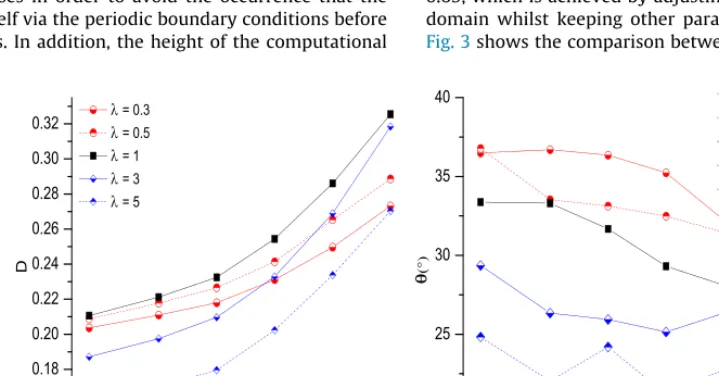
ratiorangesfrom0.18to0.7.Fig.6(a)showsthevariationofthe deformationparameterfor=0.3,0.5,1,3,and5.Itisobserved thatthedeformationincreaseswithincreasingviscosityratioupto unity.Uponafurtherincreaseoftheviscosityratio,the deforma-tiondecreases.Inaddition,weobservethatincreasingconfinement ratioleadstobiggerdeformationofthedropletforallthe viscos-ityratios.Interestingly,thedropletdeformationdoesnotpresent alinearcorrelationwiththeproximityof thewalls.Itincreases almostlinearly,withdifferentrates,beforeandafter2R/H=0.4. Uptothisvaluethedeformationexhibitsaslowincrease,which becomesmorerapiduponhighervalues, especiallyforthehigh viscousdroplets.Thiscanbeexplainedtogetherwiththe corre-spondingorientationangles. Thevariationof thecorresponding
[image:8.646.105.483.212.732.2]orientation angle () with the confinement ratio is shown in
Fig.6(b).Increasingviscosityratiocausesthedroplettoalignmore withtheshearflow,thusresultinginasmallerorientationangle. For≥1,boththedeformationparameter(seeFig.6(a))andthe orientationangle(Fig.6(b))revealmoresignificantvariationswith theconfinementratio2R/H≥0.4.Thissuggeststhatthewall con-finementhasa strongereffectondropletdeformationformore
viscousdroplets.For=3,5,theorientationanglesdonotreduce furtheronce2R/H≥0.3.Therefore,thecarrierfluidhasanarrower flowpassagetopassthedropletwhichleadstobuilt-upshearstress aroundthedroplet.Consequently,thedeformationrateincreases morerapidlyfor=3,5withincreasingconfinement.
Inordertoillustratetheeffectoftheviscosityratioandthe con-finementratioontheflowfieldinsideandaroundthedroplet,Fig.7
depictsthevelocity contoursandstreamlinesinthemiddlex–z
planefor2R/H={0.4,0.7}and={0.3,1,5}atCa=0.2.Notethatwe herelimitourinvestigationto2R/H=0.4and0.7sincetheimpact ofwallbecomesmoreevidentwiththeconfinementratiolarger than0.4.Inthisfigure,thethicksolidlinesrepresentthedroplet interfacewhere N=0,whiletheblacksolidlinesrepresentthe
streamlines,witharrowsindicatingthedirectionofthelocalflow. Itisconfirmedthattheeffectoftheviscosityratioandthe confine-mentratioarenotonlyonthedropletshapeandorientationangle, butalsoontheflowfieldpatternsinsideandaroundthedroplet. Increasingviscosityratio leadstothestreamline patterninside thedropletvaryingfromadoublevortextoasinglevortex struc-ture.Interestingly,ananalogousvariationinthestreamlinepattern wasobservedinthepreviousnumericalstudies[20,21,34,35]when theReynoldsnumberisdecreasedfromarelativelyhighvalue.In addition,astheviscosityratioincreases,theinclinationangleof theinternalvortices(streamlines)andtheorientationangleofthe dropletbothdecrease,andtheirdifferencealsoreduces.Fortwo dif-ferentconfinementratios,thestreamlinepatternsarequalitatively similarbutquantitativelydifferent,e.g.theinclinationof stream-linesinsidethedropletissmallerattheconfinementratioof0.7, whichcorrespondstoalargerdeformationandsmallerorientation angleofthedroplet.
3.2. Dropletbreakup
Inthissection,weinvestigatethecriticalcapillarynumberof thedropletbreakupatvariousviscosityandconfinementratios. Thesimulationsareconductedfortheconfinementratiosranging from0.37to0.8atthreetypicalviscosityratios,i.e.=0.3,1and 5.AlthoughtheLBMhasbeenusedextensively tosimulatethe dropletbreakup,e.g.,Refs.[32–35],tothebestofourknowledge,no studiestodatehaveconsideredsuchabroadrangeofparameters. Thisispartiallybecauseoftheunsolvedissuesoftheexisting mod-elsthemselves,suchasartificiallyenlargedinterfacethicknessand case-dependentmobilityinthephase-field-basedmodel,high spu-riouscurrents,numericalinstabilityintheinterparticle-potential model.
Fig.8showstheeffectoftheconfinementratioonthedroplet breakupattheviscosityratiosof0.3,1,and5,whicharerepresented bycircles, squares, and diamonds,respectively. Empty symbols areusedin thecaseswhere nodropletbreakupisobserved.To distinguishdifferentmodesof breakup,we usehalf-filled sym-bols to denote the binary breakup, and full-filled symbols to denotethemultiplebreakup,wherethedropletsplitsintothree ormoredaughterdroplets. Inaddition,thebreakupisdepicted at the moments before and after it occurs, for a number of cases.Followingtheaforementioneddefinition,thecritical cap-illarynumber,Cacr,liesbetweentheemptyand filled symbols.
Theconfinementratiohasdifferenteffectsonthecriticalcapillary number, depending on the viscosity ratio. For the low viscos-ityratio,i.e.=0.3,thecriticalcapillarynumberisvariedfrom 0.4≤Cacr≤0.5 at2R/H=0.37,to0.5≤Cacr≤0.6at2R/H=0.5 and
finallyto0.55≤Cacr≤0.625at2R/H=0.625,suggestingthat Cacr
increaseswithincreasingconfinement.Contrarytothelow vis-cosityratiocase,Cacr decreaseswithincreasingconfinementfor
thehighviscosityratio,i.e.=5.Specifically,thecriticalcapillary numberdecreasesfrom0.5≤Cacr≤0.6to0.3≤Cacr≤0.35 when
oneincreasestheconfinementratiofrom0.55to0.8.Fig.9shows thesnapshots ofthedropletbreakup processforCa=0.35,=5 and2R/H=0.8.Thedropletdeformscontinuouslyandeventually breaks up into two equal-sized daughter droplets, as opposed to the unbounded case where the high viscosity ratio droplet (>4)doesnotbreakregardlessofthecapillarynumber.Also,it isinterestinglyobservedinFig.8thattheconfinementratiohas smalleffectonthecritical capillarynumber for=1,which is
around0.4.Thesefindingsagreewellwiththeprevious experi-mentalandnumericalstudies[3,24].However,inthesereported works[3,24]throughalargenumberofexperimentsand/or simu-lations,itwasfoundthatfor=1thatthecriticalcapillarynumber firstdecreasesandthenincreaseswiththeconfinementratio.The minimumcriticalcapillary numberoccursat2R/H=0.5.To cap-ture this subtle variation of the critical capillary number with theconfinementratio,alargenumberofsimulationsarerequired whichwillbestudiedseparatelybyexploitingmassivelyparallel computing.
Eventhoughtheoverallagreementisquitesatisfactorybetween thepresentresultsandthoseobtainedbyJanssenetal.[3],some quantitative differences are also noticed. For example, Janssen etal.[3]experimentallyfoundthatbinarybreakupisexpectedto occurforadropletwith=1.0atCa=0.45and0.37≤2R/H≤0.45, whereasinoursimulationsternarybreakupisobserved.Fig.10
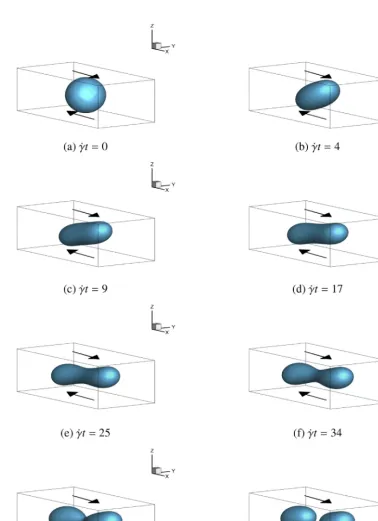
showsthesnapshotsofthedropletbreakupprocessforCa=0.45, =1 and 2R/H=0.45. Asthe droplet is stretched by the exter-nalshear flow,it first deforms toanellipsoidal shape (t˙ =4). Themajoraxislengthens while theminoraxisshrinks,leading totheformationofawaistnearthecentreofdropletatt˙ =16. Thedropletisthen elongatedtoa ‘dumbbell’shape, andatthe sametimethebulbsattheendofdropletachieveastableshape (t˙ =20).Att˙ =25,twovisiblenecksareformedbetweenthe centralportionof thedropletand bulbs.The dropletcontinues to thin and eventually breaks up into three parts (i.e., ternary breakup) with two daughter droplets having much larger size (t˙ =27).
Inaddition,thepreviousexperimentalstudyindicatedthatthe lowestCacrforallofviscosityratios(0.3≤≤5)andconfinement
ratios(0.1≤2R/H≤0.9)isaround0.4[3],butinoursimulations thelowestCacrisfoundbetween0.3and0.35,whichcanbeclearly
seeninFig.8forthecaseof=5and2R/H=0.8.Thereasonforthese differencesremainsunclear,andislikelytobetheresultofa com-binationoffactors,includingtheexperimentalerrorsandmodel accuracyindescribingtheinterfacialdynamics.
4. Conclusions
The influence of capillary number, viscosity ratio and con-finement ratio have been systematically studied for droplet deformationandbreakupinasimpleshearflow.Increasing con-finementleadstoanincreaseindropletdeformationforawide rangeofviscosityratios,andthedropletwiththesameviscosityas thecarrierfluidpresentsthelargestdeformationatallconfinement ratios.Theorientationangleofthedeformeddropletdecreaseswith increasingviscosityratio.Itisobservedthatthepresenceofwalls hasamore significantimpactonbothdroplet deformationand orientationanglewhentheconfinementratioincreasesto0.4or higher.Theflowfieldinsideandaroundthedropletshowsthat con-finementandviscosityratioscanleadtoaperplexpatternwhich mayaffectdropletbehaviour.Finally,thecriticalcapillarynumber, abovewhichthedropletbreakupoccurs,isinvestigatedforabroad rangeofflowconditions.Dependingonthevalueofviscosityratio, theconfinementratiohasdifferenteffectsonthecriticalcapillary number:astheconfinementincreases,thecriticalcapillarynumber increasesfor<1butdecreasesfor>1;andfor=1thecritical capillarynumberiskeptatavalueofaround0.4,regardlessofthe confinementratio.
Acknowledgements
TheresultswereobtainedusingtheUKEPSRCfunded ARCHIE-WeSt High Performance Computer (http://www.archie-west.
supported by EPSRC under grant no. EP/M021475/1 and EP/L00030X/1. H.L. gratefully acknowledges the financial sup-ports from the National Natural Science Foundation of China (Grant No. 51506168) and the Thousand Talents Program for DistinguishedYoungScholars.
References
[1]G.I.Taylor,Theformationofemulsionsindefinablefieldsofflow,J.Colloid InterfaceSci.38(1934)501–523.
[2]F.A.Morrison,UnderstandingRheology,OxfordUniversityPress,2001. [3]P.J.A.Janssen,A.Vananroye,P.V.Puyvelde,P.Moldenaers,P.D.Anderson,
Generalizedbehaviorofthebreakupofviscousdropsinconfinements,J. Rheol.54(5)(2010)1047–1060,URL:http://scitation.aip.org/content/sor/ journal/jor2/54/5/10.1122/1.3473924.
[4]M.R.Kennedy,C.Pozrikidis,R.Skalak,Motionanddeformationofliquid drops,andtherheologyofdiluteemulsionsinsimpleshearflow,Comput. Fluids23(2)(1994)251–278,URL:http://www.sciencedirect.com/science/ article/pii/004579309490040X.
[5]S.Guido,M.Villone,Three-dimensionalshapeofadropundersimpleshear flow,J.Rheol.42(1998)395–415,URL:http://scitation.aip.org/content/sor/ journal/jor2/42/2/10.1122/1.550942.
[6]A.Vananroye,P.VanPuyvelde,P.Moldenaers,Effectofconfinementonthe steady-statebehaviorofsingledropletsduringshearflow,J.Rheol.51(1) (2007)139–153,http://dx.doi.org/10.1122/1.2399089,URL:http://scitation. aip.org/content/sor/journal/jor2/51/1/10.1122/1.2399089.
[7]V.Cristini,Y.-C.Tan,Theoryandnumericalsimulationofdropletdynamicsin complexflows–areview,LabChip4(2004)257–264,URL:http://pubs.rsc. org/en/content/articlehtml/2004/lc/b403226h.
[8]S.Guido,F.Greco,Dynamicsofaliquiddropinaflowingimmiscibleliquid, Rheol.Rev.(2004)99–142,URL:http://www.bsr.org.uk/rheology-reviews/ RheologyReviews/liquid-drop-immiscible-liquid-GuidoGreco.pdf. [9]P.V.Puyvelde,A.Vananroye,R.Cardinaels,P.Moldenaers,Reviewon
morphologydevelopmentofimmiscibleblendsinconfinedshearflow, Polymer49(25)(2008)5363–5372,http://dx.doi.org/10.1016/j.polymer. 2008.08.055,URL:http://www.sciencedirect.com/science/article/pii/ S0032386108007544.
[10]M.Minale,Modelsforthedeformationofasingleellipsoidaldrop:areview, Rheol.Acta49(8)(2010)789–806, http://dx.doi.org/10.1007/s00397-010-0442-0.
[11]C.E.Chaffey,H.Brenner,Asecond-ordertheoryforsheardeformationof drops,J.ColloidInterfaceSci.24(2)(1967)258–269,http://dx.doi.org/10. 1016/0021-9797(67)90229-9,URL:http://www.sciencedirect.com/science/ article/pii/0021979767902299.
[12]J.M.Rallison,Noteonthetime-dependentdeformationofaviscousdrop whichisalmostspherical,J.FluidMech.98(1980)625–633,http://dx.doi.org/ 10.1017/S0022112080000316,URL:http://journals.cambridge.org/article S0022112080000316.
[13]J.M.Rallison,Anumericalstudyofthedeformationandburstofaviscous dropingeneralshearflows,J.FluidMech.109(1981)465–482,URL:http:// journals.cambridge.org/download.
php?file=%2FFLM%2FFLM109%2FS002211208100116Xa. pdf&code=afc88fbdcd8cfaf45e74d9e8bd98cb77.
[14]F.Greco,Second-ordertheoryforthedeformationofaNewtoniandropina stationaryflowfield,Phys.Fluids14(3)(2002)946–954,http://dx.doi.org/10. 1063/1.1445182,URL:http://scitation.aip.org/content/aip/journal/pof2/14/3/ 10.1063/1.1445182.
[15]S.Guido,Shear-induceddropletdeformation:effectsofconfinedgeometry andviscoelasticity,Curr.Opin.ColloidInterfaceSci.16(1)(2011)61–70, http://dx.doi.org/10.1016/j.cocis.2010.12.001,URL:http://www. sciencedirect.com/science/article/pii/S1359029410001226.
[16]P.Maffettone,M.Minale,Equationofchangeforellipsoidaldropsinviscous flow,J.Non-NewtonianFluidMech.78(1998)227–241,URL: http://ac.els-cdn.com/S0377025798000652/1-s2.0-S0377025798000652-main.pdf? tid=dff6b528-f0e2-11e4-9bfa-00000aab0f6c&acdnat=1430581973 58d00b70d8ae847f6b0278389a56cf08.
[17]M.Minale,Aphenomenologicalmodelforwalleffectsonthedeformationof anellipsoidaldropinviscousflow,Rheol.Acta47(2008)667–675,URL: http://download-v2.springer.com/static/pdf/111/art%253A10. 1007%252Fs00397-007-0237-0.pdf?token2=exp=1430583106acl =%2Fstatic%2Fpdf%2F111%2Fart%25253A10.1007%25252Fs00397-007- 0237-0.pdf*hmac=ff39c5831a50644cd93dd91a50ff042eefced0064b60370 d315695fcd2cb594c.
[18]M.Shapira,S.Haber,LowReynoldsnumbermotionofadropletinshearflow includingwalleffects,Int.J.MultiphaseFlow16(2)(1990)305–321,URL: http://www.sciencedirect.com/science/article/pii/030193229090061M. [19]V.Sibillo,G.Pasquariello,M.Simeone,V.Cristini,S.Guido,Dropdeformation
inmicroconfinedshearflow,Phys.Rev.Lett.97(5)(2006)1–4,http://dx.doi. org/10.1103/PhysRevLett.97.054502,054502.
[20]J.Li,Y.Y.Renardy,M.Renardy,Numericalsimulationofbreakupofaviscous dropinsimpleshearflowthroughavolume-of-fluidmethod,Phys.Fluids12 (2)(2000)269–282,URL:https://www.math.vt.edu/people/renardyy/ Research/Publications/feb2000.pdf.
[21]Y.Y.Renardy,V.Cristini,Effectofinertiaondropbreakupundershear,Phys. Fluids13(1)(2001)7–13,http://dx.doi.org/10.1063/1.1331321.
[22]Y.Renardy,Theeffectsofconfinementandinertiaontheproductionof droplets,Rheol.Acta46(4)(2007)521–529,http://dx.doi.org/10.1007/ s00397-006-0150-y.
[23]P.J.A.Janssen,P.D.Anderson,Boundary-integralmethodfordropdeformation betweenparallelplates,Phys.Fluids19(2007)1–11,043602,URL:http:// www.mate.tue.nl/mate/pdfs/7660.pdf.
[24]A.Vananroye,P.J.A.Janssen,P.D.Anderson,P.VanPuyvelde,P.Moldenaers, Microconfinedequiviscousdropletdeformation:comparisonofexperimental andnumericalresults,Phys.Fluids20(2008)1–10,http://dx.doi.org/10.1063/ 1.2835312,013101,URL:http://scitation.aip.org/content/aip/journal/pof2/20/ 1/10.1063/1.2835312.
[25]V.Cristini,J.Blawzdziewics,M.Loewenberg,Anadaptivemeshalgorithmfor evolvingsurfaces:simulationsindropbreakupandcoalescence,J.Comput. Phys.168(2001)445–463,URL:http://www.sciencedirect.com/science/ article/pii/S0021999101967130.
[26]O.Shardt,J.Derksen,S.K.Mitra,Simulationsofdropletcoalescenceinsimple shearflow,Langmuir29(21)(2013)6201–6212,http://dx.doi.org/10.1021/ la304919p.
[27]A.K.Gunstensen,D.H.Rothman,S.Zaleski,G.Zanetti,LatticeBoltzmann modelofimmisciblefluids,Phys.Rev.A43(1991)4320–4327,http://dx.doi. org/10.1103/PhysRevA.43.4320.
[28]M.R.Swift,W.R.Osborn,J.M.Yeomans,LatticeBoltzmannsimulationof nonidealfluids,Phys.Rev.Lett.75(1995)830–833,http://dx.doi.org/10.1103/ PhysRevLett.75.830.
[29]X.Shan,H.Chen,LatticeBoltzmannmodelforsimulatingflowswithmultiple phasesandcomponents,Phys.Rev.E47(1993)1815–1819,http://dx.doi.org/ 10.1103/PhysRevE.47.1815.
[30]X.He,S.Chen,R.Zhang,AlatticeBoltzmannschemeforincompressible multiphaseflowanditsapplicationinsimulationofRayleigh–Taylor instability,J.Comput.Phys.152(2)(1999)642–663,http://dx.doi.org/10. 1006/jcph.1999.6257,URL:http://www.sciencedirect.com/science/article/pii/ S0021999199962575.
[31]H.Xi,C.Duncan,LatticeBoltzmannsimulationsofthree-dimensionalsingle dropletdeformationandbreakupundersimpleshearflow,Phys.Rev.E59 (1999)3022–3026,http://dx.doi.org/10.1103/PhysRevE.59.3022.
[32]R.vanderSman,S.vanderGraaf,Emulsiondropletdeformationandbreakup withlatticeBoltzmannmodel,Comput.Phys.Commun.178(7)(2008) 492–504,http://dx.doi.org/10.1016/j.cpc.2007.11.009,URL:http://www. sciencedirect.com/science/article/pii/S0010465507004675.
[33]H.Liu,A.J.Valocchi,Three-dimensionallatticeBoltzmannmodelfor immiscibletwo-phaseflowsimulations,Phys.Rev.E85(2012)1–14,http:// dx.doi.org/10.1103/PhysRevE.85.046309,046309.
[34]S.Farokhirad,T.Lee,J.F.Morris,Effectsofinertiaandviscosityonsingle dropletdeformationinconfinedshearflow,Commun.Comput.Phys.13(3) (2013)706–724,URL:http://www.academia.edu/8043985/EffectsofInertia andViscosityonSingleDropletDeformationinConfinedShearFlow. [35]A.Komrakova,O.Shardt,D.Eskin,J.J.Derksen,LatticeBoltzmannsimulations
ofdropdeformationandbreakupinshearflow,Int.J.MultiphaseFlow59 (2014)24–43,URL:http://www.sciencedirect.com/science/article/pii/ S0301932213001547.
[36]A.Gupta,M.Sbragaglia,Deformationandbreakupofviscoelasticdropletsin confinedshearflow,Phys.Rev.E90(2014)1–14,http://dx.doi.org/10.1103/ PhysRevE.90.023305,023305.
[37]H.Liu,Y.Ju,G.Xi,Y.Zhang,LatticeBoltzmannmodelingofcontactangleand itshysteresisintwo-phaseflowwithlargeviscositydifference,Phys.Rev.E 92(2015).
[38]H.Liu,Y.Zhang,A.J.Valocchi,LatticeBoltzmannsimulationofimmiscible fluiddisplacementinporousmedia:homogeneousversusheterogeneous porenetwork,Phys.Fluids27(2015),http://dx.doi.org/10.1063/1.4921611. [39]J.Brackbill,D.Kothe,C.Zemach,Acontinuummethodformodelingsurface tension,J.Comput.Phys.100(1992)335–354,URL:http://ac.els-cdn.com/ 002199919290240Y/1-s2.0-002199919290240Y-main.pdf? tid=c67f7a46-f0e0-11e4-9008-00000aab0f27&acdnat=1430581072
91f0c5465fa22f45755df6ed0232b289.
[40]I.Halliday,A.P.Hollis,C.M.Care,LatticeBoltzmannalgorithmforcontinuum multicomponentflow,Phys.Rev.E76(2007)1–13,http://dx.doi.org/10.1103/ PhysRevE.76.026708,026708.
[41]H.Liu,Y.Zhang,A.J.Valocchi,Modelingandsimulationofthermocapillary flowsusinglatticeBoltzmannmethod,J.Comput.Phys.(2012)4433–4453, URL:http://www.sciencedirect.com/science/article/pii/S0021999112000940. [42]Z.Guo,C.Zheng,B.Shi,Discretelatticeeffectsontheforcingterminthe
latticeBoltzmannmethod,Phys.Rev.E65(2001)1–6,http://dx.doi.org/10. 1103/PhysRevE.65.046308,046308.
[43]Y.Q.Zu,S.He,Phase-field-basedlatticeBoltzmannmodelforincompressible binaryfluidsystemswithdensityandviscositycontrasts,Phys.Rev.E87 (2013)1–23,http://dx.doi.org/10.1103/PhysRevE.87.043301,
043301.
[44]H.Liu,Y.Zhang,Phase-fieldmodelingdropletdynamicswithsoluble surfactants,J.Comput.Phys.229(24)(2010)9166–9187,http://dx.doi.org/10. 1016/j.jcp.2010.08.031,URL:http://www.sciencedirect.com/science/article/ pii/S002199911000478X.
[46]H.Liu,Y.Zhang,Dropletformationinmicrofluidiccross-junctions,Phys. Fluids23(2011)1–12,http://dx.doi.org/10.1063/1.3615643,
082101.
[47]T.Zhang,B.Shi,Z.Guo,Z.Chai,J.Lu,Generalbounce-backschemefor concentrationboundaryconditioninthelattice-Boltzmannmethod,Phys. Rev.E85(2012)1–14,http://dx.doi.org/10.1103/PhysRevE.85.016701, 016701.
[48]S.Kwak,C.Pozrikidis,Adaptivetriangulationofevolving,closed,oropen surfacesbytheadvancing-frontmethod,J.Comput.Phys.145(1)(1998) 61–88,http://dx.doi.org/10.1006/jcph.1998.6030,URL:http://www. sciencedirect.com/science/article/pii/S0021999198960302.
NikolaosIoannouobtaineda5-yearDiploma,equivalent toMasterofSciencedegree,inMechanicalengineering fromtheSchoolofMechanicalEngineering,National Uni-versityofAthensin2010.In2014,heobtainedaMasterin ComputationalMechanicsfromthesameinstitution.He isaPh.DcandidateunderthesupervisionofProf. Yong-haoZhangintheMechanicalandAerospacedepartmentof theUniversityofStrathclyde,andamemberoftheJames WeirFluidsLaboratorysinceDecember2012.Hisresearch involvesinterfacialdynamicsatthemicroscaleand non-Newtonianfluids.
HaihuLiuisanAssociateProfessoratXi’anJiaotong Uni-versity,China.HereceivedhisBEngandMEngdegreesin FluidMachineryandEngineeringfromXi’anJiaotong Uni-versityin2004and2007,respectively.Hethenjoinedthe JamesWeirFluidsLaboratoryasaPhDstudentin2007. AfterawardedhisPhDin2011,heworkedasa post-doctoralresearchassociateintheDepartmentofCivil& EnvironmentalEngineeringintheUniversityofIllinoisat Urbana-Champaign,USA.InSeptember2013,hejoined UniversityofStrathclydeasaLecturerandthenbecame anAssociateProfessoratXi’anJiaotongUniversityChina in2014.