City, University of London Institutional Repository
Citation
:
Mera, M. (2015). Agitprop Rap? "Ill Manors" and the Impotent Indifference of Social Protest. In: Miller, T. (Ed.), The Routledge Companion to Global Popular Culture. (pp. 268-281). New York, USA: Routledge. ISBN 978-0-415-64147-0This is the accepted version of the paper.
This version of the publication may differ from the final published
version.
Permanent repository link: http://openaccess.city.ac.uk/6383/
Link to published version
:
Copyright and reuse:
City Research Online aims to make research
outputs of City, University of London available to a wider audience.
Copyright and Moral Rights remain with the author(s) and/or copyright
holders. URLs from City Research Online may be freely distributed and
linked to.
Agitprop Rap?: ‘Ill Manors’ and the Impotent Indifference of Social Protest
Miguel Mera
Abstract
This chapter analyses the content and impact of Plan B’s protest song ‘Ill Manors’ which was composed in response to the 2011 English Riots. I argue that, notwithstanding the musical and lyrical brilliance of the song, its political agenda was limited because of the complex socioeconomic climate into which it emerged. By aligning Žižek’s notion of post-politics with Bauman’s concept of the underclass as collateral casualties of consumerism, I investigate how the vestiges of political protest could be seen to be assimilated by liberal capitalist ideology. This chapter shows how articulate musical rage followed a series of inarticulate violent acts formed in an age of political indifference.
Introduction
In Music and Politics (2012) John Street argued that the protest song is both a form of
political communication and a mode of political representation, and he suggested that
the former is only possible because of the latter: “It is not enough to be able to speak
up; you must also be able to speak for a people or a cause” (2012: 42). This
theorization nuances R. Serge Denisoff’s classic but problematic text, Sing a Song of
Social Significance (1983), where protest songs were defined as either “Magnetic” or
“Rhetorical”. “Magnetic” songs, according to Denisoff, attract people to movements
and promote group solidarity and “Rhetorical” songs are intended to change public
opinion.
In this chapter I will examine Plan B’s protest song ‘Ill Manors’ (2012) which
was composed in response to the riots that took place in England in August 2011. The
track explores both the causes and the consequences of the riots, focusing on societal
attitudes towards an underprivileged youth population. Guardian columnist Dorian
Lynskey described it as “the first great mainstream protest song in years” (2012). The
song, together with an album and feature film of the same name, were part of a
alienating class divide. I will focus here only on the song and its accompanying music
video (which incorporated actual footage from the riots), although much could be said
about the integration of music, narrative, and the rhetoric of protest over the entire Ill
Manors project.
The central claim I hope to advance is that, despite its musical and lyrical
brilliance, the song was neither effective magnetically or rhetorically, or using
Street’s formulation, that ‘Ill Manors’ was a masterpiece of political communication
that could never succeed in encouraging change because it did not sufficiently realize
its potential as a mode of political representation. The reasons for this are complicated
but relate to the incoherence surrounding the riots themselves which Winlow and Hall
have defined as “both political and apolitical; destructive, but also strangely
conformist” (2012: 149). Those who rioted were not driven by an ideological vision
or progressive political agenda. There appeared to be no conscious desire to bring
about social change or a more equitable world (Carter 2011; Prasad 2011a, 2011b).
The riots were ultimately characterized by opportunistic looting with fifty percent of
the recorded offences acquisitive in nature (Singh et al. 2012).
In fact, the riots seemed to encapsulate Slavoj Žižek’s notion of post-politics where the political is not repressed but foreclosed. Žižek argued that in a post-political age we increasingly see irrational and excessive violence “grounded in no
utilitarian or ideological reason” (Žižek 1999: 201; see also Žižek 2008). The anti-capitalist elaboration of this concept by Zygmunt Bauman (2007) and an
amplification by Winlow and Hall (2012) provide useful scaffolding to investigate
how the vestiges of political protest could be seen to be assimilated by nihilistic
consumerism. The incomprehension in the debate surrounding the causes of the riots
anti-social criminality as entirely savage and indicative of a society in the throes of moral
decay. Prime Minister David Cameron’s one-dimensional analysis of the riots was
that that they demonstrated “criminality pure and simple” (2011a) and provided
evidence of a threatening and amoral underclass. Subsequent analyses revealed a
much more complex picture of the motivations, class, age, race, and social make-up
of the rioters which was far from uniform or coherent (Rusbridger & Rees 2011).
Emerging from this sometimes contradictory and convoluted discussion, ‘Ill
Manors’ skillfully expressed a subconscious desire for change, but it could not
promote group solidarity because there was no group to speak for. The crowd had
dispersed and only confused individuals remained who did not understand what, if
anything, had unified them in the first place. In short, this was the right song in the
wrong place at the wrong time. Plan B’s articulate rage followed a series of
inarticulate violent acts formed in an age of political indifference. This raises
important questions about the impact of the social protest song in a contemporary
society where violence carries an implicit admission of impotence. We will consider
the mixture of impotence and indifference, how this framed the riots and,
consequently, limited the capacity of the song to speak for its cause.
The term agitprop rap is, of course, loaded. I use it in its very broadest sense,
referring to political agitation and propaganda through artistic means. It is a form of
communication that aims to influence the attitude of the community by focusing on a
particular (one-sided) aspect of an argument. Agitprop is a portmanteau of the
Agitation and Propaganda Section of the Central Committee Secretariat of the
Communist Party in the former Soviet Union which was mounted in the years after
the 1917 revolution. It has typically conjured negative connotations. I encourage a
in an era where there is constant evidence of eroding public confidence in the
institutions of representative democracy, as well as other signs of public cynicism and
lack of trust in politicians. Furthermore, ‘Ill Manors’ makes extensive and dazzling
use of samples derived from Shostakovich’s Seventh Symphony, popularly known as
the Leningrad Symphony (1942). Along with many other artists at the time
Shostakovich faced constant censorship and scrutiny. His music was even denounced
as ‘formalist’ by the Soviet authorities and was banned on several occasions (Fay
2000, 2004). Yet the Seventh Symphony with its narrative about the defence of
Leningrad from the Nazis during WWII, enhanced his reputation as a Soviet patriot,
at least temporarily. The connections between the sampled material and its adapted
cultural context provide some insights into the strategies of rhythmic and textural
‘agitation’ and techniques of irony that are employed in ‘Il Manors’.
Riots of Impotence and Indifference
In the summer of 2011, between August 6and 10, an estimated 13,000–15,000 people
were involved in riots in several London boroughs and in cities across England. The
riots followed the police shooting of Mark Duggan on August 4. The Metropolitan
Police stated that officers were attempting to arrest Duggan—a black male—on
suspicion of planning an attack. They stated that he was in possession of a handgun
which he had fired first before police acted in response. Subsequent evidence
suggested that Duggan was not armed when he was shot. Ballistics tests revealed that
a bullet that had lodged in a police officer’s radio had in fact come from a police
firearm. The incident was immediately referred to the Independent Police Complaints
Commission (IPCC). Overnight, differing media accounts appeared, some
Unsatisfied with a lack of transparency and clarity surrounding Duggan’s
death, a protest was arranged by the local Broadwater Farm residents on August 6.
The Broadwater Farm estate already had a history of tension between the black
community and police and was the scene of riots in 1985 (Gifford 1986). Local
community supporters and members of the family, gathered outside Tottenham police
station. Initially the protest was peaceful but, later in the evening, violence broke out.
Some of this was motivated by racial tension surrounding restrictive law enforcement
practices, but increasingly the trigger for the violence became a distant memory as
opportunistic looting took hold. By Sunday August 7 the riots had spread to twelve
areas within London and by Monday August 8 the riots had spread nationally. Social
media was seen as catalysing the unrest with debates surrounding the role of
technology resulting in the moniker the “Blackberry Riots” (Economist 2011; Baker
2012). Rioters made use of Blackberry smartphones, whose encrypted Messenger
Service allowed private group messages to be sent simultaneously to users’ contacts.
There were different phases and different motivations for the riots in different places
and ultimately the entire series of events was characterized by genuine disorientation
(Angel 2012; Goringe & Rosie 2012; Briggs 2012a, 2012b).
The British Prime Minister interrupted his holiday and returned to the UK to
oversee the Government response. Police leave was cancelled and Parliament was
recalled on August 11 to debate the situation. According to the official report sixty-six
areas experienced rioting, five people lost their lives, and widespread arson and
looting caused severe damage to businesses and local communities (Singh et al.
2012).
By mid-October there had been 4,000 arrests, 2,000 people had been charged
resulting in an immediate custodial sentence (Rusbridger & Rees 2011). The legal
system was required to work under extraordinary pressure, with all-night court
sittings, and the use of severe prison sentences for many of those convicted of
riot-related offences.
The outbreak of explanations and solutions was almost as incoherent as the
riots themselves, as politicians, journalists, academics and other commentators
attempted to make sense of what had happened. The Conservative-led Government
were quick to condemn the riots and blame gang culture and moral decay. David
Cameron had already referred to “broken Britain” throughout the campaign for the
2010 general election, and thereafter continued to refer to marriage and a stable
two-parent family as central to mending a sick society (Mooney & Neal 2010: 145). In a
speech outlining the Government’s response to the riots on August 15 Cameron
argued that the riots were not about poverty but rather about behavior, perpetrated by
“people showing indifference to right and wrong” and with a “twisted moral code”.
Cameron was quite sure that many of the rioters had “no father at home”, where it was
standard to grow up without a male role model “looking to the streets for their father
figures, filled up with rage and anger” (2011b).Key to Cameron’s agenda was reform
of the welfare system, because he argued that it encouraged the worst in people who
could “be as irresponsible as they like because the State will always bail them out”
(2011b). A further extraordinary response from the Justice Secretary, Kenneth Clarke,
referred to the rioters as a “feral underclass”.
The discourse surrounding poverty and social class in British society, therefore, was
grossly simplified and distorted, but did align with some longstanding Conservative
political values. By highlighting deviancy and instinctive criminality, a fundamental
belief in the concept of pure meritocracy was maintained. The ‘underclass’ existed
exclusively through choice and lack of ambition rather than any other root causes,
thus emphasizing the role of the individual and absolving the State of any
responsibility.
Efforts to present a united front over the riots became strained when the
Conservative Party’s coalition partners, The Liberal Democrats, warned of the danger
of kneejerk reactions. They had focussed their rhetoric on causes related to
dependency and isolation, but also believed that the precise reasons for the various
acts of disorder were complicated and needed to be carefully understood. It was only
as a concession to the Liberal Democrats that the Prime Minister agreed to a public
enquiry.In his contribution to the debate, The Leader of the Opposition, Ed Miliband,
said it was important to recognize that both “culture” and “opportunity” (i.e. values
and poverty) were determining factors (Miliband 2011). He also emphasized
inequality, explaining that the rioters were not the only people guilty of immoral
greed, citing several exemplars including bankers taking huge bonuses even as the
taxpayer bailed out financial institutions following the subprime mortgage crisis
(2008), the MPs expenses scandal (2009), and the News International journalists
involved in the phone hacking and bribery scandal (2011). Miliband argued that there
was a societal gap “glorifying those who make millions while others struggle to keep
up” (Miliband 2011). The discussion surrounding inequality was, of course, especially
designed to make Conservative politicians feel uncomfortable, because it had obvious
three main political parties taking somewhat predictable positions but also touching
on relevant issues, the debate failed to provide any substantial insight into the riots or
its underlying causes. The common factor beyond political point scoring was utter
incomprehension.
The concept of impotent indifference is one way in which the riots can be
understood as simultaneously political and apolitical. The writing of Zygmunt
Bauman is particularly helpful in framing this discussion. The consistent use of the
term ‘underclass’ in the discourse surrounding the riots would, for Bauman, reinforce
his prescient theorization relating to the commodification of the individual and its
inevitable impact on society. He argued that the consequence of the new social
landscape, where a society of producers had been transformed into a society of
consumers, was the creation of a sizeable ‘underclass’ with little or no ability to
consume or be consumed.
The ‘underclass’ evokes an image of an aggregate of people who have been declared
off-limits in relation to all classes and the class hierarchy itself, with little chance and
no need of readmission: people without a role, making no useful contribution to the lives of the rest, and in principle beyond redemption. People who in a class-divided society form no class of their own, but feed on the life juices of all other classes,
thereby eroding the class-based order of society (2007: 123).
Bauman dismantled the controversial concept of an ‘underclass’ as a
politically convenient way of grouping an otherwise disparate range of individuals,
reduced to a single entity as a parasitic threat to the rest of society. But he went
further and argued that ubiquitous consumer values affected all aspects of social life,
so that in order to succeed, people had to follow consumerist principles or suffer
humiliating exclusion. In a world that evaluates everything by its commodity value
the ‘underclass’ were failed consumers, the “walking symbols of the disasters that
connected to the social whole primarily through their capacity as consumers, then the
rioters could be understood as “collateral casualties of consumerism” (2007: 117).
These were not the riots of an ‘underclass’, these were the riots of “defective and
disqualified consumers” (Bauman 2011a).
Others made similar observations about the victory of liberal capitalist
ideology (Grover 2011; Moxon 2011; Varul 2011) and argued that the nihilism of the
riots may have had the external appearance of protest, but in fact had simply provided
evidence of compliance with the underlying values of the free market society. There
were, to be sure, deeper symptoms of unresolved social problems, but not genuine
protest. Somewhat countering and nuancing this viewpoint is one of the most
sophisticated and provocative theoretical analyses of the riots to date, provided by
criminologists Winlow and Hall who argued that post-modern subjectivity provided a
framework for the “profound sense of lack” exhibited by young people (2012: 154).
Their insistent dissatisfaction triggered by consistent social and economic marginality
stimulated the rage that exploded when an occurrence in the shared social experience
provided the catalyst. Frustration at limited opportunities and urban social conditions
certainly played a role in framing the riots, but the nihilism of the looting suggested a
broader malaise contextualised, but not entirely subsumed, by consumer society.
There were underlying political motivations to the riots, but because of an absence of
genuine political alternatives “the unconscious dissatisfaction the rioters felt about
their place in the world could only be expressed by further engagement with the
meaning system of late capitalism” (Winlow & Hall 2012: 162).
The concept of impotent indifference, then, allows us to consider ideas of
engagement and disengagement, protest and opportunism, even the sense of ‘moral’
but both are formed by pointlessness. With a feeling of impotence there is no point in
trying because the subject knows they are powerless to effect any change. This leads
to indifference where there is no point in trying because the subject is convinced of
their own insignificance and no longer cares. In the English riots of 2011 impotent
indifference, framed by an increasing sense of marginality, did not mean that the
desire for change was absent, rather, the subconscious protest could not find its voice
because there was no political opposition to contemporary liberal capitalism and, in
any case, nobody really understood this as a problem. So the riots were certainly
about inequality, and greed, and opportunism and many other factors, but they were
also about the inability to be heard resulting in the inability to speak. As Winlow and
Hall stated “the riot is a distraction from the humdrum reality of everyday life,
momentarily absorbing, but in the absence of real politics, incapable of yielding the
progressive change that the subject subconsciously desires” (2012: 155).
Articulate Musical Rage
Within this framework it is useful to consider Plan B’s assessment of the riots which
focused on the urban youth for which he endeavoured to stand up as spokesman,
“society needs to take some responsibility for the cause of these riots” (Plan B 2012).
He made it clear that he did not condone the riots, but wanted society to understand
why so many young people did not feel that they had a future or did not care about
receiving a criminal record. He also argued that there was “very public prejudice
towards the underclass” which made him and others feel alienated: “These kids have
been beaten into apathy. They don’t care about society because society has made it
An example of this is the word ‘chav’ that means council housed and violent, a derogatory phrase that is openly used by certain sectors of middle England to label and define people from poor backgrounds. It’s a derogatory phrase no different in my opinion to the ones concerning race or sex. The difference is that the papers use it publicly. If they did the same with racial or sexist derogatory terms it would be deemed, and rightly so, as offensive and politically incorrect (Plan B 2012).
The term ‘chav’ here is presented as a bacronym, because it was originally derived
from the Romany Gypsy word chavi, simply meaning child. In its pejorative and
stereotypical extension it has become associated with an antisocial subculture of
vulgar, poorly educated, lower-class youths who typically wear imitation designer
clothes. Several commentators, along with Plan B, have identified the term as an
example of highly offensive class abuse (Jones 2012; Toynbee 2011). It is from the
perspective as the ‘universal chav’, playing on middle class nightmares, that Plan B
takes an ironic stance to form his acerbic political musical commentary. The
aggressive chorus, “Oi! I said oi! What you looking at, you little rich boy!” represents
predatory underclass youth, but also puns on the sick society tropes perpetuated by
politicians and the media with the recurrent phrase “My Manor’s ill” (see Fig. 1. 5 for
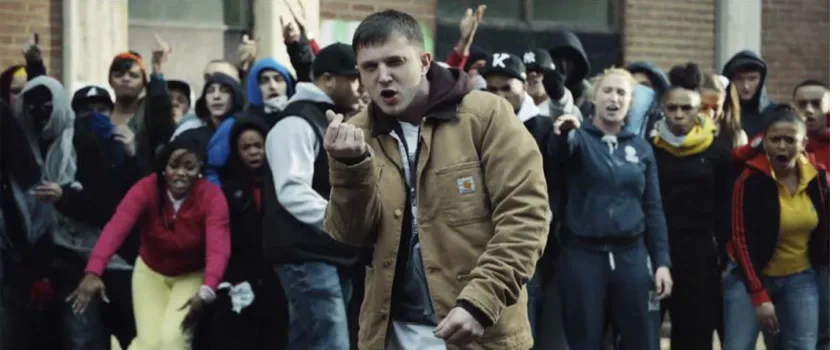
the song’s complete lyrics). The music video contains heavily stylized, caustic images
of, for example, Plan B dressed in a ‘hoodie’ preparing to attack an old lady (Fig.
1.1). The overall strategy is one of satirical distance, perpetuating the stereotype while
simultaneously dismantling it. The constant duality is one of the reasons for the
song’s intensity and insight. By comparison, Bloc Party’s song ‘Kettling’ (2012), for
example, also presented the rioters’ perspective but was so naively one-sided that it
seemed only to glorify violence without providing any depth or critical distance. Plan
B, however, repeats the cultural myths and tells us that they are all true, but his tongue
is firmly in his cheek as he swaggers his way through a series of unresolved
Keep on believing what you read in the papers Council estate kids, scum of the earth Think you know how life on a council estate is, From everything you’ve ever read about it or heard
[image:13.595.93.511.168.336.2]Well it’s all true, so stay where you’re safest There’s no need to step foot out the ‘burbs
Fig. 1.1. Plan B “Get you bloody tools out”
Fig. 1.2. Leader of the Pack
Allan Moore reminds us that “… a musical persona, from whom the protest
comes, always exists within a musical environment” (2013: 397). This seems
especially relevant to ‘Ill Manors’ where a musical as well as a lyrical analysis reveals
how rigorously rhythm and texture are controlled to generate an underlying,
[image:13.595.92.512.392.567.2]choruses.
The musical material in ‘Ill Manors’ features samples taken from
Shostakovich’s 7th Symphony. This was not an original idea, as Peter Fox’s song
‘Alles Neu’ (2008) employed virtually identical accompaniment. A comparison of
these two tracks is beyond the scope of this chapter, but suffice to say that borrowing
as homage is a common practice in Hip Hop. We can also observe that Peter Fox’s
track is much more aspirational and is much less concerned with rhythmic and timbral
agitation than ‘Ill Manors’.
One wonders if Plan B was aware of the context of Shostakovich’s Symphony
No. 7, which was dedicated to the citizens of Leningrad who had suffered relentless
German bombardment during WWII. Shostakovich hoped that the Symphony would
receive its first performance in Leningrad, but the première was held in Kuybïshev
and performed by the Bolshoi Theater Orchestra in March 1942 because both the
Leningrad Philharmonic and Shostakovich had been evacuated. The propagandist
potential of the Symphony was fully understood and it was quickly adopted as a
symbol of heroic struggle with repeat performances in several Soviet cities.
Anti-Fascist sympathizers in the West also saw the Symphony as an important icon of
resistance. A microfilm of the score eventually found its way out of the Soviet Union
and the piece was performed by Sir Henry Wood in June 1942 at the Proms in
London and then in July by Arturo Toscanini with the NBC Symphony Orchestra in
New York. The Symphony was first performed in Leningrad in August 1942 while
the city was still under siege. With the Radio Orchestra down to only fourteen
players, the city mustered the performance by recalling musical reinforcements from
the front. In an audacious example of psychological warfare, this performance was
The sampled material in ‘Ill Manors’ is derived from a rather isolated section
in the fourth movement between measures 337–367. There are obvious surface links
that could be made to a city under siege, or a call to arms in the face of relentless
assault. More interesting, however, is the way that the agitation and claustrophobia
contained within the sampled material itself is amplified to generate a sense of
relentless tension.
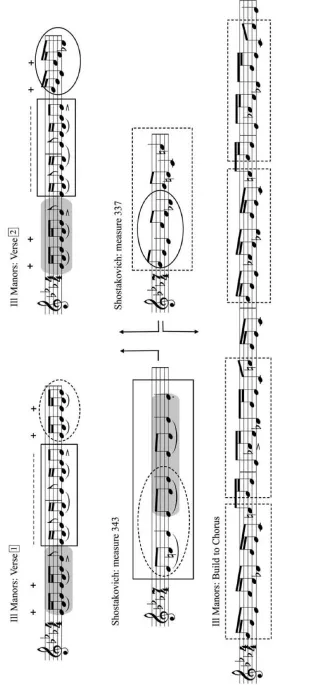
Figure 1.3 shows how the sampled Shostakovich material is applied. Verse 1
and Verse 2 are alternating two measure phrases that form the musical
accompaniment throughout the verses. The immediate challenge is to find a way to fit
Shostakovich’s ‘irregular’ 7/4 patterns into a 4/4 song structure, a process that
inherently generates a sense of internal rhythmic dissonance. Different cells of
sampled material derived from measures 337 and 343 are combined and their
organization emphasizes waves of rhythmic tension and release. There is clear
demarcation of the beat at the beginning and ends of the two bar phrases and
disruptive rhythmic syncopation in the middle. In Figure 1.3 this is represented by
crosses showing strong beat reinforcement and dotted lines indicating rhythmic
dissonance against the beat. The basic musical pattern used throughout the song is,
therefore, inherently unstable and generates a sense of insistent unease. A half-time
drum pattern frames the nervous energy created through the sampled sources.
Furthermore, Plan B’s ‘flow’, or the rhythmic style of rapping, seamlessly shifts
between “speech effusive” and “percussion effusive” styles (Krims 2000: 48–54) with
moments of rhythmic stability contrasted with rapid acceleration. Overall this creates
three multi-faceted, constantly shifting, rhythmic layers between the voice, drums and
instrumental accompaniment.
build to the chorus where it is as if Shostakovich’s 7/4 figures can no longer be
contained within the 4/4 rhythmic structure. At the bottom of Figure 1.3 the sample
construction of the four measures before each chorus are shown. Derived from
repetitions of Shostakovich’s measure 337, the dotted boxes show appearances of the
seven-beat motif that vies for rhythmic dominance against the 4/4 pulse. The song’s
symmetrical drum pattern and the asymmetrical samples trip over each other resulting
Figure
1
. 3: ‘Ill Manors’ Samp
le Construction Derived from Shostakovich Symphony No. 7, Fourth Movement.
If these are minor skirmishes, then the build up to the final chorus results in an
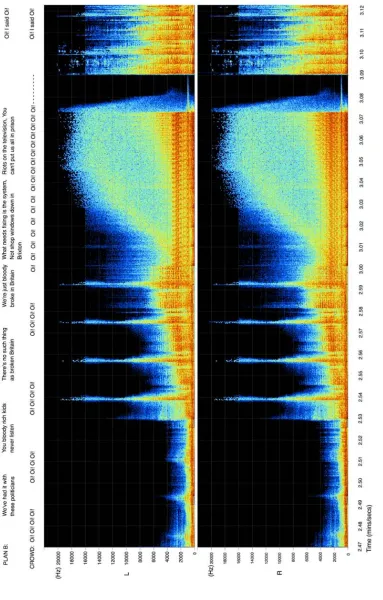
almighty explosion. To demonstrate this we can use a sonogram analysis. This is a
visual representation of the spectrum of frequencies in a sound as they vary over time.
The vertical axis represents frequency (from low to high, 0 to 22000 hz), the
horizontal axis represents time (mins/secs), and a third aspect indicating the amplitude
of frequencies at particular times is represented by the intensity or color of each point
in the image. Fig. 1.4 shows the build up to and the beginning of the final chorus
between 02:47–03:12. Only the instrumental accompaniment is shown in the
sonogram itself, the text of the vocal parts appears above. Initially the mangled sound
groans at the lower end of the spectrum, the first and only time in the track where the
instrumental frequency range is intensely concentrated well below 4000 Hz. Four
heightened snare drum strikes then cut through the texture, leading to an intense
accumulation of sound covering the entire frequency spectrum (20000 Hz is generally
considered the upper range of human hearing). This accumulative spectral tension is
further emphasized by the interplay between Plan B and the crowd. Throughout the
song, both visually and aurally, Plan B has been presented as the leader of the crowd
(see Fig. 1.2). Typically, his solo rapping in the verses is contrasted with the
entry of the group who join him in the choruses. In the last section, this interplay is
further developed with increasingly rapid call and response between the crowd and
the rapper that eventually merges into one collective body before the entire crowd
bellows the final chorus.
There is much to commend in the articulate musical rage of this bold,
politically incisive, protest song. Its bellicose lyrics play with ironic distance and its
agitated, unsettled rhythmic and textural development acts as a visceral representation
of underlying tension that relentlessly and unavoidably leads to rupture.
Fig
ure
1
. 4: Spectrogram Show
ing Build to Final Chorus in ‘Ill Manors’
[image:19.595.100.483.97.697.2]Conclusions
‘Ill Manors’ is a musical and lyrical masterpiece of political communication, but I
have also argued that the song could not act as a mode of political representation in
the climate of impotence and indifference into which it emerged. On April 7 2012 the
song entered the UK singles chart at number six but dropped to number twenty-three
the following week and then rapidly descended out of the top forty. At the time of
writing it’s official music video had the lowest You Tube hit rate of the UK’s top
twenty songs from April 2012; this included two ‘local’ artists Olly Murs and Rizzle
Kicks. By aligning itself with the rioters, the song presented a specific perspective
that was intended to galvanize a marginalized youth and open the eyes of middle
England towards the impact of some of its own prejudices. The song sought to
challenge the notion of the ‘underclass’ which still underpins discourses of
disadvantage and poverty in the UK. Yet, perceptions of Britain's disenfranchised
youth have not changed, there does not appear to be an alternative perspective.
However unreasonable and mistaken the actions of the rioters were, the
mediatization and politicization of the riots further entrenched beliefs in a
maladjusted, defective and broken society that have not been shaken. Perhaps it is
unfair to expect music to bear the responsibility for changing these kinds of attitudes.
Protest songs probably do not have such an overarching degree of influence, but they
are more likely to make an impact when there is an underlying consensus, or when a
song identifies something that has been persistently troubling society. The successful
protest song emerges at the perfect moment and seems to express the core values that
a community had been unable to articulate before it appeared. The identification with
a specific socio-economic group in ‘Ill Manors’ was both necessary and problematic,
communities, but equally problematic because the riots were infinitely more
complicated than a rich-boy-politicians-versus-poor-kids narrative. Even though these
ideas were skillfully placed within an ironic musical context, irony is a very
dangerous weapon when riots seem like a parody of political activism, or when
political responses to the riots seem like a parody of public engagement.
The issues at the heart of ‘Ill Manors’, however, are profound and worthy of
further debate. The sense of social unease that Bauman and others have identified was
both the provocative initial spur and the reason for the ultimate weakness of ‘Ill
Manors’. Bauman argued that the “underclass is not merely an absence of community;
it is the sheer impossibility of community” (2011b: 152). Following the English riots
of 2011, there was no self-conscious community to stand up for. The rioters were not
actively pursuing a progressive political agenda, many were unable to reconcile their
actions. In this sense, both the riots and the musical response expressed “a spirit of
revolt without revolution” (Žižek 2011), an explosion of anger that could only be disappointingly self-defeating.
Postscript
On January 8 2014 the inquest into the death of Mark Duggan reported its findings.
By a majority of eight to two the jury found that Duggan was “lawfully killed by
police”, yet eight members of the jury also stated they were sure that Duggan “did not
have a gun in his hand” when he was shot (http://dugganinquest.independent.gov.uk).
At the time of writing, Mark Duggan’s family are appealing the decision against
Fig. 1. 5. ‘Ill Manors’ Lyrics
Verse
Let’s all go on an urban safari We might see some illegal migrants Oi look there’s a chav
That means council housed and violent He’s got a hoodie on give him a hug
On second thoughts don’t you don’t wanna get mugged
Oh sh*t too late that was kinda dumb Whose idea was that… stupid ***t He’s got some front, ain’t we all Be the joker, play the fool What’s politics, ain’t it all Smoke and mirrors, April fools? All year round, all in all Just another brick in the wall Get away with murder in the schools Use four letter swear words cause we’re cool We’re all drinkers, drug takers
Every single one of us burns the herb
Keep on believing what you read in the papers Council estate kids, scum of the earth
Think you know how life on a council estate is,
From everything you’ve ever read about it or heard
Well it’s all true, so stay where you’re safest There’s no need to step foot out the burbs Truth is here, we’re all disturbed
We cheat and lie its so absurd
Feed the fear that’s what we’ve learned Fuel the fire, let it burn
Chorus
Oi! I said oi!
What you looking at, you little rich boy! We’re poor round here, run home and lock your door
Don’t come round here no more, you could get robbed for
Real (yeah) because my manor’s ill My manor’s ill
For real
(Yeah) you know my manor’s ill, my manor’s ill!
Verse
You could get lost in this concrete jungle New builds keep springing up outta nowhere Take the wrong turn down a one way junction Find yourself in the hood nobody goes there We got an Eco-friendly government, They preserve our natural habitat Built an entire Olympic village
Around where we live without pulling down any flats
Give us free money and we don’t pay any tax
People get stabbed round here, there’s many shanks
Nice knowing someone’s got our backs when we get attacked
Don’t bloody give me that I’ll lose my temper
Who closed down the community centre? I kill time there used to be a member What will I do now until September?
School’s out, rules out, get your bloody tools out
London’s burning, I predict a riot Fall in fall out
Who knows what it’s all about
What did that chief say? Something ‘bout the kaisers
Kids on the street no they never miss a beat, never miss a cheap
Thrill when it comes their way Let’s go looting
No not Luton
The high street’s closer, cover your face And if we see any rich kids on the way We’ll make ‘em wish they stayed inside Here’s a charge for congestion, everybody’s gotta pay
Do what Boris does, rob them blind
Chorus
Transition
We’ve had it with these politicians You bloody rich kids never listen There’s no such thing as broken Britain We’re just bloody broke in Britain What needs fixing is the system Not shop windows down in Brixton Riots on the television
You can’t put us all in prison!
References
Angel, H. (2012) “Viewpoint: were the Riots Political,” Safer Communities, Special Edition on The Riots, 11 (1), 24–32.
Baker, S. (2012) “From the Criminal Crowd to the ‘Mediated Crowd’: The Impact of Social Media on the 2011 English Riots,” Safer Communities, Special Edition on The Riots, 11 (1), 40–49.
Bauman, Z. (2007) Consuming Life. Cambridge: Polity.
________. (2011a) “The London Riots – On Consumerism coming Home to Roost” 9th August 2011
http://www.social-europe.eu/2011/08/the-london-riots-on-consumerism-coming-home-to-roost/ [accessed 22nd November 2013]
________. (2011b) Collateral Damage: Social Inequalities in a Global Age, Cambridge: Polity Press.]
Briggs, D., ed. (2012a) The English Riots of 2011: A Summer of Discontent, Hook; Hampshire: Waterside Press.
Briggs, D. (2012b) “What We Did When it Happened: A Timeline Analysis of the Social Disorder in London,” Safer Communities, 11 (1), 6–16.
Cameron, D. (2011a) ‘Statement on the Riots’ 9th August 2011,
http://www.youtube.com/watch?v=UohyrhMKou0 [accessed 22nd November 2013] ________. (2011b) 15th August.
http://www.number10.gov.uk/news/pms-speech-on-the-fightback-after-the-riots/ [accessed 24th November 2013]
Carter, H. (2011) “Rioter profile: ‘Looting was nothing personal. It’s just business’”
The Guardian, 5th December,
http://www.theguardian.com/uk/2011/dec/05/english-rioter-profile-just-business [accessed 22nd November 2013]
Clarke, K. (2011) ‘Punish the feral rioters, but address our social deficit too,’ The Guardian, 5th September,
http://www.theguardian.com/commentisfree/2011/sep/05/punishment-rioters-help [accessed 21st November 2013]
Denisoff, R. S. (1983) Sing a Song of Social Significance, Bowling Green, Ohio: Bowling Green State University Popular Press.
Economist (Anonymous) “Technology and Disorder: The Blackberry Riots,” The Economist, 13–19 August, 22.
Fay, L. (2000) Shostakovich: A Life, Oxford: Oxford University Press
.
Fay, L., ed. (2004) Shostakovich and His World, Princeton: Princeton University Press.
Gibbs, C. H. (2004) “The Phenomenon of the Seventh: A Documentary Essay on Shostakovich’s ‘War’ Symphony,” in Laurel E. Fay, ed. Shostakovich and His World, Princeton, NJ; Princeton University Press, 59–113.
Gifford, T. (1986) The Broadwater Farm Enquiry: Report of the Independent Inquiry into disturbances of October 1985 at the Broadwater Farm Estate, Tottenham, London: Karia.
Gorringe, H. & M. Rosie (2011) “King Mob: Perceptions, Prescriptions and Presumptions About the Policing of England’s Riots,” Sociological Research Online, Vol. 16 (4).
Grover, C. (2011) “Social Protest in 2011: Material and Cultural Aspects of
Jones, O. (2012) Chavs: The Demonization of the Working Class, London: Verso. Krims, A. (2000) Rap Music and the Poetics of Identity, Cambridge: Cambridge
University Press.
Lynskey, D. (2012) “Why Plan B's Ill Manors is the greatest British protest song in years,” The Guardian, Music, 15th March,
http://www.theguardian.com/music/musicblog/2012/mar/15/plan-b-ill-manors [accessed 22nd November 2013]
Miliband, E. (2011) ‘Speech on the Riots” Haverstock School, 15th August. http://www.newstatesman.com/politics/2011/08/society-young-heard-riots
[accessed 25th November 2013]
Mooney, G. & S. Neal (2009/10) “‘Welfare worries’: mapping the directions of welfare futures in the contemporary UK,” Research, Policy and Planning, 27 (3), 141–150.
Moore, A. (2013) “Conclusion: A Hermeneutics of Protest Music” in J. C. Friedman, ed. The Routledge History of Social Protest in Popular Music, New York: Routledge, 387–399.
Moxon, D. (2011) “Consumer Culture and the 2011 Riots,” Sociological Research Online,16 (4) 19.
Peddie, I. ed. The Resisting Music: Popular Music and Social Protest. Aldershot: Ashgate, 2006.
Plan B (2012) “Statement on Ill Manors” http://www.time4planb.co.uk/news/statement-on-ill-manors [accessed 26th November 2013]
Prassad, R. (2011a) “Rioter profile: ‘I saw an opportunity to take stuff, so I entered the shop,’” The Guardian, 5th December,
http://www.theguardian.com/uk/2011/dec/05/rioter-profile-opportunity-take-stuff [accessed 22nd November 2013]
Prassad, R. (2011b) “Rioter profile: ‘I don’t condone it, but it’s helped me out financially,’” The Guardian, 7th December,
http://www.theguardian.com/uk/2011/dec/07/rioter-profile-condone-helped-financially [accessed 22nd November 2013]
Rusbridger, A. & J. Rees, eds. (2011) Reading the Riots: Investigating England’s Summer of Disorder. The Guardian and the London School of Economic and Political Science. http://www.theguardian.com/uk/series/reading-the-riots [accessed 22nd November 2013]
Singh D. (2012) After the Riots, London: The Riots Communities and Victims Panel. http://webarchive.nationalarchives.gov.uk/20121003195935/http:/riotspanel.indepe ndent.gov.uk/wp-content/uploads/2012/03/Riots-Panel-Final-Report1.pdf
[accessed 22nd November 2013]
Street, J. (2012) Music and Politics, Cambridge: Polity Press.
Toynbee, P. (2011) “Chav: the vile word at the heart of fractured Britain,” The Guardian, Tuesday 31st May,
http://www.theguardian.com/commentisfree/2011/may/31/chav-vile-word-fractured-britain [accessed 29 November 2013]
Varul, M. Z. (2011) “Veblen in the (Inner) City: On the Normality of Looting,”
Sociological Research Online, 16 (4) 22.
Žižek, S. (1999) The Ticklish Subject: The Absent Centre of Political Ontology, London: Verso.
Žižek, S. (2008) Violence. London: Profile Books.