The gut in the beaker: missing the surfactants?
Clive G Wilson
1*, Gavin W. Halbert
1, Jenifer Mains
2.
1.
Strathclyde Institute of Pharmacy and Biomedical Sciences, University of Strathclyde,
Glasgow G4 0RE, Scotland, U.K.
2.
EnCap drug delivery, Livingston EH53 0TH, Scotland, U.K.
In this review, we attempt to distill our thoughts regarding the study of the interaction of
luminal fluids with the drug-matrix interface, a subject close to Sandy’s long-term research
interests enveloping excipients, lipids, drug absorption mechanisms and innovative
formulation approaches. The interests of our panel of writers, stimulated by some of
Professor Florence’s earlier work, has prompted us to review how much of the absorption
process can be understood in terms of simple physicochemical mechanisms, processes that
will allow us to examine the idiosyncrasies of compounds and formulations in complex
matrices, representing food and the changing states of secretions. This paper is our
contribution to the special edition of the International Journal of Pharmaceutics in honour of
Professor Alexander Florence, a friend and a mentor for many years.
The rate of appearance and, in some cases, the total quantity of an active pharmaceutical
ingredient found in the systemic blood after oral administration is related to the ability to
form a solution of the drug in the contents of the gastrointestinal lumen (Nelson, 1957).
Although the physicochemical properties and basic aqueous solubility of the drug are key
drivers in this process, it has been appreciated for some time that simple in vitro aqueous
solubility is a poor predictor of in vivo gut solubility (Dressman et al., 2007). The
biopharmaceutical importance of this discrepancy increases inversely in relation to the
dose/solubility ratio of the API, as expressed in the Developability Classification System
(Butler & Dressman 2010). Achieving solubility in poorly mixed gut luminal fluids is a
complex phenomenon but two features are important: the drug’s physicochemical properties
and the influence of both natural and excipient based surfactants in sustaining solubility of
the API as the luminal composition changes. Professor Florence has contributed to the study
of these aspects and ongoing research has attempted to fill in some of the gaps in our
luminal fluids is complicated because fluids vary in composition between individuals,
influenced by diet, drug exposure and disease. The impact in some cases will be minor
whereas for some chemical classes they will be significant. Moreover, the fluids are complex
media that alter as they travel down the gut and different structures form. This is especially
true for the fed state where additionally, mechanical forces are applied to the food matrix to
aid dispersion and increase surface area for enzymatic action. Oral formulations are
subjected to altered (increased) mechanical forces when taken with food and therefore such
conditions need to be simulated in laboratory-based tests.
transporter mechanisms became evident to reduce exposure and detoxifying enzymes
inducible to aid excretion of the xenobiotics.
It can be immediately appreciated that the gut is actively monitoring the composition of
ingested material. Drugs have almost no nutritional value and mechanisms that help us to
protect ourselves from poisons come into play: specifically taste and the vomiting reflex have
to be intentionally bypassed by disguise of the API in a formulation. That work then has to be
undone further down the gut to achieve the anticipated drug concentration -time exposure.
The analytical task we face is how to make continuous measurements in a murky
media, whose composition changes along the gastrointestinal tract (Dressman et al.,
2007). Within the darkness of the gut, phenomena such as disintegration,
super-saturation, precipitation and dissolution are occurring in unidentified segments. The
impact of variability is to necessitate the performance of expensive clinical trials and
to slow medicine development, a situation that should be avoided if necessary. The
simulated biological fluids that are used in pharmaceutical sciences are evolving
recipes and for some media, considerable differences exist as exemplified by the
formulae, as reviewed by Marques and colleagues. For example, simulated saliva,
which in five recipes, differs in electrolyte composition and the presence or absence
of mucin (Marques et al., 2011). The importance of mucin is more apparent in
considering a food matrix rather than medications, since salivary mucin induces
flocculation of some emulsions, probably changing sensory perception
(Vingerhoeds
et al., 2005). It is however essential to assist the normal swallowing reflex.
Tasting and judging whether you can swallow a medicine.
medications is a commonly reported problem but although
phagophobia
, a perceived
risk of choking in the absence of a physiological explanation is rare in patients, it has
been reported in HIV sufferers who have a high oral dose burden (Duggan et al.,
2014). Saliva needs to be present as a lubricant and pools in the mouth below the
tongue and on the cheek- gum boundary. The dosage form is usually moistened by
the action of the tongue pressing the dosage form against the palate and then moving
it backwards, contained in a depression formed in the tongue. Food is usually chewed
and moistened with saliva to form a bolus for swallowing and if the tongue senses the
food is too dry; the swallow will be aborted. The wetted bolus is presented to the
back of the mouth, stimulating the palatal receptors and touch receptors of the
pharynx
(Gleeson, 1999). Pharyngeal peristalsis imparts a forward velocity of a
swallowed bolus >0.3m/s as measured by video fluoroscopy. In patients with
dysphagia, increasing the viscosity of the bolus to ‘pudding consistency’ ( 3682 mPa.s)
was associated with more efficient swallowing
(Clavé et al., 2008). Surprisingly, thin
liquids present special problems for patients with neurological disease. For solid
formulations that will be swallowed, still more decisions based on shape factors and
surface feel become at issue.
As yet, our success in replicating mouth sensations is limited. Taste perception is
modulated by various factors including aging, gender, ethnicity, cigarette smoking,
olfactory stimuli [as well as the temporary loss of smell sense during a cold], time of
day and even psychological processes.
As we get older, we lose the ability to detect
salty and bitter substances whereas the thresholds for sour or sweet stimuli appear to
be unchanged up to the age of 90 (Mojet et al., 2001)
.Swallowing medicines
At the present time, we do not have i
n vitro
systems for testing the ability to swallow a
formulation. Professor Florence was interested in the phenomenon of tablet adhesion,
especially precipitated by concerns relating to early osmotic tablet formulations. Swisher and
colleagues at ALZA described a method of evaluating adhesion of tablets and capsules to the
isolated dog and pig oesophagus and ranked the forces of adherence for different
Strathclyde University to examine tissue adhesion of tablets and hard-shell capsules showing
that film coated tablets had low adhesion (Al-Dujaili
, 1986). These data are generally
supported by
in-vivo
measurements in man using gamma scintigraphy. As we age, there is a
noticeable decrease in the efficiency of muscular coordination, coupled with muscle
weakness tendon stiffness and a loss of motor control. Significantly, impaired transit in the
elderly can be readily demonstrated scintigraphically which is of particular relevance for
formulations containing irritant drugs (Perkins et al. 1994;
ibid
2001). Dr. Stegeman has
made an extensive study of the problems in this age group with regard to swallowing
medicines and has proposed that attention to appropriate dosage forms for the elderly will
have to be provided in the future (Stegeman, 2010).
The stomach
Functionally the stomach divides into two chambers on eating, the upper part (the fundus)
relaxing to accommodate the food. In the body, propagating muscular contractions
becoming stronger below the midline of the stomach cause contractions against a partially
closed pyloric sphincter, sieving solids and liquids. Acid is formed by secretion aided by the
increased hormonally driven blood flow. The duodenum plays a role as a sensor and by
modulating the wall pressure difference between the duodenum and the pylorus, the
dispersed material enters as an approximately isocaloric load.
After a meal, the matrix distributed in the stomach is non-uniform, with channels of
liquid travelling around consolidating food masses, which are stacked from the greater
curvature and as food is digested, small particles empty with the liquid phase. It has
been generally accepted that preparations that dissolve or form particles of less than 2
mm in diameter pass through the stomach in a similar fashion to liquids and are less
likely to be influenced by gastroparesis (Pohle & Domschke 2003). Particles can
empty as boluses, mix in with the food, or partially stratify according to when during
the meal the formulations are consumed (O’Reilly et al., 1987).
Finholt & Solvang, who described the role of surface tension on dissolution kinetics of
phenacetin and phenobarbitone in polysorbate-hydrochloric acid media (Finholt & Solvang,
1968). At the same time as John Fell’s work in Manchester, Efentakis and Dressman were
rediscovering some of the data known to gastroenterologists and applying it to
biopharmaceutical purposes. They reported that aspirated gastric samples had a pH between
1 and 2 with a measured surface tension of between 35 and 45 mM/m (Efentakis and
Dressman, 1998).
For a drug formulation, the key factors are a dynamic change in the media reflecting the
balance of dilution, secretions and buffering by the food (especially protein) and the erosive
forces which are applied during trituration of intact objects by contractions in the distal
stomach. These conditions are not mimicked in any compendial apparatus and in order to
get a more realistic simulation of the conditions in the human stomach in a physical
simulator, there must be attention to the nature of the gut fluids, the volume changes, the pH
gradient occurring in the stomach and the periodic forces applied to the formulation. During
emptying, the stomach changes shape although this factor is rarely considered; it is however
of importance for floating dosage forms.
with regard to turbidity and media which have high optical absorbance. In spite of these
reservations, a prediction based on performance in such apparatus is generally superior to
that seen in compendial apparatus based on acids and buffers.
Parts or all of an oral formulation must dissolve in the gastrointestinal contents and the active
pharmaceutical ingredient pass from lumen to the absorbing surface. Drugs are not absorbed
to any great extent in the stomach and therefore the rate of entry into the duodenum controls
the onset of action of immediate release, well-absorbed drugs. As a consequence, there is
little need for extensive
in vitro
examination and simple measures such as disintegration time
may be sufficient to characterise the API release from the dosage form in a conventional
dissolution apparatus. In contrast, sustained-release formulations may encounter situations
which cause altered release; for example, those formulations which are sensitive to alcohol.
Here, the physical presentation of the dose form may be responsible for important differences
in robustness. As an example, physical compression of the dosage form occurs in the distal
stomach, which may be sufficient to cause structural weaknesses in an intact formulation
exposed to ethanol – containing media.
In most cases, the interest centres on the processes during the transfer of the formulation from
stomach to intestine. Changes in solubility stimulated by pH may cause precipitation; if this
is avoided by supersaturation i.e. in the presence of an excipient, then careful examination of
the process to maximise passive Fickian drive maybe justified. Such a process does lend
itself to advanced physicochemical investigation to dissect specific API – excipient
interactions.
Small Intestine
In the intestine, the glandular secretory epithelium of the stomach abruptly alters to an
absorptive epithelial lining with deep folds and villi. Neutralisation of gastric acid occurs in
the shortest section of the intestine and transit through the duodenal region is quick –
typically less than five minutes. In fasted conditions, formulations are moved through the
intestinal by waves of contraction originating from the fundal region, propagated through to
the terminal ileum. In clinical trials where the volunteer remains fasted, stasis of the
physiological changes including increased splanchnic blood flow to the upper GI regions, fat
intake release of bile and changes in the intestinal motility to generate more segmenting
movements. Dietary fat is an essential substrate in a variety of functions including energy
supply and vitamin absorption. During this time there will be movement of water across the
gut wall as food is broken down to small more osmotically active fragments causing
secretion and small nutrient absorption occurs with water drag of the solutes.
For dissolution and disintegration processes, the aspects regarding absorption,
transporters and efflux are not important although there have been attempts to
combine models which utilise all the information. Generally, suitable cell lines are
used to characterise apical and basal transfer of API from and into the lumen. In silico
models are then constructed which utilise all of the information available in order to
make predictive simulations. Improvement of biorelevant dissolution fluids and
apparatus, which sequentially exposes the drug to differences in luminal composition,
suffice to examine rates of dissolution of a particular drug. Thus, for conventional
drugs which follow solute-dominated pathways and partition across membranes, the
perspective for optimized in vitro approaches is high. This is the objective of the Oral
biopharmaceutics tools Initiative, a collaborative venture between industry and
academia to develop new instrumentation and computer models, attempting to fill
knowledge gaps relating to oral drug delivery (Lenner
näs et al, 2014)
. Recent
research in the OrBiTo program has attempted to more closely define the composition
of fluids in the distal gut in order to be able to improve biorelevance.
Solubility, Dissolution, Surfactants and Gut contents
as the medium responsible for increasing the solubility of drugs and other water
insoluble substances in gastrointestinal fluid by generation of micellar solutions
(Borgstrom, 1962). The micellar assembly of surfactants, the thermodynamic driving
forces for this and the ability of these systems to solubilise drugs and impact on
formulation problems has been a constant theme of Professor Florence’s research
(Elworthy & Florence 1963, Elworthy, Florence & Macfarlane 1968, Attwood &
Florence 1983). Even in these early publications, it was recognized that, “the use of
solubilizers in pharmacy to increase the solubility of sparingly soluble drugs has wide
implications, and it is important that these are understood”, a task that continues
today ( Khadra et al., 2014, Fuchs et al., 2015).
Endogenous Surfactants in the Gut
The impact of bile salts on drug solubility in the gut was an early area of
biopharmaceutical research with studies indicating that dissolution of poorly soluble
drugs was enhanced in the presence of bile salts (Bates et al., 1966a), a result of such
importance that it warranted publication in a high impact journal! Studies also
indicated that solubilisation capacity was bile salt concentration dependent and
influenced by the bile salt employed. Additionally, digestion products for example
phospholipids and fatty acids impact on gut solubility and therefore the bioavailability
of poorly soluble drugs (Charman et al., 1993).
Interest in the role of the gut microbiome in health and disease has revealed
significant signaling effects of bile acids on the composition of the colon microbiota,
in addition to direct effects on the membrane G-protein coupled receptors which
regulate several host pathways (
Wahlström et al., 2016)
. Short term changes in diet,
e.g. to entirely animal or vegetarian sources overwhelms the balance of the
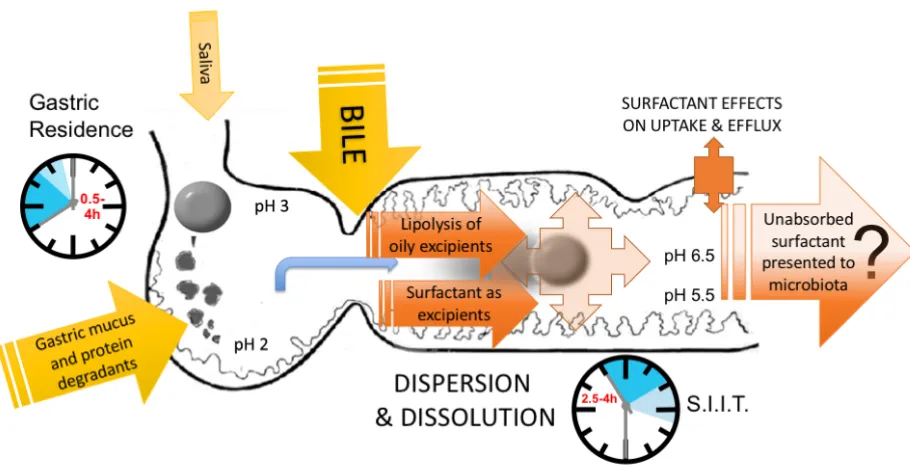
Figure 1 near here.
Surfactants in Dissolution
In 1897 Noyes and Whitney published the first analysis of the dissolution of sparingly
soluble compounds and introduced a mathematical analysis demonstrated that the
rate of solution of a solid in a bulk dissolution medium was dependent upon the
compound’s saturation solubility (Noyes & Whitney,1897). In the 1950’s and 1960’s,
the biopharmaceutical implication of this relationship with respect to the oral
administration of drugs was recognized along with examples of differences in
bioavailability due to formulation or batch-to-batch variations in performance. In the
1970’s the first pharmacopoeial dissolution tests were introduced in recognition of the
importance of this property and in an attempt to apply quality control procedures to
oral dosage form performance. In 1995 Amidon introduced the Biopharmaceutical
Classification System categorising drugs based on their aqueous solubility and
intestinal permeability. Compounds with a low aqueous solubility present the greatest
formulation and biopharmaceutical challenge in vivo, and in vitro during dissolution
testing. For low solubility compounds, the in vitro dissolution required the
development of media with increased solubility either through the use of solutions of
single synthetic surfactants or simulated intestinal media (Dressman et al., 1998). The
former is simple and illustrate that increased solubility through non-ionic surfactants
such as polysorbate 80 increases dissolution, although the surfactant will also affect
surface wetting (Mysels & Florence 1970). Biorelevant media which mimic the
natural surfactants and conditions present in the gut are complex mixtures
In-vitro
characterisation of lipid-based formulations (LBFs) presents significant
challenges and a simple phosphate buffer dissolution experiment is often not
representative of the complex environment of the small intestine. In response to lipid
ingestion, secretions of pancreatin and bile salts from pancreas and gall bladder
respectively work to digest the lipids, creating a digestion product composed of mixed
micelles and bile salt complexes. These mixed micelles act to preserve the drug
molecule in the solubilised state and can carry the drug to the site of absorption in the
small intestine. For this reason, the representation of the gut in the beaker, particularly
the small intestine, requires a more complex media and enzymatic reactions are
required to be taken into account particularly for lipid-based formulations.
Representative
in-vivo
characterisation is by no means novel and historically has been
investigated by a number of groups, with a common goal of achieving a global
in-vitro
model, which is predictive of
in-vivo
digestion and absorption. Typically, LBFs are
assessed in-vitro through dispersion and digestion tests, to investigate emulsification
behaviour and solution stability. Initially, dispersion testing is performed in order to
understand the stability of LBFs on dilution and likelihood of the API to precipitate
from the emulsion. Digestion testing is then used in an attempt to understand the
behaviour of the API within the formulation during digestion in the intestine. Early
investigational work concerning digestion dates back to the 1980’s, where data from
in-vitro lipolysis of medium chain triglycerides (MCT) and long chain triglycerides
(LCT) were reported (Reymond & Sucker, 1988). Further models were then developed
which described the solubilisation of poorly water-soluble substances during digestion
in lipid-based formulations (Christensen et al 2004, Porter et al 2004, Cuine et al.,
2008, Sassene et al 2010, Larsen et al.,2011). More recently, the desire within the
scientific community to develop standardised
in-vitro
methods for characterisation
and assessment of LBFs, led to the formation of the Lipid Formulation Classification
System Consortium (LFCS Consortium). The LFCS Consortium has combined
Table 1 near here…
The concentration of bile salt and drug loading has been investigated with respect to
the generation and sustainment of supersaturation of a model poorly soluble API,
danazol (Williams et al., 2012b). Bile salt concentration was found to influence the
in-vitro digestion of type I and II LBFs; however, the impact of concentration on type
III LBF’s was not marked due to speed of digestion. In addition, danazol solubilisation
within the digested aqueous phase increased with increasing bile salt concentration,
up to a concentration of 3mM. The potential for danazol to be maintained as a
supersaturated solution within digested formulations, without precipitation, was also
characterised. These initial findings were expanded incorporating alternative model
APIs fenofibrate and tolfenamic acid (Williams et al., 2013), to help confirm the
proposal that the maximum drug supersaturation ratio (SR
M) can help define the
limitations of supersaturation in in-vitro digested LBFs. The SR
Mis determined from
the ratio of maximum theoretical API concentration in the aqueous phase following
LBF digestion to maximum API solubility within the digested aqueous phase. It has
been suggested by the LFCS Consortium that in order to maintain supersaturation and
to limit precipitation, when defining maximum API loading within LBFs the calculated
SR
Mshould not exceed 3. In the final part of the series, more challenging conditions
for the digestion test were proposed in an attempt to further understand the impact on
maintenance of supersaturation and provide discriminatory tests between formulations
behaving similarly with standard digestion testing (Williams et al., 2014,
Bakala-N’Goma et al., 2015). Following this extensive development, the methods refined by
the LFCS Consortium have been used routinely in both academia and industry.
Surfactants incorporated into the Formulation
The application of surfactants for the solubilisation of materials can be traced back to
the 1890’s with studies on bile salts and soaps but it was not until the 1930’s that
these observations were related to the thermodynamically formed colloidal micellar
phase. The study of surface tension lowering excipients in pharmaceutical systems
started with poorly soluble steroid hormones (Ekwall & Sjoblom, 1949) but as
reviewed by Elworthy, Florence and Mcfarlane in 1968 and again in 1983 (Attwood
and Florence) rapidly expanded to cover multiple drugs, dosage routes and
solubilisation systems. Initial application in medicines development was limited by
the systemic toxicity of the ionic surfactant systems available and it was only on the
development of the less toxic non-ionic surfactants that wider pharmaceutical
application of solubilized formulations was possible. The physicochemical
characterisation of non-ionic surfactants is a research area that was initiated by Sandy
and has been a continual focus of his career. The solubilisation and formulation of
poorly drugs in surfactant systems was reviewed by Professor Florence in 1981 and
this work providing more detail on the influence of the hydrocarbon portion of
non-ionic surfactants on solubilisation (Florence 1981a). Since that initial review, the
number of surfactants available and systems studied has expanded considerably and
along with “simple” micellar solubilisation, polymeric micelles and lipid based drug
delivery systems (LBDDS) have been developed (Cannon & Long 2008). Several
marketed products incorporate this approach; for example, cyclosporine formulations
utilize either corn or olive oil with mixtures of various non-ionic surfactants.
Polymeric micelles formed using block co-polymers have mainly been applied to
parenteral systems and can be employed for controlled release (Law, Florence &
Whateley 1986). The chemical variability associated with surfactants and the
development of chemical coupling systems permits the generation of new
supramolecular surfactant-polymer systems
. (Al-Jamal, Sakthivel& Florence, 2005).
It is not yet known if these systems will find utility in marketed oral dose products.
Surfactants, enhanced absorption and toxicity
previously reported in the literature (
van Hoogdalem, de Boer & Breimer 1989).
This property is most obvious with drugs which would normally have low or
negligible bioavailability when administered orally, for example the oral absorption of
methotrexate can be increased by co-administration with polysorbate 80
(Azmin et al
1982).
There is however no molecular specificity in this effect and the absorption of
poisons is equally promoted to that of the drug
(Walters, Dugard, & Florence
1981)
. The magnitude of this effect is surfactant concentration-dependent and is
linked to the presence of surfactant monomers in solution, leading to activity below
the critical micelle concentration (CMC). Above the CMC, solubilisation into the
micelle reduces the effect (Florence 1981b) whilst the free monomer concentration is
constant. The effect is due to an interaction of the free surfactant monomers with the
gut wall epithelial lining. As discussed previously, the membrane is a complex
structure consisting of multiple lipid components and proteins. Penetration of the
hydrophobic portion into the outer surface of the bilayer disturbs function, increasing
absorption. This effect can be applied in multiple drug delivery problems to enhance
absorption or tissue penetration (Kerr et al., 1987). However, the negative effect of
this interaction is the potential toxicity to the normal physiological function of the
membrane (Baillie et al., 1989), which will have to be balanced against increased
bioavailability. Additionally, since the surfactants are not selective, the “reduction” of
barrier function will not be specific and may also increase the availability of
potentially toxic agents from the gut
(Al-Jamal, Sakthivel & Florence, 2005).
Surfactants: the future
Since the early studies on the influence of surfactants, including natural or synthetic
substances, the knowledge base concerning the absorption of poorly soluble drugs
from the gut has expanded considerably. Professor Florence’s multiple and varied
contributions to this field have provided important foundations.
2014) and in vivo studies expose the boundaries of current knowledge with respect to
the composition of gut fluids (Riethorst et al., 2016) and reveal the impact this might
have on solubilisation and absorption.
The availability and use of the non-ionic surfactants, as formulation excipients for
drug delivery by all routes has expanded massively in the half-century since Professor
Florence published his first manuscript in the field. The use of surfactants in oral
formulations either alone, in combination or with lipid-based excipients is now
established with multiple marketed formulations for poorly soluble drugs based on
these systems. Current research is focused on expanding this armamentarium with
more novel combinations of hydrophilic entities with the almost standard
hydrophobic long chain fatty acids.
References
Al-Dujaili, H., Florence, A. T., Salole, E. G., 1986. The adhesiveness of proprietary tablets
and capsules to porcine oesophageal tissue. Int. J. Pharm. 34, 75-79.
Al-Jamal, K. T., Sakthivel, T., Florence, A. T., 2005. Solubilisation and transformation of
amphipathic lipidic dendron vesicles (dendrisomes) into mixed micelles. Colloids and
Surfaces A: Physicochemical and Engineering Aspects, 268, 52-59.
Attwood, D.,Florence,A.T., 1983. Surfactant Systems: Their Chemistry, Pharmacy and
Biology, Chapman and Hall Ltd, London, 1983.
Azmin, M. N., Stuart, J. F., Calman, K. C. et al.,1982. Effects of polysorbate 80 on the
absorption and distribution of oral methotrexate (MTX) in mice. Cancer chemotherapy and
pharmacology, 9, 161-164.
Baillie, A. J., Al-Assadi, H., Florence, A. T.,1989. Influence of non-ionic surfactant structure
on motility inhibition of Tetrahymena elliotti: a model for surfactant-membrane interactions.
Int. J. Pharm. 53, 241-248.
Bakala-N’Goma, J. C., Williams, H. D., Sassene, P. J., et al., 2015. Toward the establishment
of standardized in vitro tests for lipid-based formulations. 5. Lipolysis of representative
formulations by gastric lipase. Pharm. Res.32, 1279-1287.
Bates, T. R., Gibaldi, M., Kanig, J. L., 1966a. Solubilizing properties of bile salt solutions I:
Effect of temperature and bile salt concentration on solubilization of glutethimide,
griseofulvin, and hexestrol. J. Pharm. Sci. , 55, 191-199.
Bates, T. R., Gibaldi, M., & Kanig, J. L., 1966b. Solubilizing properties of bile salt solutions I:
Effect of temperature and bile salt concentration on solubilization of glutethimide,
Bergström, C. A., Holm, R., Jørgensen, S. A.,et al., 2014. Early pharmaceutical profiling to
predict oral drug absorption: current status and unmet needs. Eur. J. Pharm. Sci., 57,
173-199.
Borgstrom, B. (1962). Digestion and absorption of fat. Gastroenterology, 43, 216-219.
Butler, J.M., Dressman, J.B. 2010. The Developability Classification System: Application of
Biopharmaceutics Concepts to Formulation Development. J. Pharm. Sci., 99, 4940-4954
Cannon, J.B., Long, M.A. 2008. Emulsions, Microemulsions, and Lipid-Nased Drug Delivery
Systems for Drug Solubilization and Delivery - Part II Oral Applications, in: R. Liu (Ed.) Water
Insoluble Drug Formulation, CRC Press, Boca Raton, 2008, pp. 227-254.
Charman, W. N., Rogge, M. C., Boddy, A. W.,et al.,1993. Effect of food and a
monoglyceride emulsion formulation on danazol bioavailability. J.Clin. Pharmacol. 33,
381-386.
Christensen, J. Ø., Schultz, K., Mollgaard, B., et al., 2004. Solubilisation of poorly
water-soluble drugs during in vitro lipolysis of medium-and long-chain triacylglycerols. Eur. J.
Pharm. Sci. 23, 287-296.
Clavé, P., Arreola, V., Romea, M.,et al., 2008. Accuracy of the volume-viscosity swallow test
for clinical screening of oropharyngeal dysphagia and aspiration. Clin. Nutr. 27, 806-815.
Cuine, J. F., McEvoy, C. L., Charman, W. N.et al., 2008. Evaluation of the impact of
surfactant digestion on the bioavailability of danazol after oral administration of lipidic self
-‐
emulsifying formulations to dogs. J. Pharm. Sci. 97(2), 995-1012.
Dressman, J. B., Amidon, G. L., Reppas, C., et al.,1998. Dissolution testing as a prognostic
tool for oral drug absorption: immediate release dosage forms. Pharm. Res. 15, 11-22.
Dressman, J.B., Vertzoni, M., Goumas,K., et al., 2007. Estimating drug solubility in the
gastrointestinal tract, Adv. Drug Deliv. Rev. 59,591-602.
Duggan, J. M., Shukla, V., Akpanudo, B., et al., 2014. Doc, I Just Can’t Swallow Pills”: HIV
Infected Patients and Pill Phagophobia. J. AIDS Clin Res. 5:348 doi:
10.4172/2155-6113.1000348
Efentakis, M., Dressman, J.B., 1988. Gastric juice as a dissolution medium: surface tension
and pH. Eur. J. Drug Met. Pharmacokin. 23, 97-102.
Ekwall, P., Sjoblom, L., 1949. On the solubilization of steroid hormones by association
colloids. Acta Chemica Scand. 3, 1179-1180.
Elworthy, P.H., Florence,A.T., 1963. Thermodynamics of micelle formation of non-ionic
detergents, J.Pharm. Pharmacol. 15, 851-852.
Elworthy, P.H., Florence, A.T., Macfarlane, C.B. 1968 Solubilization by surface active agents
and its applications in chemistry and the biological sciences., Chapman and Hall, London,
1968.
Fell, J. T., Mohammad, H.A.H., 1995. The wetting of powders by bile salt solutions and
gastric juice. Int. J. Pharm. 125, 327-330.
Finholt, P.,Solvang, S., 1968. Dissolution kinetics of drugs in human gastric juice—the role
of surface tension. J. Pharm. Sci. 57, 1322-1326.
Florence, A.T.,1968. Surface chemical and micellar properties of drugs in solution. Adv.
Colloid Interface Sci., 2, 117-149.
Florence, A.T.,1981a. Drug solubilisation in surfactant systems., in: S. Yalkowsky (Ed.)
Techniques of solubilisation of drugs, Marcel Dekker, New York, 1981.
Florence, A. T.,1981b. Surfactant interactions with biomembranes and drug absorption. Pure
and Applied Chemistry, 53(11), 2057-2068.
Fuchs, A., Leigh, M., Kloefer, B., et al., 2015. Advances in the design of fasted state
simulating intestinal fluids: FaSSIF-V3. Eur. J. Pharm. Biopharm. 94, 229-240.
Garbacz G., Wedermeyer R.S., Stefan N et al., 2008. Irregular absorption profiles observed
from diclofenac extended release tablets can be predicted using a dissolution apparatus that
mimics in vivo stresses. Eur. J. Pharm. Biopharm. 70: 421-428.
Gleeson, D. C., 1999. Oropharyngeal swallowing and aging: a review. J. Communication
Disorders, 32,373-396.
Kerr, D. J., Wheldon, T. E., Russell, J. G., et al., 1987. The effect of the non-ionic surfactant
brij 30 on the cytotoxicity of adriamycin in monolayer, spheroid and clonogenic culture
systems.Eur. J. Cancer. Clin. Oncol. 23, 1315-1322.
Khadra I., Zhou Z., Dunn C.,et al., 2014.
Statistical investigation of simulated intestinal
fluid composition on the equilibrium solubility of biopharmaceutics classification
system class II drugs . Eur. J. Pharm. Sci., 67, 65-75.
Larsen, A. T., Sassene, P., Müllertz, A. 201). In vitro lipolysis models as a tool for the
Law, T. K., Florence, A. T., Whateley, T. L., 1986. Some chemically modified poloxamer
hydrogels: controlled release of prostaglandin-E 2 and testosterone. Int. J. Pharm., 33, 65-69.
Lennernäs H., Aarons, L., Augustijns, P. et al., 2014. Oral biopharmaceutics tools- Time for a
new initiative – an introduction to the IMIM project. Eur. J. Pharm. Sci., 57, 292-299.
Marques, M.R.C., Loebenberg,R. , Almukainzi, M. 2011. Simulated biological fluids with
possible application in dissolution testing.
Dissolution Technol
18, 15-28.
Mojet, J., Christ-Hazelhof, E., Heidema, J., 2001. Taste perception with age: generic or
specific losses in threshold sensitivity to the five basic tastes?. Chemical Senses, 26, 845-860.
Mysels, K. J., Florence, A. T. 1970. Clean Surfaces: Their Preparation and Characterization
for Interfacial Studies in ’Techniques and criteria in the purification of aqueous surfaces’
Goldfinger E. (Ed) Marcel Dekker, New York, pp 227-268.
Nelson, E.,1957. Solution rate of theophylline salts and effects from oral administration. J.
Pharm. Sci. 46, 607–614.
Noyes, A.N., Whitney W.R., 1897. The rate of solution of solid substances in their own
solutions. J. Am. Chem. Soc 19, 930-934.
O'Reilly S., Wilson C.G., Hardy J.G., 1987. The influence of food on gastric emptying of
multiparticulate dosage forms. Int. J. Pharm. 34, 213-216
Perkins, A. C., Wilson, C. G., Blackshaw, P. E., et al., 1994. Impaired oesophageal transit of
capsule versus tablet formulations in the elderly. Gut, 35, 1363-1367.
Pohle, T., Domschke, W., 2003. Gastric function measurements in drug development. Br. J.
Clin. Pharmacol. 56, 156–164
Porter, C. J., Kaukonen, A. M., Taillardat
‐
Bertschinger, A., et al.,2004. Use of in vitro lipid
digestion data to explain the in vivo performance of triglyceride
-‐
based oral lipid
formulations of poorly water
-‐
soluble drugs: studies with halofantrine. J. Pharm. Sci. 93,
1110-1121.
Reymond J.P., Sucker H., 1988. In vitro model for ciclosporin intestinal absorption in lipid
vehicle. Pharm. Res. 5, 673-6.
Riethorst, D., Mols, R., Duchateau, G. et al., 2016. Characterization of human duodenal
fluids in fasted and fed state conditions. J. Pharm. Sci. 105, 673-681.
Sassene, P. J., Knopp, M. M., Hesselkilde, J. Z., et al., 2010. Precipitation of a poorly soluble
model drug during in vitro lipolysis: characterization and dissolution of the precipitate. J.
Pharm. Sci. 99, 4982-4991
Shefter, E., Higuchi, T., 1963. Dissolution behavior of crystalline solvated and nonsolvated
forms of some pharmaceuticals. J. Pharm. Sci. 52, 781-791.
Stegemann, S., Ecker, F., Maio, M. et al., 2010. Geriatric drug therapy: Neglecting the
inevitable majority. Ageing Res. Rev., 9, 384-398.
Swisher, D. A., Sendelbeck, S. L., Fara, J.W., 1984. Adherence of various oral dosage forms
to the esophagus. Int. J. Pharm. 22, 219-228.
van Hoogdalem, E. J., de Boer, A. G., Breimer, D. D., 1989. Intestinal drug absorption
enhancement: an overview. Pharmacol. Ther. 44, 407-443.
Walters, K. A., Dugard, P. H., Florence, A. T.,1981. Non
-‐
ionic surfactants and gastric
mucosal transport of paraquat1. J. Pharm. Pharmacol. 33, 207-213.
Wahlström, A., Sayin, S. I., Marschall, H. U.,. et al., 2016. Intestinal crosstalk
between bile acids and microbiota and its impact on host metabolism. Cell
Metabolism, 24, 41-50.
Washington, N., Wilson, C.G., Davis, S.S., 1985. Evaluation of ‘raft-forming’antacid
neutralizing capacity: in vitro and in vivo correlations. Int. J. Pharm. 27, 279-286.
Williams, H. D., Sassene, P., Kleberg, K. et al., 2012a. Toward the establishment of
standardized in vitro tests for lipid
‐
based formulations, part 1: method parameterization and
comparison of in vitro digestion profiles across a range of representative formulations. J.
pharm. Sci. 101, 3360-3380.
Williams, H. D., Anby, M. U., Sassene. et al., 2012b. Toward the establishment of
standardized in vitro tests for lipid-based formulations. 2. The effect of bile salt concentration
and drug loading on the performance of type I, II, IIIA, IIIB, and IV formulations during in
vitro digestion. Mol. Pharmaceut. 9, 3286-3300.
Williams, H. D., Sassene, P., Kleberg, K. et al., 2013. Toward the establishment of
standardized in vitro tests for lipid-based formulations, part 3: understanding supersaturation
versus precipitation potential during the in vitro digestion of type I, II, IIIA, IIIB and IV
lipid-based formulations. Pharm. Res. 30, 3059-3076.
[image:23.595.67.527.113.325.2]
(24)Illustrations
[image:24.595.72.527.121.359.2]