City, University of London Institutional Repository
Citation
:
Foster, H. and Spanoudakis, G. (2012). Taming the cloud: Safety, certification
and compliance for software services - Keynote at the Workshop on Engineering
Service-Oriented Applications (WESOA) 2011. In: Lecture Notes in Computer Science. (pp. 3-8).
Springer. ISBN 9783642318757
This is the unspecified version of the paper.
This version of the publication may differ from the final published
version.
Permanent repository link:
http://openaccess.city.ac.uk/1594/
Link to published version
:
http://dx.doi.org/10.1007/978-3-642-31875-7_2
Copyright and reuse:
City Research Online aims to make research
outputs of City, University of London available to a wider audience.
Copyright and Moral Rights remain with the author(s) and/or copyright
holders. URLs from City Research Online may be freely distributed and
linked to.
City Research Online:
http://openaccess.city.ac.uk/
[email protected]
Taming the Cloud: Safety, Certification
and Compliance for Software Services
Keynote at the Workshop on Engineering
Service-Oriented Applications (WESOA) 2011
Howard Foster and George Spanoudakis
Department of Computing, School of Informatics, City University London, Northampton Square,
London, England, United Kingdom {howard.foster.1,g.e.spanoudakis}@city.ac.uk
Abstract. The maturity of IT processes, such as software development,
can be and is often certified. Current trends in the IT industry sug-gest that software systems in the future will be very different from their counterparts today, with an increasing adoption of the Service-Oriented Architecture (SOA) design pattern and the deployment of Software-as-a-Service (SaaS) on Cloud infrastructures. In this talk we discuss some is-sues surrounding engineering Software Services for Cloud infrastructures and highlight the need for enhanced control, service-level agreement and compliance mechanisms for Software Services. Cloud Infrastructures and Service Mash-ups.
1
Introduction
Aligned with the WESOA workshop theme for this year, this talk discussed the areas of Software Engineering for Cloud, Service-Orientation and Mash-Ups with a focus on safety, security and compliance. Although it is individually challeng-ing to discuss these areas, integratchalleng-ing these together involves further complexity and challenges. The talk specifically aims to highlight the challenges to soft-ware engineers, both in engineering discipline at design-time and run-time. We firstly highlighted an interesting case study where architectural decisions in soft-ware service design and deployment decisions caused process and resource usage safety issues. Second, we discussed certification for software services and specif-ically how it enhances a trust mechanism in service discovery and composition. Third, we outlined service policies and constraints, in the form of Service-Level Agreements (SLAs) and how these can be used to monitor services on cloud infrastructures.
2
Safety of Services in Cloud Deployment
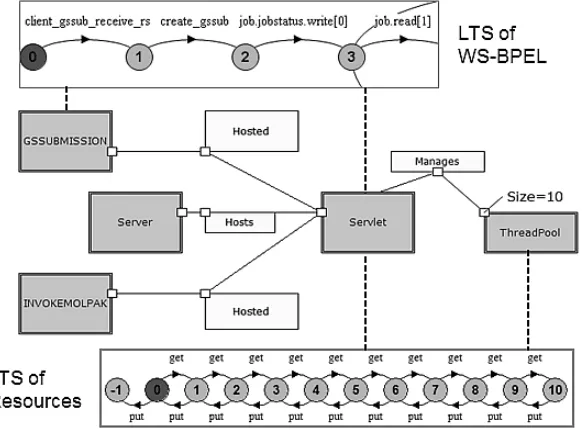
dynamically changing resource providers and consumers. As an example prob-lem, when enacting a web service orchestration defined using the Web Services Business Process Execution Language (WS-BPEL) we observed various safety property violations. This surprised us considerably as we had previously estab-lished that the orchestration was free of such property violations using existing BPEL model checking techniques. In this talk, we described the origins of these violations. They result from a combination of design and deployment decisions, which include the distribution of services across hosts, the choice of synchro-nisation primitives in the process and the threading configuration of resource containers. We illustrated how model checking can take execution resource con-straints into account (see Figure 1). We evaluate the approach by applying it to the above application and are able to demonstrate that a change in allocation of services to hosts is indeed safe, a result that we are able to confirm exper-imentally in the deployed system. The approach is supported by a tool suite, known as WS-Engineer, providing automated process translation, architecture and model-checking views [2, 5, 6].
Fig. 1.Example Models for Safety Analysis in Service Deployment
standards? What are the quality standards that describe this? How are certifi-cations expressed and related between others? What are the safety and security properties we are interested in upholding? These are covered the following parts of the talk.
3
Service Certifications and Cloud Security
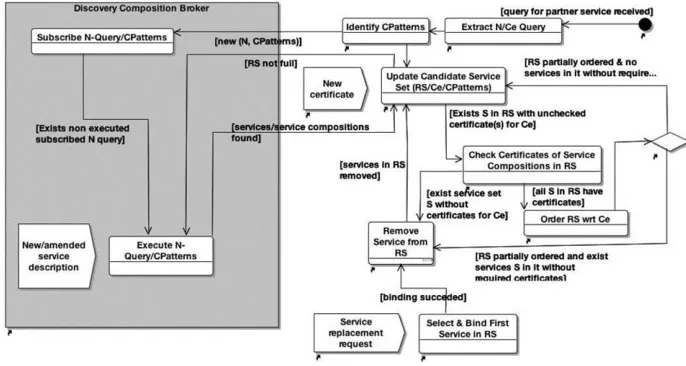
[image:4.612.134.477.372.555.2]Software certification has largely focused on certifying security mechanisms (e.g. ISO/IEC 15408) or product quality metrics (e.g. ISO/IEC 9126*). Our work in certification and assertions for services is part of the EU funded project ASSERT4SOA [8]. ASSERT4SOA aims to provide a general service certifica-tion framework, notacertifica-tion and architecture for supporting certificates in service discovery and composition. The ASSERT4SOA language vocabulary is split in to three certification areas: Evidence-based (ASSERT4SOA-E), Model-based (ASSERT4SOA-M)andOntology-based (ASSERT4SOA-O). The three types of certification are used as part of a wider framework to specify and utilise certifica-tions in a service-oriented architecture. As an example usage of this framework, a process for security certificates in service discovery and composition is illustrated in Figure 2.
Fig. 2.ASSERT4SOA Framework for Service Composition with Certificates
4
Monitoring Service SLAs in the Cloud
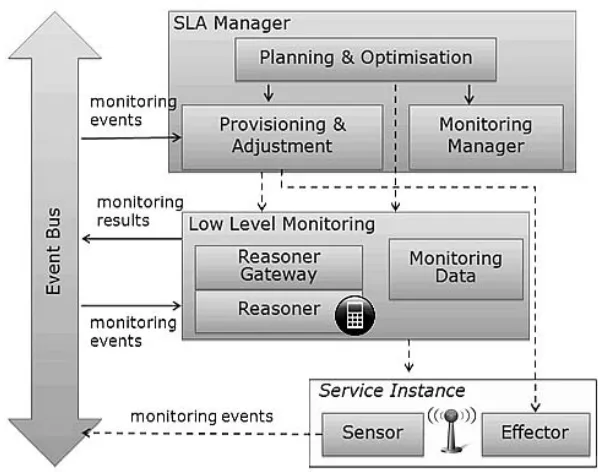
[image:5.612.156.455.270.506.2]Both Cloud business and infrastructure models emphasise a greater need for ac-curate levels of service and conformity. With this in mind, specifying and assuring coverage of certain service and infrastructure properties has been undertaken in the EU funded SLA@SOI project [7]. In this project we undertook providing a service monitoring infrastructure with mechanically derived configurations from service-level agreements (SLAs). The architecture for this is illustrated in Figure 3.
Fig. 3.SLA Monitoring Infrastructure for SOA/Cloud
5
Vision of Service Compliance
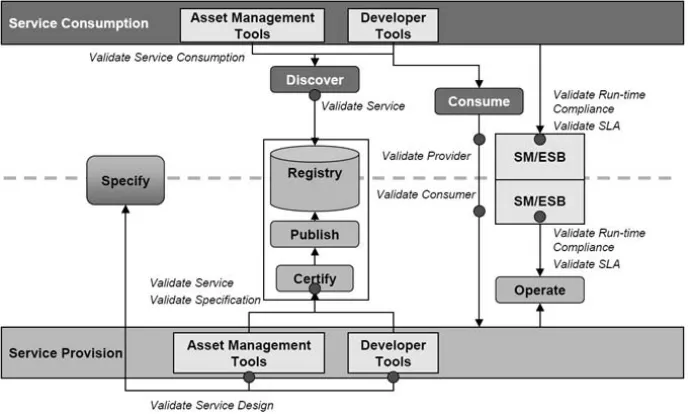
[image:6.612.135.479.268.475.2]Providing both static and dynamic testing tools is a challenge for such techniques discussed previously however we plan to investigate novel yet practical methods for dynamically analysing, monitoring and reacting to violations in such dynamic infrastructures as the Cloud. We discussed mainly a design-time analysis previ-ously, however there is potentially great value to combine service analysis with service monitoring and in the direction of compliance - to ensure certifications are upheld through the software engineering process. Practically, this may be realised through an architecture with checkpoints such as that described by the CBDI [1] and illustrated in Figure 4.
Fig. 4.SOA Architecture with Example Compliance Checkpoints (CBDI 2006)
In summary, we believe that service safety, certification and compliance checking can facilitate a safer cloud of services. As we move towards a more dynamic service-based internet of things, the need for assurance in both provid-ing and consumprovid-ing services has never been greater. Additionally, new standards of IT compliance may well be delegated to the service engineer to counter such risks as data mis-use and inappropriate service behaviour as a result of ad-hoc service compositions.
Acknowledgements
References
1. L.Wilkes, Policy Driven Practices for SOA, presented at the CBDI SOA Seminar, April 2006. Available from: http://www.omg.org/news/meetings/workshops. 2. H.Foster, S.Uchitel, J.Magee and J.Kramer, An Integrated Workbench for
Model-Based Engineering of Service Compositions, IEEE Transactions on Services Com-puting, IEEE Computer Society, April 2010.
3. H.Foster and G. Spanoudakis, Dynamic Creation of Service Monitoring Infrastruc-tures, Service Level Agreements for Cloud Computing, Wieder, P.; Butler, J.M.; Theilmann, W.; Yahyapour, R. (Eds.), Springer-Verlag Berlin and Heidelberg GmbH Co. (November 2011).
4. H.Foster and G. Spanoudakis, Model-Driven Service Configuration with Formal SLA Decomposition and Selection, in proceedings of the 26th ACM Symposium on Applied Computing (SAC), TaiChung, Taiwan, March 2011.
5. A.Argent-Katwala, A.Clark, H.Foster, S.Gilmore, P. Mayer and M.Tribastone, Safety and Response-Time Analysis of an Automotive Accident Assistance Service. Proceedings of ISoLA 2008, Chalkidiki, Greece. October 2008.
6. H.Foster, S.Uchitel, J.Magee, J.Kramer, Model-based Verification of Web Ser-vice Compositions, IEEE Automated Software Engineering (ASE) 2003, Montreal, Canada, 2003.
7. SLA@SOI, A Business-Ready Service-Oriented Infrastructure Empowering The Ser-vice Economy in a Flexible and Dependable way, EU Project ICT-2007.1.2. Avail-able from: http://sla-at-soi.eu.