City, University of London Institutional Repository
Citation
:
Goodall, A. H. (2013). Should doctors run hospitals?. CESifo DICE Report,
11(1), pp. 37-40.
This is the published version of the paper.
This version of the publication may differ from the final published
version.
Permanent repository link:
http://openaccess.city.ac.uk/12726/
Link to published version
:
Copyright and reuse:
City Research Online aims to make research
outputs of City, University of London available to a wider audience.
Copyright and Moral Rights remain with the author(s) and/or copyright
holders. URLs from City Research Online may be freely distributed and
linked to.
City Research Online:
http://openaccess.city.ac.uk/
[email protected]
S
HOULD
D
OCTORS
R
UN
H
OSPITALS
?
A
MANDAG
OODALL*
Introduction
The question of whether hospitals are better run by doctors or non-medically trained managers has been hotly debated for a number of years. In the past, hos-pitals were routinely led by doctors. All that has changed. In the UK and the US, most hospital chief executive officers (CEOs) are now non-physician managers rather than physicians (Falcone and Satiani 2008). Of the 6,500 hospitals in the US, only 235 are led by physicians (Gunderman and Kanter 2009).
It has been suggested that placing physicians in lead-ership positions can result in improved hospital per-formance and patient care (Horton 2008, Falcone and Satiani 2008, Darzi 2009, Candace and Giordana 2009, Dwyer 2010). A few years ago the UK estab-lished five academic health science centres. Their mission is to bring the practice of medicine closer to research – in the hope that innovative science can be more quickly translated into clinical procedures (Smith 2009). Physician leadership was also priori-tised in the 2008 National Health Service (NHS) review (Darzi 2008, 2009). Some outstanding US medical facilities – for example the Cleveland and Mayo clinics – have explicitly introduced leadership training (for example, Stoller, Berkowitz and Bailin 2007, Stoller 2013), and management and leadership education is being incorporated into medical degrees.
Despite the growing body of research into hospital performance, there are currently no empirical stud-ies that assess the physician-leadership hypothesis that hospitals perform better when they are led by doctors. To establish a clear relationship between
leadership and organisational outcomes is challeng-ing. Unlike in medical trials, random assignment – in this case of chief executive officers to hospitals – cannot be used. My research provides an empirical inquiry (Goodall 2011). It looks at the leaders cur-rently being hired by hospitals and examines whether CEOs in hospitals ranked higher are typi-cally physicians or non-medical managers.
Specialist leaders versus generalists
The issue about whether hospital leaders are, or should be, doctors or managers relates to the larger question about specialist leaders versus generalists. This topic is germane because there is recent evi-dence that major US firms have moved away from hiring CEOs who are specialists and towards the selection of generalist leaders (Frydman 2007; Bert -rand 2009). Frydman (2007) examines the career paths of the three highest-paid executives from 1936 to 2003 (total of 708 managers) in the top fifty US public corporations (in the year 1960). She patterns a rise in the number of business degrees held by executives, and a concomitant decline in technical degrees (science, engineering and law). As the overwhelming majority of hospital leaders in the US are general managers (85 percent), it seems likely that hospital management has followed this same trend.
I first considered the question of specialist leaders versus generalists in the context of research uni -versities, after having worked closely with two organisational leaders. I noticed that both pre -sidents that I worked with had different ideas about institutional priorities: one, who had been an obsessive and very highly cited researcher, focused on hiring great scholars; whereas the other, who had stopped doing research early in his career to become an administrator, seemed less interested in research output and scholarship. This led me to ask the question, who should lead research universi-ties? Should they essentially be good scholars or good managers?
My study of university presidents was published in se veral journals and a book (Goodall 2009b). The fin dings suggests that there is a relationship between uni versity performance and leadership by an accomplished scholar (Goodall 2006; 2009a,b). I found that not only were the best universities in the world more likely to be led by outstanding scholars (e.g. the Stanfords and MITs), but I could also show, in longitudinal data, that universities improved their performance over time when better scholars took the reins. Thus, I found that a leader’s characteristics (success in scholarship) were closely aligned with the core busi ness activity of a university (research and teaching).
Over the last few years I have examined the question of how much core business knowledge leaders should have in a number of different settings. One was the highly-skilled environment of basket-ball, where it is possible to clearly identify the coach-es’ characteristics and teams’ performance. In a study with Larry Kahn and Andrew Oswald we found a strong relationship between brilliance as a basketball player and the (much later) winning percentage and playoff success of that person as a basketball coach. Indeed, we found that the bet ter the player (they played for the All-Stars), the bet ter their performance as a coach (Goodall, Kahn and Oswald, 2011). In my most recent study I have shifted setting again, this time looking at the competitive industry of Formula 1 World Con -structors’ Championship. My co-author Ganna Pogrebna and I use six decades of field data from Formula 1. In our study we measure the change in leader (F1 principal), with the change in per -formance (the number of Grand Prix wins and podiums) over the 60 years. In our calculations we control for the race circuit, the race year, the con-structors (McLaren, Red Bull, Ferrari, etc), and the number of cars that qualified. Our primary results show that the most successful team leaders in Formula 1 motor racing are more likely to have started their careers as drivers or mechanics – as compared with leaders who were principally man-agers or engineers (with degrees). When we looked further into the data we found that the result is driven by team principals who were themselves for-mer racing drivers. In other words, time spent as a driver has a big effect on future performance as a leader. The extra probability of gaining a po dium position when a driver has had a decade’s experience of competitive racing is about one-in-seven.
Studying CEOs of top-ranked US hospitals
The study of hospital leaders outlined here uses a simple cross-section methodology at a given time. It therefore cannot make claims about the effective-ness of leaders; instead, it can shed light on who top hospitals hire as CEO. The wealthiest and most pres-tigious hospitals arguably have the widest choice of leadership candidates. If it can be shown that hospi-tals positioned higher in a widely-used media rank-ing are more likely to be led by medical experts rather than managers, this is one form of evidence that physician-leaders may make effective CEOs.
The paper identifies the CEOs in the top ranked hospitals in America – determining whether those hospitals situated higher in the league-table are more likely to be headed by physician-leaders or by professional managers. To this end, one particular quality ranking is used, namely the league tables pro-duced by US News and World Report’s “Best Hospitals” 2009.
The US News and World Report ranking is designed to inform consumers about where to seek treatments for serious or complex medical problems. Media-generated league tables cannot be viewed as entire-ly reliable measures of quality. However, using rating systems as heuristic devices to assess healthcare providers has nonetheless become common in the US (Schneider and Epstein 1998) and it has been shown to influence consumers’ behaviour (Pope 2009). I use this ranking because it is one of the most
0 5 10 15 20 25 30 35
Cancer Digestion Heart Physician CEO Manager CEO
Mean Index of Hospital Quality (IHQ)
Score of hospitals led by physician CEOs and manager CEOs in three specialty fields
IHQ Scores
[image:3.595.335.538.555.775.2]Source: The author.
well-established in its field. The dataset in my study covers the top-100 hospitals in the three specialist fields of cancer, digestive disorders and heart and heart surgery. Each hospital CEO is then identified and classified into one of two categories – physician-leaders, who have been trained in medicine (MD), and leaders who are non-physician managers.
Physician-led hospitals are higher-quality hospitals
To establish whether hospitals higher in the rank-ings are more likely to be led by physicians, I use t-tests and regression equations. I do this for the top-100 hospitals in each of the three medical fields of cancer, heart and heart surgery and digestive dis -orders.
In the field of cancer there are 51 physician-leaders among this set of 100 CEOs. Thirty-three are in the top-50 hospitals and 18 lead hospitals in the lower 50 group. For the other two specialities, there are 34 physician-leaders in the top-100 hospitals in digestive disorders, and 37 in heart and heart surgery respectively. As can be seen in Figure 1, in each of the three cases, the average quality score of hospitals where the chief executive officer is a physician is greater than the score of the hospitals where the CEO is a professional manager.
In the statistical analyses, the regression equations reveal that the presence of a physician-CEO is positi ve ly associated with an extra eight to nine
hos-pital qua lity points (at the p<0.001 level) – in short, hospital quality scores are approximately 25 percent higher in physician-run hospitals than in the average hospital.
To control for the size of hospital, in the field of can-cer I included a variable for the number of beds. However, this size variable was insignificant and, importantly, it did not affect the importance of physi-cian-leaders.
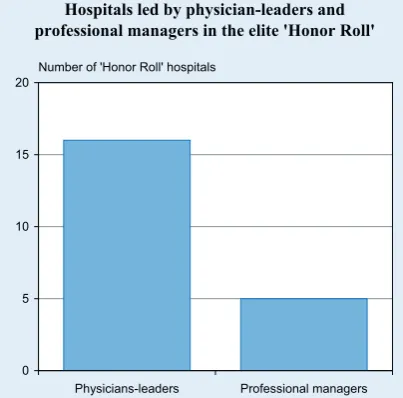
The US News and World Report ranking also includes an ‘Honor Roll’ category which is made up of the most outstanding hospitals – those that achieved high hospital quality scores in at least 6 specialty fields. Figure 2 shows that the CEOs in ‘Honor Roll’ hospitals are more likely to be med-ically trained physician-leaders. Using a simple check I have found that in each year since 2009, when the data in this study were collected, ‘Honor Roll’ hospitals have continued to be dominated by physician CEOs.
Why are better hospitals more likely to be led by physicians?
This study’s results are cross-sectional associations and use one particular hospital-quality ranking. This means they have important limitations. The findings do not prove that doctors make more effective lead-ers than professional managlead-ers. Potentially, they may even reveal a form of the reverse – assortative matching – in that the top hospitals may be more likely to seek out MDs as leaders and vice versa. Arguably, however, the better hospitals will have a wider pool of CEO candidates to choose from thanks to the extra status and wealth that they attract. This makes the fact established in this study an interesting one. The results show that hospitals positioned highest in the ranking made judgements that differ from those made by hospitals lower down. On average they chose to hire physician-leaders as CEOs.These findings are consistent with my earlier work on the role of “expert leaders” in other (non-medical) settings as outlined above.
Cross-sectional analyses can only be suggestive of causality. It is nevertheless interesting to consider possible explanations. What differentiates expert leaders from generalists? Experts may have the advantage that they have acquired a deep intuitive knowledge about the core business of their
organisa-0 5 10 15 20
Physicians-leaders Professional managers
Hospitals led by physician-leaders and professional managers in the elite 'Honor Roll'
Number of 'Honor Roll' hospitals
[image:4.595.57.259.562.761.2]Source: The author, based on US News and World Report ranking.
tions and this may help with decision-making and institutional strategy. Falcone and Satiani (2008, p. 92) suggest that a physician-leader who has spent years as a medical practitioner has acquired an integrity that implies “walking the walk” which, they argue, enhances a leader’s credibility. Physician-lead-ers who have greater credibility may act as role mod-els for medical staff and their presence may help hospitals to attract talented medical personnel. Hiring practices may be driven by homophily – like-for-like selection – thus, great surgeons and researchers may be more likely to hire other great surgeons and researchers. More importantly, it is probable that physician-leaders share the same val-ues as other medically trained staff, and therefore may create better working conditions for doctors, surgeons and nurses.
There has been much journalistic coverage in the UK in recent years of the rise of managers and man-agement practices in UK hospitals. UK hospitals are overwhelmingly led by non-MD managers. Might these manager-CEOs have been creating the right conditions for other managers, but not necessarily for their doctors? Such explanations are merely sug-gestive; as the mechanisms are not yet properly understood. The next, and vital, step for researchers is to design longitudinal inquiries into the possibility that physician-leaders improve the performance of hospitals.
Conclusion
There has been much discussion in the US, and increasingly in Europe, about the relative merits of having physicians and non-physician managers in leadership positions. Yet no evidence has been pub-lished one way or the other. This work does not establish that physicians make more effective lead-ers when compared with professional managlead-ers; but it starts the empirical process. It finds – in each of three disciplinary fields – that hospitals positioned higher in the US News and World Report’s “Best Hospitals” ranking are led disproportionately by physicians. The next, and vital, step for researchers is to design longitudinal inquiries into the possibility that physician-leaders improve the performance of hospitals.
References
Candace, I. and R. W. Giordano (2009), “Doctors as Leaders”,
British Medical Journal338, b1555.
Darzi, A. (2008), High Quality Care for All: NHS Next Stage Review Final Report, Department of Health, London.
Darzi, A. (2009), “A Time for Revolutions – The Role of Physicians in Health Care Reform”, New England Journal of Medicine361, e8. Dwyer, A. J. (2010), “Medical Managers in Contemporary Healthcare Organisations: A Consideration of the Literature”,
Australian Health Review 34, 514–22.
Falcone, B. E. and B. Satiani (2008), “Physician as Hospital Chief Executive Officer”, Vascular and Endovascular Surgery42, 88–94.
Goodall, A. H. (2006), “Should Research Universities Be Led by Top Researchers, and Are They?”, Journal of Documentation62, 388–411.
Goodall, A. H. (2009a), “Highly Cited Leaders and the Performance of Research Universities”, Research Policy 38, 1079–92.
Goodall, A. H. (2009b), Socrates in the Boardroom: Why Research Universities Should Be Led by Top Scholars, Princeton University Press.
Goodall, A. H. (2011), “Physicianleaders and Hospital Perfor -mance: Is there an Association?”, Social Science and Medicine 73 (4), 535–39.
Goodall, A. H., L. M. Kahn and A. J. Oswald (2011), “Why Do Leaders Matter? A Study of Expert Knowledge in a Superstar Setting”, Journal of Economic Behaviour and Organization77, 265–84.
Goodall, A. H. and Pogrebna, G. (2012), “Expert Leaders in a Fast-moving Environment”, IZA Working Paperno. 6715.
Gunderman, R. and S. L. Kanter (2009), “Educating Physicians to Lead Hospitals”, Academic Medicine84, 1348–51.
Horton, R. (2008), “The Darzi Vision: Quality, Engagement, and Professionalism”, The Lancet372, 3–4.
Pope, D. G. (2009), “Reacting to Rankings: Evidence from ‘America's Best Hospitals’”, Journal of Health Economics 28, 1154–65.
Schneider, E. C. and A. M. Epstein (1998), “Use of Public Performance Reports”, Journal of the American Medical Association279, 1638–42.
Smith, S. K. (2009), “The Value of Academic Health Science Centres for UK Medicine”, The Lancet373, 1056–58.
Stoller, J. K. (2013), “Commentary: Recommendations and Remaining Questions for Health Care Leadership Training Programs”, Academic Medicine: Journal of the Association of American Medical Colleges88 (1), 12–15.
Stoller, J. K., E. Berkowitz and P. L. Bailin (2007), “Physician Management and Leadership Education at the Cleveland Clinic Foundation: Program Impact and Experience over 14 Years”,
Journal of Medical Practice Management22, 237–42.