Theses Thesis/Dissertation Collections
9-21-2012
Cross-enterprise access control security for
electronic health records: Technical, practical and
legislation impact
Mark Rodzinka
Follow this and additional works at:http://scholarworks.rit.edu/theses
This Thesis is brought to you for free and open access by the Thesis/Dissertation Collections at RIT Scholar Works. It has been accepted for inclusion in Theses by an authorized administrator of RIT Scholar Works. For more information, please [email protected].
Recommended Citation
Security for Electronic Health Records:
Technical, Practical and Legislation
Impact
by
Mark Rodzinka
A Thesis Submitted
in
Partial Fulfillment of the
Requirements for the Degree of
Master of Science
in
Computer Science
Supervised by
Dr. Stanisław P. Radziszowski
Department of Computer Science
B. Thomas Golisano College of Computing and Information Sciences
Rochester Institute of Technology
c
The thesis “Cross-Enterprise Access Control Security for Electronic Health Records:
Technical, Practical and Legislation Impact” by Mark Rodzinka has been examined and
approved by the following Examination Committee:
Dr. Stanisław P. Radziszowski Professor (Chair)
Thesis Committee Chair
Dr. Hans-Peter Bischof Professor (Reader)
Dedication
This thesis is dedicated to my family and many friends who have supported me along the
way. I am grateful to my wife Krista, and my son Jackson. Krista provided me with the
support and encouragement when the work seemed overwhelming. Jackson was always
there to brighten my day and keep me focused on the finish line. I am also thankful for
my Mother Dorothy’s love and support through my entire academic career. Finally I would
Acknowledgments
I would like to thank my committee for all of the time, work and guidance during this
process. My committee chair and advisor, Dr. Stanisław Radziszowski, provided the
en-couragement and support to keep the wheels of progress turning. Dr. Hans-Peter Bischof’s
critical eye on my research, challenged me to think about my thesis topic in new ways. My
colleague from L-3 Communications, Dr. Nicholas Cianos, took his personal time to help
me with the editing process and motivated me to reach my fullest potential.
The direction for my thesis was established from my discussions with Jess Edwards
and my brother Mike Rodzinka. My research was guided through interactions with Marco
Casale and Mike McClure of the University of Rochester Medical Center (URMC) IT.
They helped me develop an understanding of healthcare IT in practice, including security
concerns.
Finally, I would like to thank all of my friends and family in the healthcare industry.
Many of our impromptu conversations provided valuable insight into the challenges of
Abstract
Cross-Enterprise Access Control Security for Electronic Health
Records: Technical, Practical and Legislation Impact
Mark Rodzinka
Supervising Professor: Dr. Stanisław P. Radziszowski
In this thesis we investigate the relationship of security, privacy, legislation, computational
power in relation to Cross-Enterprise User Assertions (XUA), which allows us to develop
the recommendations for the appropriate, architecture, functionality, cryptographic
algo-rithms, and key lengths. The evolution of health records from paper to electronic media
promises to be an important part of improving the quality of health care. The diversity of
organizations, systems, geography,laws and regulations create a significant challenge for
ensuring the privacy of Electronic Health Records (EHRs), while maintaining
availabil-ity. XUA is a technology that attempts to address the problem of sharing EHRs across
enterprise boundaries. We rely on NSA suite B cryptography to provide the fundamental
framework of the minimum security requirements at the 128 bit security level. We also
recommend the use of the National Institute of Standards and Technologys (NIST) FIPS
Dedication. . . iv
Acknowledgments . . . v
Abstract . . . vi
1 Introduction. . . 1
2 Background . . . 4
2.1 Background . . . 4
3 Policy . . . 7
3.1 United States Legislation and HIPAA . . . 7
3.2 European Union Legislation . . . 11
3.3 Critique . . . 13
4 EHR Case Studies . . . 14
4.1 Lombardy Italy . . . 14
4.2 Kronoberg County, Sweden . . . 17
4.3 University of Rochester Medical Center . . . 20
4.4 Critique . . . 26
5 Cryptography Fundamentals . . . 27
5.1 Building Blocks . . . 28
5.2 Authentication . . . 30
5.3 Kerberos . . . 31
5.4 Web Security Via TLS . . . 33
5.5 X.509 Public Key Infrastructure . . . 37
5.6 Cryptographic Framework . . . 40
6 Web Services and Security . . . 43
6.1 SOAP . . . 43
6.2 SAML . . . 47
6.3 WS-Trust Protocol . . . 55
7 Addressing XUA . . . 60
7.1 Technical Challenge . . . 62
7.2 Cross-enterprise Authentication Law and Regulations . . . 63
7.3 Auditing . . . 64
7.4 XUA Design . . . 65
7.5 Critique . . . 67
8 Experiment . . . 68
8.1 Target Devices . . . 68
8.2 Implementation Description . . . 69
8.3 Implementation Results . . . 76
9 Summary . . . 80
8.1 Public Key Algorithm Comparison [20] . . . 79
9.1 Algorithm Classification Levels . . . 84
4.1 SISS Architecture . . . 16
4.2 COSMIC Tiered Architecture . . . 19
4.3 URMC Before EHR Preparations . . . 22
4.4 URMC EHR Implementation Preparations . . . 23
5.1 TLS/SSL Handshake . . . 36
6.1 SAML Assertion Overview . . . 52
6.2 Direct Trust Relationship . . . 56
6.3 Delegated Trust Relationship . . . 58
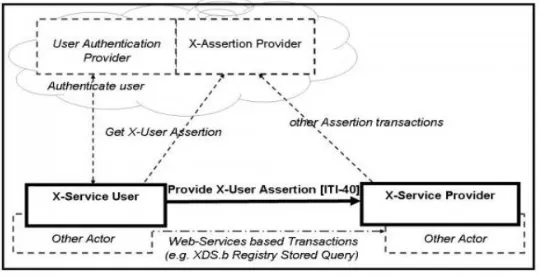
7.1 XUA Actor Diagram . . . 66
8.1 OpenSAML Architecture, courtesy of Will Provost . . . 70
Chapter 1
Introduction
The Electronic Health Record (EHR) is on the forefront of modernizing today’s healthcare
system. In February of 2009 the American Recovery and Reinvestment Act allocated $20
billion for migrating to EHR [35]. On August 20, 2009 the United States Government
announced more funds in the form of $1.2 billion in grants. These funds were targeted
to help private practices and hospitals to convert to EHR and build the infrastructure to
share this information [43]. A major component of this funding is to securely facilitate
the sharing, management and storage of EHR data. While there is some infrastructure in
place to accomplish this, the aspect of securely sharing medical data across a diverse set of
organizations still raises many privacy and security concerns.
There are many challenges associated with implementing a secure method of sharing
EHRs among all of the different healthcare organizations. Hospitals, specialists, primary
care physicians, insurance companies, medical billing agencies, and others require access
to a unique subset of a patient’s data. Furthermore, these organizations commonly have
very different systems in place for accessing the information and sharing it. EHRs may also
need to be accessed by healthcare organizations outside of the patients regional healthcare
system. This can extend far beyond city and state borders to an international healthcare
provider. Finally, authentication for healthcare systems poses a completely different
prob-lem than a typical security environment. For most organizations the safest resolution to an
authentication conflict is to deny access to a questionable user. In healthcare, this scenario
catalyst for this thesis.
The topics of this thesis include the legal, technical and practical aspect of
authentica-tion in electronic health records. The foundaauthentica-tion of the research is based on the Integrating
the Health Enterprise (IHE) Cross-Enterprise User Assertion (XUA). IHE is an initiative by
healthcare providers and industry “to improve the way computer systems share healthcare
information” [23]. XUA defines transactions that allow entities to communicate claims
of identity across different enterprise boundaries. This allows the systems to use known
trust relationships between organizations to infer trust relationships between members of
those organizations. While XUA covers this trust establishment, as well as
recommend-ing security basics for implementrecommend-ing it, it does not explicitly provide a preferred set of
cryptographic algorithms appropriate for this scenario [31].
Based on the legal implications of policies like HIPAA, we recommend a set of
cryp-tographic algorithms and key lengths that are aligned with the National Security Agency
(NSA) Suite B Cryptography specification. Since these algorithms are sufficient for
trans-mitting both secret, and top secret information they are appropriate for protecting health
information. Aside from the algorithm specifications, we also recommend certification
against FIPS 140-2 ”Security Requirements for Cryptographic Modules” [34]. This
as-sures that the design of the software protecting the information’s privacy is implemented
properly and with the appropriate safe guards. These recommendations are critical for
im-plementing secure health information systems, as privacy legislation is intentionally
non-prescriptive. The challenge of legislation is that it must be written for the future, when
today’s cryptographic algorithms will become to weak to protect EHRs. In the end these
recommendations need to evolve as cryptography evolves.
Finally there are some scenarios where even the best cryptographic algorithms and
pro-tocols can’t address the problem. A specific area of concern in this thesis is the ”break
the glass” scenario. This occurs when a healthcare practitioner needs urgent access to a
this situation presents itself, the best approach is to default to allowing access, yet
gener-ate audit notices. These audit notices must be reviewed regularly to ensure the emergency
access was legitimate. This audit protected access in combination with the appropriate
cryptographic algorithms and key length will help to provide a sufficient level of patient
privacy. Lastly the human factor of security is one of the most challenging obstacles in
security. For example complex passwords provide the best security, however they are
diffi-cult to remember. People also have to remember numerous passwords, and pin numbers for
work email, personal email, web site logins, bank accounts and in many other areas. This
often results in a person using the same passwords across all of their accounts, or using
simple passwords which are much more vulnerable to attack. Similarly, while the break
the glass scenario can be more robust through the use of audits, if the auditor is responsible
for reviewing hundreds of false positive audit notices, it could be easy to miss an actual
Chapter 2
Background
2.1
Background
PARIS is the Primary Access Regional Information System, used by the Vancouver Coastal
Health Authority. This system is used to store information related to various healthcare
services such as residential care, mental health, and addiction services [13]. The
imple-mentation of the PARIS system started in 2002 and it now covers more than 75 community
locations [13]. While the system has provided a great resource for sharing healthcare
in-formation it has not come without it’s concerns. Even though this is a single example of a
healthcare information system, it still provides a good example of the challenges faced by
all healthcare information systems.
The office of the Auditor General produced a report in February of 2010 which detailed
many of the shortcomings of the PARIS system. The report proposed 127 unique
recom-mendations to improve the security controls and procedures which were classified into 6
main audit areas [13]. The key audit areas are security policies, system security, database
and operating systems, application access, account management and monitoring. We are
are going to be simplifying this into the categories of traceability, accountability and access
control. These three topics directly relate to the authentication problem addressed in this
thesis.
In the United States, the outlook on EHR privacy and security is not much better.
breaches. An article in HealthIT news, isolated one of the problems to organizations being
more focused on compliance with the regulations, rather than ”the risk associated with data
breach” [29]. This article highlights a survey of 250 healthcare professionals conducted by
Kroll Fraud Solutions and HIMSS Analytics [29]. Some of the key findings of this report
are:
• Despite new regulatory activity, including the implementation of Red Flags Rule and
HITECH Act, and increased compliance among healthcare providers, the reporting
of healthcare breaches is on the rise.
• The number of healthcare organizations that reported a breach increased by six
per-cent in 2010 to 19 perper-cent of total respondents up from 13 perper-cent in 2008.
• healthcare organizations continue to think of data security in specific silos (IT,
em-ployees, etc.) and not as an organization-wide responsibility, which creates unwanted
gaps in policies and procedures.
While this is a small set of examples of the overall system, it highlights some important
facts about the state of privacy and security for EHR. First, regulations may provide an
incentive to ensure compliance, compliance does not necessarily mean security. Second,
given the rise of security breaches coupled with the incentives for a system that maintains a
high level of security and privacy, there are still technical and practical challenges to
over-come. Finally the privacy and security technologies used in all areas of EHR management,
must make the best possible effort to address the human weakness in security.
The authentication problem raises some very important security questions, especially
when it faces the challenge of integrating diverse sets of information systems across
enter-prise boundaries. These questions include:
• What security protocols can be used to provide access, accountability and traceability
between different health information systems?
• What key sizes are appropriate for the cryptographic functions?
• What are the system limitations and how do they impact the protocol and
crypto-graphic primitive selection?
• Are there security challenges that cannot be addressed directly through protocols and
cryptographic primitives?
Chapter 3
Policy
Health information security and privacy is impacted by the policy, rules and regulations
in areas in which the systems are implemented. The Health Insurance Portability and
Ac-countability Act (HIPAA) plays a very important role in regulating how personal health
information is protected in the United States. The countries of the European Union have a
different set of challenges as they are governed by the laws of the European Union as well
as the laws of their home country. In this section we examine the HIPAA and EU
regula-tions to determine what kind of impact they have on the exchange of health information.
3.1
United States Legislation and HIPAA
This section is based on the ”Standards for Privacy of Individually Identifiable Health
In-formation” document produced by the United States Health and Human Services Office for
Civil Rights [46]. Part of this organization’s responsibilities include enforcing the HIPAA
privacy and security rules. To understand these policies, we examine the evolution of these
policies from their conception. The United States government recognized the importance
of protecting health information. One of the specific concerns was that the advancement
of technology would make sensitive patient information more vulnerable to unauthorized
disclosure. In order to address the vulnerability of private healthcare data, the United State
Congress passed the Health Insurance Portability and Accountability Act of 1996. This
(HHS) to establish a set of regulations to ensure the privacy and security of sensitive health
information. This lead to the HHS development of the HIPAA Privacy Rule, and Security
Rule. The challenging aspect of privacy and security of health information is that there
is a delicate balance between security and access to critical information. If you look at a
non healthcare related example, it may be acceptable to deny a third party access to bank
account information if they don’t have sufficient proof of the necessary permissions. In a
healthcare setting denial of access to healthcare information could have fatal consequences.
An important component of understanding how HIPAA applies to organizations, is an
understanding of the terminology. The concept of a covered entity is a very important
aspect of HIPAA. It establishes what organizations must conform to HIPAA rules and
reg-ulations. There are three classes of covered entities defined by HIPAA. The classes listed
below are taken from the Center for Medicare and Medicaide Services Covered Entity Chart
[7]. Although they are ultimately defined by HIPAA, the Covered Entity Chart provides a
straightforward way to determine whether an organization or individual or organization is
a Covered Entity. The classes are:
1. A healthcare provider that conduct specific types of electronic transactions
2. A healthcare clearinghouse
3. A health plan
The act of providing compensated healthcare services which are sent via electronic
trans-actions covered by HIPAA policy, makes the entity conducting the transtrans-actions a covered
entity. A clearing house processes health information for other legal entities. Finally a
HIPAA defined health plan can fall under numerous categories, such as HMO, group,
Medi-care Supplement, and others. Once one of these classifications is met, the organization must
comply with HIPAA regulations.
In order to clarify HIPAA privacy requirements, the ”Standards for Privacy of
Individ-ual Identifiable Health Information” were written. These standards are typically referred to
reasonable level of risk for communication or processes. The document that was developed
by the United State Health and Human Services Office for Civil Rights provides context
for this concept. The document’s example is when a person overhears a conversation
be-tween a patient and their doctor. While the doctor may be using discretion, there is still
a possibility of a passerby overhearing the conversation. The main reason for this is that
interfering with the flow of health information could have serious consequences. Similarly
the privacy rule requires reasonable steps to prevent the exposure of protected health
infor-mation. This section is referred to as the ”minimum necessary standard.” The Privacy Rule
also attempts to address the relationship between the covered entity and it’s business
asso-ciates. The covered entity is allowed to share necessary data with it’s third party partners, if
it is necessary for the patient’s care. An illustration of this is when a company that handles
billing for the hospital. This billing company will receive access to patient information
and diagnosis codes. This is protected health information, but it is necessary for the billing
service to determine the proper value for the healthcare services. In this case the burden is
on the covered entity in order to make sure their business partner has the proper protections
in place to safeguard sensitive data.
An important observation of the Privacy Rule topics that were previously discussed,
is the generality in which the rules are written. This type of wording is typical in the
legislation and associated literature. Many generalities such as reasonable protection, and
reasonable limit, are a common theme. While this type of wording allows for regulations
to impose a necessity for security, it can also leave room for questions about what is
con-sidered to be reasonable in accordance with the law. The literature that is supposed to assist
covered entities with implementing privacy and security often requires the covered entity to
define policies and procedures which establish the standard level of security. This was one
of the drawbacks of HIPAA that Mike McClure mentioned in one of our discussions. Mike
is consultant in the field of IT Security, who is working with the University of Rochester
Medical Center. His observation which sums up the underlying theme of these regulations
for achieving these results.
The Security Rule has more of a technical focus of the security requirements. It contains
a specific section which addresses this subject area. The technical safeguards encompass
five main topic areas.
1. Access Control
2. Audit Control
3. Integrity
4. Person or Entity Authentication
5. Transmission security
In order to assist industry with implementing their health IT systems within the
con-straints of HIPAA’s guidelines, the Centers for Medicare and Medicaid Services published
a set of educational papers called the ”HIPAA Security Series” [6]. The specific area of
concern to this thesis is topic four of the series. Topic four addresses these five technical
safeguards. The main theme of this paper is that HIPAA does not impose specific security
requirements on covered entities, it simply defines required and desirable security features.
An example of this is contained in the section which addresses transmission security. The
security rule requires ”...technical security measures to guard against unauthorized access
to electronic protected health information that is being transmitted over an electronic
com-munications network” [6]. The security series paper defines two areas that help address
this. These areas are Encryption and Integrity Controls. Integrity controls are supposed to
ensure protected information is not tampered without being noticed. Encryption’s purpose
is to prevent unauthorized users from viewing the protected information. Both of these
items are listed as addressable and not required options in the paper. This means that these
features are desirable, but may be circumvented if there is a small enough risk, or if their
The important aspects of both of these rules along with the HIPAA legislation is security
and privacy are required, but the method of implementing them is not specified. These
requirements are left up to the software developers who create the applications to handle
this information, and the end users who define the system requirements. Not only are the
end users responsible for establishing the requirements, they must have the policies in place
to properly handle the sensitive data. These policies must also establish the requirements to
handle emergencies, data breaches, data or infiltration into the systems. These policies will
allow the end users to select the appropriate systems and software to maintain the security
of the protected health information and satisfy HIPAA requirements.
3.2
European Union Legislation
The countries of the European Union (EU) have a unique circumstances. These countries
rely on the Union’s legislation until an area is not specifically addressed, in this case each
independent country’s legislation closes the gaps. The EU has specific protections for
personal privacy. The EU European Commission Directorate-General for Justice’s website
on Data Protection provides a basic overview on the protection of personal data. This
legislation is broader than HIPAA in that it protects personal data in general. It is not
constrained to a healthcare only setting. The foundation of the data protection rights was
based on Article 8 of the ”Charter of Fundamental Rights of the European Union.” This
legislation recognizes that there is a ”fundamental right to the protection of personal data”
[17].
The data protection Directive 95/46/EC, establishes that member nations of the
Euro-pean Union must have legislation that meets the directive’s requirements. This data
pro-tection relates to personal data in various forms, and addresses many areas outside of the
health information domains. This is in contrast to the United State’s HIPAA legislation,
which focuses on the healthcare domain. Despite the broader reach of this legislation, there
purposes, and only the necessary data may be accessed. It also has similar requirements to
HIPAA in that entities who handle personal data must do so securely, the subject (person)
of the data must be aware that this entity is processing it, and why the data is being
pro-cessed. The person who the data pertains to has right to view, update, and correct any of
their data. The directive also states that sensitive data can not be processed, unless specific
consent was received or in emergency circumstances. The genres of sensitive data covered
include:
1. racial or ethnic origin
2. political opinions
3. religious or philosophical beliefs
4. trade union membership
5. health or sexual preference
Similar to HIPAA, the Data Protection Directive provides more of a framework for
how sensitive data should be handled. It lays the groundwork to establish that this data
must be kept secure and private, while giving the data’s subject the right to know that if,
when, where and how their personal data is being handled. There is not a specific mention
of what technologies should be used to ensure this privacy. This is an understandable
position in that the law is a binding legal document, rather than the design of an approach.
The data directive also leaves much of the legal implementation details to the member
state’s legislation. Each member state is responsible for the oversight of this directive by
implementing its own legislation, policies, and oversight organizations. This would be akin
to each State within the United States having their own legislation and policies regarding
HIPAA covered information. It is well beyond the scope for the over-arching EU authority
to manage the day to day details of the data protection directive. However, it is still critical
3.3
Critique
It is very tempting to claim the legislation falls short on establishing the appropriate privacy
and security safeguards for private health information. The key observation with
legisla-tion is that it must not be prescriptive. If legislalegisla-tion provided the appropriate standards to
secure this data, it would need to be constantly revised as weaknesses were found. Since
legislation is typically a slow process, this could further risk individual privacy. Healthcare
providers would face the dilemma of violate the law and select a new approach to secure
protected health information, or risk maintaining the current standards while the law
strug-gles to catch up with the technology.
The work done by the United States and European Union is a reasonable approach
to legislating privacy. The law makers understand these dilemmas, and are working with
an appropriate focus for the future. The legislation establishes the responsibilities of the
organizations who are implementing these systems, and the rights of the those who’s data
resides in the systems. The incentives such as grants, and financial support to implement
secure EHR systems help to generate the momentum to implement these systems. The
disincentives which provide the legal recourse to punish the people or entities who do not
Chapter 4
EHR Case Studies
The following chapter reviews three case studies that review Electronic Health Records
in Europe and the United States. The European case studies are based on work known
as the EHR IMPACT study, while the University of Rochester Medical Center (URMC)
section is based on a presentation and correspondence with the people who took part in
deploying the EHR system. The European case studies provide a high level overview with
some important implementation details, while the URMC section offers more details of the
implementation and the evolution of its EHR implementation.
4.1
Lombardy Italy
The United States is not the only nation concerned about the Implementation of Electronic
Health Record Systems. The member nations of the European Union have been undergoing
similar initiatives. The EHR Impact study [12] provides detailed information about many
of these initiatives. ”The goal of the EHR IMPACT study is to support ongoing initiatives
and implementation work by the European Commission, Member States governments,
pri-vate investors, and other actors. The study aims to improve awareness of the benefits and
provide new empirical evidence on the socio-economic impact and lessons learned from
successfully implemented systems” [12]. This study contains several reports detailing the
successful implementation of EHR systems in various geographic areas. The Lombardy
ideas on how issues like emergency records access, and privacy can be addressed. This
section is based on the EHR Impact Lombardy Case Study document [12].
Lombardy’s implementation included EHR and ePrescribing systems. These systems
are known as Sistema Informativo Socio Sanitario (SISS) or social service and health
infor-mation system. The SISS accommodates roughly 9.5 million people served by 34 hospitals,
7700 general practitioners and 2500 pharmacies. It provides access to various health data
such as lab results, referrals, and discharge information. SISS security employs Smart
Cards as its primary form of access control. The system uses Citizen Cards for patients,
and Professional Cards for the healthcare practitioners.
The citizens in the region covered by the SISS are automatically sent a Citizen Card.
These cards are activated at a location such as a hospital or pharmacy. The activation
process allows the card holder to establish the consent configuration. This consent
configu-ration allows the card holder to restrict access to some or all providers, as well as access to
some or all of the card holder’s data. All of the card holder information and the associated
EHR is stored at a regional general registry.
Similarly the Professional cards are issued to the healthcare providers. These cards
es-tablish the care provider’s authorizations as defined by the regional health authorities. The
cards in combination with the assigned PIN are used to generate the key to digitally sign
patient data submitted to the SISS. The rules that govern access to patient data are different
for general practitioners and hospitals. A patient typically sees a general practitioner on a
regular basis, therefore general practitioners have access to a patient’s data with only their
professional card. Hospitals require the patient’s card as well as the practitioner’s card for
this access. This automatically imposes a consent step for those who would not typically
have access to a patient’s data. In the case of an emergency a professional may access the
patient’s data with just their professional card. This access generates a notification to the
patient and their general practitioner.
The regional general registry in a central point where EHRs are gathered. The system
means of obtaining the detailed results form the location where the report was created. The
SISS architecture also contains a Regional Data Warehouse. The warehouse is responsible
[image:27.612.125.493.164.408.2]for providing EHR data for analysis, administration, planning and studies.
Figure 4.1: SISS Architecture
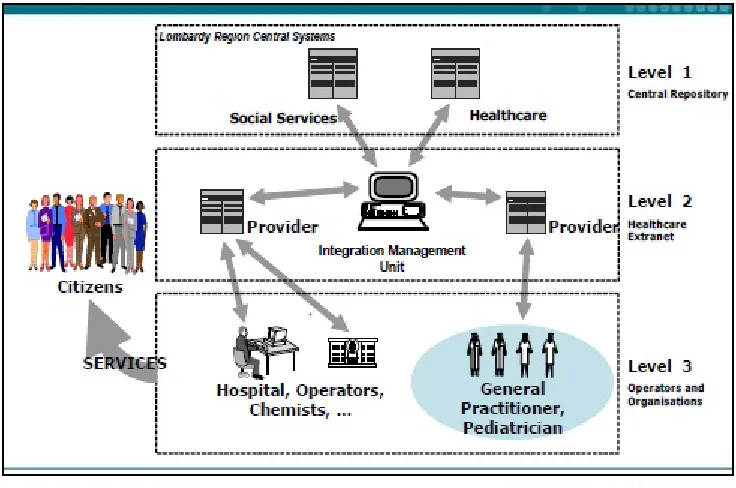
Figure 4.1 illustrates the system interconnect of the SISS. Virtual Private Networks
(VPN) provide the security between the different elements of the SISS network. The VPN
connections utilizes public networks that are widely available. Using public network
sig-nificantly reduces cost because an isolated private network infrastructure does not need to
be created. The network is broken down into three levels. Level 1 is the central repository
which stores the basic user EHR data. The third level are the local data repositories that
store the patient data. The Level 1 Central Repository points to the specific EHR records
stored on the local Level 3 servers. The second level acts an intermediary between the
central repository and the Level 3 operators and organizations.
While this case study examined a high level view of the SISS implementation, it
between each node through the use of VPNs. Secondly, the smart card system provides a
strong multi-factor authentication system. The PIN number and professional card
combina-tion are required to generate the digital signature key. This digital signature key is required
to upload patient data to the SISS. The Citizen smart cards provide the consent mechanisms
necessary in an EHR system. The combination of Citizen and Professional cards establish
a set of checks and balances for EHR access. The SISS architecture also accounts for
emer-gency access to patient data. This is especially critical in situations where the patient may
not be able to give consent, as the practitioner can get access to critical patient data and
the appropriate people are notified of the access. This provides both traceability and audit
features for the emergency access.
4.2
Kronoberg County, Sweden
Another target market of the EHR IMPACT study was Kronoberg County Sweden. This
section is based on the published Kronoberg EHR impact case study [11]. The
implemen-tation was on a smaller scale then Lombardy study, however it provides a good example of
an alternative design approach. Kronoberg’s system supports 182,000 people, 2 hospitals,
31 healthcare centers, 3 mental health units and 25 dental care centers. The combination of
all of these facilities results in 5700 professional staff.
The basic structure of the Kronoberg system is divided into National, Regional and
Lo-cal components. At the national level the ministry of health and social affairs oversees the
regional level. The regional level is responsible for the day to day operations for
hospi-tals and primary care practitioners. The local level responsibilities include nursing homes,
school health and home care. In contrast to the United States, the majority of primary care
centers are operated by the regional authorities, with the medical and professional staff
be-ing salaried employees. This structure is primarily funded by local taxes(71%), with the
makes it inherently easier to implement large scale changes to the health information
tech-nology infrastructure, as it limits the number of responsible decision makers. This is in
sharp contrast to the United States, where legislation can help to drive such changes, but
the implementation is left to a vastly larger number of private and public owned institutions
who are under different management.
The backbone of the Kronoberg EHR system is Cambio Healthcare Systems AB
COS-MIC Software. COSCOS-MIC is ”Compliant Open Solutions for Modern Integrated Care” [11].
The COSMIC is Java based, and it’s Application Programming Interfaces (API)
commu-nication protocols are structured around J2EE and CORBA. J2EE provides many of the
background API’s and protocols in order to simplify the development of highly integrated,
Web-based applications [9]. The desired end result from using these common APIs is that
security is built into the components, leaving less room for programming errors by the
ap-plication developers. The data handling API’s also provide versioned access to the data
that includes the change originator and the time of the changes. These versioned data
pro-vide the necessary audit mechanisms and traceability for the data in which there are many
potential contributors.
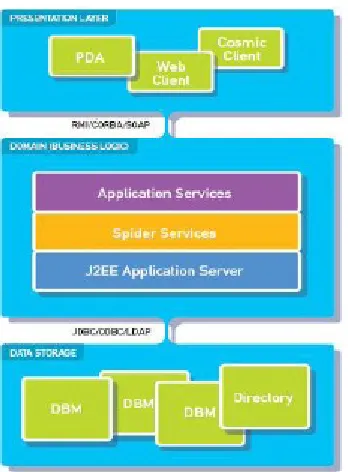
The framework of the COSMIC software is based on a three tier system. Figure 4.1
illustrates the software architecture. The presentation layer is aptly named as it presents
data to the end user. The domain level also known as the ”business logic” encapsulates all
of the application’s services. Finally all data is stored in the data storage layer. All of these
components communicate over TCP/IP. The software API’s provide an abstraction layer
isolating applications from the low level interfaces. For example the application interfaces
use APIs to communicate with the data storage layer as opposed to SQL.
The COSMIC software incorporates numerous security features, from its forms of
au-thentication down to the network security. A user’s identity is established by means of
password authentication and optionally via Public Key Infrastructure (PKI). Another
sup-ported authentication mechanism is electronic identity cards, however Kronoberg did not
Figure 4.2: COSMIC Tiered Architecture
for the first quarter of 2010. The authentication methods are combined with various classes
of access control. The classes can be inclusive or exclusive such that groups can either
be granted or prevented access to records. The network that the system runs on utilizes
TLS/SSL. TLS prevents both internal and external threats from viewing the data, because
it encrypts the data before transmission. This data can only be decrypted by the intended
recipient because the TLS handshake establishes a shared secret only known between the
two parties negotiating the connection.
The software provides the security features, but policy and legislation determine how
this security is used. Basic patient privacy rights are partially established by the Patient
Data Act of 2008 and the Swedish Secrecy Act. They establish that patient data must
only be accessible to those who are responsible for that patient’s care, and that only the
necessary data (for treatment) is available. Kronoberg’s EHR implementation established
policies to determine what constitutes a valid need for the data. The county council
for verifying EHR accesses are legitimate. The EHR data includes (but is not limited to)
items such as hospital visits, charges, and diagnosis. If a patient without an EHR visits a
healthcare provider, the healthcare provider can create the record for that patient.
All EHR accesses are protected by password authentication. The password
authentica-tion allows any EHR access to be logged for oversight and auditing purposes. A patient
EHR establishes the access restrictions and/or permissions for healthcare professionals
out-side of the group in which that record was created. These access rights are inherited by the
staff of the healthcare professionals as well. For example if a patient grants an orthopedist
access to data generated by his internist, the orthopedist’s nurse or administrative staff will
also have access to the data. Typically a physician will have full access to a patients record
in the form of both read and write access, while nurses and administrators may be limited
to read access or only certain parts of the record. The access permissions also rely on what
the EHR Impact Report refers to as established relationships. A general practitioner who
oversees a person’s day to day care will have access to all of their patients’ data. Referrals
establish the patient/provider relationship granting the referred practitioner access to the
patient data. In order to handle emergencies, practitioners who are treating a patient
out-side of the typical setting (general practitioners, or referrals) have full access to the patients
data. This is an automatically established relationship, as the care provider may need all of
the patients data in order to perform a proper diagnosis and treatment.
4.3
University of Rochester Medical Center
The University of Rochester Medical Center (URMC) provides an excellent example of the
challenges that implementers are faced with when trying to implement the sharing of
elec-tronic health records. Our research of URMC’s EHR implementation is derived from a
pre-sentations provided by Marco Casale [5]. Mr. Casale’s presentation focused on URMC’s
”Application Integration and Clinical Data Warehousing” [5]. The URMC is composed of
also belongs to a Regional Health Information Organization (RHIO) named the Rochester
RHIO. Rochester RHIO is a nonprofit organization that provides fast and accurate access to
patient medical information. To put things in perspective of XUA terminology, the URMC
is a covered entity which includes Strong and Highland Hospital. URMC also belongs to
an affinity domain, known as the Rochester RHIO. Even from this level the challenge of
keeping two geographically separate hospitals synchronized with patient data starts to
be-come evident. The data integration effort bebe-comes even more difficult when the underlying
health information systems are examined. URMC has put in a significant amount of effort
to integrate its various systems via a common applications interface.
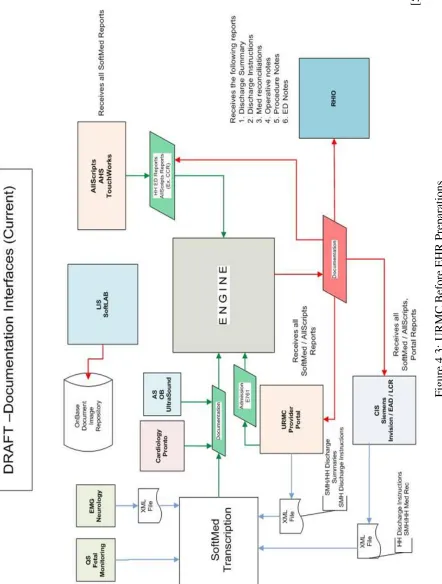
Figure 4.3 illustrates a snapshot of how some of the URMC’s Health Information
Sys-tems were integrated prior to the phase 1 implementation of their new Epic EMR system.
The heart of the system is the ”Engine,” which acts as the underlying interface between
the different systems. Although there was a good effort to integrate some of the systems,
the diagram provides a clear illustration of how data could be lost in unconnected systems.
The Figure clearly shows how data can be distributed and isolated over various segments
of a hospital’s health information systems. This data patchwork makes integrating with
another organization difficult. The system would have to identify which system the request
needs data for and than perform the necessary transactions to retrieve it. Conceptually it
should not be exceedingly difficult to obtain access to the hospital’s data form the RHIO.
However, the road blocks introduced by isolated systems with their own access controls
[5]
Figure
4.3:
URMC
Before
EHR
[image:33.612.108.550.107.691.2][5]
Figure
4.4:
URMC
EHR
Implementation
[image:34.612.100.544.107.692.2]In order to improve the system’s capabilities, the URMC redesigned the the flow of
data through the engine. A big part of this was adding the EPIC EMR system. This system
simplifies the means of retrieving medical data and can also provide a more secure system.
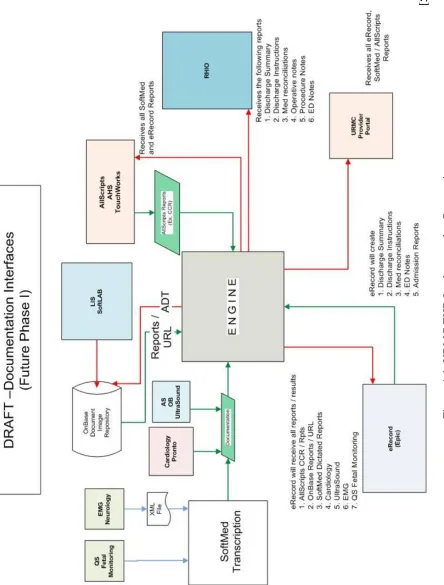
Figure 4.4 illustrates the proposed first phase of the URMC’s EPIC EMR implementation.
While it provides access to data resources like the SoftLab Lab Information System (LIS),
which may have been previously unavailable, there are some important security benefits.
The diagram illustrates that the EPIC eRecord system has ”reports/results” for all of the
data which passes through the engine. Therefore access controls can be made to protect
patient data at a single point in the data-flow. Essentially instead of establishing special
access control mechanisms for the different systems, all external requests from the RHIO,
or Provider Portal can be secured between the access point and the eRecord system. This
also improves auditing, because RHIO requests can be logged by the eRecord system for
auditing. In the pre-EPIC implementation in figure fig:URMCPhase0 , it is unclear of how
and where such data requests could be logged in some of the isolated systems.
This implementation leads to some important points about implementing secure EHR
access via IHE XUA in today’s health information systems. The evolution of modern
health information systems has likely lead to organizations with diverse systems that are not
easily integrated into a common framework. Despite the URMC’s previous development
of their engine interface, it was still important to re-architect how data passed through their
systems. This patchwork of systems is likely to be common situation for various healthcare
providers. Based on this experience, the implementation of the proper access controls, and
auditing technologies will require a significant time and financial investment.
EPIC’s security features must also be examined to understand how it impacts URMC’s
security. EPIC’s security employs a multi-level approach. The security features that EPIC
inherently supports are SSL/TLS, data encryption via AES, and the minimization of the
amount of transported data[8]. When crossing enterprise boundaries EPIC employs the
Hyper Text Transfer Protocol over SSL (HTTPS). In order to establish identity and
This means that EPIC system is capable of authenticating users (internal and external), and
protecting the data that is being accessed. Once users are authenticated a method of
estab-lishing permissions must be used in order to determine a user’s access controls. As with the
Kronoberg EHR IMPACT study implementation, there are numerous methods of
determin-ing an EMR’s access permissions. The Authentication Guide’s list of access control options
include user roles, security classes, user security, profiles, break-the-glass, restricted
ser-vice areas, restricted patients, patient lists, and sensitive encounters, orders and notes. This
gives an administrator the control to implement very precise and detailed access controls.
In a discussion with Mike McClure (head of IT security at URMC) we were able to
obtain a few other key insights on the direction that the health information systems field is
moving towards. Within URMC many of the systems were using single factor
authentica-tion to access their systems. This would typically be a Windows Active Directory systems
which requires Username and password. However a recent visit to one of the URMC’s
outpatient treatment centers lead us to the discovery that at least some of the departments
within URMC are using finger print scanners for an extra layer of access control. With
regards to the industry in general we get the impression that much of the security aspects of
these systems are left up to the interpretation of those deploying them. There is a consensus
that data in transport should be encrypted, however it is not the case for data at rest. It would
be ideal to have encryption of data in motion and data at rest. If the private health data is
encrypted on a server, it adds an extra layer of security. It can discourage those within the
organization from viewing data they do not need, and add an extra road block if someone
breaks through the systems access controls to access the servers. However, currently the
industry is a good distance away from the ideal situation. Mike McClure provided some
insight of the complications for adding encryption to server side data. It is common to have
multiple layers of middle-ware between the operating system and the EHR systems. This
raises the questions of at what level (OS, middle-ware, or EHR software) the encryption
would have to exist, and what kind of complications are introduced at the other layers.
to it. Finally the industry is moving towards systems that are best of suite rather then best
of breed. The URMC infrastructure in Figure 4.3, is an excellent example of best of breed
concept migrating towards best of suite. Without the details of the decision making
pro-cess involved in selecting the original systems are URMC, it is a plausible theory that each
department picked the best system for their needs. While it met that department’s needs it
also made it challenging to integrate it with the hospital’s other systems. The best of suite
approach would look at these systems from the big picture perspective. The systems and
software would be selected according to what suite of software would support the needs
of the organization. The needs of the organization would be defined by each department’s
needs. Therefore instead of buying 10 solutions from 10 vendors, the choice would be 10
solutions from a single vendor that are natively integrated with each other. URMC is
mi-grating to best of suite, because Epic is now core of their EHR system. Any future software
additions would be made based on their integration with the Epic platform.
4.4
Critique
The case studies illustrate successful implementations of EHR systems, however there is
not any substantial detail focused on whether these systems have proven to be secure. While
the systems used sound security principals, they were not necessarily proven to be secure
in practice. This is especially concern when the human factor is added into the security
equation. Secondly some of the features, such as the smart card system would be difficult
to implement in the United States. The European case studies involved a higher authority
managing all of the health care institutions, while the United States has mostly
indepen-dently managed health care organizations. This put into question, who would manage
aspect of the EHR systems, such as smart cards. This is one of the key differences involved
with implementing EHR systems in different healthcare systems. In the end, all of the case
studies take steps to manage patient privacy. Only time will tell whether their efforts are
Chapter 5
Cryptography Fundamentals
The fundamental objective of cryptography is to enable two people, usually referred to as
Alice and Bob, to communicate over an insecure channel in such a way that an opponent,
Oscar, cannot understand what is being said [44]. This is the essence of the problem of
sharing EHRs. Health care providers, and the various other support entities require access
to various subsets of a patient’s health record. This information must be communicated
over an insecure channel; therefore a mechanism of encoding or enciphering the data must
be developed such that it is computationally infeasible for an observer to decipher the
infor-mation. Oscars attempt to decipher a message between Alice and Bob can be referred to as
cryptanalysis. More specifically, cryptanalysis is the method of deciphering an encrypted
message without access to the information used to encrypt it. Typically an unencrypted
message is referred to as plaintext, while the encrypted message is referred to as ciphertext.
One of the best historical examples of cryptography is Ultra and Enigma during World
War II. Enigma was the name of the German cipher system. It used a series of
config-urable mechanical wheels to encrypt messages that were typed in via it’s keyboard. This
system proved to be a major challenge for Allied forces because as each letter was typed
the wheels changed position. This change in position made it unlikely typing the same
let-ter again would generate the same encrypted characlet-ter. Traditional frequency analysis was
rendered ineffective for this problem [19]. The German forces were so confident in their
technology that they used it in a substantial amount of their communications. It wasn’t
able to make any progress cracking the code. However, it took the capture of two Enigma
machines and their settings information in March of 1941 to enable the Allies to reliably
decipher the German communications. The Ultra nomenclature was created by the British
to classify any information regarding the Enigma machine. The Ultra classification was
regarded as Top Secret, and was only available to a very select few people in the British
command [25]. This piece of history illustrates the importance of being able to control the
flow of information. Although it is an example from military history, these concepts are
what have evolved to implement today’s cryptographic technology.
5.1
Building Blocks
The study of cryptography has led to the development of various cryptographic primitives.
These primitives are the building blocks used to securely share information. The main areas
of cryptography that will be discussed in the context of health care systems include:
• Public Key Cryptosystems
• Block Ciphers
• Cryptographic Hash Functions
The actions of encrypting and decrypting data, require a set of rules that govern how data
is encoded and decoded [44]. The rules include the encryption algorithm being used, and
the key information needed by the encryption and decryption algorithms. These concepts
translate fairly easily to the concepts of physical security. A cryptosystem can be thought
of as a safe. A message can be placed in the safe (encrypt), and a key can be used to lock it,
thus limiting casual observers from reading the message during delivery. This safe can be
delivered to the message recipient. The recipient can use a key to open the safe (decrypt)
and view the message.
There are two basic methods for locking and unlocking data. In a private key
is used to encrypt and decrypt the message. In a public key cryptosystem, a pair of keys
is constructed for encoding and decoding data. The first key is publicly known and can be
made available to anyone. This public key can be used to encrypt a message for a recipient
with the second key. The recipients key is not publicly available, however the mathematical
combination of the message encrypted with the public key and the application of the private
key allows the message to be decrypted by the recipient only [18].
Block cipher is a generic name for the algorithms necessary for encrypting and
decrypt-ing fixed size data. The basic properties of a block cipher are that it takes a fixed length
input, with key information to generate a fixed length output using the same key for
en-cryption or deen-cryption [41]. Block ciphers are generally used in private key cryptosystems,
as they require the same key for encryption and decryption. Two commonly known block
ciphers are the Data Encryption Standard (DES), and the Advanced Encryption Standard
(AES). AES is the current block cipher standard recommended by the National Institute
of Standards and Technology (NIST) in 2001. DES was the predecessor of AES which
succumbed to brute-force attacks by the Electronic Frontier Foundation in 1998 [14].
A hash function takes an arbitrarily long input and generates a fixed length output.
Conceptually, it generates a fingerprint of the input, that cannot be reversed to regenerate
the original input from the function’s output [18]. Theoretically there is a limit to the length
of the input, however the hash function is designed such that the probability of exceeding
the maximum input length is extremely low. There is a possibility of a collision, in which
two different inputs generate the same output. While there is a possibility of a collision the
hash function is designed such that creating a collision is computationally infeasible [18].
The cryptographic primitives are used to build the cryptographic protocols to securely
transfer, and authenticate data. While the individual primitives of a cryptographic protocol
may be secure, it must still be designed to use the primitives to maintain security. The
other protocol problem that must be dealt with is the introduction of weaknesses by the end
user. Even the most secure encryption algorithms can be defeated if the end users choose
his Cryptogram Newsletters [41]. ”Semantic attacks directly target the human/computer
interface, the most insecure interface on the Internet. Only amateurs attack machines;
professionals target people. And any solutions will have to target the people problem, not
the math problem” [41].
5.2
Authentication
Authentication is a method of verifying an entity’s identity. The most commonly known
form is the challenge and response method. An example of challenge and response
authen-tication is known as ”captcha”. In order to prevent automated access to website functions,
it is a common practice to prompt the end user with a simple question. The question is not
easily answerable by automated system software (a computer program), but is easy for a
human to answer. A typical example of a captcha is a website sign-in screen presenting
some text (represented with an image file) that is distorted. This text is fairly easily read by
a human, while it would be extremely difficult for a computer program to recognize it [47].
In addition to challenge and response, there are mutual authentication schemes, in
which each entity verifies the other’s identity. To get a better picture of how this
au-thentication works, it will be examined from a client/host perspective. The client is the
entity attempting to get access to the host. Mutual authentication is more powerful than the
challenge and response protocol, because it provides a greater level of assurance that the
client is accessing the desired host, as well as ensuring the client’s credentials match what
the host expects. Introducing cryptographic primitives into authentication creates a greater
level of assurance that the identity claims are accurate. One example of this is adding a
message authentication code (MAC) into identification. A MAC is the output of a keyed
cryptographic hash function. The private key must be known by the client and the host so
it can be used to verify authenticity. Therefore a challenge and response protocol given in
”Cryptography Theory and Practice” [44] might occur as follows (assumingK is a shared
verifying Alice’s identity: [44]
1. Bob chooses a random challenger, and sends it to Alice,
2. Alice computesyand sends it to Bob, wherey=M ACK(ID(Alice)||r), 3. Bob computesy0 wherey0 =M ACK(ID(Alice)||r),
4. Bob accepts ify0 =yelse Bob rejects.
The use of the private keyKand the MAC provides assurance that if Oscar intercepts either
y ory0, he is unable to impersonate Bob or Alice. The MAC which incorporates a
one-way/hash function makes it computationally infeasible for Oscar to create a response (y) that will include the challenge as well as the ID without access to the secret key information.
[44]. Essentially the MAC incorporates the challenge (r) and Alice’s identity (ID(Alice)) into a digital fingerprint.
5.3
Kerberos
A practical example of authentication is the Kerberos protocol. It was developed at MIT
for the Athena Project [41]. Kerberos is designed so that it can securely authenticated
systems on an unsecured network where packets can be captured, inserted and modified. It
accomplishes this authentication without any dependence on addresses, host, or operating
system [33]. In a client/server model, there will be a client, server, Kerberos, and a
Ticket-Granting Service. Kerberos ”knows” all of the secret keys of the clients on it’s network.
Based on Kerberos 5 when a client wishes to access a specific server the transactions in
the list below occur [41]. The nomenclature in the list, makes use of standard size fonts to
illustrate what the data is and subscripts to illustrate who the transaction’s participants are.
a key for the client and Ticket-Granting Service. When a parameter is enclosed in curly
brackets and followed by a key type parameter (ie.Kc), this means the parameter enclosed by the curly brackets is encrypted with the key parameter that follows the curly brackets.
For example {Kc,tgs}Kc represents the client and Ticket-Granting Service key, which has been encrypted with the client’s key.
1. The client requests a ”Ticket-Granting Ticket”
2. Kerberos responds with the key for the Ticket-Granting Service and the client session
{Kc,tgs}Kc, that is encrypted with the clients secret key, as well as a Ticket for the Client and Ticket-Granting Service that is encrypted with the Ticket-Granting
Ser-vice’s Key{Tc,tgs}Ktgs.
3. The client sends client server authentication information encrypted with the
client/Ticket-Granting Service key{Ac,s}Kc,tgs, and the client/Ticket-Granting Ser-vice ticket encrypted with the Ticket-Granting SerSer-vice’s Key from the previous
ex-change{Tc,tgs}Ktgs.
4. The Ticket-Granting Service sends the client the client/server key encrypted with the
client/Ticket-Granting Service key{Kc,s}Kc,tgs, and the client/server ticket encrypted with the server key{Tc,s}Ks
5. Finally the client sends the server the client/server authentication information that is
encrypted with the client/server key{Ac,s}Kc,s, and the client/server ticket encrypted with the server key{Tc,s}Ks.
Kerberos uses a methodology of ”trickling out” authentication information to the client
and server. Each step of the protocol is carefully constructed to allow the client and server
to authenticate, while limiting exposure of sensitive secret key information. While more
sophisticated than the challenge and response protocol, there are still challenges posed in
the health care environment, especially when trying to establish cross-enterprise
5.4
Web Security Via TLS
The Internet has significantly changed from it’s humble beginnings. The first networked
computer systems connected four US universities, which allowed them to build the
foun-dation of ”worldwide, on-line connectivity” [15]. This network was created to facilitate the
open exchange of information. Advances in computing power and networking
technolo-gies have changed the way this network infrastructure is used. Applications like on-line
banking have attempted to take an open network and secure it to protect a user’s private
information. Only the proper use of cryptographic primitives and secure design practices
can make this possible. One of the methods to secure the Wold Wide Web for applications
with sensitive data is the Transport Layer Security (TLS), which was formerly known as
the Secure Sockets Layer (SSL).
TLS provides a means of authentication, establishes the cryptographic functions to be
used during a session, allows the generation of keying material, as well as other TLS
spe-cific information [27]. TLS was originally developed under the name of SSL by ”Netscape
Communications Corporation to provide security and privacy over the Internet” [38]. It’s
development was taken over in 1996 by the Internet Engineering Task Force (IETF) under
the badge of RFC 2246 or TLS 1.0 [21]. The IETF TLS working group continues to update
the TLS specification to add new cryptographic features, and clean up the dependency on
weaker algorithms [21].
TLS is composed of two protocols known as the Handshake protocol, and the Recorder
Protocol. The Handshake protocol is responsible for the initial authentication,
crypto-graphic algorithm negotiation, and key establishment. The recorder protocol is
respon-sible for the actual data transfer after the initial handshake. Both of these protocols rely on
specific cryptographic algorithms which are listed below [10].
1. Digital Signature Algorithms
(a) RSA
(c) ECDSA
2. Hash Algorithms
(a) MD5
(b) SHA-1
(c) SHA-224
(d) SHA-256
(e) SHA-384
(f) SHA-512
3. Block Ciphers
(a) RC4
(b) 3DES (EDE)
(c) AES
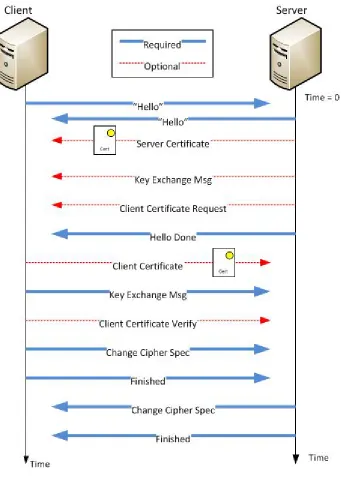
RFC 5246 specifies that TLS establishes a secure connection by first running it’s
Hand-shake Protocol. This protocol involves a four way handHand-shake between a client and server,
in which multiple sets of data are transmitted in the transactions. The first step in step in
establishing a secure connection is the ”Client Hello” message [28]. This message contains
the client’s current time expressed in the 32 bit unix timer format (seconds since January
1, 1970), and 28 bytes of random data, the client’s highest supported version of TLS, an
optional session id, a list of cryptographic algorithms in order of the client’s preference,
a compression method, and an optional extensions field. Each item in the cipher-suite list
specifies a key exchange algorithm, a bulk encryption algorithm, a MAC algorithm, and a
Pseudo-random Function algorithm (PRF) used to generate keys.
The server responds in the next phase of the handshake with a ”Server hello” message.
The server’s hello message contains similar random data and time stamp that was
completion, the best cipher suite choice, the selected compression method, and any
exten-sions. The server should choose the best cipher suite achievable by both client and server.
This means if both have the same capabilities with the exception that the server supports
128 bit and 256 bit AES, while the client only supports 128 bit AES, the compatible suite
containing 128 bit AES must be chosen. During this phase, the server will send a
certifica-tion if the agreed upon key exchange method requires one. The server will also send a key
exchange message if a required certificate does not contain enough information for client
to send a ”premaster secret” or a public key of some kind. Finally the server can send an
optional client certificate request. The server indicates it has completed sending data with
a closing Server Hello Done message.
The third phase of the handshake are messages from the client to server which are
dependent on the requirements of the server’s hello message. The client shall send it’s
certificate if one was requested by the server. The client must follow with the client key
ex-change message which is either an RSA encrypted secret or the Diffie-Hellman parameters
that allow the two to agree on a secret. The client follows the key exchange message with
a certificate verify message (if a client certificate was sent) that allows the server to verify
the clients certificate. Prior to sending the Client finished message (indicating the client is
done sending data), the Client will also send a Change Cipher Spec message indicating that
subsequent data will be protected by the agreed upon cryptographic algorithms.
The final phase of the handshake contains the server’s change cipher spec message
indicating to the client that it’s following data will be protected by the agreed upon
cryp-tographic algorithms. This is immediately followed by the server finished message which
indicates that the next data transfered between the client and server shall be under the
pro-tection of the Record Protocol [10]. The record protocol simply sends and receives data
packets based on the configuration established in the handshake mechanism. The
5.5
X.509 Public Key Infrastructure
The book ”Understanding PKI” by Carlisle Adams and Steve Lloyd fundamentally defines
the concept of a Public Key Infrastructure (PKI) as ”the basis of a pervasive security
in-frastructure whose services are implemented and delivered using public key concepts and
techniques” [1]. PKI is the application of several cryptographic functions at various scales.
This scale of the infrastructure described by Adams and Lloy can support a vast group of
Internet users, or a small set of people within an organization. A PKI is typically managed
through the use of certificates. These digital certificates contain the data and information
necessary to ensure certificate authenticity. Douglas Stinson [44] details the core
compo-nents of a PKI as follows.
1. Certificate issuance
2. Certificate revocation
3. Key backup, recovery, and update
4. Time stamping
Certificate issuance is performed by a Certificate authority who is responsible for
gen-erating the appropriate signature mechanism which can be used to verify it. Revocation
allows an authority to make a certificate invalid in the case of the termination of a trust
relationship or if the subject, certificate, or certificate authority was compromised. The
ability to backup, recover and update keys is critical as it provides a method to reestablish
trust if keys are lost, if keys are compromised, or a new set of keys need to be distributed.
The time stamp aspect of a certificate allows an authority to put a ”lifetime” limit on the
validity of a certificate.
A generic example of a public key infrastructure transaction is given below. The
compo-nents of this example include Bob, Alice, and Jeanie. Bob and Alice wish to communicate
securely and ensure each party on the other end is not an adversary. Jeanie is the all
key information for all of her users. Jeanie is also responsible for providing the verification
process to ensure the desired end user is the once communicating. Jeanie issues certificates
to both Bob and Alice, which contain their respective public key information, as well as a
Jeanie’s signature of authenticity. Bob and Alice know and inherently trust Jeanie. They
are also able to verify her signature on the certificates she issues.
1. Bob and Alice are introduced
2. Bob sends his certificate whic