JOURNAL OF VIROLOGY, Jan. 1976,p.291-295 Copyright01976 AmericanSocietyforMicrobiology
Vol. 17, No. 1 PrintedinU.S.A.
In
Vitro
Transcription
of
70S RNA
by the RNA-Directed DNA
Polymerase of Rous
Sarcoma Virus: Lack
of
Influence
of
RNase H
MARC S. COLLETT AND ANTHONY J. FARAS*
Department ofMicrobiology, Universityof Minnesota MedicalSchool,Minneapolis,Minnesota55455
Received forpublication8August 1975
The influence of Roussarcomavirus(RSV)-associatedRNaseHontheinvitro
synthesisofDNA by the RSV RNA-directed DNA polymerase wasdetermined
under conditionswherebyRNase Hactivitywasselectivelyinhibited with NaF.
Notonly were weunable todetect any effect onthe size, structure, orgenetic
complexity of the DNAproductsynthesizedinthe absence of RNaseH activity,
but the displacementofDNAfromthe70S RNA:DNAhybridstructureswasalso
unaffected. The suitability of70S RNA:DNA hybrid structures synthesized in
vitroto serve as asubstrate for RNase H is discussed.
We have beenstudying theinvitro
transcrip-tionoftheRoussarcoma virus(RSV) 70S RNA genome in an effort to elucidate the mech-anisms by which the RNA-directed DNA
po-lymerase synthesizes DNA. To date, several
apparentlimitations exist regardingtheability
ofthe DNApolymerase toefficiently transcribe
the RSV genome in vitro. These include the
relatively small size of the bulk of the DNA
product compared with that of the RSV
ge-nome, the inefficiency of transcription ofRNA
intoDNA, and the limited transcription ofthe
genome intodouble-stranded DNA (10, 13, 20). In our attempts to understand the nature of
theselimitations, and therefore the capabilities
ofthe RNA-directed DNApolymerase, we
ana-lyzed the effect of RNase H on the in vitro
synthesis ofDNA since this particularactivity
appears toresideonthesamepolypeptideasthe
DNA polymerase activity (12, 22, 23) and is
thought to play a role in the synthesis of
pro-viral DNA in vivo (2, 7, 11, 13, 15-17). These
studies were facilitated by the recent
demon-strationthat the RNaseH activityof
ether-dis-rupted virions of avian myeloblastosis virus
(AMV) can be selectively inhibited by NaF
without appreciably affecting the DNA
polym-erase activity (2, 7). We obtained similar data
employing detergent-disrupted preparations of
RSV. For instance, when NaF isincluded at a final concentration of 30 mM instandard reac-tionmixtures(2a, 3, 5,6)greaterthan90% ofthe RNase H activitywas inhibited, asdetermined
bysolubilizationof
[3H]poly(rA)n
.(dT)
12-18(24),whereas the DNA polymerase activity (8) was
virtually unaffected. Utilizingthis selective
in-hibition procedure, we compared the nature of
the DNA product synthesized in vitro in the
presence (-NaF) and absence (+NaF) of
RNase H activity. Under reaction conditions
thatpromoteextensivetranscription of theRSV RNAgenomeinto DNA (2a),no majoreffects on
either the size (a result analogous to that
ob-tainedrecentlyby Brewer and WellswithAMV
[21)orthesecondarystructureofthe DNA
prod-uct canbe detected (datanotshown).
Inadditiontostudiesonthesizedistribution
of the product DNA, we also examined the
genetic complexity of the DNA synthesized
during NaF inhibition of RNase H activity by
twomethods. First, the total DNAproduct was
analyzed for its ability to protect radiolabeled
70S RNA frompancreatic RNase hydrolysisto
determine theextentoftheRSVgenome
repre-sented by the DNA transcripts (9). The data
(Fig. 1) demonstrate that theextent of
nucleo-tide sequence representation of the RSV ge-nome in the total DNAproduct was unaffected
by the selective inhibition ofRNase H during
enzymatic synthesis of DNA. Secondly, the
kinetics of reassociation of denatured duplex
DNAwasanalyzed in an effort to determine the geneticcomplexity of the double-stranded DNA
(21). Similarly, no difference in the
reassocia-tionkinetics ofthedouble-strandedDNA
prod-ucts synthesized in the presence or absence of
NaFinhibitionofRNaseH activity was
demon-strable (data not shown).
We have also attempted to determine the effect, if any, ofRNase H on the integrity of the
291
on November 10, 2019 by guest
http://jvi.asm.org/
XR60 _
40
10° 101 102
DNA/RNA RATIO
FIG. 1. Extent of RSV genome represented by
RSV-specific DNA synthesized in the presence or
absenceofRNase Hactivity.3H-labeled DNA
synthe-sizedbydetergent-disruptedRSV in thepresence(30 mM) orabsence ofNaF was purified as described
previously(2a, 3).Approximately0.5 ng(2g200counts/
min) of 32P-labeled RSV 70S RNA (4, 10), 40;tgof yeast RNA, and varying amounts ofthe denatured
'H-labeledDNAproductsin 0.1 mlof3xSSC(Ix =
0.15MNaClplus0.015Msodiumcitrate)were
over-laidwithparaffinoil andincubatedat68 Cfor36h.
The extent of hybridization was measured by
hy-drolysiswithpancreaticRNaseasdescribedelsewhere
(3, 9). The results are plotted as a function of the
ratio of DNA to RNA present in each sample.
Symbols: *0,DNAproductsynthesizedin theabsence
of NaF;O. DNAproductsynthesizedin the presence
ofNaF.
70S RNAgenome and the releaseofDNAfrom
70S RNA:DNA
hybrid
structuresduring
en-zymatic
synthesis
ofDNA. These studies wereperformed
with reconstructed reactionscon-taining
purified
RNA-directed DNApolymer-ase and 70S RNA (5) to obviate the apparent
problem
ofdegradation
oftemplate
RNA byvirion-associatednucleases other than RNase H
during enzymatic
synthesis
ofDNA(1, 5, 14, 18,19). The
specific
effect of RNase Hactivityonthe 70S RNA template was determined by
comparingthe profiles, in
polyacrylamide
gels,ofdenatured 70SRNAobtained from reactions that lackeddeoxynucleoside
triphosphates
withdenatured 70S RNAobtained from enzymatic
reactions containing
deoxynucleoside
triphos-phates.
Since the70SRNAtemplate obtainedfrom reactions containing
deoxynucleoside
tri-phosphates
is in the form of an RNA:DNAhybrid structure, itwasconceivable that these
structures might provide a suitable substrate
for RNaseH. However,the profiles of denatured
70SRNA obtained from eitherofthereactions
were quite similar (Fig. 2), indicating that
RNase H did notexhibit adramatic effect on
the integrity of the template RNA during the
enzymatic synthesis of DNAinvitro.
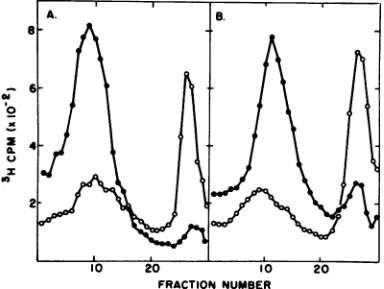
Finally, we tested the effect ofRNase H on
the release of the DNA product from 70S
RNA:DNA hybrid structures synthesized in
vitro since previous pulse-chase experiments
performed in our laboratory indicated that
DNA initially associated withviral70S RNAis
ultimatelydisplaced from the hybridstructures
bysome asyetundescribed mechanism (4, 19). We performed similar pulse-chase studies with
detergent-disrupted virus under conditions in
which RNase H activityisselectively inhibited
with NaF. The same amount ofpulse-labeled
DNA was chased out of the 70S RNA:DNA
hybrid structuresirrespective ofwhetheror not NaF was present in the reaction mixture (Fig.
3). Therefore,although much of the DNA
prod-uct may have been displaced from the 70S
RNA:DNA hybrids during thecourse of
pulse-chase experimentsbythe action of other
virion-associated nucleases, RNase H did notappear
toincrease either the rate (datanotshown) or
amountofDNA releasedfrom 70S RNA:DNA
hybrids significantly (Fig. 3). This contention
was substantiated by the apparent lack of
release of DNA from purified 70S RNA:DNA
hybrids added toreaction mixtures containing
the purified AMV DNA polymerase (Collett
andFaras,unpublished data).Furthermore,no
displacement of DNA product from 70S
RNA:DNAhybridstructures could bedetected
during the synthesis of DNA in enzymatic
reactions containing purified 70S RNA and
AMV DNApolymerase (datanot shown).
Although theRNase H activity ofthe
RNA-directed DNApolymerase of oncornaviruses is
anintegralpartof theenzyme structure (12,22,
23) and is probably required to facilitate
the
synthesis ofproviral DNAinvivo, we havenot
yetbeen able todetectany significant effect on
the synthesis of DNA in vitro. From these
studies it appears unlikely that the enzyme
activity is responsible for any of the major
limitations andrestrictions of reverse
transcrip-tion in vitro. The reasons for our inability to
detect any effect of RNase H during DNA
synthesis are not clear, but mayreflect either
the structure of the 70S RNA:DNA hybrid
molecules synthesized invitro orsome specific
requirement ofRNase H activity, orboth.For
example, since the enzyme is a processive
exoribonuclease requiring unblockedtermini of
the RNA moiety of RNA:DNA hybrids for
on November 10, 2019 by guest
http://jvi.asm.org/
[image:2.491.61.235.54.275.2]NOTES 293
o$J
a.~~~~~~~~~~~
20
40
6080
DISTANCE
MIGRATED
(mm)FIG. 2. Effect ofRNase H on 70S template RNA during the enzymatic synthesis of DNA. Theeffect of
RNase Hactivity on the 70S RNA template during enzymatic synthesis of DNA wasdeterminedasfollows. Deoxynucleoside triphosphateswereomittedfromcontrolreactions to inhibit DNA synthesis and thus prevent
the formation of a potential RNA:DNA hybrid substrate for RNase H. Conversely, reactions containing
deoxynucleoside triphosphates synthesizeRNA:DNA hybrid structures, which were tested for theirpossible
utilization by RNase Has asubstrate. Both reactions contained 3H-labeled 70S RNA (50,000 counts/min),
purified AMV DNA polymerase, and 32 ug of bentonite per ml, which inhibits all traces of nonspecific
nucleolytic activitypresent in the AMV DNApolymerase preparations withoutappreciably affecting either RNase H or DNA polymerase activity under the conditions employed (Collett and Faras, manuscript in
preparation).Afterincubation at 37 Cfor1 h, 70S RNA or 70S RNA:DNA hybrid structures were extracted
with sodiumdodecyl sulfate-phenol (19), precipitatedwithethanol, denatured by heat, and analyzed in 2.25%
polyacrylamide gels (0.4 by 10 cm) as described previously (2a, 6, 19). The solid line representsdenatured 70SRNA incubated in reaction mixtures lacking deoxynucleoside triphosphates. The broken line represents 70SRNA:DNAhybrids synthesized in reaction mixturescontainingdeoxynucleoside triphosphates.
Differen-tially labeled 28S and18SrRNAwere includedasmarkers in thegels. The twoelectropherograms are
super-imposed for comparativepurposes.
A.
8.
activity (12, 16), it is possible thatvery few, ifs - any, of the 70S RNA:DNA hybrid structures
synthesized
in vitroexhibit thenecessarystruc-ture required for activity. However, although
6-6
'o r \ \ l t \ l t concentrationof3.5 x 10-6and 1.8 x 10- 6M, respec-tively. Each reaction was divided into two aliquots
N4 and incubatedfor 15minat37C.Afterthe
incuba-tionperiod,oneofthe reactions(pulse labeled) was
z
stopped by
the addition of 0.5% sodiumdodecyl
2 I w I \ . , x SY \ sulfateand incubated with 500 Mgof Pronase per ml for 30minat 37 C. The other reaction(pulse-chase)
was incubated for an additional 105minat 37 C after
.RACTION theadditionofa140-foldexcessofunlabeled TTP and
I0
OU2BER
20
a50-fold
excessof unlabeled
dATP. The reactionwasFRACTIONNUMBER
adjusted
to 0.5%sodium dodecyl sulfate and 500,g
of FIG. 3. Effect ofRNase Hactivity on the displace- Pronase per ml and incubated for 30 min at 37 C. ment ofDNA from 70S RNA:DNA hybrids during After phenol extraction and ethanolprecipitation,
enzymatic synthesis of DNA by detergent-disrupted samples were analyzed byrate-zonal centrifugation in RSV. Standard reaction mixtures containing deter- anSW50.1rotor for100minat50,000 rpm. A and Bgent-disrupted virus were incubated at 37 C either represent the enzymatic productsynthesized in the in the presence or absence of NaF. Both unla- absence of NaF and in the presence of the
inhibitor,
beled dGTP and dCTP were present at a final con- respectively.Symbols: 0,enzymaticproduct synthe-centration of 4 x
10-'
M. The labeled precursors sized after a 15-minpulse; 0, enzymatic product['HJTTP and
['HJdATP
were included at a final synthesized after a pulse-chase. VOL. 17,1976on November 10, 2019 by guest
http://jvi.asm.org/
[image:3.491.87.425.57.275.2] [image:3.491.37.229.442.587.2]the precise nature ofthe hybridstructures has
not yetbeen elucidated,wehavecircumstantial
evidence suggestingthat the 5' end of the viral
RNAgenome might be capable of servingas a
substrate for RNase H. First, we and others
have localized the principle RSV RNA primer
molecule near (within 10%) the 5' end of the
RSV genome (K. Staskus, M. S. Collett, and
A. C. Faras, submittedfor publication;J.
Tay-lor, in press; and B. Cordell-Stewart, personal
communication). Secondly, under the reaction
conditions employed in these studies, most of
the DNA transcripts ranged between 900 and
1,500 nucleotides inlength (2a). Therefore, it is
entirely conceivablethat the 5' end of the viral
genome is in the form of RNA:DNA hybrid
structures suitable as a substrate for RNase H
activity. Ifthis wereso, thenonly <10% ofthe
RSVgenomewould be affectedbyRNaseHand,
therefore, wouldnotbedetected inourassay
sys-tem (Fig. 2). Anotherdifficulty is suggested by
the recent demonstration thatthe5' end of the
RSV RNAgenome is blockedby m7Gand
con-sists ofthe sequence m7GpppGmCp (J. Keith,
personal communication). RNase H maybe
in-capableofutilizingthisparticularterminusas a
substrate. Furthermore, avian RNA-directed
DNApolymerases maybe unable toeffectively
transcribethe"capped" 5' terminusoftheviral
genomein vitro and thusprevent the formation
of a suitable substrate for RNase H. Further
studies are currently in progress in our labora-tory to delineate the nature of the 70S RNA:
DNAhybridswithrespecttotheirstructureand
possible utilizationas apotential substrate for
RNase H.
Wethank C.Foxand S. Kanellosforexcellenttechnical
assistanceandP.Plagemannforeditorialassistance.
Thisinvestigationwassupported byPublic Health Service
research grantCA 14790-01fromtheNationalCancer
Insti-tute. M.S.C. was supported in part by a H. Rackham
Fellowshipfrom theUniversityofMichigan. LITERATURE CITED
1. Baltimore, D.,and D. F. Smoler. 1972. Association ofan
endonuclease with theavianmyeloblastosisvirus
de-oxyribonucleic acid polymerase. J. Biol. Chem. 247:7282-7287.
2. Brewer, L. C., and R. D. Wells. 1974. Mechanistic independence of avianmyeloblastosis virus DNA
po-lymerase and ribonuclease H.J.Virol.14:1494-1502.
2a. Collett, M. S., and A. J. Faras.1975.In vitro transcrip-tion of DNAfromthe70SRNAof Roussarcomavirus:
identification and characterization of various size
classes of DNAtranscripts.J. Virol.16:1220-1228.
3. Collett, M. S., R. M. Kieras, and A. J. Faras. 1975.
Studiesonthereplicationof reticuloendotheliosis
vi-rus: detection ofviral-specificDNAsequences in
in-fected chick cells.Virology65:436-445.
4. Faras, A.J., L. Fanshier,A. C. Garapin, W.Levinson,
and J. M.Bishop.1971.Deoxyribonucleicacid
polym-ofdouble-stranded deoxyribonucleic acid synthesis. J. Virol. 7:539-548.
5. Faras, A. J., J. M. Taylor, W. E. Levinson, H. M. Goodman, and J. M. Bishop. 1973. RNA-directed DNA polymerase of Rous sarcoma virus: initiation of synthe-sis with 70S viral RNA as template. J. Mol. Biol. 79:163-183.
6. Faras, A. J., J. M. Taylor, J. P. McDonnell, W. E. Levinson, and J. M. Bishop. 1972. Purification and characterization of thedeoxyribonucleic acid polymer-aseassociated with Roussarcoma virus. Biochemistry 11:2334-2342.
7. Flugel, R. M., J. E. Larson, P. F. Schendel, R. W. Sweet, T. R. Tamblyn, and R. D. Wells. 1973. RNA-DNA bonds formed by DNA polymerases from bacteria and RNA tumor viruses, p. 309-331. In R. D. Wells and R. B. Inman (ed.), Second Annual Steenbock Sympo-sium; DNAsynthesis in vitro. University Park Press, Baltimore.
8. Garapin, A. C., J. P. McDonnell, W. E. Levinson, N. Quintrell,L.Fanshier,and J. M.Bishop. 1970. Deoxy-ribonucleic acidpolymerase associated with Rous sar-comavirus and avianmyeloblastosis virus: properties ofthe enzyme and its product. J. Virol. 6:589-598. 9. Garapin, A. C., H. E. Varmus, A. J. Faras, W. E.
Levinson, andJ. M. Bishop. 1973. RNA-directed DNA synthesis by virions of Rous sarcoma virus: further characterization of the templates and the extent of their transcription. Virology 52:264-274.
10. Gillespie, D., W. C. Saxinger, and R. C. Gallo. 1975. Information transfer in cells infected by RNA tumor viruses and extension to human neoplasia. Prog. Nu-cleic AcidRes.Mol. Biol. 15:1-108.
11. Grandgenett, D. P., G. F. Gerard, and M. Green. 1973. Ribonuclease H: anubiquitous activity in virions of ribonucleic acid tumor viruses. J. Virol. 10:1136-1142. 12. Grandgenett,D.P.,G. F. Gerard, and M. Green. 1973. A single subunit from avian myeloblastosis virus with both RNA-directedDNA polymerase and ribonuclease Hactivity.Proc. Natl. Acad. Sci. U.S.A.70:230-234. 13. Green, M., and G. F. Gerard. 1974. RNA-directed DNA
polymerase: properties and functions in oncogenic RNA viruses and cells. Prog. Nucleic Res. Mol. Biol. 14:187-334.
14. Hung, P. P. 1973.Ribonucleases of Rous sarcoma virus. Virology51:287-296.
15. Keller, W., and R. Crouch. 1972. Degradation of DNA: RNAhybridsby ribonuclease H and DNA polymerase ofcellularand viralorigin. Proc. Natl. Acad. Sci. U.S.A. 69:3360-3364.
16. Leis, J.,I.Berkower, and J. Hurwitz. 1973. Mechanism of action ofribonucleaseHisolated from avian myeloblas-tosisvirus andEscherichia coli. Proc. Natl. Acad.Sci. U.S.A. 70:466-470.
17. Molling, K., D. P.Bolognesi, H. Bauer, W. Busen, H. W. Plassmann, and P. Hausen. 1971.Association of viral
reversetranscriptase of an enzymedegradingthe RNA moiety of RNA-DNAhybrids. Nature (London) New Biol. 234:240-243.
18. Quintrell,N., L.Fanshier, B. Evans,W. E.Levinson,and
J. M. Bishop. 1971. Deoxyribonucleic acid polym-erase(s) of Rous sarcoma virus: effects of virion-associated endonucleaseontheenzymaticproduct. J. Virol. 8:17-27.
19. Taylor, J. M., A. J. Faras, H. E. Varmus, W. E. Levinson, and J. M. Bishop. 1972. Ribonucleic acid directed deoxyribonucleic acidsynthesisby purified deoxyribo-nucleic acidpolymeraseofRoussarcomavirus: charac-terization of the enzymatic product. Biochemistry
11:2343-2351.
on November 10, 2019 by guest
http://jvi.asm.org/
NOTES 295 20. Temin, H. M., and D. Baltimore. 1972. RNA-directed
DNA synthesis and RNAtumorviruses,p.129-186.In
K. M. Smith and M. A. Lauffler (ed.), Advances in virusresearch, vol.17.AcademicPress Inc., New York.
21. Varmus, H.E.,W. E. Levinson, and J. M. Bishop. 1971.
Extent of transcription by the RNA-dependent DNA polymerase ofRous sarcoma virus. Nature (London)
New Biol.233:19-21.
22. Verma, I. M. 1975. Studies onreverse transcriptase of
RNA tumor viruses. I. Localization ofthermolabile
DNA polymerase and RNase H activities on one
polypeptide. J. Virol. 15:121-126.
23. Verma, I. M. 1975.Studies on reversetranscriptase of
RNAtumorviruses. III.Propertiesofpurified Moloney murine leukemiavirus DNA polymerase and
associ-ated RNase H. J. Virol. 15:843-854.
24. Wang,L., andP.H.Duesberg. 1973.DNApolymeraseof murine sarcoma-leukemia viurs: lack of detectable RNase H and low activity with viralRNA and natural
DNAtemplates. J. Virol. 12:1512-1521. VOL. 17, 1976
on November 10, 2019 by guest
http://jvi.asm.org/