A decision-analysis-based framework for analyzing stakeholder behaviour in scenario planning
In press at European Journal of Operational Research. Accepted for publication on July 12th, 2015.
George Cairns, School of Management, RMIT University, Melbourne, Australia1 Paul Goodwin, Department of Management, University of Bath, Bath, UK George Wright, Strathclyde Business School, University of Strathclyde, Glasgow, UK
Professor George Cairns Contact Details:
School of Management, Z Block, Level 9, Queensland University of Technology, 2 George Street, BRISBANE, QLD 4000, Australia.
Email: [email protected] Tel: +61 (0) 416 514 560
Professor Paul Goodwin Contact Details:
School of Management, University of Bath, Claverton Down Rd, BATH, BA2 7AY, UK. Email: [email protected]
Tel: +44 (0) 1225 383549
Professor George Wright (Corresponding Author) Contact Details:
University of Strathclyde, Department of Strategy and Organisation, Livingstone Tower, Richmond Street, GLASGOW, G1 1XQ, UK.
Email:[email protected] Tel: +44 (0)141 548 3940 (EXT. 3940)
A decision-analysis-based framework for analyzing stakeholder behaviour in scenario planning
Abstract
Scenario planning is a method widely used by strategic planners to address uncertainty about the future. However, current methods either fail to address the future behaviour and impact of stakeholders or they treat the role of stakeholders informally. We present a practical decision-analysis-based methodology for analysing stakeholder objectives and likely behaviour within contested unfolding futures. We address issues of power, interest, and commitment to achieve desired outcomes across a broad stakeholder constituency. Drawing on frameworks for corporate social responsibility (CSR), we provide an illustrative example of our approach to analyse a complex contested issue that crosses geographic, organizational and cultural boundaries. Whilst strategies can be developed by individual organizations that consider the interests of others – for example in consideration of an organization’s CSR agenda – we show that our augmentation of scenario method provides a further, nuanced, analysis of the power and objectives of all
concerned stakeholders across a variety of unfolding futures. The resulting modelling framework is intended to yield insights and hence more informed decision making by individual
stakeholders or regulators.
1. Introduction
Scenario analysis has long been recognized as a tool for strategic analysis by
organizations (cf. Schoemaker, 1991). In an uncertain and volatile world it avoids the dangers inherent in statistical extrapolations of current trends, or the biases that are often associated with experts’ estimates of future event probabilities. It provides a structured approach to enable the development of multiple narrative-based characterizations of how possible futures might unfold and allows alternative strategies to be tested so that their effectiveness and robustness can be assessed across these different futures. Recently, the combination of scenario method and multi-attribute decision analysis has been developed to allow the effectiveness of strategies to be modelled when an organization has multiple objectives. The approach reflects the need to
overcome the cognitive biases that have been identified in behavioral decision research. Because the human mind has limited information processing capacity these are likely to be particularly prominent when complex multifaceted problems are faced (e.g. Hogarth, 1987). The method addresses this by combining the benefits of using a structured ‘divide and conquer’ approach to decision making with those of scenario planning, such as its ability to challenge prevailing mental models and strategic inertia. As such, it offers a number of advantages to alternatives, such as the use of decision tree analysis for aiding decision making in the face of uncertainty (cf. Goodwin and Wright, 2001; Montibeller et al, 2006). However, one aspect of scenario planning that has received little attention is the development of structured approaches for anticipating the behaviour of stakeholders within particular scenarios (cf. Wright and Cairns, 2011). This aspect can be important because powerful stakeholders, whose interests are threatened by changes in their environment, are unlikely to remain inactive and their behaviour is likely to have a direct effect on the alternative futures that may prevail.
inherent in our stakeholder analysis provides insights for understanding the complex interplay of individual stakeholder actions.
The paper is structured as follows. First, we outline the intuitive logics scenario method as a tool for envisaging possible alternative futures that are regarded as being critical in terms of the uncertainty associated with them and/or their potential impact on an organization. We discuss how this basic method has been developed to involve consideration of the different perspectives of stakeholders (this enhancement is referred to as “critical scenario method” (CSM)), but argue that this approach should be extended further so that the behaviour of
different stakeholders in different futures can be anticipated. Then, we outline our augmentation of current scenario methods through embedding the stakeholder analysis framework. Thereafter, we present our illustrative example of application to the international business of ship disposal. Finally, we discuss the implications and limitations of our approach.
2. Intuitive logics and the critical scenario method
In the basic intuitive logics approach to scenario development (Cairns et al, 2010, Wright and Cairns, 2011, Chapter 2), a focal issue is first analysed by exploring the “driving forces” – political, economic, social, technological, ecological and legal (PESTEL) factors – that will shape the emergent future. These driving forces are then clustered through causal/chronological analysis to determine a smaller number of “higher level factors”, impactful to the focal issue. These factors are subjected to comparative impact/uncertainty analysis, using a matrix where each is first ranked along the length the horizontal axis for perceived impact on the issue relative to all others. Then, without disturbing this horizontal ordering, they are ranked for relative uncertainty on the vertical axis – where uncertainty is related to what the outcomes of events that the factor encapsulates might be.
The two factors that combine the greatest perceived impact with the greatest perceived uncertainty as to what that impact will be are labelled Factor A and Factor B. Four scenarios are constructed around the combination of “extreme outcomes” of Factors A and B (A1/B1; A1/B2; A2/B1; A2/B2). These outcomes need not be set on some “best/worst” continuum but, rather, might be defined in very different terms (e.g. financial vs. environmental) or in differential terms of either good (fine vs. excellent) or bad (poor vs. diabolical).
interests of stakeholders and how they might behave to protect or further these interests (Wright and Cairns, 2011). However, in the basic scenario method consideration of stakeholders is an option to be used only when scenario builders consider their actions to be relevant. Cairns et al (2010) suggested that this is a limitation and proposed what they have referred to as “critical scenario method” (CSM) which prompts interrogation of each of the scenarios from the perspective of the full range of stakeholders using Flyvbjerg’s (2001, 2003) value-rational question framework for phronetic social inquiry, namely:
“Where are we going?
Is this development desirable?
What, if anything, should we do about it?
Who gains and who loses, and by which mechanisms of power?” (Flyvbjerg, 2003: p. 364)
In the extant CSM literature, the answer to the first question (Where are we going?) is assumed to be answered by the title and brief outline of each of the four scenarios – presenting four different possibilities that are applicable to all stakeholders. The answers to the second and third questions are set out in a basic tabular format that summarises each in a few words for each stakeholder group for each scenario in terms of a projected impact (Is this desirable?) and
response (What should we do?). Here, the “we” is defined as the particular stakeholder group for whom the question is being considered. The final question is answered in summary form that considers all stakeholders and assesses which groups are major winners, which lose out and who holds key power, with the results presented in a tabular summary of basic “win/lose” options (Cairns et al., 2010, p. 977).
relative power of multiple stakeholders within each scenario. In addition, it does not consider how a single organization may vary or put aside its corporate social responsibility agenda (cf. Garriga and Melé, 2004) under volatile market conditions. Tapinos (2012) distinguishes between scenario development – the construction of scenario stories of possible and plausible futures – and scenario planning as a process that is directed towards decision-making and action through combining scenario development with strategy development. It can be seen that CSM, as it is currently presented, engages with scenario development and the role of stakeholders but, through its basic binary classifications, it lacks sophistication to effectively inform strategy development and hence action.
3. Background to the augmented CSM method
3.1 The role of decision analysis
Given the relative informality with which CSM incorporates the assessment of
stakeholder values and actions, our enhancement of CSM involves the use of decision analysis modeling methods to apply a structure to the process. Decision analysis can yield a number of potential benefits in this context (cf. Goodwin and Wright, 2001, 2014, Ram and Montibeller, 2013, Stewart et al. 2013). The need to consider a broad range of issues across a range of futures, including the organisation’s objectives and trade-offs between them, the performance of
alternative strategies and the possible behaviour of significant actors within different scenarios can mean that scenario planning will be complex. In the face of this complexity behavioral decision research suggests that decision makers will address a restricted set of issues so that the planning problem, as they frame it, is a distorted and deficient representation of the real problem. The decomposition structure inherent in decision analysis is designed to allow decision makers to address all the key issues involved in a decision and determine whether the existing set of options and objectives can be enhanced (Ram and Montibeller, 2013). Ram and Montibeller (2013) combined multi-attribute decision analysis with scenario planning in three case problems in Trinidad and Tobago and found that it encouraged participants to gather more information about options reflect on whether the existing set of options could be improved upon.
fundamental objectives –objectives that are both essential and controllable, in that the decision alternatives can influence the extent to which the objective is achieved. This framework is intended to make explicit ‘the values that one cares about in [a given] context’ and hence
produce statements of what the stakeholder wants to achieve in that context. The value-focussed framework distinguishes between means and ends objectives. An ends objective is an essential reason for a stakeholder’s interest in a situation. For example, it may be the minimization of the health impacts of an industrial activity on local population. Means objectives are those that are important because they have implications of other objectives. For example, the minimization of sulphur dioxide emissions may be a means objective because it is important in order to minimize heath impacts.
Tools such as means-ends objective networks and cognitive mapping can be used to sharpen an analyst’s understanding of the different stakeholders’ objectives and to distinguish between the different types. Gregory and Keeney (1994) report on an application of this approach in the elicitation of stakeholders’ objectives in relation to a proposal to construct a coalmine in Malaysia. The objectives here were elicited directly from representatives of the stakeholders and the intention here was to bring stakeholders together in the hope that they could find a solution that resolved their different interests. However, a key outcome was the generation of new policy alternatives that were acceptable to all parties. Such creative insights could also be helpful to an analyst attempting to anticipate alternative actions that might be pursued by actors who, while they are not formally engaged in negotiations or direct communications with other stakeholders, may through self-interest be considering mutually beneficial courses of action. Keller et al (2009) give detailed examples of other applications intended to: “identify mutually agreeable alternative actions, design new and better alternatives, and foresee opposition to decisions.” Again, these involved direct elicitation of objectives from stakeholders.
However successful applications of decision analysis to negotiation problems described in Raiffa (1982), Ulvila and Snider (1980) and Goodwin and Wright (2014) found that the use of multiattribute value analysis helped analysts to anticipate the objectives and actions of actors without the opportunity of direct elicitation and even where attempts may have been made to conceal these factors to secure an advantage in negotiations
pursued (Keeney and Gregory, 2005). These allow attribute values to be assigned numeric preference scores with the intention of making an unambiguous assessment of an option’s performance on an objective. Unambiguity is achieved when it is clear how to score a consequence on an attribute or how to interpret a score as a given consequence (Keeney and Gregory, 2005).
When addressing uncertainty, decision analysis methods have typically employed assessments of probabilities, with utilities being used to represent decision makers’ risk preferences. However, when decision makers have multiple objectives such analyses can be extremely complex. Durbach and Stewart (2012) provide a critical review of alternative methods and conclude that “[the combination of multicriteria decision analysis and scenario planning] exemplify reasonable compromise positions on the spectrum between methods that are theoretically rich but heavily parameterized and practically complex, and those that are
transparent and easily understood but may not conform to prescriptive principles of rationality”. If assessments have to be made for multiple stakeholders the need for such compromises is even greater as otherwise the analysis may well become intractable.
In almost all modelling processes there is a tension between the extent to which the model represents the real problem and the simplifications that are required to keep the process tractable. However, the simplification inherent in models brings a number of benefits. It allows decision makers to enhance their understanding of problems by focusing on key issues,
unobscured by less important details. In decision analysis it may even allow a more faithful representation of a real problem because the judgments that need to be elicited from decision makers are likely to be more straightforward and hence less prone to error (Edwards and Barron, 1994). Simple modelling processes are also likely to be more attractive to decision makers who may be suspicious of “black box” mathematical methods or unwilling to expend the necessary time and effort demanded by more complex formulations, though this to some extent may depend on cognitive decision making style (Boschetti et al., 2011). The use of a simple approximate model with acknowledged limitations may be preferable to a situation where decision makers resort to unaided judgments because they are unwilling to engage with a difficult modelling process (Keeney, 2004). These considerations lead us to propose the use of relatively simple decision analysis models within a CSM framework.
3.2 Identifying stakeholders
indifferent to the plight of strategically unimportant stakeholders, as managers their concerns are likely to focus on the concerns of financial stockholders. Similarly, whilst agreeing Freeman's (1994) “broad” definition of stakeholders – as those who can affect or are affected by the achievement of the organization's objectives – Heath (2006) notes that any downgrading of stockholder interests creates tension with corporate law, where most jurisdictions provide stockholders a special status that can be legally enforced. Carson (1993) takes this line of argument further in a more general way, arguing that the lesser interests of more important stakeholders should sometimes take precedence over the greater interest of less-important stakeholders.
Tashman and Raelin (2013) note that "stakeholder salience" to a particular firm will often be based on managerial perceptions. They note that when a firm's managers perceive stakeholder interests as conflicting, they are likely to assume that these interests are mutually exclusive. They then argue that, in such situations, managers may overlook one or more stakeholders because of an inability to cope with the resulting complexity – labeling this a “boundedly rational” response. Alternately, managers may undertake stakeholder analysis only to identify those that might resist or retaliate against the organization’s actions (cf. Ackermann and Eden, 2011).
The approach that we present here is specifically designed to enable engagement with complexity and ambiguity and facilitate “democratic conversation” on points of conflict. We challenge notions of “important” and “less-important” stakeholders where the focus of decision-making is on achieving a common good – providing the best outcome for the greatest number rather than the greatest return to the financial stockholders, who may be relatively few in number. Miles, Munilla and Darroch (2006, p. 195) propose such an inclusive approach, stating that it is good business practice “to actively engage all stakeholders…[] in the development of sustainable strategies that reflect both economic and socially responsible outcomes”. It is to such a value set of business and managerial decision-making that our proposed framework is directed.
3.3 Overview of the augmented critical scenario method
As outlined above, the application of the intuitive logics scenario method will result in four scenarios, each representing a plausible future. Stakeholders may, therefore, find
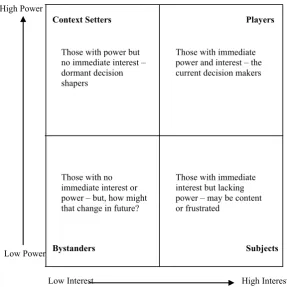
stakeholder each scenario may therefore have important implications for the extent to which its objectives are achieved. In some cases the emergence of a given scenario may be beneficial to that stakeholder in that its objectives are largely achieved. For example a domestic oil company would probably benefit from the legislation described above. However, if a stakeholder finds that the conditions prevailing in a particular scenario are inimical to the achievement of its objectives it is likely to take action to attempt to remedy the situation if it has the power, relative to other stakeholders, to do so. Figure 1 categorises stakeholders based on their power and interest in influencing future events.
INSERT FIGURE 1 ABOUT HERE.
The concept of power itself is the one of the most contested in the social sciences (cf. Rowlands, 1997, Kabeer, 1999). It has been viewed as the ability to make choices (Kabeer, 1999), the ability to overcome resistance to one’s intended actions from another actor (Emerson, 1962), the capacity to impact the surrounding world and the capacity to dominate other beings (Lukes 1974), the capacity of individual actors to exert their will (Finkelstein, 1992) and the ability to intentionally change another actor’s action-environment (where the action-environment consist of an actor’s alternatives, understanding of the situation and valuation) (Balzer, 1992). Flyvbjerg (2001, 2003) discusses complex understandings of power with reference to the philosophical texts of Nietzsche, Foucault and others.
In augmented critical scenario method the strategic choices available to stakeholders are already specified explicitly so it is important not to double count the ability to make these choices when making a subsequent assessment of a stakeholder’s power. Power is therefore perceived as being related to an individual strategy and reflects the ability of a stakeholder to pursue that strategy given the conditions that prevail in a scenario and the potential actions of other stakeholders. This means that stakeholders who have no option but to pursue a single strategy may have power in some scenarios when there is no resistance to this strategy. Formally, we define power as the probability of being able to implement a strategy in a given scenario. An "equilibrium" state, in relation to a particular scenario will occur when either: (i) all stakeholders have their objectives satisfied by the unfolding of external events without the need for stakeholder action by those with power, (ii) the stakeholders with power act to improve achievement of their own objectives and no stakeholder is disadvantaged in objective(s)
objectives but this is to the disadvantage of stakeholders who lack the power to take such actions.
Multiattribute decision analysis in the form of value scales and swing weights enable assessments to be made of the extent to which a given stakeholder’s objectives would be achieved in a given scenario, taking into account the trade-offs they would be prepared to make between objectives. However, because the focus is on the extent to which an objective would be achieved it is necessary to use global scales with end points of “zero achievement” (scoring 0) and “complete achievement” (scoring 10). Because the ends of the scale are not arbitrary, as in an interval scale, (0 meaning no achievement at all) the scores will be measured on a ratio scale. This raises the question of what would represent the complete non achievement or complete achievement of an objective. Monat (2009) suggests a number of approaches such as
experienced extreme values, imagined extremes, aspirational extremes and universal extremes (the worst and best possible values conceivable). Using one of these approaches a company could, for example, estimate its largest possible annual loss as $50 million and its largest possible profit as $60m. When formulating global scales it is important to be aware that overly long scales can be problematical in discriminating between a set of options that have values that occupy only a small part of the range. For example, profits ranging from $2 million to $4 million would have scores that were hardly distinguishable on a scale ranging from -$50 billion to +$50 billion. It is important to assess whether the bounds of the scale represent levels that are realistic and feasible.
In contrast, there are reasons why a scale may occupy too narrow a range. Behavioral decision research indicates that ranges like these are typically underestimated so some extension of them may be necessary after careful thought (Makridakis et al, 2009). Montibeller, and von
Winterfeldt (2015) discuss methods that can reduce or overcome this bias. These include
eliciting ranges from multiple experts to generate a wide range of perspectives, the avoidance of values that might act as anchors in the estimation process and the use counterfactuals to
encourage people to think of reasons why an outcome might lie outside the initially estimated range.
power to implement these actions) it helps an assessment to be made of which action they would be most likely to select. Finally, in the equilibrium state, the augmented critical scenario method enables the extent to which all stakeholders will have achieved their objectives to be determined, following the actions of powerful stakeholders.
The stages in the augmented critical scenario method are as follows.
1) Formulate scenarios.
2) Identify stakeholder groupings and the objectives that each wishes to achieve. 3) Obtain a weighted score to determine the extent to which each stakeholder group’s
objectives are achieved within each scenario (exclude the effect of any potential new actions by stakeholders at this stage). Plot the results.
4) For each stakeholder who has a significant shortfall in the achievement of their objectives in a given scenario, identify strategies available to them (if any) for remedying the situation.
5) For each strategy obtain a new weighted score to determine the extent to which the stakeholder’s objectives would be achieved if the strategy was implemented
6) For each strategy rate the relative power of the stakeholder to implement the strategy in the given scenario
7) For each scenario, plot the weighted scores of the strategies against the power rating, and determine the strategy that each stakeholder would be likely to select
8) Identify the consequences of these actions for all stakeholders in each scenario 9) Apply sensitivity analysis to the assessed scores, weights and power ratings.
4. Illustrating the “augmented critical scenario method”
Our illustrative case study builds on Cairns’ (2014) analysis of global ship disposal and the Bangladesh ship breaking industry, in which Factors A and B, respectively, are posited as:
“Effectiveness of global regulation”, and
“Commitment to ‘green practices’ in Bangladesh”.
“Global Cooperation” – effective global regulation combined with internal commitment to change in Bangladesh (A1/B1),
“World Divided” – nominally effective global regulation, but without commitment to enforcement and change within Bangladesh (A1/B2),
“Bangladesh Goes Alone” – the industry in Bangladesh is shut down, but dirty breaking transfers to other least developed countries (LDCs) without global control (A2/B1), and, “Business-as-usual” – dirty breaking continues unabated (A2/B2).
Building on these outlines, we expand the scenarios through the various stages as follows, with further research from a broad range of sources:
4.1 Stage 1: Formulate scenarios
Our expanded scenario outlines are as follows:
4.1.1 Scenario A: Global Cooperation
In a world of economic and political stability, there is international agreement and action to require disposal of redundant ships by the use of “green” breaking, brought about by the combined actions of a wide variety of stakeholders, across and within nations. At the
international level, there is commitment by the International Maritime Organization (IMO), ship builders and owners (cf. NGO Shipbreaking Platform, 2014), insurance brokers, countries of registration, etc. to enforce regulation (cf. NGO Shipbreaking Platform, 2013). At the same time, there is commitment to the prevention of beaching by the governments of India and Pakistan and investment in “green” technologies (cf. Daily Star, 2011), with inward investment and/or
international aid as well as local finance for Bangladesh.
4.1.2 Scenario B: A World Divided
Global conditions are characterized by economic and political stability. There is concerted action by environmental pressure groups, ship-owning nations’ governments,
transnational agencies and others at the supply end of the chain to develop a binding accord that seeks to end to the practice of beaching. This prevents major international shipping companies from selling off ships without retaining control over their final dismantling (cf.
Huda, 2012) and over time the yards dismantle a diminishing supply of older and smaller ships from unregistered sources in countries outside of the accord.
4.1.3 Scenario C: Bangladesh Goes Alone
The global economic and political environment remains turbulent but, under pressure from both international NGOs and local pressure groups such as Young Power for Social Action (YPSA) and the Bangladesh Environmental Lawyers Association (BELA), the Bangladesh government commits to legislation to ban the beaching and dismantling of ships (cf. Daily Star, 2012; NGO Platform on Shipbreaking, 2009). However, despite court orders to the contrary (cf. Greenpeace/FIDH, 2005), redundant ships continue to be beached for breaking in India, whilst Pakistan turns a blind eye, and new operations start up in Africa. With the IMO remaining a “toothless tiger” (IMO, 2004) and registration states showing no desire to intervene, the practice of beaching persists in its worst form in these other locations.
4.1.4 Scenario D: Business as Usual
Nothing changes in a world in economic and political uncertainty. There is an expressed desire by many to put an end to beaching and dirty breaking, but there is no effective
international or local framework to prevent it.
4.2 Stage 2: Identify stakeholder groupings and the objectives that each wish to achieve in their strategic actions
In this section, we address the objectives of three illustrative stakeholder entities, in order to open debate on their interaction with one another. Whilst our framework is designed to
address the full stakeholder constituency, here we restrict our illustration to three stakeholders for reasons of space and simplicity. We recognise that the wider stakeholder constituency includes those who have complex and perhaps ambiguous objectives and options and consider the possibilities of more complex and inclusive modelling in our later discussion.
The following stakeholder outlines are based on fact and literature but should not be identified as real individuals or organizations that exist in the present or past:
a) GlobeTrade: a global shipping company with the key objective of remaining competitive and providing a return to stockholders in a market that is subject to volatile financial and
within Europe and the US and possible negative reputation risk factors that might influence its institutional stockholders. It considers its CSR options in the context of different external market conditions across scenarios.
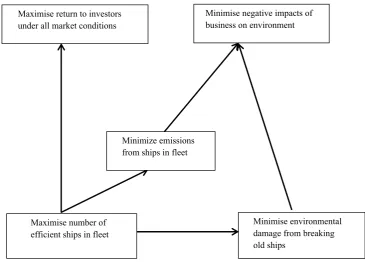
Figure 2 displays a possible mean-ends objectives network for GlobeTrade. The company has two fundamental objectives at the top of the network. The lower–level objectives show how the higher levels objective can be better achieved (Keeney, 1992). The arrows show the direction of influence. For example, maximising the number of efficient new ships in the company’s fleet, will serve to minimize emissions and help to minimize the negative effects of the company’s activities on the environment. However, more new ships in the fleet will also mean that more older ships need to be broken. The process of structuring diagrams like this should help an analyst to identify gaps where a stakeholder’s objectives may have been
inadvertently omitted (Bond et al., 2008). The risk of inadvertent omission of objectives can by reduced by subsequently challenging people to extend their list of objectives and combining lists generated independently by individuals in the planning team (Bond et al., 2010). Ideally, the objectives that are eventually identified should meet the criterion of mutual preference
independence for the stakeholder group. After several iterations two objectives are identified for GlobeTrade: (i) maximise financial returns, and (ii) minimise pollution from ‘dirty’ ship
breaking.
b) GreenWorld: a single issue international environmental NGO with the fundamental objective of minimising the shipping industry’s damage to the environment. It thus has a non-negotiable means objective of minimizing dirty ship breaking. It proclaims its CSR agenda as being the common good and it will operate in any way within, and sometimes outside legal frameworks using direct action and political manoeuvring.
c) Workers: those who provide labour in one of the major yards in Bangladesh. The workers have the fundamental objective of maximising the welfare of their families who mostly live in the rural hinterland of northern Bangladesh where there is little or no opportunity for
Star, 2009). (For brevity a means-ends objectives network is not displayed for this stakeholder group.)
INSERT FIGURE 2 ABOUT HERE.
4.3 Stage 3: Obtain a weighted score to determine the extent to which each stakeholder group’s objectives are achieved within each scenario
GlobeTrade estimates that its possible annual returns (measured as profit) could range between a loss of $15million and a profit of $180 million. These are assigned values of 0 and 10 on the global scale for returns. Profits are then estimated for each scenario and assigned a score based on their distance between -$15 million and $180 million. Linear value functions have been assumed here for simplicity. Edwards and Barron (1994) found that these were an accurate approximation to non-linear value functions, unless the non-linearity was such that the ratio of the steepest slope to the least steep was greater than 2.5. However, Stewart (1996) indicated, on the basis of simulations, that multiattribute value models can be sensitive to the shape of the constituent value functions. This may particularly be the case where long scales are associated with global value functions. When linearity cannot be assumed, methods such as bisection (e.g. see Goodwin and Wright, 2014, p.43) can be used to elicit the required values. For ‘dirty ship breaking’ the gross tonnage of the company’s ships broken in this way per year is estimated to range from 0 to 1.5 million. These are assigned values of 10 and 0, respectively on the global scale for gross ship tonnage broken. The estimated number that would be broken in each scenario is then mapped on to this scale. Table 1 shows the scores obtained. Note that, in the case of objectives for which there is no natural numeric scale (e.g. company image or
reputation), scores can be assigned directly onto the scale to show how a stakeholder’s preference for a given outcome compared to the worst and best possible outcomes.
INSERT TABLE 1 ABOUT HERE.
ships broken under dirty conditions from 1.5 million to zero. The swing on the financial returns objectives is the most preferred so this is assigned a ‘raw’ weight of 10. A swing on the ship breaking objective is considered only 2/3 as preferable yielding a raw weight of 6.67. These weights are then normalized by dividing by their sum (16.67) to yield weights of 0.6 for ‘returns’ and 0.4 for ‘ship breaking’. These weights are multiplied by the scores to give weighted average scores that show the relative extent to which GlobeTrade meets its objectives in each scenario. The results are shown in Table 2. Comparing these to the maximum value of 10 indicates that that GlobeTrade would be dissatisfied in all scenarios, particularly World Divided.
INSERT TABLE 2 ABOUT HERE.
Table 3 shows the weighted scores for all stakeholders. These have been obtained using a similar process to that used for GlobeTrade. Note that GreenWorld will be extremely dissatisfied in the Business-as-Usual as scenario, while the Workers see their interests as best served in this scenario.
INSERT TABLE 3 ABOUT HERE.
4.4 Stage 4: For each stakeholder who has a significant shortfall in the achievement of their objectives in a given scenario, identify strategies available to them (if any) for remedying the situation.
For GlobeTrade, the strategic options to remain competitive in volatile trading
conditions, but with secondary consideration of the CSR/environmental agenda and its possible consequences are posited as:
a) Order new efficient ships and dispose of old ships directly to “green” breakers, b) Order new efficient ships and dispose of old ships on an open market through
third-party agents, seeking guarantees of “green” disposal. These, however, have been shown to be unenforceable internationally and often unenforced locally (cf. Government of India, 2009; IMOWatch, 2010; USEPA, 20092),
c) Keep ships until end of viable life then dispose of them on open market, most likely to end life on dirty beaches under current prevailing conditions.
For GreenWorld, with its no-compromise focus on a closure agenda, we posit a single strategic option; that is, to advocate for green ship breaking globally and the closure of all dirty beaching yards. Finally, we see the Workers as having no real strategic options, other than continuing with the status quo. We have assumed here that strategies can be applied in different scenarios. In some cases, a completely different set of strategies may be applicable in each scenario.
4.5 Stage 5: For each strategy obtain a new weighted score to determine the extent to which the stakeholder’s objectives would be achieved if the strategy was implemented
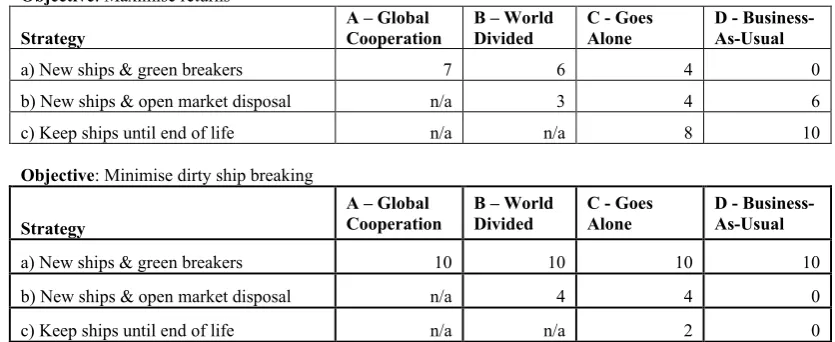
Only GlobeTrade has multiple strategies available to it. Table 4 shows the effectiveness of each strategy (measured, as before, on the 0 to 10 global scale) in achieving each objective in each scenario. Note that these scores reflect the conditions that exist within each scenario and the likely actions of other stakeholders within that scenario. Actions by GreenWorld against
GlobeTrade if it pursues the strategy of keeping ships to the end of their life are not thought to influence significantly GlobeTrade’s returns in this scenario though their actions may reduce the probability of this strategy being adopted in the first place (see Stage 6).
INSERT TABLE 4 ABOUT HERE.
The swing weights that were derived earlier are applied to these scores to obtain the weighted scores in Table 5. These indicate that under the scenario of Global Cooperation, GlobeTrade would have
no choice but to order new efficient ships and dispose of old ships directly to “green” breakers. It would also prefer to follow this strategy in the World Divided and Goes Alone scenarios, though in the latter case there is some uncertainty as keeping ships until the end of their life and then disposing of them on the open market is almost as attractive. Under Business-as-Usual it would clearly prefer to keep ships until the end of their life.
The scores, from 0-10, may be read as addressing Flyvbjerg’s (2003) second question: “Is this development desirable?”
4.6 Stage 6: For each strategy rate the relative power of the stakeholder to implement the strategy in the given scenario
While stakeholders may have strategies that they would most wish to pursue they may not always have the power to pursue them. Factors inherent in a given scenario, such as market conditions, and the potential actions of other stakeholders or regulatory bodies, such as
governments, may restrict the probability that a given strategy can be pursued in a given scenario. For each scenario we therefore estimate a power index to reflect the probability that a given strategy will be implementable in a particular scenario. This index is measured on a 0 (zero probability) to 10 (certainty) ratio scale. Note that the probability of being able to implement a strategy is to be distinguished from the success, or otherwise, of achieving one’s objectives through that strategy. The latter is already reflected in the weighted scores in Table 5.
We expect that, in scenarios like World Divided , Goes Alone, and Business-as-Usual, GlobeTrade’s ability to pursue strategy ‘a’ (ordering new efficient ships and dispose of old ships directly to “green” breakers) would be threatened by the actions of competitors who, could undercut its shipping rates by pursuing a ‘less green’ strategy. Thus, for example in the
Business-as-Usual scenario we estimate that the there is only a 4/10 probability that they would consider this strategy to be feasible. Similarly, pressure groups like GreenWorld could imperil GlobeTrade’s ability to pursue strategy ‘c’ (keeping ships to the end of their life) through actions intended to adversely affect the company’s reputation. Hence in the Business-as-Usual scenario this strategy would only have 7/10 probability of being pursued by the company even though this strategy has the highest weighted score in that scenario. GreenWorld is able to continue its advocacy for green ship breaking globally and the closure of all dirty beaching yard in all
INSERT TABLE 6 ABOUT HERE.
4.7 Stage 7: For each scenario, plot the weighted scores of the strategies again the power rating, and determine the strategy that each stakeholder would be likely to select
The results of this exercise are shown in Figure 3. It can be seen that in the Global Cooperation scenario the actions of the stakeholders are well defined. The Workers have no power to continue the status quo and both GlobeTrade and GreenWorld are able to pursue their single available strategies. In World Divided, GlobeTrade is most likely to pursue strategy a: “Order new efficient ships and dispose of old ships directly to green breakers” as this has the highest score and they also have the highest probability of implementing this strategy. Under the Goes Alone scenario there is some uncertainty as to whether they would pursue strategy ‘a’ or ’b’, as the former has the highest score but the latter has a greater probability of being
implementable. Under Business-as-Usual they will probably pursue c: “Keep ships until end of viable life then dispose of them on open market” as this yields the highest score and has the greatest possibility of being implemented.
INSERT FIGURE 3 ABOUT HERE.
4.8 Stage 8: Identify the consequences of these actions for all stakeholders in each scenario.
Next, we consider the level of achievement of stakeholders’ objective from the present day to the future outlined in each scenario, providing a response to the first part of Flyvbjerg’s (2003) fourth question – “Who gains and who loses?”. Note that direct comparison of the levels of satisfaction achieved by different stakeholders in a given scenario is not possible. A swing from a weighted score of 0 to 10 may bring more satisfaction to one stakeholder than another. Hence we can only consider the extent which given stakeholders gain or lose in different scenarios.
entities, the Workers are shown to be much more in a position of losing, particularly in relation to a focus on the key objective of maintaining livelihood, which is presented as a win situation only in the Business-As-Usual (D) scenario.
4.9 Stage 9: Apply sensitivity analysis to the assessed scores, weights and power ratings.
Because the scores, weights and power ratings are subjective estimates it is advisable to investigate how robust the indications of the model are to changes in these values. Also when a team is making the assessments there may be disagreements between individual members and it useful to investigate the extent to which these differences would have an impact on the
conclusions drawn from the model. One question is whether there are circumstances where GlobeTrade would be likely to pursue the ‘greenest’ strategy (a) in the Business-as-Usual scenario. This would be likely to be the case if this strategy was placed to the ‘north-east’ of the GlobeTrade’s other strategies in the Business-as-Usual chart in figure 3. To achieve this, the power to implement this strategy would have to increase from 4 to above 7 and the normalized weight placed on minimising dirty ship breaking would have to increase from 0.4 to greater than 0.5 (see figure 4). Thus only a slight change in the weights could lead to the pursuit of this strategy. However, increasing the power to implement it might pose more of a challenge, with likely market conditions of high competition and costs combined with over-capacity and low sea freight rates.
INSERT FIGURE 4 ABOUT HERE.
5. Implications of the analysis
Our framework enables consideration of complex, inter-stakeholder relationships and the impact of strategic decision-making in support of, or in conflict with, the objectives and
aspirations of others. Here, developing our illustrative case study, we focus specifically on decisions informed by organizations’ considerations of corporate social responsibility and the potential impacts of these decisions on remote stakeholders.
trading conditions, GlobeTrade may be inclined towards a symbolic rather than substantive commitment to CSR (Perez-Batres et al., 2012). In addition, if global regulatory frameworks remain weak or non-existent (cf. Recyclingportal.eu, 2012), then there are no real grounds for concerned stockholders to exert pressure for substantive commitment. However, there is precedent for international NGOs like GreenWorld pursuing aggressive strategies that force alternative approaches by MNCs, as with Greenpeace’s engagement with Shell in relation to the Brent Spar oil platform (cf. Kirby, 1998). Across scenarios, depending upon the specific
economic, political, social and regulatory frameworks that exist, we see major organizations setting strategies that are both responsive to different futures for their own benefit and setting the ground for how others will be impacted within these different scenarios. However, as we posit for the Bangladesh Worker stakeholders, other stakeholders may have little or no capability to set strategy. At the same time, they may have aspirations that will either be met or destroyed by the actions of others.
This brings us back to consideration of Flybjerg’s third question – “What, if anything, should we do about it?” Here, we turn to consideration of the interplay between one group’s strategy and another’s future, looking first at the Global Cooperation (A) scenario. Here, Figure 2 indicates that both GlobeTrade and GreenWorld have achieved high weighted scores, with GlobeTrade having done so through pursuing its first choice strategic option that both generates stockholder return and follows a CSR/environmental agenda of common good. The external conditions are such that economic and political stability supports collaboration and cooperation across organizations and agencies. However, for the Worker group; with members who have no employment contracts, no security of employment, no trade union support and no real options for alternative employment; “jobs at any cost” is the key objective. Here, the Worker group are losers, compared to the outcome received under the Business as Usual (D) scenario, with the closure of the dirty breaking yards and, as a result, the loss of most of the associated jobs. Notice, however, that the Global Cooperation (A) scenario represents “equilibrium” state (iii) – see our earlier discussion in Section 3.3.
government of one of the world’s poorest countries is limited beyond its own boundaries. As such, it would require collaboration with and support from organizations and governments with broader economic and political power to bring necessary investment to build employment opportunities.
In the Business-As-Usual (D) scenario (Figure 3), GreenWorld is shown as a complete loser in relation to its single cause and objective whilst, here, GlobeTrade’s success in a weak economy and global market rests upon its focus on financial measures only, and withdrawal from any effective CSR/environmental agenda for ship disposal. If, however, GlobeTrade wishes to follow strategy (i) of ship replacement and green disposal within a scenario of Business-As-Usual for others, then it must do so by seeking to exercise its power in order to influence others to steer the future away from this scenario and towards the Global Cooperation scenario. However, it must do this under poor market conditions.
As we see, GlobeTrade has strategic options, but ones that require it to make decisions between objectives that are in opposition to each other in this scenario. If the company chooses to act for broad social, sustainability reasons rather than purely its own narrow financial
purposes, then the latter aim; and the primary objective of competitiveness; will be
compromised. We see here that GlobeTrade has options within this scenario whilst GreenWorld is seen to lose out. However, the Bangladesh Workers’ desire for jobs at any cost is met only in this scenario. Here the group has power to maintain the status quo, and to achieve its primary objective, through possession of its own physical labour which remains in demand on the beaches.
Similar tensions and issues can be identified between stakeholders across the remaining two scenarios, dependent upon which strategic options are pursued. The Bangladesh Goes Alone scenario shows a future in which the nation’s government has exercised power to close down the industry (cf. Daily Star, 2012). However, the government’s power does not transcend national boundaries, and no similar action is taken within other key jurisdictions of India and Pakistan. Here, we must consider the power differentials between nations, agencies and organizations across the supply chain, and the extent to which any one can bring about meaningful change acting on its own.
range of other stakeholders. Their “Stakeholder Influence Network” plots visually the formal and informal relationships between stakeholder groupings, providing insights into the degree to which a focal organization’s actions are likely to be monitored by other specific stakeholders – by considering which of the specific stakeholder’s goals might be attacked or endangered by a particular strategy or action. In our framework, considering every stakeholder’s position relative to other stakeholders’ prompts questions on the nature and relationships of power, on what if anything should be done about it, and on who gains and who loses as a result of decisions made.
6. Discussion
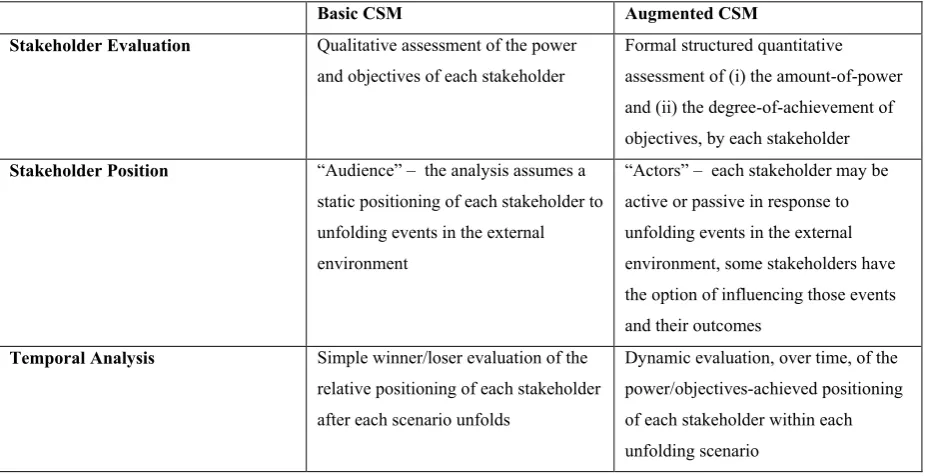
The framework of augmented CSM, that we have proposed and illustrated here, has the potential, when applied to considerations such as CSR, to enable democratic conversation on what is a complex and conflicted situation (Miles et al., 2006). Incorporating global scales for the level of achievement of key objectives and for the power for different stakeholder groups to pursue strategies designed to enhance the extent to which objectives are achieved, the model permits a dynamic evaluation of positions. It thereby enables a more nuanced analysis of the status of individual stakeholder groupings relative to each other within and across multiple future scenarios (see Table 7). Critically, the design of the method takes into account the need to provide a modelling framework that mitigates the cognitive biases that would likely to be
associated with unstructured strategic choice.
INSERT TABLE 7 ABOUT HERE.
Our approach supports consideration of the choices that some organizations have between different CSR agendas – ranging from the symbolic to the substantive – the impacts of choice on other stakeholders, and the role of power and pressure in determining choice and outcome (Perez-Batres et al., 2012). It incorporates the core elements of both scenario-based decision analysis and critical scenario method (CSM) that have established foundations,
respectively, in the literature on systematic strategy analysis (Goodwin and Wright, 2001, 2014) and application of Aristotelian phronēsis as a mode of social inquiry (Flyvbjerg, 2001, 2003).
assumption. For example the trade-off between increased financial returns and more pollution may not depend on which scenario is being considered. In other cases, for example, where the scenarios include different levels of cultural or political tolerance of pollution, weights specific to each scenario may need to be elicited (Montibeller et al., 20061). Similarly, as presented, our framework assumed that stakeholders had objectives that were applicable across all scenarios. In some cases different objectives may apply in different scenarios.
Our power indices assumed that we could determine the probability of prevailing with a given strategy in the light of the action of other stakeholders. This itself assumes that a
stakeholder has both the political acumen and the will to exercise their power to pursue a strategy when it is in their interests to do so (the ‘skill and will’ Mintzberg, 1983) In some situations the reaction of other stakeholders might itself be uncertain so that we may, for example, have a 0.8 probability of prevailing if they employ strategy A and a 0.4 probability if they employ strategy B. This situation could simply be displayed as two separate points on figure 2 to inform any discussion that is being supported by the model. Alternatively, the application of game theory may point to a state of equilibrium between the stakeholders, possibly indicating that each party would have complete power to pursue a particular strategy, given the reaction of the other (c.f. Dixit and Skeath, 1999). Similarly, if GreenWorld had alternative strategies available these might impact GlobeWorld’s weighted scores to different degrees. Again a game-theory matrix could be used here to display how the weighted scores depended on the interaction of the strategies of the opposing stakeholders and possibly be used to identify equilibrium.
In addition, the strategies were assumed to be discrete and mutually exclusive. The implementation of strategies along continua is possible (for example, GreenWorld might decide to assign resources anywhere between $50m and $100m to contesting dirty ship breaking) as are mixtures of strategies (e.g. commission a few new ships and send two-thirds of decommissioned ships to the green breakers and a third to the open market). These could be most easily
represented within the framework by a few selected ‘discrete’ strategies (e.g. GreenWorld assign resources of $50, $75 or $100m) which should be sufficient to inform the conversation that the model is supporting.
The scales presented for power and achievement of objectives are, of course, our own value-laden assessments of the positions of others with information accessed through secondary sources. However, as discussed earlier, approaches like this have been successful in supporting preparations for negotiations with other parties. Moreover, our assessments are based upon in-depth knowledge of the literature on ship disposal and of key decisions and actions across the global and Bangladesh contexts. Whilst acknowledging our own subjectivity in this particular illustrative case study, in the application of the method in the practice arena there is the
opportunity for in-depth research and analysis of the focal issue from multiple perspectives, and for live engagement with stakeholders in undertaking the scenario construction and developing the various indices. By raising questions about the interests and relative power of key
stakeholders the application of augmented CSM will provides guidance on what information needs to be gathered and where in-depth research needs to be directed.
Where it is not possible to engage the entire stakeholder constituency – which would be the likely situation for our issue no matter what the time and resources available – we advocate either engagement of legitimate proxy groups, or consideration of role-play of excluded groups by active participants. It has been shown that, even where participants have no first-hand experience of the lives of others, role-play can enhance the quality of the valid prediction of stakeholders’ actions – beyond mere information gathering (Green and Armstrong, 2011). This approach is equally applicable in the classroom where our analytic framework can be used as a mode of action learning.
Notwithstanding the insights derived from role-play, since our method can be used in a team-based context – where individual members’ evaluations of stakeholders’: (i) key objective achievement, and (ii) degree of power are explored and evaluated – it is possible that there will be differences of opinion. It may be that minor differences in such evaluations have little impact on the outcome of the interplay between actors and a particular unfolding future. However, more substantial differences in the evaluations must be addressed, since these may indicate very different scenario out-turns and, as such, these out-turns are sensitive to the team members’ evaluations. In these circumstances, further analysis and discussion must be undertaken in order to bring a resolution of the identified sensitivities.
stakeholders was both challenging and insightful. Our model requires that students identify remote but impacted, rather than merely immediate and involved stakeholders. For many, this was an exercise not considered by their organizations and, for some, one that raised ethical questions that challenged the basic assumptions of the business model. It would be
straightforward, in such teaching contexts, to include attitudinal measurements of the perceived value of the stakeholder analysis component relative to other components that provide structure to the analysis of an organisation's business environment.
In our view, future research would best be employed to evaluate decision makers’ experiences of using the method in different contexts and also address the importance of the limitations identified above, together with methods for overcoming them. For example, to what extent would making swing weights specific to particular scenarios add to the complexity of the method and potentially reduce its acceptability to users? How could game theory matrices best be integrated with the method, when the weighted scores of stakeholders depend on the
interaction of their strategies, without sacrificing the method’s tractability? Our application in the MBA classroom, outlined above, was within a stand-alone course which also provided the students’ first introduction to scenario methods and for which feedback was informal. Future iterations could incorporate more formal subjective evaluation under conditions of ethics approval. Further, some of the possibilities we outline here for evaluation of our model against other approaches might be tested and evaluated in a more controlled teaching environment. For example, where students are introduced to the theory and use of scenario methods at the outset of their study program (cf. Bradfield, Cairns & Wright, in press), they might then be required at a later stage to evaluate decisions in response to the same basic scenario problem using the alternative approaches outlined above.
Overall, our analytic framework is designed to enable a more complex and nuanced engagement with the “multiple realities” (Beech and Cairns, 2001) of stakeholder worlds. As such, it extends the possibilities of decision analysis in relation to strategic options across multiple scenarios and beyond the single organization’s field of interest (cf. Wright and Cairns, 2011), to incorporate broad stakeholder (Freeman, 1994) engagement and analysis.
7. Concluding remarks
Strategic planning in an uncertain and volatile world, where there are multiple
decision research that, when faced with this complexity, unaided decision makers can be subject to cognitive biases because of their inability to simultaneously process all the information required. Our aim is this paper has been to present a structured approach that allows decision makers to address the full range of issues and relationships that are pertinent in a given situation enabling them to gain new insights and a deeper understanding of their strategic options, taking into account the likely behavior of key actors if different futures prevail. Our step-by-step method analyses the interplay between stakeholders who have both different values and objectives and also differing degrees of power to act to achieve their objectives within an
unfolding set of events. As such it facilitates engagement with complex and conflicted situations and provides an aid to subsequent decision-making – whether based upon a CSR agenda, as here, or on an instrumental firm-centric rationality.
We propose that our method has potential value both in the classroom and the
boardroom; as a means of exploring complex business issues and assessing strategic options; and in broad society, for engaging with an analysis of the impact of organizational strategy and action across all stakeholders. In situations where there are overarching stakeholders with virtually complete power within their own domains, like governments, the framework also has potential value in identifying where interventions might be necessary to protect stakeholders who lack the power to resist exploitation or harm.
References
Agle, B. R., Donaldson, T., Freeman, E., Jensen, M. C., Mitchell, R. K. & Wood, D. J. (2008). Dialogue: toward superior stakeholder theory. Business Ethics Quarterly, 18: 153-190.
Ackermann, F., & Eden, C. (2011). Strategic management of stakeholders: theory and practice. Long Range Planning, 44: 179-196.
Aristotle. (350BC/2004) The Nicomachean ethics. Tr. J.A.K. Thomson, 1953. Rev. H. Tredennick, 1976. London: Penguin Books.
Balzer, W. (1992). Game Theory and Power Theory: A Critical Comparison. In T.Wartenberg (ed.), Rethinking Power. Albany:State University of New York Press.
BAN. (2005). The digital dump: Exporting re-use and abuse in Africa. Basel Action Network. Available at http://ban.org/films/TheDigitalDump.html, accessed 5 August 2013.
BAN. (2006). Hazardous ships dismantled in Pakistan. Toxic Trade News, 20 March. Available at
http://www.ban.org/ban_news/2006/060320_pakistan.html, accessed 13 April 2007. BBC. (2006). Pakistan ship breaking, BBC Inside Out, available at:
BBC. (2012) Where the world’s ships go to die, News Asia, 27 May. Available at
http://www.bbc.co.uk/news/world-asia-18182706, accessed 10 September 2012.
Bebbington, J., Larringa, C., & Moneva, J. M. (2008). Corporate social reporting and reputation risk management. Accounting, Auditing & Accountability Journal, published online: DOI 10.1108/09513570810863932.
Beech, N. and Cairns, G. (2001) Coping with change: the contribution of postdicthomous ontologies. Human Relations, 54: 1303-1324.
Bond, S.D., Carlson, K.A. & Keeney, R.L. (2008). Generating objectives: can decision makers articulate what they want? Management Science, 54: 56-70.
Bond, S.D., Carlson, K.A. & Keeney, R.L. (2010). Improving the generation of decision objectives. Decision Analysis, 7: 238-255.
Boschetti, F., Richert, C., Walker, I. & Price, J. (2011). Assessing attitudes and cognitive styles of stakeholders in environmental projects involving computer modelling. Ecological Modelling, 247: 98-111.
Bradfield, R., Cairns, G. & Wright, G. (in press). Teaching scenario analysis – an action learning pedagogy. Technological Forecasting & Social Change. Published online:
http://www.sciencedirect.com/science/article/pii/S0040162515001110#FCANote
Cairns, G. (2007). Postcard from Chittagong: Wish you were here? Critical Perspectives on International Business, 3 (3): 66-79.
Cairns, G. (2014) A critical scenario analysis of end-of-life ship disposal: the ‘bottom of the pyramid’ as opportunity or graveyard?. Critical Perspectives on International Business, 10 (3): 172-189. Cairns, G., Śliwa, M. and Wright, G. (2010) Problematizing international business futures through a
‘critical scenario method’. Futures, 42: 971-979.
Carson, T. L. (1993). Does the stakeholder theory constitute a new kind of theory of social responsibility?
Business Ethics Quarterly, 3: 171-176.
Chen, Y-S. & Chang, C-H. (2012). Greenwash and green trust: The mediation effects of green consumer confusion and green perceived risk. Journal of Business Ethics, published online: DOI
10.1007/s10551-012-1360-0.
Chick, A. & Micklethwaite, P. (2011). Design for Sustainable Change. Lausanne: AVA Publishing. Daily Star. (2012). SC approves closing hazardous ship-breaking yards. The Daily Star, 12 November.
Available at http://www.thedailystar.net/newDesign/latest_news.php?nid=42393, accessed 31 January 2013.
Daily Star. (2011). Govt plans ‘green’ ship-breaking. The Daily Star, 5 December. Available at
http://www.thedailystar.net/newDesign/news-details.php?nid=212979, accessed 31 January 2013. Daily Star. (2009). Thousands join human chain in Chittagong: Save ship-breaking sector, cry jobless
workers. The Daily Star, 22 March. Available at
Dixit, A. & Skeath, S. (1999). Games of strategy. New York: W.W. Norton.
Durbach, I.N. & Stewart, T.J. (2012) Modeling uncertainty in multi-criteria decision analysis. European Journal of Operational Research, 223(1): 1-14.
Edwards, W., & Barron, F. H. (1994). SMARTS and SMARTER – Improved simple methods for multiattribute utility measurement. Organizational Behaviour and Human Decision Processes, 60: 306-325
Emerson, R. M. (1962). Power-dependence relations. American Sociological Review, 27, 31-41.
FIDH/YPSA. (2008). Childbreaking yards: Child labour in the ship recycling industry in Bangladesh. Paris/Chittagong, Bangladesh: FIDH/YPSA in cooperation with the International Platform on Shipbreaking.
Finkelstein, S. (1992). Power in top management teams: Dimensions, measurement, and
validation. Academy of Management Journal, 35(3), 505-538.
Flyvbjerg, B. (2001). Making social science matter: Why social inquiry fails and how it can succeed again. Cambridge: Cambridge University Press.
Flyvbjerg, B. (2003). Making organization research matter: Power values and phronesis. In B.
Czarniawska and G. Sevón (Eds.) The northern lights: Organization theory in Scandinavia: 357-382. Copenhagen: Liber Abstrakt – Copenhagen Business School Press.
Freeman, R. E. (1994). The politics of stakeholder theory: Some future directions. Business Ethics Quarterly, 4(4): 409-421.
Freeman, R. E. & Reed, D. L. (1983). Stockholders and stakeholders: A new perspective on corporate governance. California Management Review, XXV (3).
Gariga E., & Melé, D. (2004). Corporate social responsibility theories: Mapping the territory. Journal of Business Ethics, 53: 51-71.
Goodwin, P. & Wright, G. (2001). Enhancing strategy evaluation in scenario planning: a role for decision analysis, Journal of Management Studies, 38, 1-16.
Goodwin. P. & Wright, G. (2014) Decision Analysis for Management Judgment, 5th Edition. Chichester: Wiley.
Goodpaster, K. E. (1991). Business ethics and stakeholder analysis. Business Ethics Quarterly, 1: 53- 74.
Government of India. (2009). Subject: US ship ‘Platinum-ll’. Office memorandum No. 29-3/2009-HSMD, 9 November. New Delhi: Ministry of Environment & Forests.
Green, K. C. (2002). Forecasting decisions in conflict situations: A comparison of game theory, role-playing, and unaided judgment. International Journal of Forecasting, 18: 321-344.
Greenpeace/FIDH. (2005). End of life ships: The human cost of breaking ships. Dhaka, Bangladesh: Greenpeace, International Federation of Human Rights, in conjunction with Young Power in Social Action.
Gregory, R.S. & Keeney, R.L. (1994) Creating policy alternatives using stakeholder values. Management Science, 40(8), pp.1035-1048.
Gregson, N., Crang, M., Ahamed, F., Akhtar, N. and Ferdous, R. (2010). Following things of rubbish value: end-of-life ships and ‘chocky-chocky’ furniture and Bangladeshi middle class consumer. Geoforum, 41(6): 846-858.
Harrison, J. S., & Wicks, A. C. (2013). Stakeholder theory, value, and firm performance. Business Ethics Quarterly, 23: 97-124.
Heath, J. (2006). Business ethics without stakeholders. Business Ethics Quarterly, 16: 533-557. Hogarth, R. (1987). Judgment and Choice. Second edition, Chichester: Wiley.
Huda, S. (2012). Ship-breaking sector set to get patronage from gvt. The Financial Express, 2 November. Available at
http://www.thefinancialexpress-bd.com/index.php?ref=MjBfMTFfMDJfMTJfMV85MF8xNDg1Nzc=, accessed 7 March 2013.
IMO. (2014) IMO Member State audit scheme is tool to eliminate sub-standard shipping, says IMO Secretary-General. Available at
http://www.imo.org/blast/mainframe.asp?topic_id=848&doc_id=3534, accessed 25 September 2014.
IMOWatch. (2010). Platinum ll case may change Indian vessel scrapping rules. Blogspot, 16 March. Available at http://imowatch.blogspot.com.au/2010/03/platinum-ll-case-may-change-indian.html, accessed 7 February 2013.
Jungermann, H., & Thuring, M. (1987). The use of mental models for generating scenarios. in G. Wright and P. Ayton (Eds.) Judgmental Forecasting. London: Wiley.
Kabeer, Naila (1999). The conditions and consequences of choice: Reflections on the
measurement of women's empowerment. United Nations, and United Nations Research Institute for Social Development Vol. 108. Geneva: UNRISD, 1999.
Kahneman, D. (2011). Thinking, fast and slow. New York: Farrar, Strauss and Giroux. Keeney, R.L. (1992) Value-focused thinking. Cambridge: Harvard University Press . Keeney, R. L. (2004). Making better decision makers. Decision Analysis, 1: 193-204.
Keeney, R.L. & Gregory, R.S. (2005) Selecting attributes to measure the achievement of objectives. Operations Research, 53(1): 1-11.
Keller, L.R. Simon, J., and Wang, Y. (2009) Multiple-Objective Decision Analysis Involving Multiple Stakeholders. Tutorials in Operations Research. Informs Conference.
http://dx.doi.org/10.1287/educ.1090.0066
Kirby, A. (1998). Sci-tech: Brent Spar’s long saga. BBC News. Available at
Lukes, S. (1974). Power: A radical view (Vol. 1). Macmillan: London.
Makridakis, S., Hogarth, R. and Gaba, A. (2009). Dance with chance, Oxford: Oneworld Publications. Maersk. (Undated). Ship recycling. Available at
http://www.maersk.com/Sustainability/EnvironmentAndClimate/Pages/ShipRecyclingAndWaste Handling.aspx, accessed 10 January, 2011.
Matten, D. & Moon, J. (2004). Corporate social responsibility education in Europe. Journal of Business Ethics, 54: 323-337.
Miles, M. P., Munilla, L. S & Darroch, J. (2006). The role of strategic conversations with stakeholders in the formation of corporate social responsibility strategy. Journal of Business Ethics, 69 (2): 195-205.
Mintzberg, H. (1983). Power in and around organizations.Englewood Cliffs, NJ: Prentice-Hall.
Monat, J.M. (2009). The benefits of global scaling in multi-criteria decision analysis, Judgment and Decision Making, 4: 492–508
Montibeller, G. & Franco, L.A. (2011) Raising the bar: strategic multi-criteria decision analysis. Journal of the Operational Research Society, 62(5): 855-867.
Montibeller, G., Gummer, H., & Tumidei, D. (2006). Combining scenario planning and multi‐
criteria decision analysis in practice. Journal of Multi‐Criteria Decision Analysis, 14(1‐
3), 5-20.
Montibeller, G., & von Winterfeldt. D.(2015). Cognitive and motivational biases in decision and risk analysis. Risk Analysis, (forthcoming). doi:10.1111/risa.12360.
NGO Platform on Shipbreaking. (2009). Victory for safe jobs and the environment: High Court halts deadly shipbreaking on the beaches of Bangladesh. Media Release, 18 March. Dhaka, Bangladesh: NGO Platform on Shipbreaking.
NGO Shipbreaking Platform. (2013). Green ship recycling: Growing support in EU Parliament for financial mechanism. Press Release, January 22. Available at
http://www.shipbreakingplatform.org/press-release-green-ship-recycling-growing-support-in-eu-parliament-for-financial-mechanism/, viewed 31 January 2013.
NGO Shipbreaking Platform. (2014). Platform news – platform applauds Hapag-Lloyd for new ship recycling policy, calls on ship owners to follow. Available at
http://www.shipbreakingplatform.org/platform-news-platform-applauds-hapag-lloyd-for-new-ship-recycling-policy-calls-on-ship-owners-to-follow/, accessed 25 September 2014.
Perez-Batres, L. A., Doh, J. P., Miller, V. V., & Pisani, M. J. (2012). Stakeholder pressures as determinants of CSR strategic choice: Why do firms choose symbolic versus substantive self-regulatory codes of conduct? Journal of Business Ethics, 110: 157-172.