Autonomous Robots
.
White Rose Research Online URL for this paper:
http://eprints.whiterose.ac.uk/148938/
Version: Accepted Version
Book Section:
Gleirscher, Mario orcid.org/0000-0002-9445-6863, Foster, Simon David
orcid.org/0000-0002-9889-9514 and Nemouchi, Yakoub (2019) Evolution of Formal
Model-based Assurance Cases for Autonomous Robots. In: Software Engineering and
Formal Methods. Lecture Notes in Computer Science . Springer , pp. 87-104.
https://doi.org/10.1007/978-3-030-30446-1_5
[email protected] https://eprints.whiterose.ac.uk/
Reuse
["licenses_typename_other" not defined]
Takedown
If you consider content in White Rose Research Online to be in breach of UK law, please notify us by
Assurance Cases for Autonomous Robots
Mario Gleirscher,∗[0000
−0002−9445−6863] Simon Foster,[0000−0002−9889−9514] and Yakoub Nemouchi
Department of Computer Science, University of York, United Kingdom
[email protected],http://www.cs.york.ac.uk
Abstract. An assurance case should carry sufficient evidence for a com-pelling argument that a system fulfils its guarantees under specific en-vironmental assumptions. Assurance cases are often subject of mainte-nance, evolution, and reuse. In this paper, we demonstrate how evidence of an assurance case can be formalised, and how an assurance case can be refined using this formalisation to increase argument confidence and to react to changing operational needs. Moreover, we propose two argument patterns for construction and extension and we implement these patterns using the generic proof assistant Isabelle. We illustrate our approach for an autonomous mobile ground robot. Finally, we relate our approach to international standards (e.g. DO-178C, ISO 26262) recommending the delivery and maintenance of assurance cases.
Keywords: Assurance case·formal verification·refinement·autonomous robot·integrated formal methods·model-based engineering.
1
Introduction
Autonomous robots in complex multi-participant environments can engage in risky events (e.g. because of faults or partial state knowledge) possibly lead-ing to accidents. To reduce the opportunities for all participants to engage in such events or their consequences, one wishes to observe only specific machine behaviours. Assurance Cases (ACs) [20] are structured arguments, supported by evidence, intended to demonstrate that such machines fulfil theirassurance guarantees [22], subject to certainassumptions about their environment [18,32]. Among the wide variety of assurance objectives, we will focus on safety in the rest of this paper, with a careful eye onliveness.
Compelling ACs require models to describe the behaviour of the real-world artefacts subjected to the assurance claims, and to provide evidence for these, contingent on validation. In particular, formal methods (FMs) can be applied to the rigorous analysis of a system’s state space, and to the computer-assisted ver-ification of requirements. However, verver-ification and validation can, in reality, fail to deliver safe systems, for example, due to an inadequate model that abstracts
∗
from essential detail. Such shortcomings can be difficult to identify in advance, and consequently, models and assurance cases have toevolve[2,7]. Particularly, one might want to modify or extend an existing AC, for example, weaken its assumptions, make its model more precise, or strengthen its guarantees. Several such steps might be required to arrive at an acceptable confidence level.
In their study of assurance practice, Nair et al. [27] report that evidence completeness and change impact is managed mostly manually using traceability matrices. These authors observe a lack of tool support for change management and that evidence structuring is done mostly textually rather than with model-based ACs. Importantly, their study raises the question of how evolution and change impact is identified, assessed, and managed at the level of ACs?
Contributions. We consider formal model-based assurance cases (FMACs) to construct assurance arguments in a rigorous and step-wise manner. We define an FMAC as an ACmodule that conveys formal verification results with respect to a model and certain environmental assumptions. Our motivation is the assur-ance of physical systems such as autonomous mobile robots, and so we chose to support models and requirements in differential dynamic logic (dL) [33].
We underpin our approach by ACpatterns for the incremental construction of increasingly richer models, guarantees, and proofs that these models fulfil the guarantees. We provide two patterns, one for AC construction and one for AC extension, particularly, for increasing confidence in an AC by making the formalisation successively more precise. Both patterns provide guidance to how successive engineering steps can preserve assurance results from previous steps. We implement these patterns in Isabelle/SACM [28] and show how they can be instantiated and how assurance claims can be linked to verification results.
We complement recent approaches to robot verification (e.g. [26]) by a data refinement[40] fordLthat is lifted to the level of AC construction and evolution.
For a mobile ground robot, we illustrate two refinement steps from a maximally abstract model to one describing safe path planning and emergency braking. We indicate how one can derive safety guarantees from hazard analysis yet avoiding too conservative solutions by adding liveness guarantees. We demonstrate our proofs in Isabelle/HOL [29] by formalising the robot model in an implementation of dL in Isabelle/UTP [10,11].
Related Work. Bate and Kelly [2] discuss the notion of AC modules, interfaces, and their composition into an AC architecture via claim matching and assump-tion/guarantee(A/G)-style reasoning (e.g. weakening of assumptions). Following their discussion of AC change with a focus on traceability and change impact analysis, we focus on AC extension for the verified evolution of AC modules.
Prokhorova et al. [34] propose the construction of formal model-based safety cases based on a classification of safety requirements using Event-B. The authors discuss argument patterns for all classes of requirements. The patterns integrate proof and model-checking evidence1and cover refinement steps. Complementing
1
their Event-B application, our approach supports hybrid system modelling. We cover their requirements classification, except for temporal and timing properties requiring binary modalities. We focus on step safety and liveness, and path safety. To support argument maintenance and scalability, we separate system modelling and proof derivation from argumentation, keeping model and proof details separate from the argument structure. This separation is facilitated in our Isabelle-based implementation by usingdLfor system modelling and verification
and the FMAC concept for assurance argumentation.
Oliveira et al. [30] propose hierarchical modular safety cases to reuse common product-line features in general safety arguments and to decompose and refine the general argument into feature-specific argument modules. While the authors cover hazard analysis (viz. model-based failure analysis) and product-line mod-elling, our notion of AC extension based on data refinement can be useful for the verified derivation of a product-specific AC from the product-line AC.
For adaptive systems, Calinescu et al. [4] elaborate on the idea of through-life argument maintenance [7,31], focusing on the maintenance of a parametric AC whose parameters are subject of optimisation during the operation of a system. We complement their approach by a notion of data refinement to accommodate fundamental structural changes frequently desired for argument evolution.
Overview. The remainder of this article is structured as follows: We introduce the concepts in Section 2, explain our contributions in Section3, evaluate our approach with a robot example in Section4, discuss implications on formal robot verification and certification practice in Section5, and conclude in Section 6.
2
Background and Formal Preliminaries
We introduce assurance cases from a practical viewpoint and provide the pre-liminaries on system specification and verification.
2.1 Assurance Cases
An AC is a compelling2 argument, supported by evidence, that a system in a specific context fulfils (or refuses to fulfil) guarantees of interest, for example, freedom of hazards (safety), sustained correct service (reliability), freedom of unauthorised access (security), or productivity (performance). Intuitively, an AC is a hierarchical structure, withclaims that are broken down into subclaims using argumentation strategies, and referencing an appropriatecontext, such as system element descriptions and environmental assumptions. An AC is deemed to be “finished” when all leaf claims are supported by adequateevidence, though there is always the possibility of evolution.
We consider ACs as formalised in theStructured Assurance Case Metamodel (SACM), an OMG standard.3Wei et al. [39] summarise the work around SACM
2
Usually structured, balanced, and exhibiting many further argumentation qualities. 3
and demonstrate how established frameworks like theGoal Structuring Notation (GSN) [19] and Claims Arguments Evidence (CAE)4 can be represented using SACM. SACM thus connects users of these techniques with rigorous model-based AC construction. SACM can be characterised by three principal concepts:
1. arguments, that present the claims and inferential links between them; 2. artifacts, evidence to support leaf claims, and the relations between them.
Examples include outputs of hazard analysis, actors, test reports, system data sheets, formal models, and verification results. An AC whose evidence is based on results obtained from analysis of system models, such as formal verification, is called amodel-based assurance case [16,39];
3. terminology, to support controlled languages for expressing claims, that are otherwise specified using free-form natural language. Often, these are used to refer to model elements in model-based ACs;
In AC modules, certain top-level claims and artefacts can be made public by an A/G-style ACinterface. Several modules can then be composed to produce the overall AC. Claims can besupported by an argument within the module or assumed to hold of thecontext. In the latter case, corresponding external argu-ments have to be imported from other AC modules. This can be achieved by A/G reasoning, as is present in the design-by-contract paradigm [25]. Addition-ally, AC modules adhere to the standardised SACM package concept.
AC modules often need to evolve, for example, because of updates of the system design or the hazard list. Such evolutions should be conservative, in that existing claims should remain supported, assumptions should remain satisfiable, and terminology should stay consistent. This need motivates our notion of AC extension, the key contribution of this paper, fostering step-wise development and evolution of ACs. For this, we further develop Isabelle/SACM, our imple-mentation of SACM as an interactive DSL for AC construction in the proof as-sistant Isabelle. Isabelle/SACM extends the document model Isabelle/DOF [3] to accommodate AC concepts and to provide well-formedness checking for ACs. Isabelle/SACM allows us to describe ACs with claims and evidence obtained from various formal methods. Details on Isabelle/SACM are explained in [28].
2.2 Isabelle/UTP and Differential Dynamic Logic
The evidence for an FMAC is obtained by formal verification using an imple-mentation of dL [33] in our verification framework, Isabelle/UTP [10,11]. dL
specialises Dynamic Logic by combining a modelling notation for hybrid sys-tems, called hybrid programs, with a formal property language for reasoning about such programs. In a hybrid program, we can use operators like sequential composition, assignment, branches and iteration, and an operator for specifying systems of ordinary differential equations (ODEs). It can therefore be used to represent hybrid systems that combine continuous evolution and discrete control. The property language extends predicate calculus with two modalities: [P]φ,
4
which specifies that φ holds in every state reachable from P; andhPiφ, which specifies that there is at least one state reachable fromP satisfyingφ.
Isabelle/UTP implements Hoare and He’sUnifying Theories of Programming (UTP) [17], a framework for development of semantic models for programming and modelling languages based on heterogeneous paradigms using an alpha-betised relational calculus. Isabelle/UTP develops this idea by allowing UTP semantic models to be adapted into verification tools, such as Hoare calculus deductive reasoning. Then, we can harness the array of automated proof tech-niques in Isabelle/HOL [29], such as integrated automated theorem provers, to discharge resulting verification conditions. We apply this approach to develop thedLhybrid program model, and the associated proof calculus as a set of
de-rived theorems. Moreover, we have developed a tactic,wp-tac, which calculates [P]φand hPiφconditions using Isabelle’s simplifier and thus automates proof.
3
Formal Model-based Assurance Cases
In this section, we develop FMACs, that is ACs that contain a formal model from which evidence for the top-level claims is derived. The informal structure of an FMAC is provided through Isabelle/SACM. We formalise claims using the modalities from dL, which allows us to formulate LTL-style guarantees of the
form p ⇒ ◦q,p ⇒ ♦q, and p ⇒ 2q. This integration of dynamic and tem-poral logic supports the objective underlying many ACs, that is, to integrate evidence from different provenance. We develop a formal notion of FMAC ex-tension, which employs both A/G reasoning and data refinement [40], which allows us to elaborate models in a style similar to Event-B refinement [34].
3.1 Assurance Case Construction
In this section, we introduce a generalised model of dL-style hybrid programs,
use these to define the notion of a Cyber-Physical Machine (CPM), and then define FMACs, which assure properties of a CPM using formal verification.
Hybrid programs are defined with respect to an alphabet,A, of typed state variable declarations (x :t), whose names are drawn from the set V. Ainduces a state spaceΣ, and hybrid programs are modelled as potentially heterogeneous alphabetised relations over state spaces, that is, subsets ofΣ1×Σ2. We give the following syntax for such relations.
Definition 1 (Generalised Hybrid Programs).
P::=P#P | P ⊓ P | P∗
|?E | hSi | V:=∗ | {S | E} S::=id|nil| S(V 7→ E)
Here,E gives syntax for expressions overA. Hybrid programs,P, are composed using sequential composition (P #Q), nondeterministic choice (P⊓Q), Kleene star (P∗
denoted as a relational predicate (for details see [10,11]). As usual in UTP [17], relations are partially ordered by refinement (P ⊑Q), which corresponds to uni-versally closed reverse implication. Most of the operators follow the dL hybrid
program notation, the exceptions being assignments and ODEs, whose general-isations help support data refinement.
Generalised assignment, hσi, uses a substitution, σ: a potentially heteroge-neous total function between state spaces, Σ1 → Σ2. The basic substitution id :Σ →Σ maps every variable to its present value. Then, hidiis the ineffec-tual program (skip). Moreover, nil : Σ1 → Σ2 is a heterogeneous substitution that assigns arbitrary values to every variable, ignoring the initial state.
An existing substitution can beupdatedwith a mapletx7→e, assumingxand ehave the same type. We then use the notation[x17→e1,· · ·,xn7→en]to denote
id(x17→e1,· · · ,xn 7→en), that is, the substitution that assignsn expressions to
n variables, whilst leaving all other variables in the alphabet unchanged. Then, the usual singleton assignmentx :=ecan be represented ash[x 7→e]i. Similarly, the notation Lx1 7→ e1,· · ·M constructs a heterogeneous substitution where x1 ande1are from different state spaces. Moreover, substitutions can be applied to expressions using σ†e, which substitutes all variables ine with those specified in σ. ODEs,{σ|b}, are modelled similarly but hereσ represents the mapping of variables to their derivatives, andb is a boundary condition, as indL.
In our model of hybrid programs, we define the modalitieshPiφand [P]φ
fromdLusing the corresponding UTP definitions for weakest precondition (wp)
and weakest liberal precondition (wlp) [17], respectively:
Definition 2 (Modalities). hPiφ,(∃v′•P #?φ) [P]φ,¬hPi(¬φ) Here,v′refers to the final value of the state. Thus,hPiφis the relational preimage ofP underφ, and[P]φis its dual defined by conjugation. From these definitions the usual laws of dL can be proved as theorems. We use hybrid programs to
represent CPMs, whose form is inspired by Parnas’ four-variable model [32]:
Definition 3. A CPM is a tuple M= (A,I,Inv,T)where
– A is an alphabet formalising the state space, which is divided into disjoint regions for controlled (ctrl), monitored (mon), and internal variables (st); – I ⊆ Ais an initialiser that assigns initial values to state variables; – Inv⊆ A is an invariant predicate overst andctrl;
– T ⊆ A × Ais the machine’s transition relation.
To reduce dependencies on the environment, we chose to not allow Inv to use monitored variables. The transition relation specifies the steps the machine can take, and is formulated using hybrid programs of the form
T = (?g1#P1⊓?g2#P2⊓ · · · ⊓?gn#Pn)
which corresponds to a set of non-deterministic guarded commands (gi →Pi).
Definition 4. A CPM is valid if the following conditions hold:
1. I ∩Inv6=∅ — there is a valid initial state satisfying the invariant; 2. Inv⇒[T]Inv — the invariant is maintained by all transitions;
3. Inv⇒ hT itrue — if the invariant holds, there is an enabled transition; 4. ∀r • hT ir ⇒ (∃(ctrl,st) • r) — only controlled and state variables are
changed by the body; any predicate r , refering tomononly, is invariant.
The conditions together ensure the machine is well-formed, maintains the invari-ant, and is free of deadlock. We can now use CPMs to define FMACs:
Definition 5. An FMAC is a tupleAC = (M,As,Gr)with
– a valid cyber-physical machine (M) describing the system behaviours; – a set of environmental assumptions (As), specified as predicates onmon; – a set of guarantees (Gr), specified as predicates onmon,ctrl,st.
The assumption As constrains the environment with a predicate on the moni-tored variables. The guarantee predicates are LTL formulas corresponding to a subset of dLformulae, namely:
– p⇒ ◦q: ifpholds currently, thenq holds in the next state; – p⇒2q: ifpholds, thenq holds in all subsequent states;
– p⇒♦q: ifp holds, thenq holds in at least one subsequent state.
Below,Grs denotes a set of(s)afetypredicates of the kindp⇒ ◦q andp⇒
2q, and Grl a set of (l)iveness predicates (p ⇒ ♦q). In Section 4, we use this
convention to identify corresponding predicates. Next, we define a satisfaction relationM |=φ(spoken: “the machineMsatisfies the formulaφ”).
Definition 6 (Satisfaction Relation).
M |= (p⇒ ◦q),(As∧Inv ∧p⇒[T]q)
M |= (p⇒2q),(∃I •(I ⇒[T]I)∧(As∧Inv∧p⇒I)∧(As∧Inv∧I ⇒q))
M |= (p⇒♦q),(As∧Inv ∧p⇒ hT∗iq)
M satisfies p ⇒ ◦q when wlp of T under q—i.e., the set of states from which
T leads to a state satisfying q or is undefined—is implied by p. Similarly,M
satisfiesp⇒♦qwhenwpofT∗
underqis implied byp. For universal properties, our definition requires an invariant.Msatisfiesp⇒2q if there is an expression I such that (1) I is an invariant of T; (2) I is implied byAs ∧ Inv ∧ p; and (3) I, conjoined withAs and Inv, impliesq. From this definition, we obtain a property similar to the other definitions as a theorem:
Theorem 1 (∗-Global). If M |= (p⇒2q) then As∧Inv ∧p⇒
T∗ q.
Finally, we define a notion of validity for FMACs themselves:
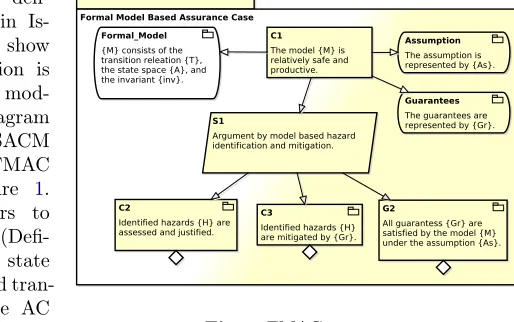
Fig. 1.FMAC pattern With a formal
defi-nition of FMACs in Is-abelle, we can now show how this information is presented in an AC mod-ule. A GSN diagram visualising the SACM pattern for an FMAC is shown in Figure 1. This pattern refers to the CPM model (Defi-nition 3), with its state space, invariant, and tran-sition relation. The AC module has a top-level
claim of relative safety with respect to the model,M. It requires a set of haz-ards, an assumption, and a set of guarantees that mitigate the hazards. The main claims, C1–C4, are made public (indicated by the folder icon), so they can be used as components in another AC. As indicated by the diamonds, the reasoning for hazard mitigation and guarantee satisfaction is left to be developed as part of the instantiation of the pattern.
3.2 Assurance Case Extension
FMAC extension allows us to extend an existing AC by refining the CPM model, weakening the assumptions, and adding new guarantees. In this way, the guar-antees of the original FMAC can be carried over from the old to the new AC. For this, we define a notion of machine refinement.
Definition 8. A machine refinement is a triple(Ma,Mc, ρ), for retrieve
func-tionρ: Σc→Σa, such that the following conditions hold:
1. Invc ⇒ (ρ†Inva) — the abstract invariant is strengthened by the concrete
invariant;
2. (?Invc #hρi#Ta)⊑(?Invc#Tc #hρi)—when the concrete invariant holds
ini-tially, each transition in the abstract machine can be matched by a transition in the concrete machine (simulation [40]).
We writeMa ⊑sρMc when(Ma,Mc, ρ)is a machine refinement.
Typically,ρshows how the variables ofAa are defined in terms of the variables
ofAc, with the following form:
ρ,Lx17→e1(y1,· · ·,yn),x27→e2(y1,· · · ,yn),· · ·M, forxi∈ Aa andyi∈ Ac
Each abstract variable is mapped to an expression ei in terms of the concrete
Ma andMc. We require that (1)Inva is strengthened byInvc, when the retrieve
functionρis applied; and (2)Ta is simulated byTcmoduloρ, which is expressed
using a refinement statement of the usual form [40].
From Definition8, we prove the following theorem about safety invariants:
Theorem 2. If Ma ⊑sρMc and (Inva ∧φ)⇒[Ta]φ, that is φ is an invariant
ofMa, then it follows that(Invc∧ρ†φ)⇒[Tc] (ρ†φ), whereρ†φis the retrieve
function ρapplied as a substitution toφ.
This theorem shows that any invariant of the abstract CPM is also an invari-ant of the concrete CPM, moduloρ. Consequently, we now have a method for adapting safety guarantees from an abstract to a concrete assurance case via data refinement. We now use this to define the extension operator for FMACs.
Definition 9. Given ACa and ACc according to Definition5, then we define ACa⊕ρACc,(Mc,Asc,Grc∪ {r ↑ρ|r ∈Gras})where
(p⇒ ◦q)↑ρ ,((ρ†p)⇒ ◦(ρ†q)) (p⇒2q)↑ρ ,((ρ†p)⇒2(ρ†q))
In an AC extension, every abstract safety guarantee is lifted to a concrete guar-antee through the retrieve function. By applyingρas a substitution, we compute the meaning of each of the safety guarantees in the refined state space. We do not map ♦q guarantees, as these are not in general preserved by refinement. Refinements allow one to restrict behaviours to specific trace subsets. Traces es-tablishing liveness guarantees might get excluded while meeting invariants and safety guarantees. Here, we leave liveness guarantees to be translated manually fromGra to Grc. Finally, we demonstrate when an AC extension is valid:
Theorem 3. ACa⊕ρACc is a valid FMAC provided that:
1. Ma andMc are both valid CPMs;
2. ACa is a valid FMAC;
3. Ma ⊑sρMc — machine refinement holds;
4. (ρ†Asa)⇒Asc — the assumption is weakened modulo ρ;
5. ∀g ∈Grc• Mc|=g — all additional guarantees are satisfied.
This theorem shows that the existing safety guarantees can be verified with respect to the refined model. Essentially, Definition 7 is met because (1) any invariant can be transferred from abstract to concrete (Theorem 2); and (2) satisfaction of2q properties requires an explicit invariant (Definition6).
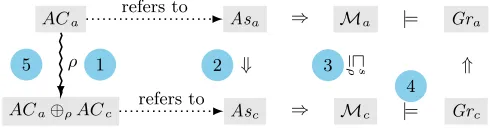
Figure 2 summarises the formal relationships between the artefacts of the extension argument. We then claim thatACc extends ACa moduloρ. The
fol-lowing steps are carried through in Isabelle/UTP for each extension of ACa:
1. We define the retrieve function ρ.
2. We prove that the concrete assumptions weaken the abstract assumptions translated usingρ, that is,Asc⇐(ρ†Asa).
3. By establishing the refinement Ma ⊑sρ Mc, we ensure that Mc preserves
ACa
ACa⊕ρACc
Asa
Asc
Ma
Mc
Gra
Grc
ρ ρ⊑ s ⇐
|=
|=
refers to
refers to
⇒
⇒
⇒
1 2 3
[image:11.612.185.431.119.184.2]4 5
Fig. 2.Artefacts and satisfaction relationships of an extension step
4. We establish the satisfaction relationshipGrc=| Mc to verify all safety and
liveness guarantees introduced by the extensionACc.5
5. By help of ρ, the steps 2 to 4 establish the extension ACa⊕ρACc
repre-senting the extended assurance caseACc.
Figure3summarises the extension argument pattern. The FMAC extension readjusts or increases confidence overACa by following three principles:
1. Regarding the existing assumptions and guarantees, and modulo ρ, the claims C5 and C8 establish consistency of ACc with the previous ACa
and thus help topreserve argument confidence.
2. Based on RET FUN, claim C6 aims at increased precision, that is, any strict data refinement of the existing alphabet, the guarantees (i.e., existing hazards), and the transition relation increases argument confidence. 3. The claims C6 and C7 aim at completion, that is, any strict extension of
[image:11.612.264.475.450.571.2]the set of hazards and, potentially, guarantees, whilenot strengthening the assumptions, increases argument confidence.
Fig. 3.GSN version of the FMAC extension pattern We implemented the FMAC
patterns in Isabelle/SACM, particularly, their argument structure and the link-ing of claims with arte-facts in Isabelle/UTP (Sec-tion 2.1). Unlike GSN, SACM allows us to struc-ture contextual elements, e.g. one can express infer-ential links between For-mal Model (Figure 1) and its componentsAs,Gr, and Inv. This way, SACM
exceeds GSN’s expressiveness. Our implementation in Isabelle/SACM is de-scribed in more detail in [13].
5
The steps 3 and 4 imply that the concrete safety guarantees strengthen the abstract safety guarantees, that is,Grcs⇒(ρ†Gr
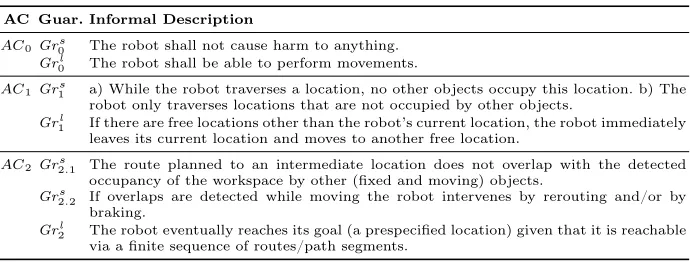
Table 1.Overview of the guarantees for the initial assurance case and its extensions
AC Guar. Informal Description
AC0Gr s
0 The robot shall not cause harm to anything. Grl
0 The robot shall be able to perform movements.
AC1Gr s
1 a) While the robot traverses a location, no other objects occupy this location. b) The
robot only traverses locations that are not occupied by other objects.
Grl
1 If there are free locations other than the robot’s current location, the robot immediately
leaves its current location and moves to another free location.
AC2Gr s 2
.1 The route planned to an intermediate location does not overlap with the detected occupancy of the workspace by other (fixed and moving) objects.
Grs 2
.2 If overlaps are detected while moving the robot intervenes by rerouting and/or by braking.
Grl
2 The robot eventually reaches its goal (a prespecified location) given that it is reachable
via a finite sequence of routes/path segments.
4
Application to Mobile Ground Robot
Mobile ground robotsare required to achieve a variety of tasks by moving through a workspace while manipulating and transferring objects. Such robots are used for transport in warehouses or hospitals, for cleaning in buildings, for manufac-turing in factories. In this paper, we focus on safety and liveness of themovement part in such tasks. Hence, our FMAC will argue about safe steps of movement, route planning with obstacle avoidance, and emergency braking.
We now instantiate the FMAC patterns from Section3 to get three succes-sively more detailed assurance cases of such a robot, calledAC0, AC1, andAC2. Table1 summarises the guarantees for the corresponding evolution steps.
4.1 AC0: Initial Assurance Case
In M0, we only consider the propositional variable harm which is true if any harm to any asset has occurredbecause of the robot’s behaviour.
I0 ,[harm7→false]
Inv0 ,Gr0,¬harm
T0 ,Move,?true#skip
Because we do not have any elements in the model to express bad things,Move has to cover only and exactly the safe movements the robot can make in order to fulfilGr0. Ifharmistruethen it is not because ofMove. Hence, it must have been
truebefore but this contradicts our assumption. Although the latter technically
provides an argument for safety, clearly, this argument is not anywhere near a compelling or meaningful one. Thus, we have to increase confidence.
4.2 AC1: First Extension
next location to move to. The operation Move now gets the atomic assignment p:=aim. Furthermore, inM1, we include a state functionocc:LOCATION ⇒ bool which is true for all locations occupied by objects other than the robot,
falseotherwise. For a weak notion of liveness with respect to Move, the robot
is required to choose aim such that it keeps moving as long as occ is false
for some location in LOCATION. InM1, the choice ofaim is implemented by a type-safe and constrained non-deterministic assignment. The following listing summarises the FMAC consisting of the modelM1and the assurance caseAC1:
I1, id
Inv1, ¬occ(p)
T1 ,Move, aim:=∗#?aim∈freeLocs∧aim6=p∧ ¬occ(aim)#p:=aim
As1, ¬occ(p)∧freeLocs6=∅
Gr1, ?(p=aim)#¬occ(aim)
ρ1, Lharm7→occ(p)M
We assume that while the robot performs aMove to locationaim, the environ-ment will not occupy aim. Regarding the confidence ofAC1, this assumption is realistic if locations are close enough to each other and the maximum speed of other objects is low enough. WithAs1, we assume that occ changes (i.e., other objects can be randomly (re)located in LOCATION) beyond that restriction only after aMove of the robot is completed.6Also,Gr
1 encodes the assumption that whenever the robot has reachedaim in this state, no other object can have reachedaim in the same state. Hence, a location is deemed occupied if a moving object is expected to touch this location during the currentMove of the robot. A more detailed model forAC1 is given in [13, Secs. 4 and 5].
Now, to argue thatAC1 is an extension ofAC0 as explained in Section3.2, we first prove thatAs0is weakened byAs1moduloρand show that the existing safety guarantees are preserved by establishing the refinement M0 ⊑sρ M1. Finally, we show by establishing Definition7in Isabelle thatAC1 is valid.
Regarding the confidence ofAC1, the introduced location model, the condi-tionalMove, and the occupancy-based safety guarantee illustrate how we slightly but correctly increased the precision of our argument for the claim thatthe robot is safe. The extension fromAC0toAC1is an instance of the pattern in Figure3. A complete pattern instance for this step is provided in [13, Fig. 6].
4.3 AC2: Second Extension
For M2, we refine the data model of M1, where each location is reachable from everywhere, by a relationConnection⊆LOCATION ×LOCATION. Our model also contains a notion of distance between locations and allows to mark a specific location as the goal. Based onConnection, we extendA2 by a variable trj: LOCATION list to manage routes and oldDist to measure the progress
6
towards the final goal. The following list summarises the model M2 and the corresponding extensionAC2:
I2, [trj 7→[],occ7→occ]
Inv2, ¬occ(p)
T2, Plan⊓MicroMove⊓EmgBrake
As2, minBrakingPrefix(trj)∈clearPaths
Gr2s.1, hazardousMove⇒ ¬occ(p)
Gr2l , clearPaths6=∅∧p6=goal∧(¬hazardousMicroMove)
⇒oldDist>dist(p,goal)
ρ2, Locc(p)7→minBrakingPrefix(trj)6∈clearPaths,occ(aim)7→occ(aim)M
Safety in M2 relies on the assumption As2 that any update ofocc by the en-vironment will not lead to an occupancy of any prefix of the planned route trj shorter than the minimum braking distance, that is, minBrakingPrefix(trj) 6∈
clearPaths. Based onAs2,Gr2s.1guarantees safe emergency braking, that is, not actively hitting any (moving) objects beyond minimum braking distance. This corresponds to the notion of passive safety in [26].
For liveness inM2, we use a conjunctp6=goal in the precondition forGr2l that specifies the termination of the robot’s goal seeking activity. The postcondi-tion ofGrl
2states that after eachMicroMove, the robot should strictly get closer to the goal. Grl
2 is required for the desired liveness property of M2. However, only ifclearPath=∅cannot occur infinitely often,Grl
2 implies termination. The proof that AC2 actually extends AC1 works in a way similar to the extension proof forAC1, now based onρ2. ForM2, we use further parameters and definitions. These as well as the definitions of the three operations Plan, MicroMove, andEmgBrake are provided in the model in [13, Sec. 6].
5
Discussion
Here, we put our FMAC patterns into the context of formal robot verification, robotic engineering practice, and practically relevant standards. We also relate our contribution to model validation arguments.
Formal Robot Verification. Early work by Rahimi et al. [35] models a robot con-troller as a set of actions specified by pre/post conditions derived from hazard analysis. The authors use real-time logic to verify whether action implemen-tations in software comply with these conditions. Beyond their work, our robot example demonstrates proof automation, refinement verification, and integration of proof evidence into a maintainable AC for certification.
authors verify an elaborate plant model against performance (i.e., a generali-sation of safety and liveness) guarantees by proving observational equivalence with reducing the embedded SAT problem to a filtering problem on Bayesian networks. Our approach based on Isabelle/UTP facilitates more generic abstrac-tion and proof assistance based on relaabstrac-tions anddL.
Mitsch et al. [26] model robots indL and verify successively refined notions
of safety and liveness. These include static safety (i.e., no collision with static obstacles), passive safety (i.e., no active collision),passive friendly safety (i.e., safe braking circle does not intersect with other moving objects’ safe braking circle), andpassive orientation safety(i.e., braking cone does not intersect with other moving objects’ braking cones). While our robot model is less detailed, we formalise the transition between increasingly precise notions of safety by data refinement, assumption weakening, and guarantee strengthening. Beyond [24] and [26], we demonstrate how robot validity and refinement proofs can be evolved within a standardised AC framework.
Though [26] does not explicitly invoke refinement in their stepwise develop-ment, refinement in dL was previously investigated by Loos and Platzer [23].
They extend dL with a refinement operator α ≤ β, that specifies that a
hy-brid program αis more deterministic than a programβ. If a safety guarantee,
θ ⇒ [β]φ, can be proved for β, then the guarantee can automatically be de-rived for the refinementα(Theorem2). Their notion of refinement permits local reasoning, such that subcomponents of a program need only demonstrate refine-ment under the condition they are reachable. Our refinerefine-ment notion is global; however it is possible to derive their localised refinement relation in our setting. Effectively, our work can be seen as an extension of [23] with data refinement, which we believe can support stepwise development in the style of [26].
For a multi-robotic system, Desai et al. [8] verify safety and liveness proper-ties of a trajectory coordination protocol based on a verified state-machine ab-straction of almost-synchronously clocked plan execution units and asynchronous analysis and planning units. They apply SMT and A∗-search for safe plan gener-ation and model-checking of the coordingener-ation protocol. While their assumptions for modelling multi-robot coordination differ strongly from the assumptions ap-plied in our single robot example, we can see the opportunity to enhance their fixed-model approach with data refinement to integrate multi-robot verification evidence into an extensible FMAC.
ISO 26262 (e.g. Part 2, Clause 6.4.5.4) recommends a safety case for each system component with a safety goal and that these safety cases are subject of configu-ration and change management, thus, maintenance and evolution. Overall, these standards provide many opportunities for FMACs and Isabelle/SACM.
Adequacy and Completeness of the Formalisation. For controller design and syn-thesis, control engineers performmodel validation experimentsto assess how well a model of the process, they want to control, complies with the real world [37]. Likewise, the formal model associated with an FMAC (extension) has to be ac-companied by an argument (potentially based on experiments using simulation and test [9]) that this modelfaithfully abstracts from and predicts [21] the im-plemented controller (i.e., the potentially distributed embedded system) and the surrounding plant. Isabelle/SACM allows us to enhance arguments accordingly. However, a further discussion of model validity arguments is out of scope.
Safety guarantees result from accident experience, domain expertise, and haz-ard analysis [22]. Regarding continuous hazard analysis, the pattern in Figure3 accommodates changes of the hazard list and the corresponding guarantees as assumed claims (C3,C4) and the corresponding hazard mitigation as an un-developed claim (C9). The step from hazard analysis to the derivation of new guarantees and model improvements is discussed in more detail in [12].
6
Conclusions
Assurance cases have to evolve to readjust or increase confidence [7]. Hence, we propose a framework forformal model-based assurance caseconstruction and extension. Our framework is based on Isabelle/UTP whose semantic foundations allow one to express the system model for the construction of the assurance case in various but precisely linked formalisms, for example, relations and dL. This
linking, paramount to the engineering of many critical systems [14], enables the step-wise refinement of the system model including data refinement and the simultaneous extension of an existing assurance case, resulting in an evolved assurance case readjusting or increasing the level of confidence of the argument. In [15], we discuss how model-based engineering can accommodate the way how innovation typically drives the evolution of requirements and designs. Extensible FMACs further develop this idea towards continuous model-based assurance.
Next Steps. The use of A/G-style specification for FMACs paired with invari-ants as constraints on the controlled and internal state variables improves the preservation of properties of FMAC compositions. To deal with more complex FMACs, we want to simplify composition and refinement at the level of FMACs by providing a new operator, ACa ⊑argρ ACc. We also want to improve the
modifiability of an existing FMAC, particularly, support the deletion or substi-tution of guarantees on updates from hazard analysis. Furthermore, we want to enhance the handling of liveness guarantees across an extension step via⊕ρ.
Inspired by [1,34], we want to investigate the benefits of a further integration of Isabelle/Isar with the argument structure in Isabelle/SACM. Particularly, Basir [1] discusses how natural deduction program proofs (e.g. using Hoare logic) can formally underpin an argument and how interactive theorem proving can aid in checking the soundness of this argument.
Acknowledgements
This work is partly supported by the EPSRC projects CyPhyAssure7, grant reference EP/S001190/1, and RoboCalc, grant reference EP/M025756/1.
References
1. Basir, N.: Safety cases for the formal verification of automatically generated code. Ph.D. thesis, University of Southampton (2010)
2. Bate, I., Kelly, T.: Architectural considerations in the certification of modular systems. Reliability Engineering & System Safety 81(3), 303–324 (Sep 2003).
https://doi.org/10.1016/S0951-8320(03)00094-2
3. Brucker, A.D., Aït-Sadoune, I., Crisafulli, P., Wolff, B.: Using the Isabelle ontology framework - linking the formal with the informal. In: CICM. Lecture Notes in Computer Science, vol. 11006, pp. 23–38. Springer (2018)
4. Calinescu, R., Weyns, D., Gerasimou, S., Iftikhar, M.U., Habli, I., Kelly, T.: Engineering trustworthy self-adaptive software with dynamic assurance cases. IEEE Transactions on Software Engineering 44(11), 1039–1069 (nov 2018).
https://doi.org/10.1109/tse.2017.2738640
5. Common Criteria Consortium: Common criteria for information technology secu-rity evaluation – part 1: Introduction and general model. Tech. Rep. CCMB-2017-04-001 (2017),https://www.commoncriteriaportal.org
6. Cooper, D., et al.: Tokeneer ID Station: Formal Specification. Tech. rep., Praxis High Integrity Systems (August 2008),https://www.adacore.com/tokeneer 7. Denney, E., Pai, G., Habli, I.: Dynamic safety cases for through-life safety
as-surance. In: 2015 IEEE/ACM 37th IEEE International Conference on Software Engineering. IEEE (5 2015).https://doi.org/10.1109/icse.2015.199
8. Desai, A., Saha, I., Yang, J., Qadeer, S., Seshia, S.A.: DRONA: a frame-work for safe distributed mobile robotics. In: Proceedings of the 8th Interna-tional Conference on Cyber-Physical Systems - ICCPS’17. ACM Press (2017).
https://doi.org/10.1145/3055004.3055022
7
9. Edwards, S., Lavagno, L., Lee, E.A., Sangiovanni-Vincentelli, A.: Design of embed-ded systems: formal models, validation, and synthesis. Proceedings of the IEEE 85(3), 366–90 (1997).https://doi.org/10.1109/5.558710
10. Foster, S., Baxter, J., Cavalcanti, A., Woodcock, J., Zeyda, F.: Unifying semantic foundations for automated verification tools in Isabelle/UTP. Submitted to Science of Computer Programming (March 2019), preprint: https://arxiv.org/abs/1905. 05500
11. Foster, S., Zeyda, F., Nemouchi, Y., Ribeiro, P., Wolff, B.: Isabelle/UTP: Mecha-nised Theory Engineering for Unifying Theories of Programming. Archive of Formal Proofs (2019),https://www.isa-afp.org/entries/UTP.html
12. Gleirscher, M., Carlan, C.: Arguing from hazard analysis in safety cases: A modular argument pattern. In: High Assurance Systems Engineering (HASE), 18th Int. Symp. (1 2017).https://doi.org/10.1109/hase.2017.15
13. Gleirscher, M., Foster, S., Nemouchi, Y.: Evolution of formal model based assurance cases for autonomous robots. Supplemental material, University of York (2019).
https://doi.org/10.5281/zenodo.3344489
14. Gleirscher, M., Foster, S., Woodcock, J.: New opportunities for integrated formal methods. Unpublished working paper, Department of Computer Science, Univer-sity of York (2018)
15. Gleirscher, M., Vogelsang, A., Fuhrmann, S.: A model-based approach to in-novation management of automotive control systems. In: 8th Int. Workshop on Software Product Management (IWSPM). IEEE digital library (2014).
https://doi.org/10.1109/IWSPM.2014.6891062
16. Hawkins, R., Habli, I., Kolovos, D., Paige, R., Kelly, T.: Weaving and assurance case from design: A model-based approach. In: Proc. 16th Intl. Symp. on High Assurance Systems Engineering. IEEE (2015)
17. Hoare, C.A.R., He, J.: Unifying Theories of Programming. Prentice-Hall (1998) 18. Jackson, M.A.: Problem Frames: Analysing & Structuring Software Development
Problems. Addison-Wesley (2001)
19. Kelly, T.: Arguing Safety – A Systematic Approach to Safety Case Management. Ph.D. thesis, University of York (1998)
20. Kelly, T.P., McDermid, J.A.: Safety case construction and reuse using patterns. In: Daniel, P. (ed.) SAFECOMP, 16th Int. Conf. pp. 55–69. Springer (1997).
https://doi.org/10.1007/978-1-4471-0997-6_5
21. Lee, E.A., Sirjani, M.: What good are models? In: Formal Aspects of Component Software, pp. 3–31. Springer International Publishing (2018).
https://doi.org/10.1007/978-3-030-02146-7_1
22. Leveson, N.G.: Engineering a Safer World: Systems Thinking Applied to Safety. Engineering Systems, MIT Press (1 2012).
https://doi.org/10.7551/mitpress/8179.001.0001
23. Loos, S.M., Platzer, A.: Differential refinement logic. In: Proc. 31st Intl. Symp. on Logic in Computer Science (LICS). ACM (July 2016)
24. Lyons, D.M., Arkin, R.C., Jiang, S., Liu, T.M., Nirmal, P.: Performance verification for behavior-based robot missions. IEEE Transactions on Robotics31(3), 619–636 (jun 2015).https://doi.org/10.1109/tro.2015.2418592
25. Meyer, B.: Applying “design by contract”. IEEE Computer25(10), 40–51 (1992) 26. Mitsch, S., Ghorbal, K., Vogelbacher, D., Platzer, A.: Formal verification of
27. Nair, S., de la Vara, J.L., Sabetzadeh, M., Falessi, D.: Evidence management for compliance of critical systems with safety standards: A survey on the state of practice. Information and Software Technology 60, 1–15 (apr 2015).
https://doi.org/10.1016/j.infsof.2014.12.002
28. Nemouchi, Y., Foster, S., Gleirscher, M., Kelly, T.: Mechanised assurance cases with integrated formal methods in Isabelle. In: Submitted to iFM 2019 (2019), preprint:https://arxiv.org/abs/1905.06192
29. Nipkow, T., Wenzel, M., Paulson, L.C.: Isabelle/HOL: A Proof Assistant for Higher-Order Logic. Lecture Notes in Computer Science, Springer, Berlin, 1 edn. (2002).https://doi.org/10.1007/3-540-45949-9
30. de Oliveira, A.L., Braga, R.T., Masiero, P.C., Papadopoulos, Y., Habli, I., Kelly, T.: Supporting the automated generation of modular product line safety cases. Advances in Intelligent Systems and Computing 365, 319–330 (2015).
https://doi.org/10.1007/978-3-319-19216-1_30
31. Palin, R., Habli, I.: Assurance of automotive safety – a safety case approach. In: Schoitsch, E. (ed.) Computer Safety, Reliability, and Security, LNCS, vol. 6351, pp. 82–96. Springer (2010).https://doi.org/10.1007/978-3-642-15651-9_7
32. Parnas, D.L., Madley, J.: Function documents for computer systems. Science of Computer Programming25, 41–61 (1995)
33. Platzer, A.: Differential dynamic logic for hybrid systems. J. Autom Reasoning41, 143–189 (June 2008)
34. Prokhorova, Y., Laibinis, L., Troubitsyna, E.: Facilitating construction of safety cases from formal models in event-b. Information & Software Technology60, 51–76 (2015).https://doi.org/10.1016/j.infsof.2015.01.001
35. Rahimi, M., Xiadong, X.: A framework for software safety verification of industrial robot operations. Computers & Industrial Engineering20(2), 279–287 (jan 1991).
https://doi.org/10.1016/0360-8352(91)90032-2
36. RTCA: DO-333: Formal Methods Supplement to DO-178C and DO-278A (2012) 37. Smith, R.S., Doyle, J.C.: Model validation: a connection between robust
con-trol and identification. IEEE Trans. Automatic Concon-trol37(7), 942–52 (Jul 1992).
https://doi.org/10.1109/9.148346
38. Spivey, J.: The Z Notation: A Reference Manual. Prentice Hall (1992)
39. Wei, R., Kelly, T., Dai, X., Zhao, S., Hawkins, R.: Model based system assurance using the structured assurance case metamodel. Journal of Software and Systems 154, 211–233 (August 2019)