DEVELOPMENT OF A MOBILE ROBOT WITH HUMAN-ROBOT
INTERACTION (HRI) FEATURES
Submitted in accordance with the requirement of the Universiti Teknikal Malaysia Melaka (UTeM) for the Bachelor Degree of Manufacturing Engineering (Hons.)
by
MOHAMED ZAID BIN ZULMI
B051410271
950908-14-6253
FACULTY OF MANUFACTURING ENGINEERING
DECLARATION
I hereby, declared this report entitled “Development of A Mobile Robot with Human-Robot Interaction (HRI) Features” is the result of my own research except as cited in
reference.
Signature : ……….
Author’s name : MOHAMED ZAID BIN ZULMI
APPROVAL
This report is submitted to the Faculty of Manufacturing Engineering of Universiti Teknikal Malaysia Melaka as a partial fulfilment of the requirements for the degree of Bachelor of Manufacturing Engineering. The members of the supervisory committee are as
follow:
i
ABSTRAK
ii
ABSTRACT
iii
DEDICATION
Only
My respected father Zulmi Bin Wan
My appreciated mother Lila Binti P. Mohd Meeran My siblings Zainab, Zulaika and Zulaini
iv
ACKNOWLEDGEMENT
First and foremost, I would like to express my gratitude to ALLAH SWT that have blessed me to complete this final year project successfully.
To my respected supervisor Dr. Syamimi Binti Shamsuddin that have always motivates me to do my best, I would like to thank you for always giving me guidance and recommendation on how to tackle a problem and challenge. Besides that, I would also like to express my gratitude to her Master student, Muhammad Winal Zikril Bin Zulkifli who have helped me solved some technical problem even though I came without prior notice.
v
TABLE OF CONTENTS
Abstrak i
Abstract ii
Dedication iii
Acknowledgement iv
Table of Contents v
List of Tables viii
List of Figures ix
List of Abbreviations xi
List of Symbols xii
CHAPTER 1: INTRODUCTION
1.1 Background 1
1.2 History of Robot 2
1.2.1 Introduction to social robot 3
1.2.2 Human-robot interaction (HRI) 4
1.3 Motivation 4
1.4 Problem Statement 5
1.5 Objectives 6
1.6 Scope and Limitation 6
1.7 Project Planning 8
CHAPTER 2: LITERATURE REVIEW
2.1 Human Robot-Interaction (HRI) in Healthcare Setting 9
vi
2.1.2 Components of mobile robot for human-robot interaction 13
2.2 Sensors 14
2.2.1 Types of sensor for mobile robot 14
2.2.1.1 Infrared sensor (line sensor) 14
2.2.1.2 Ultrasonic Sensor 16
2.2.1.3 Communication module 16
2.3 Controller 17
2.3.1 Arduino 18
2.3.2 Programmable logic controller 19
2.4 Human-Robot Interaction 20
2.4.1 Methods for perceiving humans Error! Bookmark not defined. 2.4.2 Methods for motion planning Error! Bookmark not defined. 2.4.4 Methods for human-robot coordination Error! Bookmark not defined.
2.5 Software 20
2.5.1 Programming software for mobile robot controller 21 2.5.2 Programming software for touch screen display 21
2.5.2.3 Proteus 21
2.5.3 Design Software 21
2.5.3.1 CATIA 22
2.6 Summary 22
2.7 Previous Studies 23
CHAPTER 3: METHODOLOGY
3.1 Overview 28
3.2 Flow Chart 29
3.2.1 Literature Review 30
vii
3.3 Project Tools 32
3.3.1 Software Tools 32
3.3.2 Material 34
3.3.3 Fabricating tools 35
3.3.4 Testing Tools 36
3.3.5 Feedback tools 37
3.4 Summary 38
CHAPTER 4: PROJECT DEVELOPMENT
4.1 Project Development 39
4.2 Fabrication and Assembly 39
4.3 Wiring and Circuit 43
4.4 Programming using Arduino IDE and Nextion 44
4.5 Results of the project 50
4.5.1Setting Up Experiment 52
4.5.2Conducting the Experiment 54
4.5.3 Survey 55
4.6 Summary 57
Chapter 5: Conclusion and recommendatio
5.1 Conclusion 58
5.2 Recommendation 59
5.3 Sustainability Element 59
viii
LIST OF TABLES
1.1: The Project element and scope covered 7
1.2: The Gantt chart for Final Year Project 1 8
1.3: The Gantt chart for Final Year Project 2 9
2.1: Differences of optical and ultrasonic sensor 17
2.2: Arduino vs. PLC 18
2.3: Arduino board specification 20
2.4: Previous Studies 25
3.1: The Material specification 36
3.2: Example of test-retest reliability sheet 38
ix
LIST OF FIGURES
1.1: Model of ‘The da Vinci robot’ with internal mechanism 2
1.2: A general configuration of robots 3
2.1: Types of robot 10
2.2: Children interacting with a Nao robot 11
2.3: iRobiQ Robot 11
2.4: Example application of Giraff the mobile avatar 12
2.5: The Robot Seal Paro 12
2.6: A mobile robot with HRI feature 13
2.7: Components of mobile robot 14
2.8: Infrared (IR) Sensor 15
2.9: Sensor detection flow chart 16
2.10: Communication Module 17
2.11: Arduino board 19
3.1: Flow chart of the study 31
3.2: Design concept flow chart 32
3.3: Programming flow chart 33
3.4: The parts of software tools 34
3.5: (a) Showing CATIA outlook, (b) CATIA analysis 35
3.6: (a) 3D printing machine, 36
3.7: The outlook of Arduino IDE 37
x
4.1: (b) The robot divided into parts for fabrication 40
4.2: Static Analysis from CATIA 41
4.3: A hacksaw to cut aluminium bar 42
4.4: The measurement from the mattress to the floor 43
4.5: The circuit design using Fritzing 44
4.6: The flow chart of the working principle of the robot 45 4.7: (a) Transmitter and (b) receiver of RF Module 46
4.8: (a) Program for transmitter RF module 46
4.8: (b) Example of transmitter module attach to Arduino Uno with a limit switch 46 4.9: The working principle of transmitter, ultrasonic, line sensor and motor driver 47
4.10: Emic-2 Text to Speech Module with AUX Cable 49
4.11: The speaker that is connected to the Emic-2 and the Emic-2 code 49 4.12: (a) 7’ Nextion LCD (b) Overview of the LCD page 50 4.13: Flow chart of the experiment at Pusat kesihatan UTeM 52
4.14 The layout of the man’s ward 53
4.15: (a) Overview of the man’s ward (b) Patient on the bed 54 4.15: (c) Line sensor on the standby position (d) The robot at parking position 54
4.16: Patient pushing the call button 55
4.17: (a) The robot arrive at the patients bed and the voice output is played 55
4.17: (b) Patients interacting with the LCD 55
4.18: The survey given to the respondents 56
xi
LIST OF ABBREVIATIONS
HRI - Human-Robot Interaction DOF - Degree of Freedom LCD - Liquid Crystal Display PLC - Programmable Logic Circuit
IR - Infrared
I/O - Input/Output
xii
LIST OF SYMBOLS
mm - Millimetre
cm - Centimetre
1
CHAPTER 1
INTRODUCTION
1.1 Background
Hospital, an institution that provides treatment with specialized medical and nursing staff and equipment. They consist of departments or traditionally called wards divided according to cases. In each ward, the nurses will focused on the care of the patients in any way needed so they may recover to their peak health and quality of life. A statistic from the Malaysian Department of Statistic in the year of 2014 shown that the ratio of nurse to population is 1:331, which means that 1 nurse to 331 people. In 2015 the statistic shown that the ratio of nurse to population is 1:312. Even though the ratio is getting better, but for 1 nurse to care and handle for 312 patients is a burden. In accordance with the increase of the Malaysian population in 2016, which is about 31.6 million, to 32 million in 2017, the quantity of nurses to population will either influx up or down depending on the factor whether the production of nurses can keep up with the population growth rate of 1.3%. The similar aging population is also a concern in other countries like in the United States as mentioned by Murray (2002) that there will be a lack of registered nurses by 2020.
2
Technology is used to help solving the predicament by introducing robots to provide assistance. Robot is a machine, capable of carrying a multifaceted series of actions automatically. It is divided into two main categories which is Industrial Robots and Non-Industrial Robots. In this study, it will discuss on the introduction of service robot in health care setting
1.2 History of Robot
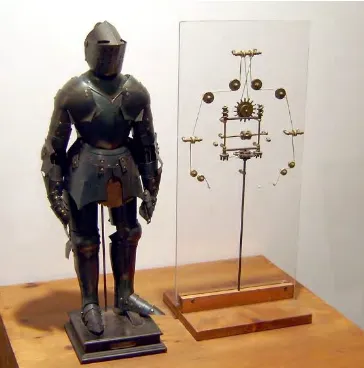
[image:17.595.199.381.359.543.2]In the Webster’s Seventh New Collegiate Dictionary (1966), the word robot originally came from the Czechoslovakian word that means work. Also, robot is a manipulator which can be reprogrammable designed to move material through variable programmed motions (Robot Institute of America, 1979).
Figure 1.1: Model of ‘The da Vinci robot’ with internal mechanism (Endourol, 2006)
Renaissance Italy, around 1495, Leonardo da Vinci have drafted a humanoid robot. In the journal by Taddei (2008), there are a detailed drawing of a mechanical knight or better known as Leonardo’s robot when Da Vinci's notebooks is rediscovered. Though the design was not confirmed if it was ever produced.
3
by Stanford, that has the ability to perceive and model its environment, it can also complete simple task finding route and rearrange simple objects.
[image:18.595.75.525.177.420.2]1.2.1 Introduction to social robot
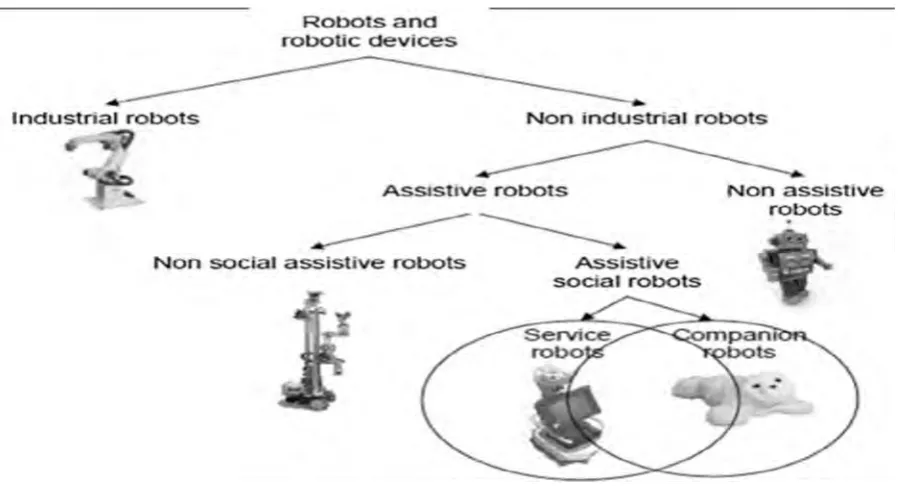
Figure 1.2: A general configuration of robots (Heerink, 2010)
As its name, service robot its main task is to help human by reducing their workload. The service robot is under the assistive social robots classification, where it is one of the branches from the assistive robot as shown in Figure 1.2. Assistive robot when it is introduced to a sensor or screen where it can interact with human will become an assistive social robot. The interaction of a robot and human through the usage of sensor and the screen is called Human-Robot Interaction features.
4 1.2.2 Human-robot interaction (HRI)
Human-robot interaction or known as HRI is the study of the interaction of human and robot that aims to enable a successful interaction between them. There are many studies being done on HRI have been a popular topic with the advance in technology. What is once considered impossible was being done as the expectation of this once defined as worker. Robots is now expected to play a role in society to help ease and interact with human in daily basis.
1.3 Motivation
The purpose of this project is about the design, fabrication and programming of a simple robot with human-robot interaction (HRI) capabilities in healthcare settings.
The main motivation of the study and fabricating of the robot is by the need to expose Malaysian to robot application in healthcare. To date, the exposure of robot in Malaysia is low as stated by (Argenan, 2017) that there is a paucity studies on developing HRI robots for health care applicants in this country. The demand of automation in industry or manufacturing or even in social settings has increased, along with the current trend of automation and data exchange in manufacturing technologies or better known as Industry 4.0. Industry 4.0 is one of examples called industrial revolutions, caused by mechanization, use of electrical energy and electronics and the needs of the people knowledgeable (Benešová & Tupa, 2017). As the increase of demand in using automation and robots, Malaysia must not be left behind, especially since Malaysia in not a research and development (R&D) nation making the exposure and the studies and research low. R&D took too much asset or allowances, but showed little improvement over time and the country cannot afford the expenditure over time because of various reasons and problem.
5
1.4 Problem Statement
The research is conducted after identifying 4 main problems that occur in hospital wards.
i) Time needed for a nurse to attend to patients.
In the ward, the nurses are responsible to the well-being of the patient, be it their care nor their problem, the nurse will take care of it with the best of their ability. As the current technology develops, the age of human liveability also increased, making the influx of patients especially the elderly increase. The increase of patient will also increase the burden of the nurse where it will affect the quality and details of care to the patient. This is mentioned by UTeM researches (Argenan, 2017) who develop a simple robot with HRI features to solve the waiting problem of hospital patients and visitors to get attention from a nurse.
ii) Repetitive simple routine
As the number of patients increase as the year increased, the number of nurses cannot catch up with the intake of patients. With too many patients to handle and take care of, the nurse will not have enough time to take care of every patient thoroughly. A simple routine such as checking up on patients, giving medicine or even pouring some water to them is done by the nurse. From Ettelt (1998) the task which were those repetitive simple routine, took time and keep experienced hospital staff from doing their primary job: caring for patients.
iii) Patients in the ward get lonely and bored
As a patient, especially with a chronic disease and in critical condition, they are not allowed to roam around too much as they need a rest. Without nothing to do and no visitor, the patient can get their minds off with interacting with the robot by using the LCD display
iv) Patient’s visitor/carers cannot leave patients alone
6
1.5 Objectives
The objectives of this study are;
i) To design an assistive mobile robot with a human-robot interaction (HRI) features including an LCD display and voice output.
ii) To develop and program the robot to be user friendly for the interaction with patients and visitors and test the robot for application in the hospital ward system
1.6 Scope and Limitation
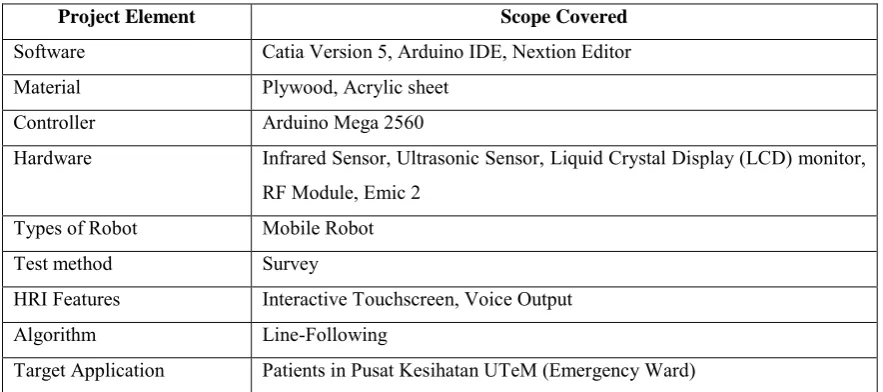
In this paper, the main focus will be the on usage or application of the assistive social robot. The robot will be used in the ward to lessen the burden of the nurse. The robot can help by bringing a water bottle or interact using LCD and voice output with the patient. It will be designed to have a user friendly look using Catia to ease the interaction between the robot and human. Human-robot interaction features like the LCD and the voice output system will be equipped on the robot. The LCD will be programmed to have the clinic’s portal and a game to relieve the boredness of the patient. The robot will be controlled using an Arduino Mega controller that will be programmed using Arduino IDE. It will have an infrared sensor or line following sensor for navigation and an ultrasonic sensor for obstacle detection and avoidance.
7
Table 1.1: The Project element and scope covered
Project Element Scope Covered
Software Catia Version 5, Arduino IDE, Nextion Editor
Material Plywood, Acrylic sheet
Controller Arduino Mega 2560
Hardware Infrared Sensor, Ultrasonic Sensor, Liquid Crystal Display (LCD) monitor, RF Module, Emic 2
Types of Robot Mobile Robot
Test method Survey
HRI Features Interactive Touchscreen, Voice Output
Algorithm Line-Following
8
1.7 Project Planning
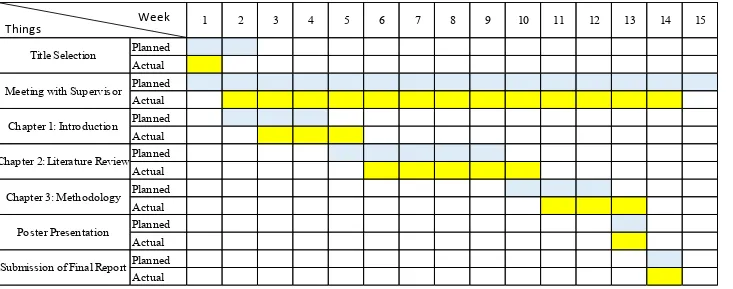
[image:23.842.76.809.207.496.2]Table 1.2 shows the Gantt chart for the final year project 1.
Table 1.2: The Gantt chart for Final Year Project 1
Planned Actual Planned Actual Planned Actual Planned Actual Planned Actual Planned Actual Planned Actual
13 14 15
4 5 6 7 8 9
Poster Presentation
Submission of Final Report
10 11 12
1 2 3
Title Selection
Meeting with Supervisor
Chapter 1: Introduction
Chapter 2: Literature Review
Chapter 3: Methodology
9
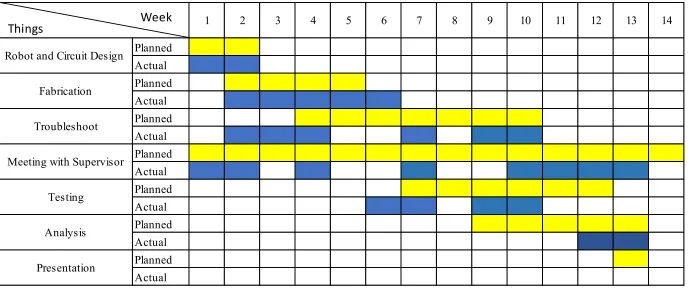
Table 1.3: The Gantt chart for Final Year Project 2
Planned Actual Planned Actual Planned Actual Planned Actual Planned Actual Planned Actual Planned Actual Testing
Analysis
Robot and Circuit Design
Fabrication
Troubleshoot
Meeting with Supervisor
10 11 12 13 14
5 6 7 8 9
1 2 3 4
Presentation